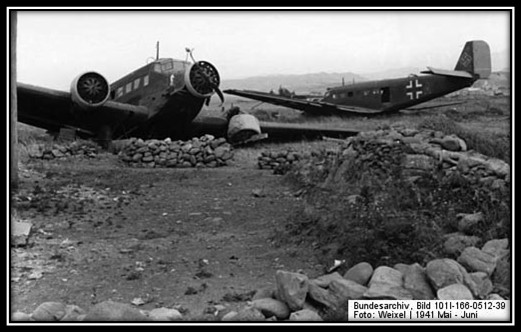
The British evacuation from Crete moves into high gear today. During the early morning hours, 4,000 men of the British 14th Infantry Brigade are taken off from Heraklion. After dark, another 1,500 men are taken off. The German 1st Fallschirmjäger Regiment takes possession of Heraklion as the British leave.
Force D evacuates 6,029 men from Sfakia, including the Greek Commander in Chief. Light cruiser HMS Phoebe takes some minor damage from a bomb, but otherwise, the large force escapes unscathed.
The Germans, of course, notice what is going on. The Luftwaffe shifts its focus from the north coast ports that the Germans need for supplies to the south shore ports such as Sfakia where the Royal Navy is frantically loading as man men as possible. It becomes a situation of “every man for himself” both on Crete and in the waters to the south.
Junkers Ju 87 Stukas catch two light cruisers, HMS Orion and Dido, on their way back to Alexandria during the afternoon and damage them. While the ships remain maneuverable, Orion suffers 105 crew and 260 troops killed, with 280 troops wounded. Dido has 27 crew and 100 troops killed by fire or water pumped in to prevent the magazine from exploding. Destroyer Decoy also is damaged during this action. The flotilla makes it to Alexandria around 20:00.
The Stukas also hit sink destroyer Hereward about five miles south of Crete. With daylight approaching the rest of the Royal Navy force abandons Hereward and its crew to its fate. The Hereward’s captain tries to make it to shore to beach his ship, but Luftwaffe Junkers Ju 87 Stukas finish the job and the ship sinks before he can make it. Italian motorboats pick up some survivors. There are 165 survivors and 76 deaths.
Also during the early morning hours, Italian bombers from 41° Gruppo damage I-class destroyer HMS Imperial. While the ship makes it partway to Alexandria, the steering goes out. The crew tries to make repairs, but ultimately they are forced to scuttle the Imperial (with the assistance of HMS Hotspur) 55 nautical miles (102 km; 63 mi) east of Kassos.
There are British Commonwealth troops trapped all over Crete who have no hope of making it to an embarkation point on the south coast. Colonel Campbell, for instance, is trapped at Heraklion because he has too many men for the meager evacuation convoys to take off. A large contingent also remains at Rethymno (Retimo), where the original drop of German Fallschirmjäger has not made a dent in the British defenses. However, the Fallschirmjäger unit from Maleme rapidly approaches from the west.
The Italians who have landed at Sitia with their 13 tanks move westwards to link up with the Germans heading east from Maleme, Canea, and Suda. They are harassed as much by local proto-partisans as by the fleeing British.
In Cairo, Middle East Commander General Archibald Wavell is planning another offensive on the Libyan frontier. British intelligence reports tell him that the Germans have placed about two-thirds of their tank force on the Tobruk perimeter, leaving the frontier sparsely defended. Assuming that the “Tiger Cub” tanks will arrive from Alexandria quickly, Wavell sets 7 June as the start date for Operation Battleaxe.
At Tobruk, the Luftwaffe (Junkers Ju 87 aircraft of II Staffeln, Sturzkampfgeschwader 2) sinks 913-ton anti-submarine trawler HMT Sindonis.
On Malta, the government sets up a mobile machine-gun company to guard against Fallschirmjäger dropping on the island as they did on Crete. The company is formed from 1st Battalion Cheshire Regiment.
Churchill is increasingly annoyed about General Wavell. Private Secretary John Colville notes in his diary:
“PM [Churchill] much upset by telegram from Wavell, who shows some sign of defeatism. “He sounds a tired and disheartened man,” said the PM.”
Churchill long has felt that Wavell lacks an aggressive spirit and does not use his troops efficiently. Wavell’s quick plea to give up Crete after Churchill had sent a message only hours earlier on the 27th clearly still rankles. It is worth mentioning here that Wavell has kept the British position intact in the Middle East and has consolidated it by largely eliminating the longstanding Italian presence from East Africa with minimal troop investment.
The end is at hand on 29 May 1941 in Iraq for the Rashid Ali pro-Axis government as British troops near the capital from the south and west. The German military mission, which effectively means Special Force Junck (Sonderkommando Junck) led by Luftwaffe Oberst Werner Junck, flies out after dark in its last two serviceable Heinkel He 111s. There are still Italian Fiat Cr-42 fighters operating over Baghdad, but their effectiveness is minimal. When the RAF attacks the Italians’ airfield at Kirkuk, the Italians (2nd Lt. Valentini) damage an RAF Audax and wound the pilot, forcing it to land. An RAF Gladiator (Wing Commander W.T.F. ‘Freddie’ Wightman of No. 94 Squadron) shoots the Fiat down. It is a rare World War II battle where biplane fighters take each other on, with both sides losing planes.
Rashid Ali, the Grand Mufti, and Ali’s cabinet flee to Persia. The British under Major-General Clark are still five miles from Baghdad, but rioting and panic have begun there as Iraqi control collapses. The disparity of forces between the two sides is immense — some 20,000 Iraqi troops face about 1450 British troops — but the British are used to facing such odds against native forces and prevailing against them.
The British air-lift the 2/4th Gurkha Battalion of Indian 20th Brigade from Basra to Habbaniya, which now is well behind the lines.
The real action now is in Syria, which is in British sights because it has been providing the Luftwaffe with transit hubs for flights to Iraq at Palmyra and Aleppo. Germans on 29 May 1941 send forces from the Italian Dodecanese Islands to the port of Latakia in northern Syria. These troops, in armored cars, head down to Beirut.
Associated Press reported: “A German infantry detachment geared for speed lands at the port of Latakia just south of the Turkish border. Armored cars and mobile field guns are among the equipment unloaded from coastal steamers which apparently hugged the coast to avoid British naval interception en route from the Italian Dodecanese islands. The German units are believed to have moved southward to Beirut.”
According to the evening War Cabinet minutes, Churchill feels that French Somaliland is ripe for invasion. He suggests that “the Foreign Office should be prepared to take action in French Somaliland at the psychological moment of our entry into Syria.”
Winston Churchill sends General Ismay a memo telling him to hold off for now on seizing the Vichy French ships being detained at Alexandria. “We must wait at present to see how things go in Syria.”
The Daily Mail’s editorial says: “When are we really going to get down to the job of winning the war? When are we going to run machines, factories, and shipyards to full capacity; when are we going to see an end of masterly retreats…? Churchill declined to believe that there was any uneasiness about Greece. Perhaps he can be persuaded that the people are deeply disturbed about Crete. We have been surprised in Norway, France, Greece and Crete. We have suffered from serious mistakes. The Germans seem to have made no mistakes. Something is wrong… Changes are needed and Churchill should not hesitate to make them. The fate of the government may well depend upon his prompt and vigorous action.”
Most of the British media, however, is focused on the victory of battleship Bismarck to the exclusion of continuing problems elsewhere. This is a low point in the war for the British despite flashy victories in the Atlantic.
Putting a final period on the failure of Operation RHEINÜBUNG, German cruiser Prinz Eugen — the always overlooked part of the operation — develops engine trouble and heads for France. Her destination is Brest, and she will make it there unhindered on 1 June. She has not sunk a single ship. In a cable today to President Roosevelt, Winston Churchill notes how “most important” it is to find the Prinz Eugen quickly. He also notes in passing that the Bismarck was “a terrific ship and a masterpiece of naval construction.”
The Royal Navy decides to make a sweep of the Atlantic for supply ships sent out by the Kriegsmarine to support battleship Bismarck (now sunk) and the Prinz Eugen. A powerful force led by the aircraft carrier HMS Eagle departs from Freetown to seek out such German ships in the South Atlantic.
Winston Churchill sends a memo to David Margesson, Secretary of State for War, suggesting that “Italian white prisoners” be brought to Great Britain to work in British factories. Churchill makes a backhanded slap at the Irish in his memo, saying that it would involve “complications,” but concludes:
“However, it might be better to use these docile Italian prisoners of war instead of bringing in disaffected Irish, over whom we have nothing like the same control.”
Churchill proposes bringing “say, 25,000 of these Italians” and using them as farmers. Churchill’s proposal is at the very least arguably contrary to accepted rules of war, as prisoners of war are not supposed to be used as slave labor in war industries.
During the evening War Cabinet meeting, President Roosevelt’s recent speech beginning a state of emergency is discussed. The meeting minutes state:
“Referring to the comment on the disappointing reception accorded in the British Press to President Roosevelt’s speech, the Prime Minister directed that the Ministry of Information should arrange for a more enthusiastic line to be taken.”
Of course, it goes without saying that the entire German press is controlled and a mouthpiece for the German government to a much, much greater extent than any other government uses its media (outside of Moscow). However, this is evidence that the British press also is not completely independent during the war. Great pains are made throughout the conflict to shape public opinion through manipulation of the British press.
Foreign Secretary Anthony Eden gives a talk at The Mansion House. He argues that the German “vast and sinister fabric” of “tyranny” cannot last because the “despotism is utterly ruthless” and “no system that is built upon hate can survive.” In a remark that is part prescient and part massive understatement, he states:
“In speaking of the reconstruction of Europe I do not overlook the fact that its settlement may affect and may be affected by developments elsewhere, such as, for example, in the Far East.”
He disavows any British interest in “economic exploitation either of Germany or of the rest of Europe” after the war.
He adds, “Yet this vast and sinister fabric will not endure. For this many reasons could no doubt be given. I will be content with two.”
The pledge given by Anthony Eden, British Foreign Secretary, on behalf of the British Government, to support an independent Syria and a unified Arab world is of great interest. It is clearly aimed at detaching the Arab sovereigns and chieftains from German influence.
King George VI, wearing the uniform of an Admiral of the Fleet, visits HMS King Alfred, a training establishment at Hove.
At Colditz Castle, the Oflag IV-C “Officer’s Camp,” a dozen British and Polish prisoners attempt a breakout. They crawl through a sewer pipe from the canteen to an outer courtyard, where they have to descend a 40-foot wall. To pull of the escape, they have bribed a seemingly sympathetic guard. However, the guard double-crosses them and reports the escape plan, and other guards are waiting. The prisoners, including later author Pat Reid, are sent to solitary confinement (the “Cooler”).
Count Ciano notes in his diary: “The Duke of Spoleto comes on a visit. He wishes to take Guariglia (diplomat, former ambassador to Germany and France) with him to Zagreb, and this seems to me an excellent choice. He said nothing of any particular importance, but the tone of his conversation was distinctly anti-German.”
The German Navy began to execute its plans for the invasion of the Soviet Union.
It is a quiet day on the Channel front, with the Luftwaffe sending its units to Poland for Operation Barbarossa and the RAF only performing normal patrol operations.
U-557, commanded by Kapitänleutnant Ottokar Arnold Paulssen, sank British steamer Empire Storm (7290grt), a straggler from convoy HX.128, in 55N, 39-50W. At 2043 hours on 29 May 1941 the Empire Storm (Master George Willbourne Stephenson), a straggler from convoy HX.128, was torpedoed and sunk by U-557 south of Cape Farewell. Three crew members were lost. The master, 35 crew members and four gunners were picked up by the Norwegian merchant Marita and landed at St.Johns, Newfoundland on 4 June. The 7,290-ton Empire Storm was carrying grain and flour and was bound for the United Kingdom.
U-38, commanded by Kapitänleutnant Heinrich Liebe, sank British steamer Tabaristan (6251grt) in 6-32N, 15-23W. At 2350 hours on 29 May 1941, U-38 fired a spread of two G7a torpedoes at the unescorted Tabaristan (Master Thomas Dunn) about 250 miles southwest of Freetown. The ship was hit by both torpedoes and sank by the stern after four minutes. 20 crew members and one gunner were lost. The master, 36 crew members and two gunners were picked up by HMS Bengali (FY 165) (Skr F.C. Butler, RNR) and HMS Turcoman (FY 130) (Lt R.F. Pretty, RNVR) and landed at Freetown. The 6,251-ton Tabaristan was carrying groundnuts, pig iron, manganese ore, and general cargo and was bound for the United Kingdom.
Heavy cruiser HMS Dorsetshire arrived in the Tyne to refit.
Light cruiser HMS Edinburgh arrived at Scapa Flow after Bay of Biscay patrol.
Convoy OB.328 departed Liverpool, escorted by destroyers HMS Beagle and HMS Boadicea. The convoy was joined on the 30th by destroyers HMS Columbia and HMS Niagara, sloop HMS Egret, minesweepers HMS Bramble and HMS Gossamer, and anti-submarine trawlers HMS Lady Madeleine and HMS St Loman. The escort was detached on 2 June when the convoy was dispersed.
Destroyer HMS Lightning arrived at Scapa Flow at 2200 from Rosyth to work up.
Ocean boarding vessel HMS Malvernian captured German weather ship August Wriedt (407grt) 45-20N, 32-10W. The weather ship was sent into St John’s, Newfoundland with a prize crew. The ship used under the name Maria as a wreck dispersal vessel in the Royal Navy.
On the 29th, prior to arriving at Gibraltar, Lt P. A. Nedwill, Lt B. P. H. Brooks, and Leading Airman J. L. Savill from light cruiser HMS Sheffield were killed when their Walrus crashed as they were attempting to deliver a message to battlecruiser HMS Renown. A passenger, Petty Officer J. W. B. Marjoram, was picked up by destroyer HMS Wishart, but died of injuries.
Submarine HMS Severn arrived at Gibraltar.
After an aircraft sighted a submarine on the surface in 35-30N, 10-16W, destroyers HMS Forester and HMS Fury and five Motor Launches departed Gibraltar to search. Destroyer Forester attacked a submarine on the surface in 35-41N, 10-00W. Italian submarine Veniero reported torpedoing one of the attacking destroyers.
Force D departed Alexandria at 2100/28th with light cruisers HMS Phoebe, having completed her hull repairs, and HMAS Perth, troopship Glengyle, anti-aircraft cruisers HMS Calcutta and HMS Coventry, and destroyers HMS Jervis, HMS Janus, and HMS Hasty. The anti-aircraft ships were not to embark troops and provided anti-aircraft protection only.
During the night of 29/30 May, the evacuation of Crete continued.
Sfakia: Light cruisers HMS Phoebe and HMAS Perth, anti-aircraft cruisers HMS Calcutta and HMS Coventry, commando ship Glengyle, and destroyer HMS Janus, HMS Hasty, and HMS Jervis. Light cruiser Perth carried two landing craft. After the force had departed Alexandria on the 28th, it was thought to recall Glengyle and substitute for her destroyers HMAS Stuart, HMS Jaguar, and HMS Defender. However, the order came to late to justify sending Glengyle back, but the three destroyers joined anyway to assist in anti-aircraft protection, joining at daylight on the 30th. Six thousand and twenty nine troops were embarked. The Greek Commander in Chief was aboard cruiser Phoebe. Damage to this force was limited to a single bomb hit in light cruiser Perth’s engine room on the 30th. The cruiser sustained four ratings, two Marines, and seven passengers killed. The cruiser arrived at Alexandria on the 30th. She was repaired at Alexandria in June.
Australian destroyer HMAS Vampire passed through the Suez Canal and departed Suez to refit at Singapore, arriving on 19 June.
Anti-submarine trawler HMS Sindonis (913grt, Chief Skipper C. W. Freer RNR) was sunk by German bombing in Tobruk Harbour.
MTB depot ship HMS Vulcan and MTB.68 and MTB.215 of the 10th Motor Torpedo Boat Squadron departed Port Said and Alexandria, respectively for Famagusta, via Port Said and Haifa. On 1 June, MTB.215 arrived at Famagusta. MTB.68 arrived later in the day under tow.
Aircraft carrier HMS Eagle departed Freetown, escorted by destroyer HMS Velox, to search for German supply ships in the South Atlantic. Light cruiser HMS Dunedin was ordered to join aircraft carrier Eagle and rendezvoused on the 31st. Destroyer Velox was detached on 1 June. Light cruiser Dunedin departed on 5 June.
In Washington today, President Roosevelt conferred with Mayor La Guardia of New York, Harold D. Smith, Director of the Budget, and Associate Justice Frank Murphy. He sent to the Senate the appointment of John J. Dempsey of New Mexico to be Under-Secretary of the Interior; Ganson Purcell to be a member of the SEC and the reappointment of Robert E. Healy to the SEC. He sent to the Senate and asked confirmation of the treaty with Canada providing for diversion of water from the Niagara River for defense purposes. In mid-afternoon, he left for a weekend at Hyde Park.
The Senate completed Congressional action on the bill authorizing the requisitioning of idle foreign ships in United States ports, considered amendments to the Sugar Act, received the Pepper resolution for a Senate expression of unity with the President in his foreign policies, heard Senator Truman urge strikers in Pacific Coast shipyards to return to work, and recessed at 3:10 PM until noon on Monday.
The House heard criticism of the President’s foreign policy and the WPA, and adjourned at 2:17 PM until noon Monday.
Senator George W. Norris, Nebraska Independent, said tonight that Great Britain should undertake to destroy, after the end of the present European struggle, “every single ship, plane, tank and munitions factory in Germany, the breeding ground for war.” Norris, who voted against American entry into the World war, said he agreed with Anthony Eden’s peace proposals, but believes the most important is that which would “guarantee that this starvation and suffering is never again visited upon the world.” Complete destruction of Germany’s military machine and capacity to produce the lethal weapons of war is an absolutely indispensable prelude to any lasting peace, Norris contended.
Senator Claude Pepper, Florida Democrat, who pioneered all-out aid to Britain, sought today to obtain a Senate vote of confidence in President Roosevelt’s newly enunciated foreign policy but was persuaded to withdraw his unprecedented request. Pepper demanded immediate consideration of a resolution which would have declared it to be the sense of the senate that Mr. Roosevelt was “right” in his Tuesday night fireside chat and that he “deserves the full confidence of the congress and the country.” The move was frustrated when several senators served notice they would not give the necessary unanimous consent. Pepper then reluctantly withdrew his request.
Assailing interventionists as false prophets with a record of “utter failure” behind them, Charles A. Lindbergh declared in an address in Philadelphia tonight that if this country attempted to follow a defense policy such as President Roosevelt has suggested it would start “a war between the hemispheres” that might last for generations. He charged that the President had gone beyond “even Hitler” when Mr. Roosevelt said that “the safety of America lies in controlling the Cape Verde Islands off the coast of Africa.” He accused Mr. Roosevelt of advocating “world domination” in some statements on hemisphere defense and, at one point in his address, where he was referring specifically to “the interventionists,” he asked if it were not time for this nation “to turn to new policies and to a new leadership.” “Suppose the Germans said that the safety of Europe lay in controlling the Fernando de Noronha Islands off the coast of South America,” Mr. Lindbergh told an audience at a “No Foreign War” rally in the Arena, held under auspices of the America First Committee.
President Roosevelt went to Hyde Park today for a rest. The White House stated that he would not even receive local visitors at the Hudson River estate, and that he planned no further action this week. Stephen Early, White House Secretary, said the Executive intends to spend most of his time with his mother, Mrs. James Roosevelt, and to relax as completely as possible. The return to Washington is not scheduled until Tuesday morning. By the time the President returns to the capital, much of the mail and telegrams which have been pouring into the White House since his proclamation of an unlimited emergency are expected to be tabulated.
British Prime Minister Winston Churchill sends a cable to President Roosevelt in which Churchill praises Roosevelt for his recent fireside chat declaring an unlimited state of emergency. He hints at upcoming events:
“[US Ambassador John Gilbert] Winant will tell you what I managed to send out there secretly, and the hopes I have of some good news coming to hand before long.”
Churchill apparently is referring to the 200+ tanks sent to Alexandria in the Tiger convoy, and the “good news” the upcoming operation planned on the Libyan border, Operation Battleaxe.
The U.S. agrees to train RAF pilots to fly American planes supplied under Lend-Lease. The U.S. Army Air Corps (superseded by the US Army Air Forces effective 20 June 1941) activates the Air Corps Ferrying Command to assist the British in the movement by air of American-built planes from factories in the United States to Britain and the Middle East. Initially, the aircraft were flown to Canada or to bases in the U.S. where British pilots would pick them up. But the command was shortly tasked with delivering aircraft across the Atlantic to the UK and Africa.
The U.S. Navy extended its boundaries of Neutrality Patrol to North and South Atlantic. In the event that Germany invaded Spain and Portugal, the Joint Board (the oldest inter-service agency, established in 1903 to facilitate Army-Navy planning) approved a plan for an occupation of the Portuguese Azores Islands. The plan envisions an occupation force of 14,000 Marines and 14,000 Army troops being sent to the Azores. They would be under the command of Major General Holland M. “Howlin’ Mad” Smith, Commanding General of the 1st Marine Division.
The government acted today to restrict use of steel for non-essential civilian purposes, and there was talk in high places of limiting household consumption of electricity, banning night baseball with its huge electric lights, and forbidding automobile pleasure riding on Sundays as citizens were asked to conserve for defense. Gasoline-less Sundays for the East and restrictions on the use of electric energy were predicted today by Secretary Ickes as possible emergency measures. Faced with a prospective shortage of the most vital and basic of all war materials, steel, E.R. Stettinius Jr., priorities director of the Office of Production Management, signed a general preference order today which was designed to give defense and essential civilian needs first call on all kinds of steel.
Stirred by President Roosevelt’s radio address, David Dubinsky, president of the International Ladies Garment Workers Union, announced yesterday that his organization had pledged itself to buy $500,000 worth of defense bonds.
A.F.L. machinists maintained their picket lines about San Francisco shipyards yesterday despite President Roosevelt’s plea for an end to strikes, pressure from a senate committee for resumption of work, and a declaration from the A.F.L.’s executive council the strike should be called off immediately. However, an increasing number of workmen in other A.F.L. crafts were reported going through the picket lines, and Jack Reynolds member of the Alameda county A.F.L. building and construction trades council, said, “I think they’ll all be back very soon.”
A strike (“The Great Disney Strike”) by the AFL Animators Union gets underway at the Walt Disney Studios building in Burbank, California. The Screen Cartoonists Guild has been working on this since the fall of 1940. Walt Disney himself instigated the timing of the strike by firing one of his workers who was organizing the union. There are a lot of hard feelings generated by this strike on both sides. Disney workers also protest in front of theaters showing Disney Studios films such as “Pinocchio.” Incidentally, there are many female strikers because the Disney ink and paint department — which colors animated films up until the 1980s — is staffed almost exclusively by women.
The Senate was asked by President Roosevelt today to ratify the treaty agreement with Canada authorizing the diversion of water from the Niagara River for defense power purposes.
Benjamin (Bugsy) Siegel tonight was ordered removed to New York from Los Angeles to face charges of harboring Louis (Lepke) Buchalter, alleged head of a murder syndicate. The removal order was signed by U. S. Commissioner David B. Head after a hearing which lasted more than a week and during which Siegel denied knowledge that Buchalter allegedly headed the murder syndicate or was wanted by federal authorities. Commissioner Head ruled that the only Issue in the hearing was the correct identification of Siegel as the man named In the New York indictment and that he would be given his “day in court” at his trial. Siegel posted $25,000 bond to guarantee his appearance In New York for trial.
TG 3, comprising carrier USS Ranger (CV-4) (VB 5, VF 5, and VS 5), heavy cruiser USS Tuscaloosa (CA-37), and destroyers USS McDougal (DD-358) and USS Eberle (DD-430), departs Bermuda for a 4,355-mile neutrality patrol that will conclude there on 8 June.
U.S. Navy Patrol Squadron Fifty Two (VP-52), based at Naval Air Station (NAS) Argentia, Newfoundland with PBY-5 Catalinas, expands its reach. It sends planes to survey the remote east coast of Greenland, suspected of being used by the Germans at abandoned Danish weather stations. Royal Navy auxiliary oiler Teakwood arrives at St. John’s to support the Newfoundland Escort Force (NEF), which has a lot of ships but virtually no support services. The NEF already is up and running, however, escorting its first convoy bound for Liverpool.
Thirteen passenger liners and cargo vessels totaling nearly 200,000 gross tons of shipping were ordered withdrawn from their merchant routes yesterday for Federal employment as military auxiliaries.
Naval Powder Factory, Indian Head, developed and successfully tested a 4.5-inch AA rocket.
Major League Baseball:
Ted Williams is 3-for–5 and scores a pair in the Boston Red Sox 6–4 win over the Philadelphia Athletics. Ted will score 2 or more runs for the next 7 games giving him 8 in a row. The Sox pulled into an early 3-0 lead by belting Jack Knott for five hits and working him for a pass. Williams homered after pitcher Joe Dobson hit safely in the seventh and Skeeter Newsome provided the final Boston run in the eighth by driving a homer over the left-field wall. Dobson gave the Athletics eight of their nine hits and three of their runs before being relieved by Mike Ryba with none out in the ninth.
Bill Dietrich of the White Sox twirls a one-hitter in beating the Browns, 4–0. Chet Laabs 4th-inning single is the only St. Louis safety. Dietrich threw a no-hitter against the Browns in 1937. Laabs’s hit was a clean smash between shortstop and third base. The only other St. Louis batsmen to get on base were George McQuinn and Johnny Lucadello, who walked in the first and fourth innings, respectively. Julius Solters homered for the White Sox.
Rapid Robert Feller improved his reputation today as the Indians’ slump breaker by blanking the Tigers, 9–0, for his tenth victory of the season and extending to twenty-nine his string of scoreless innings. In recording his fifth consecutive victory and third straight shutout, Feller permitted only two Tigers to advance beyond first base while scattering seven singles. He was invincible, in contrast to the Tribe hurlers who, in three straight defeats, had been belted by Detroit for thirty-four hits totaling sixty-one bases. The Indians blasted Tommy Bridges and Floyd Giebell, their 1940 nemesis, for thirteen hits, including Ken Keltner’s fourth-inning homer, his sixth of the year. Roy (Stormy) Weatherly gathered four safeties, two of them doubles. Feller fanned eight batters in gaining his third triumph over the team that defeated him five times last season. In the second inning Pinky Higgins reached third with one out on a single, error and passed ball, but the Iowa farm boy retired the side by fanning Birdie Tebbetts and Eric McNair.
Break out the rocking chairs. At the Polo Grounds, 41-year-old Gabby Hartnett is 4-for–4 with a homer to pace the Giants to a 9–2 win over the Braves. Young Bob Carpenter is the winner. The Braves end the game with Johnny Cooney in centerfield, Lloyd Waner in left field and Paul Waner in right field; their combined age is 113 years. In all, the Giants peppered three pitchers for thirteen hits, a bristling attack that enabled the bespectacled Carpenter, after a wabbly start, to help himself handsomely to his second mound triumph of the season in his first complete game.
The Cards nip the Reds 10–9 for their 10th straight win. The last five are one-run victories. The Reds almost pull the game out, scoring 3 in the 9th, but Marty Marion snags an Ernie Lombardi line drive and doubles up Ernie Koy at second base. The Cardinals scored in six innings. Don Padgett, Enos Slaughter and Martin Marion got three hits each. The Reds’ chief batsman was Frankie McCormick, who came through with a home run and had a perfect day at the plate after being dropped from clean-up to seventh in the batting order.
Despite scoring 5 runs in the top of the 6th, the Yanks and Senators tie 2–2 in a game called after 5 innings. DiMaggio has a hit and a strikeout, just his 3rd this year. The downpour came in the first half of the sixth inning after two were out. The Yanks had sent five runs across in this frame as they chased a former teammate, Steve Sundra, to the showers, and Tommy Henrich was approaching menacingly to the plate to greet Bucky Harris’s relief pitcher, Walter Masterson. Since the sixth inning was not completed, the game, under the rules, reverted to the full-turned fifth, and that brought the score back to 2–all. Umpire in chief Ed Rommel waited an hour and three minutes before calling it off.
Philadelphia Athletics 4, Boston Red Sox 6
St. Louis Browns 0, Chicago White Sox 4
Cleveland Indians 9, Detroit Tigers 0
Boston Braves 2, New York Giants 9
Cincinnati Reds 9, St. Louis Cardinals 10
New York Yankees 2, Washington Senators 2
An early completely definitive alignment of the forces of the Far East is foreseen here as an outcome of President Roosevelt’s speech Tuesday night. Authoritative observers believe it portends American action that will bring a clash with Germany or at least so sharpen United States-German relations that Japan will be compelled either to take action in support of the Reich or to indulge extensive appeasement of the United States and Great Britain and compromise with China. Either alternative, it is argued, would produce a related counteraction in China, especially if Japan supported Germany, and China might soon find herself allied with the United States and Britain.
President Roosevelt’s speech was subjected to most careful scrutiny by the Japanese Government today and was discussed at a liaison conference between the government and the High Command. Following the conference, Foreign Minister Yosuke Matsuoka received Japanese reporters. He was asked whether the speech had not contained language to which Japan could not remain indifferent. Mr. Matsuoka replied: “I do not wish to make any comment on President Roosevelt’s fireside chat at present. I do not see any necessity for doing so.”
General Douglas MacArthur informs Army Chief of Staff General George C. Marshall that he would be closing the Philippines Mission and returning to the U.S. in the near future.
Export-control machinery in the Philippines began to function today soon after receipt of word that President Roosevelt had signed the act curbing Japanese access to important raw material stores in Manila.
A demand the Netherlands East Indies reach a trade agreement immediately with Japan to fill her need for oil was understood to have been made today by Foreign Minister Yosuke Matsuoka. The demand was said to have been a topic of conversations Matsuoka had with British Ambassador Sir Robert Leslie Craigie and German Ambassador Eugen Ott, in the wake of which the controlled Japanese press took up the cry. Some papers, notably Yomiuri, attributed failure to reach an agreement to a “four-power military alliance” among the Indies, United States, Britain and Australia. Matsuoka consulted the British ambassador on the demand, It was said, because the Netherlands emigre government now is located in London. (In London, Aneta, N.E.I, news agency, denied the five months old negotiations bad reached a crisis.)
Dow Jones Industrial Average: 116.23 (+0.07)
Born:
Bob Simon, television correspondent (CBS, “60 Minutes”), in the Bronx, New York, New York (d. 2015).
Pepi Bader, German bobsledder (World C’ship gold 2-man 1970; Olympic silver medals, 1968, 1972), in Grainau, Germany (d. 2021).
John Kennedy, MLB third baseman, shortstop, and second baseman (World Series Champions-Dodgers, 1965; Washington Senators, Los Angeles Dodgers, New York Yankees, Seattle Pilots-Milwaukee Brewers, Boston Red Sox), in Chicago, Illinois (d. 2018).
Roy Crewdson, British rock guitarist (Freddie and The Dreamers — “I’m Telling You Now”), in Manchester, England, United Kingdom.
Doug Scott, English mountaineer (first ascent of south-west face of Mount Everest), in Nottingham, England, United Kingdom (d. 2020).
Naval Construction:
The Royal Navy Assurance-class rescue tug HMS Adept (W 107) is laid down by Cochrane & Sons Shipbuilders Ltd. (Selby, U.K.).
The U.S. Navy Tangier-class seaplane tender USS Chandeleur (AV-10) is laid down as a Maritime Commission type (C3-S-A2) hull under Maritime Commission contract (MC hull 173) by the Western Pipe & Steel Co. (San Francisco, California, U.S.A.).
The U.S. Navy SC-497-class (110-foot wooden hull) submarine chaser PC-524 (later SC-524) is laid down by the Mathis Yacht Building Co. (Camden, New Jersey, U.S.A.)
The Kriegsmarine (German Navy) Type VIIC U-boat U-262 is laid down by Bremer Vulkan-Vegesacker Werft, Bremen-Vegesack (werk 27).
The Kriegsmarine (German Navy) Type VIIC U-boat U-618 is laid down by Blohm & Voss, Hamburg (werk 594).
The Nihon Kaigun (Imperial Japanese Navy) Yūgumo-class destroyer HIJMS Takanami (高波, “Tall Wave”) is laid down by the Uraga Dock Company, Uraga, Japan.
The U.S. Navy Gleaves-class destroyer USS Carmick (DD-493) is laid down by the Seattle-Tacoma Shipbuilding Corp. (Seattle, Washington, U.S.A.).
The U.S. Navy Benson-class destroyers USS MacKenzie (DD-614) and USS McLanahan (DD-615) are laid down by the Bethlehem Steel Corp. (San Pedro, California, U.S.A.).
The U.S. Navy Accentor-class coastal minesweeper USS Detector (AMc-75) is launched by the Gibbs Gas Engine Co. (Jacksonville, Florida, U.S.A.).
The Royal Navy Bangor-class (Turbine-engined) minesweeper HMS Whitehaven (J 121) is launched by George Philip & Sons Ltd. (Dartmouth, UK); completed by B.T.H..
The Royal Canadian Navy Bangor-class (VTE Reciprocating-engined) minesweeper HMCS Swift Current (J 254) is launched at Montreal, Province of Quebec.
The Nihon Kaigun (Imperial Japanese Navy) No.13-class submarine chaser HIJMS Ch-22 is launched by Mitsubishi Heavy Industries, Yokohama, Japan.
The Royal Navy Hunt-class (Type II) escort destroyer HMS Southwold (L 10) are launched by J.S. White & Co. (Cowes, U.K.).
The Royal Navy Hunt-class (Type II) escort destroyer HMS Grove (L 77) is launched by Swan Hunter and Wigham Richardson Ltd. (Wallsend-on-Tyne, U.K.); completed by Wallsend.
The Royal Navy Fairmile B-class motor launch HMS ML 272 is commissioned.
The Royal Navy harbor defence motor launch HMS HDML 1041 is commissioned.
The Kriegsmarine (German Navy) Type VIIC U-boat U-132 is commissioned. Her first commanding officer is Oberleutnant zur See Ernst Vogelsang.
The Kriegsmarine (German Navy) Type VIIC U-boat U-452 is commissioned. Her first commanding officer is Kapitänleutnant Jürgen March.
The Kriegsmarine (German Navy) Type VIIC U-boat U-572 is commissioned. Her first commanding officer is Kapitänleutnant Heinz Hirsacker.
The Royal Netherlands Navy Gerard Callenburgh-class destroyer HNLMS Isaac Sweers (G 83) is commissioned. Her first commanding officer is Kapitein-luitenant ter zee (Commander) Jacques Houtsmuller, RNN.
The U.S. Navy Gleaves-class destroyer USS Swanson (DD-443) is commissioned. Her first commanding officer is Lieutenant Commander Marvin Peirce Kingsley, USN.
 History Diaries