Britain, West Germany, Canada and other NATO allies expressed alarm today over President Reagan’s decision to stop adhering to the terms of a 1979 strategic arms accord unless there is a major change in Soviet policy. According to participants in talks here among the foreign ministers of the North Atlantic Treaty Organization, Secretary of State George P. Shultz found himself isolated in defending the American decision. In announcing the decision Tuesday, Mr. Reagan said the United States would destroy two old submarines, which would keep it within the treaty limits for the next few months. But he said that when more cruise missiles are deployed on B-52 bombers later in the year, the United States would no longer destroy older missiles to stay within the limits. Initial news reports stressed the dismantling of the submarines and continued observance of the limits. But Mr. Shultz made it plain today that, barring an unexpected Soviet shift, the 1979 treaty will be dead in a few months so far as the United States is concerned. Mr. Shultz contended that the accord had become obsolete in arms control terms and that continued observance raised constitutional problems for President Reagan. “There is clearly a difference of view between the Americans and virtually everyone else,” a Western European participant said.
Most of the leading NATO foreign ministers attended the meeting, including Sir Geoffrey Howe of Britain, Hans-Dietrich Genscher of West Germany, Joe Clark of Canada and Jean-Bernard Raimond of France. Sir Geoffrey arrived here with Mr. Shultz from Washington, where he held private talks with the Secretary of State to express Britain’s particular concern over the fraying of the treaty observance. At the meeting today, Sir Geoffrey was quoted by a spokesman as having said, “It is in the West’s best interest to uphold and strengthen if possible those arms control agreements that already exist.” The 1979 treaty, which set limits on offensive nuclear forces, was signed in Vienna by President Jimmy Carter and Leonid I. Brezhnev, but was not ratified after Soviet troops intervened in Afghanistan. However, each side agreed not to undercut the treaty as long as the other did not. The NATO allies said the decision to no longer be guided by the treaty terms would have serious public opinion consequences in Western Europe and would give ammunition to those who say the United States is not interested in arms control.
Several leading arms control experts said today that President Reagan’s new arms policy could multiply the difficulties of developing an effective defense against long-range missiles. Three former high-ranking Government officials made their comments at a news conference after the President announced that he planned to stop abiding by the terms of the unratified 1979 arms limitation agreement. They also said Mr. Reagan’s plan was likely to lead to an intensified arms race in which the Soviet Union could quickly outrun the United States in the number of warheads available for nuclear war. The officials were Gerard C. Smith, chief negotiator of the first arms limitation agreement and the 1972 treaty limiting missile defenses; Paul Warnke, chief negotiator of the 1979 treaty, and Robert S. McNamara, a former Defense Secretary.
The Reagan Administration today repeated allegations that the Soviet Union waged chemical warfare in Southeast Asia and Afghanistan five years ago, saying that a Canadian Government study that seemed to refute the accusation referred to another time period. The Canadian report, issued Wednesday, said toxins found in the blood of some patients in Laos and Cambodia, were not agents of chemical war, but natural byproducts of fungus-infected food. However, Charles E. Redman, a State Department spokesman, said the Canadian report was based on work conducted in 1984, and the United States allegations, first made in September 1981, concerned an earlier period.
An American doctor who is treating the victims of the Chernobyl nuclear disaster said here today that the number of deaths from radiation exposure had risen to 21. The doctor, Robert Peter Gale, a specialist on bone marrow transplants from the medical center at the University of California at Los Angeles, said the total number of deaths from the accident was 23, including two people who were killed in the explosion at the Chernobyl power plant at the town of Pripyat in the Ukraine on April 26. Dr. Gale said in a telephone interview that several more victims being treated in Moscow would probably die before the end of the week. Before the Chernobyl accident, according to Hans Blix, the head of the International Atomic Energy Agency, a United Nations organization based in Vienna, no one had died as a result of radiation exposure at a commercial nuclear power plant.
The Soviet Union has promised a detailed accounting of the accident at the Chernobyl nuclear power plant at an international forum this summer, probably in July, according to a senior American nuclear official. Soviet officials made the commitment at a meeting last week in Vienna of the International Atomic Energy Agency, the American official, Harold R. Denton, director of reactor regulation at the Nuclear Regulatory Commission, said today. While the Russians provided frustratingly few technical details of the Chernobyl disaster at the Vienna meeting, information gleaned from “hall talk” with Soviet officials confirmed earlier indications that the reactor was being used in experiments when the accident occurred, Mr. Denton said. Soviet officials have given no indication of what those experiments might have been. Some Western experts suspect that the reactor was being used to produce plutonium for weapons.
More than 100 Moscow food trade workers have been brought to trial since late 1983 on charges of embezzlement and of taking more than $1 million in bribes, the government newspaper Izvestia reported. Detailing a Soviet scandal that led to the 1984 execution of Yuri Sokolov, the head of Moscow’s best-known food store, for accepting almost $400,000 in bribes, the newspaper said that police are still investigating 30 other cases. Investigators were quoted as saying that corruption extended into the regional government, the state economic planning committee and the national Trade Ministry.
The Soviet authorities have been pleased with Andrei D. Sakharov’s recent statements in Gorky on the Chernobyl disaster and disarmament, but his wife’s behavior in the West has harmed his chances of being allowed to settle again in Moscow, an informed Soviet journalist said today. The journalist, Victor Louis, who several times in the past has provided information on Dr. Sakharov to the West, said the exiled physicist had behaved as a “normal patriot” in his statements. But his wife, Yelena G. Bonner, who was allowed to travel to the West six months ago for medical treatment, had become “a politically outspoken figure helping forces hostile to the Soviet Union,” Mr. Louis said. If there was a chance for Dr. Sakharov to return to Moscow, Miss Bonner is the obstacle, Mr. Louis said. “It’s not his behavior; it’s hers,” Mr. Louis said today in an interview with Reuters. “He wants a quiet life, but she would start calling press conferences.”
The Government of Prime Minister Andreas Papandreou has shaken up the leadership of the nation’s intelligence and security agencies. The move is widely seen in Greece as a response to widespread criticism of ineffectiveness in combating a Greek terrorist group. In the latest move made known, the chief of the Central Information Service — the principal intelligence agency — was replaced last Friday by his deputy, Maj. Gen. Philippos Makedos of the Air Force. The old chief, George Politis, a retired lieutenant general, was appointed head of the Prime Minister’s military office.
The ousted Haitian leader Jean-Claude Duvalier and his family will leave Grasse today or Friday and move to Cannes on the French Riviera, real estate agents said. Mr. Duvalier, his wife, Michele, their children and aides have been living in a 10-room villa with swimming pool and tennis courts since March 7.
Last year at this time, when the deluge of American tourists coming to London traditionally begins to reach flood levels, the press commentary here was filled with foreboding at the onslaught. The Guardian warned darkly that Britain, given its heedless embrace of tourism as a substitute for its dying industries, was in danger of becoming “an ice-cream economy.” If the British were not careful, some cautioned, gum-chewing Americans, loaded with money and ignorant of history, might succeed in appropriating the country as the 51st state. One writer suggested that Britain should simply declare the nation the United Kingdom Theme Park Inc. This year, again, there is a tone of foreboding, but now the worry is the shortage of American tourists. Just how much the traffic from the United States has slowed since the air attack on Libya in mid-April, with fears of terrorist reprisals against Americans traveling abroad, is difficult to gauge precisely because of a three-month lag in the official statistics, British officials say.
A controversy has arisen here over whether Foreign Minister Yitzhak Shamir had a role in a reported cover-up of the beating deaths of two captured Palestinian terrorists. For the last two days Israeli newspapers have been filled with disclosures from “official sources” asserting that Avraham Shalom, the head of Shin Beth, the domestic intelligence agency, received “approval” from his political superiors for his agency’s actions during and after the hijacking of an Israeli bus south of Tel Aviv on April 12, 1984. The assertions, all by unidentified sources, have not been confirmed. The daily newspaper Maariv today quoted sources close to Shin Beth as saying the “political level” — Mr. Shamir was Prime Minister at the time of the incident — “was aware of all the events concerning the bus affair.” The case has prompted a power struggle between the Israeli Attorney General, who asked the police this week to examine evidence of a cover-up that he had gathered, and Prime Minister Shimon Peres, who argues that pursuing the case could compromise national security and hurt Israel’s efforts to combat terrorism.
Secretary of State George P. Shultz is giving active consideration to making his first trip to the Middle East in more than a year if it would provide momentum to stalled diplomatic efforts in the region, his top aides said today. But Bernard Kalb, his spokesman, stressed that no decision had been made yet to go to the region. Mr. Shultz, who is here for a NATO ministerial meeting, has until now resisted suggestions from Israeli and Arab leaders that he become more involved in Middle East diplomacy. And last week he refused to commit himself on a trip when pressed to do so by Ezer Weizman, a Minister Without Portfolio in the Cabinet of Prime Minister Shimon Peres of Israel.
Italian authorities ordered the expulsion of 12 Libyans, bringing to 36 the number ordered out in the last month, the Italian news agency ANSA said. The 12 Libyans were ordered to leave Italy within three days. Italian police said that 16 other “undesirable” Libyans have apparently already left Rome. In Spain, the news agency Europa Press said that Libya’s top-ranking diplomat there, Ahmed Mohammed Nakaa, has left the country amid accusations by right-wing terrorists that he financed and helped organize their attacks on U.S. and Israeli targets in Europe.
More than 3,000 tourists trapped in the strikebound resort of Darjeeling in eastern India were evacuated in government buses as normal traffic resumed for the first time since Sunday. Paramilitary police patrolled the Himalayan tourist resort, hit five days ago by a strike of militant Gurkha inhabitants campaigning for autonomy in their region of West Bengal. Bus service had been halted and hotels were running short of water, prompting the evacuation. The tourists, including 200 foreigners, were stranded after Gurkhas rioted in the nearby town of Kurseong on Sunday to demand the release of supporters arrested during an earlier strike.
Artillery shells hit a rebel-controlled Cambodian refugee camp just inside Thailand today, killing at least 11 people and wounding as many as 40, officials reported from the camp. Several of those reported dead were children. At the time of the shelling, Vietnamese troops were clashing with Khmer Rouge rebels on Cambodian territory about 3 miles away. It was not clear whether the shells went astray or were aimed at the camp. Thai military officers and Western aid workers said six artillery and mortar rounds struck the heart of the camp, which is called Site 8, causing some of the 30,000 refugees to flee into nearby cornfields with their belongings through heavy rains. Military spokesmen at the camp said the 122-millimeter and 105-millimeter rounds were fired from Phnom Makhoen in Cambodia, about 7 miles away.
Most Ontario, Canadian doctors began a two-day strike today as part of an effort to stop the provincial government from limiting physicians’ ability to collect fees. At least 75 percent of the province’s 17,000 doctors were reported to have taken part in the strike today. Only emergency services were provided, and elective surgery was canceled. Offices were largely closed, but doctors in hospitals made rounds. The doctors are also delaying discharges from hospitals, and are withdrawing from hospital committees. Other as yet unannounced steps are planned, and further strike action beyond the scheduled two days is likely. The strike is part of a protest by doctors against legislation introduced by Ontario’s year-old Liberal Party government to end the practice of “extra billing,” the term for charging patients amounts greater than fees set by the provincial health insurance system. Other provincial governments have taken or are planning to introduce similar laws, threatening to make the dispute nationwide.
Barbados’ Democratic Labor Party swept into power, taking 24 of 27 constituencies in an election in which Prime Minister Bernard St. John and 11 of his Cabinet ministers lost their assembly seats. The new prime minister, Errol Barrow, criticized what he called subservience to the United States by the incumbent Barbados Labor Party. Barbados was a participant in the U.S.-led Grenada invasion in 1983. However, political observers say the new government is unlikely to antagonize Washington because the island’s economy is dependent on tourism, its currency is pegged to the U.S. dollar and its electorate is considered the most conservative in the Caribbean.
The New York-based human rights organization Americas Watch said that killings or disappearances linked to politics in El Salvador last year numbered nearly 2,000, a figure it said was relatively low compared to some previous years. It said U.S.-trained armed forces and rightist death squads were responsible for 1,740 killings or disappearances. It blamed leftist guerrillas for 173 such incidents. In 1981, at the height of the civil war, 13,000 people were killed out of El Salvador’s population of 5 million, Americas Watch said.
Nicaraguan rebel leaders, formally announcing a unity accord, said today that they would seek continued assistance from the United States and elsewhere even if a regional peace treaty is signed by the nations of Central America. The rebel leaders, whose war against the Nicaraguan Government is backed by the Reagan Administration, argued that they have a right to fight until it is proved that the terms of such a treaty are fully observed by the Sandinistas. Speaking in a news conference here, the three co-leaders of the American-backed rebel front known as the United Nicaraguan Opposition, or UNO, said they had resolved strong internal political differences. “In this moment UNO is in its most solid, firm position ever,” Alfonso Robelo, one of the three co-leaders of the rebel front, said.
A man known to Nicaraguan rebels as an official of the Central Intelligence Agency induced six senior commanders to desert the insurgent leader Eden Pastora Gomez, according to officials of rival rebel factions. Mr. Pastora, a hero of the Sandinista revolution who later turned against the Nicaraguan Government, announced May 16 that he was giving up his guerrilla campaign because the the C.I.A. “denied us aid.” There was speculation that the desertion of most of his high command was a major factor in his decision to quit. Mr. Pastora, known by the nom de guerre Commander Zero, had refused to ally his Democratic Revolutionary Alliance with the C.I.A.-organized Nicaraguan Democratic Force, arguing that it was dominated by former National Guardsmen who had served the dictator Anastasio Somoza Debayle.
Britain condemned Argentina’s attack on three Taiwanese trawlers fishing between Argentina and the Falkland Islands as an attempt to “pursue a sovereignty claim by force.” Britain recaptured the islands in a 1982 war after an invasion by Argentina. Britain has allowed other countries to fish in a 150-mile “exclusion zone” around the Falklands. An Argentine cutter fired on the trawlers, setting one ablaze and leaving one crewman dead and three injured, when they strayed outside that zone into waters claimed by Argentina.
The Deputy Prime Minister of the Sudan said today that Africa recognized that “a mighty national effort” was needed to carry out its plans for economic recovery, but felt it was “the duty” of the international community to provide necessary financial backing. The Sudanese official, Zain Elabdin Elhindi, spoke at the General Assembly’s special five-day session on the African economic crisis. He said that without international support, the chances for the success of “Africa’s priority program” would be “very small.” Mr. Elhindi spoke on the problem of drought.
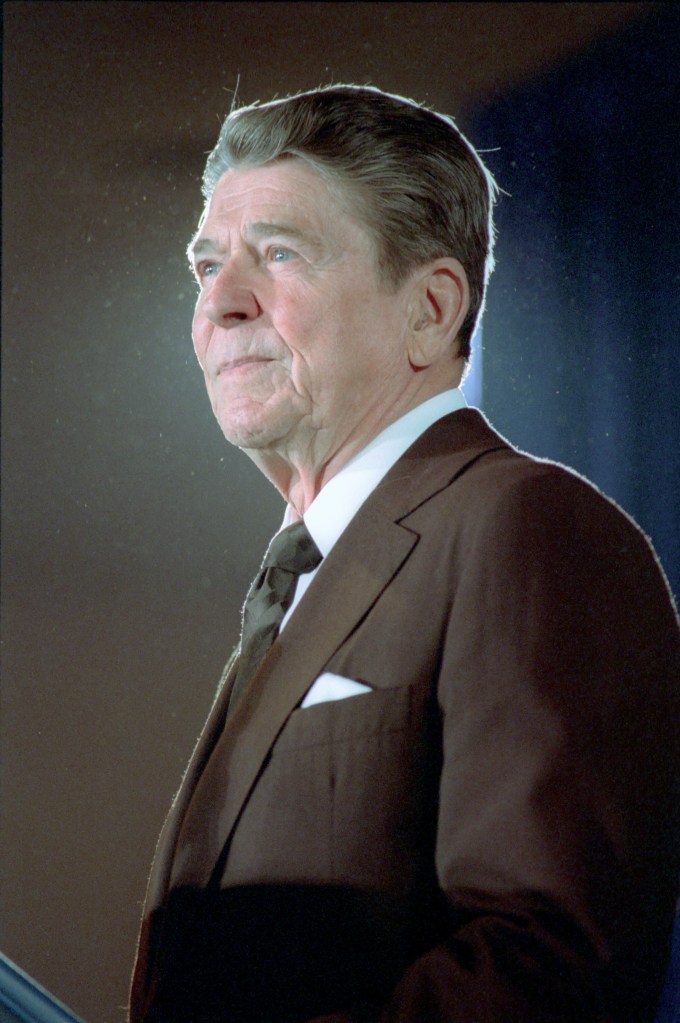
President Ronald Reagan delivered remarks to the Annual Meeting of the National Association of Manufacturers (NAM) in Washington, D.C., focusing on international trade and tax reform. He emphasized keeping trading systems “free and fair” and urged support for pending tax reform Reagan today denounced efforts in the House of Representatives to revise the nation’s trade laws as an exercise that could “send our economy into the steepest nose dive since the Great Depression.” In a speech that aides had billed as a major policy statement, Mr. Reagan accused House Democrats of engaging in election-year politics through “kamikaze legislation” that could cost millions of Americans their jobs. “This bill is so potentially destructive that even many of those who voted for it did so in the expectation it would be vetoed and so never become law,” Mr. Reagan told the National Association of Manufacturers. “Well, if it comes to that, I assure them they will get their wish.”
President Reagan speaks with David Rockefeller, Chairman and CEO, Chase Manhattan Bank, New York, NY.
President Reagan places a call to Zbigneiw Brzezinski, Senior Advisor at the Center for Strategic and International Studies.
A three-judge Federal court today named Whitney North Seymour Jr., a former United States Attorney in Manhattan, as an independent counsel to investigate conflict-of-interest charges against Michael K. Deaver. The court asked him to determine whether any lobbying activities by Mr. Deaver, a longtime friend of President Reagan who resigned last year as a top White House aide, violated Federal law. The appointment came as the Justice Department released a seven-page report concluding that Mr. Deaver’s representation of the Governments of Canada and Puerto Rico “could constitute a number of offenses” under criminal law. Under Federal laws on conflict of interest, former high-ranking officials are forbidden to lobby their old agencies on any matter for a year after leaving; to lobby any department for two years on an issue in which they had direct responsibility, or ever to lobby on issues in which they participated “personally and substantially.”
Five men and three women were accused by the federal authorities today of taking part in a nine-year pattern of bombings, murder and bank robberies by two terrorist groups. Federal officials said that the eight people had committed 19 bombings or attempted bombings in Massachusetts and New York; 10 bank robberies in Maine, Vermont, Connecticut, New York and Virginia; three attempted murders, and the murder in 1981 of a New Jersey state trooper, Philip Lamonaco. All eight indicted today have been convicted previously of other Federal charges related to some of the latest accusations and all are in various Federal prisons, the officials said. Prosecutors said the violence grew out of a radical left-wing movement to overthrow the government. According to the indictment, members of the groups carried out the bombings from 1976 to 1984 using two names — “The Sam Melville-Jonathan Jackson Unit,” or the “United Freedom Front.” Mr. Weld identified the eight people named in the latest indictment as Raymond Luc Levasseur, 39 years old, and Patricia Helen Gros, 31, both of Calais, Maine; Thomas William Manning, 39, and Carol Ann Manning, 31, of Sanford, Maine; Jaan Karl Laaman, 38, of East Boston, Massachusetts; Barbara J. Curzi, 28, of Cambridge, Massachusetts; Richard Charles Williams, 38, of Boston, and Christopher Everett King, 36, of Cambridge.
Federal prosecutors today stopped a witness from giving details about the operation of a highly secret project to intercept Soviet communications. The situation arose in the espionage trial of Ronald W. Pelton after his lawyer tried to elicit the details. In dramatic testimony later in the day, Mr. Pelton’s former lover said he drank heavily and because of that once missed an appointment, which the prosecution says was a telephone call from a Soviet agent. The witness, Ann Barry, said he was “very upset” and told her, “That was our money and now we’re not going to have any.” She said she knew nothing of the nature of the appoinment or of any espionage activities by him.
An F.B.I. agent pleaded not guilty to five charges of making false statements to the Government about his dealings with Jackie Presser, the teamster union president. About 60 bureau agents went to Washington from the Cleveland area to show support for their colleague, Robert S. Friedrick.
A Middlebury, Vermont, police officer testified that John A. Zaccaro Jr. was considered a major supplier of cocaine on the Middlebury College campus. David Wemette’s testimony came as lawyers for the son of former vice presidential candidate Geraldine A. Ferraro sought to suppress evidence taken when the 22-year-old Zaccaro was arrested February 22 on charges of selling $25 worth of cocaine to an undercover state trooper. Zaccaro has pleaded not guilty to one charge of sale of a regulated drug and one charge of possession.
A 9-year-old girl with a pacemaker who suffered convulsions on a Chicago bus died after a good Samaritan carried her to a hospital when the bus driver refused to leave his route, said the child’s mother and the man who came to her aid. “The woman was sitting there screaming her baby was having a heart attack, she’s got a pacemaker, and the bus driver was telling her, ‘Get off the… bus, lady,”” said Ted Garrettson, identified by a hospital spokesman as the man who carried Nicole Hobson into the emergency room. Chicago Transit Authority officials refused to comment, saying they were interviewing the driver.
Adlai E. Stevenson III will run as a third-party candidate for governor of Illinois instead of waiting for a court decision on his attempt to run as an independent candidate, a campaign spokesman said in Springfield. Stevenson will continue to appeal a court decision that is preventing him from mounting an independent candidacy, but at the same time he will begin preparing for a third-party effort, spokesman Bob Benjamin said.
A New York magistrate set $750,000 bail for a retired Israeli general implicated in a plot to sell U.S.-made arms to Iran. A lawyer for retired Brigadier General Avraham Bar-Am, 52, argued against a request by federal prosecutors that he be jailed without bail. Bar-Am was among five men deported Wednesday to the United States from Bermuda. They are accused of plotting to sell an estimated $2.1billion worth of weapons to Iran in violation of a U.S. arms embargo.
An Air Force helicopter providing security for a missile maintenance ground convoy crashed today, killing five of the six people on board, military officials said. The HU-1 helicopter was carrying two crew members and four military police, said Airman 1st Class Ron Brown of the public affairs unit at Ellsworth Air Force Base. He would not identify the victims. Dave Heaton, a witness who drove to the site minutes after the 3 PM crash, said: “There were five men dead and one woman still alive. We saw the bodies. Two were burned beyond recognition.” The woman was listed in critical condition at a nearby hospital. The helicopter was accompanying a missile maintenance convoy from the base to a missile site, Airman Brown said. Ellsworth Air Force Base near Rapid City is a Strategic Air Command base responsible for 160 Minuteman missile silos in western South Dakota.
Three members of Delta Upsilon fraternity at Johns Hopkins University were indicted in Baltimore on charges of arson, conspiracy and assault with intent to murder in the firebombing of a shanty built to protest apartheid in South Africa. Michael Moffa, 19, of Bellmore, New York, Richard Hoheb, 22, of Holmdel, New Jersey, and Russell Abrams, 20, of Riverdale, New York, are accused of throwing cups of gasoline on the shanty and setting it afire last Saturday morning, slightly burning one of the three students inside. The victims belong to the school’s Coalition for Free South Africa.
Tests on all Anacin-3 capsules taken from 10 Walgreen stores in Austin because of the cyanide poisoning death of a chemistry student last May 21 uncovered no signs of cyanide, officials said. “All of those tests are completed and the results were uniformly negative. No tampering and no poison,” said Bob Henna, director of the food and drug division of the state Health Department. The poison found in the body of University of Texas student Kenneth Wayne Faries, 24, was linked to an Anacin-3 capsule from a bottle he purchased at a Walgreen drugstore, authorities said.
The stabbing death Tuesday of an Islamic scholar in his home in Wyncote, Pennsylvania, was an assassination by a killer “filled with hate and rage,” the coroner said. But police said they have not discarded the idea that a botched burglary led to the deaths of Ismail Faruqi, 65, a Temple University religion professor, and his American-born wife, Lois, 59, who taught part time at Temple. Their 27-year-old pregnant daughter was stabbed six times.
With sharply fewer young nuns and priests, the nation’s Roman Catholic religious communities face a critical shortage of $2.5 billion to $3.5 billion in providing for the retirement of aging members, a church study has found. The median age for American nuns is 62-63, and the median age for priests is 54-55.
For at least some American blacks, the Fourth of July Statue of Liberty centennial celebration evokes mixed feelings and emotions well short of enthusiasm. Some say a celebration that focuses attention on the nation’s immigrant heritage serves as a disquieting reminder of the way in which blacks arrived in America and how they have fared since. Others say they accept the celebration of the statue’s symbolism for immigrants as long as black immigrants from the Caribbean are recognized. Still others view it as someone else’s celebration. The ambivalence was also suggested in the approach of the Schomburg Center for Research in Black Culture in Harlem toward planning and naming its exhibit marking the centennial.
Airborne dioxins are a threat to public health, according to a report presented to the American Academy for the Advancement of Science. The report said that much of the currently uncontrolled dioxins and related dibenzofurans to which Americans are exposed come from the incineration of wastes.
The oil bust in Texas has set off a reluctant reappraisal of the state’s budget priorities that will shape the state’s development over the rest of the century. At its heart, officials say, is the fact that Texas’ tax system, based on the supremacy of oil, is no longer truly representative of the state’s economy or adequate to meet expected spending. It is unclear whether that will mean incessant fiscal paring, the development of new taxes, wider application of existing taxes or an increase in rates. But officials say the fierce budget battles shaping up for the legislative session next January will be only the first step in a long adjustment to a new financial situation.
59th National Spelling Bee: Jon Pennington wins, spelling odontalgia.
The Houston Rockets tried to stop the Boston Celtics tonight by using three big men to slow them down and then by using three small men to run with them. But those strategies, plus everything else that Coach Bill Fitch threw at the team he once led and helped put together, were not enough. The Celtics countered with too much Larry Bird, too much Kevin McHale and too much balance, producing a 117–95 victory and a 2–0 advantage in their four-of-seven-game championship series in the Boston Garden, where the temperature reached almost 90 degrees. It was the 40th consecutive victory at home for the Celtics, who have lost only once in 50 regular-season and playoff games at home. With the help of three 3-point baskets, Bird scored 31 points, handed out seven assists, blocked two shots and grabbed eight rebounds. The rest of the time, he was directing the fast break with some phenomenal passing, boxing out under the boards and helping out defensively on Ralph Sampson and Akeem Olajuwon. Bird’s 13-point second period paved the way for the Celtics’ 60–50 halftime advantage and a 34-point third quarter that put the game out of the reach of the young Rockets.
Major League Baseball:
At Anaheim, the Tigers down the Angels, 7–4. All the Haloes runs come in on Dick Schofield’s grand slam. Detroit starter Dave LaPoint pitched five no-hit innings and Lou Whitaker and Lance Parrish hit home runs, leading the Tigers past the California Angels. LaPoint, 2–3, with both victories coming against California, did not allow a hit until Gary Pettis led off the sixth with an infield single. The Tigers jumped on Don Sutton, 2–5, who was trying for his 298th career victory.
Keith Hernandez at first grappled with Fernando Valenzuela. He spent the first three times up stepping in and out of the batter’s box, always diagnosing his and the pitcher’s approach. And then, as if he had Valenzuela figured out all the time but was just waiting him out, Hernandez struck. He hit a long double in the seventh inning to break open a one-run game and the Mets beat the Dodgers, 5–2, to sweep a three-game series. And Shea Stadium rocked yet again. Hernandez is hitting .365 in his last 30 games and his average is .338. George Foster kept up his power display with another home run. Ray Knight had two more hits, Sid Fernandez allowed the Dodgers just four hits over eight innings before Roger McDowell and Jesse Orosco put the Dodgers away in the ninth.
Larry Sheets hit a pair of two-run home runs and Cal Ripken Jr. added a two-run homer today to lead the Baltimore Orioles to their 15th victory in their last 18 games, an 8–6 triumph over the Oakland A’s. Brad Havens (2–1), in relief of Ken Dixon, did not allow a hit in four and two-thirds innings and struck out five. Don Aase pitched the final two innings for his 12th save. Chris Codiroli (3–6) took the loss. Sheets hit a two-run home run in the second inning to pull the Orioles to within 3–2 and added another two-run homer in the sixth to put the Orioles ahead, 7–6. Oakland took a 3–0 lead in the first inning on a three-run home run by Jose Canseco, a rookie. Bruce Bochte doubled with one out and Carney Lansford reached on an error by the third baseman Juan Beniquez. Canseco then hit his 14th home run, a line shot over the center-field fence. Baltimore pulled to within 3–2 in the second. Ripken drew a one-out walk and Sheets followed with his second homer in two games and fifth of the season, a blast to right field. The Orioles moved in front, 5–3, in the third, but the A’s came back with three runs in their half to take the lead. The Orioles went ahead for good in the sixth inning on Sheets’s second home run.
It took Milt Thompson two months to get his first run batted in of the season and it came at the perfect time. Thompson singled home the winning run in the ninth inning to lift Philadelphia to a 5–4 win over the San Francisco Giants. With two out in the bottom of the ninth, Thompson singled to center field off the reliever Greg Minton (2–3) to score Steve Jeltz and enable Philadelphia to sweep the three-game series. Don Carman (2–0) got the victory with three innings of one-hit relief. Jeltz walked with one out in the ninth and moved to second on a single by Greg Gross, the 100th pinch hit of Gross’s career, which tied him for 10th with Rusty Staub on the career list. Jeltz moved to third on a long fly to center by Jeff Stone and came home on Thompson’s hit.
The Yankee offense rested tonight, but the pitching thrived. Dennis Rasmussen, whose career has been marked by his inability to throw complete games, came within one out of getting one, finally settling for a 2–0 victory over the Seattle Mariners at the Kingdome. Rasmussen, now 5–1, did not allow a hit after the fifth inning and struck out five. When he walked Alvin Davis with two out in the bottom of the ninth, Manager Lou Piniella brought in Dave Righetti, who retired Gorman Thomas for his 12th save.
Detroit Tigers 7, California Angels 4
Los Angeles Dodgers 2, New York Mets 5
Baltimore Orioles 8, Oakland Athletics 6
San Francisco Giants 4, Philadelphia Phillies 5
New York Yankees 2, Seattle Mariners 0
Stock prices overcame weak early trading yesterday to rise to a record for the second consecutive day, but advancing stocks outnumbered declining issues by only a narrow margin. The Dow Jones industrial average edged 4.07 points higher, to 1,882.35, marking its fifth consecutive rise and bringing the total gain in that period to more than 107 points. Rising issues on the New York Stock Exchange edged out retreating issues by 835 to 754. Volume on the Big Board shrank to 135.7 million shares, from 159.6 million shares Wednesday.
Dow Jones Industrial Average: 1882.35 (+4.07)
Born:
Mike Windt, NFL long snapper (San Diego-Los Angeles Chargers), in Cincinnati, Ohio.
Jaslene Gonzalez, Puerto Rican model, television host, and winner of “America’s Next Top Model” season 8, in Bayamón, Puerto Rico.

