Evacuations continue of British soldiers on Crete. At Sfakia, destroyers HMS Napier and Nizam take off 1510 men. The Luftwaffe catches them as they sail for Alexandria and damage both with near misses. Overall, 6029 Commonwealth troops are taken off on 30 May before dawn and again before midnight, but there are many more waiting for evacuation.
German motorcycle troops moving east from Suda and Canea (Chandia) link up with Italian troops and armor heading west from their landing ground at Sitia. They can now head south toward Sfakia, where the British are busy evacuating their troops. Troops of the 1st Fallschirmjäger Regiment reach Heraklion (Candia), linking up with the German garrison there. While in doubt only days earlier, Operation Mercury is turning into a roaring success.
The Luftwaffe attacks the Royal Navy ships evacuating the Commonwealth troops from Crete. These include Australian cruiser HMAS Perth, damaged in its engine room with 13 dead, destroyer HMS Kelvin, also damaged, and cruiser Calcutta sunk northwest of Alextrania.
2nd Lt Charles Hazlitt Upham (b. 1908), 2nd New Zealand Expeditionary Force, displayed great valor many times from 22-30 May. He receives the Victoria Cross and bar; this is the only VC and bar of the war. Brigadier Vasey’s Australian 19th Infantry Brigade serves as the rearguard for the evacuation, but British, Greek and New Zealand troops also fight hard. New Zealand soldier Charles Hazlitt Upham receives the Victoria Cross for his services on Crete through 30 May. Today, his platoon disperses an advance party of German soldiers coming down a ravine near Force Headquarters at Sfakia.
There are British troops left behind all across Crete. Remnants of Australian 2/1 and 2/11 battalions, which have been cut off, surrender near Retimo (Rethymno).
Partisan activities continue on Crete. At this stage, they mainly involve helping Commonwealth troops defend specific locations, but there are instances of sniping and full-scale armed defense of villages. The Germans are quite upset that non-soldiers are fighting them and vow revenge.
The Luftwaffe bombs and sinks 105 ton Greek freighter Aghios Pantlemon off Tobruk.
There is a major incident when 3821-ton Bulgarian freighter Knyaguinya Maria Luisa (Fürstin Maria Luisa) explodes at Piraeus, Greece. As it blows up, it also destroys 2140 ton German freighter Alicante and 3127-ton Romanian freighter Jiul (Ziul). There are multiple casualties on all three ships, a tug, and also Italian freighter Adis Abeba. Damage to the city of Piraeus is minimized only because the ship does not explode at once, but only while being towed to a shipyard by tugs. There is a dispute as to the cause of this explosion: Greek partisans claim that their sabotage sinks the Maria Luisa, while RAF Wellington bombers also may be the cause.
At Malta, the Cheshire Regiment lands on Gozo, which the British fear may be used for an invasion of Malta.
The British Middle East Air Force announced: “In Iraq our fighter squadrons flew patrols throughout the day in support of our advancing troops while Italian aircraft tried to prevent them. One of these aircraft was shot down ar Khanugh (Iraq). A number of British reconnaissance planes and bombers operated in cooperation with motorised units. We have destroyed the hangars on the airfield at Deir ez Zor in Syria. In Abyssinia, South African aircraft attacked Italian troops still fighting near Gimma. Direct hits were observed on buildings, as were a number of fires. Several Italian motor trucks went up in flames north of Algeh. Forts Azozo and Digya were bombed at Gondar (Ethiopia). In Libya, an enemy bomber wing yesterday undertook an assault on Tobruk; antiaircraft succeeded in shooting down four of them and several others were damaged. Five of our own aircraft failed to return from these operations.”
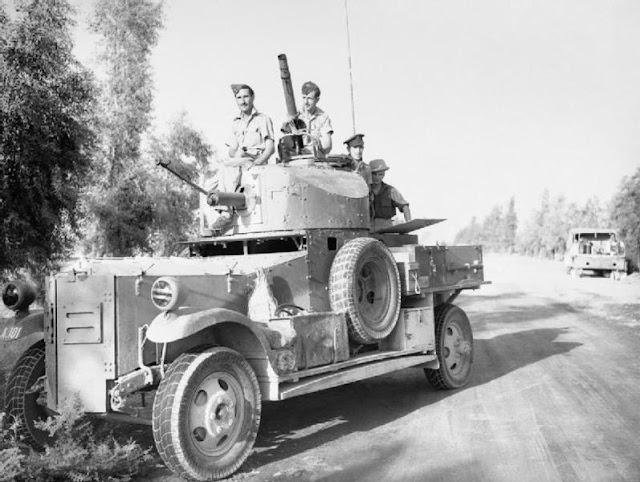
The British 4th Cavalry Brigade of 1st British Cavalry Division, an advance party of Habforce troops, arrives at Baghdad on 30 May 1941 and opens talks for surrender. The entire Habforce only numbers 1,200 men, with eight guns and a few armored cars, but the numerically superior Iraqi troops refuse to fight them. The British occupy the nearby airfield.
Iraqi leader Rashid Ali has left for Persia, taking his soldiers’ monthly payroll of 17,000 dinars. Accompanying him are the Grand Mufti and the rest of the Iraqi government. They head for Germany.
The British are expanding their cushion around their main base at Habbaniyah airfield. They attack Ramadi, about a dozen miles northwest of Habbaniyah. Another large British force from Basra advances past Ur. The Indian 25th Infantry Brigade arrives aboard ship at Basra.
Dr. Fritz Grobba, the head of the German diplomatic mission to Baghdad, leaves the capital today. There now is no longer any German presence in Iraq, as the small Luftwaffe contingent is in disarray with all of its planes out of operation. There is a force of about ten Italian Fiat Cr 42 biplane fighters, but they also prepare to flee from their base at Kirkuk.
From Jerusalem, the American Associated Press News Agency reported: “British and Indian troops are continuing their non-stop advance toward Baghdad and encountering no major resistance anywhere. It is now known that two motorised columns are carrying out the operation. Other British forces supported by tanks are operating against Iraqi troop positions at Ramadi about 12 miles northwest of Habbaniyah.”
British Prime Minister Winston Churchill is still concerned about the Iraqi oil fields — he sends a memo to General Ismay warning of a “fierce and justifiable outcry if we fail to destroy these oil fields before they fall into enemy hands.”
Churchill to Wavell: “It would be convenient to have [Djibouti] in the near future, and I shall be glad if you will consider what forces would be necessary to break the French resistance… The time to strike depends, of course, upon events in Syria which may lead to a breech with Vichy”
The East African 22nd Infantry Brigade, advancing west from Soddu, reaches Sciola in Galla-Sidamo. The Italian defenders withdraw from Sciola after dark
Grand Admiral Erich Raeder renews his proposal to Hitler that there should be a ‘decisive Egypt-Suez offensive for the autumn of 1941 which would be more deadly to the British Empire than the capture of London.’ Hitler decides that this can wait until the collapse of the Soviet Union which should happen no later than October. There remains a large body of opinion among members of the German government and Wehrmacht that is opposed to Operation BARBAROSSA, and this is one of their final attempts to dissuade Hitler from invading the Soviet Union.
The German military administration in Yugoslavia defined what a Jew was, demanded the removal of Jews from the professional and public service, started registration of Jewish property, introduced forced labor, forbade the Serbian population form hiding Jews, and ordered all members of the Jewish community to wear the yellow Star of David.
Rudolf Hess’ British captors assign Estonian-born psychiatrist Dr. Henry Victor Dicks to pose as Hess’ physician. Dicks, a Jew who wrote that he despised Hess on sight, reports directly to British intelligence.
The Fianna Fáil government of Éamon de Valera signs into law the Second Amendment of the Constitution of Ireland. Among other things, it includes restrictions on the right to habeas corpus, an extension of the right of the government to declare a state of emergency, changes to provisions dealing with the reference of bills to the Supreme Court by the president and various changes needed to bring the official Irish text of the constitution into line with the English text.
The tenth and last Lake-class U.S. Coast Guard cutter, USCGC Itasca is transferred to the Royal Navy as HMS Gorleston.
The first anti semitic measures in Serbia are carried out. The German occupation authorities introduce repressive measures against the Jewish population of Yugoslavia. Among other things, all persons now identified as Jews (the definition has just been decided) are forced to wear the yellow Star of David.
Two university students named Manolis Glezos and Apostolos Santas climb on the Acropolis and tear down the swastika flag. This is considered a seminal point in the Greek resistance of World War II.
Prime Minister Winston Churchill sends a memo to Foreign Secretary Anthony Eden telling him that “No encouragement should be given to those suggestions of treachery and bad faith on our part towards the Zionists.” The Revisionist Zionist Movement has alleged that the British are moving toward a more conciliatory policy toward Arab interests due to the war in Iraq. He notes that “I am quite certain that we should lose in America far more than we should gain in the East.”
In Tokyo, Richard Sorge sends another message to Moscow. It begins:
“Berlin informed [German Ambassador to Japan] Ott that German attack will commence in the latter part of June. Ott 95 percent certain war will commence.”
As he has with numerous other warnings about Operation Barbarossa, Soviet Premier Joseph Stalin disregards this warning. In fact, he has had his staff work up plans for an invasion of Germany (see the Zhukov Plan of 15 May 1941).
After dark, Luftwaffe bombers attack the Bristol area and the Mersey industrial area.
About 30 German planes cross England and bombs Dublin just after midnight on 31 May. The local inhabitants send up a flare to denote their status as neutrals, which the Germans disregard. Areas hit include Phoenix Park (home of the Dublin Zoo) and the North Strand area. Overall, 34 people perish, 90 are wounded, twenty homes are destroyed, 55 greatly damaged and 400 people left homeless. The Irish lodge a diplomatic protest in Berlin, to which the Germans reply that “there can be no question of any intentional attack on Éire territory.” The Reich blames “high winds” on the “error.”
RAF Bomber Command, Day of 30 May 1941
12 Blenheims on a coastal sweep but nothing seen. 1 Stirling on a photographic reconnaissance flight to Monster turned back.
Churchill tells Sir Archibald Sinclair, Secretary of State for Air (and also the leader of the Liberal Party) that the RAF should supply the Army with “the modest force they require” for Army co-operation squadrons. This means transferring 30 Blenheim bombers now and 30 more (for an army reserve) at a later date.
U-38, commanded by Kapitänleutnant Heinrich Liebe, sank British steamer Empire Protector (6181grt) in 6N, 14-25W. At 1311 hours on 30 May 1941 the unescorted Empire Protector (Master John Cringle) was hit by one of two G7a torpedoes from U-38 southwest of Freetown. The ship sank within a few minutes after being hit aft by a G7a coup de grâce at 1407 hours. Five crew members were lost. The master, 29 crew members and three gunners were picked up by Arundo and landed at Freetown. The 6,181 ton Empire Protector was carrying cotton, cotton seed, and copper and was bound for London, England.
U-106, commanded by Kapitänleutnant Jürgen Oesten, sank British steamer Silveryew (6373grt) at 16-42N, 25-29W. At 0036 hours on 30 May 1941 the unescorted Silveryew (Master James Smith) was hit in the stern by one of two torpedoes from U-106 and sank west of the Cape Verde Islands. The master and two crew members were lost. 47 crew members, three gunners and one passenger made landfall at San Antonio, Cape Verde Islands. The 6,373 ton Silveryew was carrying pig iron, kernels, manganese ore, and kyanite ore and was bound for London, England.
Italian submarine Marconi sank Naval oiler RFA Cairndale (8129grt) 170 miles WSW of Trafalgar, 35-19N, 8-33W. Five crewmen were lost on the tanker. Escorting corvettes HMS Coreopsis and HMS Fleur de Lys attacked the submarine. Destroyers HMS Faulknor, HMS Forester, and HMS Fury were sent to assist the corvettes. Later on the 30th, corvettes HMS Azalea and HMS Woodruff and anti-submarine trawler HMS Imperialist joined the search. Destroyer HMS Wrestler and sloop HMS Bideford sailed later. At 1521, Captain D.8 in destroyer Faulknor reported that the destroyers, corvettes, and motor launches had made seven attacks on submarine contacts. At 0932 on the 31st, destroyers Faulknor, Forester, and Fury were recalled to Gibraltar.
Heavy cruiser HMS Dorsetshire arrived at the Tyne for refitting completed on 15 July.
Light cruisers HMS Aurora and HMS Kenya departed Hvalfjord for patrol.
Sloop HMS Black Swan departed Dundee at 2315 on completion of repairs and arrived at Scapa Flow at 1745/31st having carried out gunnery practices en route.
In a flying accident, a Swordfish of 774 Squadron was lost near Tintagel. P/T/Sub Lt (A) J. H. Formby RNVR, Ordinary Seaman E. W. Page, and Ordinary Telegraphist F. Thurlow were killed.
Aircraft carrier HMS Argus and destroyers HMS Fearless, HMS Foresight, and HMS Foxhound arrived at Gibraltar.
British tanker British Yeoman (6990grt) reported she had been torpedoed in 35-28N, 8-11W. Destroyer HMS Faulknor and anti-submarine trawler HMS Alouette departed Gibraltar and the five motor launches were diverted to this position. The ship later arrived at Gibraltar and it was found she had received only slight damage.
British steamer Westavon (2842grt) was sunk on a mine in 51-36N, 1-11E. The entire crew was rescued.
British steamer Kyleclare (700grt) was damaged by German bombing off Limerick.
During the night of 30/31 May, the evacuation of Crete continued.
Sfakia: destroyers HMS Kelvin, HMS Kandahar, HMAS Napier, and HMAS Nizam departed Alexandria at 0600/30th. However, soon after sortie, destroyer Kandahar broke down and forced to return to Alexandria. Soon thereafter, destroyer Kelvin was damaged by a near miss of an air bomb and also forced to abort. The destroyer sustained one rating killed and four crewmen wounded. Destroyers Napier and Nizam continued to Sfakia and lifting 1510 men. Returning to Alexandria, they were both damaged by near misses of air bombs. Both destroyers sustained machinery damage from the near misses, but neither sustained any personnel casualties. The destroyers arrived at Alexandria on the 31st.
Submarine HMS Triumph torpedoed and damaged Italian armed merchant cruiser Ramb III (3667grt), which was en route from Tripoli to Benghazi, off Benghazi.
Submarine HMS Utmost attacked a convoy of steamers Tilly Russ and Ca’Da Mosto, escorted by torpedo boats Pallade and Polluce off Sirte. The convoy arrived safely at Tripoli on the 31st.
Submarine HMS Torbay reported sinking two caiques in the Aegean by gunfire.
Bulgarian steamer Knyaguinya Maria Luisa (3821grt) was sunk near Piraeus by an act of sabotage. The steamer blew up and sank German steamer Alicante (2140grt) and Rumanian steamer Jiul (3127grt) nearby. Greek patriots caused a major fire in the Bulgarian transport vessel, which was laden with ammunition destined for the German army
Greek steamer Aghios Pantlemon (105grt) was sunk by German bombing when she lost touch with her escort of minesweeper whaler Falk off Tobruk.
Convoy SL.76 departed Freetown escorted by armed merchant cruiser HMS Moreton Bay to 21 June and corvettes HMS Amaranthus to 1 June, HMS Asphodel to 7 June, HMS Clematis to 1 June, and HMS Columbine to 7 June. Destroyer HMS Velox escorted the convoy from 4 June to 6 June. Heavy cruiser HMS Cumberland escorted the convoy from 10 to 16 June. Corvettes HMS Coreopsis and HMS Fleur de Lys escorted the convoy from 13 to 18 June. Light cruiser HMS Sheffield escorted the convoy from 14 to 16 June. On 16 June, destroyers ORP Piorun and HMS Roxborough and ocean boarding vessels HMS Corinthian and HMS Maron joined to 21 June. Destroyer HMS Westcott and corvettes HMS Auricula and HMS Periwinkle joined on 18 June to 21 June. On 19 June, destroyer HMS Wanderer and corvettes HMS Freesia, HMS Hibiscus, and HMS Marigold joined to 21 June. The convoy arrived at Liverpool on 21 June.
Memorial Day in the United States.
Stirred by the need for national strength and unity during the unlimited national emergency, hundreds of thousands of Americans throughout the United States, more than ever before in recent decades, honored those who had given their lives for the nation in past wars at Memorial Day exercises today.
President Roosevelt signed a bill late today exempting from the draft all men who have served three consecutive years in the Marine Corps, coast guard or navy. It also exempts men who have spent one year in any of the three services and two in the reserve. The exemption already applies to men who have been in the army, and the objective of the new act was to accord equal treatment to those who had served in the other branches of the armed forces.
More than 2,500 opponents of America’s entry into the European war packed the Turner Arena in Washington tonight, cheered Charles A. Lindbergh’s name for 35 seconds, booed and hissed the names of Anthony Eden and Viscount Halifax, and gave only mild catcalls when Hitler or nazism were mentioned by speakers at a rally of the Keep America Out of War Congress.
That Adolf Hitler’s speeches have failed to reassure Americans regarding Germany’s intentions toward this country, and that a majority of Americans think a victorious Germany would eventually start a war against the United States, are facts which emerge today from a nationwide survey by the American Institute of Public Opinion. 62% expect a Nazi attack on the U.S. within ten years if the British are forced to capitulate.
Hundreds of employees, on strike for 16 days, returned to work today at the Phoenix Iron Co., saying they had heeded the nation-wide appeal of President Roosevelt for cessation of strikes in defense industries. The C.I.O. Steel Workers Organizing Committee called the strike after the employees association declined to a collective bargaining election.
Shipyards of the Bethlehem Steel Co. at Sparrows Point hummed today when “almost all” of 6,000 workers refused to take “an optional holiday,” a company official said tonight. He said the men told “their immediate bosses they were willing to work at straight pay today, and for time and a half tomorrow. Otherwise, the plant would have been closed from Thursday night to Monday morning. It was a patriotic thing for them to do, and almost all of the 6,000 came to work this morning.”
Extraordinary precautions were taken throughout the country today to protect factories producing Army and Navy equipment, shipyards, docks, navy yards and other key points in the defense program against sabotage, as a result of information obtained by the Federal Bureau of Investigation that large-scale sabotage was planned for the Memorial Day week-end.
Senator Norris, Nebraska independent, suggested today the government under take a multi-billion-dollar national power development to meet a “serious shortage” of electricity needed for the defense program. Norris, legislative father of the Tennessee valley authority, told a press conference such a program should provide for establishment of regional power authorities throughout the country and should make possible a coast-to-coast network of transmission lines.
Sergeant Alvin C. York, hero of the World War, spoke today before the tomb of the Unknown Soldier in Arlington cemetery and called for immediate, all-out aid to England, including convoys if necessary.
John G. Winant, United States Ambassador to the Court of St. James, returned from London today aboard the Yankee Clipper for a brief visit to report to President Roosevelt and Secretary of State Cordell Hull. He was accompanied by Benjamin V. Cohen, legal counselor to the embassy at London.
Acting on the authority of Attorney General David T. Wilentz, Sheriff Denton J. Quick of Sussex County raided the German-American Bund’s Camp Nordland in Andover, New Jersey this evening and closed it as a public meeting place under New Jersey’s statute empowering the authorities to close “every building or place where the law is habitually violated.”
The last “Lake”-class U.S. Coast Guard cutter, authorized for transfer on 10 April under Lend-Lease, is transferred to the Royal Navy: The USCGS Itasca became the HMS Gorleston (Y 92). The Itasca was present at Howland Island in 1937 during the Amelia Earhart around-the-world flight, at the time of her disappearance.
The service comedy film “In the Navy” starring Abbott and Costello was released. The Andrews Sisters, Dick Powell, and Shemp Howard also appear. This is the comedy duo’s follow-up to smash hit “Buck Privates” and is another big hit, becoming the sixth most popular film of 1941.
Floyd Davis and Mauri Rose won the Indianapolis 500. This was the last time in Indianapolis 500 history that one winning car would carry two different drivers. The race would not be held again until 1946.
Major League Baseball:
The Red Sox and Yanks split, New York winning the opener by scoring three unearned runs in the 9th, and Boston trouncing New York in the nightcap, 13–0. Mickey Harris allows just two hits and the Sox cap it off with a triple steal in the 5th inning. The Sox add another steal in the frame. With Dom DiMaggio at the plate, Skeeter Newsome, who earlier had stolen second base, scores on the front end of the trifecta, with Frankie Pylack taking third base and Harris stealing second. Williams laces 6 hits in the doubleheader, while Joe DiMaggio hits in both games to run his streak to 16. It is not a good day for the DiMaggio, suffering from a cold, as he commits an error in the opener and 3 more in the nightcap, two on overthrows of home. In addition, Johnny Sturm missed a pop fly, Tommy Henrich booted a single in right and Joe Gordon made a wild heave. Thus Charley Stanceu’s debut ag a major league starting pitcher was thoroughly gummed up. The relief pitching was less than adequate, and the Yankees dropped the nightcap, a nightmare, by 13–0. The left-handed Mickey Harris was able to breeze through the finale with a two-hit shut-out.
The rollicking White Sox lambasted the league-leading Cleveland Indians in both ends of a double-header today, 7–1 and 5–2, behind the sterling pitching of Ted Lyons and Thornton Lee. A holiday crowd of 37,565 saw the forty-year-old Lyons set the Indians down with five hits in the opener. Lee followed with a six-hitter, the two losses slicing Cleveland’s margin over the second-place White Sox to only two games. Lou Boudreau opened the battle against Lyons with a single, stole second, advanced to third on an infield out and scored on Gerald Walker’s roller to short. The veteran pitcher was invincible in the pinches thereafter. The Sox combed Al Smith for seven hits and seven runs in four innings. Joe Kuhel put the game on ice with a three-run homer to climax a four-run splurge in the fourth. The White Sox got away to a running start in the nightcap when Luke Appling singled in the first inning and Kuhel followed with another homer, his sixth of the season. Mike Tresh doubled in the second and scored on a single and Rollie Hemsley’s error. The Sox continued their assault on young Jim Bagby in the third, sending him to the showers. Clint Brown replaced him and retired the side without a run scoring.
Big Rudy York’ belted his eleventh and twelfth home runs of the season as the Tigers maintained their mastery over the Browns by winning a double-header today before 35,412 spectators. The Tigers, twice came from behind in extending to fourteen games their string of victories over St. Louis at Briggs Stadium. Pinky Higgins’s ninth-inning single, his fourth hit of the game, won the opener, 6–5, and an eighteen-hit attack on four hurlers clinched the nightcap, 10–6.
With Brooklyn 3 games in back of the Cards, 59,487 jam the Polo Grounds to watch the Dodgers and Giants. Whitlow Wyatt shuts out the Giants to win the opener, 8–0, and Brooklyn overcomes a 2–1 deficit in the nightcap to score 5 runs in the 9th, the rally being capped by Dolph Camilli’s eleventh homer of the season, and win 6–2. Practically all the fireworks came in that explosive ninth of the nightcap. After a wobbly start in the first inning, when singles by Peewee Reese and Pete Reiser and a fly by Cookie Lavagetto gave the Dodgers a run, Melton settled down to seven innings of hitless and run-less pitching. Meanwhile, the Giants wrenched the lead from Hamlin with a pair of runs in the sixth on singles by Joe Orengo and Johnny Rucker and a two-bagger by Mel Ott that dropped just inside the right-field foul line while three Dodgers were chasing it frantically. But in the ninth Melton cracked wide open as Reese singled and swept to third on Billy Herman’s single. Reiser grounded to Billy Jurges, whose throw to the plate came too late to check Reese. Gabby Hartnett, catching this game for the Giants, was badly jarred on this play and forced to retire. Cookie Lavagetto flied out, but Jurges fumbled Joe Medwick’s grounder and the bases were filled. A moment later came Vosmik’s line single to right, and as Ott’s throw-in bounded past Harry Danning at the plate, three runners scored. Vosmik was eventually retired in trying to make third on the misplay, but the Dodgers still had one more ball to fire and Camilli fired it into the upper right tier for a homer. Mace Brown received credit for the victory, his second as a Dodger.
The Phillies and the Braves took turns today in ending long losing streaks as they split a doubleheader before 12,937 at Shibe Park. The Phils stopped a six-game plunge by taking the opener, 6–5, while the Braves shattered an eight-game losing streak by winning the afterpiece, 4–1, as Southpaw Art Johnson turned in a five-hitter in his first major league start.
You win some, you lose some. Rip Sewell loses game 1 of the Cubs-Pirates twinbill, allowing 6 runs in 5 innings as Chicago wins, 7–6. Sewell comes back in game 2 with 3 scoreless innings in relief to win, 5–4. Sewell started the first contest for the Pirates, but was a victim of triples by Bob Sturgeon and Phil Cavaretta, both coming with two men on base, and was charged with the ‘loss, while Big Bill Lee was credited with his fifth victory of the season. In the nightcap, after the Pirates had bunched six singles in the sixth to score four times and tie the game, Sewell came in as a relief hurler and shut out the Cubs. He scored the winning run in the ninth on Frankie Gustine’s single after hitting a double. Rookie Eddie Stewart crashed against the right field stand to grab a liner off Stan Hack’s bat in the ninth inning of the second game, then doubled Claude Passeau off first with a fine throw to Elbie Fletcher.
The Cards run their win streak to 11 in a row by defeating the Reds, 4–1, in the opener. The Reds win game 2 by a 3–2 score in thirteen innings. The Reds used their ace pitchers, Paul Derringer and Bucky Walters, but Derringer was beaten and Walters was knocked out in the ninth inning of the second game when the Cards rallied to tie the score. Elmer Riddle relieved Walters and became the first pitcher since May 20 to gain a victory over the Redbirds. He allowed one hit in four and two-thirds innings. Frankie McCormick, back in the clean-up slot for the Reds after batting seventh for one day, drove in the winning run with a double following Ival Goodman’s single. Charlie Aleno’s single, Lonnie Frey’s double and an infield out gave Cincinnati its first run in the second inning, and the Reds added another in the sixth on Frank McCormick’s double and Aleno’s single. With Walters checking the Cardinals, that looked like enough until the ninth. Martin Marion started the Cards’ ninth with a double and scored on a single by a pinch hitter, Coaker Triplett. Triplett held up at third on Johnny Hopp’s double, which sent Walters to the showers, and scored the tying run on Jimmy Brown’s fly.
The Athletics found Washington pitching to their liking and triumphed, 7–4 and 14–4, in a holiday double-header today. The double loss stretched the Senators’ string of defeats to twelve. Lester McCrabb scattered Washington’s twelve hits in the opener, while his mates bunched their dozen hits effectively. The Senators’ three errors were a big factor in the loss. In the nightcap Johnny Babich limited Washington to six hits, while the A’s teed off for fourteen blows off Vernon Kennedy, Walter Masterson, Alex Carrasquel and Bill Zuber. Ben Johnson of the Athletics clouted a two-run homer into the left-field bleachers in the first inning and Buddy
Lewis hit for the circuit for Washington in the fifth.
New York Yankees 4, Boston Red Sox 3
New York Yankees 0, Boston Red Sox 13
Cleveland Indians 1, Chicago White Sox 7
Cleveland Indians 2, Chicago White Sox 5
St. Louis Browns 5, Detroit Tigers 6
St. Louis Browns 6, Detroit Tigers 10
Brooklyn Dodgers 8, New York Giants 0
Brooklyn Dodgers 6, New York Giants 2
Boston Braves 5, Philadelphia Phillies 6
Boston Braves 4, Philadelphia Phillies 1
Chicago Cubs 7, Pittsburgh Pirates 6
Chicago Cubs 4, Pittsburgh Pirates 5
Cincinnati Reds 1, St. Louis Cardinals 4
Cincinnati Reds 3, St. Louis Cardinals 2
Philadelphia Athletics 7, Washington Senators 4
Philadelphia Athletics 14, Washington Senators 4
King Rama VII Prajadhipok, former King of Siam from 1925 to 1935, passes away.
Denying reports in the United States that Japan had become indifferent to the German-Italian-Japanese treaty, Foreign Minister Yosuke Matsuoka issued a formal statement through the Foreign Office tonight reaffirming Japan’s loyalty to the triple alliance. He also threatened, with obvious reference to the trade dispute with the Netherlands Indies, that if Japan’s peaceful policy in the South Seas became impossible she might have to reconsider it. The statement followed a call on Mr. Matsuoka by Lieutenant General Eugen Ott, the German Ambassador; a report that a large part of the United States Pacific Fleet had been shifted to the Atlantic and a meeting of the War Council and other high army leaders at the residence of the War Minister, Lieutenant General Eiki Tojo, at which Domei, the Japanese news service, said the situation in China as well as in Europe was discussed.
The Australian Government is seeking to obtain from the United States 700 light and medium tanks designed for long-range operations to equip a new home defense armored division. Officers for the division are being trained. Recruiting will begin in August.
Born:
John Miller, MLB pitcher (Baltimore Orioles), in Baltimore, Maryland (d. 2020).
Died:
Prajadhipok, 47, King of Siam from 1925 to 1935.
Naval Construction:
The U.S. Navy YMS-1-class auxiliary motor minesweeper USS YMS-56 is laid down by the Gibbs Gas Engine Co. (Jacksonville, Florida, U.S.A.).
The Royal Navy Fairmile B-class motor launch HMS ML 265 is commissioned.
The Royal Navy MMS I-class motor minesweeper HMS MMS 10 (J 510) is commissioned. Her first commanding officer is T/Lieutenant Richard Terence Mills, RNVR
The Royal Navy MMS I-class motor minesweeper HMS MMS 13 (J 513) is commissioned. Her first commanding officer is T/Lieutenant Frank Burgess, RNVR.
The Royal Navy MMS I-class motor minesweeper HMS MMS 17 (J 517) is commissioned. Her first commanding officer is Commander D G Silcock, RNVR.
The Royal Navy British Power Boat 63-foot Motor anti-submarine boat HMS MA/SB 23 is commissioned.
The Royal Navy Banff-class sloop HMS Gorleston (Y 92) [ex-USCGS Itasca] is commissioned. Her first commanding officer in British service is Commander (retired) Ronald W. Keymer, RN.
The Royal Navy Flower-class corvette HMS Myosotis (K 65) is commissioned. Her first commanding officer is Lieutenant Gerald Peter Shiers Lowe, RNVR.
The Royal Navy “U”-class (Third Group) submarine HMS P 33 is commissioned. Her first commanding officer is Lieutenant Reginald Denis Whiteway-Wilkinson, DSC, RN.
 History Diaries