The Death of the Bismarck
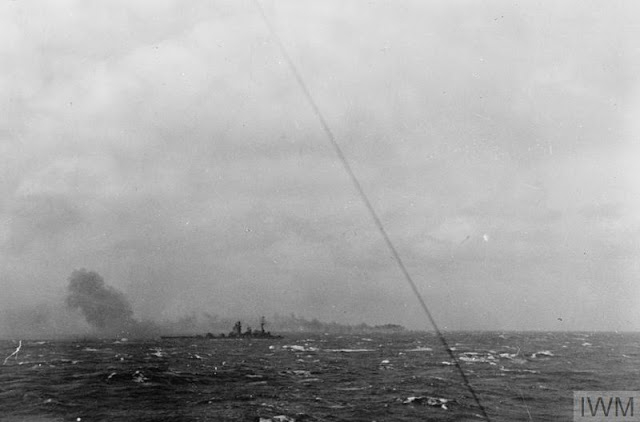
Operation RHEINÜBUNG ends. After taking more damage, the crippled Bismarck was severely damaged from overwhelming Royal Navy shelling and torpedoes from the battleships HMS King George V and HMS Rodney and the Heavy Cruiser HMS Dorsetshire; still afloat despite the enemy bombardment, the Bismarck was scuttled by her own crew.
As the day begins, the German battleship Bismarck has been crippled by a torpedo hit in the stern that has jammed its left rudder. This prevents it from proceeding to the southeast and safety under the protection of the Luftwaffe. The Royal Navy closes in, and within hours the Bismarck is surrounded and everyone awaits daylight for the end.
Everyone on the Bismarck knows the situation is hopeless. Around midnight, Admiral Günther Lütjens, in command aboard the Bismarck, makes his last radio transmission to headquarters: “Ship unmaneuverable. We shall fight to the last shell. Long live the Führer.”
The Royal Navy’s 4th Destroyer Flotilla, under the command of Captain Philip Vian, arrives on the scene after being diverted from escorting troop convoy WS8B from Glasgow to the Indian Ocean. His destroyers make runs at the battleship, launching torpedoes. It is unclear (and unlikely) if the destroyers make any hits, but they keep the Germans busy.
U-556 (Kptlt. Herbert Wohlfarth), which has completed its patrol with Wolfpack West in the North Atlantic and returning to base in France, receives orders to retrieve the logbooks from Bismarck. Wohlfarth heads to the position, and on his way spots aircraft carrier Ark Royal and the battlecruiser Renown. However, U-556 is out of torpedoes and can do nothing.
At 08:47, the Royal Navy begins firing. British battleships HMS Rodney and King George V achieve quick hits, silencing the Bismarck’s guns. After closing in, at around 10:00 each British battleship achieves two penetrations of Bismarck’s armor, two on the starboard side by King George V and two on the port side by Rodney. The British battleships, low on the fuel, then leave the scene and leave the ending to smaller ships.
Heavy cruiser Dorsetshire then closes and sends three torpedoes into the blazing German ship. Around the same time, the surviving Bismarck crew sets off scuttling charges. It is unclear if the torpedoes would have sunk the Bismarck, or if it required the Bismarck crew scuttling the now-defenseless ship — but the Bismarck capsizes and sinks at 10:40.
The sea is full of the Bismarck’s crew, but there is great fear in the British ships about U-boats. Dorsetshire and destroyer Maori spend an hour picking up survivors, and 110 men are saved. The British ships then quickly depart the scene, leaving many sailors to drown. Later, U-74 (Kptlt. Eitel-Fredrich Kentrat) and Kriegsmarine weather ship Sachsenwald arrive, with U-74 picking up three men and the weather ship two. One man later dies, so 114 men survive the sinking. About 2200 Bismarck crew perish during the battle, including Admiral Lütjens and Bismarck Captain Lindemann (both of whom likely died early on when the bridge was hit, but some survivors reported seeing Lindemann standing at attention on the stern as it sank).
Operation Rheinübung involved two ships: Bismarck and heavy cruiser Prinz Eugen. The latter ship is forgotten by virtually everyone, Prinz Eugen — almost out of fuel — has made a rendezvous with tanker Spichern far to the south. Today, it develops some engine trouble, reducing its speed to 28 knots. Ultimately, this will force Prinz Eugen to abandon its mission and seek haven in France.
At Berchtesgaden, Hitler crony Walther Hewel notes in his diary, “Bismarck sunk … Führer melancholy beyond words.”
On Crete, the situation is getting desperate for the British. In the morning, the New Zealand 28th (Māori) Battalion, the Australian 2/7th Battalion, and the Australian 2/8th Battalion fix bayonets and charge the German 141st Mountain Regiment which is blocking the road from Suda (Souda) to Chania (Canea). In this “Battle of 42nd Street,” the Commonwealth troops succeed. This re-opens a line of retreat for the Commonwealth troops still fighting in and around Chania, which the Germans now completely take.
In the Battle of 42nd Street, the Allies temporarily halted the German advance in Crete. There was an unsealed road that ran from Chania to Tsikalaria lined with olive trees, and running south from the main coastal road from Chania to Suda Bay. The road was lower than the surrounding land and was nicknamed 42nd Street, after the 42nd Field Company of the Royal Engineers, who had previously camped there, and the film 42nd Street (but it was known locally as Tsivalarion Road). As a German battalion advanced towards the road, the Anzac defenders carried out a bayonet charge that inflicted heavy casualties on the German attackers, which forced them to withdraw and briefly halted the German advance. Afterwards, the Anzac troops kept retreating towards the southern coast of the island. During a bayonet charge, some mortar teams tried to fight back but they were overrun and killed. The retreating Germans who tried to hide were bayoneted. The charge resulted in the Germans retreating over 1,500 metres (1,600 yd). The pursuit stopped and Dittmer ordered the Maori Battalion’s second-in-command, George Bertrand to retrieve the rest of the New Zealanders. Some of them were unhappy about having to return to 42nd Street, with one soldier saying “The boys didn’t want to stop. Had we let them they would have chased the enemy indefinitely.” The Australians too, were ordered to return to the road by Walter Miller, commander of the C Company, after he realized his troops had no cover and that they had already pushed the Germans far enough back. On the way back to 42nd Street, many of the Anzacs stopped to pick up rations from the German dead. About 280 Germans were killed and three taken prisoner; 10 Australians from the 2/7th were killed and 28 wounded, while the Maori Battalion suffered a further 14 casualties. The action halted the German 5th Alpine Division for the remainder of the day. That afternoon, the Anzacs spotted German forces moving across the flanks of the mountains, trying to encircle them. The Anzac troops withdrew, joining the columns retreating south. A short time later, the British high command authorized the evacuation of Crete, ordering a withdrawal across the White Mountains to Sfakia in the south where the troops could be taken off the island by the Royal Navy. The Australian 2/7th subsequently took part in further rearguard actions. Although it had planned to evacuate, it was the last Allied unit to be withdrawn, and when the evacuation of Commonwealth troops ceased on 1 June due to heavy losses at sea, the battalion was left behind. Still on Crete, Walker surrendered the remaining troops, having helped delay the German advance long enough to allow 12,000 others to be withdrawn. The battalion was later rebuilt from the small cadre that managed to avoid capture, and later fought in the Pacific against the Japanese
German troops captured Chania (Canea), Crete, Greece, thus securing the use of the anchorage at Suda Bay. Chania and Suda were occupied by the Germans. The Allied forces were now largely split up and moving in a disorganized manner in the direction of Sfakia to be evacuated.
At 02:00, Prime Minister Winston Churchill cables Middle East Commander General Archibald Wavell: “Victory in Crete essential at this turning point in the war. Keep hurling in all aid you can.” At 08:42, Wavell responds. He has a much closer view of the actual situation on Crete and knows that events at sea or in Iraq mean nothing for his defense of the island. Wavell cables back, “Fear we must recognize that Crete is no longer tenable….”
Wavell’s cable arrives while the War Cabinet is in session. As the meeting’s minutes state:
“The Prime Minister said that all chances of winning the battle in Crete now appeared to have gone and we should have to face the prospect of the loss of most of our forces there.”
Churchill casually adds that he will reveal nothing of this to the House of Commons in his morning statement. In fact, he simply states that the army’s “magnificent resistance hangs in the balance.”
Archibald Wavell sent a message to Churchill explaining that Crete was “no longer tenable” and that troops must be withdrawn. The Chiefs of Staff agreed and ordered evacuation. The evacuation of Crete was authorized by the Commander-in-chief of the Middle East, General Archibald Wavell, after he consulted with London.
The decision to withdraw from Crete is made formal when Churchill sends a memo to General Ismay which states:
“In view of General Wavell’s latest message, he should be ordered to evacuate Crete forthwith, saving as many men as possible without regard to material, and taking whatever measures, whether by reinforcement or otherwise, are best.”
So, London now accepts the inevitable. British island commander General Bernard Freyberg quickly orders Allied troops to begin withdrawing to the south shore for evacuation. The British troops at Suda and Beritania, including 800 Commandos just landed on the 26th, begin heading down the road to Vitsilokoumos, north of Sfakia. The Germans occupy the critical naval base at Suda Bay as the British depart.
More troops are embarked on three destroyers (HMS Hotspur, HMS Imperial, and HMS Kimberley) at Alexandria for transport to Crete when the decision to evacuate to the island is received. The troops are not sent.
Responding to an OKW request made on the 26th, the Italians send a convoy from Rhodes to reinforce the Germans on Crete. It contains a brigade from the 50th Infantry Division Regina, supported by 13 L3/35 light tanks. As many have noted, Operation Mercury has been an odd battle because the Germans have had no tanks, and the British Army has had no air support. This Italian convoy, comprising a motley collection of four fishing vessels, two steamships, one riverboat, two reefer ships, three tugs, and three tankers, aims to bring ashore some Axis armored support. Their planned landing date is the afternoon of 28 May. The convoy is escorted by destroyer Crispi and two torpedo boats (Lince and Lira).
Royal Navy battleship HMS Barham is covering the withdrawal of minelayer Abdiel from Suda Bay, where it landed Commandos on the 26th when the Luftwaffe bombs it. The bomb destroys Y turret and kills seven crewmen while wounding six. Barham makes for Alexandria, then Durban, for repairs, which take until 30 July.
In the evening of 27 May 1941, the British Habforce troops that have occupied Fallujah under Major-General George Clark begin advancing on Baghdad. The British are in multiple columns in a concentric attack, with Indian 20th Brigade coming from the south on the Euphrates, Indian 21st Brigade advancing along the Tigris River from Basra while Habforce troops marching from Fallujah. The defending troops of Rashid Ali destroy bridges and dams, slowing the advance. However, while Clark’s force is far smaller than the defending Iraqis, militarily it is far superior.
The German military mission also is under intense pressure in Iraq. The Luftwaffe force has been vastly reduced in size, while the eleven Italian Fiat Cr-42 fighters that have just arrived can do little. All continue to fight, but prepare to leave the country should Baghdad fall.
As the British near Baghdad, rioting and looting begin to break out.
In London, Prime Minister Winston Churchill tells the House that “In Iraq, our position has been largely re-established, and the prospects have greatly improved.”
Operation SKORPION ended with the Germans recapturing Halfaya Pass. General Erwin Rommel unleashes Kampfgruppe von Herff on the Libyan frontier in Operation SKORPION. The battle plan involves a feint to the west of Fort Capuzzo by Group Bach acting as a decoy, intended to fool the British into thinking that they are about to be outflanked. This, the thinking goes, will induce the British out of their defensive positions and expose them to attack. The British, however, barely react, so Oberst Maximilian von Herff orders Group Cramer (which has the bulk of the panzers) to move northwards directly on the objective: Halfaya Pass. At dawn, Group Knabe attacks the head of the pass and Group Bach attacks the foot. The British only have nine tanks in Halfaya Pass, and they are out-matched by the massive German attack.
After an hour or two of the unequal battle, British commander Lieutenant-General William “Strafer” Gott authorizes a withdrawal. Lieutenant-Colonel J. Moubray, in command of the 3rd Battalion Coldstream Guards and the other units garrisoning the pass (including the 4th Royal Tank Regiment (4th RTR, Major C. G. Miles), field, anti-tank and anti-aircraft guns, and the 7th Support Group of the 7th Armoured Division), blasts his way out of his encirclement with some troops captured by Group Bach.
While not a major battle, Operation SKORPION deprives the British of their last gain from their Operation BREVITY of May 15-16. It also provides an unusual incident where the roles of the two sides are reversed, the Germans being able to intercept some British wireless messages while the British get no help from Ultra. The British Army loses 173 men (40 prisoners), four 25-pounder field guns, eight 2-pounder anti-tank guns, and five Infantry tanks. The Germans capture nine 25-pounder field guns, seven Matilda (A12) tanks, and two other tanks. Most importantly, the battle eliminates any British hope of a quick relief of Tobruk.
The Afrika Korps wastes no time in reinforcing its defenses both at Tobruk and along the Gazala Line. Rommel orders a defensive line built just over the border in Egypt, based on Halfaya Pass, in an arc through Qalala and Hafid Ridge 6 miles (9.7 km) south-west of Fort Capuzzo to Sidi Aziz.
At 00:50, Churchill sends Wavell a brief cable, “Hope you are preparing your desert stroke and that Tobruk will not be idle.” The British in Egypt now brings forward the tanks from the Tiger Convoy (Churchill’s “Tiger Cubs”) for another offensive planned in mid-June (Operation BATTLEAXE). At the evening War Cabinet meeting, Admiral Sir Dudley Pound emphasizes the “vital importance from the naval point of view of the recapture of Cyrenaica.”
Italian submarine Scirè launched three manned torpedoes into Gibraltar harbor; they failed to damage any enemy vessel.
At the morning War Cabinet meeting — usually held in the evening, but assembled due to the naval battle occurring at the time involving the Bismarck — Churchill gives his thoughts about conscription in Northern Ireland. Irish leader Eamon De Valera has warned against conscription as having a negative effect on public opinion. Churchill opines that a statement should be issued that states in part:
“His Majesty’s Government had now come to the conclusion that, although there could be no dispute about our rights, or about the merits, it would be more trouble than it was worth to apply conscription to Northern Ireland.”
The War Cabinet, of course, agrees with this very grudging concession, as it does with virtually everything that Churchill proposes throughout the war. This is exactly what he tells the House.
In the House of Commons, Winston Churchill rejects a request that prisoner Rudolf Hess be tried as a spy or illegal alien.
Winston Churchill sends a memo to General Ismay which urges expansion of the British paratrooper force “on the German model” based on its success on Crete. If imitation is the sincerest form of flattery, Churchill is paying the Fallschirmjäger a huge compliment. This is somewhat ironic considering the opposite conclusions about Operation MERCURY that the German leadership are drawing at this time.
The War Cabinet’s “Tank Parliament” meets, and it agrees that tank production must be greatly expanded.
The War Office issues a secret memo barring Fascists and Communists from serving in the Home Guard. All those already in the service are to be dismissed as “Services no longer required”.
Prime Minister Winston Churchill makes a radio broadcast to the nation. He states that Britain is heading into a “long, stern, scowling valley of war, to victory.”
The first catapult-equipped merchantman, the steamship ‘Michael E’ puts to sea, with its complement of two Hurricanes. It is later sunk by torpedo.
Vichy Vice Premier Admiral François Darlan and German ambassador to France, Otto Abetz sign the Paris Protocols. These Protocols grant the Germans military facilities in Syria, Tunisia, and French West Africa, while the French get a reduction in occupation costs (from 20 to 15 million Reichsmarks a day) and the release of 6800 more French POWs. These are not formally ratified, but provide a framework for French collaboration.
The Albanian who recently attempted to assassinate the king of Italy and the prime minister of Albania, Vasil Laçi, 19, is executed.
The Luftwaffe performs an armed reconnaissance across the Channel. The Germans lose a Heinkel He 111 from 4./KG 55 west of St. Ives, Cornwall to Pilot/Officer F. Oliver of RAF No 66 Squadron.
RAF Bomber Command, Day of 27 May 1941
Prinz Eugen
52 Wellingtons and 12 Stirlings searched over a wide area of sea for the cruiser Prinz Eugen after the German battleship Bismarck had been sunk in the Atlantic. Nothing was seen. 14 Blenheims on shipping sweeps off Holland and Germany and 9 Blenheims attacked Lannion airfield, claiming German aircraft on the ground destroyed. No losses.
RAF Bomber Command, Night of 27/28 May 1941
Cologne
46 Whitleys and 18 Wellingtons to city center but Cologne only records 31 high-explosive bombs and 300 incendiaries in the whole city although these damaged 167 buildings; 11 people were killed and 39 injured. No aircraft lost.
Minor Operations: 24 Wellingtons and Whitleys to Boulogne, 36 Hampdens minelaying off Brest and St-Nazaire. 1 Hampden lost.
The Luftwaffe bombs and damages ocean boarding vessel HMS Registan in Bristol Channel. The master beaches it at Falmouth, Cornwall, and the Registan is later refloated and repaired. There are 70 deaths. Those lost include Dudley Joel, 37, a British businessman and a Member of Parliament. Some sources place this as happening on the 28th.
The RAF force based on Malta loses two Blenheims of RAF No. 82 Squadron while attacking a large Italian supply convoy that reaches Tripoli safely. At Malta, the Luftwaffe drops mines in Grand Harbour.
U-107, commanded by Kapitänleutnant Günter Hessler, sank British steamer Colonial (5108grt) in 9-13N, 15-09W. At 0101 hours on 27 May 1941 the Colonial (Master Joseph Devereaux), dispersed from convoy OB.318, was hit by one torpedo from U-107 and sank after a coup de grâce at 0146 hours about 200 miles west-northwest of Freetown. The master, the convoy commodore (Rear Admiral W.B. Mackenzie, RN), 88 crew members, six naval staff members and four gunners were picked up by the British target ship (and former battleship) HMS Centurion (I 50) (Lt Cdr R.W. Wainwright) and landed at Freetown. The 5,108-ton Colonial was carrying general cargo and was bound for Beira, Mozambique.
Heavy cruiser HMS Devonshire departed Liverpool to rejoin the Home Fleet after refitting which began on 14 February. The heavy cruiser arrived at Scapa Flow on the 28th.
Light cruisers HMS Galatea and HMS Aurora arrived at Hvalfjord. On the 28th, CS.2 transferred to light cruiser Aurora from light cruiser Galatea. Light cruiser Galatea then departed Hvalfjord on the 28th for the Clyde to store and embark passengers for the Mediterranean. The light cruiser arrived in the Clyde on the 30th. Light cruiser Galatea continued on and arrived at Plymouth on the 31st.
Destroyer HMS Matabele completed repairs at Barrow. Leaving Barrow on 4 June, the destroyer ran aground on 5 June and returned for further repair. The destroyer was under repair until August.
Minelayer HMS Teviotbank, escorted by destroyer HMS Cotswold, laid minefield BS.62 off the east coast of England.
Anti-aircraft ship HMS Alynbank departed Scapa Flow at 2100 and met convoy WN.32 in the Pentland Firth. Off Buchan Ness on the 28th, the ship transferred to convoy EC.25. In the early part of the morning of 29 May, the ship transferred to convoy WN.33. The convoy was taken to Methil arriving at noon on the 30th.
Ocean boarding vessel HMS Registan (5886grt, A/Cdr E. A. Divers RNR), en route to Southampton for refitting, was damaged off Cape Cornwall by German bombing. Lt Cdr J. W. Tone RNR, P/T/Lt G. Cox RNR, Midshipman H. C. R. Powell RNR, T/A/Gunner H. N. Watson, T/Lt A. G. Muir RNR, T/Lt Cdr (E) E. Ashworth RNR, T/Lt (E) G. Bishop RNR, T/Lt D. J. B. Joel, M. P. RNVR, T/Surgeon Lt A. T. Leggate RNVR,T/A/Sub Lt (E) C. C. Cuff RNVR, T/A/Sub Lt (E) J. A. McGough RNVR, T/A/Sub Lt (E) C. J. Tidey RNVR, T/A/Sub Lt (E) L. R. Warn RNVR, and fifty two ratings were lost. Destroyers HMS Wivern, HMS Vansittart and HMS Wild Swan departed Plymouth to assist the vessel. Destroyer HMS Wild Swan picked up a party of twenty in charge of T/Paymaster Sub Lt J. S. Learmond RNR. Four survivors died of wounds. Destroyer Wivern picked up thirty six survivors and eight dead. The St Ives lifeboat, two motor launches, and a tug was sent to assist. Cdr Divers and five men reboarded the vessel which was taken in tow. The vessel was taken to Falmouth and beached.
The first CAM ship used by the British, Michael E, sailed as escort to convoy OB.327. However, before she catapulted her Hurricane aircraft, she was sunk on 2 June by U-108.
Minesweeping trawler HMS Evesham (239grt, Skipper G. R. Bull RNR) was sunk by near misses of German bombing off Yarmouth. No crew members were killed in the loss.
Norwegian steamer Royksund (695grt) was sunk by German bombing 50-46N, 5-18W. Three crewmen and three gunners were lost on the steamer. Ten survivors were rescued by destroyer HMS Cleveland.
Battleship HMS Barham was bombed on Y turret off Kaso while covering the withdrawal of the minelayer HMS Abdiel force. Seven ratings were killed and six crewmen were wounded. Battleship Barham departed Alexandria, after emergency repairs, on the 31st escorted by destroyers HMS Janus and HMS Kandahar and sloop HMS Flamingo. The three escorts arrived back at Alexandria on 1 June. The battleship was repaired at Durban, completed 30 July.
Destroyers HMS Imperial, HMS Kimberley, and HMS Hotspur embarked troops for Suda Bay at Alexandria, but the sailing was cancelled.
Submarine HMS Unbeaten was repairing grounding damage at Malta until 4 June.
Italian destroyer Crispi, torpedo boats Lira and Lince, and two MAS boats departed Rhodes to land troops at Sitia Bay, Crete during the night of 28/29 May.
Armed trawler HMS Thorbryn (305grt) was sunk by German bombing off Tobruk.
Naval whaler HMS Syvern (307grt, Lt Cdr R. E. Clarke RNR), on passage from Crete, was sunk by German bombing. T/Lt (E) J. W. Carr RNR, and T/Lt A. R. J. Tilston RNR, were wounded.
Greek steamers Antonios (1187grt) and Julia (4352grt) was sunk by German bombing at Suda Bay. The crews were landed safely in Crete.
Submarine HMS Truant sighted as suspicious tanker in 40-13N, 38-19W, but lost contact. The submarine was unable to regain contact.
Convoy OB.326 departed Liverpool, escorted by destroyer HMS Skate and corvette HMS Alisma. The corvette was detached the next day. Destroyers HMCS Assiniboine and HMS Salisbury, corvettes HMS Abelia and HMS Anemone, anti-submarine yacht HMS Philante, and an anti-submarine trawler joined on the 23rd. The escort was detached when the convoy was dispersed on the 26th.
Convoy HX.129 departed Halifax, escorted by armed merchant cruiser HMS Chitral and destroyers HMS Buxton and HMS St Croix; the destroyers were detached the next day.
Convoy BHX.129 departed Bermuda on the 27th escorted by ocean escort armed merchant cruiser HMS Ranpura. The convoy rendezvoused with convoy HX.129 on the 31st and the armed merchant cruiser was detached.
Battlecruiser HMS Repulse joined on the 31st. On 3 June, corvettes HMCS Colingwood and HMCS Orillia joined the convoy and were detached on 7 June. Heavy cruiser HMS Suffolk joined the escorted on 4 June and the battlecruiser was detached. On 6 June, destroyers HMS Verity, HMS Veteran, and HMS Wolverine and corvettes HMS Begonia and HMS Convolvulus joined and the heavy cruiser was detached. Destroyers HMS Chelsea, HMS Lincoln, HMS Mansfield, and HMS Venomous, catapult ship HMS Springbank, corvettes HMS Alisma, HMS Kingcup and HMS Sunflower, and anti-submarine trawler HMS Wallard joined. Corvette Alisma was detached on 10 June and destroyers Chelsea, Linoln, Mansfield, Veteran, and Wolverine and corvette Sunflower were detached on 11 June. The convoy arrived at Liverpool on 12 June.
In Washington, President Roosevelt delivered tonight his speech to the nation. In the afternoon he read it to Vice President Wallace and Congressional leaders of both parties who came to the White House.
The Senate was in recess. The Defense Investigation Committee heard labor officials on the West Coast shipyard strike and the Judiciary subcommittee continued hearings on administrative procedure.
The House passed the bill extending the President’s monetary powers for two years, approved the conference report on the Foreign Ship Acquisition Bill, received the President’s request for an emergency defense appropriation of $3,329,936,785 and adjourned at 5:50 PM until 11 AM tomorrow. The Naval Affairs Committee approved the bill authorizing $31,115,000 in public works at naval shore establishments; the Rules Committee approved bills broadening RFC powers, authorizing $50,000,000 for small boat bases and authorizing the Justice Department to tap wires in certain cases; the Ways and Means Committee continued tax hearings; the Dies Committee continued questioning of Richard Krebs (Jan Valtin).
President Roosevelt gave a fireside chat announcing an unlimited national emergency. Proclaiming the existence of an “unlimited national emergency,” President Roosevelt said tonight that the United States would do whatever may be necessary to assure the safe delivery of war supplies to England, and served notice that it would actively resist any effort by Hitler to gain control of the seas. President Roosevelt issues the proclamation that an unlimited national emergency confronts the United States, requiring that American military, naval, air, and civilian defenses be readied to repel any and all acts or threats of aggression directed toward any part of the Western Hemisphere. In a separate address to the nation to acquaint it with “cold, hard fact” that the conflict in Europe has developed into a “world war for world-domination,” the President announces that the Atlantic Neutrality Patrol has been extended and that the Atlantic Fleet, greatly increased during the past year, is being constantly built up. He also mentions the dangers posed by “Nazi battleships of great striking-power” that pose “an actual military danger to the Americas,” undoubtedly a reference to the recent operations of German battleship Bismarck. The President states the national policy as two-fold: active resistance “to every attempt by Hitler to extend his Nazi domination to the Western Hemisphere, or to threaten it,” and “his every attempt to gain control of the seas, and giving “every possible assistance to Britain and to all who, with Britain, are resisting Hitlerism or its equivalent with force of arms.” The delivery of supplies to Britain, Roosevelt tells the nation, “is imperative. This can be done; it must be done; it will be done.”
Text of proclamation that accompanied the speech:
WHEREAS on September 8, 1939, because of the outbreak of war in Europe a proclamation was issued declaring a limited national emergency and directing measures “for the purpose of strengthening our national defense within the limits of peacetime authorizations,”
WHEREAS a succession of events makes plain that the objectives of the Axis belligerents in such war are not confined to those avowed at its commencement, but include overthrow throughout the world of existing democratic order, and a worldwide domination of peoples and economies through the destruction of all resistance on land and sea and in the air, AND
WHEREAS indifference on the part of the United States to the increasing menace would be perilous, and common prudence requires that for the security of this Nation and of this hemisphere we should pass from peacetime authorizations of military strength to such a basis as will enable us to cope instantly and decisively with any attempt at hostile encirclement of this hemisphere, or the establishment of any base for aggression against it, as well as to repel the threat of predatory incursion by foreign agents into our territory and society,
Now, THEREFORE, I, Franklin D. Roosevelt, President of the United States of America, do proclaim that an unlimited national emergency confronts this country, which requires that its military, naval, air, and civilian defenses be put on the basis of readiness to repel any and all acts or threats of aggression directed toward any part of the Western Hemisphere.
I call upon all the loyal citizens engaged in production for defense to give precedence to the needs of the Nation to the end that a system of government that makes private enterprise possible may survive.
I call upon all our loyal workmen as well as employers to merge their lesser differences in the larger effort to insure the survival of the only kind of government which recognizes the rights of labor or of capital.
I call upon loyal State and local leaders and officials to cooperate with the civilian defense agencies of the United States to assure our internal security against foreign directed subversion and to put every community in order for maximum productive effort and minimum of waste and unnecessary frictions.
I call upon all loyal citizens to place the Nation’s needs first in mind and in action to the end that we may mobilize and have ready for instant defensive use all of the physical powers, all of the moral strength, and all of the material resources of this Nation.
Under the powers of unlimited national emergency which President Roosevelt proclaimed tonight, the chief executive may close or commandeer radio stations, demand preference for troops and war materials on any transportation system, suspend trading on securities exchanges, and take over powerhouses, dams and conduits needed in munitions and manufacture. These are but a few of the broad powers available to him.
Roosevelt also declares that labor and capital must defer to government mediation processes “without stoppage of work.”
President Roosevelt today asked congress to appropriate an additional $3,319,000,000 for the army and navy, over and above budget estimates, most of which would go for more warplanes. In a letter to House Speaker Sam Rayburn, he asked that the army air corps be given $2,506,868,000 and that $529,046,600 be furnished for naval aviation. The rest of the total would go for army and navy ordnance and the army signal corps. The house rules committee provided for early floor consideration of an administration-sponsored bill to create an unlimited number of vice-admiral commands for “task forces” which some sources said may be used instead of convoys to guard sea lanes to Britain.
Winston Churchill cables Roosevelt thanking him for the decision to release half a dozen small aircraft carriers to the Royal Navy. “All this will be most helpful.”
Representative Fish, New York Republican, a frequent critic of administration policies, was ordered today to active duty by the army as a colonel in the specialist reserve for four weeks of training. He was ordered to report at Fort Bragg, North Carolina, July 1 to serve until July 28.
Capital reaction to President Roosevelt’s fireside chat tonight ranged from high praise by administration supporters to a charge by Representative Melvin J. Maas, Minnesota Republican, that “this means war.” Maas, ranking minority member of the house naval affairs committee, said: “This means war. The president did not use the term convoys but he pledged delivery of goods to Britain. The methods of the World war escort system, as he points out, are obsolete. But the purpose is the same. “It may take full fleet action to deliver the goods. This means shooting just as the escort system would mean shooting.”
In the face of strong Republican opposition the House voted 226 to 138 today to extend for two years the authority of President Roosevelt to operate the $2,000,000,000 Exchange Stabilization Fund and alter the gold content of the dollar. A Republican motion to recommit the bill was defeated 218 to 144.
John G. Winant, American ambassador to Great Britain, will return to the United States this weekend to report, the State Department disclosed today. No other details were given but It was presumed Winant had been called home for consultation with President Roosevelt and Secretary of State Hull. Winant took up his post In London about three months ago.
The defense mediation board announced in Washington last night that an agreement had been reached averting a strike at the North American Aviation Co. plant at Inglewood, California. The strike had been called for this morning. The agreement, subject to ratification by local 683 of the C.I.O. United Automobile Workers, provided that there be no stoppage of work while the dispute is pending before the board and for three days after the board’s recommendations are made. William P. Goodman, head of the United Automobile Workers’ strike committee, said tonight that North American Aviation Co. employees “will strike anyway” unless their demands have been met by next Tuesday.
In San Francisco, California the test firing of the 12-inch coastal defense guns at Fort Barry lit up the evening sky. The garrison at San Francisco, California test-fires the 12-inch coastal artillery in the evening, a spectacle seen throughout the city.
Major League Baseball:
At Fenway, the Red Sox and A’s split a pair, with the Sox taking game 1, 5–2. The A’s take the second match, 11–1, as the two outfields tie an American League record by making 18 putouts. Phil Marchildon, young Canadian right-hander, stifled the Boston batting array in the finale with three scattered hits while his mates were belting the offerings of Dick Newsome, Emerson Dickman and Tom Judd for twelve blows and a total of twenty-six bases.” It was the first decision the Athletics have gained over the Red Sox in six starts this season and gave them eight victories in their last ten games. In the opener Charlie Wagner hooked up with the veteran Irving (Bump) Hadley in a hurling duel which saw each give up seven hits, but the Boston team combined its blows more effectively to capture the verdict. The Athletics had two big innings in the nightcap, driving Newsome to cover in the fourth with a four-run outburst and adding six more to the tally in the seventh, with Bob Johnson’s eighth homer of the season with two aboard and a subsequent circuit wallop by Sam Chapman leading the assault. Jimmy Foxx saved the home team from a shutout in the Boston half of the seventh when he drew a pass and went around to third on a muff of Joe Cronin’s fly by Wally Moses and a Pete Fox single. Foxx scored on Skeeter Newsome’s long fly to left field. Dom DiMaggio, with three for three, a single, double and triple, and Ted Williams, with a bristling home run into the distant right-field stands, sparked the Sox hitting in the opening game.
Joe Grace is a double shy of the cycle as he drives in 3 runs in the Browns 5–2 win over the White Sox. For the Pale Hose, Luke Appling hits his first homer, off Bob Muncrief, since 1937. The
Browns, who usually play dead against the White Sox, rose up today and defeated the Chicagoans, behind Rookie Bob Muncrief’s six-hit pitching. The triumph, the Browns’ first in five starts against the Sox this season, was earned on an eleven-hit attack on Starter John Rigney and two relief hurlers. Joe Grace drove in the first St. Louis run with a triple and — scored the second on George McQuinn’s long fly. Later he accounted for another pair of tallies with a homer into the right-field stands. Roy Cullenbine also hit for the circuit, both home runs coming off Rigney. Taft Wright and Luke Appling hit homers for the Sox, the round-tripper being Appling’s first since August of 1937.
Detroit’s Bruce Campbell, who won the game yesterday with an RBI-double, hits two homers over his ex-mates as the Tigers trim the Indians, 9–6. Campbell’s second homer is a 3-run homer in the 7th. Schoolboy Rowe, the Detroit starter, who needed the able relief help of Johnny Gorsica, also made a circuit blow with the sacks empty and Ken Keltner and Ray Mack produced identical drives for the Indians. Campbell’s slugging gave the Tigers both contests of the series, which will be resumed in Detroit tomorrow.
At the Polo Grounds the score 1–1 between the Giants and Braves when umpire Jocko Conlan calls time at the end of the 7th. The crowd and the two teams then listens for 45 minutes while President Roosevelt’s radio message about the war in Europe is heard on the loudspeakers. When play resumes, the Braves lift Jim Tobin for Manny Salvo, while the Giants take out starter Hal Schumacher, replacing him with Carl Hubbell. Hubbell’s single wins it for New York, 2–1, in the 9th. It was a 1–1 game when play was interrupted at the end of the seventh inning with the Giants’ Hal Schumacher outpitching Manuel Salvo in a tight battle. Schumie yielded only two hits, but one of them was a homer by Eddie Miller in the seventh. Salvo gave only four, but one of them was a circuit shot by Joe Orengo in the fifth.
Hugh Casey limited the Phillies to seven hits while the Dodgers were making eight good for a 6–0 triumph to run the current Brooklyn winning streak to four games. The Phils have yet to win in eight meetings with the Dodgers. Johnny Podgajny, Doc Prothro’s starter, was the victim of all the runs and seven hits, a terrific three-bagger by Joe Medwick sending Johnny away in the sixth. Our old friend, Lee Grissom, took over then and permitted one more blow, a double by Pete Reiser in the seventh. Peewee Reese carried the first run home in the opening frame on his two-bagger to left, Billy Herman’s long fly to Stan Benjamin and Reiser’s scoring single to right center. In the third, the two youthful roommates, with a potent assist by Herman, collaborated for two more runs. Reese popped a single to center and Herman drove him all the way home with a double through short, a spot just vacated by Bob Bragan, who was heading over to cover second. Reiser then handcuffed Bragan with a bullet-like drive to the left of second base, which should have been a hit but was charged as an error, Herman scoring. The other three runs were bunched in the sixth on Blimp Phelps’s line single to right, Dolph Camilli’s double off the right-field wall, Cookie Lavagetto’s scoring fly. Medwick’s triple and, after Grissom had replaced Podgajny, Joe Vosmik’s infield out.
Pinch-hitter Johnny Mize singled to center with the bases full in the ninth inning and scored Enos Slaughter with the run that gave the Cardinals a 3–2 victory tonight over the Cubs. It was the Cardinals’ eighth straight triumph. A crowd of 15,940 saw the game. Mize, out with a sore finger, went in to bat for Max Lanier. Slaughter had walked to open the Cardinals’ half of the ninth. Steve Mesner laid down a sacrifice bunt but the play for Slaughter at second was late and all hands were safe. Martin Marion sacrificed them along. and Gus Mancuso walked to fill the bases. That was the situation when Mize poled his game-winning single. The Redbirds took the lead in the fourth inning on a single by Don Padgett and Slaughter’s fourth home run of the year. Chicago tied the count in the sixth. Jake Mooty and Stan Hack singled and Phil Cavarretta walked. Bill Nicholson forced Cavarretta, but Mooty scored and Lou Novikoff singled in Hack.
Joe DiMaggio is 4-for–5 with three runs and three RBIs to pace the Yankees to a 10–8 win over the Senators. DiMaggio cudgeled Kendall Chase, Arnold Anderson and Alejandro Carrasquel for four straight hits, one of them his seventh homer of the campaign. He hammered in three runs and came home with three. And on his last trip to the plate he hit a long fly that advanced a base-runner. Johnny Sturm, Joe Gordon and Frankie Crosetti made three hits apiece as Manager Harris tossed five flingers at the Yanks in a futile bid to halt his squad’s dizzy nose-dive. But all the Yankee hitting couldn’t hide the fact that the Yanks’ pitching and defense were not up to par. The New Yorkers had trouble winning even after leading at 9 to 1 in the sixth inning.
Philadelphia Athletics 2, Boston Red Sox 5
Philadelphia Athletics 11, Boston Red Sox 1
St. Louis Browns 5, Chicago White Sox 2
Detroit Tigers 9, Cleveland Indians 6
Boston Braves 1, New York Giants 2
Brooklyn Dodgers 6, Philadelphia Phillies 0
Chicago Cubs 2, St. Louis Cardinals 3
New York Yankees 10, Washington Senators 8
The Battle of South Shanxi ended in Japanese victory. The Japanese North China Front Army defeats the Chinese 1st War Area in the Battle of South Shanxi. This is one of the worst land defeats for the Chinese forces of the entire war and is largely due to refusal of the Communist 8th Route Army to rescue trapped Nationalist (Kuomintang) forces. The Nationalists are wiped out despite having an almost 2:1 advance in troop strength.
Agreements under the United States lease-lend aid involving the supply to this country of American materials to the value of nearly $100,000,000 have been reached between the United States and Chinese Governments and the initial shipments are already arriving in China, it was stated today.
Japan has 500 warships and 4,000 naval planes in perfect trim and is ready to do battle at any moment, Dut will battle only in self-defense if challenged or subjected to such economic pressure as to threaten her right to existence. That is a summary of what is apparently an authoritative expression of Japan’s stand, stated in a broadcast to this nation last night by Captain Hideo Hiraide, chief of the naval intelligence section of Imperial Headquarters, and it was apparently intended as an advance answer to President Roosevelt’s speech. “I do not think anybody can guarantee that Japan will not take part in the war,” he declared, but he emphasized that “everything depends on the attitude of other countries.” “Never will Japan undertake to challenge other countries,” he said. His own question whether Japan would plunge into the war under the Axis alliance was left with a question mark.
Joseph Grew, U.S. Ambassador to Japan, writes Hull to advise that war was inevitable if the diplomatic talks between the U.S. and Japan broke down. Grew sends a cable to Washington:
“A member of the Embassy was told by my ——- colleague that from many quarters, including a Japanese one, he had heard that a surprise mass attack on Pearl Harbor was planned by the Japanese military forces, in case of “trouble” between Japan and the United States; that the attack would involve the use of all the Japanese military facilities. My colleague said that he was prompted to pass this on because it had come to him from many sources, although the plan seemed fantastic.”
Grew’s unnamed friend, of course, is absolutely correct — the Japanese have been planning for an attack on U.S., British and Dutch interests in the Pacific for some time. The U.S. already has a defensive plan prepared for such possibilities, so the ONI (Office of Naval Intelligence) files the warning without acting on it.
Dow Jones Industrial Average: 115.95 (+0.22)
Born:
Dan Ardell, MLB pinch runner, pinch hitter, and first baseman (Los Angeles Angels), in Seattle, Washington.
Adriaan Venema, Dutch journalist, author and art dealer (“The Plough”; “Writers, Publishers and their Collaboration”), in Heiloo, Netherlands (d. 1993).
Teppo Hauta-aho, double bassist and composer, in Helsinki, Finland (d. 2021).
Died:
Vasil Laçi, 19, Albanian patriot who attempted to assassinate the king of Italy and the prime minister of Albania (executed).
Günther Lütjens, 52, German admiral (killed in the sinking of the Bismarck).
Naval Construction:
The U.S. Navy YMS-1-class auxiliary motor minesweeper USS YMS-129 is laid down by the Tacoma Boat Building Co. (Tacoma, Washington, U.S.A.).
The U.S. Navy Accentor-class coastal minesweeper USS Prestige (AMc-97) is laid down by Anderson & Cristofani (San Francisco, California, U.S.A.).
The U.S. Navy Accentor-class coastal minesweeper USS Valor (AMc-108) is laid down by Snow Shipyards Inc. (Rockland, Maine, U.S.A.).
The Royal Navy Assurance-class rescue tug HMS Frisky (W 11) is launched by Cochrane & Sons Shipbuilders Ltd. (Selby, U.K.).
The Royal Fleet Auxiliary Ranger-class fleet support tanker RFA Gray Ranger is launched by the Caledon Shipbuilding and Engineering Company Limited (Dundee, Scotland).
The Royal Navy Dance-class ASW trawler HMS Coverley (T 106) is launched by the Ardrossan Dockyard (Ardrossan, Scotland); completed by Plenty.
The Royal Navy Flower-class corvette HMS Vetch (K 132) is launched by the Smiths Dock Co., Ltd. (South Bank-on-Tees, U.K.).
The Royal Canadian Navy Flower-class corvette HMCS Louisburg (K 143) is launched by the Morton Engineering and Dry Dock Co. (Quebec City, Quebec, Canada).
The Royal Navy Flower-class corvette HMS Montbretia (K 208) is launched by Fleming & Ferguson Ltd. (Paisley, Scotland). Transferred to the Sjøforsvaret (Royal Norwegian Navy) on completion, commissioning as the HNoMS Montbretia (K 208).
The Royal Navy Fairmile B-class motor launch HMS ML 235 is commissioned. Her first commanding officer is T/Lieutenant Philip Grainger Brown, RNVR.

