The White House announced today that President Reagan had decided to dismantle two old Poseidon submarines, which would keep the United States in step with the provisions of the unratified 1979 arms treaty when a new Trident goes to sea on Wednesday. But Mr. Reagan also said in a statement that the United States would no longer be bound by the provisions of the treaty in making future decisions on deploying strategic weapons. He said he had decided to take actions that would push the United States over the treaty limits at the end of the year. These limits would be exceeded if he fulfills his intention to continue deploying cruise missiles on bombers “without dismantling additional U.S. systems as compensation” under the treaty. President Reagan said this was not being done as a weapons control step, but primarily for budgetary reasons. Mr. Reagan suggested that he was prepared to review his decision thus to breach the terms of the arms treaty if the Soviet Union significantly changed its arms control policies. He said he hoped “the Soviet Union will use this time to take the constructive steps necessary to alter the current situation.” “Should they do so, we will certainly take this into account,” he said. Although the 1979 treaty has not been ratified by the United States and the Soviet Union, the two sides have said they will adhere to its provisions informally as long as the other side does. Washington has accused the Moscow of a number of “violations.”
The Soviet Union has informed the United States that it will resolve 36 cases of divided families by allowing 117 Soviet citizens to emigrate, the State Department said today. It called the Soviet move “a significant step.” A spokesman, Charles E. Redman, said the Soviet Union had also agreed to clear up two additional cases, one involving the spouse of an American citizen and the other a person claiming United States citizenship. The list of cases was conveyed to the United States by the Soviet Union on Monday in Bern at a conference on East-West contacts that closed today. The conference, which reviewed the human rights provisions of the 1975 Helsinki accords, ended after the United States had refused to go along with a “consensus statement” signed by the 34 other participants. The United States called the statement too weak and modest. Mr. Redman, the State Department spokesman, said that if the latest Soviet-American family reunifications were carried out, it would mark the largest single resolution of human rights cases since the United States began pressing for family reunification in the mid-1950’s.
A leading Soviet newspaper today challenged a recent United States Embassy recommendation that pregnant American women and infants in Moscow should not drink milk because of increased radioactivity readings. The paper, Sovetskaya Rossiya, denied that Soviet milk posed any danger or contained increased radiation levels resulting from the accident at the Chernobyl nuclear plant. The newspaper’s comments appeared only two days after the embassy warning was first published in the United States, causing alarm among Russians about the safety of milk as word of the American warning filtered back into the Soviet Union on short-wave radio broadcasts.
A 35-nation meeting called to review human-rights provisions under the Helsinki accords of 1975 ended its six-week session in Bern, Switzerland today after the United States blocked adoption of a final set of recommendations as too “weak and modest.” The final document was approved by consensus by the other 34 signers of the Conference on Security and Cooperation in Europe, but it does not become part of the Helsinki process.
Diplomats from the United States, Britain and France defied an East German demand today that they show their passports while crossing from East to West Berlin or back again. But other diplomats complied with the measure, which the West has denounced as an attack on Berlin’s delicate postwar status. The American mission in West Berlin scheduled a meeting Wednesday with a representative from the Soviet Embassy in East Berlin to discuss the looming test of wills over the East German attempt to alter obscure — but symbolically important — diplomatic practice in the city. Western diplomats said they had little doubt that Moscow had assented to the latest East German move.
President Francois Mitterrand, countering a statement by France’s neo-Gaullist Prime Minister, reiterated his opposition today to French participation in the American research program on space-based anti-missile systems. Mr. Mitterrand’s statement came only days after Prime Minister Jacques Chirac expressed support for the program, the Strategic Defense Initiative, also known as “Star Wars.” Mr. Chirac said France could not afford to be left out of the American research program, which he called “inevitable, irreversible, and justified,” and added, “It would be completely irresponsible to remain on the side of the road.”
Poland announced that an imprisoned Solidarity activist who has been on a hunger strike has been charged with plotting to overthrow the Communist system. Czeslaw Bielecki, 38, a publisher, architect and writer, was captured in April, 1985. He has been on a hunger strike since October 13 at Rakowiecka Prison, demanding status as a political prisoner. A Polish government spokesman confirmed a report that Bielecki is being force-fed but said his health has not recently deteriorated. The charges, which carry a maximum 10-year jail sentence, are the same as those brought recently against a former underground opposition leader, Tadeusz Jedynak, who is also awaiting trial.
The publisher Rupert Murdoch has made a $75 million “final offer” to end his dispute with striking print unions. The unions have been struggling unsuccessfully for 17 weeks to block publication of Mr. Murdoch’s two daily and two Sunday newspapers here. The Australian-born publisher’s newspapers account for about 30 percent of the total circulation of the British press.
Prime Minister Margaret Thatcher said today after winding up talks with Israeli officials and Palestinian leaders that she would “have a lot more to talk about with the King” when King Hussein of Jordan visits London in three weeks. The British leader, speaking at a news conference before leaving Jerusalem, said she was not carrying specific proposals from Prime Minister Shimon Peres. She declined to give details of her three-day discussions but said she would try to revive the stalled Arab-Israeli peace process. Mrs. Thatcher said the legitimate rights of the Palestinians could be satisfied in a federation with Jordan. She said that if the Palestine Liberation Organization or branches of the organization could not be persuaded to renounce terrorism, accept United Nations Security Council Resolution 242 and recognize Israel’s right to exist, other Palestinians would have to be found to take part in the peace process.
Israeli Prime Minister Shimon Peres defended the embattled head of the Shin Bet internal security agency and accused U.S. news organizations of conducting a “trial by media.” Israeli Attorney General Yitzhak Zamir has accused the Shin Bet chief, Avraham Shalom, of attempting to obstruct justice in a probe of the apparent murder of two Arab terrorists by their Israeli interrogators after a bus hijacking two years ago. Zamir has complained of official pressure to drop the case. Peres denied this and contended that an investigation would jeopardize national security. After his Parliament speech, Peres defeated four no-confidence motions over his handling of the affair.
Bombs in Karachi, Pakistan, shattered a Pan American World Airways office and two offices of the Saudi Arabian national airline. A guard was killed and at least two other people injured. Police said the dead guard was a Pan Am employee, but the airline’s headquarters in New York said the victim was not one of its workers. One of the blasts directed against the Saudis went off in the Saudia Airlines’ district finance office, and another demolished a nearby ticket office. No one immediately claimed responsibility, and police refused to say if terrorist groups were suspected.
Thai Prime Minister Prem Tinsulanonda dismissed General Arthit Kamlang-ek from his politically powerful post as commander in chief of the army, the official Radio Thailand said. The dismissal was reportedly sparked by rumors that Arthit, 60, was planning to kidnap Prem and seize power before elections July 27. Arthit, who retains his ceremonial post of supreme commander, was replaced by General Chaovalit Yongchaiyut, 54, the army chief of staff. General Chuthai Sangthaweep, the deputy army commander, also was dismissed.
France performs a nuclear test at Mururoa Atoll in the South Pacific.
Canadian patrol vessels rounded up two outlaw Spanish trawlers and forced them to sail to St. John’s, Newfoundland, ending a five-day ocean odyssey that began when the fishermen fled Canadian waters with four game officers aboard. The Fisheries Department officers boarded the Julio Molina and Amelia Meirama last week near the Grand Banks to investigate alleged trespassing and illegal fishing. The vessels fled with the officers on board, but two patrol vessels carrying a Royal Canadian Mounted Police team caught up with them 700 miles from Newfoundland. The Mounties, clearing the decks with small explosives, boarded the trawlers and shepherded them back to Canada, where the crews will face a variety of charges.
There appears to be no evidence to back up an American official’s allegations that the Governor of the northern Mexican state of Sonora is growing marijuana or opium poppies on ranches near this town, according to information gathered here. On May 13, the head of the United States Customs Service, William von Raab, told a Senate Foreign Relations subcommittee, “The Governor of Sonora is alleged to own four ranches located near Alamos in Sonora on which all four ranches is grown marijuana and opium poppies. “We believe these ranches are currently or occasionally guarded by the federal judicial police and the Mexican Army,” Mr. von Raab added.
The Caribbean island of Barbados, a participant in the U.S.-led invasion of Grenada in 1983, holds legislative elections today, with late polls putting the ruling party slightly behind. Prime Minister Bernard St. John’s Barbados Labor Party has faced a strong challenge from the Democratic Labor Party of Errol Barrow, a former prime minister. St. John wants to strengthen U.S. ties, but Barrow is a critic of the Grenada invasion. The 27-member Assembly elected today will choose the prime minister for the next five years.
President Reagan meets with Jose Simeon Azcona Hoyo, President of the Republic of Honduras. The Administration expressed satisfaction today that the leaders of democracies in Central America were not being “forced into action” on a peace agreement that might fall short of a desired goal of more democracy in Nicaragua. The view, offered in public and private comments by Administration officials, came as President Reagan held a meeting at the White House with President Jose Azcona Hoyo of Honduras and again vowed that the United States would come to aid of Honduras if it were threatened by “Communist aggression.” The United States warning, which echoed other stern warnings that have been made by the Administration in past years, was contained in a joint communique issued after the White House meeting and was apparently directed at Nicaragua. The comments on the peace treaty were the first by the Administration since Mr. Azcona and the Presidents of four other Central American nations concluded talks over the weekend in Guatemala. The Latin leaders agreed to postpone the proposed June 6 signing date for such an agreement to a later time to permit additional talks.
President Daniel Ortega Saavedra said today that Nicaragua was prepared to seek “concrete agreements on arms control” in an effort to resolve a deadlock over a Central American peace treaty. The proposal appeared to be the first substantive Nicaraguan statement on a key aspect of the proposed treaty that deals with limits on weapons and military manpower in the region. “The purpose of the proposal is not to disarm Nicaragua, but for all Central American nations to reach an agreement on what weapons we can reduce, limit, regulate and omit,” Mr. Ortega said. He called the proposal “a point of departure” for discussions about “armaments and maneuvers, bases and advisers.”
President Abdou Diouf of Senegal opened a special General Assembly session on Africa’s economic crisis today with a call for African and donor nations to make “an act of faith” in developing the world’s poorest continent. The 50-year-old President, who is also chairman of the Organization of African Unity, asked delegates from the 159 member countries to avoid ideological quarrels and “bear in mind the essentials: the survival of a continent, the recovery of Africa.” The weeklong session, the first meeting of the Assembly on a regional economic problem in its 40-year history, is considering an O.A.U. report presented today by Mr. Diouf. The report outlines the continent’s declining agricultural production, widespread environmental destruction, mounting debt and uncontrolled population growth.
Secretary of State George P. Shultz says that he hopes the special United Nations session on Africa will “mark a historic turning point” by promoting bold economic measures to stimulate free market and individual initiative. Mr. Shultz’s remarks were contained in a speech prepared for delivery at the United Nations General Assembly Wednesday and made public by the State Department tonight. African nations have been seeking commitments to a large-scale increase in aid, but Mr. Shultz, in his prepared text, did not address the issue of what the United States might be expected to contribute in the future. He said that “Africa remains the neediest continent.”
President Reagan signed legislation limiting federal spending for future presidential libraries but exempting the planned $45-million Reagan library from key cost-saving provisions of the new law. Under current statutes, private supporters raise money to establish presidential libraries, which then are turned over to the National Archives to operate. Taxpayers paid $15.7 million last year to operate the libraries of former Presidents Herbert Hoover, Franklin D. Roosevelt, Harry S. Truman, Dwight D. Eisenhower, John F. Kennedy, Lyndon B. Johnson and Gerald R. Ford. For the first time, the new law would require that those who raise money to build the libraries also provide endowments to underwrite operating costs.
President Reagan places a call to former President, Jimmy Carter.
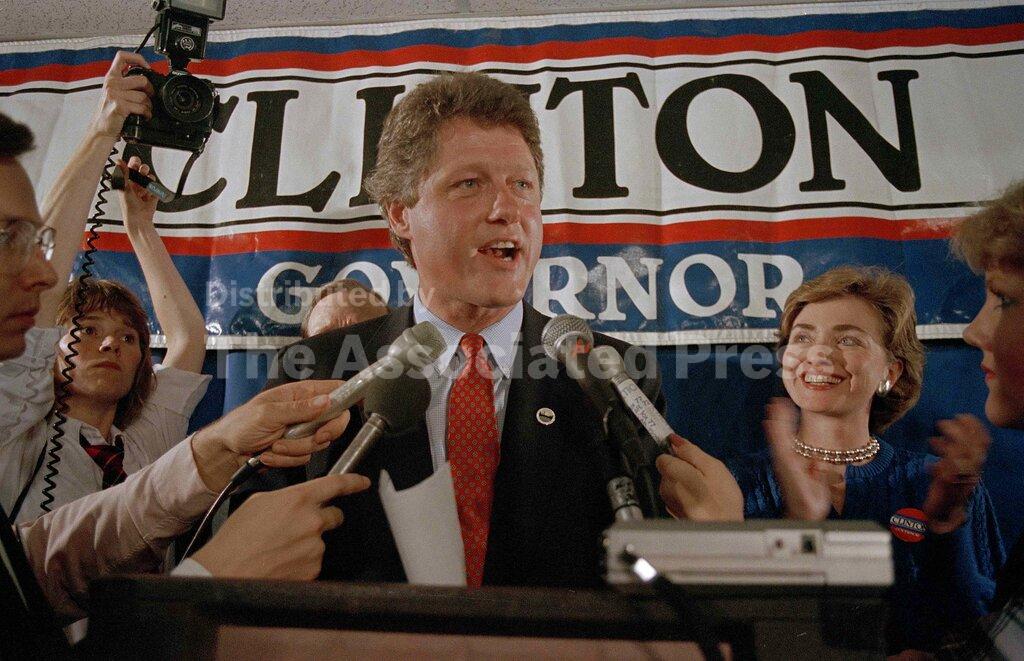
Arkansas Governor Bill Clinton thwarted former Governor Orval E. Faubus’ comeback attempt, defeating the one-time segregationist in a Democratic primary, while another former governor, Frank White, won the Republican nomination and will face Clinton for a third time. In Kentucky, Louisville attorney Jackson M. Andrews won the Republican nomination to oppose Democratic Senator Wendell H. Ford, and in Idaho, Connie Hansen failed in her bid for the GOP nomination for the House seat lost by her husband, George, after his felony conviction.
Maryland, following the lead of eight other states, will hold its primary election the second Tuesday in March in 1988 in an effort to give the South a bigger role in presidential politics. Governor Harry Hughes, who had been contemplating a veto of the Super Tuesday primary bill, signed the legislation into law. Alabama, Georgia, Florida, Kentucky, Mississippi, Missouri, Oklahoma and Tennessee also have adopted the Super Tuesday primary date.
Senate Majority Leader Bob Dole (R-Kansas) scheduled floor debate on the Finance Committee’s tax revision bill to start next week but indicated that major work on the measure would not begin quickly. An aide said Dole met with Finance Committee Chairman Bob Packwood (R-Oregon) and decided to open debate on the measure next Wednesday, shortly after Congress returns from its Memorial Day recess.
A special three-judge Federal court will appoint an independent counsel to investigate conflict-of-interest charges against Michael K. Deaver. The court announced today that it had received an application from the Justice Department requesting the appointment for an investigation of Mr. Deaver, a former White House aide. The law gives the court no alternative but to grant such a request. A Justice Department spokesman said he expected the court to name the independent counsel in the next few days.
The Supreme Court agreed today to hear the Justice Department’s appeal of a ruling that kept Government lawyers from using some grand jury evidence in a subsequent civil suit. The ruling, by a Federal appellate court in Manhattan, limited the lawyers’ access to Federal grand jury evidence obtained in a criminal investigation of alleged price-fixing, bid-rigging and fraud in connection with Government-financed sales of tallow to an unidentified foreign government. After deciding that the New York City case did not warrant criminal prosecution, the department’s antitrust division had sought to use the grand jury evidence in a related civil suit against the companies that were targets of the grand jury investigation, and to share it with lawyers from the civil division. But the United States Court of Appeals for the Second Circuit, reversing a Federal district judge, ruled that the department’s use of the materials violated grand jury secrecy rules and a 1983 Supreme Court ruling. It said the Government had not shown the required “particularized need” for the grand jury evidence.
The Reagan Administration has begun a top-level campaign to win Senate confirmation for a judicial nominee whose legal background and conservative political views have come under attack by Democratic lawmakers. Justice Department officials who asked not to be quoted by name acknowledged that without a substantial lobbying effort, the nominee, Daniel A. Manion, an Indiana lawyer, could be the Administration’s first nominee for the Federal bench to be defeated in the Senate. “There is a top-level determination to make sure this thing goes through,” said Patrick Korten, a department spokesman. “I cannot recall any other instance where a candidate of the President for the circuit bench has been subjected to a negative campaign that is so exclusively attuned to ideology.”
Pentagon research chief Donald Hicks plans to resign because of Defense Secretary Caspar W. Weinberger’s intention to bypass him and appoint a Bechtel Inc. executive to a new post, Pentagon sources said. Weinberger wants the key new position of undersecretary of defense for acquisition to go to Richard Godwin, the president of Bechtel Inc., Weinberger’s former employer, the sources, who asked not to be identified, said.
The chief of the space agency said today that he had told the White House that building a redesigned space vehicle based on advanced technology would take 10 years longer than replacing the lost space shuttle with a similar craft. James C. Fletcher, the head of the National Aeronautics and Space Administration, said such a delay was unacceptable. However, he said, “We would make as many upgrades as would make sense” in a new space shuttle to replace the orbital craft destroyed Jan. 28 with seven astronauts aboard. Mr. Fletcher, a former Administrator of NASA who was reappointed to the office this month, said he believed that Presidential approval for building a replacement for the shuttle Challenger “should be forthcoming soon.”
Two of the world’s largest computer makers, the Burroughs Corporation and the Sperry Corporation, agreed yesterday to merge in an effort to create the most potent competitor to the International Business Machines Corporation. Under the long-expected agreement, which received Justice Department antitrust approval last week, Burroughs will acquire Sperry for $76.50 a share in cash and securities, or $6.50 more than it first offered three weeks ago. The total cost will be $4.8 billion. Burroughs has argued that a merger would create economies needed to compete effectively against I.B.M. But industry analysts say they are skeptical that the strategy will dent the world’s largest computer maker, which controls more than two-thirds of the market for mainframes, the largest commercial computers. The joined companies will leapfrog the Digital Equipment Corporation to become the nation’s second-largest computer company, but even with their combined annual revenues of about $10 billion, Burroughs and Sperry will be only a fifth the size of I.B.M. Still, it is the first major shift in the mainframe computer industry since RCA and General Electric abandoned it more than 15 years ago.
Ronald W. Pelton told the Soviet Union that the United States was eavesdropping on some of its highest-level communications, according to testimony in the opening day of his trial on espionage charges. Intelligence experts say that both sides assume the other tries to monitor secret communications, but the prosecutor said Mr. Pelton gave Soviet officials valuable information that enabled them to determine exactly what communications were being intercepted, how quickly they were obtained and to what extent American intelligence agents were able to interpret them. After getting this information from Mr. Pelton, the prosecutor said, the Soviet Union took countermeasures. The prosecutor, John G. Douglass, said in his opening argument this morning that the information Mr. Pelton sold the Soviet Union about United States electronic surveillance capabilities was “among the most closely guarded secrets” of American intelligence.
A drifter went on trial today for the murder of the Charles Goldmark family, a crime that sent shivers through Seattle’s governing class. Within minutes after opening arguments began in King County Superior Court, a prosecutor asserted that the initial target was a man with even closer ties to the city’s power centers. The prosecutor, William Downing, told the jury that David Lewis Rice, 27 years old, said in a confession that he had sought out Mr. Goldmark, a prominent lawyer who lived in Seattle, only because he was confused by the street grids in the suburb of Bellevue. That is the home of James R. Ellis, 64, a leading figure in public affairs here for 30 years; according to Mr. Downing, he was Mr. Rice’s initial target.
Presidents of union locals from Bethlehem Steel Corporation mills in four states approved a contract today that would cut wages and benefits for 30,000 workers by $1.96 an hour. The contract, approved 20 to 6, now goes to the rank and file for a vote. The ballot is expected after several weeks of union meetings and informational mailings, union officials said. Bargainers for the nation’s third-largest steelmaker and the United Steelworkers of America initialed the tentative three-year agreement on Monday. The agreement includes a stock and profit-sharing plan intended to recoup the concessions. Before any pact is presented to rank-and-file workers it must be approved by the full union bargaining committee, which includes 26 voting members and other officers from union locals from mills in Pennsylvania, Maryland, New York and Indiana.
Two Ghanaian nationals were found guilty in Newark, New Jersey, of conspiring to buy missiles, anti-aircraft guns and other weapons for what U.S. prosecutors said was a 100-member private army in the African nation. A mistrial was declared for a third defendant, former Ghanaian finance minister Joseph Henry Mensah, when the jurors could not reach a verdict after nearly 19 hours of deliberations. Convicted after 16 hours of jury deliberations in the two-week trial were Kwasi John Baidoo of Rockaway Township and John Andrew Boateng of New York.
The District of Columbia City Council unanimously approved legislation today that requires life insurance companies to provide coverage to people exposed to the virus that can cause AIDS. The National Gay Task Force called the bill one of the most comprehensive AIDS insurance laws ever passed in the United States. The bill, which is subject to Congressional review, goes to Mayor Marion S. Barry Jr., who has indicated he will sign it. The insurance industry contends that the bill will mean significantly higher insurance rates for city residents and is trying to mount a $200,000 advertising and lobbying campaign to defeat it. The bill stipulates that life and disability premiums could go up for a person exposed to acquired immune deficiency syndrome, but only after a five-year grace period and with permission from the city superintendent of insurance. The Council voted to impose fines of $50 to $300 a day for insurance companies refusing to provide coverage to AIDS victims.
Chicago Mayor Harold Washington won an important battle over opposition aldermen today when a circuit judge ruled that the City Council properly approved 25 mayoral appointments. The appointments, some bottled up in committee since Mr. Washington’s 1983 election, were approved May 9. The breakthrough came after special elections turned the Mayor’s 21-to-29 disadvantage on the council into a 25-to-25 tie, with Mr. Washington’s tie-breaking vote giving him control. Alderman Edward Burke, one of those who challenged the appointments, vowed a swift appeal. Judge Arthur L. Dunne of the Cook County Circuit Court said in his ruling that it was “unfortunate that the courts have to become involved in council matters.” The lawsuit, filed May 12, contended a two-thirds vote, not a majority, was needed to free the appointments from committees still headed by opposition bloc aldermen.
125 Florida pigs face tests by Government inspectors. The Agriculture Department sent a team to collect blood samples from the pigs on one farm and quarantined the animals after scientists found evidence that one pig might have been exposed to African swine fever, a deadly disease. Federal veterinarians cautioned that an outbreak of the disease, which has been found on three continents but never in North America, had not been confirmed.
A one-story Pennsylvania stone house designed by the architect Frank Lloyd Wright was severely damaged by fire just before dawn Monday, the authorities said. Fire Chief James Bungard said he did not know what caused the fire, but added that arson was not suspected at this time. The house was built in 1956 for I. N. and Bernadine Hagan, who owned a dairy and ice cream manufacturing company until 1969. The house, which has been vacant for some time, was recently purchased by the Penobscot Corporation of Philadelphia for about $600,000. It is two miles from Ohiopyle in Stewart Township and is near one of Wright’s most famous houses, Falling Water, designed in 1936 for the Kaufmann family of Pittsburgh. Chief Bungard said the fire damaged the Hagan house’s art room and a bedroom. He said there also was extensive water and smoke damage, but he offered no estimate of the loss.
A 6-year-old New York girl who was chosen as the first link in the Hands Across America chain because her family had been homeless signed an acting contract through benefit organizers three weeks before the event, it was disclosed yesterday. Ken Kragen, the promoter of the event Sunday to raise money to fight hunger and homelessness, said he had not mentioned Amy Sherwood’s contract earlier because “it didn’t have any relevance.” “Wouldn’t it have sounded funny?” Mr. Kragen said. “It would have sounded like she was a professional kid. You know, this story could so easily be turned around and misconstrued. I’m conscience-free on it.”
High water in the Great Lakes is forcing many shore residents to move their houses inland. The lakes, the world’s largest body of fresh water, are “dangerously high,” according to the Army Corps of Engineers, which has measured levels up to 2.5 feet above normal. By some estimates, repairing all the damage will cost more than $1 billion. When a 25-foot chunk of Frank Lundell’s yard tumbled into Lake Michigan not long ago, he did what 12 of his neighbors had already done. He hired someone to move his house safely away from the shore. “You always know that every wave is lapping away at your land,” said Mr. Lundell, who is an elementary school principal, “but when the lake levels get so high, you worry that it will take the house as well as the land.” While parched communities in the South are worrying about too little water, the headaches around the Great Lakes are about too much water.
Major League Baseball:
The Cincinnati Reds beat the Chicago Cubs, 5–4. Dave Parker had four singles, including one off the right-field wall to drive in the go-ahead run, to lead Cincinnati. The victory was the fifth in the last six games for the Reds, who took advantage of three Chicago errors to score two unearned runs. Tom Browning got the win for Cincinnati to improve his record to 2–4.
At Cleveland, the Red Sox are leading the Indians, 2–0, in the 6th inning when the game is delayed then called on account of fog. Mike Brown is the winning pitcher but Oil Can Boyd comes up with the winning quote about the called game: “That’s what you get when you build a ball park on the ocean?” Brown (3–1) allowed six hits while striking out one and walking two over five innings. Crawford retired two batters in the sixth before the game was stopped for his first save and Boston’s third straight victory, which put the Red Sox two games ahead of the Yankees. Neal Heaton (2–4) allowed just four hits but took Cleveland’s fourth consecutive loss. The fog started filling Cleveland Stadium in the third inning and became noticeably denser in the bottom of the fifth. After Brown walked Tony Bernazard to lead off the Cleveland sixth, the umpire crew chief, Larry Barnett, halted play for 15 minutes beginning at 9:18, and the Indians batting coach Bobby Bonds then hit a pair of test flyballs to right field. Play was resumed at 9:33 after the fog lifted, and Brown left after Julio Franco singled Bernazard to second. Crawford struck out Joe Carter before Mel Hall’s drive to center was hauled in by Tony Armas. As Pat Tabler was batting, visibility declined quickly and play was halted again at 9:44. The game was called at 11:18.
The Brewers spanked the Royals, 9–1. Rob Deer hit two home runs and Ted Higuera scattered seven hits for Milwaukee. Seven of the Brewers’ runs were unearned as the result of two errors by the shortstop Argenis Salazar, who earlier this season set a Kansas City record for consecutive errorless games by a shortstop. Winning pitcher Teddy Higuera, 6–4, scattered seven hits, struck out four and walked one. Loser Danny Jackson, 2–1, went five innings but still lowered his earned-run average from 4.10 to 3.45.
The Twins edged the Blue Jays, 7–6, in extra innings. Minnesota’s Tim Laudner’s sacrifice fly to left field scored Kent Hrbek for the winning run in the 11th inning. With one out, Hrbek walked off Tom Henke (3–3) and moved to third on a double by Tom Brunansky. After an intentional walk to Gary Gaetti, Jim Acker replaced Henke. With the infield and outfield playing shallow, Laudner lifted a shallow fly to left, and George Bell’s throw to the plate was too late. The Twins had not won two games in a row from the Toronto Blue Jays since September 1983. But their 7–6 victory in 11 innings Tuesday night, on the heels of Monday’s 9–1 triumph, ended the drought.
The Expos edged the Padres, 5–4. Hubie Brooks’s groundout drove in Mitch Webster from third base with the tiebreaking run in the seventh inning. Webster, who had three hits, led off the seventh by reaching base on an error by Tim Stoddard (1–2). Webster stole second, took third on a fly ball by Andre Dawson and scored on Brooks’s hard grounder to third. Steve Garvey’s three-run homer helped San Diego take a 4–0 lead in the first inning.
George Foster hits a grand slam and Ron Darling (6–0) strikes out 12 in 9 innings as the Mets whip the Dodgers, 8–1. New York is 4.5 games ahead of Montreal, with everyone else way back. It took just one quick turn on a fastball thrown across the letters. With it George Foster accomplished the following: He gave Ron Darling and the Mets a big lead, he completely tore at the composure of the Dodgers and he turned a cool, quiet evening at Shea Stadium into a rollicking, explosive affair. The old slugger can still have his say. Foster’s grand slam home run was the high point of a six-run sixth inning. It was a game which featured the finesse work of Darling, who struck out 12, gave up five hits and won for the sixth time this season without a defeat. Eight times, Dodger hitters looked at a called third strike. But the night became memorable for the more active moments — Foster’s screaming drive and the chaos that ensued. Tom Niedenfuer, the reliever who threw the home run pitch to Foster, followed up immediately by plunking Ray Knight on the left forearm. Knight charged Niedenfuer. Players wrestled. The Dodger manager, Tom Lasorda, became red-faced, screaming. “I guess it was a good idea that I played,” said Foster, relishing that he had not been scheduled to play.
The Phillies beat the Giants, 6–2. Mike Schmidt’s two-run homer broke an eighth-inning tie and helped bring Steve Carlton the victory. With the score 2–2, Juan Samuel led off the eighth with a single. Schmidt then connected on the first pitch from the reliever Jeff Robinson (2–1) for his eighth home run of the season. Greg Gross added a two-run double off Greg Minton later in the inning. Carlton, 3–6, pitched eight innings and gave up two runs on seven hits. He struck out eight and walked none. The Giants had tied the game, 2–2, in the top of the eighth when Bob Brenly singled, took second on a sacrifice and moved to third on pinch-hitter Joel Youngblood’s infield hit. Brenly scored on pinch-hitter Chili Davis’ groundout.
Terry Harper, who entered the game in the 11th inning on defense, belts a grand slam with two out in the top of the 12th to provide Atlanta with a 6–2 win over the Pirates. A season-low crowd in Pittsburgh of 2,830 watched the Pirates drop their sixth straight. Atlanta loaded the bases when Rafael Ramirez walked, Dale Murphy singled and Bob Horner was walked intentionally. Harper, who grounded out to end a bases-loaded threat in the 10th, hit a 1–1 pitch into the left-field seats for his fourth homer of the season. Bob Walk, 2–2, who entered the game in the 12th after 11 innings from starter Rick Reuschel, took the loss. Gene Garber, 1–1, the fifth Braves pitcher, was the winner.
The Astros squeaked past the Cardinals, 5–4. Kevin Bass scored from second base on the shortstop Ozzie Smith’s throwing error in the ninth, giving Houston the victory. Bass opened the ninth with a single off Ken Dayley (0–3) and took second on a groundout. Mark Bailey was intentionally walked by Todd Worrell, and Dickie Thon followed with a potential double-play grounder back to the mound. Worrell threw to Smith for a forceout, but Smith’s throw to first base was wide for an error.
Oddibe McDowell singled, doubled, hit a home run and scored three times to back up Charlie Hough’s four-hitter, as the Texas Rangers defeated the Chicago White Sox, 6–3. Two of the hits off Hough, 3–2, were home runs by Tim Hulett with a man on base in the fifth inning and Greg Walker’s solo shot in the ninth. Hulett’s homer gave Chicago a 2–1 lead but McDowell, who had homered off Chicago starter Richard Dotson, 2–5, in the third inning, ignited a two-run rally in the Rangers’ fifth with a leadoff double. Scott Fletcher was hit by a pitch and both runners advanced on Pete O’Brien’s fly ball. McDowell scored as Pete Incaviglia grounded out and Gary Ward gave the Rangers a 3–2 lead with an RBI double. Singles by McDowell and Fletcher, a throwing error by Chicago reliever Joel McKeon and a balk by Bob James gave the Rangers two more runs in the seventh. Darrell Porter hit a solo homer, his fifth, to finish the Texas scoring in the eighth.
Cincinnati Reds 5, Chicago Cubs 4
Boston Red Sox 2, Cleveland Indians 0
Milwaukee Brewers 9, Kansas City Royals 1
Toronto Blue Jays 6, Minnesota Twins 7
San Diego Padres 4, Montreal Expos 5
Los Angeles Dodgers 1, New York Mets 8
San Francisco Giants 2, Philadelphia Phillies 6
Atlanta Braves 6, Pittsburgh Pirates 2
Houston Astros 5, St. Louis Cardinals 4
Chicago White Sox 3, Texas Rangers 6
The stock market continued its recent surge yesterday as blue-chip issues lifted the Dow Jones industrial average by more than 29 points, to within 3 points of its highest close. In the last three trading days, the Dow has risen nearly 78 points. With yesterday’s 29.74-point climb, it closed at 1,853.03, ending slightly below its record close of 1,855.90 last April 21. Analysts said that the market continued to follow bond prices, reflecting investor optimism over the direction of interest rates in the near term.
Dow Jones Industrial Average: 1853.03 (+29.74)

