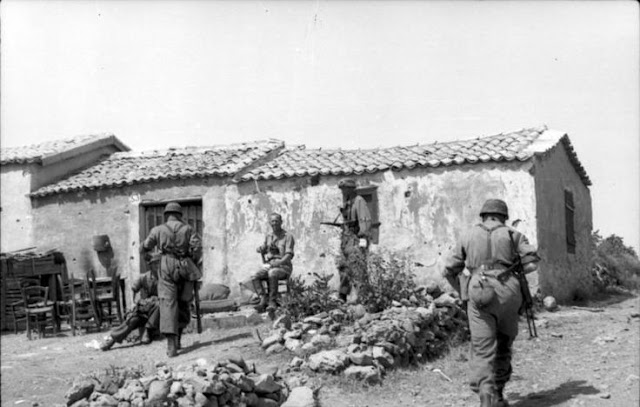
With the British decision to evacuate Crete having been made at the highest levels on the 27th, Commonwealth troops fight rearguard actions as they head south for pickup at Sfakia (Sphakia, south of Canea/Chandia) and other points. Two companies of the Māori Battalion under Captain Rangi Royal in the New Zealand 5th Brigade make a temporary stand at Stylos, beating up the 1st Battalion of the 141st Gebirgsjäger (Mountain) Regiment and 85th Gebirgsjäger Regiment in order to allow the main force to gain ground. Sgt Alfred Clive Hulme (1911-82) of the 2nd New Zealand Expeditionary Force wins the Victoria Cross for actions here and elsewhere on Crete throughout the past week. Many other anonymous soldiers also fight valiantly.
However, not all of the Commonwealth troops get away clean. The 800 men of Layforce (so named for commander Colonel Robert Laycock), which landed at Suda Bay on the 26th and 27th, are caught there along with some other units (20th Heavy Anti-Aircraft Battery). At the end of the day, Laycock’s men stage a night retreat to Beritiana, but it is too late — most are killed or captured. In all, only 179 of the 800 Commandos of Layforce make it to Egypt. Laycock himself, along with brigade major Evelyn Waugh (the famous author), escape in one of the unit’s three tanks.
The Luftwaffe is active over the ports and airfields on the north coast such as Heraklion, Suda, and Rethymno which the Germans need to bring in more reinforcements. This gives the retreating British time to get to the southern embarkation points — but they have to hurry. The German planes sink 667 ton Greek freighter Georgos at Heraklion (Candia) Harbour and 298 ton Greek freighter Aghia Kyriaki at Cape Kephola.
The Italian relief convoy which set out on the afternoon of 27 May from Rhodes arrives at Sitia at 17:20. They are surprised to encounter no Royal Navy ships at all, which they don’t realize are all to the south of the island supporting the evacuation. The Italians bring 13 L3/35 tanks and 3000 men of the 50th Infantry Division. This is the first Axis armor on Crete. The Italians ignore the retreating British and hook up with the German troops at Ierapetra.
The Royal Navy sends Force B, led by light cruisers Ajax, Dido, and Orion, from Alexandria to take men off from Heraklion. They arrive at 23:30 and evacuates 3,486 men from Heraklion after dodging Luftwaffe bombs, with Ajax hit and forced to return to base. On the way home, the Luftwaffe bombs and sinks destroyer Hereward, with 71 men killed or missing and 85 taken prisoner.
Royal Navy Force C heads for Sfakia. Consisting of destroyers Kandahar, Kelvin, Napier and Nizam, it takes off 608 men without loss.
Evacuations from Sfakia generally wait for the 29th. There are 32,000 Commonwealth troops on Crete, which is a manageable number to evacuate, but they are spread out throughout the island and some either can’t make it to the south coast or have to fight their way through to get there. Men try to get off every which way they can — motor launch HMML 1030 (Lt W. M. O. Cooksey RNVR) sinks while trying to escape from Suda Bay.
Greek civilians participate in the attacks on the advancing Wehrmacht. There are snipers, groups of civilians actively participating in the defense of key points, and supply services given to the defending Commonwealth troops. The defense is fiercest around Heraklion. The Germans view such civilian participation as illegal and treacherous, beginning a cycle of hatred between the local inhabitants and the occupying forces.
While the disastrous situation on Crete is being wound up, the British turn to other sectors. Winston Churchill sends Middle East Commander General Archibald Wavell with “observations” about the Middle East which Wavell is much more able to judge himself. Churchill opines that “Everything must now be centered upon destroying the German forces in the Western Desert” considering that “you and Freyberg pronounced situation [on Crete] hopeless.” He urges Wavell to fight until he has “beaten the life out of General Rommel’s army.” He hopes that in this way “the loss of Crete will be more than repaired.”
As usual, Churchill cannot resist some covert digs at Wavell. He notes that “We were all very much puzzled” at some of Wavell’s appointments of commanders. It is akin to a baseball team owner questioning a manager’s lineup. Churchill notes that, while one such appointment to command troops in the western desert, Noel Beresford-Peirse, “is a good Divisional Commander, it is difficult to believe that he can compare with Wilson [sent to Palestine] in military stature, reputation or experience.” One can only imagine Wavell’s reaction to such second-guessing from afar.
British General Archibald Wavell ordered Operation BATTLEAXE against Axis positions in Libya; it was to be launched on 7 June.
Wavell to CIGS: “All available armoured strength, which will be deciding factor, is being put into “Battleaxe.” Various difficulties are delaying reconstitution 7th Armoured Division. Earliest date for beginning of forward move from Matruh will be June 7, and may be later. 2. I think it right to inform you that the measure of success which will attend this operation is in my opinion doubtful. I hope that it will succeed in driving enemy west of Tobruk and re-establishing land communications with Tobruk. If possible we will exploit success further. But recent operations have disclosed some disquieting features. Our armoured cars are too lightly armoured to resist the fire of enemy fighter aircraft and, having no gun, are powerless against the German eight-wheeled armoured cars, which have guns and are faster. This makes reconnaissance difficult.”
In Malta, soldiers begin wearing their summer uniforms. The government decides to clamp down on a long-standing issue of soldiers selling their uniform equipment such as boots and shirts to civilians by stamping clothing with the soldiers’ serial numbers.
Things begin heating up in Syria on 28 May 1941, which is on the list of British targets because it is considered the gateway to the ongoing battle in Iraq. The RAF raids Aleppo, a key transit hub for the Axis support of operations in Iraq. During this raid, an RAF Blenheim reconnaissance is shot down by Vichy French pilot Lt. Vuillemin of 7 Squadron, 1st Fighter Group (GCI/7) in a Morane 406. This is the first aerial victory of a Vichy French pilot over the RAF.
The Vichy French also send 28 new Dewoitine D.520s of the 6th Squadron, 3rd Fighter Group (GCIII/6) from Algeria via Athens, which unit arrives on 28 May 1941 at Rayak (two planes failing to make it).
The British continue their concentric attack on Baghdad. The main thrusts are from the south (Indian troops from Basra) and west (Habforce advancing from Fallujah). Today, the 20th Indian Brigade captures Ur after a march of 110 miles.
In Baghdad, rioting and looking take hold as the British approach. Dr. Fritz Grobba, head of the German diplomatic mission, cables Berlin with the warning that the British are approaching with “one hundred tanks.” While this is a vast exaggeration, it conveys the key message that the city is about to fall. The Luftwaffe mission, Special Force Junck (Sonderkommando Junck) led by Luftwaffe Oberst Werner Junck, has only two Heinkel He 111s left and only four bombs for them. A force of eleven Italian Fiat CR-42 fighters has arrived but is having little effect.
Prime Minister Winston Churchill instructs General Ismay to begin setting up “Air Squadrons and also at least a Brigade Group” composed of Yugoslav expatriates. A similar agreement is reached with Norwegian refugees.
Churchill also sends a telegram to William Averell Harriman (“My dear Harriman”), one of President Franklin’s “special envoys,” thanking him for a recent note promising delivery of six Douglas DC-2 transport planes and fourteen Lockheed transports.
British Lord Woolton announced experimental egg rationing and further restrictions on fish and milk.
In the United Kingdom, successful prosecutions under Food Control Orders now totaled 17,319.
German bombers attacked HMS Tartar and HMS Mashona 100 miles west of Ireland in the morning, killing 36 men as a bomb hit Mashona. HMS Tartar rescued 184 survivors and destroyers HMS Sherwood and HMCS St. Clair scuttled Mashona with gunfire. The Luftwaffe is active over the Atlantic searching for Royal Navy ships returning from the interception battleship Bismarck. Many of the Royal Navy ships are low on fuel and traveling slowly and without zig-zagging or other precautions. The German planes attack Canadian destroyer HMCS St Clair (formerly USS Williams (DD-108)) and HMS Mashona about 100 miles west of Galway Bay, Ireland. The handful of German planes (Junkers Ju 88 aircraft of I Staffeln, Kampfgeschwader 77) sink the Mashona.
Nazi Germany and Vichy France signed the Paris Protocols, granting the Germans military facilities in French colonies in exchange for the French receiving a reduction in the occupation costs they were obligated to pay Germany as well as the release of French prisoners of war. The agreement would never be ratified.
Maximilian Kolbe, a Franciscan friar and a future saint of the Catholic church, arrives at the German Auschwitz camp from Warsaw.
German agents in Iraq, Syria and Palestine are smuggling arms to renegade Arab tribesmen in the desert and mountains of Palestine, inflaming the Muslims for war against the British and the virtually defenseless 500,000 Jews in the Holy Land, according to news received here from a Jewish agency in Jerusalem.
South African Prime Minister Jan Smuts was appointed as a Field Marshal in the British Army. He was the first South African to hold the rank.
RAF Bomber Command, Day of 28 May 1941
7 Blenheims to the mouth of the River Elbe. 1 ship was attacked but not hit. 1 aircraft lost.
RAF Bomber Command, Night of 28/29 May 1941
Kiel
14 Whitleys to bomb Tirpitz encountered thick cloud and storms. Only 3 aircraft claimed to have bombed Kiel, which reports, ‘Considerable rain but luckily no bombs.’ 1 Whitley lost.
The RAF attacks Italian shipping off Tripoli, damaging Italian freighters Sebastiano Venier and Marco Foscarini. The master of the Foscarini beaches it near Tripoli.
U-107, commanded by Kapitänleutnant Günter Hessler, sank Greek steamer Papalemos (3748grt) in 8-06N, 16-18W. At 1452 hours on 28 May 1941 the unescorted Papalemos was hit on the port side in the stern by one torpedo from U-107 The explosion destroyed large parts of the superstructure and a lifeboat. After the crew had abandoned ship in two lifeboats the sinking was accelerated with shots from the AA guns into the waterline at 1600 hours. The U-boat went to the lifeboats for questioning, took care of three wounded survivors and provided them cigarettes, chocolate and provisions before leaving the area on a deception course. The 3,748-ton Papalemos was carrying grain and was bound for the United Kingdom.
Destroyer HMS Brighton departed Scapa Flow at 1200 on completion of repairs for Loch Alsh.
Light cruiser HMS Edinburgh intercepted German steamer Lech (3290grt), which had left Rio de Janiero on 28 April, in 45-33N, 23-25W, four hundred miles north of the Azores. The steamer scuttled herself.
During the night of 28/29 May, the evacuation of Crete began.
Heraklion, Force B: light cruisers HMS Dido, HMS Ajax, HMS Orion with destroyers HMS Hotspur, HMS Kimberley, HMS Hereward, HMS Jackal, HMS Decoy, and HMS Imperial departed Alexandria on the 28th. En route on the 28th, both Ajax and Imperial were near missed by air bombs. Damage to Ajax also included an aerial torpedo hit which caused Ajax to return to base. Destroyer Imperial was able to continue. Cruiser Ajax sustained five ratings killed and Commissioned Gunner C. N. Lewis and eighteen ratings, one dying of wounds, were wounded. Destroyer Imperial had one man wounded. The force arrived at Heraklion at 2330 and set off at 0300/29th. After lifting troops, the steering gear on Imperial (Lt Cdr C. A. De W. Kitcat) failed. The destroyer was abandoned and scuttled by destroyer Hotspur in 35-23N, 25-38E.
Bombing attacks while the force was returning badly damaged destroyer HMS Hereward (Lt W. J. Munn) which was later sunk after being left. Gunner (T) W. O. Brown was killed and Lt N. A. E. P. Acheson, Lt J. R. Paterson, and A/Lt I. B. Souter RNVR, were missing. Midshipman P. P. C. Bateman, Lt (E) D. N. Callaghan, Lt J. E. Mammatt, Lt W. J. Munn, Lt T. F. P. U. Page, and T/Surgeon Lt P. C. Steptoe RNVR, were taken prisoner. Bateman died as a prisoner of war on 14 September 1943. Four ratings were killed and sixty seven ratings were missing. Eighty five ratings were taken prisoner; one dying while in captivity.
Light cruiser HMS Orion (Captain G. R. B. Back) was hit by German bombs on A turret at 0900 and on the bridge at 1045. The cruiser was also near missed at 0930, causing damage. Back, Midshipman J. C. R. Pounsford, Lt Cdr C. M. Sarsfield-Hall Rtd, Midshipman D. St. C. Reid, Lt Cdr (E) J. H. Pears, Lt (E) A. L. C. J. Spearman, Lt (E) D. O. B. Taylor, Paymaster Midshipman C. J. Duncan, sub Lt J. A. Osborn RNVR, and ninety seven ratings were killed. Eighty four crew, including T/Sub Lt (E) D. Bradshaw, were wounded. Of the 1100 troops on the cruiser, one hundred and fifty five were killed and two hundred and sixteen were wounded. Cruiser Orion arrived at Alexandria at 2000/28th. The cruiser was later taken to Simonstown for temporary repair. She departed Aden en route on 29 June. Light cruiser Orion was under repair at Simonstown from 14 July to 5 August. The cruiser then proceeded to Mare Island, California, where she was under repair from 5 September to 15 February 1942.
Light cruiser HMS Dido was hit on B turret by a German bomb. Twenty seven ratings were killed and ten crewmen were wounded and nineteen soldiers were killed and twenty eight soldiers were wounded. Light cruiser Dido arrived at Alexandria at 2000/28th. Light cruiser Dido departed Alexandria on the 31st. On 1 June, cruiser Dido arrived at Port Said. On 2 July, the cruiser arrived at Durban. She proceeded on to New York and was repaired in the Brooklyn Navy Yard completing on 31 October.
Destroyer HMS Decoy was damaged by a near miss. She sustained one crewman killed eight were wounded.
Force B reached Alexandria at 2200/29th. Three thousand, four hundred and eight six troops were evacuated from Heraklion.
Sfakia, Force C: destroyers HMAS Napier, HMAS Nizam, HMS Kelvin, and HMS Kandahar departed Alexandria at the same time as Force D The group lifted 1000 men without loss. Force C arrived back at Alexandria with six hundred and eight troops at 2100/29th. Cdr G. H. Beale and Warrant Observer E. S. Wicks, from HMS Grebe operating from Maleme, were made prisoners of war on the 29th.
Submarine HMS Perseus unsuccessfully attacked a steamer in the Gulf of Nauplia.
Greek steamer Georgos (667grt) was sunk by German bombing at Candia.
Greek steamer Aghia Kyriaki (298grt) was sunk by German bombing near Cape Kephola, Crete.
Motor launch ML.1030 (Lt W. M. O. Cooksey RNVR) was lost on passage from Suda Bay.
Submarine HMS Olympus arrived at Gibraltar from Malta.
Submarine HMS Clyde departed Gibraltar for patrol in the Tyrrhenian Sea.
Destroyers HMS Faulknor, HMS Forester, HMS Fury, and HMS Wishart departed Gibraltar to escort Force H into port. Battlecruiser HMS Renown, aircraft carrier HMS Ark Royal, light cruiser HMS Sheffield, and destroyers HMS Faulknor, HMS Forester, HMS Fury, and HMS Wishart arrived at Gibraltar on the 29th.
Submarine HMS Severn sighted a submarine on the surface in 36-58N, 10-48W.
Convoy OB.327 departed Liverpool, escorted by destroyers HMS Ramsey and HMS Ripley. Destroyer Ripley was detached the next day. On the 29th, destroyer HMS Walker and minesweepers HMS Hebe, HMS Seagull, and HMS Sharpshooter joined. The escort was detached when the convoy dispersed on 1 June.
Today in Washington, President Roosevelt held a special press conference to clarify certain points in his speech last night. Earlier in the day he saw Gano Dunn, senior consultant of OPM’s production division, who reported that demands for steel this year would greatly exceed production; Edward J. Flynn, Democratic National Chairman; Viscount Halifax, British. Ambassador, and John Maynard Keynes, British economist.
The Senate was in recess. Its defense investigating committee continued questioning of union leaders in the West Coast shipyard strike. The Education and Labor subcommittee heard C.I.O. opposition to the Ball Mediation Bill.
The House passed the bill broadening the powers of the Reconstruction Finance Corporation, heard discussion of the President’s fireside chat and adjourned at 5:26 PM until noon tomorrow. The Appropriations subcommittee approved the regular 1942 War Department Appropriation Bill of $9,452,000,000. The Ways and Means Committee concluded a hearing on a new tax bill.
Contending that the Neutrality Act in no way infringes upon the nation’s newly reasserted policy of insisting upon the freedom of the seas, President Roosevelt disclosed today that he sees no reason for repealing or changing that law. In addition he made it clear that despite the renewed determination to see Great Britain through to victory expressed in his speech last night, the administration will continue to keep American flagged ships out of British and other belligerent ports. Roosevelt warned of Hitler attempting world domination and directly threatening the United States: “… the Azores and the Cape Verde Islands, if occupied or controlled by Germany, would directly endanger the freedom of the Atlantic and our own physical safety. Under German domination they would become bases for submarines, warships and airplanes raiding the waters which lie immediately off our own coasts and attacking the shipping in the South Atlantic. They would provide a springboard for actual attack against the integrity and independence of Brazil and her neighboring republics.”
The president said no additional action was contemplated at this time to implement his call for a cessation of strikes and his request that capital and labor abide by the decisions of impartial boards. But he went on to say that if strikes continue, some action will have to be taken. This was not said, he added, as a threat.
The American Federation of Labor directed all its affiliates last night to refrain from striking against defense industries until all possibilities of mediation had been exhausted. It called upon the international unions to discipline any locals that strike before government agencies have an opportunity to adjust the disputes peacefully and promised similar action itself against federal unions which do so. In a statement issued In Washington, the federation’s executive council called attention to President Roosevelt’s fireside appeal of Tuesday that labor unions utilize the government’s conciliation and mediation machinery to avoid stoppage of defense production.
Senator Burton K. Wheeler, Montana Democrat, charged tonight that President Roosevelt in his address to the nation had adopted the creed of the “warmakers” who would “sacrifice lives that are not theirs to give.” Wheeler struck at the president’s new declaration of policy and unlimited emergency proclamation. He addressed a rally sponsored by the America First committee and broadcast nationally by C.B.S. An audience of 7,000 roared approval. He said Mr. Roosevelt had surrendered to the influence of “our Rockefellers, Morgans, Dorothy Thompsons, Stimsons, Knoxes, Walter Winchells… These international bankers, jingoistic journalists, fierce and warlike statesmen would plunge this nation into war either because of their hate or fear of the little paper-hanger from Berlin,” Wheeler asserted. The president’s fireside chat to the nation, he said, was a deliberate attempt “to implant fear in the minds of the American people.” “Mr. President,” he addressed himself to Mr. Roosevelt, “preaching fear has been the weapon you have used so successfully against your political adversaries.”
Expressing approval of President Roosevelt’s Tuesday night speech and his declaration of an unlimited national emergency, Wendell L. Willkie called last night for an end to selfish politics and urged industry, labor and agriculture to forget separate objectives for a united purpose.
Former Governor Alfred E. Smith, John W. Davis and former Governor James M. Cox of Ohio, all former Democratic Presidential candidates, appealed jointly last night in a radio broadcast for national unity in support of the foreign policy enunciated by President Roosevelt in his Tuesday evening fireside chat.
The O.P.M. priorities division said today that defense orders will need from 95 to 100 percent of all the available aluminum, including scrap, during June. Accordingly, the O.P.M. said, a salvage campaign will be started soon to gather worn-out pans, pots, kettles and other aluminum scrap on a nation-wide scale.
Combined military, civilian and export demands for steel will exceed capacity by 1,400,000 tons in 1941 and 6,400,000 tons in 1942, it was reported to President Roosevelt today. At a press conference later, the President indicated that priorities would be invoked to curtail civilian demands.
The Ways and Means Committee completed twenty-three days of hearings on the proposed $3,500,000,000 defense tax bill and took a short recess until next week before beginning the task of determining what form the measure would take and the levies and rates to provide the revenue.
Hamilton Fish, a New York congressman who chairs the Naval Affairs Committee (and who is not a favorite of President Roosevelt), reviews some data about U.S. cooperation with the British. He reveals that the Royal Navy has filed 132 requests with the U.S. government for permission to have damaged warships repaired at U.S. naval yards. This, of course, violates the rules of war for neutrals, but the U.S. is neutral in name only at this point.
Today, the light cruiser HMS Liverpool adds to the list of Royal Navy ships repaired in the U.S. as it departs from Manila bound for repairs in San Francisco due to damage sustained in October 1940.
Animation workers vote to go on strike at the Walt Disney studios after Walt Disney fires Union leader Art Babbitt. They are members of the AFL Screen Cartoonists Guild.
Major League Baseball:
After blowing a 6–1 lead, the Philadelphia Athletics rally in the 16th inning to beat the Boston Red Sox, 8–6. The crowd at Fenway is 1,400, the smallest of the season. Philadelphia launched the winning rally with two out. Dick Siebert started by banging a single off Jimmy Foxx’s glove and came all the way around when Sam Chapman clouted Jack Wilson for his fourth consecutive hit, a double to center. After Frankie Hayes had been purposely passed, Chapman made the extra run on Pete Suder’s single to right. Suder sent the Athletics into their 6-1 lead in the sixth by hitting a homer with two on. Bob Johnson drove for the circuit with Benny McCoy aboard in the third. The Sox then set off a four-run blast in the sixth, featured by Jim Tabor’s three-run homer, which he poled out after Ted Williams had doubled and scored on Foxx’s single. A pass to Dom DiMaggio and Lou Finney’s double enabled the Red Sox to deadlock with two out in the ninth.
The St. Louis Browns, after spotting the Chicago White Sox a 4–1 lead going into the sixth inning, knocked Edgar Smith out of the box today and went on to an 8–4 victory, their second in a row over Chicago. St. Louis made twelve hits off Smith and Pete Appleton, while Chicago got thirteen off Denny Galehouse, Elden Auker and Bob Harris. Smith was chased in the ninth after giving ten hits. Galehouse lasted until the fifth, yielding eight hits and all of the Sox runs. Harlond Clift led the St. Louis attack with two homers and a double. Bill Knickerbocker of the Sox had a perfect day with a single, double and two triples.
At Crosley Field, Max Butcher allows 12 hits but chops up the Reds to give Pittsburgh a 7–4 win. Vince DiMaggio clouts a 3-run homer in the 3rd and wins himself a suit of clothes by hitting a beer sign atop a laundry outside left field. Butcher scattered a dozen hits through seven of nine innings but only in the eighth and ninth did the Reds “do business,” gaining two tallies in each. His mates meanwhile found the range on Whitey Moore almost from the start, scoring twice on walks to Jeep Handley and Eddie Stewart and singles by Maurice Van Robays and Elbie Fletcher. Moore, gunning for his second victory, survived the second but went to the showers and his initial setback two-thirds of the way through the third.
The Detroit Tigers today overcame defensive flaws with an eleven-hit slugging attack to defeat the league-leading Cleveland Indians for the third successive time. The score was 8–5. Kicking in with four errors, the Tigers blasted Mel Harder from the mound and finally clinched the game off a relief hurler, Harry Eisonstat, after the Indians had rallied to tie the score. Ray Mack’s three-run homer in the seventh chased Paul Trout, Detroit starter, and fireman Al Benton received credit for his third victory. Bruce Campbell, belting his fifth homer in six games, led Detroit’s assault against three Tribe hurlers.
The Phillies became stubborn before a crowd of 10,666, including several hundred fervid Flatbush fans, and kept the Shibe Park arc lights blazing until 12:24 this morning before subsiding for the ninth time this year before Leo Durocher’s Dodgers. They tied the contest at 5–5 in the ninth and it wasn’t until the twelfth that young Pete Reiser, the National League’s leading hitter, belted a long double to left-center that scored Billy Herman, who had walked, with the winning run. The score was 6–5 and the time of the game 3 hours 24 minutes. Roy Bruner, fourth of Doc Prothro’s pitchers, was the loser, while Bill Swift, who took over at the start of the tenth, was credited with his third relief triumph of the campaign.
The strong-finishing Cardinals snatched another victory right out of their opponents’ hands today, defeating the Chicago Cubs, 6–5, with a three-run rally in the ninth inning. Although outhit, eleven to nine, and three runs down as they moved into the stretch, the league leaders put together a double, a triple and two singles to sweep the series and mark up their ninth consecutive victory. Duplicating the feat of Johnny Mize, who, despite an injured finger, pinch-batted the Cards to a ninth-inning victory over the Cubs last night, Don Padgett swung for Catcher Gus Mancuso at the crucial moment today and lined a sharp single to right field to score Steve Mesner from third with the winning run. Mesner had singled to drive in Coaker Triplett with the tying score. Clyde Shoun, who worked only one inning, was credited with his first victory of the year.
The New York Yankees edge the Washington Senators, 6–5, before 25,000 in the first night game at Griffith Stadium. Walter Johnson tosses out the first pitch, throwing a fast ball through a beam of light to trigger the stadium lights. The daytime temperature is a record 97 degrees and it is still muggy at game time. The Yanks, down 3–1 to start the 8th, rally as DiMaggio triples in his last at bat against Sid Hudson. The next three batters reach base and George Selkirk follows with a pinch-hit grand slam off Hudson. New York wins, 5–4, sending Washington to its 10th straight loss. Selkirk was called out of the seclusion of the dugout with the Yankees needing a run to tie, the bases filled and one out in the eighth inning. Hudson had turned back the ex-champions with five hits through seven innings as the Senators cudgeled Steve Peek for eight hits and three runs. Tommy Henrich’s home-run blast opening the sixth was the only dent in Hudson’s delivery, until Joe DiMaggio, hitless until then, crashed the triple off the right-field wall with one down in the eighth.
The scheduled game between the Boston Braves and the Giants at New York was postponed due to rain. The game will be made up as part of a doubleheader on September 20.
Philadelphia Athletics 8, Boston Red Sox 6
St. Louis Browns 8, Chicago White Sox 4
Pittsburgh Pirates 7, Cincinnati Reds 4
Cleveland Indians 5, Detroit Tigers 8
Brooklyn Dodgers 6, Philadelphia Phillies 5
Chicago Cubs 5, St. Louis Cardinals 6
New York Yankees 6, Washington Senators 5
President Roosevelt’s speech last night, especially his declaration of “an unlimited national emergency,” is viewed in Japan as bringing the United States “one step nearer war” and making that country’s “final participation a certainty.” Although from the Japanese standpoint this might tend to create a difficult situation, there is relief here over “the unexpected moderation” of the speech, especially its avoidance of any reference to specific measures, such as convoys, that might tend to put Japan on the spot. This feeling of relief is greatly reinforced by a report that a large part of the United States Pacific fleet has passed through the Panama Canal into the Atlantic. The speech and accompanying developments were carefully studied by Foreign Minister Yosuke Matsuoka and other high officials following which it was stated there would be no official comment.
Light cruiser HMS Liverpool departed Manila for San Francisco for repair of October 1940 bomb damage.
Dow Jones Industrial Average: 116.16 (+0.21)
Born:
Beth Howland, actress (‘Vera’ — “Alice”, “Company”), in Boston, Massachusetts (d. 2015).
Died:
Dudley Joel, 37, British businessman and Member of Parliament (killed in action when the steam merchant Registan was bombed and sunk off Cape Cornwall).
Naval Construction:
The U.S. Navy Accentor-class coastal minesweeper USS Progress (AMc-98) is laid down by Anderson & Cristofani (San Francisco, California, U.S.A.).
The Royal Navy Bangor-class (Reciprocating-engined) minesweeper HMS Guysborough (J 52) is laid down by the North Vancouver Ship Repairs Ltd. (Vancouver, British Columbia, Canada). She is transferred to the Royal Canadian Navy upon completion and commisions as HMCS Guysborough (J 52).
The Kriegsmarine (German Navy) Type IXC/40 U-boat U-183 is laid down by AG Weser, Bremen (werk 1023).
The Royal Navy “P”-class (Second group) minesweeping trawler HMS Professor (T 189) is launched by Uniao Fabril (Lisbon, Portugal)
The Royal Canadian Navy Bangor-class (VTE Reciprocating-engined) minesweeper HMCS Kelowna (J 261) is launched by the Prince Rupert Dry Dock and Shipyards Co. (Prince Rupert, British Columbia, Canada).
The Royal Navy LCT (Mk 2)-class landing craft, tank HMS LCT 137 is launched by Stockton Construction (Thornaby, U.K.).
The U.S. Navy Elco 77-foot patrol motor torpedo boat USS PT-30 is launched by the Electric Launch Company Ltd. (Elco), (Bayonne, New Jersey, U.S.A.).
The Kriegsmarine (German Navy) Type VIIC U-boats U-579 and U-580 are launched by Blohm & Voss, Hamburg (werk 555 and 556).
The Royal Navy Flower-class corvette HMS Sundew (K 57) is launched by J. Lewis & Sons Ltd. (Aberdeen, Scotland). She is transferred to the Forces Navales Françaises Libres (Free French Naval Forces) upon completion on 19 September 1941 and enters service as Roselys.
The Royal Navy Flower-class corvette HMS Cowslip (K 196) is launched by Harland & Wolff Ltd. (Belfast, Northern Ireland).
The Royal Navy “P”-class destroyer HMS Panther (G 41) is launched by Fairfield Shipbuilding & Engineering Co. (Govan, Scotland).
The Royal Navy Fairmile B-class motor launch HMS ML 216 is commissioned.
The Royal Navy Fairmile B-class motor launch HMS ML 242 is commissioned.
The Royal Navy Fairmile B-class motor launch HMS ML 258 is commissioned.
The Royal Navy harbor defence motor launch HMS HDML 1069 is commissioned.
The Royal Navy harbor defence motor launch HMS HDML 1070 is commissioned.
The Polish Navy Hunt-class (Type II) escort destroyer ORP Krakowiak (L 115), originally launched as HMS Silverton (L 115), is commissioned. Her first commanding officer is Kmdr. ppor. (Commander) Tadeusz Gorazdowski, ORP.
The Royal Navy “L”-class destroyer HMS Lightning (G 55) is commissioned. Her first commanding officer is Commander Richard Graham Stewart, RN.
 History Diaries