The Bismarck Sinks the HMS Hood
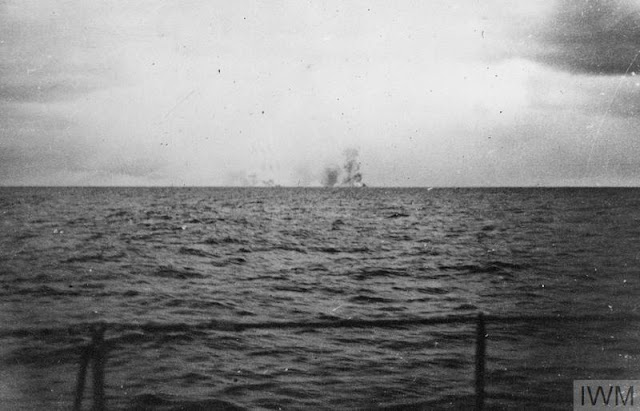
Photograph: A column of smoke rising above the sinking British Battlecruiser HMS Hood. HMS Prince of Wales in the background. This picture was taken from the German Heavy Cruiser Prinz Eugen, 24 May 1941. (Imperial War Museums, IWM # HU 385)
1,415 men are dying in this photograph. There will be 3 survivors.
The Battle of the Denmark Strait was fought. The German battleship Bismarck and heavy cruiser Prinz Eugen sank the British battlecruiser HMS Hood. The Battle of the Denmark Strait takes place when the German battleship Bismarck and the heavy cruiser Prinz Eugen engaged the battleship HMS Prince of Wales (53), the battlecruiser HMS Hood (51), and the heavy cruisers HMS Norfolk (78) and HMS Suffolk (55). British battlecruiser HMS Hood and battleship HMS Prince of Wales engaged German battleship Bismarck and cruiser Prinz Eugen at 0552 hours at the distance of 24 kilometers. The German battleship Bismarck reported ‘in fight with two heavy units’ as she was engaged by British warships. Prinz Eugen engaged in combat with HMS Prince of Wales and HMS Hood alongside of German battleship Bismarck. She scored the first hit on HMS Hood. Between 0555 and 0601 hours, Bismarck was hit on the port side by three shells from HMS Prince of Wales.
Both hits on the Bismarck are shrugged off by the Germans, but in fact, they are quite serious. The third (and last) hit floods a generator room and partially floods a boiler room, wounding five men. The hit in Bismarck’s bow removes access to 1000 long tons of fuel oil and leaves an oil slick. It also causes a 9-degree list to port, reduces the ship’s speed by two meters, and makes the ship “lean forward” with its bow now riding two meters lower in the water than designed.
The German ships open fire at 05:55 after some discussion on the bridge of the Bismarck. Admiral Lütjens waits for better conditions, but finally, Bismarck Kapitän zur See Ernst Lindemann ends the debate: “Ich lasse mir doch nicht mein Schiff unter dem Arsch wegschießen. Feuererlaubnis!” (“I’m not letting my ship get shot out from under my arse. Open fire!”). Lütjens then orders Prinz Eugen Kapitän zur See Helmuth Brinkmann to open fire as well. Both Bismarck and Prinz Eugen concentrate on Hood, and they score one minor hit on the Hood’s boat deck, and then another at the base of the bridge.
At 0600 hours, a 15-inch shell from Bismarck detonated a magazine and sank HMS Hood with almost all killed. At 06:00, Admiral Holland orders a turn to port for both British ships to bring the aft main guns into action. The distance at this point has closed to about nine miles (14 km). A salvo from Bismarck then straddles the Hood, with one hit around the mainmast that apparently ignites the aft magazine. The Hood immediately blows up in a fireball of such force that it blows the two massive aft turrets into the sea. Hood breaks in two and sinks in three minutes. There are three survivors out of 1,419 men.
Prince of Wales almost runs over the rapidly disappearing Hood, but an abrupt change, of course, avoids a collision. Both German ships now focus on the Prince of Wales, with one hit by the Bismarck and three by the Prinz Eugen. Two of the shells fail to explode, but minor flooding results that also releases some fuel oil. The problems with the guns put more out of action, and at 06:04 Captain John Leach decides to withdraw with 13 dead and nine wounded.
As a result of the hits from HMS Prince of Wales, the top speed of the Bismarck was reduced to 28 knots. The battleship was 3° down by the bow and had a 9° list to port. Because of this, the blades tips of the starboard propeller were out of the water at times. Therefore the starboard void tanks in sections II and III were flooded to reduce the bow trim and list. The damage was not particularly serious, the Bismarck maintained intact her fighting capability, good speed, and there were no casualties among the crew; only five men had been slightly wounded. However, the loss of fuel was to affect the remaining course of action. At 0801 hours, Bismarck reported damage with electric plant no. 4 and boiler room no. 2; she would head for Saint-Nazaire due to her low fuel levels.
With Hood’s loss, Force H (Admiral Somerville) with battlecruiser HMS Renown, carrier Ark Royal and cruiser HMS Sheffield is sailing north from Gibraltar. Battleship Ramillies, released from convoy escort duties, and Rodney, then to the west of Ireland, head towards Bismark’s expected track. Ramillies does not play a part in later operations.
At this point, the Germans have a decision to make. They can chase the fleeing Prince of Wales, head back to port due to the damage to Bismarck, or continue on their original course as if nothing had happened. Captain Lindemann wishes to chase the Prince of Wales, but Lütjens refuses. He orders a return to the original course, preferring to following standing orders from German Naval Commander Groß Admiral Erich Raeder to avoid unnecessary action. The German ships turn due west. The pursuing British cruisers continue shadowing them, and Suffolk fires a few salvoes even though it is out of range. Rear-Admiral Wake-Walker in Norfolk now assumes command of the British squadron.
Lindemann’s men try to repair the damage from the Battle of the Denmark Strait, but they fail completely. He has to shut down Boiler Room No. 2, and this reduces the ship’s speed to a still fast 28 knots. Bismarck now no longer has enough fuel for a raiding mission, so Lütjens decides to head for France — rather than Norway, which is closer. Once again Lütjens overrules Lindemann, who wants to return to Bergen. Since Prinz Eugen is undamaged, Lütjens detaches it for an independent raiding mission while he sets a course for the French port of Saint-Nazaire.
Early in the morning of 24 May, Admiral Lütjens had already decided to detach the Prinz Eugen, and at 1420 sent a semaphore signal to Captain Brinkmann: “Intend to shake stalker as follows: During rain squall, the Bismarck will change course west. Prinz Eugen will maintain course and speed until he is forced to change position or three hours after the departure of Bismarck. Subsequently, is released to take on oil from “Belchen” or “Lothringen”. Afterwards, pursue independent cruiser war. Implementation upon cue word, ‘Hood’.”
In Berlin, Admiral Raeder learns of Lütjens’ decision from wireless messages and, after much back-and-forth with his staff, calls Adolf Hitler in Berchtesgaden. Hitler says to those with him:
“If now these British cruisers are maintaining contact and Lütjens has sunk the Hood and nearly crippled the other, which was brand new and having trouble with her guns during the action, why didn’t he sink her too? Why hasn’t he tried to get out of there or why hasn’t he turned around?”
Basically, Hitler sides with Lindemann on both issues of dispute between him and Lütjens. It is easy to question Lütjens’ decisions, but he has the entire Royal Navy and RAF after him, and he really has no good choices far from home with a damaged ship.
Radio Berlin announces the sinking of the Hood in the evening to wild acclaim, but witnesses report that Hitler is not happy, but rather very worried about Bismarck’s prospects.
At 1509, Admiral Tovey had detached Rear-Admiral Alban Curteis (in Galatea) with the carrier Victorious (Captain Henry Cecil Bovell) and the four light cruisers Galatea, Aurora, Kenya and Hermione to close the range and deliver a torpedo attack. At 2210, some 120 miles from Bismarck, Victorious launched all her nine Swordfish torpedo planes of the 825th Squadron under the command of Lieutenant-Commander (A) Eugene Esmonde.1 At 2300, they were followed by three Fulmars of the 800Z Squadron, and at 0100 by two more to maintain touch. Esmonde obtained a surface contact on his ASV (Air-to-Surface Vessel) radar at 2350, and prepared his aircraft for the attack, but instead of Bismarck he found the US Coast Guard Cutter Modoc (Lieutenant-Commander Harold Belford). The Bismarck, only six miles away, spotted the British aircraft and opened fire immediately while increasing the speed to 27 knots. One Swordfish lost contact with the rest of the squadron in a cloud layer, and only eight planes proceeded to attack around midnight. The German anti-aircraft fire was very intense and even the main and secondary batteries opened fire. Lindemann and the helmsman, Hans Hansen, operating the press buttons of the steering gear, successfully avoided the first six torpedoes when suddenly the battleship was hit. At 2350 hours, 8 British Swordfish torpedo bombers from aircraft carrier HMS Victorious attacked Bismarck and scored one torpedo hit. A 18 inch MK XII torpedo struck Bismarck’s starboard side, amidships, at the level of the main belt which resisted the explosion very well. The damage was minimal, although the explosion caused the death of Oberbootsmann Kurt Kirchberg (who became the first casualty aboard) and injured six men. Despite the heavy anti-aircraft fire none of the obsolete Swordfish were shot down, and by 0230, all of them had landed on the Victorious. However, the last two Fulmars that had been launched from Victorious were not so fortunate, and they were lost after they ran out of fuel and were forced to land in the sea. The crew of one of them was rescued later by the merchant ship Beaverhill.
After the Swordfish attack, the Bismarck reduced her speed to 16 knots to alleviate the pressure in the forecastle and carry out repairs. The distance between both forces decreased, and at 0131 on 25 May (Lütjens’ 52th birthday), the Prince of Wales opened fire on Bismarck. The battleships exchanged two salvoes each at a range of 15,000 meters (16,400 yards), but due to the poor visibility neither side scored any hits. The morale aboard the Bismarck was high and sometime about then, the crew wished the Chief of Fleet a happy birthday by the ship’s loudspeaker system.
The battle for Crete already is decided, though the British refuse to accept reality. Mediterranean Fleet Commander Admiral Andrew Cunningham already has recognized what is going on. As he reported on 23 May:
“The operations of the last four days have been nothing short of a test of strength between the Mediterranean Fleet and the German Air Force. I am afraid that, in the coastal area, we have to admit defeat and accept the fact that losses are too great to justify us in trying to prevent seaborne attacks on Crete. This is a melancholy conclusion, but it must be faced.”
If nothing else, this is final and decisive proof of the superiority of air power over naval power. Today, the real-life implications of the loss of naval control become evident.
Allied troops began to fall back southward in Crete, Greece. The Allies are pushed back to Galatas as German forces build-up around Maleme.
The Germans begin expanding from their Maleme airfield lodgement in earnest today to the east. The Luftwaffe attacks Allied forces in Kastelli, near Heraklion, paving the way for the 95th Gebirgs Pioneer Battalion to take the town. Incidental to this attack, German paratroopers (Fallschirmjäger) who had been captured there following the initial landings on 20 May manage to escape by killing or capturing their captors (New Zealand officers of the 1st Greek Regiment). The Greek troops put up a fierce defense in the area that lasts for days, but they are low on ammunition and steadily pushed back. The Germans approach Canea.
The Germans make one last attempt at a seaborne landing. At Piraeus, Oberleutnant-zur-See Österlin, who had commanded the abortive landing attempt at the beginning of the invasion which the Royal Navy prevented, tries again. He puts two Panzer II tanks on a wooden lighter and sets out for Crete under tow from tug Kentauros. However, the Luftwaffe spots Royal Navy units nearby, so he aborts this attempt as well and puts in at the island of Kithira. Thus, the Germans on Crete continue to operate without armor, but the British there have only a handful of tanks, so this is not a major issue.
The British still hold Suda Bay. They use it today to land 200 commandos (A and D battalions of British Layforce) aboard fast minelayer Abdiel. The Abdiel then quickly turns around and departs. About 800 additional commandos are on destroyers offshore but cannot be landed due to bad weather.
The Australian 19th Infantry Brigade attacks the German 2nd Fallschirmjäger Regiment near Retimo. The Germans there are in purely defensive mode, as the entire German invasion focus is on Maleme.
During the night Ramcke’s forces break though to Oberst Heidrich at Galatos. The New Zealand defense line is smashed by Stuka dive bombers and the way to Chania is open. After dark, British minelayer HMS Abdiel transported 200 British commandos from Alexandria, Egypt to Suda Bay, Crete; another effort to transport 800 commandos to Port Lutro, Crete was canceled due to bad weather.
Daily Keynote from the Reich Press Chief: “The special announcement about Crete should form your front-page story. Germany’s is one of the boldest military strokes in world history and awakens the pride of the nation. It should be an occasion for emphatic political commentary. Above all, emphasize the contrast between Churchill’s initial boastful remarks and the German reporting that began only when factual battle results could be truthfully reported.”
The British media, meanwhile, are much more circumspect about the battle and provide dramatic stories about massive losses on both sides. General Ismay, visiting Prime Minister Churchill at Chequers, notes in his memoirs that Churchill is “almost exclusively” interested in the chase of the German battleship Bismarck despite the situation on Crete being “critical.”
About 16 miles south of Sicily, Royal Navy submarine HMS Upholder (Lt-Cdr Malcolm David Wanklyn) penetrates an Axis convoy and damages 4854 ton Vichy French tanker Capitaine Damiani. Upholder also torpedoes and sinks 18,500 ton converted troop ship Conte Rosso. The Conte Rosso sinks within 40 minutes. There are 2729 soldiers and crew on board, and roughly half (1300) perish. The escorts then force Wanklyn to submerge and survive 37 enemy depth charges. The Capitaine Damiani makes it to Naples under tow from tug Goliath. There is some question whether the Upholder makes both attacks on the 24th, one may take place on the 23rd.
The Luftwaffe raids Tobruk. It sinks 76-ton naval drifter Aurora II. While making a nightly run to the port, Royal Navy sloop Grimsby and the small freighter it is escorting are sunk as well.
Admiral Cunningham orders aircraft carrier HMS Formidable to prepare to go to sea. The Formidable is to head to the island of Scarpanto (Karpathos) and attack the Axis airfield there. This will be Operation MAQ3.
Soddu, Ethiopia, falls to the Allies.
According to the War Cabinet minutes, Prime Minister of Northern Ireland John Andrews informs Winston Churchill that the Ulster Unionist Council has approved conscription in Northern Ireland. Andrews tells Churchill that he should do “what His Majesty’s Government in the United Kingdom thought was best for the Empire.”
The British government collected £124,000,000 in donations after a week-long War Weapon Week event.
A “MOST SECRET” British document lists how the Irish have cooperated with the British by:
- Giving them a large amount of detailed information about roads, railways and military facilities in Eire in the event of a German invasion.
- Whenever a German aircraft or submarine was sighted in or over Irish territory, the Irish would broadcast the location of the intruder “in the clear” on radio frequencies the British monitored.
- Allowed the RAF to fly over certain specified areas.
- Did not protest overflights by RAF aircraft over the rest of the country.
- Provided daily intelligence information to Britain.
- Allowed the British Legation to keep two secret transmitters and a private telephone line to London and Belfast.
- Routed all German and Italian official communications through Britain.
- Allowed the British to install equipment that resulted in the decreased efficiency of the RTE, the Irish national radio service, so the Germans could not use it as a guide for bombing the UK.
- Transferred seven Irish tankers to Britain.
- Allied airmen who went down in Eire were quietly taken to the border and turned over to Allied officers in Ulster.
- All German spies and military personnel who were captured were interned for the duration of the war.
A Finnish military delegation, headed by Lieutenant General. Erik Heinrichs, travels to Germany. In the next two days they’re engaged in negotiations with generals Jodl and Halder about the Finnish military dispositions in the event of a Russo-German war. While the Finns are not empowered to make any binding promises, it is understood that Finland shall prepare to go to war against Soviet Union. Since the end of the Winter War in March 1940, Finland had looked for an opportunity to seek redress for one way or another. Initially it was feared that Soviets will attack at the first opportunity to finish conquering Finland, and especially in the summer and autumn of 1940 the situation looked very threatening. The Soviet diplomats began forcing issues by threats, and it looked like all the Soviets were looking for was an excuse. The Finnish intelligence detected Soviet troop movements near the border. But the invasion never came. It is possible that Stalin was waiting for the Germans to provide a diversion to draw world’s attention away from Finland, namely in the form of a German invasion of Britain. It can perhaps be said that by defeating the Luftwaffe in the Battle of Britain, the RAF also saved the Finnish independence. During the Winter War Germany had been very cool towards Finland, respecting the pact it had with Stalin. But in late 1940 the attitude began to change. Hitler had decided to go to war with the Soviet Union, and the Finns were in that case valuable allies. Germany began to sell arms to Finland, and soon began dropping hints about a possible change in the Russo-German relations. In the spring of 1941 the Fenno-German co-operation had become quite concrete, and German troops were streaming into northern Finland. Around that time, in late spring 1941, Stalin’s attitude towards Finland began to change. Threats were forgotten, and the Soviet Union became very accommodating in all deals. But by now it was already too late. Stalin’s actions had driven Finland firmly in the German camp.
The occupying German authorities begin arresting union representatives during the Norway Theater Strike.
Jan Smuts was made a field marshal of the British Empire.
It is Empire Day (later Commonwealth Day), but there is little good news in the Empire aside from schoolchildren who have the day off. Winston Churchill ignores the terrible war news by screening “Seven Sinners” starring Marlene Dietrich at Chequers.
German athlete Rudolf Harbig runs a world record 1,000m in 2:21.5 at Dresden, Germany.
The OKW sends trainloads full of troops east in preparation of Operation BARBAROSSA. This will continue from this point forward until the launch of Operation BARBAROSSA.
RAF Bomber Command, Day of 24 May 1941
23 Blenheims on coastal sweeps. Shipping was attacked and 1 ship was hit. 1 aircraft lost.
U-38, commanded by Kapitänleutnant Heinrich Liebe, sank British steamer Vulcain (4362grt) at 9-20N, 15-35W. At 0249 hours on 24 May 1941 the unescorted Vulcain (Master Jack Reginald Lewis), dispersed from convoy OB.317 on 6 May, was hit on the starboard side underneath the bridge in #2 hold by one G7a torpedo from U-38 165 miles northwest of Freetown. The ship was steaming on a zigzag course at only 6 knots as she had boiler troubles and sank rapidly by the bow after being hit. Seven crew members were lost. The U-boat had spotted her while chasing the Berhala in the evening on 23 May, sank the other ship and managed to locate Vulcain again, but missed with a spread of two G7a torpedoes at 0032 hours on 24 May. One of the torpedo that missed had been observed passing from port by the third mate on watch and the crew of 38 and four gunners (the ship was armed with one 12pdr, one 25mm and four machine guns) heard and felt the concussion after it detonated at the end of its run, so they were alert and able to quickly abandon ship in the lifeboats when hit. The survivors later made landfall at Boffa, French West Africa, where they were interned by the Vichy French authorities and after some months repatriated to Freetown. The master was awarded the Lloyds War Medal for bravery at sea. The 4,362 ton Vulcain was carrying coal and was bound for Freetown, Sierra Leone.
U-103, commanded by Korvettenkapitän Viktor Schütze, sank Greek steamer Marionga (4236grt) in 5-42N, 10-29W. At 0356 hours on 24 May 1941 the unescorted Marionga, dispersed from convoy OB.317 on 6 May, was hit underneath the aft mast by one torpedo from U-103 and sank by the stern within four minutes about 30 miles west-southwest of Buchanan, Liberia. The U-boat had spotted the ship 8 hours earlier, but had to wait for the night due to the very good visibility and then missed with the first two torpedoes fired at 0036 and 0154 hours. On 28 May, three survivors were picked up from a raft by the British steam merchant City of Rangoon in 05°42N/10°29W and were landed at Capetown on 9 June. Two survivors landed at Monrovia on 10 June. The 4,236 ton Marionga was carrying British government stores and was bound for Takoradi, Ghana.
Destroyers HMS Echo, HMS Icarus, HMS Electra, and HMS Achates were detached from the battlecruiser Hood force to search north, then refuel at Hvalfjord.
Battlecruiser HMS Hood and battleship HMS Prince of Wales engaged German battleship Bismarck and heavy cruiser Prinz Eugen in 63-21N, 32-47W. Battlecruiser Hood (Captain R. Kerr CBE) was sunk by gunfire from battleship Bismarck and heavy cruiser Prinz Eugen. There were only three survivors. Midshipman W. J. Dundas and two ratings were picked up by destroyer HMS Electra, which returned with the other destroyers to the scene of the battle. Vice Admiral L. E. Holland CB, Captain R. Kerr CBE, T/Midshipman N. N. Adams RNR, Lt Cdr C. D. Awdry, Signal Boatswain A. E. T. Bartley, Lt Cdr A. R. T. Baley, Midshipman T. N. K. Beard RCN, Paymaster Lt R. H. P. Browne, Lt Cdr J. G. P. Brownrigg, Midshipman D. M. Bryant, Midshipman P. J. Buckett RNVR, T/A/Warrant Ordnance Officer H. Burgess, P/T/Sub Lt (E) J. H. Cambridge RNVR, Paymaster Lt Cdr G. V. Carlin RNVR, Captain T. D. Cartwright, RM, Commissioned Gunner J. A. Chapman, Paymaster Midshipman J. P. Collings, Commissioned Gunner (T) S. J. Cope, Cdr W. K. R. Cross, Lt (E) R. H. Dale, Senior Master R. T. Davies, Midshipman H. K. Davies RNVR, Surgeon Lt C. H. C. Dent RNVR, A/Sub Lt J. R. Down RNVR, Midshipman G. R. Eagles, Lt Cdr (E) J. G. M. Erskine, Surgeon Lt J. O. Fielding, T/Midshipman D. C. Ford RNR, Warrant Supply Officer T. C. Freeborn, T/Lt L. E. Friend RNVR, A/Sub Lt N. H. Frodsham, T/Paymaster Lt J. R. Graves RNVR, A/Cdr E. H. G. Gregson, Cdr (E) R. T. Grogan, Lt Cdr J. W. Hall, Lt D. S. R. Harris, RM, A/Warrant Engineer C. Haughton, Captain (E) S. J. Herbert, T/Midshipman R. A. Hibbs RNVR, T/Paymaster Lt N. H. Hoare RNVR, T/Paymaster Cdr J. M. Hogan, A/Lt (E) M. S. T. Humphrey, Surgeon Cdr H. Hurst, T/Electrical Lt J. M. Iago RNVR, Midshipman F. L. L. Jones RCN, T/Midshipman R. F. Knight RNR, T/Midshipman P. R. Lapthorn RNVR, Lt E. P. S. Lewis, Major H. Lumley, RM, Paymaster Lt T. G. P. Luxmoore, Lt Cdr J. L. Machin, T/Midshipman J. B. McLaren RNR, Lt Cdr E. H. F. Moultrie, T/Lt C. B. N. Newey RNVR, Midshipman C. J. B. Norman RCN, Lt Cdr G. E. M. Owens, Lt Cdr A. Pares, Surgeon Lt (D) J. E. C. Peacock, Midshipman R. G. C. Perman, RIN, Paymaster Lt R. G. Phillips, Warrant Engineer R. A. H. Plumley, Paymaster F. A. P. Porter-Fauset, Warrant Shipwright W. A. Price, Lt (E) B. C. J. Roach, sub Lt A. C. R. Robins RNR, Paymaster Cdr D. C. Roe, sub Lt J. H. A. Scott-Kerr, Lt (E) H. G. E. Smith, T/Lt (E) T. F. Spence, Instructor Cdr D. M. Steel, T/Midshipman D. P. Stevenson RNR, The Rev. R. J. P. Stewart, Chaplain, T/Lt C. F. B. Stubbs RNVR, Commissioned Ordnance Officer J. C. Sulley, Commissioned Telegraphist W. O. Taylor, Commissioned Gunner H. G. H. Tozer, Paymaster Midshipman G. D. B. Vacher, Commissioned Gunner A. C. Varlow, Warrant Engineer W. F. B. Walter, P/T/Midshipman K. G. Warden RNR, A/Cdr S. J. P. Warrand, P/Paymaster Sub Lt S. Watkinson, NZNF, Gunner (T) E. F. Wheeler, P/T/Sub Lt T. Willets RNVR, T/Midshipman R. G. L. Williams RNVR, A/Warrant Electrician F. J. Woodward, Lt Cdr H. D. Wyldbore-Smith, and Boatswain R. G. Yates were lost on the battlecruiser. Polish Midshipmen S. Czeruy, K. Szymalski, L. Zmuda-Trzebiatowski, and O. Zurek were lost on the battlecruiser. One thousand, three hundred and twenty two ratings were lost.
Battleship HMS Prince of Wales sustained damage from four fifteen inch and three eight inch hits in this engagement. Midshipmen P. T. Dreyer and J. B. Ince and eleven ratings were killed and Lt Cdr G. W. Rowell, T/Sub Lt E. P. Knight RNVR, and eight ratings were wounded in the battleship.
Destroyers HMS Electra, HMS Achates, HMS Anthony, HMS Echo, HMS Icarus, and HMS Windsor arrived at Hvalfjord at 2140/24th for refueling. The sixth destroyer with the battlecruiser force, destroyer HMS Antelope was continuing to search for HMS Hood survivors until 2200 before proceeding to Hvalfjord.
Destroyer HMS Malcolm from convoy escort duty was also ordered into the area to search for survivors.
Battleship HMS Prince of Wales and heavy cruisers HMS Norfolk and HMS Suffolk pursued the German force southward on the 24th.
Battleship HMS Ramillies was detached from convoy HX.127 to search for the German ships. Battleship HMS Revenge departed Halifax to join convoy HX.127.
Light cruiser HMS Edinburgh, patrolling near the Azores in 45N, 25W looking for German blockade runners, was ordered to close German battleship Bismarck’s last known location.
Heavy cruiser HMS Dorsetshire left convoy SL.74 without permission. The escort was left to armed merchant cruiser HMS Bulolo.
Heavy cruiser HMS London, escorting steamer Arundel Castle with destroyers HMS Havelock and HMS Harvester from Gibraltar to join convoy SL.75 in 43N, 20W, was detached to close Bismarck’s location, but shortly after was directed to the Azores to intercept German tankers. On the 26th, the cruiser was directed to join convoy SL.75. She was diverted to Bathurst, arriving to refuel on the 31st and to join convoy SL.76. On the 25th, the destroyers were instructed to reverse course for twelve hours, then return to their original route.
Battlecruiser HMS Renown, aircraft carrier HMS Ark Royal, light cruiser HMS Sheffield, and destroyers HMS Faulknor, HMS Forester, HMS Foresight, HMS Foxhound, HMS Fury, and HMS Hesperus departed Gibraltar at 0200 to intercept Bismarck. At 1245, destroyers Foresight, Foxhound, and Fury were detached to return to Gibraltar. On the 25th, destroyers Faulknor, Forester, and Hesperus returned to Gibraltar to refuel.
Battleship HMS Rodney and destroyers HMS Somali, HMS Tartar, and HMS Mashona were ordered to leave troopship Britannic to destroyer HMS Eskimo and proceed towards Bismarck. Destroyer Eskimo remained with the troopship until 0200/26th when she proceeded to Hvalfjord.
Destroyers HMS Bedouin and HMS Impulsive remained with minelayer HMS Southern Prince until 25 May.
Destroyers HMS Bulldog and HMS Amazon, corvettes HMS Aubretia, HMS Hollyhock, and HMS Nigella, and anti-submarine trawler HMS Daneman were with convoy SC.31 to the south of battlecruiser HMS Hood nearest the Hood sinking. The convoy was taken into Hvalfjord to avoid contact, arriving on the 25th.
Three other Western Approaches convoys were at sea. Convoy OB.324, which departed Liverpool on the 18th was escorted by destroyers HMS Campbeltown, HMS Wanderer, and HMS Westcott, sloops HMS Fleetwood and HMS Rochester, and corvettes HMS Auricula, HMS Dianthus, HMS Marigold, HMS Nasturtium, HMS Periwinkle, and HMS Primrose. This escort was relieved on the 24th by destroyers HMS Chelsea, HMS Verity, and HMS Veteran and corvette HMS Convolvulus. Convoy OB.325, which departed Liverpool on the 21st was escorted by destroyers HMS Leamington and HMS Saladin, corvettes HMS Clarkia and HMS Gladiolus, and anti-submarine trawler HMS St Zeno. Convoy OB.326, which departed Liverpool on the 22nd, was escorted by destroyers HMCS Assiniboine, HMS Salisbury, and HMS Skate, corvettes HMS Abelia, HMS Alisma, and HMS Anemone, and anti-submarine trawler HMS St Kenan.
Battleship HMS Nelson was ordered from Freetown to Gibraltar. Later she escorted convoy SL.75 to 46N before returning to Scapa Flow, arriving on 8 June.
Submarine HMS Thunderbolt departed Halifax on the 25th to attempt to intercept the German ships.
Submarine HMS Sealion departed Portsmouth for patrol in Biscay and submarine HMS H 44 departed Holyhead for Biscay.
Submarines HMS Seawolf, HMS Sturgeon, HMS Tigris, and HMS Pandora were also deployed in Biscay to intercept.
Submarines HMS Severn and HMS Clyde departed Gibraltar on the 27th to take up offensive patrols in the Straits of Gibraltar.
Aircraft carrier HMS Victorious launched nine Swordfish of 825 Squadron at 2210/24th to attack the Bismarck. Three Fulmars of 800Z Squadron were flown off at 2300 for shadowing, followed at 0100 by a relief of two more Fulmars. One Swordfish, piloted by Sub Lt (A) A. J. Houston RNVR, lost contact in the cloud cover, but the other eight Swordfish attacked the German ship at 0020/25th. One hit is obtained on Bismarck’s armored belt; the damage is not serious. No aircraft were lost in the attack. However, in the relief flight of Fulmars, one Fulmar off 800Z Squadron, piloted by Lt (A) F. C. Furlong RNVR, with Observer P/Sub Lt (A) J. E. M. Hoare RNVR, crashed into the sea on return. They were picked up by a merchant ship. A second Fulmar of 800Z Squadron, piloted by Lt B. D. Cambell with Observer Sub Lt M. G. Goodger RNVR, was lost with its crew. On a search mission after the raid, sub Lt (A) P. B. Jackson died on the 25th when the plane crashed landed in the sea. A/Sub Lt (A) D. A. Berrill and Leading Airman F. G. Sparkes from Jackson’s plane were able to survive in an abandoned lifeboat before being picked on 3 June up by Icelandic steamer Lagarfoss (1211grt) which took them to Reykjavik. Lt (A) H. C. M. Pollard, sub Lt (A) D. M. Beattie RNVR, and Leading Airman P. W. Clitheroe of 825 Squadron were lost when their Swordfish failed to return on the 26th from a search mission.
At 0306, on the 25th the German ships were able to shake the shadowing cruisers in 56-23N, 36-05W. Heavy cruiser Prinz Eugen broke away and returned to Brest.
Battleship HMS Prince of Wales was sent southward from the shadowing force to join Tovey’s main group.
Destroyer HMS Lance proceeded to Hvalfjord at 1030. Destroyers HMS Bedouin and HMS Impulsive having left minelayer HMS Southern Prince in 48-35N, 31-45W were also en route to Hvalfjord.
Destroyers HMS Bedouin and HMS Impulsive had been detached to refuel with instructions if they encountered the German ships destroyer Impulsive was to make a contact report, while destroyer Bedouin engaged them.
Destroyer HMS Jupiter, which had departed Plymouth for Scapa Flow to work up, was diverted to refuel at Skaalefjord and await orders there. On the 26th, the destroyer was ordered to refuel at Londonderry and join the battleship HMS Rodney.
Destroyers HMS Electra, HMS Anthony, HMS Echo, and HMS Achates departed Hvalfjord at 2200/25th to meet battleship HMS Prince of Wales.
At 0200/26th, destroyers HMS Cossack, HMS Sikh, and HMS Zulu were detached from convoy WS.8B to join the main body of the Home Fleet. Destroyers HMS Maori and ORP Piorun were detached from the same convoy to join battleship HMS Rodney.
Destroyers HMS Icarus, HMS Windsor, HMCS Saguenay, HMS Active, and HMCS Assiniboine departed Reykjavik at 0800/26th to join aircraft carrier HMS Victorious. Destroyer HMS Antelope remained at Reykjavik with defects that made her unfit for sea.
Destroyers HMS Inglefield, HMAS Nestor, HMS Punjabi, HMS Legion, and HMS Lance departed Iceland for Londonderry. The destroyers refueled on the 28th.
Destroyer HMS Somali was detached on the 26th from battleship HMS Rodney to refuel.
Destroyers HMS Tartar and HMS Mashona were detached from battleship HMS Rodney during the night of 26/27 May to refuel.
At 1910, aircraft carrier HMS Ark Royal launched four Swordfish of 810 Squadron, four of 818 Squadron, and seven of 820 Squadron. At 2230/26th, the Swordfish attacked battleship Bismarck. A hit wrecked the battleship’s steering gear. In one Swordfish of 820 Squadron, sub Lt (A) F. A. Swanton and Leading Airman J. R. Seager of 820 Squadron were wounded and Sub Lt (A) G. A. Woods RNVR, was unhurt when the aircraft was badly shot up.
At 2310/26th, destroyers HMS Cossack and HMS Zulu contacted the German battleship. At 0100/27th, destroyers HMS Cossack, HMS Maori, HMS Sikh, and HMS Zulu carried out torpedo attacks. Destroyers Cossack, Maori, and Zulu were damaged by splinters from the battleship’s guns. Three crewmen on Zulu were wounded. Several crewmen on destroyer Maori, including Cdr H. T. Armstrong were wounded.
Light cruiser HMS Sheffield exchanged shots with the German battleship. The light cruiser was damaged by splinters and sustained twelve men wounded; three of these ratings died of wounds.
Battleship HMS Prince of Wales arrived at Iceland at 0530/27th with light cruisers HMS Aurora and HMS Galatea and destroyers HMS Anthony, HMS Electra, HMS Echo, and HMS Achates. Destroyer Anthony departed Hvalfjord on the 27th for Scapa Flow, arriving at 1100/29th. The battleship departed on the 28th escorted by destroyers Electra, Echo, and Achates. The battleship arrived escorted by destroyers Electra, Echo, and Achates at Rosyth on the 30th for repair. En route, the destroyers suffered weather damage which was repaired at Rosyth. Destroyer Electra departed Rosyth at 1430/31st for Scapa Flow arriving at 0300 on 1 June. Destroyer Achates departed Rosyth at 1100 on 7 June for Scapa Flow, arriving at 2000. Destroyer Echo departed Rosyth at 1500 on 17 June for Scapa Flow, arriving at 0200 on 18 June. Battleship Prince of Wales departed Rosyth after repair on 19 July for Scapa Flow.
Polish destroyer ORP Piorun of Vian’s destroyer force, returning to Plymouth to refuel, was attacked by German torpedo bombers on the 27th, but was undamaged. The destroyer arrived on the 28th.
Battleships HMS King George V and HMS Rodney attacked Bismarck on the 27th and wrecked her upper works. The Battleships are forced to withdraw to refuel.
Heavy cruisers HMS Dorsetshire and HMS Norfolk shell and torpedo the German ship.
The battleship sank soon after at 1101 in 48-09N, 16-07W, probably scuttled by her crew at the last. This however, is largely irrelevant. Bismarck cannot in any event reach the safety of France and is finished. Even if she could have somehow been towed and reached France, she was a complete wreck and would have soaked up vital resources that Germany could scarcely afford in the next two years. Then she would find herself absolutely useless; by 1943 the Allied dominance of the seas is such that could never have achieved anything worth the cost of repairing her.
Heavy cruiser HMS Dorsetshire rescued four officers and seventy eight ratings and destroyer HMS Maori rescued 24 ratings. Rescue efforts are terminated when a submarine alarm was received.
Spanish cruiser Canarias departed El Ferrol with destroyers Gravina and Alcala Galiano of the 1st Destroyer Flotilla at approximately 1100/27th to render assistance to the German battleship. The destroyers were forced to return to Ferrol almost immediately because of heavy weather. On the 30th, the cruiser picked up two bodies which were buried at sea.
On the 28th, U-74 rescued three survivors and weather ship Sachsenwald rescued two more survivors.
Battleships HMS King George V and HMS Rodney retired from the battle escorted by destroyers HMS Cossack, HMS Maori HMS Sikh, HMS Zulu, and HMS Jupiter. By 1600/28th, eleven more destroyers joined the battleships, destroyers HMS Somali, HMS Eskimo, HMS Punjabi, HMAS Nestor, HMS Inglefield, and HMS Lance having departed Londonderry on the 28th to join. Destroyers HMS Vanquisher, HMS Sherwood, HMS St Clair, HMS Columbia, and HMS Ripley also joined the screen.
Heavy cruiser HMS Norfolk was near missed by a German bombing bombing off the west coast of Ireland. The cruiser arrived in the Clyde on the 28th.
Destroyers HMS Bedouin and HMS Impulsive departed Hvalfjord on the 28th for Skaalefjord and Scapa Flow, respectively. Destroyer Bedouin arrived at Skaalefjord at 1900 and sailed at 2030 escorting steamer Ben My Chree (2586grt) to Iceland. They arrived at Iceland at 2030/30th and departed to return at 1830/31st. The two arrived back at Skaalefjord at 2230 on 1 June. Destroyer Impulsive arrived at Scapa Flow at 0900/30th.
On the 28th, the forces split. Battleship HMS King George V with destroyers HMS Somali, HMS Cossack, HMS Eskimo, HMS Punjabi, HMAS Nestor, HMS Lance, and HMS Jupiter proceeded to Loch Ewe. Battleship HMS Rodney with heavy cruiser HMS Norfolk and destroyers HMS Maori, HMS Sikh, HMS Legion, and HMS Columbia proceeded to the Clyde, arriving at 0300/29th.
Destroyer HMS Mashona (Cdr W. H. Selby) was sunk by German bombers southwest of Ireland while about 100 miles from Tovey’s force. Lt Cdr W. A. Elliott Rtd and thirty five ratings were lost with the destroyer; Elliott and ten ratings dying of exposure after being rescued. They were buried at sea. Seven officers and one hundred and twenty ratings were picked up by destroyer HMS Tartar which was in company. Destroyer HMS Sherwood picked up two officers and fifty four ratings and destroyer HMS St Clair four officers and eight ratings. Sherwood and St Clair scuttled the wreck of the destroyer. Tartar, Sherwood, and St Clair arrived at Moville at 0600/29th, when all the survivors were put aboard Tartar. She then proceeded and arrived at Gourock at 1545/29th.
Destroyer HMS Active departed Londonderry at 0015/28th to join aircraft carrier HMS Victorious, which arrived in the Clyde on the 29th at 1330, escorted by destroyers Active, HMS Windsor, and HMS Antelope.
On the 29th, battleship HMS King George V arrived at Loch Ewe with destroyers HMS Somali, HMAS Nestor, HMS Jupiter, HMS Lance, HMS Cossack, HMS Eskimo, and HMS Punjabi. Destroyer HMS Inglefield arrived at 1100 after the main group at Loch Ewe to refuel.
Destroyer HMS Zulu arrived at Londonderry at 0900/29th to refuel and landed wounded.
On the 30th, battleship HMS King George V departed Loch Ewe at 0300 and arrived at Scapa Flow with destroyers HMS Somali, HMS Zulu, HMS Eskimo, HMS Punjabi, HMAS Nestor, HMS Lance, HMS Cossack, HMS Jupiter, and HMS Inglefield.
Destroyer HMS Somali departed Scapa Flow at 2000 for Southampton for refitting. She arrived at 1100 on 1 June.
Destroyers HMS Maori and HMS Sikh departed Clyde for Scapa Flow at 1030/30th and arrived at 2230.
Destroyers HMS Icarus, HMS Antelope, and HMS Active departed the Clyde for Scapa Flow at 1300/30th. They arrived at noon on the 31st.
Anti-aircraft ship HMS Alynbank departed Methil and met convoy EC.23 at 1630 off May Island escorting it northward. The ship parted company with the convoy in Pentland Firth and arrived at Scapa Flow at 1830/25th.
British tanker Octane (2034grt) was damaged on a mine in 50-08N, 5-02W. Three crew members were killed on the tanker. The tanker was beached one cable northwest of Anthony. The tanker was drydocked at Falmouth on 4 June and later taken to Barry.
British steamer Sarnia (711grt) was damaged by German bombing at anchor in Milford Haven. The steamer was towed to Milford Docks.
Greek steamer Matronna (2846grt) was sunk by German bombing in Dale Roads at Milford Haven. The entire crew was rescued.
British steamer Cressdene (4270grt) was damaged by German bombers in Mumbles Roads.
Minelayer HMS Abdiel departed Alexandria during the night of 23/24 May and landed 200 commandoes at Suda Bay during the night of 24/25 May. The minelayer arrived back at Alexandria on the 25th. Eight hundred commandos from troopship Glenroy were embarked on destroyers HMAS Nizam, HMS Isis, HMS Decoy, and HMS Hero which departed Alexandria at 0900/24th. These troops were not landed at Port Lutro due to bad weather. The operation was covered by light cruisers HMS Dido and HMS Ajax and destroyers HMS Kimberley, HMS Hotspur, HMS Imperial, and HMS Janus which departed Alexandria at 0800/24th. Destroyer Janus was detached soon after sailing to return to Alexandria.
Light cruisers HMS Ajax and HMS Dido with destroyers HMS Kimberley, HMS Hotspur, and HMS Imperial were to bombard Maleme during the night of 24/25 May. The operation was cancelled when cruiser Ajax was unable to arrive due to bad weather. The Force returned towards Kaso Strait to sweep the north coast during the night of 25/26 May. Destroyers HMAS Napier, HMS Kelvin, and HMS Jackal departed Alexandria on the 25th to relieve the three destroyers in the Ajax force.
At 37-56N, 15-36E, submarine HMS Upholder torpedoed Vichy French tanker Capitaine Damiani (4854grt), which had departed Marseille on the 19th in company of tanker Alberta (3357grt) for Constanza. The tanker reached Messina that evening. She departed the next day and arrived at Naples on the 27th. Tanker Capitaine Damiani departed Naples under the tow of tug Goliath on 12 June after temporary repairs. They arrived at Marseilles on 19 June.
Naval drifter HMS Aurora II (76grt) was sunk by German bombing at Tobruk.
Destroyer HMS Brilliant departed Gibraltar for Freetown.
Submarine HMS Clyde arrived at Gibraltar from Holy Loch.
Greek troopship Nea Hellas, returning from the Middle East, arrived at Gibraltar from Freetown.
The German commerce raider Atlantis, disguised as the Dutch motor-ship Brastagi, sank by gunfire and torpedoes the 4,530 ton British freighter Trafalgar in the shipping lanes off the west coast of Africa. The Trafalgar was bound for Capetown, South Africa and Alexandria, Egypt with a cargo of coal and two aircraft. Twelve of the crew died and the other 33 were taken prisoner.
President Roosevelt in his “fireside chat” to the nation Tuesday evening will deal vigorously with opponents of democracy abroad and at home, according to Stephen T. Early, Presidential press secretary, who gave the first intimation today of the character of the coming address. “Without betraying the nature of the text of the speech,” Mr. Early said, “I would say it would not be pleasing to opponents of democracy either at home or abroad.” Mr. Roosevelt devoted the day to work on the speech and will continue with it over the weekend. He worked on the speech last night, and today had completed a rough draft of twenty-two typewritten pages. Political and diplomatic observers were keenly interested in the brief hint given by Mr. Early. They considered it obvious that the White House had deliberately given the hint, so that the public would be prepared in a general way for a strong statement.
Senator Mead, New York Democrat, urged Secretary Hull today to undertake “friendly negotiations” with the Vichy government for establishment of American defense bases on the island of Martinique and other French possessions in this hemisphere. “Should this effort prove futile and should it be the judgment of our government that the interests of this hemisphere are in jeopardy,” Mead added in a letter to Hull, “seizure by force should be accomplished without delay.” Acquisition of French island possessions has been advocated by other senators, among them Clark, Missouri Democrat, and Reynolds, North Carolina Democrat, who have been critical of present administration foreign policy. Mead expressed belief friendly negotiations initiated by this country would “invite the sympathy and support of a large portion of the French population.”
Congressional circles heard tonight that selective service officials are preparing plans to defer men over 26 from military service. Several senators disclosed that the war department is anxious to restrict training of selectees to those in their early twenties, now that army camps throughout the country have received their initial complements of older men to constitute an immediate reserve force. Brigadier General Lewis B. Hershey, deputy selective service director, wrote Speaker Sam Rayburn recently urging legislation to authorize deferment by age classes but the house military affairs committee has delayed acting on the request. Congressional informants said that selective service officials have authority, through administrative regulation, to restrict their selections to men under 26, but prefer congressional sanction of such a move. Chairman Andrew J. May, Kentucky Democrat, of the house military affairs committee has shown no disposition to begin work on Hershey’s proposal. May advocates military training for broad age groups.
Battle of Denmark Strait: British battle cruiser HMS Hood is sunk, and battleship HMS Prince of Wales damaged, by German battleship Bismarck (which is damaged by a shell from the latter capital ship) and heavy cruiser Prinz Eugen. British Home Fleet elements at sea then pursue the German battleship; carrier HMS Victorious launches FAA Swordfish that in the prevailing poor visibility conditions almost attack U.S. Coast Guard cutter Modoc, which is in the vicinity searching for survivors of ships sunk in convoy HX.126. Bismarck, although damaged by an aerial torpedo, eludes her shadowers and disappears, while detaching her consort, Prinz Eugen, to conduct independent operations. One of the pursuing ships is British battleship HMS Rodney, en route to the United States for a refit at Boston when she is rerouted to participate in the hunt for Bismarck; on board is U.S. Naval Observer Lieutenant Commander Joseph H. Wellings, who witnesses the ensuing battle from that unique vantage point.
Joseph P. Kennedy, former United States Ambassador to Great Britain, said tonight that this country should not become a belligerent “just because we hate Hitler and love Churchill.” In an address prepared for delivery at the commencement exercises of Oglethorpe University in Atlanta he said: “Facts are what the country needs, not slogans. What is the state of our own defense? What can we do if we declare war? Where will we land troops? What about Japan? What will be the result of declaring war in terms of our ability to help England?”
The Gallup organization releases the results of a poll in the United States: Do you think President Roosevelt has gone too far in his policies of helping Britain, or not far enough?
The results are 59% “About right,” 21% “Too Far,” and 20% “Not Far Enough.”
Leaders of the Office of Production Management, key agency of the country’s accelerated defense program, which will be one year old next Wednesday, reported today that they were not satisfied with defense progress to date but that “production should increase with every month from now on.” America’s great defense drive is a year old today, with William S. Knudsen, director of production, as serting airplane deliveries had increased 400 percent in that period; 1,625 new industrial projects had been started and $15,200,000,000 worth of orders placed. With the nation’s factories now swinging into mass production of planes, tanks and guns, it was also apparent that the defense program was also taking on new directions and objectives.
Construction or acquisition of 550,000 tons of auxiliary shipping for the Navy is authorized.
Evidence that the German-American Bund was organized to create a militarized organization capable of the same functions which were performed by Nazi groups in European countries conquered by Hitler was offered in a 200-page report today by the Dies Committee Investigating Un-American Activities.
Officials of the C.I.O. United Automobile Workers called a conference tonight as the national defense mediation board pleaded against a strike of 11,000 North American Aviation, Inc., workers in Inglewood, California, scheduled Wednesday. There was no hint of the union’s reaction to the mediation request. Company spokesmen likewise declined comment. The strike unless the company grants an increase from 50 to 75 cents an hour minimum wage and a blanket 10 cent an hour boost for all employees was voted early today, 5,289 to 210, the union announced.
Forcing a reduction of about 20 percent, Leon Henderson, Administrator of the Office of Price Administration and Civilian Supply, set today a maximum price schedule for ordinary commercial quality combed cotton yarns, based on a rate of 42 cents per pound for 30’s single and ranging from 32 cents per pound for 10’s single to $1.63 per pound for 120’s two-ply, effective May 26.
Selma Cloverleaf (Southeastern League) pitcher Hal Toenes relieves in the top of the ninth inning against the Jackson Mississipians with a runner on first base and 2 out (as noted by historian Bill Hickman). Without throwing a pitch, he picks the runner off first base. Selma, 4 runs down, scores 6 runs to give Toenes the pitchless win. Toenes will later have a cup of coffee with the Washington Senators.
Major League Baseball:
The Boston Braves sign veteran Paul Waner, released by the Dodgers two weeks ago.
The Dodgers, after six straight setbacks, took the measure of the Phillies, 7–3, with a five-run rally in the eighth inning that was marked by Dolph Camilli’s 450-foot home run. This blow tied the score at 3–3 and sent the crowd of more than 12,000, of whom 8,576 paid admission — the others were members of the Knothole Club — into a hysterical outburst. But there was more to come. Dixie Walker bounced a double off the scoreboard and Jimmy Wasdell, batting for Mickey Owen, was purposely passed. Lew Riggs, Durocher’s prize pinch-hitter, batted for Kirby Higbe and lined a hit to right that went for three bases when the ball took a sudden hop over Tiny Mueller’s head. This scored two more. Then Peewee Reese walked, Billy Herman shot a single to left, scoring Riggs, and Pete Reiser belted a double through the middle to send Reese home.
The Reds, after losing the first game, 4–2, earned an even break in a doubleheader today on Whitey Moore’s six-hit, 4–1 victory over the Cubs before 19,055 wind-chilled spectators. Bill Lee was master of the world champions throughout the opener although handicapped by four Cub errors. Chicago hopped on Jim Turner for ten hits in six innings, getting all their runs in the first five frames. Larry French and Moore each allowed a run in the first inning of the nightcap and pitched shutout ball until the sixth. Then the Reds knocked French out of the box in a three-run splurge, produced by singles by Frank McCormick, Chuck Aleno and Dick West and Harry Craft’s double.
The Indians stretched their American League lead to four and one-half games today by taking the second of their three-game series from the Browns with a four-run first inning, repeating their 4–2 victory of last night. Elden Auker was the victim in one-third of the Tribe’s half of the first inning. Roy Weatherly’s single, sandwiched between errors by Roy Cullenbine and Johnny Lucadello, and Hal Trosky’s single accounted for the Indians’ first two runs. Auker walked Jeff Heath, filling the bases, fanned Ken Keltner, and then walked Ray Mack to force in Gerald Walker with the third run. Gene Desautels’s single scored Trosky, and Fritz Ostermueller came in to calm the riot. Jim Bagby allowed five scattered hits to achieve his third victory.
Lefty Edgar Smith’s wild pitch with the bases full and two out in the ninth inning gave the Tigers a 1–0 victory over the White Sox today and boosted the American League champions
back into fourth place. Smith had two strikes on Johnny Gorsica, his mound opponent, when his sharp curve eluded Catcher Mike Tresh, and Rudy York galloped home. The Chicago southpaw yielded nine hits. Gorsica, limiting the Sox to seven, permitted only one runner to advance beyond first base. While scoring his fourth victory of the year against two defeats, Gorsica extended Chicago’s string of runless innings to twenty. It was Smith’s second defeat against four victories.
By scoring four runs in the seventh inning the Yankees defeated the Boston Red Sox, 7–6, for their fourth successive victory. A. crowd of 20,935 saw the game at Yankee Stadium. In the seventh the third straight single by Buddy Rosar started things off. Frankie Crosetti followed with a single, and when Charley Ruffing was called out of the dugout to pinch-hit for Norman (Red) Branch, he floored Johnson with a shot that caromed off the Boston. pitcher’s left leg. That filled the bases. Teammates rushed to the aid of Johnson, who was doubled in pain on the mound. Frenchy Bordagaray ran for Ruffing, and when the Boston hurler resumed play, Johnny Sturm boosted the Yanks to within a run of the enemy with a single that chased in Rosar and Crosetti. Red Robert Rolfe attempted a sacrifice but Bordagaray was forced in going to third, and after Tommy Henrich grounded out, Joe DiMaggio catapulted the Yanks into the lead with a single that sent in Sturm and Rolfe. The blow also drove Johnson out of the game, bringing Bill Fleming on the scene to whisk a third strike past Joe Gordon.
Wilson Dee Miles’s third straight hit as a pinch batsman gave the surprising Athletics their sixth victory in seven games as they swept a double-header with Washington today, 13–5 and 6–5. Miles came to bat in the eighth inning of the second game with the score tied and Frank Hayes on second. He rapped Vernon Kennedy’s first pitch into right field for a single, scoring Hayes and giving Rookie Pitcher Les McCrabb his fourth triumph against two defeats. The Senators had tied the score in the top half of the eighth on Mickey Vernon’s homer with two on. Philadelphia blasted Steve Sundra off the mound with six runs in the first inning of the opener to take a big lead. However, Tom Ferrick had to come to the rescue of Jack Knott in the seventh when the Senators pulled up within three runs.
Although they got only eight hits each, the Pirates and the Cardinals managed to score a total of seventeen runs today, with the National League leading Redbirds winning, 10–7. The top-heavy run production was made possible by eleven bases on balls, three errors and two hit batsmen. The sixteen hits included a home run, two triples and three doubles.
The scheduled game between the New York Giants and the Braves at Boston was postponed due to rain. The game will be made up as part of a doubleheader on August 13.
Philadelphia Phillies 3, Brooklyn Dodgers 7
Cincinnati Reds 2, Chicago Cubs 4
Cincinnati Reds 4, Chicago Cubs 1
St. Louis Browns 2, Cleveland Indians 4
Chicago White Sox 0, Detroit Tigers 1
Boston Red Sox 6, New York Yankees 7
Washington Senators 5, Philadelphia Athletics 13
Washington Senators 5, Philadelphia Athletics 6
Pittsburgh Pirates 7, St. Louis Cardinals 10
The United States and Canada, it was learned today, will establish early next week two closely collaborating economic planning boards to speed the mobilization of American resources for aid to Britain and defense of the Western Hemisphere.
U.S. Navy PBYs (VP 52) operating from seaplane tender USS Albemarle (AV-5) at Argentia, Newfoundland, and braving foul weather and dangerous flying conditions, search for Bismarck in the western Atlantic.
Winston Churchill sends Chiang Kai-shek a fulsome telegram in which he states in part, “In our different spheres our two countries are fighting in the ranks of freedom against tyranny and aggression.”
Behind an impenetrable curtain of silence and an anti-spy campaign the political leaders of Japan are engaged in a series of conferences on the outcome of which is likely to depend the future of American-Japanese relations and peace in the Pacific. Inquiries in official quarters bring the information that they concern either routine matters or are social visits. Rumors published abroad receive silent treatment in the Japanese press. The only exception was the official statement that all government quarters were “more or less agreed” on the Chine policy of hitting Chungking by armed might and supporting Nanking financially and economically and that measures along this line might be expected.
British troopship Duchess of York departed Singapore with 326 personnel. The troopship was escorted by light cruiser HMS Glasgow to 0-50N, 70E when heavy cruiser HMAS Canberra relieved the light cruiser. One hundred and forty additional personnel were embarked at Colombo. The troopship arrived at Mombasa on 9 June.
Dow Jones Industrial Average: 116.64 (-0.09)
Born:
Robert Allen Zimmerman [stage name Bob Dylan], American singer and songwriter (“Blowin’ In The Wind”; “The Times They Are A-Changin’”; “Positively Fourth Street”), in Duluth, Minnesota.
Tony Valentino, Italian-American rock guitarist (Standells — “Dirty Water”), in Sicily, Italy.
Patricia Hollis, Baroness Hollis of Heigham, English Labour politician, in Plympton, Plymouth, England, United Kingdom (d. 2018).
Bill Wakefield, MLB pitcher (New York Mets), in Kansas City, Missouri.
Died:
Lancelot Holland, 53, British admiral (killed in the Battle of the Denmark Strait).
Naval Construction:
The Kriegsmarine (German Navy) Type VIIC U-boat U-466 is laid down by Deutsche Werke AG, Kiel (werk 297).
The Royal Navy Moorburn-class mooring vessel HMS Moorfire is launched by the Devonport Dockyard (Plymouth,U.K.).
The U.S. Navy Aloe-class net tender USS Teaberry (YN-29; later AN 34) is launched by the John H. Mathias Co. (Camden, New Jersey, U.S.A.).
The Royal Navy LCT (Mk 2)-class landing craft, tank HMS LCT 129 is launched by General Steam Navigation (Deptford, U.K.).
The U.S. Navy 77-foot Elco patrol motor torpedo boat USS PT-29 is launched by the Electric Launch Company Ltd. (Elco), (Bayonne, New Jersey, U.S.A.).
The Kriegsmarine (German Navy) Type IXC U-boat U-505 is launched by Deutsche Werft AG, Hamburg (werk 295).
The Kriegsmarine (German Navy) Type VIIC U-boat U-702 is launched by H C Stülcken Sohn, Hamburg (werk 761).
The Kriegsmarine (German Navy) Type VIIC U-boat U-433 is commissioned. Her first commanding officer is Oberleutnant zur See Hans Ey.
The Kriegsmarine (German Navy) Type VIIC U-boat U-752 is commissioned. Her first commanding officer is Kapitänleutnant Karl-Ernst Schroeter.

