The United States Embassy advised pregnant American women and infants in Moscow today not to drink Soviet milk because of a sharp increase in radioactivity readings in milk distributed in the Soviet capital. The embassy said the level of iodine 131 found in recent milk samples from Moscow was 10 times greater than in milk tested immediately after the accident, but still remained well short of concentrations considered likely to produce adverse health consequences. But embassy officials said the level of iodine 131, one of the most dangerous radioactive substances spewed into the atmosphere by the damaged Ukrainian reactor, was more than double the amount considered advisable for infants. “Even though the levels are not dangerous, we thought it prudent to tell people,” an American diplomat said. Iodine 131 accumulates in the thyroid and can pose a threat to the gland and surrounding tissue, particularly in infants or fetuses, which are more vulnerable to lower concentrations. The advisory was the first indication of radiation problems in Moscow since the Chernobyl nuclear accident on April 26 and the first sign that contaminated agricultural products were being widely distributed within the Soviet Union.
The Soviet Union’s top atomic power official has disclosed that the Government issued new “operating instructions” for all its nuclear stations as soon as the Chernobyl disaster occurred last month. The instructions were intended to “enhance the reliability and safety” of nuclear power plant operations, according to the official, Gennadi A. Veretennikov. He said the directives covered unspecified “organizational measures” and called for “maximum control over the operation of all systems and equipment.”
The principal American organization for Soviet Jews has drafted a new policy statement supporting for the first time a “step by step” easing of United States trade restrictions on the Soviet Union if Moscow begins to relax curbs on Jewish emigration. The statement, in “final draft” form, was circulated Friday to several American Jewish organizations by the National Conference on Soviet Jewry, an umbrella group representing 42 national and 300 local organizations. It was given to The New York Times by a Jewish official. Much of the the text strongly affirmed the conference’s support for the 12-year-old Jackson-Vanik amendment, which bars normal tariff and credit treatment for the Soviet Union until it gives assurances it will significantly liberalize its emigration policies. The text rejects proposals that the amendment be repealed, but suggests for the first time “a modification” that would allow Washington to respond quickly to signs of change.
Yelena G. Bonner left the United States tonight to return to her husband, Andrei D. Sakharov, and their life in internal exile in the Soviet Union. Miss Bonner, 63 years old, ended her nearly six-month stay in the United States for medical treatment by boarding a 7:15 PM flight to Paris. “I feel a great sadness parting with my mother, children and grandchildren,” she said at a news conference at Logan International Airport. “I want to return to him, but it is extremely sad and extremely difficult for many reasons.
The United States has decided to try to block the appointment as chairman of the United Nations Commission on Human Rights of an East German official who Israel says was a Nazi Party member, according to a prominent Jewish figure. The Jewish figure, Rabbi Marvin Hier, dean of the Simon Wiesenthal Center in Los Angeles, said Alan L. Keyes, the American Under Secretary of State for International Organization Affairs, told of the United States’ intention in a letter to the rabbi dated May 16. Israel has raised the issue of the former Nazi Party membership of the East German official, Hermann Klenner, three times at the commission, which meets for six weeks every year at the United Nations complex here. But the calls for sanctions against Mr. Klenner, who was appointed one of the three vice presidents of the commission this year by consensus, have largely been ignored despite protests by leading Jews and a Zionist organization in New York.
A Polish military prosecutor has indicted Tadeusz Jedynak, a Solidarity underground leader, on a charge of plotting to overthrow Poland’s Communist system by force, according to a published report. Mr. Jedynak faces from 1 year to 10 years in prison if convicted. Mr. Jedynak represented the southern Katowice industrial region on Solidarity’s clandestine Provisional Coordinating Commission. He was arrested by the police a year ago after having been in hiding for two years. Mr. Jedynak, 37 years old, a former coal miner, was accused of having been a leader of underground groups connected to Solidarity, the banned labor union movement.
A presidential campaign rally for Kurt Waldheim was disrupted today by about 20 chanting demonstrators who held banners protesting the former United Nations Secretary General’s candidacy. One of the protesters was Beate Klarsfeld, a Paris-based Nazi-hunter. The police and Waldheim supporters tore up the banners. The demonstrators chanted “Waldheim, nein!” Mr. Waldheim’s campaign has been haunted by accusations that he hid a Nazi past.
The Irish Senate approved a referendum today on whether to lift the ban on divorce and set the vote for June 26. The proposal, already approved by the lower house of Parliament, cleared its last legislative hurdle after an all-day session in the Senate. Prime Minister Garrett FitzGerald’s coalition Government is pressing for the plan to end the republic’s constitutional ban on divorce. Many members of the major political parties lined up with the Roman Catholic Church in resisting the proposed change in this predominantly Catholic country.
Italian judicial and government officials said today that magistrates investigating the killings at the Rome airport in December are expected to announce this week that several Lebanese, Palestinians and Syrians were involved in the attack. Senior magistrates directly involved in the investigation emphasized that no new arrest warrants had been issued, but that important new developments were imminent. They did not disclose any details. The magistrates were responding to recent newspaper and television reports saying international arrest warrants had already been issued against about 20 Syrians, including some Syrian Government officials.
Margaret Thatcher arrived in Jerusalem tonight on the first visit to Israel by a British Prime Minister. After her Royal Air Force VC-10 jet touched down at Ben-Gurion Airport outside Tel Aviv, Mrs. Thatcher was greeted by the entire Israeli Cabinet, led by Prime Minister Shimon Peres. The Union Jack, which was hauled down 38 years ago at the close of the British Mandate over Palestine, flew side-by-side with the Israeli colors. In her arrival statement, Mrs. Thatcher offered Israelis and Arabs whatever help she could in reviving the frozen Middle East “peace process.” “I am concerned that steps towards negotiations about peace appear to have lost momentum in recent months,” Mrs. Thatcher said. “I don’t believe that it is your wish or that of the moderate and far-sighted Arab leaders with whom I have talked in recent months.” She added: “I hope that we shall be able to explore together practical steps which can be taken to build confidence where there is now distrust and suspicion, and discuss, too, ways in which momentum can be restored to negotiations for a lasting peace, which meets the needs of all the peoples of the area. I have been to your Arab neighbors as a friend. I come to Israel as a friend -indeed as an old friend. I want to help if I can.”
An Israeli Chief of Staff, General Yigael Yadin, once said that in Israel “the civilian is a soldier on 11 months’ annual leave.” Actually, General Yadin was underestimating the situation. Today, according to the army spokesman, most Jewish Israeli men spend more than a month — 47 days — on reserve duty every year, a period of service known as “miluim.” . And army reserve service, which began as a burdensome but necessary sacrifice in a nation often at war with it Arab neighbors, has over the years developed into a full-fledged Israeli subculture. It has its own codes of behavior, slang, social interaction and attire. Many Israelis now see as many benefits in the system as they see burdens.
Military analysts are increasingly worried about the introduction of highly accurate tactical missiles into Syria, calling them a new factor that could push either side into war at a time of high tension between Syria and Israel. Since 1982, the last time the two nations fought, the Syrian Army has been replacing older, less-accurate Soviet missiles with more modern versions also supplied by the Soviet Union. The deployment of these newer missiles, along with Israel’s own deployment of equally capable missiles, is “a whole new introduction of technology” in the region, said Senator Dan Quayle, Republican of Indiana, a member of the Senate Armed Services Committee who has been studying the threat posed by such tactical ballistic missiles. “It puts the Middle East on a real hair trigger,” the Indiana Republican said in a telephone interview this week.
A report published in Beirut today said that the United States had promised to provide opponents of the Soviet-backed regime in Southern Yemen with military aid and other assistance to help them seize power. Lebanon’s leading daily, An Nahar, said the promise was made by Vice President Bush when he met with leaders of the Southern Yemeni opposition in Sana, the capital of neighboring Yemen, on April 11. Mr. Bush visited Yemen, a country that overlooks the Red Sea, as part of an Arab tour that also took him to Saudi Arabia, Oman and Bahrain. In a speech, Mr. Bush expressed concern over the violent upheavals in Aden, the capital of Southern Yemen, in January that installed hardline Marxists in the Government after President Ali Nasser Mohammed al-Hassani was ousted.
A 795-mile highway in the Himalayas linking China and Pakistan has been opened to nationals of other countries for the first time since its completion in 1978 after 20 years of work. Although a journey of months for camel trains has been reduced to 36 hours of Jeep driving, the Karakoram Highway remains as arduous a road as can be found anywhere in Asia, and possibly beyond.
Prime Minister Yasuhiro Nakasone called on the Japanese people today to step up domestic consumption and give President Reagan ammunition to prevent a protectionist trade bill from passing through Congress. Mr. Nakasone emphasized attempts by Japan to reduce its trade surplus in order to deter protectionism in the United States and said Japan would make a major effort to shift toward imports and domestic consumption and away from exports. He said at a news conference: “The Government is making efforts to reduce Japan’s trade surplus. We must give ammunition to President Reagan to prevent a protectionist trade bill, which cleared the U.S. House of Representatives on Thursday, from being passed by the Senate. Once it becomes law, it will take five years to revise it.” The bill would toughen United States trade laws and would force Mr. Reagan to retaliate against countries that use unfair foreign trade practices to undercut sales by American firms.
President Corazon C. Aquino told a rally here today to forget the past abuses of the military, and she indicated at a news conference that she might be ready to grant an amnesty to some of the soldiers who had committed human-rights violations. In a day marked by a tone of increasingly uncompromising support for “my soldiers,” Mrs. Aquino also told troops at a military camp that if a proposed cease-fire with Communist insurgents failed, “we will embark upon the contrary course of war from which there will be no return except in victory.” Mrs. Aquino said she was prepared to “forgive and forget” what she says she believes is the military’s role in the 1983 assassination of her husband, Benigno, and she asked other victims of abuses to follow her example. The statements seemed to indicate a shift in Mrs. Aquino’s position away from her identification of people who felt like victims of the military.
A government official was quoted as saying today that it would take years for the Solomon Islands to recover from devastation wreaked by Typhoon Namu. The storm left a third of the population homeless and wiped out most of the archipelago’s crops. The typhoon killed at least 97 people, and 39 others are missing and presumed dead. Officials expect casualty figures to rise once reports come in from areas cut off by the storm.
More and more senior United States Government officials are coming to believe that Mexico’s political and economic problems have grown so severe that Mexico could become one of this nation’s most important foreign policy problems, many officials say. Central Intelligence Agency reports on Mexico have been warning for most of the last year that political instability and widespread violence could be the likely results if present trends in that country are not reversed, Government officials say. “When you read the stuff that’s been coming out of the agency, you say, ‘Wow, that’s bad, it’s scary,’ ” a senior Administration official said. The reports say present trends could lead to “chaos on our southern border.” Many Still Disagree With C.I.A. The C.I.A. view had not been widely shared in the rest of the Government, but in the last few months it has gained new adherents as Mexico’s problems have grown more severe, many officals from several Federal agencies said in interviews.
Five Central American Presidents began two days of meetings here today in what promises to be a difficult effort to seek consensus on resolving their region’s conflicts. The meeting, in this quiet border town, is the first gathering of the leaders of Guatemala, Costa Rica, El Salvador, Nicaragua and Honduras since the Nicaraguan revolution in 1979. The meeting is not expected to bring major policy changes, although it may produce an agreement to form a Central American parliament to serve as a forum on regional issues. Central American officials and foreign diplomats say the real purpose of the meeting will be to put pressure on Nicaragua to agree to sign a regional peace treaty.
Colombians will vote Sunday to pick a successor to President Belisario Betancur after a lengthy campaign. The campaign, which has generated little excitement, has served to confirm that despite the fundamental economic and social changes that have taken place over the last 30 years, Colombia’s politics continue to be dominated by the party machines of the Liberals and the Conservatives. The strong favorite to win is Virgilio Barco Vargas, the candidate of the opposition Liberal Party, but it is not expected that his victory would bring any dramatic change in the way this country is governed. The other leading contender, Alvaro Gomez Hurtado of the governing Conservative Party, has been the underdog since his party’s candidates did poorly in congressional elections March 9.
The South African authorities are preparing tough new legislation that will enable them to crack down on opponents in areas of unrest and detain them without charge or trial for six months. Human-rights activists and opposition legislators, in interviews today, said the new laws seemed designed to give the authorities the same powers as they had under a state of emergency lifted last March without formally declaring new emergency measures. The laws are amendments to the nation’s existing, far-reaching security laws that permit detention without trial and other harsh measures against the Government’s perceived foes and that empower the nation’s leader to declare a state of emergency. The amendments would prevent courts from scrutinizing actions by the nation’s security forces in so-called unrest areas and, human-rights activists said, would make it possible for the Government to declare total news censorship.
South Africa announced today that it intended to expel the senior United States military attaché in the country. The South African Foreign Ministry said the American attaché, Col. Robert Hastie, was being ordered expelled in retaliation for Washington’s decision Friday to oust Brig. Alexander Potgeiter, Pretoria’s ranking military representative in Washington. The United States had already said it was recalling Colonel Hastie in response to South Africa’s military strikes Monday into three African countries governed by blacks. The expulsion of the South African diplomat and Washington’s recall of Colonel Hastie were portrayed in Washington as a show of United States anger at Pretoria’s raids into Botswana, Zambia and Zimbabwe. South Africa said the raids were to attack exiled black nationalist guerrillas. In a brief statement, the South African Foreign Ministry said it had told the United States Embassy in Cape Town of its “intention to expel” Colonel Hastie, who had already been recalled to Washington for consultations.
President Reagan is reported to be nearing a decision to build another space shuttle, but a vigorous debate is likely to continue inside the Administration over precisely what kind of shuttle operations there should be and how to pay for them. A decision to replace the Challenger, which was destroyed Jan. 28 with the loss of seven astronauts, would amount to a victory for the National Aeronautics and Space Administration. But leaders of science and other Government agencies are making a strong case for carrying out fundamental changes in the shuttle program, limiting the use of the shuttles and relying more heavily than in the past on unmanned vehicles for launching commercial, scientific and military payloads. Under that plan, the shuttle would be reserved for deploying payloads too large or too heavy for most rockets, and retrieving, repairing and servicing satellites. However the issues are resolved, aerospace experts and government sources said, the shuttles will no longer play the dominant role they had enjoyed in the American space program. They may still be the flagships, but hardly the only ships, or necessarily the preferred ships, of the many and diverse users of space. Much depends on a new assessment of the matter ordered 10 days ago by Donald T. Regan, the White House chief of staff.
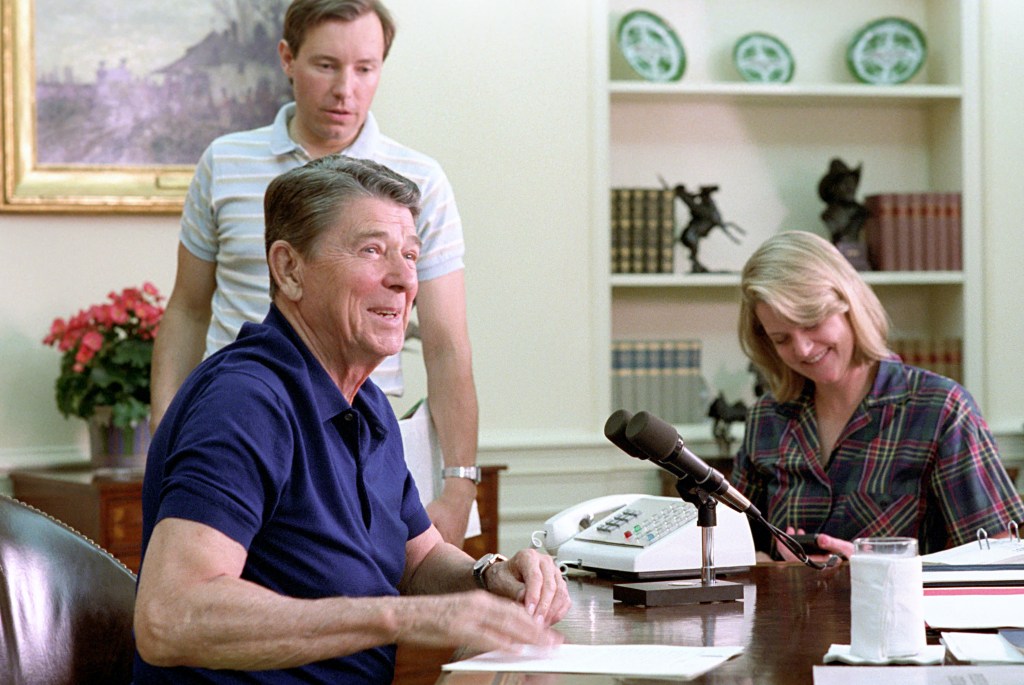
President Reagan makes a radio address to the Nation on voluntarism.
President Reagan participates in a photo opportunity with Secretary of Transportation Elizabeth H. Dole.
The Immigration and Naturalization Service has drafted a bill that would sharply enhance the Government’s power to prevent, detect and punish violations of immigration law. One of the most far-reaching provisions says that aliens for whom a final deportation order has been issued could be arrested not just by Federal agents but by any state or local law-enforcement officer designated by the Attorney General. The bill does not specify how many officers would have that authority, but a confidential report by the immigration service says this provision would permit the Federal Government to use a “nationwide network of law-enforcement agencies to assist in effecting the removal of dangerous and undesirable aliens in a cost-effective manner.” Under the draft bill, aliens who enter the United States illegally or who stay longer than authorized could be barred from the country for one year. The immigration service says this may be “the most important proposal” in the bill because it seeks to interrupt the process by which aliens violate the law, gain a foothold in the United States, then exploit that position to obtain job offers from employers who petition the Government to grant legal status to the aliens. Now, even aliens caught violating the law can obtain permanent residence or other benefits, the immigration service says.
The quality of Reagan Administration nominees for Federal appeals courts has dropped significantly in President Reagan’s second term, according to ratings compiled by the American Bar Association. The ratings show that half of the 28 lawyers nominated as appeals court judges since January 1985 were found to be only minimally qualified by the association’s judicial screening panel. In the first term, about 36 percent received a similar ranking — “qualified” or “qualified/unqualified.” The comparable figure for appeals court nominees in the Carter Administration was only 25 percent.
Senator Gary Hart said last week that he assumed Governor Cuomo would seek the Democratic Presidential nomination in 1988 and would start as the party’s best financed candidate. The Colorado Democrat, considered a leading contender for his party’s nomination, also said that Mr. Cuomo could expect strong support among party and union leaders. He added that Mr. Cuomo would have ample time to begin a Presidential campaign if he were re-elected Governor in November, even though he could be tied down in the months before the state budget is enacted next April 1.
Nine weeks into the espionage and tax fraud trial of Jerry A. Whitworth, prosecutors have begun detailing vast amounts of evidence as to the financial dealings of the defendant in an attempt to prove he received $332,000 in exchange for stolen Navy cryptographic data. Because the Government has the testimony of only one witness in an effort to prove that Mr. Whitworth received cash for passing military information, the prosecution is also attempting to prove charges of tax fraud to bolster the espionage case. Prosecutors are trying to show that the defendant’s expenditures far outstripped his legitimate earnings as a Navy radioman and his retirement benefits. The evidence has done much to dispel the image Mr. Whitworth had presented of living in modest style in a mobile home in Davis, a community east of Sacramento, where Mr. Whitworth’s wife, Brenda L. Reis, attended the University of California. She earned a doctorate in nutrition while Mr. Whitworth floundered in his attempts to make a new career after his retirement from the Navy in October 1983 as a chief petty officer.
One morning last August, Robert Friedrick, an agent of the Federal Bureau of Investigation, met with Justice Department officials to answer questions about the bureau’s relationship with Jackie Presser, the teamsters’ president. Mr. Friedrick, a former marine who won a Purple Heart in Vietnam, headed the F.B.I.’s organized crime squad in Cleveland. He is said to have used Mr. Presser as an informer who had access to Cleveland’s underworld bosses. The Government contends that at the meeting with the Justice Department officials, Mr. Friedrick made false statements that undermined a politically sensitive Labor Department investigation of payroll padding in Mr. Presser’s local.
Two men whose careers have symbolized the poles of Southern politics are seeking the Democratic nomination for Governor in the Arkansas primary Tuesday, while in another race a national Republican organization has provided support to a Democrat who seeks to unseat a Congressman from eastern Arkansas. Governor Bill Clinton, a Rhodes scholar who has tempered his early liberalism, is seeking a fourth term. He was first elected Governor in 1978, when he was 32 years old, and is considered a rising figure in the national party. He is chairman-elect of the National Governors’ Association. His challenger is former Governor Orval E. Faubus, 76, who was once a colossus in the state. He sent the Arkansas National Guard to Little Rock in 1957 to stop black students from integrating Central High School in a test of the Federal Government’s determination to carry out the mandate of courts to end school segregation. President Eisenhower nationalized Mr. Faubus’s Guard and sent an airborne unit to the city to enforce the desegregation order. Mr. Faubus served six terms as Governor before he retired in 1967.
A junior at Johns Hopkins University was charged with three counts of attempted murder and arson today for allegedly firebombing a campus shanty built to protest South Africa’s policy of strict racial segregation. The police said Russell Abrams, a 20-year-old junior, was apprehended by students sleeping in adjoining shanties shortly after the attack early today. He was charged with three counts of attempted murder and arson, and was jailed pending a bond hearing. One of three students in the shanty, Kevin Archer, 28, suffered first- and second-degree burns on 15 percent of his arms and lower body.
The police arrested 74 antinuclear activists who staged a sit-in today outside the gates at the nearly complete Seabrook reactor. The demonstration, the largest at the plant since 1980, was one of 40 planned at atomic plants as part of a National Day of Nuclear Protest coordinated by the Washington-based Nuclear Information and Resource Service in response to the disaster at the Chernobyl nuclear plant in the Ukraine. In Washington, about 200 antinuclear protesters gathered across from the White House in Lafayette Park in what the United States Park Police called a peaceful demonstration. Organizers estimated that more than 1,000 protesters turned out for a march on the Seabrook plant.
Homosexual men in San Francisco say that some health insurers are discriminating against them in issuing insurance and evaluating claims because of the prevalence of AIDS among homosexuals. A civil lawsuit filed in San Francisco Superior Court this month asserts that Great Republic Life Insurance has illegally tried to protect itself from AIDS-related claims by requiring a special questionnaire of all unmarried men in occupations that the company says have high numbers of AIDS cases. The plaintiffs in the suit say this policy discriminates against homosexuals because homosexuals account for a disproportionate number of cases of acquired immune deficiency syndrome, a fatal illness that destroys the body’s immune system. They say the suit is the first of its kind in the nation.
Long before any hands could come together this weekend in an attempt to form a human chain across the country, a vastly greater nationwide network of technology had to be formed to coordinate the event. The organizers of Hands Across America are seeking to raise $50 million to combat hunger and homelessness by forming a chain of people this afternoon from New York to California. They may not succeed in getting more than 5 million volunteers, each paying at least $10, to join hands in an unbroken line stretching 4,152 miles from Long Beach Pier in Los Angeles to the Battery in New York. But they have already succeeded, as no one has before, in using modern technology to link widely distant areas with large and small computers, telephones, television, radio signals, satellites, electronic mail and other communications systems.
Lower fuel costs brighten farm income prospects, according to agricultural economists. Total agricultural costs that can be attributed to fuel and petroleum byproducts have declined at an annual rate of about $2.5 billion, they say, and they expect most of that to be divided by about 650,000 of the country’s 2.3 million farmers. Bruce Wilkinson raises corn and soybeans on rolling hills here about 50 miles north of Kansas City. Bill Turrentine grows wheat on the level plains near Garden City, out in western Kansas. But both have a lot in common this year. They are still struggling, like other grain producers, under depressed crop prices, but they are seeing the first ray of cheer in a long time. For, like other farmers, they are sharing with consumers major benefits from the lower cost of petroleum.
Free tickets, champagne, caviar and increased security against terrorists are a few of the enticements airlines are using to lure reluctant Americans to travel abroad. International travel has accounted for about $8 billion a year in airline ticket sales, but travel agents say bookings by Americans for trips abroad this summer are only about half what had been expected. Pan American World Airways is advising travelers of stepped-up screenings of passengers and baggage. It is also posting armed guards to keep watch over its planes at airports.
In what officials here say is an unfortunate first, the Houston School District has established a program to deal with the increasing problem of students who bring guns and other weapons to school. The availability of guns here, even for children, was widely publicized early this year after 12 Houston youngsters were shot, six of them fatally, while playing with guns, in a two-month period. But guns and other weapons have become a problem urban schools across the country, officials say. “Mostly we see .22 pistols, little .25 automatics or .38 revolvers, but we did have one kid bring a fully loaded .357 magnum to school,” said Les Burton, assistant superintendent for security of the Houston district, which has 192,000 student district.
Violent, fast-moving thunderstorms with winds up to 75 miles an hour dumped nearly 4 inches of rain in Fort Worth, Texas today, caving in part of the roof of a crowded bowling alley. At least four deaths were attributed to the storm. The rains swelled creeks and flooded underpasses, the police said. Three children were reported missing, said a police spokesman, Doug Clarke. The storm collapsed the roof at Don Carter’s All-Star Bowling Lanes as more than 300 people watched a state bowling tournament. At least 14 people were injured, said a spokesman, Pat Svacina.
American country singer Garth Brooks (24) weds songwriter Sandy Mahl; they divorce in 2001.
Stanley Cup Final, Saddledome, Calgary, Alberta: The Montréal Canadiens beat the Calgary Flames, 4–3 for a 4–1 series victory and the Cup. The win gave Montréal their 23rd Stanley Cup, and their 17th in their last 18 Finals appearances dating back to 1956. Canadiens rookie goaltender Patrick Roy was awarded the Conn Smythe Trophy as the playoff MVP. It was the first all-Canadian finals since Montréal lost to the Toronto Maple Leafs in 1967, the last year of the Original Six era. This was the only time between 1980 and 1988 that neither the Edmonton Oilers (4 wins) nor the New York Islanders (4 wins) won the Stanley Cup.
Major League Baseball:
The Cubs edged the Astros, 4–3. Jerry Mumphrey scored the tying run on Dave Smith’s wild pitch and Leon Durham drove home the winning run for Chicago. It was the first time this season Houston’s bullpen had lost a save situation after 13 attempts. With Houston leading, 3–2, Mumphrey walked to open the eighth inning and Smith (0–2) relieved Charlie Kerfeld. Gary Matthews singled, sending Mumphrey to third and when the fourth ball to Ryne Sandberg was a wild pitch, Mumphrey scored and Davey Lopes, running for Matthews, went to third. Keith Moreland hit into a force play at second as Lopes held at third, but Lopes scored when Durham hit a grounder to first. George Frazier (2–3) was the winner and Lee Smith pitched the ninth inning to pick up his sixth save. The Astros scored in the first inning against Guy Hoffman on singles by Bill Doran and Billy Hatcher and a double-play grounder by Phil Garner. Garner led off the sixth with a single, stole second and went to third on an infield single by Jose Cruz. Glenn Davis hit a sacrifice fly and Kevin Bass hit a double to make it 3–0. The Houston starter, Mike Madden, took a two-hit shutout into the bottom of the sixth inning, but Shawon Dunston doubled and stayed at second as Manny Trillo, a pinch-hitter, singled off Garner’s glove at third. Kerfeld retired Mumphrey on a tapper back to the mound, but walked Matthews, loading the bases. Sandberg hit a sacrifice fly that pulled the Cubs to within 3–1. The Cubs added a run in the seventh inning. Durham singled, went to third on Ron Cey’s double and scored on Dunston’s infield ground out.
George Bell hit a three-run home run to cap a four-run fifth inning today and Lloyd Moseby drove in four runs to lift the Toronto Blue Jays to a 9–6 victory over the Cleveland Indians. The Cleveland starter, Phil Niekro, seeking his 304th career victory, took a 6–3 lead into the fifth inning, but departed after the Blue Jays loaded the bases on singles by Buck Martinez and Rance Mulliniks and a fielding error by Tony Bernazard, the second baseman. Jamie Easterly (0–2) replaced Niekro, and Martinez scored as Cecil Upshaw forced Mulliniks at second base. Bell then hit a 1–1 pitch over the left-field fence for his fifth home run of the season. Moseby stroked a two-run single in the ninth to make it 9–6. The relievers Dennis Lamp and Mark Eichhorn held the Indians hitless over the final five innings. Lamp (1–3) pitched two and two-thirds innings for the victory, and Eichhorn picked up his fourth save. Lamp entered the game with a 9.43 earned run average. The Indians took a 4–0 lead against the Toronto starter, Dave Stieb, in the second inning on a three-run double by Brook Jacoby and a run-scoring single by Brett Butler. Toronto scored three runs in the third inning with two out. Martinez, hitting .128 before the game, singled and took third on Damaso Garcia’s double. Moseby doubled home two runs and scored on Mulliniks’s single to center. Otis Nixon singled home an Indians’ run in the third inning and Chris Bando’s first home run since September 16, 1984, gave Cleveland its 6-3 lead in the fourth inning. The left fielder, Mel Hall of Cleveland, was ejected in the second inning for charging the mound after a pitch by Stieb hit him in the back.
Lance Parrish hit two home runs and drove in three runs while Jack Morris pitched a three-hitter to lead Detroit to a 4–1 win over the A’s. Morris (4–4) struck out eight and walked two. He yielded a run in the fifth when Mike Davis doubled and eventually scored on a squeeze bunt by Bill Bathe. Oakland’s Chris Codiroli (3–5) gave up six hits and three runs over the first six innings. It was the second time this year Parrish has hit home runs twice in a game.
Jim Sundberg blooped a double into center field with two outs in the bottom of the ninth inning to score George Brett from first base and lift Kansas City to a 7–6 triumph over the White Sox. Brett had walked with one out. After Frank White struck out, Sundberg sent Bob James’ 0–1 offering into center field. Brett never slowed, and the relay was just off line enough to allow him to slide in safely.
At Dodger Stadium, Fernando Valenzuela (7–2) tosses a two hit shutout in beating the Phils, 6–0. Von Hayes has both hits for the Phillies, while Mike Scioscia has 4 hits for the Dodgers. This is the third time that Hayes has had the only hits for the Phils. Philadelphia rookie Fred Toliver, 0–2 and still looking for his first major-league victory, matched Valenzuela until the seventh when he yielded one-out singles to Mike Marshall and Mike Scioscia. Greg Brock struck out before Stubbs tripled into the left-center-field gap.
Rob Deer drove home three runs with a homer and a triple and Juan Nieves allowed eight hits to lead Milwaukee to a 6–3 victory in Minneapolis. Deer, who entered the game hitting .204, opened the scoring in the second inning with his sixth homer of the year, a bases-empty shot, and also hit a two-run triple in the eighth to help Milwaukee snap a three-game losing streak. Nieves (4–1) walked none and struck out six in throwing his second complete game of the season. The left-hander, who has won four straight decisions, retired the last 10 Minnesota batters in a row. Nieves, who lasted just two-thirds innings in his last start, against Cleveland, sent the Twins to their 11th loss in the last 13 games.
It was, as far as the Yankees were concerned, a day full of untimely blunders: six errors that led to three unearned runs by the California Angels. But there was also redemption. Mike Pagliarulo, who made two errors at third base and dropped a ball that helped the Angels tie the game in the top of the ninth inning, hit a decisive single through the right side of the infield in the bottom of the ninth that lifted the Yankees to a 7–6 victory yesterday at the Stadium. Pagliarulo’s hit scored Ken Griffey from third base to give the Yankees their fourth straight victory and sixth in seven games. Griffey, bothered by tendinitis in both Achilles tendons, had come off the bench in the seventh inning to deliver a two-run homer off Donnie Moore and give the Yanks a 5–4 lead. Dave Winfield then stretched it to 6–4 with a towering home run to left that struck the foul-pole screen near the upper deck. But it did not stand up. The Yankees, some of whom were critical of the condition of the infield, had not made six errors in a game since August 24, 1975.
The Reds beat the Pirates, 4–2. Kurt Stillwell, a rookie, tripled home two runs in the second inning and Bill Gullickson got his fourth straight victory. Stillwell, who was hitting .167 entering the game, lined his triple into the right-field corner, scoring Nick Esasky and Buddy Bell, both of whom had singled. It was only the second extra-base hit in the major leagues for Stillwell. Stillwell scored on an infield out by Ron Oester. Gullickson (4–3) pitched a complete game. Mike Bielecki (3–3) took the loss. The other Cincinnati run came in the fifth inning. With two out, Eddie Milner walked and stole second. Pete Rose followed with a single to score Milner.
Rafael Santana hit a two-run double and Gary Carter had a pair of run-scoring singles to lead the New York Mets to a 5–4 win, which snapped San Diego’s four-game winning streak. The Mets survived a pair of home runs by former Reno Padres star Kevin McReynolds as Bruce Berenyi, 2–0, went 5 ⅓ innings to notch his fifth consecutive victory over the Padres dating back to 1982. Mark Thurmond, 2–4, suffered his third consecutive bad outing as the Mets racked him for six hits and four runs in 333 innings. In his last three games, Thurmond is 0–3 and has allowed 16 hits and 14 runs in just 5 ⅓ innings.
The Orioles edged the Mariners, 5–4, in Seattle. Cal Ripken’s leadoff 10th-inning homer off of Mark Husimann gave Baltimore the victory. Ripken’s homer, his sixth of the season, came after Seattle’s Gorman Thomas tied the game with a two-run homer in the ninth, erasing the last of Baltimore’s 4–0 lead.
Hubie Brooks hit a home run and drove in three runs today to lead the Montreal Expos past the San Francisco Giants, 7–4. Andres Galarraga also hit a home run and Tim Wallach had two sacrifice flies as Montreal won its third straight game and 15th of its last 20. Brooks, who raised his batting average to .342, leads the National League with 38 runs batted in. He hit a home run for the second straight game and brought his home run total to 12. Brooks’s two-out home run in the third inning broke a 1–1 tie and put the Expos ahead to stay. He singled home a run in the seventh and added a run-scoring grounder in the ninth, giving him 31 RBIs in the last 22 games. Andy McGaffigan (3–1) gave up two runs on four hits in five and two-thirds innings for the victory. Jeff Reardon pitched two and one-third innings for his 10th save. Wallach hit a sacrifice fly in the first inning against Vida Blue (1–3), who was making his first appearance since coming off the disabled list. The Giants tied it in the bottom of the first on a sacrifice fly by Jeff Leonard. After Brooks’s home run gave the Expos the lead, Galarraga led off the fourth with a home run. San Francisco made it 3–2 in the sixth on a run-scoring double by Luis Quinones. Montreal chased Blue with two runs in the seventh inning. Mike Fitzgerald led off with a double and scored on a single by Tim Raines. Brooks hit his run-scoring single off the reliever Juan Berenguer. Will Clark hit a two-run home run, his sixth, in the seventh to pull the Giants to within 5–4. The Expos added two insurance runs in the ninth inning on Brooks’s bases-loaded grounder, which was bobbled by Jose Uribe, the shortstop, for an error, and Wallach’s sacrifice fly.
The Cardinals downed the Braves, 9–5. Pitcher Ray Burris drove in four runs and hurled six innings to lead St. Louis. Burris, 2–0, has won both of his starts for the Cardinals since coming up from the minors and in each one he helped himself with a three-run double in the second inning. Burris, who was signed by St. Louis after being released by Milwaukee, checked Atlanta on six hits and two runs in his six innings.
Veteran Bobby Jones, called up from the minors earlier in the week, hit a two-run bases-loaded single with two out in the bottom of the ninth inning as Texas snapped Boston’s six-game winning streak with a 3–2 Rangers’ victory. Loser Bob Stanley, 2–2, relieved Joe Sambito after Pete O’Brien walked to start the Texas ninth. After striking out Pete Incaviglia, Stanley gave up a single to Gary Ward that sent O’Brien to third and walked Darrell Porter to load the bases. He retired George Wright on a fly to short left, with the runners holding. But Jones, batting for Geno Petralli, bounced a 2–2 pitch into right field for the tying and winning runs.
Houston Astros 3, Chicago Cubs 4
Toronto Blue Jays 9, Cleveland Indians 6
Oakland Athletics 1, Detroit Tigers 4
Chicago White Sox 6, Kansas City Royals 7
Philadelphia Phillies 0, Los Angeles Dodgers 6
Milwaukee Brewers 6, Minnesota Twins 3
California Angels 6, New York Yankees 7
Cincinnati Reds 4, Pittsburgh Pirates 2
New York Mets 5, San Diego Padres 4
Baltimore Orioles 5, Seattle Mariners 4
Montreal Expos 7, San Francisco Giants 4
Atlanta Braves 5, St. Louis Cardinals 9
Boston Red Sox 2, Texas Rangers 3
Born:
Jordan Metcalfe, English actor (“Genie in the House”), in Kingston-upon-Hull, East Yorkshire, England, United Kingdom.
Mark Ballas, American professional dancer (“Dancing with the Stars”), in Houston, Texas.
Tony Carter, NFL defensive back (Denver Broncos, New England Patriots, Indianapolis Colts), in Tallahassee, Florida.
Kareem Huggins, NFL running back (Tampa Bay Buccaneers), in Irvington, New Jersey.
Died:
Stephen Thorne, 33, American U.S. Navy officer, fighter and test pilot, and NASA astronaut candidate, as a passenger in a plane crash.

