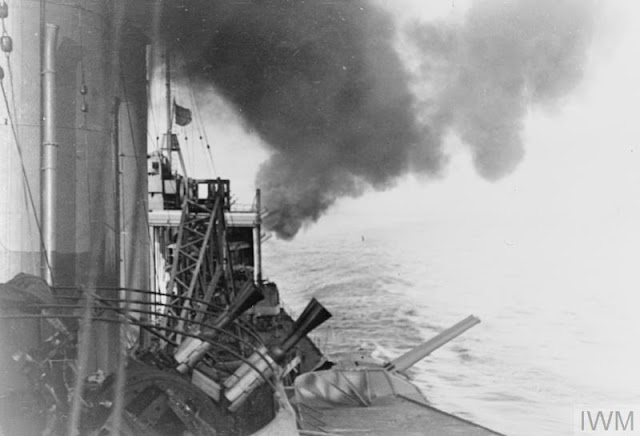
All three British ships that were shadowing the Bismarck from the port quarter had begun to zig-zag in case of a possible U-boat attack. At 0306, taking advantage of the enemy’s disposition and the darkness, Lütjens saw his opportunity to break the contact with his pursuers. The Bismarck increased her speed to 27 knots and turned to starboard, in a maneuver very similar to the one executed the previous afternoon when the Prinz Eugen was detached. The Bismarck succeeded in breaking contact and established a new course of 130º due southeast, to Saint-Nazaire. The British ships tried in vain to re-establish contact with the Bismarck, and at 0401 the Suffolk reported: “Enemy contact lost.”
It is a brilliant maneuver and leaves the entire Royal Navy stumped. The British have to resort to searching the entire North Atlantic for the Bismarck. With no idea where the Bismarck has gone, Rear Admiral Frederic Wake-Walker, commander of the two cruisers shadowing Bismarck, decides to head his three ships (Prince of Wales, Suffolk, and Norfolk) to the southwest — away from Bismarck’s actual direction.
Then, having executed a masterstroke, Admiral Lütjens makes a massive blunder. He sends a long message to Naval Group West headquarters in Paris describing his situation and plans. The British use direction-finding equipment to pinpoint the ship’s location, but make their own error and mistakenly conclude that Bismarck is heading back the way it came to Germany. The Germans did not realize that the contact had been broken, and at 0700 Admiral Lütjens sent the following message to the Group West: “One battleship, two heavy cruisers keeping contact.” At 0900, Lütjens sent another long message to the Group West. Neither message reached Group West until well after 0900. Ironically, Group West had previously sent (at 0846) a message confirming that the British had lost contact. After this, Bismarck kept strict radio silence, but the British had already intercepted her signals allowing them to calculate her approximate position. Unfortunately the British radio direction finding service put her on a northeasterly heading. Thus, the mass of Royal Navy ships heads off in that direction, opening up a path for Bismarck to slip through to a French port. Bismarck spends the 25th heading toward safety without being spotted. It now looks good for the Germans, they only have to stay hidden throughout the 26th to make it to France. That sounds easy… but the entire Royal Navy is looking for Bismarck.
Admiral Tovey sails in the wrong direction for a while before turning to the southeast in pursuit. Now he is well astern of his quarry. Only be slowing her down can her destruction become possible. In the meantime, Force H continues to sail north to take up a blocking position between Bismarck and her new goal of Brest.
At 1625, Lütjens received a message of congratulations from Hitler: “I send to you today my very best congratulation for your Birthday!” That same afternoon, Bismarck’s Chief Engineer, Lieutenant-Commander Walter Lehmann and several crewmen began to construct a dummy funnel. This would give the battleship two funnels and hopefully confuse the enemy, should Bismarck be detected again. During the night of 25/26 May, the Bismarck maintained her course and there were no incidents on board.
At his country home of Chequers, British Prime Minister Winston Churchill is in a foul mood when he hears of the loss of battlecruiser Hood to the Bismarck. Among other things, he snaps at his piano player for playing a somber tune. Churchill loudly expresses his opinion is that the Prince of Wales should have closed on Bismarck rather than turning away and concludes (according to the diary of private secretary John Colville) that the Royal Navy has become a haven for shirkers. Colville also notes that Churchill is well aware by bedtime that the Bismarck is heading for France, and this likely is due to Ultra.
The Germans on Crete continue slowly expanding their lodgment at Maleme airfield, but the Commonwealth troops launch counterattacks and otherwise put up stiff resistance. The Germans now have a good grip on the western portion of the island, but the British are trying to regroup in the eastern half. The battle is still in doubt, but the Germans continue to pour in reinforcements on Junkers Ju 52 transport planes without hindrance. The Royal Navy, meanwhile, has had to retreat from its blocking positions to the north of the island due to the Luftwaffe’s domination of the air.
Luftwaffe Lieutenant-General Kurt Student arrived at Maleme in Crete, Greece. After being reinforced through Maleme airfield on Crete, Greece, German Stuka dive bombers attacked Allied lines at 1600 hours, softening defenses for a ground assault toward Galatas on the northern coast. Elsewhere on the island, German aircraft bombed Heraklion. The Germans occupy Kandanos in southwest Crete. The resolute and unexpected resistance of the defenders infuriates the Germans who resorted to brutal reprisals: mass executions, arson, and other serious destruction.
The British Commandos of Layforce, consisting of 800 men, mainly of ‘A’ and ‘D’ Battalions, with a detachment from ‘B’ Battalion — ‘C’ Battalion (No. 11 (Scottish) Commando) had been sent to reinforce the garrison on Cyprus in case of a German invasion there — departed Alexandria and attempted to land on Crete. They were turned back by bad weather, however, and forced to return to Alexandria where they re-embarked upon the minelayer HMS Abdiel to make another attempt.
The 1st Greek Regiment fights hard at Kastelli on the outskirts of Heraklion. German attempts at seaborne reinforcement come to naught, as a half-hearted attempt to tow a lighter containing two Panzer IIs has to put into port at Kithira when Royal Navy ships are spotted. The Royal Navy brought a small force of commandos into Suda Bay as reinforcements on the 24th, but the vast majority are unable to land today due to poor weather. Basically, the German advance is stalled, but the British are unable to bring enough force to bear to dislodge them.
At 16:00, German troops attack at Galatos with support from Junkers Ju 87 Stukas. Galatos is a major British defensive position on the road to the main Royal Navy base at Suda Bay and one of the most fought-over positions in Crete. The Allies retreat except for one group under Major John Russell. New Zealand Colonel Howard Kippenberger quickly organizes a scratch rescue force to rescue the trapped men. The New Zealand troops mount a fierce charge with bayonets fixed and supported by light tanks, yelling a Maori war chant (haka). The counterattack at Galatos succeeds in freeing Russell and his men, but the Germans regroup, use mortar fire to destroy a British tank, and take back the town later in the day.
The Wehrmacht High Command announced: “Since the early morning of May 20, German paratroops and airborne troops have been fighting British army units on the island of Crete. In a bold aerial assault, the Germans conquered tactically important points on the island with the support of German fighter, destroyer, bomber and dive-bomber aircraft. After receiving further reinforcements by army units, the German troops went on the offensive. The western part of the island is already solidly in German hands. The German Luftwaffe smashed the British fleet when it attempted to intervene in the struggle for Crete, drove it out of the sea territory north of the island, sank and damaged a large number of enemy war vessels and won control of the air over the entire battle zone.”
The British sloop HMS Grimsby was bombed and sunk by Italian aircraft north of Tobruk. The Royal Navy has been running nightly supply missions to Tobruk under cover of darkness. Usually, they pass uneventfully. Today, the Luftwaffe catches sloop HMS Grimsby and accompanying 3471-ton British tanker Helka near the port and sink them about 40 miles northeast of Tobruk. There are 11 deaths on the Grimsby and two deaths on the Helka. A third ship, trawler Southern Maid, escapes damage and picks up the survivors.
The Luftwaffe keeps up the pressure on British shipping at Crete. During attacks on Heraklion, German planes sink 846 ton Greek freighter Leros.
The Royal Navy largely has abandoned the waters north of Crete due to Luftwaffe pressure, at least during the daytime. It does send a sweep north of the island during the night led by light cruisers Ajax and Dido.
A large Royal Navy formation led by battleships HMS Barham and Queen Elizabeth and aircraft carrier Formidable leaves Alexandria at noon. This is Operation MAQ3. The destination is Scarpanto Island, where a Junkers Ju 87 Stuka base is located. The plan is to launch strikes against the Luftwaffe airfield during the night to reduce German airpower in the eastern Mediterranean. The Formidable, however, has many planes that are beset with mechanical problems, but something must be done immediately about the Luftwaffe’s supremacy in the area.
Pierre Laval criticized the Vichy French government during an interview with American journalist Ralph Heinzen in Paris, France. Former Vice Premier Pierre Laval gives an interview to US journalist Ralph Heinzen of UPI at Chateldon Castle, France. Laval states that Hitler had agreed that “after the war” France would play a large role in Europe. Laval views this as a promise by Hitler to “guarantee French independence in post-war Europe.”
Girondins ASP defeated SC Fives 2–0 in the Coupe de France Final.
The commander of Germany’s resurgent navy served emphatic notice on the United States yesterday any American convoying of supplies to Britain would be an “open war act and bare, unprovoked attack” which would justify Nazi action “even against American warships.” These plain-spoken words by Germany’s Grand Admiral Erich Raeder, made public in Berlin the day after the sinking of the mighty British battlecruiser Hood, were carried significantly in a special interview with Domei, official news agency of Japan, Germany’s axis partner.
HMS Eagle arrived at Freetown, Sierra Leone, British West Africa and refueled.
Winston Churchill asks Lord Beaverbrook, who recently (30 April) resigned as Minister of Aircraft Production and currently is Minister of State, to “draw up a proposal” to get a “large infusion of civilian management” into the supply services of the Mediterranean command. The intent is for such supply experts to “take this burden off the Commander-in-Chief.” Churchill long has felt the ferrying of aircraft from Takoradi has been poorly managed, and he also feels that Middle East Commander General Archibald Wavell has assorted failings, so taking this “burden” off Wavell neatly serves two purposes.
As agreed on 20 May 1942, Finland sends a top-ranking military delegation to the Reich regarding possible military cooperation between the two nations. They meet in Salzburg — conveniently close to Hitler’s Berchtesgaden residence. Ostensibly, this meeting is about military coordination in case of a possible Soviet attack, not an invasion of the USSR. Gradually, however, the talks pivot to simply talk of a “military confrontation” without specifying which side initiates it. Artillery General Alfred Jodl gives a lecture on possible operations stretching from northern Finland to the Balkans but continues the charade of refraining from mentioning that these would be offensive, not defensive, in nature.
The Finns have no authority to enter into any agreements, but Lt. General Heinrichs indicates a general approval of the German presentation and eventual military cooperation. He promises to give some official response to the German presentation by 2 June 1941. However, it is unclear exactly what the Finns would be agreeing to, as the Germans continue claiming they are negotiating with the Soviets.
Pravda, organ of the Communist party, found it necessary today to brand as “political nonsense and an idiotic lie” a Berlin report attributed to a Finnish newspaper correspondent that Soviet Russia would lease her grain-rich Ukraine to Germany. Pravda, which said the report came from a writer for the Helsinki Sanomat in the German capital, declared sarcastically: “It is time that adult Finnish journalists stop representing the kindergarten and singing amusing nonsense in a falsetto voice. It is time for them to grow up and get wiser.”
100 troop trains are moved every 24 hours as the German High Command builds up its attacking forces on the Russian border. The Wehrmacht continues moving trains full of troops to Poland in preparation for Operation BARBAROSSA, now less than a month away. There are 100 troop trains sent every 24 hours, with the OKW operating with absolute priority and on a strict timetable.
RAF Bomber Command, Day of 25 May 1941
30 Blenheims on sweeps in the Frisians and off Denmark. Several ships were hit but German fighters were very active and 4 Blenheims were lost.
During its anti-shipping raids today, an RAF plane crashes for unknown reasons (probably anti-aircraft fire) at Den Helder. It crashes into and sinks German the sperrbrecher (functional minesweeper) Silvia. There is some likelihood that the pilot of the falling plane directs it at the Silvia, which would make it a kamikaze strike.
RAF Bomber Command, Night of 25/26 May 1941
48 Hampdens on minelaying operations off Brest and St-Nazaire; bad weather was encountered and only 27 aircraft laid mines. There were no losses.
On Malta, the RAF sends a handful of Swordfish to drop “cucumber” magnetic mines off Lampedusa, which the Axis is using during its convoys to Tripoli. Due to anti-aircraft fire, the mission fails and the Swordfish return with their mines.
Whitehall decides to replace Malta Air Officer Commanding, Air Vice Marshal Forster Maynard, AFC. His replacement at the end of May will be Air Vice Marshal Hugh Pugh Lloyd MV DFC.
The Luftwaffe based at Mosul sends two Bf 110s fo II./ZG76 to raid Habbaniya Airfield on 25 May 1941. One is forced to land behind British lines. The British will repair it using spare parts from other destroyed Luftwaffe aircraft and restore it to flying service. This aircraft is used both in Iraq and in Cairo for testing purposes and is named “The Belle of Berlin,” RAF serial No. HK846.
Eleven Fiat CR-42 fighters of Italian 155th Squadriglia arrive at Aleppo, Syria en route to Mosul, Iraq.
U-103, commanded by Korvettenkapitän Viktor Schütze, sank Egyptian steamer Radames (3575grt) off Monrovia, Liberia, in 6N, 12W. At 1631 hours on 25 May 1941 the unescorted Radames was hit in the stern by one torpedo from U-103 after being chased for about five hours and sank slowly by the stern about 80 miles from Monrovia, Liberia. The 3,575-ton Radames was carrying iron ore, groundnuts, and groundnut cake and was bound for Barry Roads, England.
U-103 also sank Dutch steamer Wangi Wangi (7789grt) in 5-24N, 12W. At 2213 hours on 25 May 1941 the unescorted Wangi Wangi (Master C. Schoen) was hit in the bow by one torpedo from U-103 and sank after 30 minutes about 90 miles south of Monrovia, Liberia. One Lascarian stoker was lost. The master, 87 crew members and four passengers abandoned ship in a motorboat and a lifeboat, reached the Liberian coast the next day and were taken to Robertsport and later to Freetown. The survivors in one boat were questioned by the Germans, provided the course to Monrovia and offered food and water, but this was refused. The 7,789-ton Wangi Wangi was carrying steel billets, lead, and general cargo and was bound for the United Kingdom.
Destroyer HMS Jupiter in the Irish Sea was ordered to join the screen of battleship HMS Rodney. The destroyer did not join until after Bismarck had been sunk.
Faroes motor fishing vessel Harry (125grt) was badly damaged by German bombing thirty miles north of Rattray Head. The vessel was sunk seventeen miles north by west of Kinnaird Head after an unsuccessful attempt to tow.
German steamer Silvia (1049grt) was sunk by bombing near Den Helder.
British operation MAQ 3 was put into motion. Battleships HMS Queen Elizabeth and HMS Barham, aircraft carrier HMS Formidable (with twelve aircraft), and destroyers HMS Jervis, HMS Nubian, HMS Hereward, HMS Kandahar, HMS Hasty, HMS Janus, HMAS Voyager, and HMAS Vendetta departed Alexandria.
During the night of 25/26 May, light cruisers HMS Dido and HMS Ajax and destroyers HMS Kelvin, HMS Jackal, and HMAS Napier swept north of Crete.
Greek steamer Leros (846grt) was sunk by German bombing at Heraklion.
British oiler RFA Cairndale and store ship City of Dieppe departed Gibraltar, escorted by submarine HMS Severn. The storeship was detached in 43-00N, 35-00W for St Johns, Newfoundland. The oiler and submarine patrolled in the vicinity of that position to refuel British ships as necessary. On the 25th, submarine Severn was recalled to patrol in the Straits of Gibraltar against a possible passage by the German battleship Bismarck. Submarines HMS Severn and HMS Clyde departed Gibraltar on the 27th for this patrol. When word of the sinking of the Bismarck was received, submarine Severn was ordered to overtake storeship City of Dieppe and escort her. This was later cancelled and submarine was ordered to return to Gibraltar. Oiler Cairndale was ordered to return to Gibraltar.
Destroyer HMS Wishart arrived at Gibraltar from Bathurst.
Light cruiser HMS Dunedin departed Gibraltar for Freetown. Her defective boiler had been blanked off.
Destroyers HMS Fearless, HMS Foresight, and HMS Foxhound departed Gibraltar to meet arriving aircraft carrier HMS Argus and escort her to Gibraltar.
Convoy SC.31 arrived at Hvalfjord on the 25th to avoid contact with the German ships with destroyers HMS Campbeltown, HMS Wanderer, and HMS Westcott, sloops HMS Fleetwood and HMS Rochester, and corvettes HMS Auricula, HMS Dianthus, HMS Marigold, HMS Nasturtium, HMS Periwinkle, and HMS Primrose which had relieved the destroyer HMS Bulldog group the day before. The convoy was able to proceed and arrived at Liverpool on the 30th.
Convoy OG.63 departed Liverpool scorted by destoyer HMS Reading, corvettes HMS Hibiscus and HMS Pimpernel, ocean boarding vessel HMS Corinthian, and anti-submarine trawlers HMS Runswick Bay and HMS St Melante. The ocean boarding vessel was detached that day. On the 26th, the convoy was joined by destroyer HMS Vanquisher and sloop HMS Wellington. On the 27th, corvette HMS Freesia joined the escort. Destroyer Vanquisher was detached on the 27th to Fleet operations and later joined SL.74. On the 30th, destroyer Reading and corvettes Freesia, Hibiscus, and Pimpernel were detached to convoy SL.74. Corvette HMS Jonquil, Dutch submarine HNLMS O.23, and anti-submarine trawler HMS Lady Hogarth joined the convoy on 1 June. Destroyer HMS Wrestler departed Gibraltar on 7 June after submarine attacks to reinforce the convoy to Cape Spartel, then join aircraft carrier HMS Victorious. On 7 June, corvette HMS Azalea joined the convoy. The convoy arrived at Gibraltar on 7 June.
A Convoy to Tobruk consisting of British tanker Helka (3471grt) escorted by sloop HMS Grimsby and trawler HMS Southern Maid was attacked by Italian bombers near Tobruk. Steamer Helka was sunk and sloop Grimsby (Cdr K. J. D’Arcy) was hit by two bombs and also sunk forty miles northeast of Tobruk. Eleven ratings were lost on the sloop. One crewman and one gunner were lost on the tanker. Trawler Southern Maid rescued the survivors from both ships.
An Italian convoy departed Naples on the 24th for Tripoli with troopships Conte Rosso (17,879 tons; with 2729 troops and crew), Marco Polo (12,272grt), Victoria (13,098grt), and Esperia (11,398grt) escorted by destroyers Freccia and Camicia Nera and torpedo boats Procione, Orsa, and Pegaso. The convoy was supported by heavy cruisers Trieste and Bolzano and destroyers Corazziere, Lanciere, and Ascari. The convoy was just clearing the Straits of Messina on the 25th when submarine HMS Upholder sank the Conte Rosso ten miles 85° from Capo Murro di Porco. Torpedo boats Cigno, Pallade, and Clio were involved in rescuing the survivors from the troopship. After the loss of the Conte Rosso, the convoy returned to Naples.
Convoy HG.63 departed Gibraltar escorted by sloop HMS Scarborough, Dutch submarine HNLMS O.23, and corvettes HMS Geranium and HMS Jonquil, and anti-submarine trawler HMS Lady Hogarth. The corvettes, submarine, and trawler were detached on the 31st. On 2 June, the convoy was joined by destroyers HMS Campeltown, HMS Wanderer, and HMS Westcott, corvettes HMS Auricula, HMS Marigold, and HMS Periwinkle, and catapult ship HMS Pegasus. Catapult ship Pegasus was detached on 8 June. The convoy arrived at Liverpool on 9 June.
A warning that a United States convoy system or any United States naval aid to Great Britain would constitute “a plain act of war” to which the German Navy would reply has been voiced by Grand Admiral Erich Raeder, Commander in Chief of the German Navy, in an exclusive interview with the Domei [Japanese news agency] correspondent in Berlin. The interview apparently was timed to follow the sinking of the British battle cruiser Hood off Greenland that revealed the presence of strong German naval units in the Atlantic. According to the Domei correspondent, Susumu Ejiri, Admiral Raeder said: “I can only confirm President Roosevelt’s opinion that convoying means ‘shooting’ and since according to American statements cargoes of convoyed ships must be regarded as contraband the introduction of such a convoy system would. be not only an unneutral act under international law but a plain act of war and unprovoked aggression.
The U.S. State Department informs German Chargé d’Affaires Hans Thomsen that an investigation into the incident concerning the tearing down of the Reich flag over the German consulate in San Francisco, California, on 18 January has yielded the fact that the individual involved was a U.S. Navy enlisted man who was tried and found guilty by court-martial for the offense, and was serving “an appropriate sentence.” In fact, two sailors had ripped down the flag, and a municipal court had found them guilty, but their sentences had been stayed pending court-martials. One had received a medical discharge in the interim, while the Navy quietly discharged the other, Harold Sturtevant Jr. Sturtevant, incidentally, reenlists on 15 December 1941 and serves in the US Navy again.
Senator Norris, Nebraska Independent, proposed today the United States transfer immediately a substantial number of war vessels to the British or Canadian navies for use in the north Atlantic convoy service. Asserting this might solve the problem of getting war supplies to Great Britain, Norris told reporters he felt the time had come for this country to take whatever risk might be involved in reducing its fleet’s striking power to make the ships available to Britain. The necessity of giving further naval assistance to Great Britain was emphasized, Norris added, by the sinking of the British battlecruiser Hood by the German battleship Bismarck.
In all manufacturing operations, whether these involve baby buggies or bombers, there is one essential requirement for mass production. That is machine tools. If there is a “most important item” in the current defense program, involving multiple production of ships and airplanes and guns, it is machine tools, a term covering the intricate contrivances which engineers characterize as “the only machines that reproduce themselves.” A year of defense effort has made the term “machine tool” commonplace in American speech, but there still is almost no understanding of what constitutes a machine tool or the infinitely complicated process back of its production.
Public interest in the national emergency and in the defense program has resulted in setting new records for incoming mails and telegrams to Washington. President Roosevelt’s mail alone when the last check was made the middle of last week, was averaging more than 10,000 letters, post cards and petitions daily. Never before, except during Christmas week of last year, have Washington’s incoming mails been so heavy as they are now, and the telegraph companies report a new peak for incoming messages.
The total present program for national defense expenditures exceeds $41,000,000,000, or about $310 for every man, woman and child in the United States, the Office of Production Management estimated today.
President Roosevelt will sign the Farm Loan Bill providing for wheat, cotton, tobacco and rice loans up to 85 per cent of parity prices, and in return Congressional farm leaders will cut the fund for direct parity payments to farmers from $450,000,000 to $212,000,000 in the incompleted appropriations measure of the Department of Agriculture, it was learned today.
Attempting the most ambitious experiment of its kind ever tried in any city in this part of the country, Newark, New Jersey sought to achieve total blackout between 12:15 and 12:30 A.M. today. The city succeeded in achieving a very respectable dark gray, shot through here and there with white, orange and green specks.
Pleas for support of the Administration’s foreign policy and for American aid to China’s 40,000,000 war refugees were voiced by Wendell L. Willkie and Governor Lehman yesterday afternoon in New York’s Columbus Circle as China Week ended with a colorful parade sponsored by the United China Relief.
Nine Michigan residents, five of them children, were killed today as a fast passenger train demolished an automobile at a downtown Upper Sandusky, Ohio, crossing. Wreckage was strewn along the tracks for seven blocks. It took investigators nine hours after the crash to determine the number killed. The train, the Pennsylvania railroad’s “Trail Blazer,” was 15 minutes behind schedule when it hit the auto at the flasher-light protected crossing. Engineer Dan Shepler of Fort Wayne, Indiana, estimated the train’s speed at 70 miles an hour. Marshal Adolph Kirchner said the victims, members of two families, were from Saginaw and Hamtramck.
A severe electric storm caused more than $10,000 damage to San Francisco Bay Area power facilities and interrupted interurban electric train service for two hours today. Four trains were stalled on the Bay Bridge, and streetcar service throughout the East Bay was halted when lightning struck one power company sub-station and damaged transformers in at least seven others. Rainfall was slight. It was the first May electric storm in the Bay Area in 13 years.
Major League Baseball:
Pete Reiser hits his only career grand slam to pace the Dodgers to an 8–4 win over the Phils. Reiser’s home run comes off Ike Pearson, who had beaned him just a month earlier. That Brooklyn needed Reiser’s homer is an understatement. In all, the Dodgers collected only five hits, as compared with double that total by the Phillies. Whitlow Wyatt started for the home team, but left hurriedly in the fourth after the first two batters had hit safely. Bill Swift, the winner, and Curt Davis mopped up. For the Phillies Lefty Lee Grissom, a former Dodger, and Pearson were the hurlers, with Pearson the loser.
At Braves Field, Johnny Rucker has 4 hits, including a triple, and Babe Young clouts a 2-run homer as the Giants whip the Braves, 6–2. The Steadman murder trial jury is in the stands for the game. Lefty Joe Sullivan was the victim of the Giants’ first thrust which, though it came as early as the third, subsequently proved the decisive move. For the Giants came up with a cluster of three and that sufficed not only to put Sullivan out of action but to give him his second defeat as well. A single by Rucker, a sacrifice and another single by Harry Danning pushed one tally over. The next two followed almost immediately when Babe Young belted his sixth homer into the right field bleachers.
Charley Root, the Cubs’ 42-year-old right-hander, won a 3–2 ninth-inning decision over Paul Derringer and the Reds before 18,663 fans today. Billy Nicholson doubled to open the frame and, after a sacrifice, Catcher Charley George singled him home. The blow broke a 2–2 deadlock existing since the third inning. Ernie Lombardi staked Cincinnati to a 2–0 lead in the second with his season’s fourth homer after Third Baseman Chuck Aleno had smashed a single off Root’s glove. Rookie Lou Novikoff homered to halve the advantage in the home second and in the third Stan Hack tripled and knotted the count on Phil Cavarretta’s fly.
The first-place Indians beat the Browns, 6–0, behind Bob Feller (9–2). More than 20,000 fans were on hand to see Feller’s fireball. They also saw Jeff Heath get a triple, a single and his ninth homer of the season. Heath became the first batter ever to loft a ball into the upper deck of the Stadium. Feller gave up seven hits and allowed only two passes. He struck out three men each in the second, third and sixth. Don Heffner’s single in the fifth was the first St. Louis hit, but in the sixth Joe Grace, George McQuinn and Roy Cullenbine singled to fill the bases. Feller struck out the next three batters. Heath’s triple in the second, behind Trosky’s single, scored the first run and Jeff came home on Gene Desautels’s fly. His homer came in the fourth.
Hal Newhouser weakened in the seventh today and the White Sox scored seven runs in that inning for a 7–3 victory over the Tigers. Three hits, three walks and an error marked the Chicago rally. The Sox thus gained an even break in the four-game series. Newhouser yielded four hits during the first six innings, but the Sox, runless for twenty-six consecutive frames, tagged him for two at the start of the seventh. Al Benton and Tommy Bridges came to the mound before the inning ended.
Going 4-for–5, Ted Williams raises his batting average over .400 for the first time during the season as the Red Sox trounce the Yankees, 10–3, at the Stadium. Lou Finney and Dom DiMaggio score 3 times for the Sox. Williams’ run to be the first since Bill Terry in 1930 to exceed the magic number will be marked in newspapers throughout the season, although it will often give way to the batting streak by Joe DiMaggio. DiMag singles today, off Boston’s Lefty Grove. Grove thus joins two of baseball’s most famous streaks — Joe’s current hitting streak and Ruth’s 60 homers in 1927. Lefty served up a gopher on September 27, 1927. Lefty also strikes out 4 times today.
The Athletics knocked Dutch Leonard out of the box with a five-run rally in the eighth inning today and scored a 7–3 victory for a sweep of the three-game series with the Senators. Jake Early’s homer in the seventh gave Washington a 2–1 lead, but Wally Moses singled a tally across in the same frame to tie the game. This came in one of the season’s oddest plays. Moses flied out, but returned to the plate for another turn. It was explained that he had called for time out, but Leonard pitched anyhow. The outfielder then singled.
The Cardinals lost another rookie star to the injury list today but went on to take a double-header from the Pirates, 6–4 and 4–3, and sweep a four-game series. Frank Crespi, second baseman, whose sensational play has featured the St. Louis club’s home stand, fractured a finger in attempting to stop a hot grounder from the bat of Lee Handley in the first game and probably will be out at least two weeks. Steve Mesner, who replaced him, slammed a double with the bases full in the eighth inning to drive in three runs. In the field Jimmy Brown moved over to second and Mesner took third. Pittsburgh rallied in the ninth to score one run after filling the bases with none out. The Cards were outhit in both games, 15 to 10 in the first and 12 to 11 in the nightcap. The twin victory extended their winning streak to six straight games and increased their margin over Brooklyn to two and a half.
Philadelphia Phillies 4, Brooklyn Dodgers 8
New York Giants 6, Boston Braves 2
Cincinnati Reds 2, Chicago Cubs 3
St. Louis Browns 0, Cleveland Indians 6
Chicago White Sox 7, Detroit Tigers 3
Boston Red Sox 10, New York Yankees 3
Washington Senators 3, Philadelphia Athletics 7
Pittsburgh Pirates 4, St. Louis Cardinals 6
Pittsburgh Pirates 3, St. Louis Cardinals 4
5,000 drown in a storm at Ganges Delta region in India.
Many divisions of Chinese troops have broken out of a Japanese encirclement in the Chungtiao Mountains in South Shansi Province and now are counter-attacking the Japanese from new positions in Southwest and Southeast Shansi, according to reports from Chungking.
At Haiphong, French Indochina, Japanese soldiers remove $10 million worth of American goods from two warehouses. Japanese soldiers broke down the doors of two Haiphong warehouses today and removed $10,000,000 worth of United States products belonging to two American companies. The goods had been blocked from reaching the Central Chinese Government. The companies are the Far Eastern Trading Company and the North American Syndicate. The Japanese, charging that the American companies were merely blinds to cover the real Chinese owners, had prevented reshipment of the goods since last September. While Charles Reed, the United States consul, made repeated efforts to release the products, the Japanese repeatedly demanded that the Indo-Chinese Government turn them over to Japanese military authorities.
French colonial authorities have openly admitted that they had no control over the American, goods Japanese soldiers seized at Haiphong today and had told United States authorities that only the Japanese could release the materials, The American Embassy at Tokyo had put diplomatic pressure upon the Japanese and on December 12 a protest from the State Department was handed to the Indo-Chinese government. The Japanese on numerous occasions have raided warehouses and taken various amounts of goods after breaking the doors.
The newspaper Asahi commented today that the sinking of the British battleship HMS Hood and other aggressive German naval action was certain to have an effect on United States preparations to enter the war and upon its conduct in the Pacific. The newspaper did not elaborate on the idea.
Walter Duranty of the New York Times writes in Honolulu: “The odds seem to be against the Japanese entering the war, despite their pledge to Germany, save for one reason. If the United States and Britain cut their oil supply then I think the Japanese will have to fight.”
Born:
Tony Lorick, NFL fullback and running back (Baltimore Colts, New Orleans Saints), in Los Angeles, California (d. 2013).
Bill Young, American rocker, in Daingerfield, Texas (d. 1999).
Naval Construction:
The Kriegsmarine (German Navy) Type VIIC U-boats U-983, U-984, U-985, U-986, U-987, U-988, U-989, U-990, U-991, U-992, U-993, and U-994 are ordered from Blohm & Voss, Hamburg (werk 183–194).
The Royal Navy Bar-class boom defense vessel HMS Barsound is launched by W. Simons & Co. Ltd. (Renfrew, Scotland).
The Royal New Zealand Navy Isles-class minesweeping trawler HMNZS Killegray (T 174) is launched by Cook, Welton & Gemmill (Beverley, U.K.); completed by Holmes.
The Kriegsmarine (German Navy) Type VIIC U-boat U-653 is commissioned. Her first commanding officer is Kapitänleutnant Gerhard Feiler.

