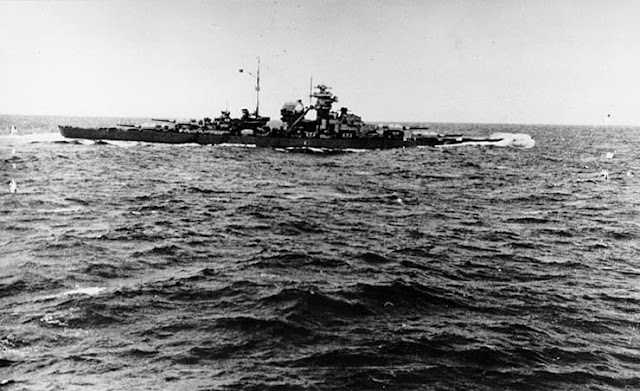
Battleship Bismarck departed Gotenhafen (now Gdynia, Poland) for the Atlantic sortie codenamed RHEINÜBUNG (Rhine Exercise) at 0200 hours and made rendezvous with heavy cruiser Prinz Eugen and destroyers Z-16 Friedrich Eckoldt and Z-23 off Rügen Island at 1200 hours. At 2230 hours, destroyer Z-10 Hans Lody joined the group.
At 02:00, battleship Bismarck leaves the port of Gdynia (Gotenhafen). This begins an operation that will become legendary and reverberate through history. This is the first step of Operation RHEINÜBUNG, a sortie into the North Atlantic. Bismarck and Prinz Eugen, both under the control of Admiral Günther Lütjens, depart without being spotted by spies and rendezvous near Cape Arkona on Rügen Island in the western Baltic. The crews of the Prinz Eugen and Bismarck have not been made aware yet that they are on an actual mission and not another training exercise.
Destroyers Z-23 (Commander Friedrich Böhme) and Z-16 “Friedrich Eckoldt” (Commander Alfred Schemmel) escort the Bismarck. Destroyer Z-10 “Hans Lody” (Commander Werner Pfeiffer) with the Chief of the 6th Flotilla (Commander Alfred Schulze-Hinrichs) join at 22:30. Accompanying the other ships are minesweepers, and the Luftwaffe provides air cover. The flotilla then passes through the Great Belt (a strait between Danish islands) shortly before midnight. One of three straits available, the Great Belt one offers maximum protection against the ships being observed by spies.
The Royal Navy actively patrols the Denmark Strait, which is the route for the two warships into the Atlantic. On patrol, there is cruiser HMS Suffolk. Today, cruiser HMS Norfolk (Rear-Admiral W.F. Wake-Walker, Rear-Admiral Commanding First Cruiser Squadron) departs from Hvalfjord, Iceland to relieve Suffolk temporarily while Suffolk proceeds to Iceland to refuel.
The Battle of Amba Alagi ended in British victory when Prince Amedeo, Duke of Aosta formally surrendered. The Duke of Aosta surrendered with the 7,000 remaining Italian troops at Amba Alagi. Of the 230,000 Italians that started this campaign in East Africa only 80,000 remain.
The Duke of Aosta is treated well by the British, but he is sent to a POW camp. The Duke has contracted tuberculosis and malaria and has not much longer to live. Out of the 230,000 or so Italians who occupied Abyssinia, very few troops remain, and this was the largest remaining force. The British War Cabinet Minutes in the evening summarize the situation;
“This meant the end of Italian resistance in the North of Abyssinia, but enemy forces were still resisting in the South and near Gondar.”
The Italian surrender at Amba Alagi generally is considered the climax of the campaign in Abyssinia. However, Italian units remain at Assab, the last Italian harbor on the Red Sea, and in the lakes district inland. As illustrated below, much hard fighting remains.
Well south of Amba Alagi, at Kolito, Abyssinia, a powerful force of Italians counterattack against an Allied bridgehead. It is a fierce battle, as the Italians use both light and medium tanks to dislodge the Allies. The Italians make some progress, but once their tanks are destroyed, they retreat.
Critical in the destruction of the Italian tanks are the actions of Sergeant Nigel Leakey (cousin of the famous anthropologist) of the 1/6th Battalion, King’s African Rifles, 22nd (East African) Brigade (12th African Division). Leakey dramatically drops out of a tree or a rock outcropping on top of a tank, opens the turret, and shoots the Italians inside (aside from the driver, who he forces to drive to a place of his choosing). Leakey and some of his cronies then try this again with other tanks, but during this second attempt, Leakey is shot dead. Leakey wins the Victoria Cross posthumously for his actions.
German aircraft continued to land at the airfields of Attica and Northern Greece to prepare for the attack on Crete.
German aircraft attacked British airfields on Crete, Greece. To prevent destruction, the British RAF evacuated all aircraft from Crete to Egypt. This action left Crete without air cover. The RAF never had sufficient numbers in Crete to be effective. Luftwaffe raids continue on Crete in preparation for Operation MERCURY, projected to begin on the 20th. The RAF is shot up and relocates its remaining six planes today from Crete to Alexandria, leaving the British troops there without air cover. Eleven Italian submarines (‘Nereide’, ‘Tricheco’, ‘Uarsciek’, ‘Fisalia’, ‘Topazio’, ‘Adua’, ‘Dessie’, ‘Malachite’, ‘Squalo’, ‘Smeraldo’ and ‘Sirena’) take up stations off of Crete. The Luftwaffe continues adding to its planes in mainland Greece. Everything appears set for the start of Operation Mercury in the early hours of the 20th.
The War Cabinet Minutes summarizes the British attitude toward the recent action south of Tobruk:
“In the recent operation around Sollum, Capuzzo and Halfaya Pass we had taken all our objectives, but Capuzzo had afterwards been lost to a counter-attack by at least 40 enemy tanks. The capture of 500 German prisoners was satisfactory, while our forces in Tobruk had also done well.”
This is a very generous appraisal of the results of Operation BREVITY by the British high command. In fact, the British accomplished virtually nothing during Operation BREVITY beyond occupying Halfaya Pass, a useless acquisition in and of itself. They also had lost some ground to Italian attacks at Tobruk. It is somewhat ironic that after many instances of giving Middle East Commander General Archibald Wavell little credit for actual and meaningful victories, Winston Churchill is happy about the truly spurious victory of Operation BREVITY.
However, Churchill still nags at Wavell. In another telegram today, he reminds Wavell that:
“I have asked in earlier telegrams… to be told programme of using tigercubs [tanks recently arrived on the daring Tiger Convoy] when they arrive…. Tremendous risks were run to give you this aid, and I wish to be assured that not an hour will be lost in its becoming effective.”
Churchill goes on to give specific instances of freighters having unloaded tanks, and pointedly asks “Shall be obliged if you will tell me in detail what has happened since those cruisers were landed.” Well versed in details of the conflict, Churchill also gets into such minutiae as how the “German 6-pdr gun” (apparently the very effective German 88 mm flak gun) is being used.
Churchill’s private secretary, John Colville, notes in his diary that “Before going to bed the PM told me he expected the German attack on Crete to begin tomorrow.” Ultra, of course, is the source of Churchill’s uncanny “insight.” However, according to the War Cabinet minutes, Crete did not even come up.
Royal Navy units have been on station off Crete for some time, and now they need to refuel. Thus, they head to Alexandria. While Churchill has his “suspicions” about a coming assault on Crete, he maintains a firm policy of not interfering with military dispositions at lower levels with the information he has obtained through Ultra so as to not reveal his war-winning secret. So, Force A and Force B, including Battleships Barham and Queen Elizabeth, leave the vicinity of the island.
Lieutenant General Sir William Dobbie is appointed Governor and C-in-C on Malta.
Winston Churchill is not happy about one aspect of Malta’s defense: air defense.
Thus, Churchill has decided to replace the Air Officer Commanding RAF Malta, Forster Herbert Maynard. He notes that “Everyone here appreciates the splendid work Maynard has done… but it is felt that a change would be better now.” This is never a good sign for an officer. Maynard will be given a desk job in Coastal Command in the UK. Maynard’s successor is not yet identified, as the first choice turned out to have health issues — but Churchill definitely wants him gone, so is in the process of finding someone else.
Operation SPLIC, a supply convoy to Malta, begins when aircraft carrier HMS Ark Royal, carrying 48 Hawker Hurricanes, departs from Gibraltar under heavy escort from Force H. However, in order to deceive spies, the ships first head west, into the Atlantic, as a feint.
An Axis convoy that includes five freighters and 6212-ton tanker Panuca depart Naples bound for Palermo en route to Tripoli. This convoy has been delayed since the 16th. An unidentified Royal Navy submarine, perhaps HMS Urge, is spotted, and the ships maneuver. This results in a collision between two of the ships, the Panuca and 8230-ton freighter Preussen. They are not badly damaged and continue on.
Iraqis surrender the town of Fallujah after it was subjected to aerial and artillery bombardment by the British. The RAF bombs Fallujah on 19 May 1941 with ten tons of bombs from 57 aircraft, and the advancing British forces take the city. 300 Iraqi troops were taken prisoner. On the same day, German bombers attacked RAF Habbaniyah in Iraq.
The Rashid government in Baghdad releases a typical “everything is fine” communique:
“Our bombers have attacked British tank units, which have suffered substantial losses in men and material. Our reconnaissance flights over Cineldebbana and other locations have proceeded without incident. Enemy aircraft overflew the area surrounding the capital and released several bombs over the base at Rashid without inflicting much damage.”
[Ed: I wonder if this was “Baghdad Bob”‘s dad…]
The Luftwaffe presence in Iraq is diminished by losses, but still capable of attacks. They attack Habbaniya Airfield, which is now safe from ground attack due to the presence of the Kingcol forces that have crossed the desert from Palestine.
RAF planes based in Egypt also attack fields being used by the Luftwaffe in Damascus.
The minutes of the nightly War Cabinet meeting show that Churchill:
“…thought that we might give the French one last chance of stopping the passage of the German air force through Syria. If they did not take this chance, we should proclaim Syria to be an independent Arab State. It was relevant that Syria was territory mandated to France by the League of Nations, and that France had ceased to be a member of the League.”
This is an instance of Churchill using sharp reasoning about legal technicalities in order to give a veneer of legality to a desired military action, i.e., an invasion of Syria. It is a favored tactic of Adolf Hitler, too. In fact, everyone accepts that France has operated a mandate in Syria for years without any question as to its legality.
In a telegram to Canadian leader William Mackenzie King, Churchill notes that:
“Clearly, there is nothing further to hope from Vichy. They have gone over into the German camp and will collaborate with Hitler to the utmost extent that French opinion will allow.”
Churchill suggests that Canada proceed to “complete rupture of relations” with Vichy France. France, of course, has possession of some small islands off the Canadian coast.
In a memo to Foreign Secretary Anthony Eden, Churchill states:
“I do not contemplate a breach of relations between the British and Vichy Governments, but only that we shall knock them about as much as may be necessary.”
All of this worry about Vichy France is due to their agreement to allow Luftwaffe planes to use Syrian airfields on their way to Iraq. Hitler also is fretting about that decision, because he thinks his foreign ministry people have given up too much in exchange for that concession.
Churchill writes an undistributed note which can be viewed as a sort of personal diary entry. He analyzes the military situation in Syria and is hopeful that the Vichy French in Syria “will come over to us,” thus obviating the need for an invasion. Regarding Iraq, he ponders trying to install Ibn Saud as a sort of viceroy over “Iraq and Transjordania.” He concludes:
“As soon as the enemy forces in Cyrenaica have been destroyed, as they should be, having regard to our large numerical superiority in troops, artillery and tanks and the Air reinforcements we are sending, and provided Crete is held, we should invade Syria in force unless in the meanwhile a favourable situation has been created by the internal action of the Syrian Arabs.”
As can be seen from later events, Churchill’s prerequisites for an invasion of Syria will be discarded as they are wildly optimistic.
Vichy France announced the repatriation of 100,000 French prisoners of war. In return for greater collaboration from the Vichy regime, 100,000 French PoWs are released.
The British War Cabinet Minutes begin by noting a number of shipping losses recently off Freetown. They say that Churchill “intended to bring the position in the Central Atlantic to the notice of President Roosevelt.”
Churchill also rejects a draft telegram to the governments of Australia and New Zealand regarding the state of United States “opinion” because it “was unduly depressing and seemed to take no account of the value of the American gesture in moving a large part of the Pacific Fleet into the Atlantic.”
Germany occupiers in Holland forbid bicycle taxis.
The OKW (military high command) issues another in a string of highly questionable orders covering the conduct of soldiers in upcoming Operation Barbarossa. This one is entitled “Guidelines for the Behavior of Troops in Russia.” It states in part that the invasion:
“…demands ruthless and energetic action against Bolshevik agitators, guerrillas, saboteurs (and) Jews, and the total elimination of all active or passive resistance.”
Special care is to taken with prisoners, the Guidelines state, as those of Asian origin are “devious, unpredictable, underhanded and unfeeling.” As with many other OKW orders issued during this period, the “Guidelines” are highly illegal under any remotely reasonable interpretation.
Adolf Hitler is buoyed by recent Italian infantry successes in North, stating:
“…It is quite clear that the Duce is one of the greatest men in modern history. He has extracted from the Italian people every ounce of what there was to be extracted—and what he has extracted from the Italian people is quite marvelous. If he did not get any further, it was simply because he had reached the extreme limit of their capabilities. After him there will not be another with his energy and talents for a long time, so events in Italy will definitely run downhill later.”
Hitler does not spend much time worrying about Operation Mercury. As his recent Directive made clear, he considers it a minor operation that is certain of success.
Reports from very reliable sources on the situation in Yugoslavia tell a tale of ruthless savagery and horror. In all parts of Yugoslavia that are inhabited by Serbs, the Germans, Hungarians and Bulgarians are said to be competing with each other in what these reports declare are cold-blooded massacres aiming at extermination of the Serbian people.
In Tokyo, sleeper Soviet agent Richard Sorge uses his wireless once again to warn the Soviets of German plans to invade the USSR. This adds to a growing pile of such warnings received — and ignored — by the Kremlin.
It is another quiet day on the Channel front, without any major air operations.
It is an overcast day on Malta, and the Luftwaffe only mounts one raid on the island. Shortly after 04:00, four fighter-bombers (Jabos) bomb Valletta and St. Julian’s Bay. The attack destroys a church and 15 houses in Valletta.
U-96, commanded by Kapitänleutnant Heinrich Lehmann-Willenbrock, sank British steamer Empire Ridge (2922grt) in 55-18N, 10-49W ninety miles west of Bloody Foreland. At 0324 hours on 19 May 1941 the Empire Ridge (Master Ernest William Clark) in convoy HG.61 was hit by one of two torpedoes from U-96, broke in two and sank about 90 miles west of Bloody Foreland. The master, 27 crew members and three gunners were lost. One crew member and one gunner were picked up by HMS Vanquisher (D 54) (Cdr N.V. Dickinson, DSC, RN), transferred to HMS Legion (G 74) (Cdr R.F. Jessel, RN) and landed at Greenock. The 2,922-ton Empire Ridge was carrying iron ore and was bound for Workington, England.
Light cruiser HMS Arethusa departed Scapa Flow with the Vice Admiral Commanding Orkneys and Shetlands for the Faroes and Iceland. The light cruiser arrived and departed the Faroes on the 20th. Light cruiser Arethusa arrived at Reykjavik on the 21st.
Destroyers HMS Inglefield, HMS Intrepid, and HMS Escapade departed Hvalfjord to provide anti-submarine protection for convoy HX.125. Destroyer Intrepid with engine defects returned to Hvalfjord at 2200. After repairs to her forecastle, destroyer Intrepid departed Hvalfjord at 2130/20th for Scapa Flow.
Destroyer HMS Walpole departed Scapa Flow at 0815 on completion of working up for London to carry out machinery repairs.
Sloop HMS Stork arrived at Scapa Flow at 1900 to carry out working up exercises.
Between 19 May and 22 August, motor torpedo boats and motor launches laid minefields PW 9 to PW 14 in the English Channel.
Armed yacht HMS Sea Angler (23grt) was destroyed by fire.
British steamer Winkfield (5279grt) was sunk on a mine 51-35N, 1-10E one mile southwest of B4 Buoy, Thames Estuary. Ten crewmen were lost on the steamer.
British paddle minesweeper City of Rochester (194grt) was sunk on a parachute mine in Acorn Yard, Rochester. The minesweeper had been paid off and was awaiting scrapping. There were no casualties.
British steamer Dixcove (3790grt) was damaged on a mine in 51-36N, 1-11E. The steamer arrived at Gravesend on the 20th in tow.
Finnish tanker Josefina Thorden (6549grt) was damaged by German bombing. The steamer arrived at Thorshavn in tow on the 22nd. She left on 1 June for Kirkwall in tow. Repaired in the Tyne.
Battlecruiser HMS Renown, aircraft carrier HMS Ark Royal, light cruiser HMS Sheffield, and destroyers HMS Hesperus, HMS Havelock, and HMS Harvester departed Gibraltar to feint westwards prior to commencing Operation SPLICE. Aircraft carrier HMS Furious, heavy cruiser HMS London, and destroyers HMS Faulknor, HMS Foxhound, HMS Fury, and HMS Forester departed later to rendezvous with Force H. On joining, heavy cruiser London and destroyers Havelock and Harvester were detached to sail westward to cover the movement of dummy battleship Anson and troopship Arundel Castle. Destroyer HMS Brilliant joined Force H at 0700/20th. Heavy cruiser London and destroyers Harvester and Havelock returned to Gibraltar on the 20th. Aircraft carrier Ark Royal flew planes off to Malta on the 21st. After the flyoff, aircraft carrier Furious and destroyers Brilliant and Hesperus were detached to return to Gibraltar for a quick docking for the aircraft carrier to repair damage and repack her stern glands from the bombing on the 5th at Belfast. Destroyer HMS Foresight departed Malta and returned to Gibraltar during this operation. Force H arrived back at Gibraltar on the 22nd.
Naval forces off Crete reorganize and units on station since 16 May were sent to Alexandria to refuel.
Force A-1: battleships HMS Warspite, HMS Valiant, light cruiser HMS Ajax, and destroyers HMAS Napier, HMS Kimberley, HMS Janus, HMS Isis, HMS Hereward, HMS Decoy, HMS Hero, and HMS Griffin.
Force A: battleships HMS Queen Elizabeth and HMS Barham retired to Alexandria, detaching destroyers HMS Hotspur and HMS Imperial to the Warspite force. Force A arrived at Alexandria on the 20th
Force B: light cruisers HMS Fiji and HMS Gloucester to Alexandria to refuel, then join A-1. Force B departed Alexandria to return on the 20th.
Force C: light cruisers HMS Naiad, HMAS Perth and destroyers HMS Kandahar, HMS Nubian, HMS Kingston, HMS Juno departed Alexandria from refueling at 0600/19th.
Force D: light cruisers HMS Dido, HMS Orion and destroyers HMS Hasty and HMS Greyhound departed Alexandria at 0200/19th. They were joined by HMS Ajax, HMS Hero and HMS Hereward at sea from A-1.
A German-Italian convoy departed Naples on the 16th with steamers Preussen (8230grt), Sparta (1724grt), Capo Orso (3149grt), Castelverde (6666grt), and Motia (2473grt), and tanker Panuca (6212grt) escorted by destroyers Euro, Folgore, Fulmine, Strale, and Turbine. Tanker Superga (6154grt) joined at Palermo. Distant cover is given by light cruisers Duca Degli Abruzzi and Garibalbi and destroyers Granatiere, Alpino, and Bersagliere. On the 19th at 1130, while evading submarine attack, steamer Preussen and tanker Panuca collided. Both ships were able to continue. On the 20th, submarine HMS Urge unsuccessfully attacked steamer Capo Orso and tanker Superga in 35-46N, 11-56E. The convoy arrived at Tripoli on the 21st.
Submarine HMS Unbeaten unsuccessfully attacked Italian steamer Silvio Scaroni (1367grt) off Tagiura in 32-46N, 14-06E. The steamer had departed Tripoli on the 19th, escorted by torpedo boat Pleiadi, for Bengasi, where they safely arrived on the 15th.
Convoy SC.32 departed Halifax, escorted by armed merchant cruiser HMS Laconia, submarine HMS Talisman, and corvettes HMCS Cobalt and HMCS Collingwood. The corvettes were detached the next day. Corvettes HMS Heliotrope, HMS Petunia, and HMS Verbena joined the convoy on the 29th. The submarine was detached on the 30th and arrived back at Halifax on 9 June. The armed merchant cruiser was detached on the 31st. Corvettes HMCS Hepatica, HMCS Mayflower, and HMCS Trillium joined on 1 June. On 1 June, destroyers HMS Beagle and HMS Boadicea and corvette HMCS Windflower joined. Sloop HMS Egret, minesweepers HMS Bramble and HMS Gossamer, and anti-submarine trawlers HMS Lady Madeleine and HMS St Loman joined on 3 June. Minesweeper Gossamer was detached on 6 June. The escort was detached when the convoy arrived at Liverpool on 7 June.
In Washington today, President Roosevelt’s guest at luncheon today was Mayor La Guardia of New York City, who is expected to head the new Home Defense setup. Other callers at the White House were Sumner Welles, Under Secretary of State, who conferred on foreign developments; the Greek Minister, Cimon P. Diamantopoulos, and Congressional leaders.
The Senate passed the $279,416,517 State-Justice-Commerce appropriation bill; confirmed the nominations of former Senator Sherman Minton as judge of the Seventh Circuit Court of Appeals, and Thomas F. McAllister as judge of the Sixth Circuit Court of Appeals; passed a $174,409,630 urgent deficiency bill, and adjourned at 4:25 PM until noon tomorrow. The Interstate Commerce Committee heard FCC Chairman James L. Fly recommend merger of the Western Union and Postal Telegraph Companies; the Judiciary Committee heard Attorney General Robert H. Jackson support the Hobbs alien detention bill; a Commerce subcommittee heard labor opposition to a bill to allow Canadian vessels to transport ore between United States lake ports.
The House passed the bill authorizing 550,000 more tons of naval auxiliary vessels, received committee reports urging continuation of the President’s monetary powers, sent the foreign ship acquisition bill to conference, passed bill establishing an officer of budget and reports under the Secretary of the Navy, received the Vinson bill to invoke wartime penalties for espionage and sabotage; received the Voorhis resolution for joint committee to initiate world peace conferences and adjourned at 3:10 PM until noon tomorrow. The Ways and Means Committee heard Treasury recommendations for increased excess profits taxes.
Important new moves in the field of international affairs designed to adjust the policy of Western Hemisphere defense to the changing situation in Europe — especially to whatever collaborative arrangement may be worked out between Germany and the Vichy Government of France — are expected to be made by President Roosevelt in the next few days. These steps, it was believed, would deal with the question of home defense, with the status of French possessions in and near the Western Hemisphere and possibly with the problem of safe delivery of war materials to the democracies for which there has been so much agitation of late in Mr. Roosevelt’s official family. Expectation of early action ran high on Capitol Hill after the President had conferred with his Congressional leaders, including Vice President Henry A. Wallace, Speaker Sam Rayburn, Senator Alben W. Barkley of Kentucky, Senate Floor Leader, and Representative John W. MacCormack of Massachusetts, Majority Leader of the House.
The New York Times reports an address by Dr. Fritz Reinhardt, German State Secretary of Finance in which states that, “with the German tax and other ordinary revenue estimated at the record sum of 40,000,000,000 marks for 1941 and the war debt considerably smaller than that of Britain, the finances of the Reich are in a healthier condition than ever and there can, therefore, be no question of using the printing press for the financing of the war.”
President Roosevelt has selected Mayor Fiorello La Guardia of New York, it was learned authoritatively today, to head a new government agency dealing with civilian defense. At a White House luncheon, the energetic little La Guardia accepted the post, it was learned, with understanding he would be able to continue as mayor of the world’s biggest city. He also is chairman of the United States Conference of Mayors and co-chairman of the Canadian-American permanent defense board. In his new job he will be asked to organize a nation-wide air raid precaution system, coordinate federal and local defense projects, plan recreation and health facilities in training camp communities and direct related activities.
From this point forward, La Guardia — who has a fan in President Roosevelt — will remain the Mayor of New York, shuttling back and forth with three days in Washington and four in the city. At this time, the OCD is an organization designed more to stir interest in the war rather than a real project, because there is little chance of any air attacks on the continental United States (and Hawaii and Alaska are not yet states at this time).
John L. Sullivan, Assistant Secretary of the Treasury, suggested to the House Ways and Means Committee today a revision of the Excess Profits Tax Act of 1940 to recapture at least $1,096,000,000 excess and other profits from the defense program. The Treasury seeks an additional $3,500,000,000 in revenue to help finance the rearmament drive.
Reporting a prospective nickel shortage for military and civilian needs of more than 45,000,000 pounds this year and of 5,500,000 pounds this month alone, the Office of Production Management today clamped down formal mandatory industry-wide controls over all supplies of nickel under which virtually all of this metal, of vital importance in defense channels, will be reserved for military uses.
A two-year agreement providing for wage increases and a vacation payment was reached yesterday between anthracite coal operators and the United Mine Workers of America and will be signed today. This ended the one-day stoppage in the anthracite field, begun yesterday morning. The 91,000 hard coal miners will return to their jobs today. It was the shortest stoppage on record in the coal industry. The agreement, retroactive to May 1, the date of the expiration of the old contract, provides for a 7 percent wage increase payable until October 1, 1941, when the increase will be raised to 10 percent. The miners also will receive a token payment of $20 for each person employed in the industry a year or more to cover vacation expenses. The first payment will be made at Christmas this year. Thereafter it will be given at each vacation period.
The nation’s railroads tonight faced a $200,000,000 annual payroll increase demand of five employees’ brotherhoods which seek a 30 percent boost for approximately 350,000 workers. Acting in joint conference, officials of the five unions based their demand on “soaring prices and the general increased cost of living.” The requested 30 percent boost in all basic wage rates for railroad employees is tantamount to a $1.80 per day minimum gain for the lowest paid union members, brotherhood spokesmen said. The conference represented all the engine, train and yard service employees of principal railroads.
Union and company officials agreed tonight that a strike at the Lorain, Ohio plant of the American Shipbuilding Company, which is working on $10,000,000 worth of defense orders, may spread to other Great Lakes yards.
The 1942 appropriation bill for the State, Justice and Commerce Departments was passed today by the Senate after it restored, 35 to 21, a $750,000 reduction made by its Appropriations Committee in the funds for the Justice Department’s anti-trust division.
The House passed unanimously today a bill authorizing President Roosevelt to acquire fifty-nine new naval auxiliary vessels at a cost of over $300,000,000. The official report on the bill said the ships were “needed for the support of the fleet in time of war,” and should be “acquired, converted, degaussed, armed and put in commission before the 1st of August.”
Major League Baseball:
Right-handed Johnny Gorsica sinker-balled the Boston Red Sox into submission today, limiting them to four hits, while the Detroit Tigers went on to score their fifth straight victory, 4–2. Gorsica retired Boston in order until the fifth, which Jimmy Foxx opened with — single. Joe Cronin ended that threat by tapping into a double play. In the seventh Ted Williams slammed his fifth homer of the season with Lou Finney, who had singled, on base, then Cronin doubled, to account for the remaining Boston hits. Detroit scored in the third, fourth, fifth and ninth innings. Frank Croucher opened the third with a single, the first hit off Joe Dobson. Gorsica bunted him to second and he scored on Bruce Campbell’s single to left. Croucher scored again in the fourth after drawing a base on balls, coming home on a Bob Harris single. Charlie Gehringer’s homer scored the fifth-inning tally and Paddy Mullin and Tuck Stainback collaborated in a double steal in the ninth for the fourth Detroit run.
Cubs pitcher Claude Passeau hits a grand slam off Hugh Casey as the Cubs score 9 runs in the 2nd inning. Chicago coasts to a 14–1 win over the Dodgers at home. Brooklyn manager Durocher protests the game claiming the Cubs are over the 25-man limit, but the protest is tossed out. The Cubs will be fined $500 for the infraction. Brooklyn also protests that the mound is several inches over the 15 inch height allowed: at the suggestion of the umps, Casey pitches from several inches in front of the rubber, but it doesn’t help.
With new blood showing its still potent effect, the Reds cut loose with a fourteen-hit attack against the Braves today and, with a great defense, gained their second straight victory, 7–3. Cincinnati thus tied Boston for fifth place, the Braves falling from the fourth notch. Big Ernie Lombardi, Rookie Chuck Aleno and Ernie Koy, recent $35,000 acquisition from St. Louis, set the pace, Lom’s strong right arm cutting down four runners at second, three as they attempted to steal and the fourth off base. Carvel Rowell, whose ninth-inning homer started Johnny Vander Meer to the showers, was cut down twice. Until the fifth, Manuel Salvo held the world champions to three hits. Vander Meer walked eight, but fanned six in gaining his third triumph.
Until Frankie Crosetti bounced a useless single in the sixth inning, there was an exciting story in the making at the Yankee Stadium yesterday, for Denny Galehouse had had a no-hit, no-run achievement in his strong right arm. Thereafter everything was anti-climax as the last-place Browns went on to beat the Yankees, 5–1, before 5,588 fans. Presented with five unearned runs, three in the first and two in the fourth, the St. Louis outfit made the New Yorkers look weak. The home team could do little against Galehouse and less for their own pitchers, Marius Russo, Steve Peek and Charley Stanceu. Only a face-saving homer by Bill Dickey in the eighth averted the first Yankee blanking of the campaign. Galehouse’s four-hitter was as neat a pitching performance as any one, except the Yankees of yesterday, would care to witness. He had
a perfect game until Joc Gordon walked with two out in the fifth.
Les McCrabb, rookie Philadelphia right-hander, turned the tables on the Indians today as the Athletics made it two in a row over the American League leaders, 5–4. McCrabb now has beaten the Indians, Yankees and White Sox and lost to Cleveland and Washington. McCrabb dropped a 6–5 decision to the Indians on April 30 when Cleveland scored three runs in the ninth after two were out. He was in trouble in the ninth today, too, but with men on first and third and only one out he got Clarence Campbell to hit a 3–1 pitch into a snappy double play, Benny McCoy to Al Brancato to Dick Siebert. The winning run scored in the eighth on catcher Frankie Hayes’s infield single that scored Siebert from third.
Carl Hubbell, the old fellow who is supposed to do most of his pitching from memory these days, did a fair job of hurling today. But it so happened that Max Butcher, who still has a long way to go before he can be mentioned in the same class with the screwball maestro, chose this occasion to pitch slightly better than his more renowned adversary. In brief, Butcher held the Giants to four blows and tripped Bill Terry’s cast, 2–1. That snapped a winning streak of four straight games for the New Yorkers.
Pitcher Vernon Kennedy’s debut in a Washington Senators uniform was spoiled by Chicago today. The White Sox capitalized on the wildness of the former Browns’ right-hander to deal the Senators an 8–2 defeat. Chicago led from the two-run first inning, and put the game away with a 4-run seventh.
Detroit Tigers 4, Boston Red Sox 2
Brooklyn Dodgers 1, Chicago Cubs 14
Boston Braves 3, Cincinnati Reds 7
St. Louis Browns 5, New York Yankees 1
Cleveland Indians 4, Philadelphia Athletics 5
New York Giants 1, Pittsburgh Pirates 2
Chicago White Sox 8, Washington Senators 2
The Japanese newspaper Yomiuri said today in a dispatch from Hanoi, French Indo-China, the United States government recently sent the Indo-China government a strong protest against any possible axis alignment. The note, the paper said, was in the same vein as President Roosevelt’s appeal last week to European France and added that the Indo-China government was preparing a reply that will not be favorable.
Ho Chi Minh and Pác Bó together form the Viet Minh. This is a form of national independence front and seeks independence for the country (Vietnam) from the French, and also opposes future occupation by any foreign power such as the Japanese.
Official quarters and the press are jubilant over recent victories reported by the Japanese forces in North China. It is declared that they converted a Spring offensive contemplated by Generalissimo Chiang Kai-shek into a rout, destroyed his last defenses north of the Yellow River lifeline and exposed some 2,000,000 of his best troops, which had been concentrated for the offensive, to annihilation.
Foreign Minister Yosuke Matsuoka received Ambassador Joseph C. Grew of the United States at his private residence this afternoon for their second talk since Mr. Matsuoka’s return from Europe. Though the visit was announced by Domei, the official news agency, there was no hint as to what the talk was about.
Dow Jones Industrial Average: 116.15 (+0.04)
Born:
Jimmy Hoffa Jr [James P. Hoffa], American labor leader and general president of the International Brotherhood of Teamsters (1999-2022), son of Jimmy Hoffa, in Detroit, Michigan.
Nora Ephron, American novelist (“Heartburn”), screenwriter (“Silkwood”; “When Harry Met Sally”), and director (“Sleepless In Seattle”), in New York, New York (d. 2012).
Bobby Burgess, American dancer and singer, in Long Beach, California.
Allen Jacobs, NFL halfback and fullback (NFL champions-Packers, 1965; Green Bay Packers, New York Giants), in Los Angeles, California (d. 2014).
Mike Lee, MLB pitcher (Cleveland Indians, Los Angeles Angels), in Bell, California.
Heinz Oberhummer, Austrian physicist and skeptic, in Bischofshofen, Austria (d. 2015).
Naval Construction:
The Royal Australian Navy Bathurst-class minesweeper-corvette HMAS Pirie (J 189) is laid down by Broken Hill Pty. Ltd. (Whyalla, South Australia, Australia).
The Royal Navy Flower-class corvette HMS Snowflake (K 211) is laid down by the Smiths Dock Co., Ltd. (South Bank-on-Tees, U.K.).
The U.S. Navy Benson-class destroyer USS Murphy (DD-603) is laid down by the Bethlehem Steel Corp. (Staten Island, New York, U.S.A.).
The Royal Navy Fairmile B-class motor launch HMS ML 231 is commissioned.
The Royal Navy Fairmile B-class motor launch HMS ML 241 is commissioned.
The Royal Navy Fairmile B-class motor launch HMS ML 266 is commissioned.
The Royal Navy Fairmile C-class motor gun boat HMS MGB 316 is commissioned.

