Secretary of Defense Caspar W. Weinberger arrived in Austria for talks with government leaders amid indications that Washington I would like the neutral nation to beef up its defenses. U.S. Ambassador Ronald S. Lauder said recently that Austria should take steps to prevent “the Soviet Bloc from viewing Austria as a quick route to the West.” He told the Vienna daily Die Presse that Austria, which has been neutral since a 1955 treaty, should add anti-aircraft missiles to its largely outdated defenses.
In the two months since he took office, Prime Minister Jacques Chirac has moved slowly -too slowly, according to a mounting chorus of criticism among his conservative allies — to begin a a program stressing the free market and law and order. Despite widespread expectations, Mr. Chirac has not concentrated on reversing the programs put into place by the Socialist Government that he and the conservatives defeated on March 16. He has proposed the removal of some specific measures put into effect by the Socialists. One proposal, for example, would repeal a special tax on the very wealthy. And Parliamentary passage is expected this week on a Government proposal to permit the sale of some 65 state-owned enterprises to private hands. Denationalization is a major element of the conservatives’ program.
The Polish authorities, eager to dispel lingering fears about the effects of the Soviet nuclear reactor disaster, are finding that rumor and suspicion have longer half-lives then radioactive iodine. Three weeks after the Chernobyl accident, “the cloud” remains the major topic of casual conversation and streams of unsubstantiated gossip have warned of contaminated water, dangerous eggs, suspicious milk and mysterious yellow powder from the skies. Meantime, the underground Solidarity movement has called for protests against the building of Poland’s first nuclear power plant. And as so often has been the case in this country, impotent anger is being vented through bitter jokes.
President Reagan participates in a meeting to discuss international terrorism and U.S.-French relations with the Foreign Minister of France Jean-Bernard Raimond.
The United Nations gave Israel the War Crimes Commission files on 347 people in response to an Israeli request last week for any information on nearly 1,400 people. The United Nations does not permit blanket access to all of the 36,000 files in the archives, but offered to supply the records on individuals.
A United States mediator tried to bridge a one-word gap today between Israel and Egypt in phrasing terms for arbitration in the dispute over the Taba border strip. The talks on the future of the 700-yard strip, with Abraham Sofaer, a State Department legal adviser, as chairman, resumed in this Tel Aviv suburb for the first time since April. “Thank God we have reached the stage where we are stuck on only one word,” said Avraham Tamir, co-chairman of the Israeli delegation. “Several months ago, it was 40 words, and a month ago, it was eight.” Israeli press reports said Israel wanted arbitration to focus on the question, “What is the correct location of the border markers?” But Egypt fears the word “correct” would imply the current location of the border markers is wrong, the reports said.
The United States urged President Hafez al-Assad of Syria today to close the Damascus office of what it says is a terrorist organization led by Abu Nidal. Reagan Administration officials said this act by Mr. Assad would demonstrate that his avowed opposition to terrorism was genuine, At the same time, a senior White House official expressed frustration at Mr. Assad’s inability to show results in the effort to free American hostages still believed held by pro-Iranian Lebanese in the Bekaa valley of Lebanon controlled by Syrian troops. “We have deliberately shown restraint in our comments about Syria because of promises from Assad that he is doing his best to get the hostages out,” the official said. “But so far, he has not produced anything.”
The Reagan Administration is considering scaling back its $354 million proposal to sell missiles to Saudi Arabia in hopes of overcoming what some officials acknowledge as virtually certain defeat by Congress, White House officials said today. The officials said consideration was being given to removing a part of the package that calls for the sale of shoulder-fired Stinger antiaircraft missiles, which is viewed by some critics as the most objectionable component of the proposal. The Administration is also seeking to sell air-to-air Sidewinder missiles and air-to-ship Harpoon missiles to the Saudis.
Sri Lankan army units backed by planes and helicopters battled Tamil separatist guerrillas for the fourth day in an offensive aimed at lifting a yearlong rebel siege of the island’s northern Jaffna Peninsula. The Jaffna Hospital superintendent said 54 people were admitted for treatment after the attacks. Witnesses reported that 12 civilians were killed, and military officials said the overall toll was at least 45 in the four days of fighting.
Government forces have overrun Karen rebel headquarters in southeastern Burma, driving 250 guerrillas into Thailand, officials said. Burmese troops, crossing the swift-flowing Salween River and traveling over mountains, caught the 400-strong force by surprise. The government reported two soldiers dead; it said guerrilla casualties were heavy but gave no figures. The Karens have been fighting for autonomy from Rangoon for 38 years.
Opposition supporters protesting 38 years of martial law staged the first organized anti-government demonstration in Taiwan since 1979. Police cordoned off a temple in Taipei, where about 200 members of an opposition movement known as tangwai (outside the party) had gathered, but no arrests or violence were reported. The protesters sang songs and chanted such slogans as “Freedom and democracy,” dispersing after police thwarted their efforts to march on government buildings.
China and Taiwan today concluded their first face-to-face negotiations in 37 years, with Peking agreeing to allow the Nationalist Government to reclaim a cargo plane flown to the mainland by its pilot, who defected. The agreement, after three days of talks here, will also involve the return of two crewmen who were flown to China on the plane by the defector. During talks on Saturday and Sunday, representatives of the airlines of Taiwan and China disagreed on where the transfer of the plane should occur. China wanted Taiwan to pick up the plane, a Boeing 747, on the mainland, while Taiwan said China should fly it to Hong Kong.
Gunmen today shot to death the Filipino leader of a recent strike at a United States air base. The union leader, Remegio Simbillo, 44 years old, was shot in the back and head after the assailants forced his car to stop near his home. Mr. Simbillo had reported receiving death threats shortly after settlement of a strike that kept Filipino employees at Clark Air Base and nearby Subic Naval Base off the job for 11 days.
A dispute over close returns in the Dominican Republic’s presidential election stalled vote counting for a second day in the Caribbean nation. Radio and TV stations repeatedly broadcast an armed forces call for citizens to await final results “with serenity.” The latest official returns showed Joaquin Balaguer leading Jacobo Majluta by less than two percentage points. Both are former presidents. Two members of the election board stepped aside after Majluta alleged irregularities, but Balaguer’s party promptly challenged one of the new board members.
Fidel Castro says Cuba has halted a six-year-old experiment with free peasant markets, calling it “a source of enrichment for neo-capitalists and neo-bourgeois.” The Cuban radio, monitored in Miami on Sunday, said Mr. Castro had announced the end of free markets aimed at giving farmers an incentive to increase production by allowing them to sell produce themselves after satisfying government quotas. “The peasant free market will pass without glory, leaving behind a great lesson, much damages and many millionaires,” Mr. Castro was quoted as having said.
The Reagan Administration is divided over whether a Central American peace treaty being put together by a number of Latin American nations can be salvaged as an instrument acceptable to the United States, according to Administration officials. The split emerged as a new Pentagon study was circulated here. The report warns that the treaty being negotiated by the so-called Contadora group countries would essentially grant Nicaragua a license to cheat. Eventually, the study says, the United States would have no alternative save large-scale military intervention. The report, a copy of which was obtained by The New York Times, was making the rounds today on Capitol Hill. The report became known as Contadora officials meeting in Panama said Nicaragua had rejected a proposal to include arms controls in the peace treaty, saying the provision would hinder its war against United States-backed insurgents. The Nicaraguan refusal brought to a standstill efforts by the Contadora nations — Mexico, Venezuela, Colombia and Panama — to end four years of fighting in Nicaragua between the Sandinista Government and the rebels, known as contras.
Three West Germans working for the Nicaraguan Government have asked the United States to help win the release of eight colleagues believed to have been kidnapped by American-supported rebels. The 11 West Germans and a Chilean man who worked with them were asleep in a house 120 miles southeast of Managua when the eight foreigners were abducted before dawn Saturday. At a press conference here, one of the Germans, Dagmar Vogel, said one of the kidnappers wore a cap with the initials “F.D.N,” the initials in Spanish of the Honduras-based, United States-backed Nicaraguan Democratic Force, the largest of the rebel groups fighting to overthrow the Sandinistas.
About 70 West Germans occupied their nation’s embassy in Managua, Nicaragua, and said the ambassador could not leave until he asks President Reagan to order U.S.-backed Nicaraguan contras to release eight captured German volunteer workers. The eight volunteers were helping to build houses for peasants. They were abducted Saturday by the rebels at a village 120 miles southeast of the capital.
Some Salvadoran soldiers say they have been cutting off the ears of dead leftist rebels to prove casualty counts. “We need something to prove we killed the terrorists,” one sergeant said. The officers of these soldiers say they are trying to end the practice, which they blame on the “excitement of the moment.” Reporters traveling with an army unit on a counterinsurgency sweep in the northeastern province of Morazan on May 11 saw a soldier hold up two ears to prove that a guerrilla had been killed during a firefight near Cerro Guacamaya. Other soldiers said it was not uncommon to cut the ears off the corpses of rebels to verify enemy casualties to commanders. But officers said they frown on the practice. “Sometimes in battle, my men get excited and cut the ears off the dead terrorists,” the lieutenant commanding the army unit said. “It is not something we order, but sometimes the excitement of the moment overcomes them.”
The police in Santiago, Chile sealed off streets around the site of a parliamentary conference starting today as the Chilean Government kept up its attacks on the event. Stores were forced to close and cars and pedestrians were barred from going within two blocks of the hotel where more than 50 members of parliament from Europe and Latin America gathered to show their support for a return to democracy here. The Government Secretary, Gen. Francisco Javier Cuadra, said in an interview published today that the presence of Communists at the conference confirmed that it had no authority and was an unacceptable violation of Chile’s sovereignty.
A Sudanese province governor, a bishop and a foreign relief coordinator for the Band Aid African hunger program were among eight people killed when rebels shot down their aircraft over southern Sudan. The official Sudan News Agency identified the official as Makour Deshgai, governor of southern Sudan’s Lakes province. Also killed was an Anglican bishop, John Milau, and Mark Fletcher, a South African-born Belgian resident who worked for the rock music charity Band Aid, coordinating relief operations in southern Sudan with World Vision International. Rebels downed the aircraft near the town of Rumbek, firing a SAM-7 missile.
South African forces attacked the capitals of Botswana, Zambia and Zimbabwe today in what military officials said was part of a continuing drive against guerrillas of the African National Congress. Three people were reported killed in Botswana and Zambia. There was no mention of South African casualties in official statements here. In Harare, Zimbabwe, a spokesman for the African National Congress said none of its members were killed, wounded or seized in the raids. The coordinated raids were the most extensive military action by Pretoria in its 25-year-old war against the Congress, the most prominent of exiled and outlawed movements seeking the overthrow of white minority rule. The raids involved attacks by aircraft on the Zambian capital of Lusaka, and by helicopter-borne commandos in and around Botswana’s capital, Gaborone, and Zimbabwe’s capital, Harare. It was the first time that South Africa had struck directly at Zambia and Zimbabwe. Botswana’s capital, Gaborone, was last attacked in June, 1985, an event that prompted the United States to temporarily withdraw its Ambassador to South Africa, Herman W. Nickel.
This morning, hours after South African commandos descended on this capital, glass and rubble littered Angwa Street in the downtown business district. All of it was from the shattered white cement building that had housed an office of the African National Congress. Away from the heart of the capital, in the Ashdown Park suburb of Harare, a house belonging to the African National Congress had been reduced to rubble, with only part of a side wall left standing. Prime Minister Robert Mugabe, who denounced the raids and called for mandatory economic sanctions against South Africa, visited the sites of the destruction this afternoon. Mr. Mugabe said four suspects had been arrested in connection with the attacks and that explosives, communications equipment and vehicles had been captured from the raiders.
The Reagan Administration expressed “outrage” today over the South African military attacks. After an official protest was filed, a spokesman said that “further steps” were under consideration by the United States against Pretoria. Despite the Administration’s criticism, however, the White House said it was not considering major economic sanctions against South Africa. “We don’t think sanctions are the solution,” said Larry Speakes, the White House spokesman. “It punishes the very people we are trying to help.” Last September, under Congressional and public pressure, President Reagan ordered a series of limited economic sanctions. In what were described as the Administration’s strongest comments against South Africa, Mr. Speakes said the South African military raids “could very well be a major setback” for peace prospects in the region. “We vigorously condemn these attacks by South Africa” on the three neighboring countries, said Mr. Speakes, adding: “The United States stands with the governments and peoples of those countries in expressing our sense of outrage at these events.”
Anti-apartheid activist Hélène Pastoors is sentenced to 10 yrs in South Africa.
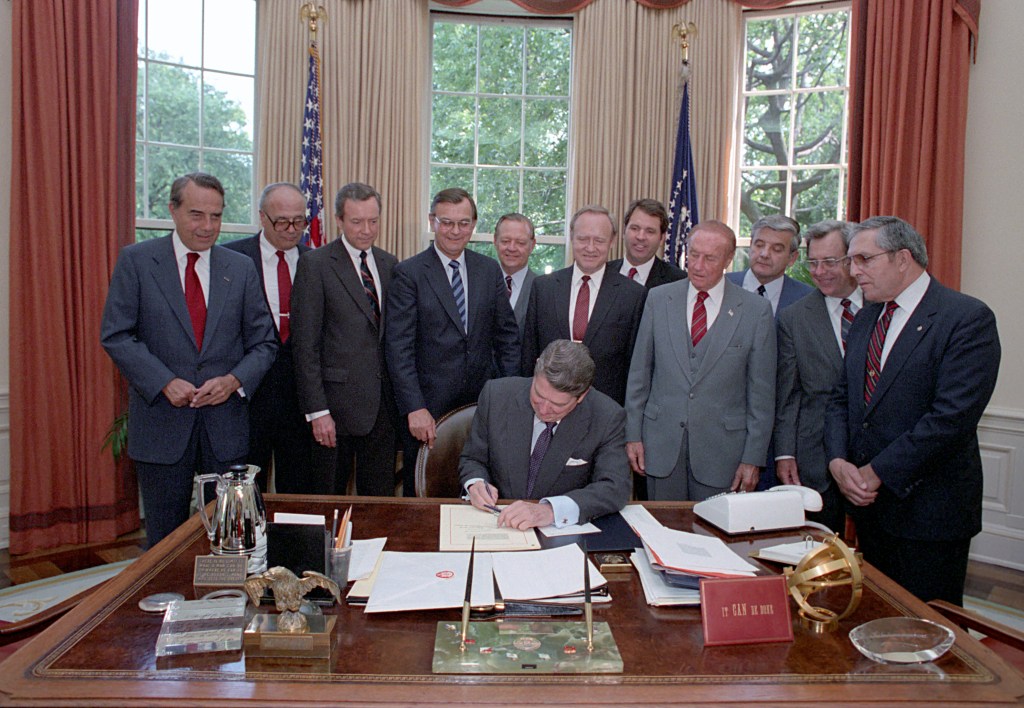
President Reagan signed legislation easing federal firearm controls and allowing gun dealers to sell rifles and shotguns to buyers anywhere in the country. The bill was passed unanimously by the Senate earlier this month after an intense campaign that pitted the gun lobby against police and handgun control organizations. The National Rifle Association and allied groups had been trying to weaken the 1968 federal Gun Control Act ever since it was passed in the wake of the murders of Dr. Martin Luther King Jr. and former Senator Robert F. Kennedy.
President Reagan participates in a signing ceremony for Proclamation 5482, World Trade Week 1986.
Bob Dole, the Senate Republican leader, said today that he would support using a first-year increase in revenue from tax overhaul legislation to provide the revenue increase proposed by the House and the Senate 1987 budgets. Mr. Dole’s comments signal that some Congressional leaders are looking at the money as a way of achieving tax increases without running into the opposition of President Reagan, who has said he will veto any tax increase to reduce the deficit. Using such a first-year increase would also put off the question of a separate tax increase until after the elections. Mr. Dole acknowledged, however, that the chairman of the Senate Budget Committee, Pete V. Domenici, a fellow Republican, is troubled by using the revenue increase because the revenue declines that the tax bill would produce in subsequent years would just worsen the deficit in those years.
A school board’s racial preference for minority member teachers in layoffs is unconstitutional, the Supreme Court ruled, 5 to 4. The Supreme Court today held unconstitutional a Michigan school board’s plan for laying off teachers that gave preference to members of minority groups. But the Justices’ reasoning broadly supported some uses of affirmative action by governmental employers. The decision was complicated, involving five separate opinions, none of them joined by more than three Justices. But a majority of the Court said governments might give preference to blacks in hiring — but perhaps not layoffs — if the plans are “narrowly tailored” to redress past discrimination.
The Supreme Court ruled today that government investigators do not need warrants to conduct aerial surveillance of areas that any pilot could legally fly over, including the fenced yards of private homes. The Court voted 5 to 4 in each of two cases to uphold warrantless aerial surveillance both of a suburban, fenced backyard where the police suspected marijuana was being grown and of a highly secured Dow Chemical Company complex in connection with possible air pollution violations. The Court ruled in each case that the Fourth Amendment’s prohibition against unreasonable searches and seizures did not apply to government investigators who use airplanes to observe or photograph places over which any private pilot might legally fly. The dissenters contended that the decisions would pave the way for unjustified use of modern technology by governments to intrude into the privacy of homes and businesses. But the majority said the marijuana defendant and Dow Chemical had no “reasonable expectation of privacy” from aerial photography in the observed areas, even though the photography of the Dow plant was done with a highly advanced $22,000 camera.
Commerce Secretary Malcolm Baldrige pointed to lawyers, not insurance companies, as the chief culprits in pushing liability insurance rates to crisis levels that many people can no longer afford. Testifying before a Senate subcommittee, Baldrige called on Congress to adopt an Administration amendment to pending legislation that would put a lid on attorney shares of court awards to injured plaintiffs. Baldrige told the consumer panel that hundreds of businesses have decried skyrocketing insurance costs, which are “out of control.”
The Gannett Company, the nation’s largest newspaper group, has agreed to pay about $300 million for the Courier-Journal and Louisville Times Company, both companies announced yesterday. Industry analysts said the price was the highest ever paid for a newspaper property. The statewide circulation and Pulitzer Prize-winning reporting of the two newspapers have made them a Kentucky institution. The two — The Courier-Journal, a morning paper, and The Louisville Times, its afternoon sister publication — have been owned by the Bingham family for nearly 70 years.
Saying that the International Brotherhood of Teamsters had “lost a great deal of public trust,” Labor Secretary Bill Brock called on the union and its leaders today to rid itself of corruption. “As Secretary of Labor, it isn’t easy to hear about mobbed-up local or pension fund abuse, misuse of members’ blood and sweat,” Mr. Brock told 2,000 delegates to the union’s 22d international convention here. “It’s impossible for me to ignore that. It is necessary for you to address this,” It was Mr. Brock’s first public comments on the union’s long history of legal problems and the first criticism of a union by a Reagan Administration official in recent memory, labor officials said. The speech was at first met with stunned silence, but at the end Mr. Brock received a standing ovation.
NBC faces possible prosecution for broadcasting a report that the Government said contained classified information. William J. Casey, the Director of Central Intelligence, said he had asked the Justice Department to investigate possible prosecution of the network. Mr. Casey said that if a report on yesterday’s “Today” show was true, it would be a violation of a law forbidding publication of communications intelligence. Mr. Casey has said several times in recent weeks that he believed the Reagan Administration should prosecute news organizations that violate the laws protecting information related to national security. The Justice Department said tonight that it would have no comment.
A Federal appeals court yesterday ordered John Gotti, the reputed boss of the nation’s most powerful organized-crime family, jailed while he appeals a lower-court ruling revoking his bail. After the ruling was handed down, Mr. Gotti, who authorities say heads the Gambino crime organization, was searched, fingerprinted and photographed in the United States marshal’s office in the Federal courthouse in Brooklyn, where he is to go on trial in August on racketeering charges. Then, wearing handcuffs and leg irons, Mr. Gotti, who normally rides in a Mercedes Benz sedan or other luxury car, was transported in a dirty blue Dodge prison van to the Metropolitan Correctional Center in lower Manhattan along with five “run of the gamut” Federal prisoners, according to a Federal marshal, Charles E. Healey. “He’s receiving no special treatment,” Mr. Healey said. Two of the prisoners ducked down when photographers tried to snap pictures through the van’s mesh-covered windows, but the 45-year-old Mr. Gotti sat erect and smiled.
A Harvard-based physician task force, which caused a furor in January by identifying 150 “hunger counties” across the nation, said in Boston that the Reagan Administration is to blame for making food stamps hard to get. “The program is permeated by a climate of fear established by officials at the federal level,” according to a study by the Physician Task Force on Hunger in America, planned for release today.
A few years ago, Texas universities were the talk of American education — ambitious, oil-rich behemoths that were making a conspicuous effort to establish citadels of academic excellence capable of challenging the nation’s best schools. But with Texas facing a $1.3 billion budget shortage, the state’s universities are confronting a new era of spending cuts, relatively flat faculty salaries and construction curbs. And the state’s top schools are having difficulty filling some of the endowed faculty positions created with such fanfare only a few years ago. At the least, officials say, the budget crunch brought on by falling oil prices will mean lowered expectations, reduced resources and perhaps closings or consolidations of smaller, less-known campuses. At the most, it could derail the hopes for greatness that institutions like the University of Texas at Austin and Texas A & M University in College Station built up in the boom years.
Lawyers for Ronald J. Straight, scheduled to be executed at 7 AM Tuesday for murdering a Jacksonville storekeeper, prepared a last-minute appeal to the United States Supreme Court today after an appeals court refused to block the execution. The United States Court of Appeals for the 11th Circuit in Atlanta turned down Mr. Straight’s appeal late today but granted a five-hour stay of execution to allow his lawyers to take the case to the Supreme Court.
The Norfolk Southern Corporation’s chairman and chief executive officer, Robert B. Claytor, was at the throttle when a special passenger train derailed here Sunday, injuring scores of passengers. The National Transportation Safety Board will question him as a normal part of its investigation into the cause of the derailment, in which 14 cars of an excursion train carrying 1,000 Norfolk Southern employees, family members and guests jumped the tracks in the Great Dismal Swamp.
A circus elephant went berserk before a picture-taking session in Catskill, New York, and stomped on his trainer, then dropped a pickup truck on him as the man lay helpless, police said. Alfred Vidbel, 59, owner of the Vidbel Circus, was critically injured in the accident. The elephant, named Daffodil, was immediately chained up and led away. It was not known what caused the elephant to turn on Vidbel, Police Sgt. Charles Adsit said. Vidbel, who had brought two elephants to the Jamesway Plaza shopping center outside Albany for a show, was bringing Daffodil closer for a picture session when the elephant became agitated.
The Boy Scouts will impose a $20 fee on every Boy Scout troop and Cub Scout pack in the country to help pay liability insurance costs, officials of the organization said. They said the fee was the first of its kind in the Scouts’ 76-year history.
“Boys need male role models,” a Connecticut judge said in rejecting the bid of a retired music teacher to become the first woman to head a Boy Scout troop. The judge, Joseph J. Chernauskas, overturned a 1984 decision by the state human rights commission that the Boy Scouts of America had violated sex discrimination laws in denying the application of Catherine Pollard, 67. A woman lost her bid to head a Boy Scout troop when a judge in Milford, Conn., agreed with arguments from the organization that young boys need a male role model to help them “in the difficult process of maturing to adulthood.” Catherine Pollard, 67, who acted as head of a troop for 16 months because no man had volunteered for the job, said she would appeal. “I’m not going to let them get away with it,” she said. “We are going to take this to the state Supreme Court.”
After nearly five days adrift on a life raft, eight crew members of a schooner were rescued from the Atlantic by a tanker yesterday, the Coast Guard said, and the survivors told how their ship had sunk north of Puerto Rico last week. Four of the crew, including the captain, are missing. The 136-foot, two-masted schooner, the Pride of Baltimore — which was to have accompanied the first tall ships into New York Harbor on the Fourth of July -heeled over and went down 240 miles north of San Juan last Wednesday about 60 seconds after being hit by a tornado-like wind, Coast Guard officials said. All 12 crew members were hurled into the sea. The survivors, six men and two women, stretched scant rations — food and water intended for six people over two days — until about 3 A.M. yesterday, when they spotted the running lights of a Venezuela-bound tanker.
A “$10 million rain” soaked the parched Alabama soil yesterday, just in time to save the state’s soybean crop. The state has not seen significant rainfall for almost two months. “This had to be a $10 million rain because time is running out for the Alabama farmers, especially the peanut and the cotton grower,” said Bubba Trotman, director of Federal Agriculture Stabilization and Conservation Administration in Alabama. Soybeans are the state’s top crop, and the rain was expected to save the seeds already planted, as well as to allow further planting. Farm Bureau Federation officials said that cotton production could fall about 20 percent because the drought forced farmers to postpone planting but that average rainfalls from now until harvest would help production.
The dark rings surrounding Uranus apparently formed after the planet did and may be the remnants of a crushed moon, scientists said at a seminar in Baltimore after analyzing results of the Voyager 2 spacecraft’s visit to the seventh planet. Four months after the robot craft skimmed within 50,600 miles of the blue-green planet’s cloud tops, researchers pulling together initial findings of the mission say Uranus and its moons have many features unique to the solar system.
39th Cannes Film Festival: “The Mission” directed by Roland Joffe wins the Palme d’Or.
Major League Baseball:
Jim Rice walked with two outs in the ninth inning, forcing home the tying run, and Mark Sullivan was then hit by a pitch with the bases loaded tonight, rallying the Boston Red Sox to an 8–7 victory over the Minnesota Twins. Ron Davis (1–4) of the Twins entered with a 7–6 lead in the bottom of the ninth and retired the first two batters. But Marty Barrett walked on a 3–1 pitch and took third on a double by Wade Boggs. Bill Buckner was walked intentionally to load the bases and Rice then fouled off five pitches with two strikes on him before walking on a 3–2 delivery, forcing home Barrett. Davis threw a strike past Sullivan but then hit him, forcing home Boggs with the winning run. Boston extended its American League East lead over the Yankees to one game. Joe Sambito (1–0) pitched the ninth inning for Boston and recorded his first major-league victory since 1981. Consecutive home runs by Kent Hrbek and Tom Brunansky had keyed a five-run fifth inning that gave Minnesota a 7–4 lead. But the Red Sox scored in the bottom of the fifth on a single by Bill Buckner and pulled to 7–6 in the eighth against the reliever Frank Pastore on singles by Rice and Rich Gedman and a groundout by Don Baylor.
The Kansas City Royals beat the Texas Rangers, 6–4. Run-scoring singles by Rudy Law and George Brett in the eighth broke open a tight game for Kansas City. The Royals were clinging to a 4–3 lead going into the eighth, but Angel Salazar reached on an infield single and moved to second on a base hit by Lonnie Smith. With two out, Law singled home Salazar and Brett followed with a single that scored Smith. Steve Farr pitched three innings of two-hit relief in place of Mark Gubicza (2–3), who let a 4–0 Kansas City lead dwindle to 4–3 before being lifted. It was Farr’s third save of the year. The Texas starter, Bobby Witt (2–3), walked six batters in six innings, two of whom scored. He also hit a batter, Willie Wilson.
The Cleveland Indians edged the Toronto Blue Jays, 6–4. Mel Hall had a triple, a run-scoring double, two singles and a walk for Cleveland to help Phil Niekro to his 303d career victory. Niekro (3–3) allowed four runs on 10 hits to enable Cleveland to break a five-game losing streak. The veteran knuckleballer struck out four and walked three before allowing a leadoff double to Tony Fernandez in the ninth. Scott Bailes came on to get his third save. Dave Stieb (0–6) worked seven innings and allowed five runs on 10 hits. He walked five and struck out six. Stieb, who had the lowest earned run average in the American League last season, had his E.R.A. soar to 6.33. He has not won a regular-season game since September 27, 1985.
The scheduled game between the California Angels and the Orioles at Baltimore was postponed due to rain. The game will be made up on May 22.
Minnesota Twins 7, Boston Red Sox 8
Kansas City Royals 6, Texas Rangers 4
Cleveland Indians 6, Toronto Blue Jays 4
Trading slowed dramatically on Wall Street yesterday as speculators apparently feared the repercussions of an insider trading investigation. Stock prices were mixed. The Dow Jones industrial average closed at 1,758.18, for a 1.62-point loss. The blue-chip index had been as low as 1,751.06 during yesterday’s session, more than a 100 points below its record close of 1,855.90 less than a month ago, on April 21.
Dow Jones Industrial Average: 1758.18 (-1.62)
Born:
Brandon Carr, NFL cornerback (Kansas City Chiefs, Dallas Cowboys, Baltimore Ravens), in Flint, Michigan.
Mario Chalmers, NBA point guard (NBA Champions-Heat, 2012, 2013; Miami Heat, Memphis Grizzlies), in Anchorage, Alaska.
Joe Paterson, MLB pitcher (Arizona Diamondbacks), in Oakland, California.
Eric Lloyd, American actor (Charlie Calvin in the “Santa Clause” franchise), in Glendale, California.

