Hess takes Flight
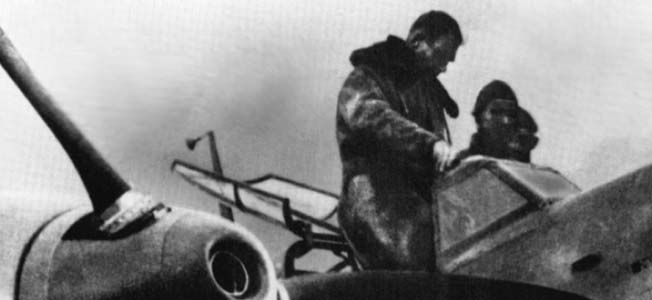
May 10, 1941, is one of the most bizarre days during World War II. The idea of a leading member of one nation willingly placing himself, without conditions, under the power of his country’s opponent is virtually unprecedented in world history. What makes the day even curiouser is that the motivations and purpose behind this strange decision also are murky and subject to interpretation.
Deputy Führer Rudolf Hess flew a Messerschmitt Bf 110 to Scotland on a solo peace mission, parachuting into Eaglesham near his objective of Dungavel House after running out of fuel. Sparking a controversy that will last long after the war, Deputy Führer Rudolf Hess landed in Scotland, United Kingdom with a Bf 110 fighter in an attempt to persuade the Duke of Hamilton to introduce him to King George VI in order to broker peace between the United Kingdom and Germany. This mission was not authorized by Adolph Hitler. He landed 12 miles from the Duke’s residence, broke his ankle, and was greeted by a ploughman armed with a pitchfork, who took him home. “My old mother got out of bed and made tea,” David Maclean said. “But the German said he did not drink tea at night.” When the Duke is asked if he will meet with Hess, he replies, ‘He can wait until the morning.’ After treatment for a broken ankle, the Deputy Führer was taken to a secret hideout near London to be questioned by Ivone Kirkpatrick, a former first secretary at the British embassy in Berlin. Hess said that Hitler would give Britain a free hand in running the empire in return for Germany being given a free hand in Europe. Kirkpatrick declined the offer. Hess says that he flew to Scotland to see the Duke of Hamilton who he believes heads the anti-war party in Britain. Hess claims that they met at the 1936 Berlin Olympics, but the duke has no recollection of this. Hess says that he decided on his flight after astrologers told him he was destined to bring peace between Germany and Britain. In a letter to Hitler, Hess said that if his mission failed, no great harm would be done, for Hitler could simply deny all responsibility by saying that Hess had gone mad. Hitler used this to say in an official communiqué that Party Member Hess had for some years suffered from mental disturbances and frequented astrologers and mesmerists. He was to remain in custody until his death.
Around 2:30 PM, German Deputy Führer Rudolf Hess, second in succession to Adolf Hitler, leaves a personal letter for Adolf Hitler and says goodbye to his wife Ilse. He then has his driver take him and his adjutant from his villa in the Munich suburb of Harlaching to the Messerschmitt aircraft factory at Augsburg. After making flight preparations for his personal Bf 110, Hess at 5:45 p.m. takes off and takes a northwesterly course to Bonn, where he then tracks the Rhine River all the way to the coast. Crossing the West Frisian islands, he veers north, then to the northwest again.
Hermann Göring, head of the Luftwaffe, is alerted to the flight and orders Adolf Galland, head of JG 26, to intercept him. However, Galland’s fighters are based too far to the south and are unable to find Hess. Berlin Radio broadcasts a cryptic alert at 8 PM that “Party member Hess had left on Saturday for a flight from which he had not yet returned.” That the Luftwaffe knows about Hess’ flight on the 10th makes Adolf Hitler’s surprised reaction to the flight on the morning of the 11th suspect, but they are not necessarily inconsistent.
Once he reaches the right latitude, Hess turns the craft due west past the final piece of land and heads toward the Northumbrian coast. Hess, concerned about being intercepted, descends to wavetop level and proceeds with skill. At RAF Fighter Command, the commanding officer responds to word that an unidentified fighter has been spotted and fighters vectored toward it by shouting, “For God’s sake, tell them not to shoot him down!” Hess has taken care of that by descending, however, thereby evading the three RAF Spitfires far above.
The RAF pilots never see him, so Hess continues flying west, remaining at the treetop level and heads toward his destination: Dungavel. However, he overflies his destination in the blacked-out north, reaches the Firth of Clyde, and then turns back in confusion. At around 10:25 p.m., his fuel tanks empty, Rudolf Hess bails out and operates his parachute, watching his Messerschmitt glide on and then crash and burst into flames not far away.
Proving himself a fairly adept navigator as well as pilot, Hess lands in Eaglesham, only a dozen miles from his destination, in a Scottish field. Hess is, as he recalls later, elated and triumphant that he has made, despite his regret at not meeting the Military Intelligence officers and Service Agents waiting for him at his destination nearby.
Scottish Lanarkshire farmer David McLean, meanwhile, has seen many warplanes overflying his farm during the war, so the notion of a pilot bailing out nearby is hardly unexpected. Hearing the plane and then observing the descending parachute, McLean grabs a pitchfork and approaches the figure laying nearby on the ground. Unable to make out even whose side the man is on, McLean asks, “Are ye a Nazi enemy, or are ye one o’ ours?” Hess replies, “Not Nazi enemy; British friend.”
McLean takes Hess into his farmhouse, which Hess accomplishes with difficulty because he has wrenched his ankle during his landing in the dark. In the kitchen, McLean’s mother makes tea (which Hess refuses), and Hess tells McLean that he is Alfred Horn and that he was flying to meet with the Duke of Hamilton, the owner of the great Dungavel estate. Soon, some local Home Guardsmen (Jack Paterson and Robert Gibson), and Hess tells them that he is Alfred Horn, just come from Germany and trying to land at the Duke’s private airfield. “Please tell the Duke of Hamilton that I have arrived.”
The two Guardsmen take Hess to their local headquarters. Soon, a crowd gathers. A dozen Home Guardsmen soon arrive to stand watch, and when the Military Intelligence and Secret Service agents arrive to pick Hess up, they are skeptical. Only when a regular army unit arrives as a backup for the Military Intelligence and Secret Service men do the locals release “Alfred Horn” to their custody. They drive Hess to the Maryhill Barracks near Glasgow.
The timing of the flight, supposedly chosen by Hess’ astrologer, serendipitously (apparently) occurs during the Luftwaffe’s biggest raid of the war against London. This could be counted upon to draw RAF air defenses to the south while Hess sneaks in from the north. Naturally, there are many unanswered questions about this incident, not least how the British knew to expect Hess. The flight comes to be known as a “peace mission,” though why such would be attempted in this fashion is unfathomable. However improbable, this begins one of the strangest tales of World War II, one that will have reverberated not just in the days and weeks and years, but even decades, to come. And it will prevent Hess from suffering the same fate at the end of the war as the other top Reich leaders.
At Fort Rutbah in Iraq, the advance elements of Arab Legion which have been shadowing the fortress while the RAF bombs it receive some ground reinforcements. The No. 2 Armoured Car Company RAF has arrived, and Squadron Leader Michael Casano, in command, attacks the defending Iraqis. The action is inconclusive, but the 40 Iraqi armoured cars which had arrived recently withdraw as RAF Blenheim bombers continue bombing the fort. After dark, the entire Iraqi Fort Rutbah garrison withdraws.
The Germans in Athens set Operation IRAQ in motion when several Me110s and a number of troop transports flew to Baghdad via Rhodes-Aleppo-Damascus-Mosul. The aim of this operation was to provide aid to the rebel Iraqi generals so as to threaten the flank of the British forces in North Africa. Churchill said later that at that time the Germans actually had an airborne landing troop strong enough to have enabled them to seize Syria, Iraq and Persia with their precious oilfields. No. 4 Squadron of the German 76th Destroyer Wing (Zerstorergeschwader 76 under Lieutenant Col. Holbein), formed part of the “Junck Special Aerial Force” which was to initiate the planned operation in Iraq. All the German aircraft carried Iraqi national emblems. Colonel Junck reported later: “The force was deployed overhastily with aircraft that were not equipped with tropical kits. Some of them did not even have the maps and charts which were indispensable for such missions.”
Having completed their capture of the Falagi Pass, Indian troops advance toward 11,400 foot Mount Gumsa. This is garrisoned by Italian troops and supposedly guards the key point of Amba Alagi from the east. However, the Italians immediately withdraw from the mountain after sunset and join the main force in Amba Alagi.
The 1st South African Brigade arrives at Amba Alagi after a long march. The Italian stronghold now is encircled, and the British plan a set-piece attack.
In the Gold Coast, the 24th Infantry Brigade captures Italian positions at Wadara in Galla-Sidamo.
British destroyers HMS Kelly, HMS Kipling, HMS Jackal, HMS Kashmir, and HMS Kelvin from Malta bombarded Benghazi, Libya at 1700 hours; German dive bombers fought back but caused no damage. After nightfall, also in Libya, British gunboat HMS Ladybird shelled Gazala 30 miles west of Tobruk.
Winston Churchill remains upset about the “bottleneck” at Takoradi airfield, the key transit hub on the 3700-mile route across Africa to supply Cairo with planes. He tells Air Chief Marshal Sir Charles Porter that “A regular flying-boat service should be established to bring back pilots which are accumulating in Egypt.” He emphasizes that “Speed is essential, as from every side one gets information of the efforts the enemy is making.” One of those “sides,” of course, is Churchill’s top-secret Ultra decryption service.
Churchill is upset about the entire Middle East Command. His dissatisfaction with Middle East Commander General Archibald Wavell is well known, and he is prone to venting his feelings both to Wavell directly and to the War Cabinet. Anthony Eden recalls in his subsequently published diary “The Reckoning” that today Churchill “was in favor [at the War Cabinet meeting] of changing [Indian Commander] Auchinleck and Wavell about.” However, Eden notes there is a rare moment of disagreement about this within Churchill’s cabinet of “yes men” (Australian Prime Minister Robert Menzies’ scathing term for them). Eden writes that “I have no doubt that Archie [Wavell] has a better mind, but one does not know how he is bearing the strain.” For the moment, the War Cabinet dissuades Churchill from making a change, which would seriously disrupt British strategy in the region at a critical juncture.
Churchill’s prime grievance against Wavell is that he is not using his forces efficiently and basically has accumulated an army of slackers who lack aggressive spirit. In Wavell’s defense, he has shown great tactical and strategic judgment, such as being skeptical of Churchill’s obsession with trying to defend Greece against the advice of Menzies and others. The garrisoning of Greece, and then the evacuation in Operation Demon, was accomplished with great skill and few unnecessary losses. Considering that Great Britain’s lifeline to India and control of East Africa and the eastern Mediterranean hinges upon control of Egypt, being conservative with the stretched British forces there could also be deemed quite prudent.
Operation TIGER continues to steam east through the Mediterranean. The Luftwaffe or Regia Aeronautica bomb and damage destroyer HMS Fortune. A large force of Royal Navy destroyers from the force bombard Benghazi at sunset. Royal Navy gunboat Ladybird bombards Gazala during the night.
Following discussions with Benito Mussolini, General Friedrich Paulus departs from Rome to Berlin. He will not return to the southern theater of operations, which his wife believes is not the place for him to make his reputation. Upon his arrival in Berlin, he reiterates his previous assessments that General Rommel is reckless and must be watched closely.
At Malta, Governor Dobbie praises the people of Malta for their support of the war effort and suggests that the government in London should issue a statement of thanks. He also requests 4000 rifles for the defense of the island; the rifle shortage has become an issue throughout the Middle East Command. The RAF loses a Beaufighter (two deaths) which was sent up to intercept a flight of Ju-52 transports flying from Sicily to North Africa.
The Italian auxiliary cruiser Ramb III was torpedoed and sunk at Benghazi Harbour by the British submarine HMS Triumph. The cruiser would be raised, repaired and returned to service.
German submarine U-110, captured by HMS Bulldog on the previous day, sank while being towed toward Iceland. Her Enigma cipher machine and code book, however, had already been retrieved by the British.
Churchill sends Alfred Duff Cooper a memo stating that “Eire has repudiated the status of a Dominion… It may well be that force will have to be used.” His concern is Royal Navy access to Irish ports, a burgeoning issue due to the recent Luftwaffe success in bombing the northern British ports such as Liverpool and Hull.
Churchill urges Chancellor of the Exchequer Sir Kingsley Wood to remove restrictions on pensions that give widows full pension rights only to those soldiers killed while on duty, whereas those whose husbands are killed while on leave — even by enemy action — get nothing. Removing this distinction, he writes, “would remove what seems to me to be a well-founded grievance.”
“The Strike of 100,000” takes place in Belgium. Led by Julien Lahaut, head of the Belgian Communist Party, the workers seek a wage increase. The strike originates at the Cockerill Steel Works in Seraing, eastern Belgium. This is the first anniversary of Fall Gelb (Case Yellow), the German invasion of Belgium and the Netherlands. While popularly known as a strike by 100,000, it is estimated that 70,000 workers participate. It is a brief strike that obviously has some nationalistic implications, and the Germans agree to 8% wage gains. The Germans display very strained tolerance for communists during this period due to the alliance with the Soviet Union.
Queen Wilhelmina of the Netherlands warns against treason in a speech broadcast by Radio Orange.
Bulgaria established diplomatic relationship with the Japanese-sponsored puppet state of Manchukuo.
British Lieutenant Anthony “Peter” Allan, held at the Oflag IV-C “officer’s” prisoner of war camp at Colditz Castle, escapes. He hides in a straw mattress being removed from the camp by French laborers who know he is in it but do not give him away. Allan was sent to Sonderlager (high-security prison camp) Colditz because he already had escaped from another POW camp but then had been recaptured. Allan originally was captured at St. Valery in June 1940 by General Rommel’s 7th Panzer Division. Allan intends to head to Poland but instead is given a lift to Vienna by a friendly (and clueless) SS officer. He ultimately will be recaptured and returned to Colditz to spend the next three months in solitary confinement.
Italian manufacturing firm Caproni delivered midget submarines CB-3, CB-4, CB-5, and CB-6 to the Italian Navy at La Spezia, Italy.
The cargo ship Empire Caribou from convoy OB.318 was torpedoed and sunk by German submarine U-556.
Winston Churchill sends Viscount Cranborne a note saying that “I have always been most strongly in favor of making sure that the Jews have proper means of self-defense for their Colonies in Palestine.” He instructs Cranborne to help them.
The Luftwaffe mounted what would turn out to be the last major bombing raid on London, but one of the most devastating. Over 1,400 people were killed and 700 acres were set on fire, with the Houses of Parliament among the buildings damaged. Low tide on the River Thames made firefighting difficult as it was harder to draw water, thus fires caused more damage than usual. Almost 1,500 people were killed. The House of Commons was severely damaged and over 2,000 fires raged over a wide area of the capital. The House of Commons, the roof of Westminster Hall and the top of Victoria Tower are alight. In the City of London, the Mint and the Tower are both ablaze. At the same time the Luftwaffe suffers its heaviest night-raid losses. 27 German aircraft are shot down, a toll which had previously only been reached during day raids. Overall, there are 3,000+ casualties from the raid (around 1,500 deaths), and some consider this the worst Luftwaffe raid against England during the entire war. It also, fortunately for the British, is the last mass raid against London of the war, though smaller raids continue for the next several years.
While the raid is an undoubted success in the sense that it causes a lot of damage, there also is a very bad omen for the Luftwaffe. It loses 21-27 planes (accounts vary) during the night, a massive and unsustainable number that reflects vastly improved British night fighter and anti-aircraft fire. This equals the number of planes the Luftwaffe lost during the great day raids of the fall of 1940 which caused its turn toward night raids. Raids in London are becoming too costly in general when easier pickings will soon be available in the East.
RAF Bomber Command, Day of 10 May 1941
5 Blenheims on shipping strike off La Pallice; ships were attacked but not hit. No aircraft lost.
RAF Bomber Command, Night of 10/11 May 1941
Hamburg
119 aircraft — 60 Wellingtons, 35 Hampdens, 23 Whitleys, 1 Manchester — to shipyards, Altona power-station and the general city area. 3 Wellingtons and 1 Whitley lost. The raid was carried out in perfect visibility. 128 fires — 47 large — were started in Hamburg with the worst of the fires in the city-centre area where a large department store (KOsters), a bank and part of the Hamburg Stock Exchange were among buildings destroyed by fire. 31 people were killed, 151 injured and 837 bombed out.
Berlin
23 aircraft, of which only 12 reported bombing targets in the city. 3 aircraft — 2 Stirlings and 1 Manchester — lost.
Minor Operations: 18 Blenheims to the Dutch coast, 6 Wellingtons to Emden, 1 Hampden minelaying in the Frisians. There were no losses. A Wellington whose pilot, Pilot Officer Ball of 103 Squadron, and his crew were flying their first operation, claimed an Me 110 and a Ju 88 shot down on the Emden raid.
RAF Headquarters announced: “Last night a Dutch bomber squadron was deployed for the first time. Up to now Dutch air crews in the Dutch aerial formation, served as reconnaissance fliers. Shipments from the USA have now made it possible to set up the first Dutch bomber wing, which flew its mission last night against a German Luftwaffe base in Kristiansund, southern Norway.”
The 200th Beaufighter is completed just as its predecessors complete their biggest victory of the war to date over London.
An experimental rocket — not jet — engine with the designation RII-203 is tested on a ground stand. Calculations show that it would reach a speed of 623 mph. The engine uses hydrogen peroxide, which the Germans call T-Stoff, oxidized by a potassium permanganate solution they call Z-Stoff. These mix in a combustion chamber and fuel a steam generator. The engine etches a distinctive purple exhaust flame behind it. Now that the engine has been shown to work, the Luftwaffe designers work on creating an airframe around it. This project ultimately, after many delays and setbacks, will result in the Me 163, but that is far in the future.
Light cruisers HMS Galatea and HMS Arethusa were relieved on the Iceland Faroes Passage patrol by light cruisers HMS Nigeria and HMS Kenya.
Heavy cruiser HMS London and destroyers HMS Mashona and HMS Tartar departed Scapa Flow at 1100 for the Clyde to provide escort for aircraft carrier HMS Furious. The three ships arrived at 0740/11th.
Destroyer HMS Blankney departed Scapa Flow at 0800 and met light cruiser HMS Neptune off Rattray Head. The two ships arrived at Scapa Flow at 1530. Light cruiser Neptune arrived at Scapa Flow to work up. Light cruiser Neptune departed Scapa Flow for the Clyde after working up on the 25th. She arrived the next day.
British Cdr L. G. E. Robinson Rtd of HMS President was killed in an air raid on London.
Anti-aircraft ship HMS Alynbank departed Methil at 0730 with convoy EC.17 from May Island to Pentland Firth. At 1130/11th, the ship and destroyer HMS Windsor, which had been sent to Scapa Flow to work up, arrived at Scapa Flow.
Armed merchant cruiser HMS Aurania and submarine HMS Tribune departed Halifax with convoy HX.126 with a local escort of Canadian corvettes HMCS Chambly and HMCS Orilla. The convoy was joined on the 20th by destroyer HMS Malcolm and on the 21st by destroyers HMS Burnham and HMS Burwell, corvettes HMS Arabis, HMS Heliotrope, HMS Mallow, and HMS Verbena. Destroyer HMS Scimitar joined on the 22nd and destroyers HMS Keppel and HMS Sabre, corvettes HMS Dianella, HMS Gladiolus, and HMS Kingcup, anti-submarine trawler HMS Lady Elsa, and catapult ship HMS Springbank on the 23rd. Anti-submarine trawlers HMS Northern Wave and HMS Northern Gem escorted the convoy in Home Waters. The armed merchant cruiser was detached on the 21st. Destroyers Burnham and Malcolm on the 22nd, corvettes Arabis, Heliotrope, Mallow, and Verbena on the 23rd, destroyer Scimitar on the 24th, destroyers Keppel and Burwell and corvette Gladiolus on the 26th, and destroyer Sabre on the 27th. Destroyer HMS Venomous joined on the 26th. The convoy arrived at Liverpool on the 28th with destroyer Venomous and corvette Kingcup. Submarine Tribune arrived at Holy Loch on the 25th.
U-556 made attacks on convoy OB.318. At 0442 hours on 10 May 1941, U-556 (Wohlfarth) attacked the convoy OB.318 southeast of Cape Farewell in 59°23N/35°25W and reported two ships with 10000 grt sunk. The xB-Dienst assumed from a SOS message that one of the ships was the Dutch steam merchant Hercules, but in fact the torpedo missed the British steam merchant Chaucer. In fact, only the Aelybryn (Master Harold William Brockwell) was hit and damaged. The ship, with her stern completely gone, was towed to Reykjavik by HMS Hollyhock (K 64) (Lt T.E. Davies, OBE, RNR), arriving on 17 May. One crew member was killed. The master and 43 crew members were picked up by HMS Daneman (FY 123) (Lieutenant A.H. Ballard, RNR).
British steamer Chaucer (5792grt) was attacked but not damaged.
At dawn, the convoy dispersed and U-556 made further attacks.
British steamer Empire Caribou (4861grt) was sunk by 59-28N, 35-44W. At 0752 hours on 10 May 1941 the Empire Caribou (Master Bernard Edwin Duffield), dispersed from convoy OB.318, was torpedoed and sunk by U-556 about 465 miles southwest of Reykjanes. The master, 31 crew members and two gunners were lost. Nine crew members and two gunners were picked up by HMS Malcolm (D 19) (Cdr C.D. Howard-Johnston, DSC, RN), landed at Reykjavik and brought to Greenock by HMS Scimitar (H 21) (Lt R.D. Franks, OBE, RN). The 4,861 ton Empire Caribou was carrying chalk and was bound for Boston, Massachusetts.
Belgian steamer Gand (5086grt) was sunk in 57-54N, 37-34W. At 2037 hours on 10 May 1941 the Gand (Master Michel Hostens), dispersed from convoy OB.318, was torpedoed and sunk by U-556 about 210 miles southeast of Cape Farewell. One crew member was lost and another wounded. The master, 38 crew members and four gunners were rescued. The 5,086 ton Gand was carrying ballast and was bound for Sydney, Nova Scotia.
German bombing on London sank small Naval auxiliary ships Altais, Comet I, Faislane (5grt), Igloo, Jake Ii, Nomad III (6grt), Safari, and Miss England (4grt).
British steamer Tower Field (4241grt) was damaged by German bombing off Outer Dowsing Buoy.
Sludge vessel Henry Ward (1438grt) was damaged by German bombing in Dry Dock, Green and Silley Weir, London.
Motor launch ML.1011 (Lt A. H. Blake RNR), on passage from Suda Bay to Sfakia, was sunk by German bombing.
During the night of 10/11 May, gunboat HMS Ladybird bombarded Gazala.
Convoy SL.74 departed Freetown escorted by armed merchant cruiser HMS Bulolo until 29 May. Corvettes HMS Amaranthus, HMS Anchusa, HMS Asphodel, and HMS Calendula escorted the convoy from 11 May to 19 May. Heavy cruiser HMS Dorsetshire joined the convoy on the 12th to 26 May. On the 30th, destroyer HMS Reading to 4 June, HMS Vanquisher to 2 June, and HMS Winchelsea to 2 June, and corvettes HMS Gentian to 4 June, HMS Hibiscus to 4 June, HMS Pimernel to 4 June, and HMS Rhododendron to 4 June joined. The convoy arrived at Liverpool on 4 June.
Ocean boarding vessel HMS Hilary captured Italian tanker Gianna M. (5719grt), which had departed Las Palmas on 27 April, 325 miles north of the Azores, 45N, 24-42W. The ocean boarding vessel escorted the tanker to join convoy HG.61. The tanker arrived in Belfast Lough on the 20th and was used by the British as Empire Control.
Submarine HMS Severn arrived at Gibraltar from Freetown.
An audience that filled the municipal auditorium in Minneapolis with a 12,000 capacity to overflowing rose to a standing ovation tonight as it heard Charles A, Lindbergh declare: “I do not know how much longer free speech will be allowed in this country. But as long as our laws permit, I intend to continue telling you what I believe.” Lindbergh, speaking under the auspices of the America First committee and against American intervention in Europe, returned to his home state and his first official appearance in Minneapolis since his historic flight to Paris in 1927, to receive a 45-second ovation as he took the platform. Senator Henrik Shipstaad, Minneapolis Republican, the state’s senior senator, who preceded Lindbergh on the platform, acclaimed the famous flier as a “premier expert in aviation until he began to give us some advice like Billy Mitchell (the late army air corps general) and then they began to attack his patriotism.” Lindbergh, holding up his hand frequently to silence applause, told his listeners that the future of democracy depended “on our ability to govern our own country.”
Some backers of the Tobey anti-convoy resolution conceded today it faced almost certain defeat and undertook to dissuade the author, Senator Tobey, New Hampshire Republican, from pressing it to a senate vote. With informal polls indicating supporters could muster less than 40 votes for the proposal, Senator Nye, North Dakota Republican, told reporters he was “afraid it hasn’t a chance.” Furthermore, Nye said he thought President Roosevelt “would take its defeat as a signal to go ahead with convoys.” For that reason, Nye said, he was attempting to convince Tobey he ought not to offer the resolution as an amendment to an administration-sponsored bill which would permit the government to take over idle foreign ships in American harbors.
Churchill cables President Roosevelt to thank him for allowing RAF pilots to train in the United States. “We have made active preparations and the first 550 of our young men are now ready to leave.” General Henry “Hap” Arnold, the head of the US Army Air Corps, originally made the offer, which Churchill calls “unexpected and very welcome.” Naturally, training a warring country’s soldiers is hardly commensurate with true neutrality, but such distinctions long ago were discarded by the United States.
President Roosevelt has a normal temperature again, the White House reported today. He has been confined to bed since Monday with a gastro-intestinal ailment and it is planned to have him remain in bed over the weekend. Stephen Early. Presidential secretary, said the President wanted to work, but Rear Admiral Ross T. McIntire, his physician, insisted with some difficulty on his remaining quiet and resting.
Australian Prime Minister Robert Menzies, recently arrived in Washington from England via Canada, discusses the situation in the United States at length with Walter Lippman, the respected columnist at the New Yimes Times. Menzies concludes that:
“General American sentiment is on our side, but the moral arguments of cowardice and short-range self-interest are being directed by [Herbert] Hoover, [Senator Burton] Wheeler, [Charles] Lindbergh & Co. to the mothers and possible draftees.”
Menzies worries that the American public is not being properly told that the war is about their future as much as that of the actual combatants. He calls President Roosevelt’s failure to properly shape public opinion in this regard “disturbing.”
Menzies meets with Roosevelt for an hour and calls him “older and more tired” than he recalls, but their conversation “most vigorous.” Menzies also says that Roosevelt is “jealous” of Churchill’s “place in the center of the picture” and that Roosevelt is “not [emphasis in original] an organizer — very like Winston — and co-ordination of effort is not conspicuous.” Reflecting on his meeting with Secretary of State Cordell Hull, Menzies concludes that Hull and the rest of the Cabinet is “for war” [emphasis in original], but Roosevelt “trained under Woodrow Wilson in the last war,” is awaiting a provocation. Menzies calls FDR’s campaign promises to keep the U.S. out of the war “foolish.”
Between 1,700 and 1,900 machinists, vital to shipbuilding and allied defense work quit their jobs at San Francisco Bay Area shipyards and drydocks today. The joint action by A.F.L. and C.I.O. unions tied up a half-billion dollars’ worth of defense contracts, employers said, In 11 bay area plants. The unions demanded $1.15 an hour; the employers offered $1.12. The present scale is $1. Currently the plants are paying double for overtime, but want to cut this to time and a half, a reduction the unions are resisting.
Senator Hatch, New Mexico Democrat, said today he had drafted an amendment to his “clean politics” law which would require individuals to report in their income tax returns all funds received or disbursed for political purposes. Under his proposal, a special form asking data on political contributions would be sent out with income tax blanks each year. Any contributor to or recipient of political funds who failed to make out the supplemental form, or made it out fraudulently, would be subject to the same federal fines and jail sentences provided for income tax evaders. Hatch said the supplemental “politics form” would be made public and declared this in itself should deter large contributions.
A majority of the 500,000 selective service trainees inducted into the U.S. army to date have been 21 through 25 years old and only about 11 percent have been 31 or older. This division of ages was disclosed today by issuance of an age group study at selective service headquarters here. The figures were considered significant at this time when officials have been considering advisability of lowering the top draft age from 35 to 30 or even lower. The study covered 183,198 men drafted up to March 1, but addition of more thousands since then has changed the averages only slightly, if at all, experts said.
Lowering of the draft age to 18 instead of 21 — a step which would add about three and a half million young registrants to the millions already on file or in training camps — is approved by a small majority of the voters in a nationwide institute survey completed early this week.
A search of the Allegheny Mountain district by seventeen planes from six airports failed yesterday to locate the private plane bearing Benjamin Brewster, New York investment broker, and his wife, who disappeared on a projected flight from Roosevelt Field, Long Island, New York, to Warren, Ohio.
An all-soldier Benefit musical show was held at the War Memorial Opera House in San Francisco, California to raise funds for military morale and recreation activities.
Whirlaway won the Preakness Stakes. Eddie Arcaro wins aboard Whirlaway, in the second leg of the successful Triple Crown bid.
Major League Baseball:
Myril Hoag’s eighth-inning double scored Mike Kreevich with the winning run today as the White Sox defeated the Tigers, 4–3, before a chilled crowd of 3,323 spectators, including British Ambassador Lord Halifax. Hal Newhouser gave the Sox only five hits in seven innings, but walked nine men. Bill Knickerbocker was safe in the fifth on Frank Croucher’s error, stole second and scored on Luke Appling’s single. Chicago increased this lead to 3–0 in the seventh on a single, a sacrifice, an error and four walks. Southpaw Thornton Lee yielded only two hits in seven frames, but Detroit reached him for four singles in the eighth to tie the score, Barney McCosky’s blow sending in the last two runs.
The world champion Reds finally got enough runs today for Big Paul Derringer to gain his second victory of the season by downing the Cubs, 5–1. The Reds made the most of seven safeties, while Derringer held Chicago to a like number, three of them scratches, and issued five walks, the most he has given in a long time. A cluster of four runs on four hits, a hit batsman and Frank McCormick’s long fly put the game on ice for Cincinnati in the fifth.
The Giants split a twin bill with the Braves, the Boston team winning the first game, 11–3, and dropping the second. 4–2. Bill Lohrman, pitching the nightcap for the Giants, did not allow a hit until there was one out in the ninth. He yielded two singles before the end. The Braves annoyed Colonel Bill Terry no end by walloping the Giants in the afternoon’s first engagement. Behind Bill Posedel’s steady pitching they routed Harry Gumbert inside of six rounds. Max West, Carvel Rowell, Eddie Miller and Babe Dahlgren exploded home runs, and these more than offset Mel Ott’s seventh circuit blow of the campaign.
Billy Herman’s five successive hits, including two triples, marked the Dodgers’ 4–1 triumph over the Phillies. It was John Whitlow Wyatt’s sixth straight triumph and the Dodgers’ fourth in a
row, which put the Dodgers two games in front of the second-place Cardinals, who were idle today. Whitlow held the Phillies to five hits today. Joe Medwick had a two-run single for Brooklyn in the first, and Dixie Walker later contributed a solo homer.
Al Milnar did today what Bobby Feller couldn’t do yesterday. The southpaw’s seven-hit performance, coupled with Lou Boudreau’s home run in the third inning, helped Cleveland gain a 4–3 victory over the Browns and snapped the Indians’ losing streak at four straight. It was Milnar’s fourth victory, against two setbacks. The Browns, whose winning ways again were sidetracked after a lone triumph, tried hard to tie the count in the ninth. Johnny Berardino batted for Pitcher Bill Trotter and drew a walk. Manager Roger Peckinpaugh thereupon removed Milnar and Joe Heving went in to pitch to Harlond Clift.
Senators staged a four-run uprising in the ninth inning today, but the rally ended with the tying run on base and the Athletics took an 8–7 decision. The loss snapped the Washington winning streak after three straight victories. A walk to Jimmy Bloodworth and hits by Ben Chapman, Rick Ferrell, Sam West and Jim Vernon brought the Senators their ninth-inning runs.
The scheduled game between the New York Yankees and the Red Sox at Boston was postponed due to rain. The game will be made up as part of a doubleheader on August 6.
The scheduled game between the St. Louis Cardinals and the Pirates at Pittsburgh was postponed due to cold and wet grounds. The game will be made up as part of a doubleheader on August 17.
Detroit Tigers 3, Chicago White Sox 4
Chicago Cubs 1, Cincinnati Reds 5
Boston Braves 11, New York Giants 3
Boston Braves 2, New York Giants 4
Brooklyn Dodgers 4, Philadelphia Phillies 1
Cleveland Indians 4, St. Louis Browns 3
Philadelphia Athletics 8, Washington Senators 7
Bulgaria becomes one of the few countries to establish diplomatic relations with the Japanese puppet state of Manchukuo.
The Japanese North China Front Army remains on the offensive, while the Imperial Air Force raids Chungking again. Japanese bombers raided the wartime Chinese capital heavily again today, but casualties were placed at only thirty, as residents took shelter more promptly than yesterday, when there were 200 casualties.
Japan feels it has presumably paved the way for economic southward expansion by virtue of the Franco-Thai peace pact and trade agreement with French Indo-China. Now Japan is apparently concentrating on what is called here the “disposal of the China incident,” which is the most important and most immediate problem confronting the nation.
Vice Admiral Toshio Shimazaki was named the Chief of Staff of the Mako naval port at Pescadores islands, Taiwan.
Ernest Hemingway, visiting Manila on his way back to the US from his China trip, gives the officers an informal briefing about events in Asia. He displays (in hindsight) an extremely accurate perception of coming events in the region, including his conclusion that Japan was on the verge of war with the US and that the Nationalist Chinese and Chinese Communists were on the verge of fighting each other as much as they were allegedly fighting the Japanese together. The US officers on the base are all recently arrived from the States, so have little idea of the realities of the theater. Robbie Robertson, recently the head of the 3d Pursuit Squadron and waiting for a return to the US aboard the USAT Washington, makes an appointment for Hemingway to brief the Philippines Department’s intelligence service and air officer on the 12th.
Growth of United States exports to the Netherlands Indies, particularly since the Netherlands was cut off by the German invasion last May, is shown by the fact that in 1939 American goods sent to the Indies were worth $35,420,000, while in 1940 this figure had risen to $53,781,000, it was revealed by figures at the Department of Commerce today.
Dow Jones Industrial Average: 117.54 (+1.08)
Born:
Ken Berry [Allen Kent Berry], MLB outfielder (All-Star, 1967; Chicago White Sox, California Angels, Milwaukee Brewers, Cleveland Indians), in Kansas City, Missouri.
Sir Winfried Bischoff, German-British banker and chairman of Lloyds Banking Group, born in Aachen, Germany (d. 2023).
Died:
Cissy Fitzgerald, 68, English-American vaudeville performer.
Naval Construction:
The Kriegsmarine (German Navy) Type 39 torpedo boat T26 is laid down by F. Schichau, Elbing, East Prussia (werk 1485).
The U.S. Navy Aloe-class net tender USS Butternut (YN-4; later AN-9) is launched by the Lake Washington Shipyard (Houghton, Washington, U.S.A.) .
The U.S. Navy Accentor-class coastal minesweeper USS Accentor (AMc-36) is launched by W.A. Robinson Inc. (Ipswich, Massachusetts, U.S.A.).
The Royal Navy LCT (Mk 2)-class landing craft, tank HMS LCT 104 is launched by Swan Hunter and Wigham Richardson Ltd. (Wallsend-on-Tyne, U.K.).
The U.S. Navy 77-foot Elco patrol motor torpedo boat USS PT-26 is launched by the Electric Launch Company Ltd. (Elco), (Bayonne, New Jersey, U.S.A.).
The Kriegsmarine (German Navy) Type VIIB U-boat U-86 is launched by Flender Werke AG, Lübeck (werk 282).
The Kriegsmarine (German Navy) Type VIIC U-boat U-374 is launched by Howaldtswerke AG, Kiel (werk 5).
The Royal Australian Navy Bathurst-class minesweeper-corvette HMAS Bendigo (J 187) is commissioned. Her first commanding officer is Lieutenant Commander James Alexander Ronald Patrick, RANR(S).

