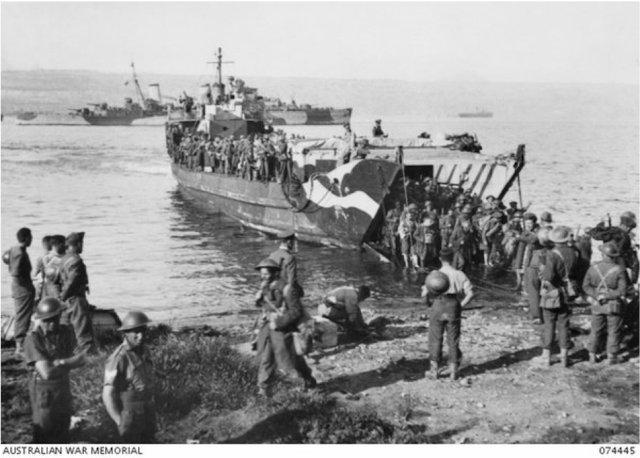
The British forces consolidated their hold on Habbaniyah airfield by driving the Iraqis back from Sin el Dhibban toward Fallujah, nearer the capital. Overnight, Iraqi troops withdrew from the plateau overlooking RAF Habbaniyah after suffering 1,000 casualties, largely by RAF aircraft, abandoning large amounts of weapons and supplies. They were pursued by the British King’s Own Royal Regiment, which caught up with the Iraqi troops at Sinn El Dhibban, taking 433 prisoners at the cost of 7 British troops killed and 14 wounded. To the south, the 21st Infantry Brigade of the Indian 10th Division arrived by sea at Basra. Meanwhile, Vichy France and Germany signed the Paris Protocol, which gave permission for German troops to march through Syria for Iraq to reinforce the Iraqis; in return, Germany lowered the tribute that France had to pay Germany from 20 million to 15 million Reichsmarks daily. The Vichy vice-premier, Admiral Darlan, agrees to let Hitler send German troops to Iraq via Syria. German Luftwaffe Colonel Werner Junck was ordered to establish Fliegerführer Irak with 12 Bf 110 fighters and 12 He 111 bombers.
The British already have two columns of troops of their own on their way across the desert from their possessions in Palestine and today receive the 21st Indian Brigade at the port of Basra, so the possibility of a remote battle between Axis and Allied troops in the desert looms.
In London, Winston Churchill writes an angry memo to General Ismay about a military appreciation he has received of the Iraq situation. The analysis by Middle East Commander General Archibald Wavell and General Bernard Auchinleck of the Indian Command suggests that the British troops in Palestine, which are headed to relieve the British forces in Iraq, are insufficient to overcome the Iraqi Army. Wavell and Auchinleck are pessimistic and they project that the outnumbered British will be forced to surrender by the 12th of May. Churchill notes that British losses in Iraq “have been nominal as so far reported” and rejects the recommendation that negotiations with Iraqi leader Rashid Ali be planned. “We should treat the present situation like a rebellion,” Churchill concludes, and the British Army has a century of experience in handling those.
General Bernard Freyberg received intelligence that the Germans were likely to launch a large airborne assault on Crete, Greece on 17 May; he would continue to expect the invasion to come from the beaches rather than the sky, however.
The German 8th Panzer Regiment arrived in North Africa.
The Allies began Operation TIGER, a convoy maneuver from Gibraltar to Alexandria. With the Afrika Korps driving through North Africa towards the Suez Canal, pushing the Western Desert Force before them and British forces close to collapse and strategic locations threatened, the British High Command risks sending a reinforcement convoy across the Mediterranean to Alexandria. The “Tiger” convoy consists of five large transport ships, escorted by Ark Royal, the battleships HMS Renown and HMS Queen Elizabeth, the cruisers HMS Sheffield, HMS Naiad, HMS Fiji, and HMS Gloucester, and screened by destroyers of the 5th Destroyer Flotilla. Prior to Ark Royal’s departure, Captain Holland left to recuperate from stress and poor health, and was replaced by Captain Loben Maund. The convoy left Gibraltar on 6 May, and was detected by Italian aircraft. The convoy, limited to 14 knots (26 km/h) and escorted by so many capital ships, is such a tempting target that Italian and German aircraft are mobilized.
Convoy AN.30, composed of four freighters, departs from Haifa and Port Said bound for Suda Bay, Crete.
British submarines HMS Taku and HMS Truant sank Italian ship Bengasi off Italy.
Winston Churchill, who apparently is in a foul mood throughout the day, sends an angry memo to Air Chief Marshal Sir Charles Portal which includes in relevant part:
“Here is another shocking week at Takoradi. Only 18 aircraft have been despatched, whereas I think a programme of nearly double the number was promised. I am afraid it must be realized that this is a very great failure in our arrangements, which may play its part in a disastrous result to the great battle proceeding in the Nile Valley [by which Churchill apparently means North Africa in general].”
Takoradi is the airfield in the British colony of the Gold Coast (Ghana) which serves as the key transit hub for flights to Cairo (a 3700-mile air route) aka the West African Reinforcement Route (WARR). Churchill wishes more planes to be shuttled from Takoradi to Cairo to help in the defense of North Africa. Bemoaning the “complete breakdown,” Churchill demands an accounting.
Churchill also sends a sarcastic memo to General Sir John Dill, asking that the suitability and supply of maps by Allied forces in Crete be determined, “Otherwise we shall soon find that any German arrivals will be better informed about the island than our men.”
In another memo, Churchill demands of Admiral Pound an inquiry into a “lapse of Staff work” over problems transporting a mobile naval base defense organization to Suda Bay, Crete. The base took 12 weeks to arrive and was packed in a disorganized fashion, he notes.
Churchill sends a memo to General Ismay which states in relevant part:
“Surely I gave directions that the C-in-C was to have full liberty to capture enemy hospital ships in retaliation for their brutality.”
On its face, this memo is evidence of Churchill authorizing war crimes (Churchill asks for previous correspondence on the matter to be found, but it is unclear if such exists).
Attacking or capturing hospital ships is against the rules of war. There have been many instances on both sides of attacks on hospital ships, though, so it is open to interpretation how much of a breach of international law Churchill’s stance really is. Certainly, whoever wins the will is likely to hide their own breaches of the rules of warfare and prosecute the other side’s transgressions, this is known sardonically on both sides as “victor’s justice.”
Indian Troops attacking at Amba Alagi in East Africa are pinned down by withering Italian crossfire throughout the day. They retreat after dark.
Sanski Most Revolt: The Serbian population near Sanski Most in Axis-occupied Yugoslavia began an uprising against the repression of the Ustaše regime. Serbs in Kijevo and Tramošnja villages are celebrating Đurđevdan slava, an Eastern Orthodox holy day in honor of Saint George when the Ustaše do something that provokes them. This develops into a massive revolt called the May 1941 Sanski Most revolt, or alternatively the Đurđevdan uprising or the revolt of the Sana peasants. The Serbs generally were pro-British before the war, and there is an element of baiting going on by the Ustaše regime. The revolt quickly spreads, and the Serbs chase the Ustaše out of town. The escaping Ustaše request German military aid from the garrison at Prijedor.
Polish doctor Zygmunt Klukowski noted in his diary that, on this date, he observed Germans conscripting Polish civilians to build military airfields and air raid bunkers even though there was no active war in Eastern Europe.
German submarines U-103 and U-105 sank 3 more British freighters off Sierra Leone, British West Africa, killing 12; the crew of U-103 stopped to help the survivors righting a listing lifeboat.
In a decision approved several days ago, Stalin officially succeeds Foreign Minister Vyacheslav Molotov as the Chairman of the Council of People’s Commissars. Thus, Stalin becomes the de jure as well as the de facto leader of the Soviet Union — but there never at any time has been any doubt whatsoever that he is the boss. This ruling-from-behind-the-scenes strategy is a recurring theme in Russian politics.
The change is noted by the German ambassador to the Soviet Union, Count Werner von der Schulenburg. Schulenburg opposes any military action against the Soviet Union, though he has not officially been made aware of the plans for Operation BARBAROSSA (though he may at this time be aware through rumors and personal observations). Ambassador Schulenburg reports the change in Soviet leadership to Berlin but passes it off as nothing but a public rebuke of Molotov for allowing German/Soviet relations to wither. The reasons for the change, in fact, are murky and subject to interpretation, especially considering that on the 5th of May, Stalin had given two bellicose secret speeches to graduating military officers in the Kremlin which strongly suggested that he, too, was contemplating beginning a war with Germany. Molotov, in any event, is not out of favor. Stalin may, viewing the change in that context, be preparing his leadership role for the war he himself intends to start.
The Soviet military attaché in Berlin warns Soviet High Command that Germany is preparing to invade the USSR.
The Luftwaffe attacks Liverpool again as part of the May Blitz. The bombing causes additional damage.
The Luftwaffe bombs Belfast with incendiaries.
Greenock Blitz: The Luftwaffe bombed the town of Greenock, Scotland for the first of two consecutive nights.
Kommodore Mölders of JG 51 shoots down an RAF No. 601 Squadron Hurricane for another victory in his new Bf 109F fighter.
RAF Bomber Command, Day of 6 May 1941
18 Blenheims on operations along coasts from France to Germany. Several ships were attacked. 2 aircraft lost 1 Stirling to Emden turned back but attacked a ship at sea.
RAF Bomber Command, Night of 6/7 May 1941
Hamburg
115 aircraft — 50 Wellingtons, 31 Whitleys, 27 Hampdens, 4 Manchesters, 3 Stirlings; few aircraft identified their targets, because of poor visibility 81 aircraft claimed to have bombed Hamburg, 22 aircraft claimed to have attacked alternative targets. Hamburg records indicate some 12 bomb loads in the city. Crews reported large fires throughout the city but Hamburg only lists 4 fires — none large, with 2 people injured and 33 bombed out. No aircraft were lost from the raid.
Le Havre
16 Wellingtons; 1 lost.
Ameland
10 Blenheims attacked a convoy by moonlight; no aircraft lost.
There were 7 minelaying sorties to Quiberon Bay and 4 O.T.U. sorties. No losses.
The RAF (830 Squadron) attacks Tripoli, losing a plane. Two crewmen are made prisoner and one perishes.
At Malta, the air defense is refined to alternate defense by fighters and anti-aircraft fire. During a large 36-plane Luftwaffe raid in the evening on Grand Harbour, the fighters shoot down one or two raiders and damage another. In addition, anti-aircraft fire shoots down two Junkers Ju 88s.
Hermann Göring is eager to increase his prestige with operations in Iraq. He organizes Fliegerführer Irak with 12 Messerschmitt Bf110 fighters and 12 Heinkel He111 bombers under the command of Luftwaffe Colonel Werner Junck. Of course, this force also must find its way to Iraq.
German U-boat U-97, commanded by Kapitänleutnant Udo Heilmann, sank British ocean boarding vessel HMS Camito (F 77) and recently captured Italian tanker Sangro 500 miles west of Ireland, killing 28. The ocean boarding vessel HMS Camito (F 77) was torpedoed and then sunk by gunfire by the U-97 west of Ireland in the northern Atlantic Ocean. On 1 May 1941 the blockade runner Sangro was captured by the British ocean boarding vessel HMS Cavina in 44°36N/30°20W. She was then escorted to the UK by HMS Camito (F 77) (A/Cdr A.A. Barnet, RNR). At 0240 hours on 6 May 1941 HMS Camito (F 77) was hit aft of amidships by one torpedo from U-97 west-southwest of Cape Clear. The U-boat had spotted the two ships at 1745 hours on 5 May and had problems to keep contact in heavy seas and bad visibility. The OBV was missed at 0202 hours with a spread of two torpedoes and three minutes later with a stern torpedo before being hit, but continued at slow speed. U-97 then chased the tanker Sangro, which caught fire after being hit by one torpedo at 0353 hours and afterwards returned to the first vessel. Heilmann thought that it is a Q-ship and left the badly damaged HMS Camito, which sank the next day in 50°15N/21°16W. Six officers and 22 ratings were lost. The survivors of both ships were picked up by HMS Orchis (K 76) (Lt H. Vernon, RNR) and landed at Greenock. The 6,466-ton Sangro was carrying oil and grease.
U-556, commanded by Kapitänleutnant Herbert Wohlfarth, sank Faroes fishing trawler Emanuel (166grt) in 62-06N, 8-10W. On 6 May 1941, U-556 sank the Emanuel with gunfire near the Faroe Islands. Three crew were killed.
U-105, commanded by Kapitänleutnant Georg Schewe, sank British steamer Oakdene (4255grt) in 6-19N, 27-55W. At 1052 hours on 6 May 1941 the Oakdene (Master Ernest Hart), dispersed from convoy OG.59, was hit aft by one G7e torpedo from U-105 and sank northwest of St. Paul Rocks. The master, 31 crew members and three gunners were picked up by HMS Dorsetshire (40) (Capt B.C.S. Martin, RN). The 4,255-ton Oakdene was carrying coal and was bound for Buenos Aires, Argentina.
U-103, commanded by Korvettenkapitän Viktor Schütze, sank British steamer Surat (5529grt) at 8-23N, 15-13W. At 0515 hours on 6 May 1941 the unescorted Surat (Master Thomas Edward Daniel) was hit by a stern torpedo from U-103 northwest of Freetown. The U-boat had spotted the ship, en route with 13 knots, at 1603 hours the day before and only could keep up with her due to her zigzag course that also caused a first torpedo fired at 2345 hours to miss. The crew apparently noticed the attack and evaded two torpedoes fired at 0510 hours and a first stern torpedo five minutes later. The second stern torpedo fired shortly afterwards then hit the stern and stopped the ship, but also a first coup de grâce at 0526 hours missed. The ship sank immediately after being hit amidships by two coups de grâce at 0613 and 0625 hours. Four crew members were lost. The master, 58 crew members and two gunners were picked up by the British hopper barge Foremost 102 and landed at Freetown. The 5,529-ton Surat was carrying pig iron, peas, and rapeseed and was bound for the United Kingdom.
U-103 also sank British steamer Dunkwa (4752grt) at 8-43N, 17-13W. At 1717 hours on 6 May 1941 the Dunkwa (Master John William Andrew), dispersed from convoy OB.310, was hit aft by one stern torpedo from U-103 and sank within 8 minutes 216 miles west-northwest of Freetown. Five crew members and three gunners were lost. The Germans noticed that the 39 survivors were in only one overcrowded lifeboat, so they righted a swamped lifeboat and provided water to the survivors. The master, 37 crew members and one gunner were picked up by the Polydorus and landed at Oban. The 4,752-ton Dunkwa was carrying general cargo and government stores and was bound for Opobo, Nigeria.
Aircraft carrier HMS Furious arrived at Liverpool. The aircraft carrier had been refitting at Belfast.
P/T/Sub Lt (A) J. V. Eckford RNVR, Leading Airman G. B. Barrett, and Leading Airman D. Henshall were killed when their Proctor of 750/752 Squadron crashed off Trinidad.
British steamer Industria (4861grt) was damaged by German bombing at Liverpool. The steamer proceeded to Greenock where she was drydocked on the 19th.
Greek steamer Moscha D. Kydoniefs (3874grt) was damaged by German bombing at Liverpool.
Submarine HMS Cachalot arrived at Gibraltar from Devonport on the 6th. The submarine departed on the 8th for Malta arriving on the 15th from England with supplies. After unloading, the submarine departed on the 16th for Alexandria.
Submarine HMS Triumph attacked a convoy of German steamers Brook (1225grt) and Tilly L. M. RUSS (1600grt) which departed Tripoli on the 5th for Benghazi escorted by Italian torpedo boat Climene off Buerat, but was unsuccessful.
Submarine HMS Taku sank Italian steamer Cagliari (2322grt) at 1944, three miles from Fuscaldo, 39-11N, 15-58E.
Submarine HMS Truant sank Italian steamer Bengasi (1716grt) three miles 131° from Cavoli.
Lt N. K. Cambell and Lt (A) G. D. Nutt of 830 Squadron from HMS St Angelo were shot down and made prisoners of war in a raid on Tripoli. Petty Officer Airman W. G. T. Welsh died of injuries on the 7th.
P/T/Sub Lt (A) L. M. Herbert RNVR, of 814 Squadron in aircraft carrier HMS Hermes, was killed when he was struck by a propeller blade.
Convoy HG.61 departed Gibraltar escorted by sloop HMS Sandwich, corvettes HMS Azalea, HMS Geranium, and HMS Jonquil, and Dutch submarine HNLMS O.21. The convoy was joined on the 7th by special service vessel HMS Fidelity. The corvettes were detached on the 12th and the submarine on the 13th. Ocean boarding vessel HMS Hilary joined the convoy with captured Italian tanker Gianna M. on the 12th and ocean boarding vessel HMS Cavina joined on the 14th. On the 16th, the convoy was joined by destroyers HMS Legion, HMS Reading, HMS Vanquisher, and HMS WINCHELSEA, sloop HMS Londonderry, corvettes HMS Campanula, HMS Freesia, HMS Gentian, HMS Hibiscus, HMS Pimpernel, and HMS Rhododendron. The convoy arrived at Liverpool on the 20th.
Convoy AN.30 of British steamer Lossiebank (5627grt), Cape Horn (5643grt), City of Canterbury (8331grt), and Rawnsley (4998grt) departed Haifa escorted by sloop HMS Grimsby and Port Said escorted by sloop HMS Flamingo for Suda Bay. Australian destroyers HMAS Stuart, HMAS Vampire, and HMAS Waterhen and Sloop HMS Auckland joined the convoy north of Alexandria on the 7th. The convoy was delayed by engine problems in steamer City of Canterbury, then in steamer Rawnsley. On the 7th, destroyer Stuart developed defects and was sent back to Alexandria being relieved by destroyer HMAS Voyager. British steamer Rawnsley (4998grt) was badly damaged by German torpedo bombing in 34-59N, 25-46E on the 8th. The steamer was taken in tow by sloop Grimsby and escorted by destroyer Waterhen. The steamer was towed to Herapatra Bay. Bad weather prevented the steamer from being towed further on the 10th. The steamer was anchored at Herapatra Bay and sloop Grimsby returned to Alexandria. Steamer Rawnsley was sunk by German air attack on the 12th off Herapatra. Destroyer Stuart attacked a submarine contact 28.5 miles 278° from Ras el Tin. She was joined in the attack by anti-submarine trawler HMS Kingston Cyanite and anti-submarine whaler HMS Kos 22. The convoy arrived at Suda Bay on the 9th.
New Zealand Division light cruiser HMS Leander departed Colombo with liners Aquitania (44,786grt), Ile De France (43,450grt), and Mauretania (35,739grt) of convoy US.10B. The convoy was turned over to Heavy cruiser HMAS Canberra on the 7th. The light cruiser then proceeded to patrol.
Convoy HX.125 A departed Halifax escorted by battleship HMS Revenge, armed merchant cruiser HMS Ascania, and corvettes HMCS Cobalt and HMCS Wetaskiwin. The corvettes were detached later that day. Escort vessels HMS Banff, HMS Culver, HMS Fishguard, and HMS Hartland joined the convoy on the 7th. The battleship was detached on the 13th. On the 16th, destroyers HMS Chelsea, HMS Churchill, HMS Mansfield, HMS Verity, and HMS Wolverine and corvettes HMS Begonia, HMS Convolvulus, and HMS Larkspur joined the escort and were detached on the 18th. On the 18th, destroyers HMS Ramsey, HMS Ripley, HMS Walker, and HMS Watchman, sloop HMS Enchantress, corvettes HMS Bluebell, HMS Candytuft, HMS Honeysuckle, HMS Hydrangea, HMS Tulip, and HMS Wallflower , and minesweeper HMS Salamander joined the convoy. Destroyer HMS Caldwell joined on the 19th. Minesweepers HMS Bramble, HMS Gossamer, HMS Seagull, and HMS Sharpshooter were with the convoy on the 19th. Destroyers HMS Escapade and HMS Inglefield joined the convoy on the 20th and corvettes Tulip and Wallflower were detached. Destroyers Escapade and Inglefield and corvette Honeysuckle were detached on the 21st.
Convoy HX.125B departed Halifax, escorted by sloop HMS Aberdeen. The escort vessels HMS Banff, HMS Culver, HMS Fishguard, and HMS Hartland arrived at Greenock on the 22nd. Both convoys arrived at Liverpool on the 22nd
Today in Washington, President Roosevelt conferred with his “War Cabinet” and with Major Gen. Henry H. Arnold, Chief of the Air Corps, who has just returned from Britain. The usual afternoon press conference was canceled, as Mr. Roosevelt was suffering from a gastro-intestinal illness and had a slight temperature.
The Senate heard Senators Pepper, Clark of Missouri and McCarran debate foreign policy, considered an amendment to the Treasury — Post office appropriations bill, received the Nye resolution for an investigation of public opinion polls, received the Thomas of Oklahoma resolution for investigation of concentration of defense contract awards and recessed at 5:16 PM until 11 AM tomorrow.
The House considered amendments to the foreign ships acquisition bill and adjourned at 5:11 PM until noon tomorrow. The Ways and Means Committee heard tax recommendations, while the Naval Affairs Committee heard Secretary Knox and approved a bill creating a Navy budget office.
Henry Stimson, the United States Secretary for War, made a surprise statement by telling his countrymen that the United States must use its fleet to ensure the triumph of democracy. Secretary of War Stimson said tonight that “in 1933 a group of men under the leadership of Adolf Hitler obtained possession of the government of Germany and overthrew the German republic. Both within and without Germany they have set back the clock of time more than five centuries.” Insistent calls for stronger action to help beleaguered Britain were sounded today by Secretary of War Stimson and Senator Pepper, Florida Democrat. Stimson, in a nationwide radio broadcast delivered after consultation with President Roosevelt, urged immediate use of the navy to guarantee the safe delivery of war goods to the British. Pepper, an early advocate of unstinting assistance to the foes of the axis, made a fiery senate speech advocating naval and aerial convoys and seizure of such strategic points as the Azores. And he also proposed that American fliers enlisting in the Chinese air force “make a shambles” of Tokyo. According to Stimson:
“The world is facing so great a crisis that all of our efforts must be turned toward the defense of our nation’s safety… our own self-defense requires that limits should be put to lawless aggression on the ocean. The President has said that we must not allow the steps which we have already taken to become ineffective.”
The major U.S. radio networks henceforth will not rebroadcast Adolf Hitler’s speeches in this country just because they’re Adolf Hitler’s speeches, it was indicated today. If it is known In advance the German führer is going to say something of historical importance or public interest to Americans, however, they will broadcast his words, as they have on occasion in the past. None of the major networks carried Hitler’s speech last Sunday, but all carried news summaries of what he said.
President Roosevelt and members of his inner defense council met today at the White House to hear Major General H.H. Arnold, Chief of the Army Air Corps, who has just returned from Britain, give an optimistic report on British ability to withstand the Nazis and to discuss further the program announced yesterday for creating the largest bomber fleet in the world.
President Roosevelt was confined to his living quarters tonight with a slight temperature caused by a gastro-intestinal disorder. Rear Admiral Ross T. McIntire, White House physician, said it was “nothing serious at all” and that “the condition should clear up promptly.” He added that apparently Mr. Roosevelt had eaten something which disagreed with him. The President’s temperature was a degree and a half above normal. The usual Tuesday afternoon press conference was canceled as a precautionary measure. The Chief Executive had conferred earller with his military advisers and informed the physician afterward that he was not feeling well.
President Roosevelt may soon send informal advice to Congress on possible savings on non-essential expenditures, it was reported today as members of Congress increased the pressure upon the leaders to make it easier to vote the huge defense tax burden. Several members of the Ways and Means Committee declared in private discussion that the popular reaction was one of frowning upon burdensome taxes if there could be no economy in non-essential expenditures. It is not that the public is averse to paying more in connection with the defense program, they said, but that the people feel the government should pull in its belt on non-essentials just as they will have to do to meet the additlonal tax load. Economy advocates in Congress expressed the hope that the President would take the lead in suggesting specific savings.
In the face of the evident intention of Hitler and his allies to seek to conquer the world, the United States should “get tough” in foreign affairs, immediately take all necessary steps to get war materials to Great Britain, and also seize bases all along the Old World side of the Atlantic, Senator Pepper of Florida told the Senate today.
Prime Minister Robert Gordon Menzies of Australia arrived today in New York from Lisbon by Dixie Clipper en route to Australia and said he felt the United States should convoy materials to Britain. In a prepared statement Menzies said that the United States could do more than produce war materials, it could “see that they arrive where they will do the most good.” “Are we to understand,” a reporter asked, “that you advocate that we should convoy materials to Britain?” “I do,” the prime minister replied. He has breakfast in Bermuda, then departs immediately for New York aboard a Douglas DC-3. He is ensconced in the Ritz-Carlton by dinnertime.
The Third Federal Circuit Court of Appeals, in a precedent-setting decision, ruled today, four to one, that merchant seamen had the right to go on strike on shipboard while their vessel was tied up in a “safe domestic port.” They rejected the arguemnt that it constituted mutiny.
Bob Hope does his first remote show from March Field, Riverside, California. Initially reluctant to leave the studio, he found an audience of servicemen so primed and ready to laugh that he was forever hooked. The roar of laughter and applause was so loud, he would recall, that he “got goose pimples” during the broadcast. Hope unexpectedly finds that he enjoys performing before a live audience, particularly servicemen who are not too demanding about the quality of the show. This will lead to Hope’s long association with the USO during World War II and thereafter. Hope is a U.S. citizen, naturalized at the age of 17 in 1920 after having immigrated from the United Kingdom, but is well past draft age and is not compelled to participate in the war. Hope will be a leading figure among a select group of celebrities including Hemingway and John Wayne who will work with the U.S. military to provide various specialized services without actually mustering in.
Carrier USS Yorktown (CV-5) suffers slight damage (a long dent and scraped paint) when the ship’s prominent “knuckle” rubs one side of Miraflores Lock, during night transit of the Panama Canal.
The Republic XP-47B-RE Thunderbolt (40-3051) makes its first flight at Republic Field, Farmingdale, Long Island, New York. Originally ordered as the XP-47-RE, this aircraft is the first of 15,579 P-47s accepted by the USAAF. Just eight months after a prototype for a new single-engine fighter was ordered by the U.S. Army Air Corps, test pilot Lowry Lawson Brabham took off from the Republic Aviation Corporation factory airfield at Farmingdale, New York and flew the prototype XP-47B Thunderbolt, serial number 40-3051, to Mitchel Field, New York. When he arrived, he exclaimed, “I think we’ve hit the jackpot!” When it made its first flight, the XP-47B was the largest single-engine fighter that had yet been built. At 12,086 pounds (5,482 kilograms), it was nearly twice as heavy as any of its contemporaries. The tough and powerful “Jug” becomes one of the iconic aircraft of the war.
Igor Sikorsky continues working on his helicopter design, the VS-300, which has been the designation for a constantly changing design. Today, he scores a major success when he flies the experimental chopper (hovering) for 1 hour, 32 minutes and 26 seconds, which is a new record, beating that of the Luftwaffe’s Focke-Wulf Fw 61.
The Douglas XB-19 four-engined bomber begins taxi tests. It has a length of 132.25 feet (40,34 meters), a wingspan of 212 feet (64,62 meters), an empty weight of 86,000 pounds (39 009 kilograms), normal range of 5,200 miles (8 369 kilometers) and a maximum range of 7,710 miles (12 408 kilometers). Although not delivered with armament, it was designed to have one 37 mm cannon and one .30 caliber (7.62 mm) machine gun in the nose and forward dorsal turret; a .50 caliber (12.7 mm) machine gun in the tail, rear dorsal turret, ventral turret, left and right waist positions; and a .30 caliber machine gun on each side of the bombardier’s position and on each side of the fuselage below the horizontal stabilizer. A normal crew consisted of 16-men but two additional flight mechanics and a six-man relief crew could be accommodated in a special compartment fitted with eight seats and six bunks. To feed this mob, a complete galley was included. The government paid Douglas $1.4 million ($17.32 million in 2006 dollars) but Douglas had spent an additional $4 million ($49.47 million in 2006 dollars) of their own money. The aircraft was used as a flying laboratory and provided valuable data that was used to develop the Boeing B-29 and the Convair “Aluminum Overcast,” aka, the B-36. During these tests, the plane had many engine-cooled problems and in 1943, the four 2,000 hp Wright R-3350 air-cooled radials engines were replaced with four 1,600 hop Allison XV-3420-1 liquid-cooled engines and the aircraft was redesignated XB-19A. This increased its maximum speed and eliminated the cooling problems. During the next 2 ½ years, it was transferred from Wright Field, Dayton, Ohio, to Patterson Field in Dayon, to Lockbourne AAAB in Columbus, Ohio, and finally to Clinton County AAFld, Wilmington, Ohio. Finally, it was placed in storage at Davis-Monthan Field, Tucson, Arizona on 17 August 1946 and was scrapped in 1949.
The XB-19 is remembered as the B-19, but after a long period of development (which aided the development of other planes) was not accepted for production and was scrapped. Two of its enormous main tires will be saved and put on display at the Hill Aerospace Museum at Hill Air Force Base in Ogden, Utah and the National Museum of the United States Air Force in Dayton, Ohio, though apparently, they are no longer there. Of course, the Germans would love to have any effective four-engine bomber, while the Americans have the luxury of testing out different kinds, keeping some and rejecting others.
Major League Baseball:
The Dodgers snag veteran second baseman Billy Herman from the Cubs for outfielder Charlie Gilbert, infielder Johnny Hudson, and $65,000. Herman, the premier second baseman in the league, is hitting just .194, but will replace the journeyman Pete Coscarart. In his first game as a Dodger, Herman is 4-for-4 to lead Brooklyn to a 7–3 win over visiting Pittsburgh. Dixie Walker contributes a grand slam in the 6th, off Rip Sewell. It was his second home run of the game. He had hit a solo shot in the first inning.
The newly renamed Boston Braves beat the Cardinals, 5–4, to snap the Redbirds 10-game win streak (12 on the road). All the runs come in the 5th and are unearned. Starter Johnny Grodzicki, given a 2–0 lead, kept the Braves under control until the fourth, when Johnny Cooney and Gene Moore singled in succession and then saw their next three team-mates set down in order. After passing Sibby Sisti and Buddy Hassett, pinch-hitting for Catcher Ray Berres, in the fifth, Grodzicki indicated he was about to settle down again by making Lefty Joe Sullivan and ‘Bama Rowell fly out. The Cardinal rookie, however, became so rattled when Jimmy Brown booted Cooney’s grounder to fill the bases, that he forced in the first Boston run by passing Gene Moore. Sam Nahem then took over the mound and Maxie West greeted him with a single to center that brought in Hassett and Cooney. When the hit rolled through Outfielder Terry Moore’s legs Gene scored and West made second base, from where he registered the deciding run when Eddie Miller singled. It’s the Cards first loss away from St. Louis since losing in spring training March 29th. Since then they’d won 25 straight — exhibition and regular — away from home.
Washington Senators pitcher Emil (Dutch) Leonard frequently was in trouble, permitting ten hits, but went the route against Cleveland for a 5–3 triumph, his second of the season. A two-run error by Indians’ third baseman Ken Keltner in the eighth inning broke a 2–2 deadlock between Leonard and Jim Bagby Jr., and gave the Indians their first setback since they dropped a 2–1 decision at Chicago April 24.
Playing in his last game before induction into the Army tomorrow, Hank Greenberg hits 2 home runs to lead Detroit to a 7–4 win over the Yankees. Each time he teams with Bruce Campbell to go back-to-back, the 2nd time in his career he’s done it. Rudy York and he teamed up. A few days later outfielder Joe Gallagher of the Dodgers is drafted. No other regular Major League player will be drafted during the season, but several others on training rosters will, as contemporary writers phrase it, “join the colors.”
Carl Hubbell spun an artful four-hitter against the Cubs at the Polo Grounds as the Giants swept the two-game series with a 5–3 triumph. Those Chicagoans certainly are a tonic for a losing streak. The New Yorkers had not won in a week until the Cubs arrived and now hopes are perking up again in the lee of Coogan’s Bluff. His only mistake was to deliver a home-run ball to Hank Leiber with two men on the bases in the first. From that point n, though, Hubbell shut the Cubs out. Babe Young and Mel Ott homered for the Giants.
Bobby Bragan and the veteran Cy Blanton teamed up today to pull the Phillies out of the National League cellar with a 4–2 victory over Cincinnati, the Phillies’ second straight over the world champions. Shortstop Bragan, who seems to hit better against the Reds than any other team, doubled Ben Warren home in the second inning and then homered off Johnny Vander Meer in the sixth for what proved to be the winning run. Blanton pitched five-hit ball in hanging up his third triumph of the season. Two of the hits were homers, by Ernie Lombardi and Harry Craft. Blanton did not issue a base on balls.
The scheduled game between the Philadelphia Athletics and the White Sox at Chicago was postponed due to rain. The game will be made up as part of a doubleheader on July 19.
The scheduled game between the Boston Red Sox and the Browns at St. Louis was postponed due to rain. The game will be made up as part of a doubleheader on July 19.
Pittsburgh Pirates 3, Brooklyn Dodgers 7
St. Louis Cardinals 4, Boston Braves 5
Washington Senators 5, Cleveland Indians 3
New York Yankees 4, Detroit Tigers 7
Chicago Cubs 3, New York Giants 5
Cincinnati Reds 2, Philadelphia Phillies 4
Convoy US.10B departs from Colombo. It includes three large liners — 44,786 ton Aquitania, 43,450 ton Ile De France, and 35,739 ton Mauretania. It is escorted by New Zealand Division light cruiser HMS Leander.
Soviet spy Richard Sorge, posing as a hard-partying newspaperman in Tokyo, warns Stalin of German plans to invade the Soviet Union. In his dispatch today, he writes:
“Possibility of outbreak of war at any moment is very high…. German generals estimate the Red Army’s fighting capacity is so low…[it] will be destroyed in the course of a few weeks.”
This information, of course, is extremely accurate and jibes with more general warnings coming from various other sources, such as his military attache in Berlin. However, Stalin does not think much of Sorge — viewing him as a sort of ne’er-do-well more interested in partying than providing useful information. Accordingly, Stalin does not change his own dispositions to any great extent.
Ernest Hemingway, who many think serves as a U.S. spy (this is only hypothetical and never proven) and who accurately predicts the eventual outbreak of war between the National and Communist Chinese, departs today from Hong Kong aboard a Pan Am Clipper to return to the United States. Hemingway has been in Asia for 100 days on a very curious trip accompanying his new bride, Martha Gellhorn. Hemingway has led a hard-partying lifestyle (which seems to have been common among expatriates in Asia at the time). Hemingway, in fact, has spent much of the trip alone — or, shall we say discreetly, without his wife — and his solo departure is commonly seen as marking the end of his brief marriage. Gellhorn, who actually may have been the spy in the couple (all of this is conjecture), will carry a grudge against Hemingway for the rest of her life. Hemingway will have many more direct interactions with World War II over the next few years.
A trade agreement was concluded between Japan and French Indochina. After four months of negotiations Japan and France today signed two agreements for economic collaboration between Japan and French Indo-China. They are hailed in Tokyo as another concrete step in the establishment of a “Greater East Asia Co-Prosperity Sphere” under Japanese leadership.
Newly arrived Brigadier General Henry B. Clagett assumes command of the newly created Philippine Department Air Force. His chief of staff is Colonel Harold Huston George.
Dow Jones Industrial Average: 117.1 (+1.26)
Born:
Fred J. Eckert, American politician (U.S. Ambassador to Fiji, Tuvalu, Kiribati & Tonga), in Rochester, New York.
Ghena Dimitrova, Bulgarian operatic soprano, in Pleven, Kingdom of Bulgaria (d. 2005).
Died:
Shūzō Kuki, 53, Japanese scholar and philosopher.
Naval Construction:
The U.S. Navy SC-497-class (110-foot wooden hull) submarine chaser USS PC-502 (later SC-502) is laid down by the Seabrook Yacht Corp. (Houston, Texas, U.S.A.).
The Kriegsmarine (German Navy) Type VIIC U-boats U-613 and U-614 are laid down by Blohm & Voss, Hamburg (werk 589 and 590).
The Royal Navy “S”-class (Third Group) submarine HMS Sea Nymph (P 223) is laid down by the Cammell Laird Shipyard (Birkenhead, U.K.).
The U.S. Navy Castor-class general stores issue ship USS Pollux (AKS-2) is commissioned. Her first commanding officer is Commander Hugh Weber Turney, USN.
 History Diaries