Radioactivity spewed from a damaged nuclear reactor in the Ukraine for 36 hours before people living near the plant were evacuated, the official heading the investigation of the accident said today. The official, Boris Y. Shcherbina, a Deputy Prime Minister, also suggested at a news conference here that local officials had initially underestimated the scope of the accident. “The first information we obtained was not the same which we obtained when we were in the area,” he said. “The local experts had not made a correct assessment of the accident.” The news conference today, a week and a half after the accident, followed widespread foreign criticism of Moscow for its failure to report promptly and fully on the disaster. The accident spread radiation far from the reactor site, 70 miles north of Kiev. Mr. Shcherbina said the explosion that led to the leak of radioactivity from the No. 4 reactor at the Chernobyl plant occurred at 1:23 AM on Saturday, April 26. The evacuation of those living near the plant, whose number was put by the Government newspaper Izvestia at 40,000, began at 2 PM on April 27 and was completed in less than three hours, Mr. Shcherbina said. He said that the cause of the explosion that touched off the accident was not known, but that it was apparently chemical in nature.
The implications of the Soviet Union’s disclosure yesterday of a 36-hour delay in evacuating towns downwind of the Chernobyl reactor, presumably exposing the populations to radioactive fallout, are difficult to estimate without more detailed information. The new town of Pripyat, with a population of 25,000, was little more than a dozen miles northwest of the burning reactor — the direction in which the wind was apparently blowing during the period immediately after the accident. The accident occurred at 1:23 AM Saturday, April 26, Soviet officials said, but it was not until 2 PM the next day that evacuation began of 49,000 residents of towns in the area.
A Swedish scientist said today that there might have been as many as three unreported reactor accidents in the Soviet Union since 1983. According to the scientist, Dr. Lars-Erik DeGeer, a nuclear physicist of the Swedish National Defense Institute, radiation readings made in Sweden indicated that the first of the suspected accidents occurred in December 1983 and that two more might have occurred in the middle of the next two winters. “The radiation from fallout we received in Sweden was very slight on each of those occasions — only about one-millionth as intense as what we have had from the Chernobyl accident,” he said in an interview. “But the composition of the fallout was what made us strongly suspect there had been releases of radioactive material from power plant accidents,” Dr. DeGeer said. The scientist said one of the most significant isotopes detected in fallout from the earlier presumed accidents by Sweden’s network of detectors was zirconium 95.
Radioactivity from the Soviet reactor accident has been detected at ground level in the United States for the first time, a Federal task force reported today. But the levels detected are so low that they pose “no danger to residents” and no need for any protective action to reduce radiation exposures, the task force said. The first ground level-reading came from a laboratory in Richland, Washington, which detected iodine-131, a radioactive substance, in a sample of rainwater collected Monday afternoon. The concentration was about 500 picocuries per liter, the task force said, adding that the measurements could be off by a factor of two.
In an unusually sharp exchange, the chief American and Soviet negotiators arriving for the Geneva arms talks on defense and space traded criticisms today over the American bombing raid against Libya last month. The American envoy, Max M. Kampelman, sharply denounced a statement by the Russian, Viktor P. Karpov, as “disappointing,” because of its reference to the Libyan raid as part of Washington’s having done “virtually nothing” to carry out last November’s Geneva summit agreement to speed up the pace of the talks.
Poland announced travel restrictions on American diplomats in retaliation for similar controls on Polish officials imposed by the United States in an effort to curtail East Bloc spying. Government spokesman Jerzy Urban said that U.S. Embassy staff members and their families are now required to notify the Foreign Ministry of any trips they plan to take outside the province in which they work. The controls affect the embassy in Warsaw and consulates in Krakow and Poznan.
A Jordanian arrested in connection with the explosion in a West Berlin discotheque last month has confessed to an earlier terrorist bombing in the city, saying it was organized by the Syrian Embassy in East Berlin, according to security sources. The suspect, Ahmed Nawaf Mansour Hazi, was also said to have told the police that he had received training in Syria and that the explosives for the earlier attack, on March 29 on the German-Arab Friendship Society in West Berlin, were picked up from the Syrian Mission in East Berlin. Manfred Ganschow, the head of a special police commission investigating the explosion at La Belle Discotheque on April 5, said at a news conference in West Berlin that two other Arabs had been arrested in connection with the March 29 bombing and had admitted involvement along with Mr. Hazi, 35 years old, and his brother, Nezar Nawaf Mansour Hendawi. Mr. Hendawi, who has been charged in London with trying to blow up an Israeli airliner last month, was depicted by the police as the ringleader of the attack on the German-Arab Friendship Society, which wounded seven Arabs. Mr. Ganschow said the brothers had tried to radicalize the organization, which helps Arabs adjust to living in the city, then took revenge after getting into a fight with some of its members.
An accord made by NBC News to keep secret the whereabouts of a terrorism suspect in exchange for an interview with him has stirred a debate in the press and Government over the propriety of the arrangement. The suspect is Mohammed Abbas, who is under indictment as the mastermind of the hijacking of the cruise ship Achille Lauro, during which Leon Klinghoffer was killed.
A newly built airport in the Christian part of Lebanon came under rocket bombardment today only hours after President Amin Gemayel took off from there in his executive jet for Tunisia. The police said six Soviet-built Katyusha rockets struck the fields 500 yards from the airstrip located at the seaside village of Halat some 20 miles north of Beirut. President Gemayel, a Christian, had flown from there six hours earlier for a two-day state visit to Tunis at the invitation of President Habib Bourguiba. The police did not say whether the rocketing was connected with the Gemayel trip or intended as a warning to his Phalange Party, which built the new airport, against advancing it as a rival to the international airport in Muslim West Beirut.
Syrian President Hafez Assad ended a 24-hour visit to Jordan, a trip designed to bring about a reconciliation with King Hussein. The visit was the culmination of an eight-month rapprochement process between the two Arab states, which have been at odds most of the time since near-conflict in 1980. However, it was unclear if the two leaders made progress on issues that divide them.
Libya called today for a “holy war” against “the conspiratorial measures of the Tokyo summit conference.” A statement by the Libyan press agency Jana said a statement on terrorism issued Monday by the seven leading industrial democracies reflected “fanatic ill-will” against the Arab world. In the summit meeting statement, Britain, Canada, France, Italy, Japan, the United States and West Germany had named Libya as a sponsor of international terrorism.
President Reagan said today that the bombing raid last month against Libya was not intended to kill Colonel Muammar el-Qaddafi, the Libyan leader, but that “I don’t think any of us would have shed tears if that had happened.” At a news conference shortly before his departure for Washington at the end of the seven-nation economic summit meeting, Mr. Reagan seemed to dismiss a report that contingency plans were being made for another military attack on Libya. “No one was more surprised than I was,” he said, to read news reports about the possible use of conventionally armed cruise missiles against Libya, “because I’m not planning that.” But he appeared determined to justify the tough policies against Libya already taken by the United States, and he indicated that he hoped such policies would be adopted by the other countries that signed a statement on terrorism here on Monday.
Iraqi military aircraft attacked and set ablaze two supertankers today in the Persian Gulf near Iran’s oil terminal at Kharg Island, marine salvage executives here said. They identified the ships as the Cypriot-registered and Greek-owned Superior and the Liberian-registered Energy Mobility, both part of a fleet commissioned by Iran. There was no immediate report of casualties. Iran’s official press agency confirmed the attack on the Superior, but did not mention the Energy Mobility.
Iran’s ambassador to the United Nations was quoted by a Tehran newspaper as saying that his nation might discuss a settlement of the Persian Gulf War if Iraqi President Saddam Hussein was replaced by Ali Saleh, a former Iraqi U.N. envoy. As one of its demands for ending the war, Iran has insisted that Hussein be ousted. Ambassador Said Rajai-Khorasani was quoted by the paper, Kayhan, as saying that Saleh is living in New York and working as a bookseller.
Soviet commanders moved hundreds of troops into Kabul, surrounded key government buildings and disarmed Afghan army units before President Babrak Karmal was replaced as leader of Afghanistan’s Communist Party, Western diplomats said in Islamabad, Pakistan. According to the diplomats, pro-Karmal demonstrations were dispersed and tanks stood on hilltops with their guns trained on the city. The Soviet-backed Afghan government has announced that Karmal has resigned and was replaced by security chief Najibullah.
Three weeks of campaigning for the first parliamentary elections in Bangladesh since 1979 came to an end this evening with a pledge by President H. M. Ershad to lift martial law when the new Parliament is in place. “This martial-law Government is conscious of its sacred responsibility to restore to the people their democratic rights,” General Ershad, who seized power in an army coup in 1982, said in an address to the nation. The campaigning for the election on Wednesday, in which nearly 50 million people are eligible to vote, has been marked by arrests, gunfights and appeals for a boycott by several opposition leaders charging that the balloting is a farce aimed at cementing General Ershad’s grip on the Government. In response, General Ershad has cracked down on anti-election forces by confining a popular opposition leader, Begum Khaleda Zia, to her house and arresting dozens of her supporters. Mrs. Zia is widow of President Ziaur Rahman, who was assassinated in 1981.
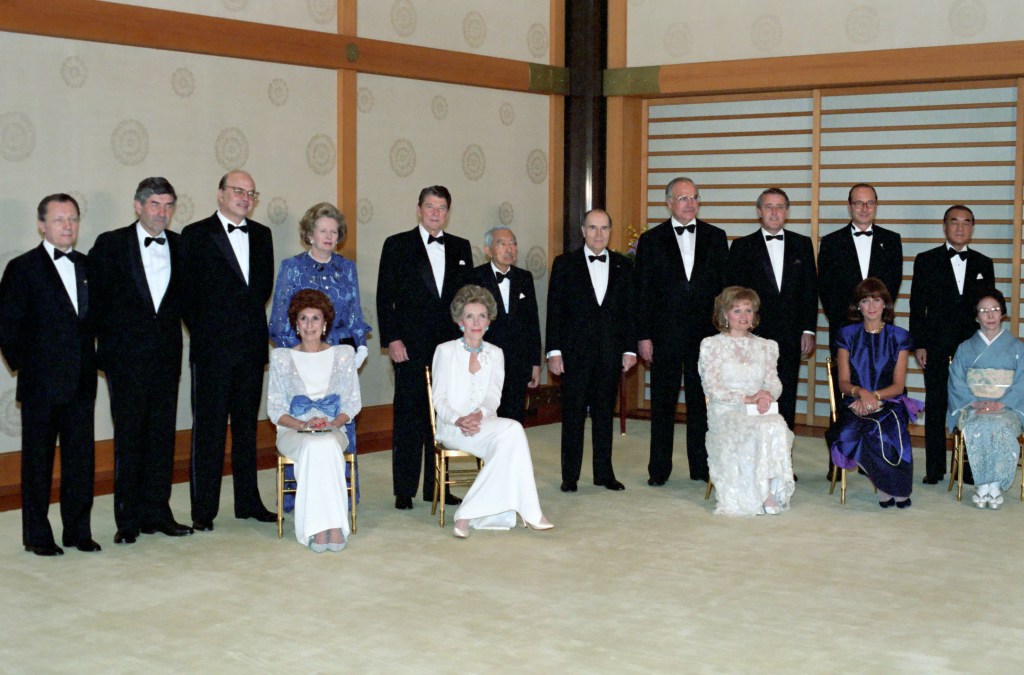
Leaders of the major industrial democracies, ending their 12th annual gathering Tuesday night, expressed satisfaction that they had confronted terrorism while taking important economic steps toward new trade talks and a revamping of the world monetary system. President Reagan said at a news conference here this morning that the meeting had been “the most successful of the six that I have attended.” He added, “All we sought to accomplish at the summit was achieved.” The news conference, carried live on television, was seen in the United States on Tuesday night. Mr. Reagan left Tokyo shortly after noon, local time, for the 16-hour flight to Washington aboard Air Force One. The Tokyo conference of leaders of the seven major industrial nations of the non-Communist world ended with a lavish formal banquet where they met Crown Prince Akihito.
At his first of these conferences, five years ago in Ottawa, Ronald Reagan was a cowboy among the intellectuals. To men like Pierre Elliott Trudeau of Canada and Helmut Schmidt of West Germany, this new American President was going on and on with oddball theories about cutting taxes and spending, liberating markets and chopping governments down to size. People were saying that the man needed cue cards to talk about the gross national product. Here, at his sixth economic summit conference, the man still needs help. Before dinner with the other six leaders on Sunday night, reporters were firing questions at him as he and his fellow leaders stood for photographs, and Margaret Thatcher of Britain and Yasuhiro Nakasone of Japan would whisper in his ears. But they whispered the questions, not the answers. All the help Mr. Reagan seems to need, at 75 years old, is a better hearing aid. President Reagan is riding high here. True, he carries the scars of earlier defeats and still loses a round or two, as he did here. He also has learned to compromise.
The Tokyo conferees set a standard for facing problems directly. Political will on the part of the seven leaders made possible a cohesion that surprised many participants. They all knew that a degree of disunity over the American bombing in Libya had to be remedied.
The Tokyo agreement for greater international economic coordination was greeted today with a mixture of praise for its far-reaching scope and skepticism that it would be effectively put into practice. According to academics, Wall Street analysts and various other policy experts, the accord represents something more than had been expected — particularly in specifying the economic indicators to be used to steer currencies in a “managed float” — but is unlikely to have much impact in the foreseeable future. “We see it as a useful step forward but we don’t regard it as the end of the road,” said John Williamson, a senior analyst at the Institute of International Economics, in a fairly typical comment. He added that he feared that the seven countries would be unable to agree on what constituted mutually compatible policy and, even if this was obtained, that they had no effective way to deal with the “virtually inevitable” divergences in economic performance from that policy.
President Reagan enjoys dinner at the Imperial Palace as a guest of the Emperor of Japan.
Nancy Reagan put a picture of the President in a “casual pose” by her bedside at the hotel and at the palace where she stayed without him this week. She called him whenever she could find matching patches of “private time” on their schedules to tell him about her tours of Buddhist temples, her tete-a-tetes with kings and queens, the glistening gifts of gold and silk. “I felt,” she said, “like Anna and the King of Siam.” When the Secret Service told her about the rocket attack during the welcoming ceremony here, she did not wait for private time. She called him right after her luncheon speech in Bangkok. It sounded pretty much like any telephone conversation a husband and wife might have during business hours. “He was in a hurry, had to go to the next meeting,” Mrs. Reagan said. “He was just unconcerned, I guess was the proper word.”
France performs a nuclear test at Mururoa Atoll.
Canada seized a U.S. fishing boat and four Spanish vessels off the coast of Newfoundland on charges of fishing illegally in Canadian waters. The U.S. boat Taormina was ordered to the port of St. John’s, where its cargo of 8,000 pounds of flatfish, valued at $1,450, was seized pending the filing of charges. The Spanish vessels were apprehended for alleged violations in 1984 and 1985. Fisheries Minister Tom Siddon said Canada would not tolerate continuing challenges to its 200-mile economic zone.
Costa Rica has defaulted on interest payments on commercial loans, bankers in New York said. They said that the Central American nation failed to make a $19 million interest payment on April 28 and did not make good the default within the five days allowed. Costa Rica thus joins the ranks of Nicaragua, Bolivia and Peru as defaulters. Economic pressures facing the government in an election year were blamed, and the bankers said they expect a new government, which takes office Thursday, to put its house in order.
The U.S. Justice Department has found no foundation for charges that large numbers of Nicaraguan rebels and private American supporters were involved in gunrunning and drug trafficking, department officials said today. A senior official, who asked not to be identified, said agents of the Federal Bureau of Investigation had conducted interviews in several states and Costa Rica and had been unable to verify the allegations. The inquiry, which had been organized by the United States Attorney in Miami, Leon B. Kellner, was disclosed in news reports last month.
An American schoolteacher has been murdered in a remote village of eastern Colombia, a spokesman for her U.S. institute said. Joan Marie Roroff Albel, 37, was stabbed in the heart last Sunday in Lomalinda, in a jungle province where the Summer Institute of Linguistics has its headquarters. The killer, described as mentally deranged, was arrested. The institute became prominent in 1981 when one of its translators, Chester Bitterman, was kidnaped and murdered by leftist guerrillas. The institute, which translates the Bible into tribal dialects, has been accused of interfering with Indians’ traditions.
President P. W. Botha of South Africa is reported to have appealed to leaders at the Tokyo economic summit meeting to acknowledge his program of cautious racial change and to support his case in negotiations on the release of Nelson Mandela, the jailed nationalist. Mr. Botha’s message, sent a week ago, was interpreted by diplomats as an effort to secure international backing for South Africa in its dealings with a Commonwealth-sponsored negotiating team that could urge mandatory sanctions by June if there is no sign of racial reconciliation. The Commonwealth team, known as the Eminent Persons Group and led by former leaders of Australia and Nigeria, is regarded by Western diplomats and South African officials as the principal international broker in South Africa’s crisis, eclipsing United States efforts to ease the nation’s turmoil.
The Senate Finance Committee, by a 20-to-0 vote, approved legislation early today that would make the biggest changes in the Federal income tax law in more than 40 years. The unanimous vote by which the bill was approved belied the intense controversy surrounding it and the several hours of private negotiations Tuesday night that preceded the final accord. Before passage, the panel adopted an amendment that would retain many tax shelters in the oil and gas industry. The committee’s chairman, Senator Bob Packwood, an Oregon Republican, said afterward that the bill would have probably been defeated without this provision. Earlier, at a news conference in Tokyo today, President Reagan, who had made tax revision one of the top domestic priorities of his second term, said the bill met his basic “requirements.” He added, “I think that very likely I can find myself supporting the Senate committee’s version.” The measure, which would go into effect next year, would reduce the taxes owed by most Americans and increase corporate taxes by about $100 billion over the next five years. Passage of the measure was Senator Packwood’s finest legislative hour in his 18 years in the Senate. He called the action a “miracle,” and added, “Congress and the country were waiting for reform, and I just happened to be there.” The legislation follows the thrust of the plan proposed by President Reagan last spring and the bill approved by the House of Representatives last December, although it differs from those bills in many important respects. The bill faces a tough fight on the Senate floor next month, where the rules permit unlimited debate and unrestricted amendments. However, Senator Packwood said he expected an “overwhelming vote” of approval by the Senate.
The Senate tonight gave final passage to a bill that eases several provisions of the Federal law on gun control. The bill, which the House approved last month, now goes to President Reagan, who is expected to sign it. Passage came on a voice vote. In an unusual procedural move, the Senate at the same time approved a separate package of amendments designed to meet objections of a coalition of law-enforcement groups that had lobbied strenuously but unsuccessfully against the main bill.
The Senate tonight decisively rebuffed the Reagan Administration’s request to sell $354 million worth of advanced arms to Saudi Arabia. The surprisingly large negative vote, 73 to 22, was six more than would be needed to override an almost-certain Presidential veto of the resolution adopted tonight and put one of the major foreign policy initiatives of the Administration in deep trouble on Capitol Hill. Twenty-nine Republicans joined 44 Democrats in voting against the arms sale, even though Senator Richard G. Lugar, the chairman of the Foreign Relations Committee, warned the lawmakers that they “were taking a headlong plunge in opposition to the President of the United States.” Only 20 Republicans and 2 Democrats backed the President.
The Senate voted 89 to 9 today to confirm James C. Fletcher to head the National Aeronatics and Space Administration for a second time. Mr. Fletcher will take over an agency that has been plagued by problems, including the destruction of the space shuttle Challenger and the loss of an expendable rocket last week.
Placing armed federal marshals on U.S. aircraft might endanger passengers rather than deter terrorists, FBI Director William H. Webster said. Although he acknowledged that marshals on airliners “may make people feel better … I think that it’s potentially an increase in threat,” Webster told the National District Attorneys Association’s legislative conference in Washington. The Federal Aviation Administration has been putting gun-carrying plainclothes security personnel, not deputized as marshals, aboard commercial jetliners on some international and domestic flights for more than 15 years. Sky marshals “can’t use their weapons for fear of causing an explosion” or a crash, if a bullet pierces the skin of the jetliner at high altitude, Webster told the prosecutors.
Transportation Secretary Elizabeth Hanford Dole, facing serious House opposition to her proposal to sell government-owned Conrail, said she is asking Norfolk Southern Corp. to raise its bid from $1.2 billion to $1.9 billion. Dole also said she is asking Congress to amend the law to make the sale subject to approval of the Interstate Commerce Commission. Congress had previously decided that the sale would not be held to the same standards as other railroad mergers.
President Reagan’s nominee for a Federal judgeship in Alabama sought to rebut charges that he was racially insensitive to members of minority groups. The nominee, Jefferson B. Sessions 3d, testifying before the Senate Judiciary Committee in March, acknowledged he had once referred to the N.A.A.C.P, the A.C.L.U., the Southern Christian Leadership Conference and the National Council of Churches as “un-American organizations.” Yesterday, he said he had “never meant to suggest” that these groups were un-American.
Former Governor Charles S. Robb of Virginia, who has assumed a major leadership role in Democratic Party’s centrist wing, asserted tonight that the United States must couple military assistance to Nicaraguan rebels with “tough, persistent diplomacy” to bring about a political solution to the conflict. Mr. Robb, in remarks prepared for delivery before a meeting of the Coalition for a Democratic Majority, said it was a mistake for Democrats simply to oppose any effort to provide military assistance to the Nicaraguan rebels. But Mr. Robb, in his first foreign policy speech since leaving the Governor’s office in January, also charged that President Reagan was pursuing the wrong policy in Nicaragua by viewing the struggle “as primarily a military one rather than a political movement with a military dimension.”
The Justice Department advised former Democratic vice presidential nominee Geraldine A. Ferraro that it has closed its criminal investigation of her and her husband, John A. Zaccaro, in connection with her congressional financial reports. Although the criminal investigation was closed, questions about Ferraro’s financial filings were referred to the department’s civil division. Federal law provides for a civil penalty of up to $5,000 for “knowingly and willfully” falsifying or failing to file information that individuals are required to report under the statute governing congressional financial disclosure.
After nine weeks of testimony, a California municipal judge today ordered Richard Ramirez, accused in a string of random, brutal slayings here, to stand trial in connection with 14 deaths and 36 other felonies. Judge James F. Nelson told a crowded courtroom that the prosecutor’s evidence against Mr. Ramirez, a 26-year-old drifter, was sufficient to try him on capital murder murder charges, which could mean the death penalty. Judge Nelson made no other comments as the preliminary hearing, held to determine whether enough evidence exists to hold a suspect for trial, drew to a close. He set arraignment in Superior Court for May 21. Mr. Ramirez smiled.
A New York State judge has barred several New York City art galleries, jewelers and auction houses believed to have done business with the former Philippine President, Ferdinand E. Marcos, and his wife, Imelda, from selling any artworks, antiques or jewelry belonging to the Marcoses or their associates. The decision, signed last Friday by Judge Harold D. Baer Jr., names four galleries: Hammer Galleries, M. Knoedler & Company, the Marlboro Gallery and Wildenstein & Company.
Federal courts today blocked the Texas executions of a rapist-murderer, scheduled to die Wednesday, and a man convicted of murder in a $1 robbery who was scheduled to die Thursday. Johnny Paul Penry, 30 years old, the rapist-murderer, had his execution blocked by a judge who wanted time to determine if a hearing on appeal issues should be granted. The second man, Robert Streetman, 25, was granted a stay by the United States Court of Appeals for the Fifth Circuit. He had been ordered to die for killing a woman in the $1 robbery.
A sailor faces a court-martial for refusing to take an AIDS blood test in the first challenge of the military’s policy of checking all personnel for the deadly disease, Navy officials said in Norfolk, Virginia. Petty Officer 2nd Class Phillip J. Nolan is charged with disobeying an order April 10 to take the test that shows if a person has been exposed to acquired immune deficiency syndrome. Nolan is the first sailor to refuse the test since the military ordered AIDS testing of its 2.2 million personnel last October, said a spokesman, Lieutenant Commander Craig Quigley.
The number of AIDS cases in the United States is expected to rise for at least two more years, a Federal health official said yesterday. The official, Dr. James W. Curran of the Centers for Disease Control in Atlanta, also said that physicians were diagnosing more cases of the lethal disorder of the immune system from more areas of the country than in previous years. “You cannot truly predict the course of the AIDS epidemic because the incubation period of the disease is variable and long,” Dr. Curran explained. But he said he believed physicians would continue to see more and more new cases for at least the next two years. He did not venture to say whether the number of cases would continue to increase after that point, whether the epidemic would level off or whether it would finally begin to decline.
Speaking today at a ceremony at the Capitol Rotunda in Washington to memorialize those killed in the Nazi Holocaust, the author Elie Wiesel suggested that acts of terrorism at the present time “may well be a consequence of what happened then.” “At first, Jews alone were the terrorists’ targets,” said Mr. Wiesel, who is chairman of the United States Holocaust Memorial Council. “Now everyone is. Terrorism has become state-sponsored, state-financed and state-planned. It must be denounced as an onslaught against humanity.”
Bright purple and green clouds are expected to light up the early morning sky tomorrow from Montreal to Jacksonville, Fla., and as far inland as Ohio. The clouds are to be produced by barium to be carried into space atop a slender rocket launched by the National Aeronautics and Space Administration from Wallops Island, Virginia. The clouds should be visible about 4:15 AM, said Joyce B. Milliner, spokesman for NASA’s Wallops Flight Facility. Another cloud, bright blue, is to appear 24 hours later on Friday when scientists send up a second rocket. Scientists hope to prove a theory holding that particles become electrically charged when blown across a magnetic field.
Record joblessness plagues Texas oilfields. A longtime welder, who was laid off two months ago, draws $203 a week in unemployment benefits, the maximum under Texas law. “You apply for a job,” he reported, “and people say, ‘I’m just fixin’ to lay off.’ ” They made jokes here in the early 1980’s about the plight of the North as blue-collar workers from the Middle West brought their families on Joad-like journeys to Texas, seeking work and new lives. “Freeze a Yankee — Drive 75,” the bumper stickers used to read. They thought what was happening up North could not happen here. Now the jokes have ended. In their place are levels of unemployment like those that afflicted the manufacturing communities of the North and the same fears that workers and communities may lose the upper-working-class or middle-class status they worked hard to achieve.
Ax-wielding intruders knocked a television station off the air 30 minutes before it was to begin a series of reports on the Ku Klux Klan and neo-Nazis, a spokesman said. WOWK-TV official Bob Willis said that the Huntington, West Virginia, station had no evidence about the identity of the vandals but that the FBI was investigating. “Our general manager is calling it an act of terrorism,” he said. The station had planned to begin its series — “West Virginia: A Haven For Hate?” — on its 11 PM newscast. Half an hour earlier, however, someone chopped cables linking WOWK with the ABC network and the station’s microwave satellite dish.
The U.S. Coast Guard rescued six people and a dog on a sailboat as it began to sink Monday. A British submarine that answered the group’s distress call sank the foundering vessel with small arms fire because it posed a threat to navigation, officials said. The submarine, HMS Conqueror, sank the 63-foot trimaran after receiving permission from the boat’s owner, who was among those rescued.
Americans gave to charities at a record pace last year, donating nearly $80 billion, a report said. The annual study, “Giving U.S.A.,” was published in New York by the American Assn. of Fund-Raising Counsel’s Trust for Philanthropy. Americans gave $79.84 billion to charity in 1985, an 8.9% increase from the previous year, the report said. In 1984, $73.3 billion was given. Charles Lawson, chairman of the trust, said the findings provide “adequate testimony to the enormous impact philanthropy has on the very fabric of the quality of life we enjoy.”
Donald E. Pelotte becomes the first Native American Catholic bishop. With whoops and yells, with chanting and beating drums, American Indians danced and sang into a strong desert wind here today to celebrate the ordination of one of their own as a Bishop of the Roman Catholic Church. Indian Catholics from across the country who had gathered here for the ceremony applauded when the Rev. Donald E. Pelotte, the son of an Algonquin laborer, who rose from poverty, prostrated himself on a Navajo rug before an outdoor altar and was anointed as the first American Indian to become a Bishop of the church. At 41 years old, he is also one of the country’s youngest bishops. “I repeat to you, never forget your roots or your cultural origins,” the Rev. Robert F. Sanchez, Archbishop of Santa Fe, enjoined him. “They will serve you well.”
Even when it was all over, Boston forward Kevin McHale wasn’t quite sure it had happened. “I don’t believe we held them to six points in a quarter,” he said. The Celtics did exactly that, outscoring Atlanta 36-6 in the third period, then rolling to a 132–99 victory Tuesday night and knocking the Hawks out of the NBA playoffs. The Celtics scored the last 24 points of the period as the Hawks set an NBA record for fewest points in one quarter of a playoff game.
Major League Baseball:
The California Angels downed the Boston Red Sox, 6–2. Gary Pettis hit his first homer in almost a year, and Rob Wilfong singled in the decisive run in the eighth for the Angels. After Boston pulled into a 2–2 tie in the seventh, Dick Scofield opened the eighth with a single to right-center field and was sacrificed to second by George Hendrick. Wilfong followed with a ground single off Dennis (Oil Can) Boyd (2–3). The Boston fourth ended with runners on first and second when Rich Gedman flied to Brian Downing in deep left-center. Downing and Pettis collided and went down, but Downing hung onto the ball. Pettis was driven from the field in a maintenance cart and taken to nearby Beth Israel Hospital. X-rays showed no fracture and Boston’s team doctor said Pettis suffered a severe muscle bruise. Pettis, who had only 7 hits in 54 previous times at bat, gave California a 2–0 lead with two out in the third when he lined his homer just inside the right-field foul pole.
The Yankees’ apparent lack of confidence in Dennis Rasmussen’s ability to pitch past the sixth inning nearly cost them a game tonight. “It would’ve been a shame to lose that game because I was taken out after six innings,” a disappointed Rasmussen said. But the Yankees overcame Brian Fisher’s seventh-inning failure and defeated the Chicago White Sox, 10–6, after they squandered a 6–0 lead built primarily against Tom Seaver. Eighth-inning singles by Willie Randolph and Don Mattingly (his fourth hit of the game) and a sacrifice fly by Dave Winfield produced the tie-breaking run in the eighth inning. Rickey Henderson added a three-run home run in the ninth. Those late-inning runs became necessary after the White Sox rallied for four runs and a 6–6 tie against Fisher in the seventh. Rasmussen, who has pitched as much as seven innings only once in five starts, pitched a strong six innings, retiring the first nine batters he faced and recording five of his last six outs on strikeouts. After the fifth strikeout, Ron Kittle doubled home a run and scored on Bobby Bonilla’s single.
The Cubs edged the Dodgers, 7–6. Leon Durham cracked a leadoff homer off Tom Niedenfuer in the bottom of the ninth inning to give Chicago the victory. Durham’s homer, his fourth of the season, came on a 1-2 pitch from Niedenfuer (0-2). Lee Smith (2-2) worked out of an eighth-inning threat to earn the victory. After Smith walked Mike Scioscia and Dave Anderson to lead off the eighth, Bill Russell, pinch-hitting, popped up a bunt and Terry Whitfield, also pinch-hitting, flied out. Steve Sax struck out to end the Dodger threat. The Dodgers tied the score at 6-6 in the eighth when Sax, who had hit a home run in the first for the first Dodger run, led off with a double to left field. He went to third on a groundout by Greg Brock and scored on a single to left by Mike Marshall.
The Cincinnati Reds blanked the Atlanta Braves, 2–0. Bill Gullickson pitched seven shutout innings, and Dave Parker hit his sixth home run as the Reds snapped their longest home losing streak of the century. Parker’s first-inning homer and Tracy Jones’s run-scoring single in the seventh sent the Reds toward their first victory in 10 games. They also snapped an 11-game home losing streak, the Reds’ worst in a season this century. Cincinnati has dropped 13 of its last 15 games for a 6-16 mark, the worst in the major leagues.
Andre Thornton drove in five runs with a pair of homers, and the streaking Indians extended their winning streak to nine games with a 6–1 rain-shortened victory over the Kansas City Royals. After an 81-minute delay because of thunderstorms, the game was halted with one out in the bottom of the fifth inning. Cleveland’s victory streak is its best since the club won 11 straight games from May 23-June 4, 1982. Tom Candiotti (2–2) allowed six hits, struck out six and walked none in pitching his second complete game. The right-handed knuckleballer lost his shutout on Argenis Salazar’s run-scoring single in the fifth. Bud Black (1–3) was the loser after winning his previous four decisions over Cleveland. In the first inning, Julio Franco blooped a one-out double down the left-field line. With two out, Thornton lined Black’s 3–1 pitch over the left-field wall for a 2–0 Indian lead. Cleveland went ahead, 5–0, in the third. Andy Allanson led off with a single, was balked to second and took third on Brett Butler’s single. Thornton then drove a 2–1 pitch to left-centerfield for his fourth homer of the season.
Paul Molitor hit a two-run homer and Ben Oglivie had three hits, driving in two runs to lead a 15-hit Milwaukee attack as the Brewers won their fifth straight game, shutting out the Mariners, 10–0. Four Mariner pitchers gave up six walks and Milwaukee scored two runs in the fifth inning on bases-loaded walks. A rookie left-hander, Juan Nieves (2-1), scattered six hits for the shutout.
Juan Bonilla hit his first American League home run and Eddie Murray and Lee Lacy also slugged homers, lifting the Baltimore Orioles to a 5–3 win in Minneapolis over the Twins. Baltimore starter Storm Davis, 2-1, struck out six and walked one and gave up seven hits in 7 ⅔ innings. Davis was chased in the eighth by Kent Hrbek’s third homer of the year and was replaced by Don Aase, who finished up for his sixth save.
Dwight Gooden pitched a two-hitter, the second of his career, and drove in two runs in the seventh inning with his first big league triple. Then, he preserved the shutout in the ninth by starting a double play that finished off the Houston Astros, 4–0, before a chilled and drenched crowd of 41,722 at Shea Stadium. “If he’s still pitching when I’m through playing,” said Bill Doran, the Houston second baseman, “I’m going to buy a ticket and go sit in the stands and watch him. Then maybe I’ll have some fun.” Gooden, who said quietly afterward that it was one of the better games he has thrown this season, took a one-hitter into the ninth. Glenn Davis opened the fifth with an infield single over the mound that both Gooden and Rafael Santana, the shortstop, said they probably could have reached.
The Expos thrashed the Phillies, 8–0. Vance Law and Andre Dawson hit two-run homers as the Expos posted their fourth straight triumph. Andy McGaffigan (2-0) gained the first shutout of his career, scattering eight hits and striking out seven. Law’s home run off Steve Carlton (1-5) capped a four-run fourth inning. Dawson also hit a two-run shot the fifth.
Candy Maldonado and Chris Brown hit home runs to back the seven-hit pitching of Mike Krukow as the San Francisco Giants beat the Pittsburgh Pirates, 7–2. Brown and Maldonado each connected for a two-run homer and combined for four runs, five hits and five RBIs to help Krukow raise his record to 4-2. The Giants won their third in a row and improved to 16-11, their best start since they went 19-8 in 1973. Last year, the Giants lost 100 of their 162 games.
San Diego Pinch-hitter Jerry Royster hit a two-out double in the ninth inning to drive in the winning run as the San Diego Padres edged St. Louis, 3–2. Tony Gwynn homered for the Padres; Jack Clark for the Cardinals. It was the 4th of the year for both.
Rookie Pete Incaviglia hit a two-run homer and Charlie Hough won his 1986 debut as the Texas Rangers defeated the Tigers, 4–2. Hough, activated Monday night, had been on the disabled list since spring training when he broke the little finger on his right hand shaking hands with a friend. Hough struck out four and walked two in 6 ⅓ innings.
The Oakland A’s crushed the Toronto Blue Jays by a score of 17–3. Dave Kingman drove in five runs with two homers and a sacrifice fly, and unbeaten Moose Haas became the major leagues’ first six-game winner, scattering three hits over seven innings. Haas, who gave up one of Jesse Barfield’s two homers, struck out five and walked one. Mickey Tettleton and Carney Lansford also had homers in Oakland’s 17-hit attack. Kingman hit his first homer of the game leading off the second inning and Tettleton hit his first of the year to lead a five-run third.
California Angels 6, Boston Red Sox 2
New York Yankees 10, Chicago White Sox 6
Los Angeles Dodgers 6, Chicago Cubs 7
Atlanta Braves 0, Cincinnati Reds 2
Kansas City Royals 1, Cleveland Indians 6
Seattle Mariners 0, Milwaukee Brewers 10
Baltimore Orioles 5, Minnesota Twins 3
Houston Astros 0, New York Mets 4
Montreal Expos 8, Philadelphia Phillies 0
San Francisco Giants 7, Pittsburgh Pirates 2
San Diego Padres 3, St. Louis Cardinals 2
Detroit Tigers 2, Texas Rangers 4
Oakland Athletics 17, Toronto Blue Jays 3
Volume improved moderately on Wall Street yesterday, but stock prices were mixed as investors, seeing interest rates inch higher, decided to capture some profits in blue-chip issues. The Dow Jones industrial average lost 5.82 points yesterday, to 1,787.95. It was hurt by a 1 ⅜-point drop, to 154 ¼, in International Business Machines. Over all, however, advancing issues outnumbered those that declined by 801 to 754.
Dow Jones Industrial Average: 1787.95 (-5.82)
Born:
Goran Dragić, “the Dragon,” Slovenian NBA point guard (NBA All-Star, 2018; Phoenix Suns, Houston Rockets, Miami Heat, Toronto Raptors, Brooklyn Nets, Chicago Bulls, Milwaukee Bucks), in Ljubljana, SR Slovenia, Yugoslavia.
C.J. Spillman, NFL safety (San Diego Chargers, San Francisco 49ers, Dallas Cowboys), in Louisville, Kentucky.
Markus Kuhn, German NFL defensive tackle (New York Giants), in Mannheim, Baden-Wurttemberg, West Germany.
Matt Langwell, MLB pitcher (Cleveland Indians, Arizona Cardinals), in Bryan, Texas.
Sasheer Zamata, American actress and stand-up comedian (“Saturday Night Live”, “Woke”, “Agatha All Along”), in Okinawa, Japan.
Tyler Hynes, Canadian actor (“Three Wise Men and a Baby”; “Holiday Touchdown: A Chiefs Love Story”), in Toronto, Ontario, Canada.
Cindy Daniel, Québécois singer (“Sous une pluie d’étoiles”), in Montreal, Quebec, Canada.
Emily Armstrong, American rock singer-songwriter(Dead Sara; Linkin Park, 2023-), in Los Angeles, California.
 History Diaries