During the night of May 5-6th, supplies were brought to the besieged garrison in Tobruk by destroyer (HMAS Voyager and HMAS Waterhen) for the first time. From this night until the end of the siege two destroyers would be used on such missions on most nights and on weekly intervals reinforcements would be brought in and the wounded evacuated.
Part of Convoy WS.8A reaches Gibraltar from England. This is the TIGER Convoy which carries badly needed tanks for General Wavell in North Africa. The plan — a pet project of Winston Churchill — is to send this convoy directly through the Mediterranean, past German, Italian and Vichy French possessions.
Fighting has died down on the Tobruk perimeter. The Axis forces hold a small wedge in the perimeter defenses on a 3-mile (4.8 km) front with a maximum depth of 2 miles (3.2 km). However, they have been ordered by visiting General Paulus to cease offensive operations unless the British begin evacuating the port — which they are not doing.
Winston Churchill writes to Air Chief Marshal Sir Charles Portal that “I am most deeply concerned” at how the air war is developing in the Middle East:
“If at the present time… we have a superiority [but] can only just hold our own, what will be our position in June, when… the enemy will have, or may have, nearly double our strength?”
He adds as an aside that “personally I never expected the Greek venture to succeed unless Turkey and Yugoslavia both came in.”
There is some trepidation in London (principally by Churchill) that the Germans may invade Cyprus instead of Crete. The Australian 7th Infantry Division (cavalry regiment) arrives there today.
Bread rationing begins in Malta, but the price is reduced. It is a quiet day, with only one air raid alert that concerns planes that don’t cross over the island. Convoy MW.7B departs Alexandria for Malta.
British troops are holding their own at Habbaniyah Airfield in Iraq despite being badly outnumbered. They do have complete control of the air. The Iraqis are slowly giving ground near the airport.
The British Defence Committee gives Middle East Commander General Archibald Wavell control over operations in Iraq. The Germans also have their eyes on Iraq and plan to supply it via their allies in Vichy Syria.
Haile Selassie re-entered the Ethiopian capital of Addis Ababa, exactly five years after it was occupied by Italian forces. May 5 is now celebrated in Ethiopia as Arbegnoch Qen, or Patriot’s Day. With an army of British, South African, African, and Ethiopian soldiers, Haile Selassie triumphantly returned to his capital to Addis Ababa to reclaim his throne. The streets of the city were lined with black and white African troops. After being welcomed with a 21-gun salute he spoke of his gratitude “to Almighty God that I stand in my palace from which the Fascist forces have fled.”
At Amba Alagi, the Indian troops (3/2nd Punjab Battalion) mount a pre-dawn raid across the exposed rock — the “Middle Position” — against entrenched Italian positions. In previous such situations, the Italians have proven adept at defending such positions with well-positioned machine guns, and this battle continues that pattern. The Indian troops are pinned down at barbed wire throughout the day and suffer 8 dead and 28 wounded, finally retreating after dark.
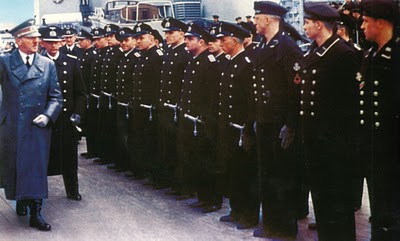
Admiral Günther Lütjens and German Chancellor Adolf Hitler inspected the German battleships Bismarck and Tirpitz at Gotenhafen (now Gdynia, Poland). While there, Hitler visits his two new battleships, Tirpitz and Bismarck. He has a meeting with Admiral Günther Lütjens, who is in command of an upcoming sortie aboard the Bismarck to the Atlantic, and Captain Lindemann of the Bismarck. Many believe that, during this meeting, Hitler creates overly optimistic expectations within Lütjens that informs some of his questionable aggressive decisions later in the month.
Hitler also inspects the interior of U-57, a U-boat which had been raised after sinking near Brünbuttel, as part of an inspection visit to the Kriegsmarine base at Gotenhafen.
French Minister of Economic Warfare Hugh Dalton tells the War Cabinet that the US is poised (by early July) to deliver 14,000 tons of flour in two merchant ships to Vichy France on humanitarian grounds. Winston Churchill permits this and other shipments to pass through the Royal Navy blockade under the overarching theory that this may give the US some leverage with the Vichy government which at some point could become useful to the war effort. The War Cabinet minutes suggest that Lord Halifax, the British ambassador to Washington, had agreed to this shipment without explicit permission to void previous British policy on the matter, which did not allow such shipments. At this point, it basically is a fait accompli.
Churchill does require that, as a condition of this continuing US aid, the French permit no further Germans entry into French possessions in North Africa — a demand that will not be met and is more an attempt to save face than anything else. This agreement appears to be motivated as much to ingratiate Churchill with President Roosevelt as to help the French. Churchill rationalizes that the blockade has been ineffective anyway.
First meeting of the Tank Parliament, a British Cabinet Committee devoted to armored forces. Churchill has formed to “make a general examination of the present position and prospects of armored formations.” The Tank Parliament will engage in long-range planning of equipment and strategy, and will, as today’s minutes indicate, take into account that “we might have to reckon with a break eastwards by the Germans.”
After his meeting with the Prime Minister of Portugal on the 4th, Australian Prime Minister Robert Menzies departs from Lisbon aboard flying boat “Dixie Clipper” bound for Horta, the Azores. Menzies arrives safely. He is en route to Bermuda, and then New York.
Churchill writes in a memo to Herbert Morrison that “Northern Ireland does not appear to be making its utmost contribution to the war effort… one-eighth of the insured population is out of work.” He requests that steps be considered to have Northern Ireland “display some initiative.”
U-69 (Jost Metzler) departed Lorient for the first long range mission by a Type VIIC U-boat. She headed into the Central Atlantic to operate off the West Coast of Africa and to lay mines. Metzler received a Knight’s Cross for this voyage on return to base.
Two Fokker employees flee Nazi occupied Netherlands to England.
Marshal Ion Antonescu, who keeps a very close eye on Soviet troop movements, warns Hitler that the Soviets are massing troops around Kiev and Odessa in what may be springboards for offensive action. In addition, Antonescu states:
“The thing worth noting is that factories around Moscow have been ordered to transfer their equipment into the country’s interior.”
Hitler, of course, already is planning to invade the Soviet Union on 22 June 1941.
Soviet Premier Joseph Stalin delivers two secret speeches to a Kremlin banquet held to honor a thousand graduating officers. All of the top Soviet brass, including Foreign Minister Molotov, Mikoyan, Voroshilov, Kalinin, and Lavrenti Beria, are there. The Germans later capture two attendees who independently recall that Stalin stated that the pact with the Third Reich was simply a temporary expedient. He states in his first speech:
“New tank models, the Mark 1 and 3, are on their way; these are excellent tanks, whose armor can withstand 76-millimeter shells. In the near future there will also be a new tank graced with my own name. This tank will be a veritable fortress. Today we have up to a hundred armored and mechanized divisions which still need to be organized into an entity. Our war plan is ready, we have built the airfields and landing grounds, and the frontline aircraft are already there. Everything has been done by way of clearing out the rear areas: all the foreign elements have been removed. It follows that over the next two months we can begin the fight with Germany. Perhaps it surprises you that I tell you of our war plans. But we have to take our revenge for Bulgaria and Finland.”
Later, after much drinking by all, Stalin delivers a second speech. In this one, he states:
“The slogan of peaceful policies is now obsolete—it has been overtaken by events. During the years of the capitalist encirclement of the Soviet Union we were able to make good use of the slogan while we expanded the Soviet Union’s frontiers to the north and west. But now we must discard this slogan for the reactionary and narrow-minded slogan that it is, as it will not serve to win us one more square inch of territory. It is time to stop chewing that particular cud, Comrade Chosin: stop being a simpleton! The era of forcible expansion has begun for the Soviet Union. The people must be schooled to accept that a war of aggression is inevitable; they must be in permanent mobilization.”
This aggressive stance will be hidden from the West, of course. It certainly does not justify in any way Germany’s invasion of the Soviet Union. However, in hindsight, it serves as a countervailing argument to those who point to Hitler’s Operation Barbarossa as an epic mistake.
Coco Chanel comes up with a new strategy in her long-running campaign to gain control over perfumes issued in her name in the 1920s. She writes to the occupying German government — she lives in the Ritz with many top German officers — claiming proprietary ownership over company Parfums Chanel, and in particular its leading brand Chanel No. 5. It is another step in a long, complicated struggle by Coco to recover what she views as her rightful ownership over the perfumes.
Channel claims sole ownership of the company over Pierre and Paul Wertheimer, who are Jewish directors of perfume house Bourjois and control Parfums Chanel. Coco Chanel herself only has ten percent of the stock in their company, and basically just licenses her name to the Wertheimer brothers, but she long has felt that she deserves all of it for various murky reasons. Her past attempts have failed, but she decides to try again. The argument that Chanel makes (this time) is that the Wertheimer brothers, being Jewish, have abandoned the property (they sailed to New York in 1940). Coco writes:
“I have, an indisputable right of priority …the profits that I have received from my creations since the foundation of this business …are disproportionate …[and] you can help to repair in part the prejudices I have suffered in the course of these seventeen years.”
The Germans, of course, are not averse to helping out a fellow “Aryan” against some Jews who have fled (for very good reason). They discover, however, that the Wertheimer brothers have assigned their controlling rights in Parfums Chanel to a “front,” Christian businessman and industrialist Felix Amiot. This tactic, fairly common during the Occupation, foils Coco’s plan.
The legal battle over Chanel No. 5 continues for years, and the Wertheimer brother will manage to operate the company from New York throughout the war using agents. The Germans and French government ultimately reject Coco Chanel’s petition to obtain sole ownership. The controversy, in fact, outlasts the war, as if it never happened. At the end of the war, Amiot returns control over the perfume company — including Chanel No. 5 — to the Wertheimer brothers, but the legal proceedings and attempts to regain control by Coco Chanel continue and intensify.
Ultimately, the parties reach a settlement which makes Coco a very rich woman for a very unlikely reason: the brand depends in part on her image. The Wertheimer brothers reason that if it is revealed that Coco consorted with German officers during the Occupation, the entire business could be ruined. Basically, she extorts them by threatening to ruin herself. So, while they are on solid legal grounds in retaining ownership, they give Coco a generous portion of their profits essentially to keep her quiet and remain a positive image for the brand.
Thus, Coco Chanel’s wartime “collaboration” (if it can be called that, and this is a very contentious issue) actually inures to her benefit in the long run. While there are scandalous rumors for the rest of her life, Coco Chanel’s image remains intact until after her death in 1971 — at the Ritz.
The fourth and final raid of the Belfast Blitz took place overnight. The German bombers cause widespread damage and lightly damage aircraft carrier HMS Furious and seaplane tender Pegasus. In addition, destroyer Volunteer and corvette La Malouine also are damaged, the latter fairly seriously (three months to repair). British 1719-ton freighter Fair Head and 6044-ton freighter Cape Breton are sunk (the latter refloated and repaired), while 2839-ton freighter Shepperton Ferry and 4283-ton blockship Frederika Lensen are damaged.
Other Luftwaffe targets during the night include Glasgow, Newcastle, North Shields and Cullercoats in Northumberland, Cleadon, Annfield Plain and Blaydon in Co Durham and Hull in Yorkshire.
The Luftwaffe “May Blitz” raids continue against Liverpool. Several more ships are damaged, some for the second time, including 6770-ton freighter Silversandal and 4672-ton freighter Clan Macinnes. In addition, 155-ton barge Traffic is sunk, and 231-ton whaler Sumba suffers a near miss and has to be beached before proceeding to Barry for repairs. St Luke’s Church in Liverpool was destroyed by an incendiary bomb. Its burned-out shell still stands as a reminder of the time.
The Luftwaffe attacks several British ports and shipping in the English Channel during the day, causing widespread damage. In the Channel, they sink Royal Netherlands Navy trawler HNLMS Jean Frederic. There are 25 deaths.
The Luftwaffe also raids Lowestoft, sinking 147-ton Royal Navy boom defense vessel Fidelia.
In an attack on Greenock, the Luftwaffe heavily damages destroyer HMS Marksman as well as submarines Traveller and Trooper, which are under construction.
RAF Bomber Command, Day of 5 May 1941
11 Blenheims on operations off the French coast. Ships were bombed but there were no hits. 1 Stirling to Bremen turned back. No losses.
RAF Bomber Command, Night of 5/6 May 1941
Mannheim
141 aircraft — 70 Wellingtons, 33 Hampdens, 30 Whitleys, 4 Manchesters, 4 Stirling& No losses. There was 10/10ths cloud all the way to the target and this hampered navigation but 121 aircraft claimed to have bombed in the target area. A very detailed report from Mannheim lists the results of the raid. Approximately 25 bomb loads hit the city. 1 house and a barn were destroyed, 4 houses were badly damaged and 199 lightly damaged (mostly broken windows and roof tiles). There were 19 small fires. 1 electricity pylon collapsed; 1 water main was broken. Casualties: 4 people killed. Farm animals: 50 rabbits and chickens killed. Effect on industrial production: nil.
Minor Operations: 5 aircraft to Boulogne, 4 to Cherbourg, 4 Hampdens minelaying in Frisians. No losses.
Luftwaffe III Gruppe of JG 27 relocates to Sicily in order to prepare for the upcoming Operation MERCURY, the invasion of Crete.
The RAF (830 Squadron) lays mines in Tripoli Harbor. The pilots observe an Axis ship mysteriously blow up in the harbor while they are at work.
U-38, commanded by Kapitänleutnant Heinrich Liebe, sank British steamer Queen Maud (4976grt) in 7-54N, 16-41W. At 1105 hours on 5 May 1941 the unescorted Queen Maud (Master Robert John McDonald), dispersed from convoy OB-309, was hit by two torpedoes from U-38 about 208 miles west of Freetown and sank within three minutes after a coup de grâce hit at 1117 hours. One crew member was lost. The master, 38 crew members and four gunners were picked up by the Portuguese merchant Mirandella, transferred to HMS Dragon (D 46) (Capt R.J. Shaw, MBE, RN) and landed at Freetown on 8 May. The 4,976-ton Queen Maud was carrying coal and government stores, including aircraft parts and was bound for Alexandria, Egypt.
Aircraft carrier HMS Furious and seaplane tender HMS Pegasus were damaged by German bombing at Belfast. Neither ship was significantly damaged. The aircraft carrier was struck by one small bomb, a parachute mine lifted Furious’s stern bodily, and a near miss slightly damaged the port funnel duct. The seaplane tender required seven days repair. The next day, aircraft carrier Furious departed Belfast for Liverpool.
Destroyer HMS Volunteer, under repair and in drydock, was also damaged by German bombing.
Corvette HMS La Malouine at anchor in Musgrave Channel was damaged by a near miss. The corvette was repaired at Belfast in three months.
Corvettes HMS Bryony and HMS Buttercup were also damaged.
Minelayers HMS Agamemnon, HMS Menestheus, and HMS Port Quebec of the 1st Minelaying Squadron departed Loch Alsh to lay minefield SN.9A escorted by destroyers HMS Intrepid, HMS Impulsive, HMS St Marys, and HMS Brighton. Light cruiser HMS Kenya was with the force from the Butt of Lewis. Light cruisers HMS Edinburgh, HMS Manchester, and HMS Birmingham of the 18th Cruiser Squadron departed Scapa Flow on the 5th to cover the minelay which was accomplished on the 6th. After the minelaying, the cruisers of the 18th Cruiser Squadron joined destroyers HMS Somali, HMS Nestor, HMS Bedouin, and HMS Eskimo, which had departed Scapa Flow at 0815/5th and refueled at Skaalefjord, for operation EB. The destroyers departed Skaalefjord at 0730/6th and joined the cruisers at sea in 62-50N, 5-20W.
Light cruiser HMS Nigeria arrived at Scapa Flow after Faroes-Iceland patrol.
Destroyers HMS Electra and HMS Escapade departed Scapa Flow to join convoy HX.122 being shadowed by a German submarine. En route, the destroyers were involved in a search for a submarine contact reported by aircraft. The search was unsuccessful and the destroyers joined the convoy by dark. After safely delivering the convoy, the destroyers met convoy SC.29 on the 6th. The destroyers were detached from convoy SN.29 at dark on the 7th and arrived back at Scapa Flow at noon on the 8th.
Destroyer HMS Tartar arrived at Scapa Flow at 1845 after boiler cleaning at Rosyth.
Destroyer HMS Brocklesby with anti-submarine trawler HMS Hamlet departed Scapa Flow at 2030 to escort tanker War Diwan to Skaalefjord. The ships arrived at 2230/6th. At 2330, destroyer Brocklesby, trawler Hamlet, and tanker War Pindari departed Skaalefjord. Five miles 270° from Gloup Holm at 2350/7th, the ships met tanker War Bharata for escort to Scapa Flow. At 1445/8th, destroyer Brocklesby arrived back at Scapa Flow after this escort duty.
Corvette HMS Begonia picked up seventeen survivors from a sunken merchant ship. She transferred these survivors to destroyer HMS Wolverine.
British boom defence vessel HMS Fidelia (147grt) was sunk by German bombing at Lowestoft.
British steamer St Eunan (436grt) was damaged by mining five miles southwest of St Ann’s Head.
British steam barge Traffic (155grt) was sunk by German bombing at Huskisson Dock, Liverpool. The entire crew was rescued.
British steamer Silversandal (6770grt), which had been slightly damaged by bombing on the 3rd, and British steamer Clan Macinnes (4672grt) were damaged by German bombing at Liverpool.
British whaler Sumba (231grt) was damaged by a near miss from German bomb. The whaler was beached in Sully Bay, Barry Roads. She arrived at Barry for repairs on the 12th.
British steamer Fair Head (1719grt) was sunk by German bombing at Belfast. Two crewmen were lost.
Destroyer HMS Newark under repair at Belfast was damaged in the bombing.
British steamers Shepperton Ferry (2839grt) and Cape Breton (6044grt) and blockship Frederika Lensen (4283grt) were damaged by German bombing at Belfast.
Steamer Cape Breton was sunk in dock. She was refloated and repaired.
Destroyer HMS Marksman, under construction at Greenock was lifted off the blocks and severely damaged by German bombing. The destroyer suffered severe damage to her stern. The construction of the destroyer, renamed HMS Mahratta, was restarted in another berth on 18 August.
Submarines HMS Traveller and HMS Trooper, under construction, at Greenock were damaged by German bombing in the Scotts yard.
Anti-aircraft cruisers HMS Carlisle and HMS Coventry, destroyers HMS Defender, HMS Greyhound, and HMS Hasty, corvette HMS Gloxinia, and whaler HMS Swona departed Alexandria on the 5th with the slow Malta convoy MW.7B consisting Norwegian tankers Hoegh Hood (9351grt) and Svenor (7616grt). Whaler Swona was to complete fitting LL sweeps at Malta. Destroyer Defender departed with convoy MW.7B, but had to return to Alexandria on the 6th with condenser problems.
In Operation MD.4, the Mediterranean Fleet battleships HMS Warspite, HMS Barham, and HMS Valiant, aircraft carrier HMS Formidable, light cruisers HMS Ajax, HMS Orion, and HMAS Perth, minelayer HMS Abdiel, and destroyers HMS Jervis (D.14), HMS Juno, HMS Jaguar, HMS Kandahar, HMS Kimberley, HMS Kingston, HMAS Napier (D.7), HMAS Nizam, HMS Imperial, HMS Griffin, HMS Hotspur, and HMS Havock departed Alexandria on the 6th. Fast supply ship Breconshire also departed Alexandria to refuel destroyers at Malta. Light cruisers HMS Dido and HMS Phoebe, anti-aircraft cruiser HMS Calcutta, and destroyers HMS Ilex, HMS Isis, HMS Hero, and HMS Hereward departed Alexandria after the Fleet with the fast Malta convoy MW.7A supply ships British Settler (6000grt), Norwegian Thermopylae (6655grt), Danish Amerika (10,218grt), and Norwegian Talabot (6798grt), and tug St Issey. On the 7th, the Mediterranean Fleet destroyers were refueled at sea from supply ship Breconshire.
During the night of 7/8 May, Light cruiser HMS Ajax and destroyers HMS Havock, HMS Hotspur, and HMS Imperial bombarded Benghazi. Italian steamers Tenace (1142grt) and Capitano Cecchi (2321grt) were sunk at Benghazi in the bombardment at 3½ miles 299° from Marabutto Sidi Bu Fachra and 2½ miles 314° from Tre Palme, respectively. The British ships rejoined the Battle Fleet at 1700/8th.
Italian light cruisers Duca Degli Abruzzi, Garibaldi, Bande Nere, and Cadorna and five destroyers departed Palermo on the 8th. They were reported by British air west of Trapani on the 8th. The escorts of both Malta convoys were detached at dark on the 8th before the convoys arrived at Malta to join the TIGER convoy off Pantelleria. Both convoys safely arrived at Malta on the 9th following corvette HMS Gloxinia’s minesweeping of the Channel. Supply ship Breconshire and destroyer HMS Hotspur, HMS Havock, and HMS Imperial proceeded to Malta on the 8th, arriving the next day.
Pilot Lt Cdr R. C. Tillard DSC and Observer Lt M. F. Somerville DSC, in a Fulmar of the 808 Squadron from aircraft carrier Ark Royal were lost on the 8th. Pilot Lt C. W. R. Peever and Petty Officer Airman F. Coston in a Fulmar of 803 Squadron, Lt Observer Lt (A) G. B. Davie RNVR, and Petty Officer Airman W. T. Chatfield in a Fulmar of 803 Squadron and Pilot T/Sub Lt (A) K. H. Smith RNVR, Observer P/T/Sub Lt (A) B. H. Groves RNVR, and Leading Airman C. F. Norman in an Albacore of 829 Squadron from aircraft carrier HMS Formidable were lost on the 8th. A second Albacore was shot down, but its crew was rescued. Additionally, an Albacore of 826 Squadron, piloted by Lt Cdr W. H. G. Saint ran out of fuel and ditched astern of battleship HMS Barham which rescued the crew.
Battlecruiser HMS Renown had a gun accident on the 8th which killed six ratings and wounded Sub Lt D. M. Brightman RNVR, and twenty five ratings.
Battleship HMS Queen Elizabeth was attacked by one Italian torpedo plane during the night of 8/9 May and was near missed. Damage was claimed in this attack on battlecruiser HMS Renown.
British steamer Empire Song (9228grt) of the TIGER convoy was lost in the Narrows off Malta on the 9th on a mine. Her crew was picked up by destroyer HMS Foresight, which was damaged by debris and concussion damage to her machinery from the exploding steamer and sustained several casualties. Destroyer HMS Fortune was also standing by the steamer and picked up all but A/Gunner (T) A. E. Carter which was killed from Foresight’s whaler which was also sunk in the explosion. Eighteen crew members and passengers were lost on the steamer.
Steamer New Zealand Star (10,740grt) was lightly damaged by mining at the same time as steamer Empire Song.
Force H was relieved at 1515/9th in the Narrows fifty miles south of Malta of the escort of the convoy by Light cruisers HMS Phoebe and HMS Dido, anti-aircraft cruisers HMS Coventry, HMS Calcutta, and HMS Carlisle, and destroyers HMS Ilex, HMS Isis, HMS Hero, HMS Hereward, HMS Greyhound, and HMS Hasty. Force H destroyers HMS Faulknor, HMS Fury, HMS Foresight, HMS Fortune, HMS Forester, and HMS Fearless proceeded into Malta to refuel. The convoy escort was still composed of battleship HMS Queen Elizabeth, light cruisers HMS Gloucester, HMS Naiad, and HMS Fiji.
The Malta destroyer force of destroyers HMS Kelly, HMS Jackal, HMS Kelvin, and HMS Janus had been mined in port since HMS Jersey’s loss on the 2nd. Minesweeping corvette HMS Gloxinia was able to clear a channel to allow the destroyers to depart to meet the TIGER convoy on the 9th. Depth charges had been used also to clear a channel to sea.
Passing the Narrows, the convoy was left to light cruisers HMS Dido, HMS Naiad, and HMS Phoebe, anti-aircraft cruisers HMS Carlisle, HMS Calcutta, and HMS Coventry, and the destroyers. The rest of the ships joined the Mediterranean Fleet Main Body.
Italian air reconnaissance reported a cruiser and four destroyers (destroyers HMS Faulknor, HMS Fury, HMS Fortune, HMS Forester, and HMS Fearless returning to rejoin Force H. after refueling at Malta; destroyer HMS Foresight remained at Malta) proceeding at high speed towards Gibraltar.
Twenty one Italian planes attacked this force on the 10th and claimed damaging a cruiser. Destroyer HMS Fortune was badly damaged by a near miss. Destroyer HMS Fury escorted the damaged destroyer. On the 11th, tug St Day and four motor launches met destroyer Fortune. Light cruiser HMS Sheffield and destroyers HMS Harvester and HMS Hesperus were detached to escort. They arrived at Gibraltar at 2039 on the 12th. Destroyer Fortune was repaired to complete in November, including refitting, at Chatham.
At 1700/10th, the British Malta destroyers HMS Kelly, HMS Kipling, HMS Jackal, HMS Kashmir, and HMS Kelvin were detached from the Battle Fleet to bombard Benghazi before returning to port. The bombardment was accomplished.
Destroyers HMS Kelvin, HMS Kelly, HMS Kashmir, and HMS Jackal were all near missed by German dive bombing after the bombardment.
Lt (A) P. S. Touchbourne and Leading Airman C. H. Thompson of 806 Squadron from HMS Formidable was killed when their Fulmar crashed taking off on the 10th.
On the 11th, anti-aircraft cruisers HMS Dido and HMS Calcutta and destroyers HMS Janus and HMS Isis were detached from the Battle Fleet to proceed to Alexandria to refuel.
On the 11th, sub Lt (A) P. D. J. Sparke and Leading Airman A. S Rush of 806 Squadron from HMS Formidable were killed when their Fulmar was lost after colliding with a German bomber.
The HMS Dido group arrived at Alexandria early on the 12th and departed the same day to join convoy ANF.30.
Destroyers HMS Kelly, HMS Jackal, HMS Kelvin, HMS Kashmir, and HMS Kipling arrived at Malta during the morning of the 12 May.
The Mediterranean Fleet arrived at Alexandria at 1300 with battleships HMS Warspite, HMS Barham, and HMS Valiant, aircraft carrier HMS Formidable, anti-aircraft cruisers HMS Naiad, HMS Carlisle, and HMS Coventry, light cruisers HMS Gloucester, HMS Fiji, and HMAS Perth, and destroyers HMS Jervis, HMS Jaguar, HMS Juno, HMAS Napier, HMAS Nizam, HMS Greyhound, HMS Griffin, HMS Ilex, HMS Hero, HMS Havock, HMS Hotspur, HMS Hasty, HMS Hereward, HMS Imperial, HMS Kandahar, HMS Kingston, and HMS Kimberley.
Force H of battlecruiser HMS Renown, aircraft carrier HMS Ark Royal, and destroyers HMS Faulknor, HMS Forester, HMS Fury, HMS Fearless, and HMS Havelock arrived at Gibraltar at 1800/12th.
Australian destroyers HMAS Voyager and HMAS Waterhen departed Alexandria on a transport mission to Tobruk during the night of 5/6 May. The destroyers arrived at 0030/6th and departed at 0400 the same day to continue to Alexandria.
Destroyer HMS Vidette departed Gibraltar for refitting in the United Kingdom.
Australian sloop HMAS Parramatta arrived at Suez to reinforce the Mediterranean Fleet. However, she was ordered to remain there temporarily to provide anti-aircraft protection for liners Queen Mary and Queen Elizabeth.
Convoy OG.61 departed Liverpool escorted by sloop HMS Scarborough and anti-submarine trawler HMS Man O’ War. The trawler was detached on the 6th and replaced by anti-submarine trawler HMS Wellard, which continued with the convoy until dark. On the 7th, destroyers HMS Keppel, HMS Lincoln, and HMS Sabre, sloop HMS Fleetwood, and corvettes HMS Alisma, HMS Dianella, and HMS Kingcup joined the convoy. Sloop Fleetwood and the corvettes were detached on the 9th and the destroyers on the 1st. Dutch submarine HNLMS O.21 joined the convoy on the 13th and corvettes HMS Azalea, HMS Geranium, and HMS Jonquil, which departed Gibraltar on the 13th, on the 14th. The convoy arrived at Gibraltar on the 19th, escorted by sloop Scarborough and submarine O.21.
Part of Convoy WS.8A neared Gibraltar after being escorted from England by battlecruiser HMS Repulse, anti-aircraft cruiser HMS Naiad, and destroyers HMS Havelock, HMS Hesperus, and HMS Harvester. This convoy, designated TIGER, was merchant ships Clan Lamont (7250grt), Clan Chattan (7262grt), Clan Campbell (7255grt), New Zealand Star (10,740grt), and Empire Song (9228grt). Battleship HMS Queen Elizabeth and destroyers HMS Velox, HMS Fearless, HMS Foresight, and HMS Fortune departed Gibraltar at 1600/4th to relieve battlecruiser Repulse and the three H-class destroyers which proceeded to Gibraltar, arriving at 1730/5th. Battleship HMS Renown, aircraft carrier HMS Ark Royal, light cruisers HMS Fiji and HMS Sheffield, and destroyers HMS Wrestler, HMS Kashmir, and HMS Kipling met the convoy and the two groups passed Gibraltar during the night of 5/6 May. On the 6th, destroyers HMS Faulknor, HMS Forester, HMS Fury, HMS Harvester, HMS Havelock, and HMS Hesperus departed Gibraltar at 0330 and joined the force. Light cruisers HMS Naiad and HMS Gloucester departed at 1320/5th and 0345/6th, respectively. Battlecruiser Repulse was left at Gibraltar due to her inadequate anti-aircraft protection.
On this day in Washington, President Roosevelt in a letter to Secretary Stimson called for increased production of heavy bombing planes, saying that command of the air by the democracies “must and can be achieved.”
The Senate debated the Treasury-Post office Appropriation Bill, received the Capper -Shipstead Farm Bill, received a resolution of Senator Thomas of Utah for an inquiry into the possibilities of permanent peace, received a resolution of Senator Gillette of Iowa for investigation of trade between the United States and the Axis Powers, received a resolution of Senator Vandenburg of Michigan for an investigation of operation of the Selective Service Act, and recessed at 2:35 PM until noon tomorrow.
The House debated the bill for acquisition of foreign-owned ships and adjourned at 5:12 PM until noon tomorrow. The Ways and Means Committee continued hearings on the tax bill.
Demands for immediate convoying of supplies to Great Britain and warnings such a step would lead to war were heard in the House of Representatives today as debate began on a bill to permit the government to use idle foreign shipping for national defense and commerce. “I think we should begin immediately to convoy,” Representative Patrick, Alabama Democrat, asserted. Chairman Vinson, Georgia Democrat, of the House Naval Committee said in an interview: “If convoys are needed, let’s have convoys.” Representative Cox, Georgia Democrat, asserted in a floor speech: “Of course we’re going to convoy and convoy right away.” But Representative Fish, New York Republican, and others countered that President Roosevelt had said convoys would mean shooting and shooting would mean war. Asserting convoys had no place in the discussion, sponsors said the ship bill was necessary to supplement a tonnage that had been depleted because of the war.
President Roosevelt called on Secretary of War Stimson tonight to obtain a “substantial increase in heavy bomber production,” asserting the democracies can and must achieve command of the air. The new objective was reported authoritatively to be 500 long-range, four-motor bombers a month, the craft to be divided between the United States and Great Britain. Fewer than a tenth of this number are being produced now but steps already have been taken to step up American production of the hardest-hitting aerial offensive weapon. Mr. Roosevelt directed the war secretary to “take whatever action is needed” to obtain a rate of production outlined in a private memorandum, which was not made public.
The White House announced: We can offer no official confirmation that 26 American merchant ships loaded with tanks, anti-aircraft guns, and other war material landed in the Suez Canal. We can only say that we do not rule out the possibility.
President Roosevelt was criticized today by Republican members of the Ways and Means Committee for not “giving some direction” to Congress in writing the new defense tax measure and for not suggesting at the same time economies in non-defense appropriations. A short but sharp debate was waged in the committee when it resumed hearings on the tax bill over Mr. Roosevelt’s letter of Friday backing the Treasury’s request for $3,500,000,000 in new revenue, but asking for a measure that would not make the “rich richer and the poor poorer.” Chairman Doughton. with the other Democratic members, defended the letter. If Mr. Roosevelt “had laid down any hard and fast rules” for determination of the new taxes, Representative Doughton said, it would have been resented by the very ones who now criticize him. When the chairman sought to introduce the letter into the record of the hearings Representative Crowther of New York protested that it was “perfectly useless” so far as any pertinent suggestion for taxes was concerned. He was supported by Representative Thomas Jenkins of Ohio. “That letter gives us very little guidance as to what to do,” the New York Republican said. “It does not say a word about cutting down expenses. In fact, there is not a word of guidance in any way.”
The House, and one member in particular, received a verbal spanking today from Speaker Rayburn over repeated violations of the rule of comity between the two legislative branches. Mr. Rayburn informed the members that he would enforce the rule hereafter to the point of halting a member’s speech when a Senator or Senate action was criticized from the floor. The Speaker said there had been more violations of the rule at this session than in any of the twenty-eight years he has served, and he declared that “If there is a thing In the world that is important, it is that there be comity and good feeling between the two legislative bodies.” The occasion for the Speaker’s statement was the offering of a resolution by Representative Clare E. Hoffman, Republican, of Michigan, to expunge from The Congressional Record the remarks made by Representative Adolph A. Sabath, Democrat, of Illinois, and chairman of the Rules Committee and dean of the House, criticizing a Chicago speech of Senator Burton K. Wheeler last week. Mr. Wheeler had vigorously attacked the Administration’s foreign policy.
General Lewis B. Hershey, acting national director of the selective service act, said tonight he favored revision of the act so men over 30 years could be deferred.
Investigation of the operation of the Selective Service law by a special committee of five Senators was proposed in a resolution introduced in the Senate today by Senator Vandenberg of Michigan.
A.F.L. President William Green pledged yesterday fullest cooperation of the American Federation of Labor in the national defense program. “I say that without reservations of any kind,” he declared in an address to the Pennsylvania State Federation of Labor at Harrisburg, Pa. Green said he felt “compelled” to make this statement because John L. Lewis, head of the United Mine Workers (C.I.O.) and former president of the Congress of Industrial Organizations, had asserted last week the government should not ex pect too much cooperation from labor unless it afforded labor a greater voice in its councils.
Basic differences between the General Motors Corporation and the United Automobile Workers of America, C.I.O., were explored today by the National Defense Mediation Board in an effort to avert a strike that would affect 165,000 employees in sixty-one plants.
Two Ford Motor Company employees, Paul J. Padgett and Melvin E. Bartling, filed suits today against the C.I.O. and the Communist party, asking damages for alleged injuries received during the recent strike at the Ford plant.
The House unanimously adopted today a bill shortening the course at the Naval Academy from four to about three and one-half years, to provide more officers. The measure was sent to the Senate. The class of 1941 was graduated Feb. 7, 1941. The class of 1942 will begin its academic course in July, instead of the Fall, and will be graduated in December. Today’s measure will shorten academic studies by about 112 hours of study for the full course. The Naval Affairs Committee said that by 1945 expansions of facilities at the academy will permit the resumption of the four-year course.
Pulitzer Prize for Drama is awarded to Robert E. Sherwood for “There Shall Be No Night.”
Major League Baseball:
Southpaw Ernie White became the fifth member of Manager Billy Southworth’s sensational rookie St. Louis pitching corps to crash the victory column today when he held the Braves to five hits while the Cardinals gained their tenth straight triumph, 5–1. White, eighth different starter the Cards have used since they were last defeated by the Reds, 3–2, on April 24, kept Boston scoreless until the eighth, when, with two out, Maxie West slammed a pinch-hit homer into the right-field stands. St. Louis made all its eleven hits, including Enos Slaughter’s third homer of the season, against Dick Errickson, starting pitcher, who suffered his fourth straight setback. Errickson gave way to Lefty Art Johnson after the eighth, when Slaughter drove the ball out of the park with Johnny Hopp on base.
Lester McCrabb pitched and batted the Athletics to a 5–4 eleven-inning victory over the White Sox today, advancing the Mackmen to sixth place. Pete Suder singled in the eleventh, advanced on Al Brancato’s sacrifice and scored on McCrabb’s single. The rookie pitcher scattered twelve hits to the Sox and stopped their rally after Chicago had tied the score in the ninth. The loss, second straight to Philadelphia, dropped the White Sox to a third-place tie with Detroit.
Behind the three-hit pitching of Bob Feller, the Indians today stretched to eleven straight games the longest winning streak of the major league season. They defeated the Senators in the ninth inning, 2–1. It was the fifth consecutive victory for the Tribe’s ace, who struck out twelve batters, six fewer than his record. Facing a Washington line-up revised by Manager Bucky Harris to put the maximum number of left-handed hitters against him, Feller pitched deliberately most of the way, but wildness overtook him. He issued seven bases on balls. Ken Chase, a southpaw, went all the way for the Senators and yielded only three safeties in the first six innings. Cleveland touched him for four more in the last three. Washington opened the scoring in the third, but Lou Boudreau led off in the seventh with his second home run of the season. With the score 1–1 going into the Indians’ half of the ninth, Boudreau drew the first of two walks issued by Chase. Hal Trosky bunted, and on Buddy Lewis’s wild throw to second both runners were safe. Jeff Heath sacrificed and Beau Bell was purposely passed, filling the bases. After Ray Mack flied out, Catcher Rollie Hemsley got his second single of the game, to drive in Boudreau.
Lefty Vernon Gomez took his second straight beating today at Briggs Stadium, and so did the Yankees as the American League champion Tigers romped off with their fourth successive victory. The count was 7–3. A crowd of 9,303 was pleased to see Detroit score on two of the three hurlers called on by Joe McCarthy. Only Norman Downs Branch, a Newark rookie who made his Yankee debut in a relief role, escaped unscathed. But his arrival was too long delayed to be of any significance. Gomez was hammered to shelter in three innings under a five-run. bombardment. Charley Stanceu lost his usefulness after the sixth when the Tigers accumulated two more runs largely through Red Robert Rolfe’s error. By the time Branch came on the scene, the game was safely stowed among Manager Del Baker’s souvenirs. By winning, the Tigers tied the White Sox for third place in the American League standing, half a game from the tottering Yanks, in second place. The Tigers’ Tommy Bridges pitched his third victory of the young season.
In what will prove to be a controversial transaction, the Tigers purchase the fine-hitting Rip Radcliff from the Browns for $25,000. The sale violates a rule pushed through at the American League meetings in December 1939 when seven of the eight teams voted in a rule that a defending champion could not make a transaction within the league in the following year (as noted by Lyle Spatz). The Yankees were the lone holdout. With the Tigers being the defending champions in 1941, the sale initiates strong criticism from the other American League franchises. The rule is looked upon as unworkable and, led by Clark Griffith’s efforts, is soon abolished.
The scheduled game between the Chicago Cubs and the Giants at the Polo Grounds in New York was postponed due to rain. The game will be made up as part of a doubleheader on June 11.
The scheduled game between the Pittsburgh Pirates and the Dodgers at Brooklyn was postponed due to rain. The game will be made up as part of a doubleheader on July 20.
The scheduled game between the Cincinnati Reds and the Phillies at Philadelphia was postponed due to threatening weather. The game will be made up as part of a doubleheader on August 18.
The scheduled game between the Boston Red Sox and the Browns at St. Louis was postponed due to rain. The game will be made up as part of a doubleheader on June 12.
St. Louis Cardinals 5, Boston Braves 1
Philadelphia Athletics 5, Chicago White Sox 4
Washington Senators 1, Cleveland Indians 2
New York Yankees 3, Detroit Tigers 7
The Mexican news agency OFJ reported: “A report from Tampico [Mexico] says that the National Bureau of Petroleum has brought up the entire oil production of the independent American and Mexican oil fields, and then sold it all to Britain. The oil will soon be loaded onto tankers for transport.”
General Isaias Medina Angarita becomes president of Venezuela.
Convoy WS.7X arrives in Bombay, India loaded with troops.
While Japanese forces continue to make occasional landings on the Kwangtung Coast, ostensibly to cut off trading with the outside world, they are also withdrawing, usually after seizing military and other supplies. There is apparently little significance to these exploits except where bases are established.
Japanese hints that Tokyo would like to explore the possibility of settling Pacific problems with the United States met complete silence in government quarters today. Nevertheless, the feeling here appeared to be that Japan is so closely allied with the axis powers that only a virtual abandonment of American interest in the Far East to the “new order in east Asia” would satisfy the Tokyo leaders. This the administration has made it clear it does not intend to do.
Tokyo suspects that its communications with the embassy in Washington, D.C. are being broken and read. It sends a message to this effect today to the embassy. An investigation is begun.
The engagement of Princess Shigeko Teru, eldest daughter of Emperor Hirohito, to Captain Prince Morihiro Higashi-Kuni, the eldest son of General Prince Naruhiko Higashi-Kuni, was announced informally today by the Department of the Imperial Household.
New Zealand Division light cruiser HMS Achilles arrived at Suva with a liner from Auckland.
Dow Jones Industrial Average: 115.84 (+0.29)
Born:
Tommy Helms, American baseball second baseman (MLB All-Star 1967, 68; NL Rookie of the Year 1966; Cincinnati Reds, Houston Astros, Pittsburgh Pirates, Boston Red Sox) and manager (Reds, 1988-89), in Charlotte, North Carolina (d. 2025).
Alexander Ragulin, Russian ice hockey defenseman (Soviet National Team, gold medals, 1964, 1968, 1972), in Moscow, Russian SFSR, Soviet Union (d. 2004).
Terry Baker, American College Football Hall of Fame and NFL quarterback (Heisman Trophy 1962, Oregon State; Los Angeles Rams), in Pine River, Minnesota.
Stanley Cowell American jazz pianist (Heath Brothers), record label co-founder (Strata-East), and educator, in Toledo, Ohio (d. 2020).
Naval Construction:
The Royal Indian Navy Basset-class minesweeping trawler HMIS Peshawar (T 263) is laid down by Alcock Ashdown & Co. Ltd. (Bhavnagar, India).
The U.S. Navy Accentor-class coastal minesweeper USS Heroic (AMc-84) is laid down by the Warren Boat Yard Inc. (Warren, Rhode Island, U.S.A.).
The U.S. Navy Accentor-class coastal minesweeper USS Liberator (AMc-87) is laid down by the F. L. Fulton Shipyard (Antioch, California, U.S.A.).
The U.S. Navy SC-497-class (110-foot wooden hull) submarine chaser USS PC-521 (later reclassified as SC-521) is laid down by the Annapolis Yacht Yard Inc. (Annapolis, Maryland, U.S.A.).
The U.S. Navy SC-497-class (110-foot wooden hull) submarine chaser USS PC-533 (later reclassified as SC-533) is laid down by the Luders Marine Construction Co. (Stamford, Connecticut, U.S.A.).
The U.S. Navy 77-foot Elco patrol motor torpedo boat USS PT-42 is laid down by the Electric Launch Company Ltd. (Elco), (Bayonne, New Jersey, U.S.A.).
The Kriegsmarine (German Navy) Type VIIC U-boat U-709 is laid down by H C Stülcken Sohn, Hamburg (werk 773).
The U.S. Navy 77-foot Elco patrol motor torpedo boat USS PT-25 is launched by the Electric Launch Company Ltd. (Elco), (Bayonne, New Jersey, U.S.A.).
The Royal Canadian Navy Flower-class corvettes HMCS Morden (K 170) and HMCS Kamsack (K 171) are launched by the Port Arthur Shipbuilding Co. (Port Arthur, Ontario, Canada) .
The U.S. Navy coastal minelayer USS Monadnock (CMc-4) is acquired by the Navy and begins conversion for naval service by the Bethlehem Steel Co., Atlantic Works, East Boston, Massachusetts. Later reclassified as a minelayer (CM-9).
The U.S. Navy coastal minelayer USS Miantonomah (CMc-5) is acquired by the Navy and begins conversion for naval service by the Bethlehem Steel Co., Atlantic Works, East Boston, Massachusetts. Later reclassified as a minelayer (CM-10).
The Royal Navy Fairmile B-class motor launch HMS ML 158 is commissioned.
The Royal Navy Fairmile B-class motor launch HMS ML 253 is commissioned.
The Royal Navy Bar-class boom defense vessel HMS Barsing (Z 75) is commissioned.
 History Diaries