The Soviet party newspaper Pravda today published the first detailed account of the accident at the Chernobyl nuclear power plant in the Ukraine. It said an explosion on the night of April 25 touched off a raging blaze that eventually reached inside the reactor and released radioactivity. The newspaper described desperate efforts by “brave, bold” firefighters to put out 100-foot-high flames while their boots sank in molten bitumen, or asphalt. It reported that “there were some panic-stricken individuals,” although it said most of the thousands of people who work at the plant and live nearby remained calm and orderly. Excerpts from the Pravda account were distributed by Tass, the Soviet press agency, several hours before the newspaper was to go on sale. The account described Pripyat, a city of 25,000 near the plant, as virtually a ghost town, with only an occasional radiation-monitoring vehicle passing through the deserted streets and teams arriving to check on the other three reactors at the plant. The Pravda article, published 11 days after the blast, presented the Soviet people with their first comprehensive account of an accident that spread radioactivity over distant reaches of the globe and touched off an international furor. The Government acknowledged the accident only April 28, and in subsequent days released only small doses of information.
Fallout from the Soviet reactor plant accident increased sharply over Scandinavia today, and there were signs it was spreading farther through Western Europe. One report reaching Stockholm said the rain of radioactive particles had reached Britain. But scientists emphasized that the overall amounts of increased fallout and radioactivity to which people in Western Europe are exposed were extremely small. To underscore this fact, Dr. Gunnar Bengtsson, director of Sweden’s National Institute of Radiation Protection, noted that an appreciable part of the increase in Sweden’s ground radioactivity in the last week had been a result of the seasonal melting of snow. Without snow cover, the natural radioactivity of Sweden’s granite registers strongly on sensitive instruments.
Small amounts of radioactivity from the Soviet reactor accident have already swept high over much of the United States, propelled across the Pacific Ocean by jet stream winds of up to 150 miles an hour, Federal officials announced today. But the radioactivity has not yet been detected at ground level, and whatever amounts eventually do arrive on the ground are not expected to be harmful to health or the environment, according to members of a Federal interagency panel. The State Department reported that health and radiation teams sent to Moscow and Warsaw had thus far found no significant health risks to American personnel stationed there. But a State Department spokesman, Charles E. Redman, said that the results were “preliminary” and that health teams would continue to monitor and evaluate the results. A third team sent to Bucharest has not yet reported on Rumania.
A high-level United States delegation began two days of private discussions with Soviet officials in Geneva today on ways to reduce the risks of an accidental nuclear war. The talks, which have not been publicized by the Reagan Administration, were called for in the communique signed November 21 at the Geneva summit meeting by President Reagan and Mikhail S. Gorbachev, the Soviet leader. The American delegation is headed by Richard N. Perle, an Assistant Secretary of Defense, and Robert B. Linhard of the National Security Council. The chief of the Soviet delegation is expected to be Aleksei A. Obukhov, the Soviet negotiator in Geneva on medium-range weapons.
Czechoslovakia ordered two Swedish diplomats to leave the country for “activity incompatible with their diplomatic mission,” Czechoslovak radio said. The action came after Sweden last week expelled five Czechoslovaks for allegedly running an intelligence-gathering operation. Czechoslovak radio described this charge as “fabricated and unjustified.” The Swedes expelled by Prague were identified as Hagard Westermark, first secretary at the Swedish Embassy, and Bengk Olof Cnattingius, trade attaché.
A bomb attached to a military truck exploded early today at a United States Army barracks in West Germany, destroying the vehicle and three nearby fuel storage tanks but causing no injuries, an Army spokesman said. The explosion occurred at about 3 A.M. at the Haide barracks near Kirchheimbolanden, 35 miles southwest of Frankfurt, according to the spokesman, George Grimes of the 21st Support Command in Kaiserslautern.
The United States Ambassador in Sofia says Bulgaria has adopted a more cooperative attitude to American requests for help in the hunt for international narcotics dealers and couriers. “We’re pleased we’re making some progress in terms of cooperation and information sharing,” the Ambassador, Melvin Levitsky, said in a recent interview. This represents a significant change in the American view, which had been unusually open in condemning purported Bulgarian unwillingness to cooperate.
At least eight people were killed and 40 injured when an earthquake jolted southeastern Turkey, Turkish state television reported. It said 1,000 homes were left uninhabitable after the tremor. The quake, measuring 5.8 on the Richter scale, struck a rural area between the towns of Adiyaman and Malatya, with the epicenter about 375 miles southeast of Ankara. Turkish television showed pictures of villagers amid the debris of their mud-and-timber homes. Turkish radio said the quake cracked the Surku Dam, and authorities evacuated residents from the area and lowered the water level to prevent flooding.
Israeli Prime Minister Shimon Peres ordered an inquiry into the World War II activities of Austrian presidential candidate Kurt Waldheim. The outcome could affect Israel’s diplomatic ties with Austria, the Foreign Ministry said in a statement. World Jewish leaders have accused Waldheim, former U.N. secretary general, of being involved in atrocities while serving with the German army in the Balkans. On Sunday, he won a plurality in the Austrian election and faces a runoff election June 8.
Syrian President Hafez Assad visited Amman, Jordan, for the first time in nearly a decade, capping an eight-month effort to improve ties between the estranged Arab neighbors. President Hafez al-Assad of Syria arrived here today for talks with King Hussein, in his first visit to Jordan since relations between the two neighboring countries turned hostile six years ago. The talks are taking place while both countries are beset with domestic and external difficulties, and senior Jordanian officials say the two leaders have sought to defuse the tensions between them even if disagreements on several basic issues cannot be resolved. “Personal relations are critical in the Middle East,” said a senior adviser to the King, “and so it is very important that these two men are talking to each other.” #2 Points of Disagreement The palace official said two major points of disagreement were expected to dominate the talks: Jordan has backed a moderate approach to peace talks with Israel while Syria is the most powerful of the hardline Arab nations, and, equally significant to the two leaders, Jordan supports Iraq in the gulf war while Syria is Iran’s chief Arab ally.
The State Department called on Syria to expel the Abu Nidal terrorist organization from territory under its control. The statement represented a shift from January, when U.S. officials were stressing the group’s ties to Libya. A State Department spokesman said that “facilities and personnel” of the terrorist group are in “Syria and in Syrian-controlled parts of Lebanon.” The Abu Nidal group is believed responsible for a number of attacks, including raids on the Rome and Vienna airports last December, in which 20 people died, including five Americans. Israel Defense Minister Yitzhak Rabin, meanwhile, said that Syria, not Libya, was behind the attempted bombing of an El Al jetliner in London last month, but he offered no proof.
Libya’s relations with the Soviet Union have been strained over what it regards as Moscow’s lukewarm support after the American bombing raid last month and its reluctance to provide Colonel Muammar el-Qaddafi with sophisticated radar equipment, officials in Tripoli, the Libyan capital, were quoted here as saying. The Lebanese daily As Safir, known for its close connection with the Libyan regime, reported Sunday that officials in Tripoli had been highly critical of the attitude Moscow has taken with regard to the United States attacks, which hit Colonel Qaddafi’s headquarters in the Libyan capital and also struck at bases in Benghazi, the second-largest city. According to the newspaper’s correspondent in Tripoli, Colonel Qaddafi chided Soviet reporters when he talked with them at an undisclosed location April 24.
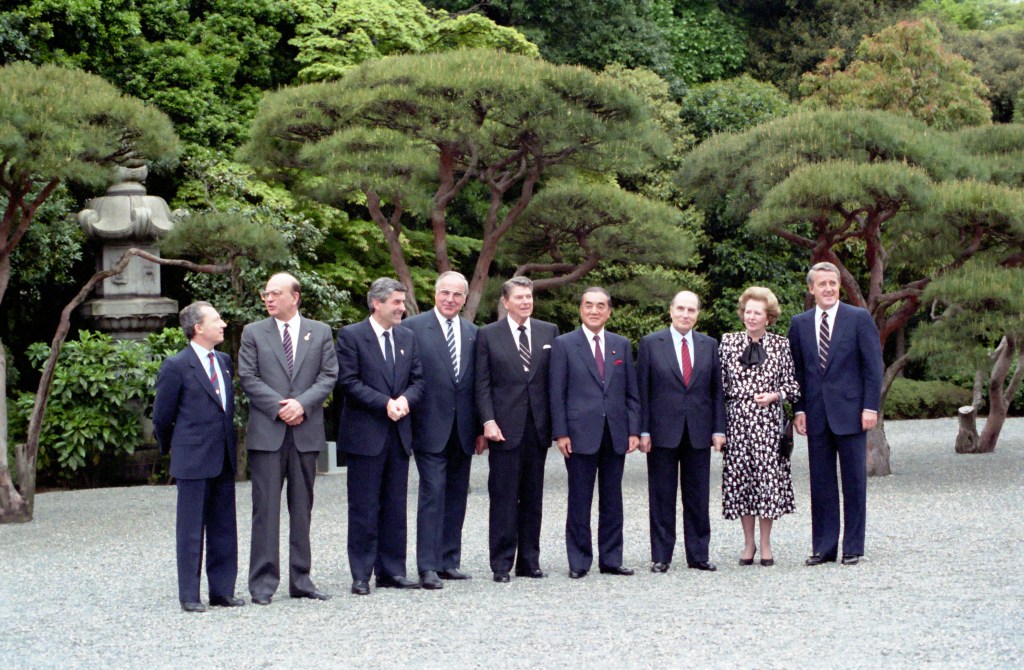
The leaders of the seven largest industrial democracies adopted a joint statement today that condemns terrorism as an international scourge that “must be fought relentlessly and without compromise.” The statement, adopted at the urging of the United States, pledged the seven to fight terrorism through “determined, tenacious, discreet and patient action combining national measures with international cooperation.” The pointed declaration fulfilled a main objective of the United States by singling out Libya as a source of state-sponsored terrorism. But the statement stopped short of endorsing the use of military action or economic sanctions such as those employed by the Reagan Administration. Secretary of State George P. Shultz, discussing the implications of the statement for the Libyan leader, Colonel Muammar el-Qaddafi, said: “The message is: ‘You’ve had it, pal. You are isolated. You are recognized as a terrorist.’ “
The seventh round of Afghan peace talks with the Foreign Ministers of Afghanistan and Pakistan opened today at United Nations headquarters. The United Nations mediator, Diego Cordovez, an Ecuadorean who is Under Secretary General for Political Affairs, and the two Foreign Ministers gave no indication that the replacement of the Afghan leader, Babrak Karmal, had altered their plans to meet here for several weeks to discuss a United Nations-sponsored accord. Mr. Cordovez said at a news conference that the negotiators would go directly to the remaining unsolved question, a document containing a timetable for the withdrawal of over 100,000 Soviet troops who have been in Afghanistan since December 1979, when Mr. Karmal came to power.
A popular Bangladeshi opposition leader was confined to her home today, and the police routed three dozen of her supporters from Dhaka’s largest mosque as the Government cracked down on political groups opposed to the holding of parliamentary elections on Wednesday. Policemen armed with shields and long bamboo sticks charged into the Baitul Mukarrum Mosque shortly after early evening prayers and arrested at least 36 men identified as supporters of a boycott.
The document on terrorism adopted today by the seven leading industrial democracies was the product of a long night of haggling over different drafts and a last-minute change by summit leaders that added a denunciation of Libya, diplomats said. In the drafting sessions, the United States and Britain, each with its own document, held out for condemnation of Libya, and Japan and France took a more measured view, the diplomats said. The United States draft was put together aboard Air Force One on the flight to Tokyo from Bali after a long discussion in the Presidential party. President Reagan handed the document on Sunday evening to each of the six other leaders attending the summit meeting here, asking them to read it overnight. It played a major role, Administration officials contended, in persuading the conferees to adopt the kind of statement on terrorism that Mr. Reagan wanted.
Leaders of the major industrial democracies agreed today to work toward closer coordination of their economic policies to assure that their currencies are fairly valued. They set up a new international body to oversee the task. Known as the Group of Seven, it will comprise the finance ministers of the seven countries with permanent seats at the annual summit meetings. It will act as a kind of economic referee, assessing each member country’s economic performance and recommending changes when policies are deemed damaging to others. Sometimes it will also intervene jointly in foreign-exchange markets, buying and selling currencies to affect values, if ministers feel it is necessary.
Whatever its long-range economic and diplomatic impact, the Tokyo summit conference has caused immediate political troubles for Prime Minister Yasuhiro Nakasone. A successful meeting, however Japanese politicians and newspapers ultimately define it, had been widely regarded as critical to Mr. Nakasone for any hope he may entertain to stay in office after his term expires next fall. Thus far the conference has not gone the Prime Minister’s way. It could produce serious consequences for him and his ruling Liberal Democratic Party if he goes ahead with plans to dissolve Parliament’s decision-making lower house and hold national elections late next month.
President Reagan fights for the inclusion of Italy and Canada into the G-5, and wins.
President Reagan enjoys a traditional Japanese lunch at a tea house.
Small explosions went off in several subway stations across the city this morning at the height of rush hour as Tokyo residents returned to work after a long holiday weekend. The police said they had no reports of injuries or damage. The explosives, which were placed in trash cans, on subway tracks, in washrooms and in newsstands, appeared to be smoke bombs and firecracker-like explosives encased in plastic boxes and equipped with timing devices. One explosive went off on a train car, and some were reported to have caused small fires.
A strong earthquake centered off Mexico’s Pacific coastline jolted the central part of the country but caused no damage or injuries, officials said today. “The quake lasted for less than a minute and had its epicenter off the coast of Michoacan state” near the Pacific coast town of Lazaro Cardenas, about 200 miles southwest of Mexico City, a spokesman for the Tacubaya Seismological Institute said. The spokesman said there were no reports of damage or injuries from the earthquake, which struck at 11:47 PM Sunday and measured 6 on the Richter Scale.
President Salvador Jorge Blanco has canceled a planned trip to the inauguration of the Costa Rican President-elect, Oscar Arias, this week after two people were killed Sunday in pre-election violence in the Dominican Republic, the President’s office announced today.
Black gunmen shot their way into a South African hospital, killing a visitor and freeing a suspected member of the outlawed African National Congress. Police said that an unknown number of raiders burst into the Edendale hospital in Pietermaritzburg and snatched Steven Mkhize, 22, from the intensive-care unit. Two police guards were slightly wounded before the attackers fled with the man, injured in a gun battle with police last week. The raiders pushed Mkhize out of the hospital on a gurney after removing intravenous-feeding and blood-transfusion tubes.
The President’s National Commission on Space is recommending that the nation begin an ambitious program to explore, exploit and eventually settle new worlds “from the highlands of the moon to the plains of Mars.” In a report mistakenly released early by the publisher, Bantam Books, the commission outlines a bold agenda for the next four decades in space and predicts that the United States will have the funds and know-how to push back the space frontier. “The future will see growing numbers of people working at Earth orbital, lunar and, eventually, Martian bases… the report said.
The Supreme Court ruled today that committed opponents of the death penalty may be barred from juries in capital cases regardless of whether this increases the likelihood of conviction. The 6-to-3 decision rejected one of the last sweeping challenges to the procedures used by most states in cases in which death is a possible penalty. The Court reversed a Federal appellate ruling in an Arkansas case that had cast doubt on the convictions of hundreds of the nation’s 1,714 death row inmates, and of many other murder convicts. The decision could quicken the pace of executions; two dozen death sentences have been postponed pending the Court’s ruling. Under the standard “death qualification” procedures used in many states, which were upheld by the Court today, judges examine prospective jurors before trial in capital cases and exclude “for cause” those who oppose the death penalty so strongly that they doubt their ability to decide impartially whether a convicted defendant should be executed. In most of the 37 states that authorize the death penalty for murder, the same jury that decides a capital defendant’s innocence or guilt also decides, after a separate sentencing hearing, whether to sentence him to death.
Personal incomes of Americans rose by an average of 5.3 percent last year, slightly outpacing a 3.8 percent rise in consumer prices, the Federal Government reported today. The biggest gains in income were achieved by residents of Nebraska and New England, while the slowest growth occurred in Western energy states. The nationwide gain was identical to the 1984 increase and left the income level at an average of $13,451 for every person in the country last year.
The Supreme Court agreed today to consider the constitutionality of a Louisiana law that required any public school that teaches the theory of evolution to teach “creation science” as well. A Federal District Court ruled in January 1985 that the law violated the First Amendment’s prohibition on establishment of religion because its purpose was to promote a religious belief in the scriptural account of creation. The United States Court of Appeals for the Fifth Circuit upheld that decision last year. In its appeal, the state argued that “creation science consists of scientific evidence and not religious concepts,” and that creationism did not necessarily endorse the scriptural account of the creation or depend on religious beliefs.
The General Accounting Office staff members studying the lobbying activities of Michael K. Deaver have recommended that the matter be referred to the Justice Department for investigation of possible illegalities, according to two officials at the agency. The Congressional agency’s study is one of several regarding whether Mr. Deaver, the former White House deputy chief of staff, used undue influence in his lobbying for foreign clients. The staff recommendation that the matter be turned over to the Justice Department indicates the staff’s contention that conflict-of-interest laws may have been violated, and criminal prosecution should be considered. One official said that the matter had moved beyond the scope of G.A.O.’s audit responsibility.
Thanks to the decline in world oil prices, the Pentagon hopes to save up to $2 billion during the next fiscal year on fuel purchases. Defense Department officials say the manner in which such savings will be used — earmarked for other defense programs or simply cut from the budget as part of the effort to trim the deficit — is a matter that must be decided by Congress.
Adlai E. Stevenson III announced in Chicago who would be his running mate in his independent bid for governor, saying he wants to defeat the supporters of Lyndon H. LaRouche Jr. “and everything they stand for.” Stevenson picked Cook County Circuit Judge Michael Howlett Jr. to complete his ticket. Stevenson resigned the Democratic nomination for governor after two supporters of LaRouche won nomination as lieutenant governor and secretary of state in the March 18 primary.
A federal judge refused to let Louisiana Governor Edwin W. Edwards, a lawyer, deliver his own closing argument to the jury in his racketeering retrial in New Orleans. Defense lawyers immediately appealed Judge Marcel Livaudais’ decision to the U.S. 5th Circuit Court of Appeals, where a three-judge panel rejected their arguments within minutes of convening. Edwards, his brother, Marion, and three business associates are charged with racketeering and fraud in connection with a $10-million hospital investment scheme.
Defense attorneys in the espionage trial of Jerry A. Whitworth focused today on the credibility of his chief accuser, John A. Walker Jr. In the first full day of cross-examining him, the defense lawyers brought out discrepancies between Mr. Walker’s testimony last week and what he told investigators for the Federal Bureau of Investigation when they interviewed him in July 1985, after his arrest. Mr. Walker, who has admitted to heading a Soviet spy ring, has testified that he began his espionage by simply walking into the Soviet Embassy in Washington in January 1968 and selling a classified Navy document. But Mr. Walker admitted today that he had told an entirely different story to the F.B.I. in 1985.
A Federal district judge today refused to let Governor Edwin W. Edwards of Louisiana deliver his own closing argument to the jury in his racketeering retrial. Defense lawyers immediately appealed Judge Marcel Livaudais’ decision to the United States Court of Appeals for the Fifth Circuit. In not allowing Mr. Edwards to speak to the jury, Judge Livaudais agreed with prosecutors that jurors might not be able to distinguish between the closing argument, which is not evidence, and testimony given under oath from the witness stand.
Robert Whipple, 19, who unplugged his comatose brother’s life-support system while holding hospital workers at gunpoint in Phoenix, was sentenced to five years’ probation. Last Jan. 19, Whipple, who had been drinking, took a shotgun into John C. Lincoln Hospital and ordered nurses to turn off his brother’s life-support system. When they refused, he unplugged the machines. After a two-hour standoff, he surrendered to police. John Whipple survived, but four days after the incident, the machines were unplugged at the family’s request, and he died. John Whipple had fallen into a coma on January 16 after a drug overdose.
A strike against the Santa Fe Railway entered its third day today with no talks scheduled, and the railroad was operating at 75 percent of capacity with supervisory personnel, company officials said. Some 20,000 workers from several unions walked off the job Saturday throughout the railroad’s 12,000-mile, 13-state network to protest the company’s decision to use management to test a new type of train. The strikers include 8,000 members of the United Transportation Union, 4,000 members of the Brotherhood of Locomotive Engineers and 8,000 members of about a dozen smaller craft unions representing clerks, mechanics and others.
The United States raid against Libya has reinvigorated the debate over the role and cost of aircraft carriers. Proponents of the aircraft carrier cite the controversy in Western Europe over the American attack on Libya as Exhibit A in their argument for more carriers. “When you use a carrier you can operate unilaterally,” said Norman Friedman, a naval expert. “The attitude of our allies shows that this capability is very valuable.” Pentagon officials note that, given the debate in Britain over the raid, it is highly unlikely that the United States would ask permission to launch F-111 bombers stationed there in a future mission against Libya or other targets the United States Government decides are “terrorist associated.” But some skeptics maintain that aircraft carriers used in the raid did not pack a lot of punch. In the raid against Libya, only 20 A-6 planes stationed on two carriers in the Mediterranean were available to attack Libyan targets with precision strikes at night, the type of tactics that the Navy says were important to minimize the risk of American and civilian Libyan casualties. Thus, F-111 bombers were flown from Britain to insure that five sets of targets could be struck at the same time. “The strength of the carrier is that it allows you to use military power flexibly at your own discretion, but there is a negative side,” said Barry M. Blechman, an author on military issues. Carriers, he said, “represent a relatively small amount of military power.”
Two abnormal surges of power occurred in the electrical system of a Delta rocket’s main engine a second before the craft lost power after launching Saturday, investigating officials disclosed. They said the evidence of short circuits in the system could explain the premature shutdown of the rocket’s main engine, which sent the vehicle spinning out of control until it was destroyed by a signal from the ground.
The loosely knit sanctuary movement has become in four years an unlikely mix of action and symbol and religion and politics operating in almost every state in the country. Backers do everything from raising money to harboring, smuggling and transporting Central American aliens into the United States. The hand-painted sign outside the Southside Presbyterian Church here is so stark and simple as to have an almost biblical quality. “Este es el santuario para los oprimidos de Centro America,” it reads, “This is the sanctuary for the oppressed of Central America.” There is very little else quite so clear about the loosely knit sanctuary movement, eight of whose leaders were convicted last week on felony charges involving the smuggling of Central Americans into the country. The movement began four years ago when five American churches declared themselves sanctuaries for Central American refugees. It has become an unlikely mix of action and symbol, religion and politics, and operates in at least 34 states both in accordance with and in violation of United States immigration laws.
Snow, cold rain and strong winds joined forces in an assault on the northern Rockies and Plains, making for hazardous travel, while hurricane-force winds tore through Browns Valley, Minnesota. Thunderstorms that stacked hail three inches deep north of Edmonson, Texas, moved northeast into the Mississippi Valley. Meanwhile, an estimated 300,000 to 500,000 Utah residents fasted and prayed for dry weather, but a gusty spring storm pushed the surging Great Salt Lake closer to its highest recorded level.
Thousands of Utah residents fasted and prayed for dry weather, but a gusty spring storm today pushed the surging Great Salt Lake closer to its highest level in recorded history. An estimated 300,000 to 500,000 northern Utah residents participated in the fasting and prayer on Sunday, Commissioner Robert Hunter of Weber County said today.
Thousands of Americans, attempting to become healthier, may be poisoning their bodies with huge doses of vitamin supplements that can be dangerous in large quantities, a group of scientists said in Washington. The scientists and the Food and Drug Administration called on the nation’s doctors to monitor their patients’ vitamin use and report side effects related to vitamin overdoses to the FDA. “Americans should get their nutrients from food instead of pills,” said Dr. David Heber of the UCLA School of Medicine.
Rock and Roll Hall of Fame Foundation announces Cleveland, Ohio chosen as the site of Rock and Roll Hall of Fame Museum.
Major League Baseball:
The Boston Red Sox blanked the California Angels, 3–0. Bruce Hurst scattered eight hits and Wade Boggs and Don Baylor hit run-scoring singles to lead Boston. Hurst (2–2) gave up seven singles in the first five innings, and a leadoff double in the ninth to Brian Downing, who had three hits. He struck out five and walked none in pitching Boston’s first shutout of the season. Boston has won seven of its last eight games. Mike Witt (2–2) was the loser.
Joe Altobelli has, after all, more managing experience than Lou Piniella, so maybe the Yankees’ dugout coach could teach the rookie a move or two — such as giving the home-run sign at critical moments. Altobelli, managing tonight as Piniella served the first half of his two-game suspension for bumping an umpire, got home runs from Mike Pagliarulo and Rickey Henderson, as many as Piniella had in the previous four games, and they propelled the Yankees to a 4–1 victory over the staggering Chicago White Sox. “I didn’t know at the beginning if I could manage again,” said Altobelli, who was dismissed as the Baltimore Orioles’ manager 47 weeks ago. “I was getting a better feel for the game when Pagliarulo hit his home run and when we got the second home run, I was thinking I could manage again. Then, when we got the two runs in the ninth and the pitching from Niekro and Righetti, I knew I could manage again.” The pitching by Joe Niekro was marred only by an unearned run in the first inning, the result of Willie Randolph’s bobble of Wayne Tolleson’s grounder that preceded Jerry Hairston’s two-out double. Niekro, gaining his fourth victory against no defeats and lowering his earned run average to 2.56, permitted four hits and walked no one in seven and two-thirds innings, the longest he has lasted in his six starts. After Rodney Craig lined a two-out, pinch-hit single in the eighth, Altobelli called for Dave Righetti, who retired John Cangelosi on a fly to center field, then retired Chicago in the ninth for his sixth save after Tolleson reached first on an error by Pagliarulo.
Atlanta’s Bob Horner hit a two-run homer off reliever Ted Power in the 11th inning Monday night to lift the Braves to a 4–3 victory over Cincinnati, which lost its ninth consecutive game. Dale Murphy started the inning with his third hit, a first-pitch double off Power, 0–3. Horner followed by lining a 2–1 itch well over the left-field wall for his fourth homer of the season. Paul Assenmacher, 1–0, pitched 1 ⅔ innings for his first major league victory. Gene Garber, who picked up his second save, got Ron Oester for the final out after Bo Diaz had reached him for an RBI single. The loss was the 13th in 14 games for Cincinnati and 11th straight at home, the Reds’ worst showing in 35 years. The Reds, at 5–16, have the worst record in baseball.
Pat Tabler bounced a bases-loaded single off the chest of the Kansas City second baseman Frank White in the 10th inning to give the Cleveland Indians a 5–4 victory over the Kansas City Royals and extend the Indians’ winning streak to eight games. The victory enabled Cleveland to remain in first place in the American League East. With the scored tied, 4–4, and one out in the bottom of the 10th, Cleveland’s Joe Carter reached base when the shortstop Buddy Biancalana’s throw pulled Steve Balboni off first base. Andre Thornton moved Carter to third with a single to right. The Kansas City reliever Dan Quisenberry (0–1) intentionally walked Brook Jacoby to load the bases for Tabler, who is now 24 for 38 in his career with the bases loaded. Tabler grounded a 2–2 pitch to White, who was unable to handle it. Carter scored from third as the ball rolled behind second base. Phil Niekro (2–2) picked up the victory in relief. The game was delayed 15 minutes as heavy ticket sales pushed the crowd to 27,118.
Tim Leary scattered four hits over seven innings and Paul Molitor drove in two runs with a single and a home run to pace Milwaukee to a 3–1 victory over Seattle. Leary (3–2) struck out six and walked one before being relieved by Dan Plesac, who got his second save. Milwaukee took a 2–0 lead in the fifth inning after Mark Langston (2–2) gave up consecutive walks to Rob Deer and Paul Householder. Molitor followed with a two-out single to right-center field for the first hit off Langston to knock in Deer. Randy Ready singled to left field, scoring Householder.
The Expos downed the Phillies, 6–4. Pinch-hitter Mike Fitzgerald’s squeeze bunt in the eighth inning scored Tim Wallach to break a tie. Wallach opened the inning with a single to left and went to third on Vance Law’s single. Dave Rucker relieved Kent Tekulve, 0–1, and got pinch-hitter Jason Thompson on a popup. Then Fitzgerald, batting for winning pitcher Dan Schatzeder, laid down his bunt. Schatzeder, 1–0, pitched one hitless inning of relief. Jeff Reardon got his third save to give Montreal its third straight victory.
Lance Parrish belts a pair of 3-run homers to lead Detroit to a 10–3 road win over Texas. Parrish capped a six-run outburst in the fourth inning with a home run off Jose Guzman, 1–5, and hit his sixth homer of the season in the eighth off Dwayne Henry. Dan Petry, 2–2, gave up seven hits in eight innings for his first victory since April 14. Guzman, a rookie, lost his fifth straight game after winning his first decision.
The Blue Jays outslug the A’s, 10–6, as Lloyd Moseby drove in four runs, including a two-run homer that broke a sixth-inning tie. Ernie Whitt also hit a two-run homer for Toronto, which rapped 12 hits and won its second straight game. The defending American League East-champion Blue Jays had not won consecutive games since April 11. With the score tied 6–6, Damaso Garcia led off the Toronto sixth with a single. Moseby then hit a 1–1 pitch from reliever Bill Krueger, 0–1, over the right-field fence for his fourth homer of the year. Whitt homered in the seventh off Krueger after Cliff Johnson walked with two out. Rookie reliever Mark Eichhorn, 3–2, pitched one-hit relief over the final 4 ⅔ innings for the victory. He struck out six and walked none.
California Angels 0, Boston Red Sox 3
New York Yankees 4, Chicago White Sox 1
Atlanta Braves 4, Cincinnati Reds 3
Kansas City Royals 4, Cleveland Indians 5
Seattle Mariners 1, Milwaukee Brewers 3
Montreal Expos 6, Philadelphia Phillies 4
Detroit Tigers 10, Texas Rangers 3
Oakland Athletics 6, Toronto Blue Jays 10
Wall Street stock prices rose yesterday but trading was at its slowest pace in more than three months. Helping shares move ahead, however, was a rally in the bond market, sparked by an announcement from the Tokyo economic summit meeting of an understanding reached by the heads of state on how to stabilize their currencies. The Dow Jones industrial average, which was down sharply last week, regained 19.09 points yesterday, to 1,793.77, leading to hopes that the market’s correction may now be over. “I think last week’s lows were it for a while,” said Jack Baker, head trader at Shearson Lehman Brothers.
Dow Jones Industrial Average: 1793.77 (+19.09)
Born:
Keith Rivers, NFL linebacker (Cincinnati Bengals, New York Giants, Buffalo Bills), in Riverside, California.
Russell Allen, NFL linebacker (Jacksonville Jaguars), in Oceanside, California.
Mitch King, NFL defensive tackle (Indianapolis Colts, New Orleans Saints).
Théo Ceccaldi, French jazz violinist, viola player, and composer, (Tricollectif), in Pithiviers, France.
 History Diaries