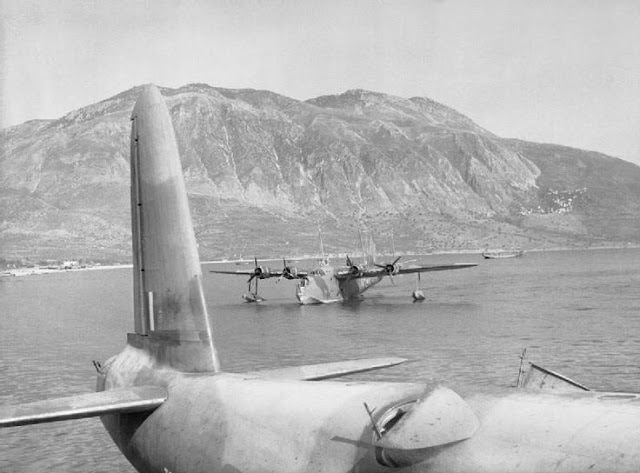
The Germans now hold almost all of Greece except for Crete. Having pocketed Athens without a fight, on 28 April 1941 the Wehrmacht continues to occupy the remaining portions of mainland Greece after collapsing British opposition. The 5th Panzer Division continues its drive across the Peloponnese, pursuing Allied troops that are evacuating as quickly as they can in Operation DEMON.
German aircraft sank Greek torpedo boat Kyzikos and 2 other ships during the day. 2 companies of the German 5th Panzer Division captured the port of Kalamata, Greece, disrupting evacuation of Allied troops; though Allied forces would recapture the port by the end of the day, all British ships had already departed from Kalamata. Overnight, 4,170 Allied troops were evacuated from the Peloponnese Peninsula in southern Greece.
Sergeant Jack Hinton of New Zealand 2nd Division led an attack to retake the quay at Kalamata, Greece, clearing out 3 machine gun nests and a mortar with grenades and capturing a 6-inch gun. He was shot in the stomach and taken prisoner. He would later win the Victoria Cross.
Günther Altenburg was made the Reich Plenipotentiary for Greece by the Nazis.
The Prime Minister of Greece, Emmanouil Tsouderos, chaired a meeting at Canea on Crete between the leaders of the Greek forces and British officers. The meeting concluded with the issue of a reinforcement request to strengthen the defense of the island.
Italian troops started occupying the Ionian and Aegean islands. Troops land at Corfu.
The Luftwaffe shoots down a Seagull amphibian plane flying off of HMAS Perth near Anti Kyrethia, Greece. The crew survives by swimming to an island and eventually is picked up by HMS Havock.
At Suda Bay, the Royal Navy ceases attempts to repair the heavy cruiser HMS York. The York had been severely damaged by the Luftwaffe in March 1941. This leads to the complete loss of York.
Following the devastating outcome of the battle on the Greek mainland, the British are feeling very insecure about their position in Egypt. Prime Minister Winston Churchill asks to see all “plans which had been prepared in certain eventualities for the evacuation of Egypt.”
Major-General Friedrich Paulus a Deputy Chief of the General Staff, remains in Tripoli reviewing Lieutenant General Erwin Rommel’s Afrika Korps operations. Italian General Gariboldi, Rommel’s nominal superior in the chain of command, arrives in Tripoli to join the deliberations. Paulus has halted Rommel’s planned attack on Tripoli scheduled for the 30th for the time being.
On the ground, both sides conduct patrol activity which the D.A.K. War Diary remarks is “lively.” At dawn, the Luftwaffe attacks on Tobruk continue, with the Junkers Ju 87 Stukas concentrating on anti-aircraft defenses and fighters conducting strafing missions. Gruppe Herff continues to edge forward southeast of Sollum, with the British forces having retreated on the coastal plain.
Reuters News Agency reports from Cairo: “The British Expeditionary Force and powerful contingents of the Greek army are continuing their retreat maneuvers, which are being conducted under the protection of naval forces and air squadrons, and which are now fully under way. Direct reporting from Greece must be interrupted for the duration of these strategic operations because even radio messages might provide valuable clues to the enemy. Australian and New Zealand troops have obeyed orders to defend their positions on the Greek mainland to the very last minute, and then assembled in good order at their evacuation points.”
The Royal Navy tries a new tactic to supply Malta. Instead of sending convoys, it despatches unescorted freighters that seek safety from stealth rather than defensive escorts. Freighter Parracombe carries 21 cased Hurricane fighters to the island along with other supplies. The Parracombe flies a Spanish flag first, then the French flag. This is Operation Temple. Another convoy, MD.3, departs from Malta to Gibraltar.
Force H returns to Gibraltar after successful Operation DUNLOP, a mission to deliver RAF Hurricanes to Malta.
Free French troops advanced into pro-Vichy French Somaliland.
The Royal Navy dispatches aircraft carrier HMS Hermes and light cruiser Enterprise (not the famous U.S. Navy aircraft carrier) to the Persian Gulf to cover upcoming British landings at Basra. Convoy BP.1 is at sea carrying troops to land there to reinforce British positions in Iraq.
In Berlin, Germany, German ambassador to the Soviet Union Friedrich Werner von der Schulenburg attempted to convince Adolf Hitler that the Soviet Union was generally friendly toward Germany, and the two nations could achieve greater friendship by working closer together. Having spent the duration of Operation MARITA in Austria “overseeing” operations from his command train “Amerika” (something that was completely unnecessary but part of his image-building and also a nostalgic return to his own homeland), Adolf Hitler returns to Berlin in triumph. Hitler meets with his ambassador to the Soviet Union, Count Friedrich Werner von der Schulenburg, at 17:15. Count Schulenburg — with Foreign Minister Ribbentrop’s approval — submits a memorandum arguing against Operation BARBAROSSA. Schulenburg later recalls that Hitler was upset that Russia had supported the anti-German “putsch” in Yugoslavia and had begun mobilizing its army. Hitler brushes aside Schulenburg’s observation that Stalin is desperate to avoid war and eager to supply grain and other raw materials to Germany; Hitler abruptly ends the interview after half an hour to have tea.
Among other things, this incident with Count Schulenburg illustrates that many of Hitler’s top lieutenants, including Ribbentrop and Reichsmarschall Hermann Göring, are opposed to Operation BARBAROSSA. As happens repeatedly throughout the Hitler regime, top figures in the Reich use surrogates to express their own views that are contrary to Hitler’s. These surrogates tend to be intimidated by Hitler to one extent or another and press their case weakly.
In any case, Hitler has always intended to have his war in the East, as he made clear in “Mein Kampf.” No one is talking him out of his intention to destroy the USSR.
The OKH orders army collaboration with the SS in the campaign in Russia. Special SS units had sole responsibility for carrying out their missions, but were under the authority of the army with respect to marching orders, food and shelter. The army high command (OKH) issues a directive that regular army units are to provide assistance to special Schutzstaffel SS units during Operation BARBAROSSA. The army is to provide logistical support such as food and ammunition to SS units, which are subject to army orders but have unique missions for which they must operate independently. Just how far this cooperation extends remains a subject of debate, as German army veterans often minimize the extent of regular army participation in some of the Einsatzgruppen (special task forces) activities that involve crimes against humanity. The Waffen (fighting) SS units technically are subject to regular operational orders, but this relationship deteriorates with time and they tend to operate either completely independently or subject to their own whims (for instance, SS units tend to attack when they are good and ready, not at the time ordered). This murky relationship between the SS and the regular army chain of command remains a source of tension throughout World War II.
British Prime Minister Winston Churchill sends a memo to Chief of Staff General Ismay in which he notes that “I see a statement that the Italians shot all the Free French prisoners they took at Tobruk.” Churchill writes “you should consider the following proposal”:
“Hand over 1,000 Italian officers to the Free French in Central Africa as working capital, and announce that for every Free Frenchman shot by the Italians, two (or three (?)) Italian officers would be executed. The question is whether an announcement of this kind might not be advantageous…. On the whole, I think we should give the Italians to de Gaulle and let him say what he likes about it. This is a matter upon which I have reached no final conclusion.”
Italians shooting war prisoners out of hand is a war crime (if true); the British turning over Italian prisoners to be shot by the Free French would be a similar war crime (if it were to happen). Churchill does note that the prime consideration weighing against this plan is the fact that “the Huns have 50,000 of our men in their hands” against whom reprisals could be taken.
In a memo to General Ismay, Churchill writes that it “seems probable” that the next German moves will be:
— to attack Crete;
— to attack Malta;
— to advance through Spain toward Morocco to take Gibraltar.
He asks for plans to counter this expected German thrust toward Morocco.
Menzies, in his diary, questions Churchill’s accuracy regarding Commonwealth casualties in Greece and observes that “W. [Churchill] is a great man, but he is more addicted to wishful thinking every day.” He openly disputes Churchill in the War Cabinet, arguing that information being supplied to Australia and the United States is bad “propaganda.” As usual, though, Menzies receives little support from Churchill’s appointees.
The German authorities in Norway conduct a massive book-burning as part of a crackdown on “degenerate” literature.
German submarine U-123 detected Allied convoy HX.121, 150 miles south of Iceland, and radioed the finding to 5 other submarines. At 0415 hours, U-552 sank a tanker. At 0725 hours, U-96 sank 2 tankers and 1 freighter.
While attacking, U-65 was sunk by depth charges launched by British destroyer HMS Douglas, killing the entire crew of 50.
German armed merchant cruiser Pinguin attacked British ship Clan Buchanan in the Arabian Sea 1,200 miles east of Mogadishu, British Somaliland. Before the crew of 110 surrendered and the ship scuttled, a distress signal was sent out, and British warships were dispatched to the area to hunt for Pinguin.
Police opened fire on demonstrators, killing at least five persons and wounding several others, as bread riots broke out anew yesterday in the principal towns of the French-mandated territory of Lebanon. Four persons were killed and 15 wounded seriously at Hama when police opened fire on a crowd of demonstrators trying to break into a police station and free a number of persons arrested for damaging property and sacking wheat mills. In similar incidents at Aleppo one persons was killed and five wounded. French armored cars patrolled the streets of the town.
The British begin their “Channel Stop” campaign. This is an effort to interdict enemy shipping in the English Channel and deprive its use to the Wehrmacht. The Germans have flak ships along the French Channel coast to protect their shipping, so this requires a battle. Today, RAF No. 101 Squadron sends Blenheims against trawlers near Calais, losing a plane to the vicious flak.
RAF Bomber Command: Day of 28 April 1941 10 aircraft — 6 Hampdens, 3 Blenheims, 1 Stirling — on cloud-cover raids to Germany. Only the Stirling reached Germany and bombed Emden. 4 of the Hampdens bombed targets in Holland and ships. No losses. 6 Blenheims of 101 Squadron inaugurated Channel Stop in the Straits of Dover. In this operation, Blenheims with fighter escort attempted to prevent all German ships passing through this narrow part of the Channel by day. Motor torpedo boats attempted to keep up the blockade by night. It became a hard-fought baffle between the Blenheims and German Flak ships and fighters. 1 fishing vessel was sunk on this day but 1 Blenheim was lost.
The Channel Stop campaign starts with the Royal Navy and RAF working to deny use of the Channel to enemy shipping. On the first day a Blenheim of 101 Sqn. is shot down by flak ships trying to attack trawlers off Calais.
RAF Bomber Command: Night of 28/29 April 1941
Brest
22 Wellingtons and 3 Stirlings; only 9 aircraft bombed in poor weather conditions. No losses.
5 Hampdens minelaying off La Rochelle. 2 aircraft lost.
The Luftwaffe raids Plymouth with 124 planes and sinks Royal Navy depot ship HMS Moncousu.
Visiting Australian Prime Minister Robert Menzies visits with Air Marshal Lord Trenchard, a hero of World War I. Trenchard, Menzies writes in his diary, is “Against bombing in France, because the bombs that miss kill Frenchmen, whereas the ones that miss in Germany kill Germans.”
At 0600 hours, German bombers attacked Tobruk, Libya. During the day, German Deputy Chief of Staff Friedrich Paulus ordered Erwin Rommel to delay the planned ground assault on Tobruk.
Hans-Joachim Marseille shot down his 8th kill, a British Blenheim light bomber, over the water off Tobruk, Libya.
The Luftwaffe mounts a large raid on Malta. German bombers attacked Malta overnight, badly damaging destroyer HMS Encounter in the drydock and destroying minesweeper HMS Fermoy.
U-65, U-96, and U-552 converged on convoy HX.121.
The U-65, commanded by Kapitänleutnant Joachim Hoppe, was sunk in the North Atlantic southeast of Iceland by depth charges from the destroyer HMS Douglas (D 90). All of the ship’s complement of 50 died. During its career under another commander (Kapitänleutnant Hans-Gerrit von Stockhausen) the U-65 sank 12 ships for a total of 66,174 tons and damaged 3 ships for a total of 22,490 tons.
U-552, commanded by Kapitänleutnant Erich Topp, torpedoed British tanker Capulet (8190grt) in 60-16N, 16-10W. At 1615 hours on 28 April 1941 the Capulet (Master Edward Henry Richardson, DSC) in convoy HX.121 was torpedoed by U-552 (Topp) south of Iceland in 60°16N/16°10W. She broke her back, caught fire and was abandoned. Eight crew members and one of four gunners were lost. After HMS Douglas (D 90) (Cdr W.E. Banks, DSC, RN) tried to sink the tanker with gunfire, the destroyer picked up the master and 17 survivors and landed them at Londonderry. 17 survivors were rescued by the British rescue ship Zaafaran (Master Charles Kavanagh McGowan, DSC) and landed at Greenock on 1 May. The 8,190-ton Capulet was carrying fuel oil and was bound for Scapa Flow, Orkneys.
Submarine U-96, commanded by Kapitänleutnant Heinrich Lehmann-Willenbrock, sank British tanker Oilfield (8516grt) in 60-05N, 17W. At 1925 hours on 28 April 1941, U-96 fired three single torpedoes at three tankers in convoy HX.121 south of Iceland and reported the sinking of two tankers with 18,000 tons and damaging another with 6000 tons after observing three hits. The tankers Oilfield and the Caledonia were sunk and the freighter Port Hardy was hit and sunk after the torpedo had missed the intended target. The Oilfield (Master Lawrence Robert Andersen) caught fire immediately and burned until she broke in two and sank the next day in 60°06N/16°06W. The master, 44 crew members and two gunners were lost. Six crew members and two gunners were picked up by HMS St. Zeno (FY 280) (Lt J.K. Craig, RNVR) and landed at Londonderry. Lawrence Robert Andersen was the commodore of the fleet of Hunting & Son Ltd. The 8,516-ton Oilfield was carrying benzine and was bound for London, England.
U-96 also sank Norwegian tanker Caledonia (9892grt) in 60-03N, 16-10W. Seven crew members of the 35 men and two gunners aboard the Caledonia (Master Ragnvald Andresen) died in the engine room. Five others jumped overboard and tried to get to the only launched lifeboat, but they drifted into the burning inferno around the nearby torpedoed Oilfield and died. The 25 men in the lifeboat desperately tried to rescue them, but this had to be given up because of the intense heat. The survivors were picked up by the British rescue ship Zaafaran and landed in Gourock on 1 May. The 9,892-ton Caledonia was carrying diesel and fuel oil and was bound for Glasgow, Scotland.
U-96 also sank British steamer Port Hardy (8897grt) in 60-14N, 15-20W. The Port Hardy (Master John Godfrey Lewis) was hit on the port side abaft the main mast by one torpedo and sank after about three hours about 165 miles north-northwest of Rockall. One crew member was lost. The master, 82 crew members, four gunners and ten passengers were picked up by the British rescue ship Zaafaran (Master Charles Kavanagh McGowan, DSC) and landed at Greenock on 1 May. The 8,897-ton Port Hardy was carrying mutton, cheese, zinc, and general cargo and was bound for Avonmouth, England.
Battlecruiser HMS Hood and destroyers HMS Echo, HMS Active, HMS Achates, and HMS Anthony departed Hvalfjord to cover convoys HX.122, escorted by armed merchant cruiser HMS Alaunia, and SC.29, escorted by armed merchant cruiser HMS Ranpura.
Heavy cruiser HMS Suffolk departed Iceland on patrol.
Submarine HMS H 31 and destroyer HMS Venomous collided during A/S training exercises at Londonderry. Destroyer Venomous was repaired at Londonderry completed on 18 May. The submarine received damage to her aft hydroplanes.
Destroyers HMS Inglefield and HMS Maori, which formed a striking force for convoy HX.121, attacked a submarine contact in 60-10N, 17W. They claimed sinking a submarine.
Destroyers HMS Somali and HMS Bedouin were sent from Scapa Flow to investigate a submarine contact reported by aircraft in 59-16N, 7-23W.
Armed trawler HMS Caroline (253grt) with a Dutch crew was sunk on a mine off Milford Haven, 13.6 cables 224° from Great Castle Head. The minesweeper was sunk with all hands.
Ammunition storage ship Moncousu (1420grt) was sunk by German bombing at Plymouth.
British steamer Clan Buchanan (7266grt) was sunk by German raider Pinguin in 5-24N, 62-46E. The entire crew was picked up. One hundred and seven crewmen were lost when Pinguin was sunk on 8 May.
British steamer Marie Dawn (2157grt) was damaged by German bombing off Sheringham Buoy.
British steamer Empire Strait (2824grt) was damaged by German bombing off Great Yarmouth.
Salvage work on heavy cruiser HMS York was suspended.
During the night of 28/29 April, Operation DEMON continues. From Kithera, sloop HMS Auckland, corvettes HMS Hyacinth and HMS Salvia embarked 750 RAF and other personnel. From Monemvasia, light cruiser HMS Ajax and destroyers HMS Havock, HMS Hotspur, HMS Isis, and HMS Griffin lifted 4320 troops, including the units delivered there by destroyer Havock on the 27th.
Light cruisers HMAS Perth and HMS Phoebe and destroyers HMS Nubian, HMS Hero, HMS Defender, HMS Hereward, HMS Decoy, and HMS Defender were dispatched to Kalamata. Destroyers HMS Kingston, HMS Kimberley, and HMS Kandahar were sent to join the Kalamata force to pick up Yugoslav refugees. On arrival at Kalamata, the harbour was reported to be in enemy hands. Destroyer Hero was sent to investigate and the Main Force retired. Destroyers Hero, Kimberley, Kandahar, and Kingston did pick up some 450 troops from Kalamata.
Lighter A15 departed Suda Bay to assist damaged A5 (A/BoatswainH. R. Paxton) off Monemvasia. The lighter had been damaged by German bombing and Lt A. B. Heckstall-Smith RNVR, had been wounded. The lighter was later sunk. En route, lighter A15 was sunk by German bombing with all hands aboard lost. The officers lost aboard were Lt Cdr P. C. Hutton DSC, (emergency), Commander of the 1st TLC Flotilla, sub Lt C. H. Whitworth DSC, T/A/Boatswain C. W. Dennis, and T/A/Boatswain J. Forster.
Greek torpedo boat RHS Kyzikos was sunk by German bombing at Salamis.
Greek steamer Aikaterini (462grt) was sunk by German bombing off Spetsopoulou.
Greek steamer Eleni Canavarioti (797grt) was sunk by German bombing. The survivors were landed at Izmir.
During the night of 28/29 and 29/30 April, Malta was heavily bombed.
Destroyer HMS Encounter in drydock at Malta was badly damaged in attacks on 29 and 30 April. On the 29th, a bomb penetrated her forecastle and exploded inside the ship. The destroyer was further damaged by bombing on 16 May. Destroyer Encounter was repaired completing in mid-July and sailed for Gibraltar on 23 July.
Minesweeper HMS Fermoy was damaged beyond repair in dock at Malta on 29 and 30 April.
Anti-submarine trawler HMS Coral and minesweeping drifter HMS Trusty Star were also damaged by bombing.
A Swordfish of 810 Squadron ditched off Gibraltar on take-off. Sub Lt R. S. Charlier was picked up by light cruiser HMS Sheffield, but Leading Airman D. R. B. Evans was lost.
Force H arrived back at Gibraltar after Operations DUNLOP and SALIENT.
Destroyers HMS Fearless, HMS Fury, and HMS Wrestler departed Gibraltar to join battleship HMS Queen Elizabeth and escort her to Gibraltar.
Submarine HMS Urge departed Gibraltar for Malta.
Convoy OB.316 departed Liverpool, escorted by destroyers HMS Wolverine and HMS Woolston and corvette HMS Begonia. Destroyer Woolston was detached on the 29th. On the 30th, destroyers HMS Saladin and HMS Skate and minesweeper HMS Harrier joined the convoy. Destroyer Wolverine and the minesweeper were detached on 3 May. Destroyers Saladin, Skate, and HMS Veteran were detached on 4 May. The convoy was dispersed on 5 May and corvette Begonia was detached.
In Washington today, President Roosevelt conferred with Congressional leaders on the legislative program and later talked with Secretary Morgenthau.
The Senate was in recess. Its Defense Investigating Committee heard witnesses on the bituminous coal strike situation, and conferees agreed on the $3,415,521,750 Naval Appropriation Bill.
The House defeated a bill for an experimental blackout of the Capital, heard Representative Sumners urge action to end defense strikes, approved the conference report on a bill authorizing the Maritime Commission to negotiate contracts for shipbuilding and adjourned at 4:07 PM until noon tomorrow. The Naval Affairs Committee approved the Vinson bill to extend defense priorities and rationing, and the Ways and Means Committee resumed hearings on the new tax bill.
Colonel Charles A. Lindbergh announced in a letter that he was resigning as a member of the Army Air Corps Reserve due to President Roosevelt’s implied criticism of him. The U.S. War Department accepted his resignation the following day. Lindbergh, the air hero and leader of the isolationist “America First” group, has resigned from the U.S. Army Air Corps reserve after President Roosevelt questioned his loyalty. Lindbergh recently said that the U.S. was being “led to war by a minority”, after which Roosevelt compared him to Northerners in the civil war who favored peace with the South. Roosevelt’s press secretary wondered if Lindbergh, who received a Nazi order in 1938, would be “returning his decoration to Hitler.” The “Verdienstorden vom Deutschen Adler” was a diplomatic decoration awarded only to foreigners. Lindbergh resigned today as a colonel in the United States Army Air Corps Reserve because he said his commander-in-chief, President Roosevelt, had implied certain things about “my loyalty to my country, my motives and my character.” Thus, the thin young man who at 25 historically flew the Atlantic, became a world hero, and rose at once from captain to colonel in recognition of his feat, beseeched his government at 39 to return him to private life because he had “no honorable alternative.” In a letter to President Roosevelt, Lindbergh took exception to “implications” he said the president uttered concerning him at last Friday’s press conference.
During the evening, Lindbergh gives a speech at an America First rally in Chicago. The crowd boos any mention of Winston Churchill and cheers when he recites facts about England’s “devastated cities.”
In a rare communication with his ambassador to the United States, Lord Halifax, Prime Minister Churchill orders that Halifax and his staff “not discourage the President from posing his questions directly to me.” Churchill is eager to cultivate his “personal relations” with Roosevelt, which he notes are “of importance.”
An agreement by southern U.S. coal mine operators to accept mediation proposals offered by President Roosevelt late last night ended the 28-day-old Appalachian coal strike which threatened to stall defense production. The White House announced receipt of a telegram from L. Ebersole Gaines, chairman of the southern group, informing Mr. Roosevelt that “we accept your proposal without equivocation” and we are ready to resume work immediately. Involved in the agreement was an immediate $1-a-day basic wage increase, resumption of mining operations, and continued negotiation, while operating, over a 40-cent-a-day wage differential between northern and southern mines.
The United States Supreme Court issues two significant rulings today:
- In a suit brought by the only African American in Congress, Representative Arthur W. Mitchell (D-Illinois), the court rules that minorities must be furnished comparable accommodations to those of whites for interstate travel. Mitchell brought the suit after he was forced from a Pullman coach to a “Jim Crow” day coach while traveling in Arkansas in 1937;
- The Court upholds the Wagner Act, which prohibits anti-union discrimination in the hiring and firing of workers.
The House refused today to sanction a “blackout” of Washington and vicinity, as training for the civilian populace against air raids, on the ground that it would add to an already serious traffic problem in an overcrowded city and would foment a “war hysteria.”
American business leaders today heard about business booming under the stimulus of billions of defense dollars, applauded a demand for the resignation of Secretary of Labor Frances Perkins, and were told by Sir Gerald Campbell, British Minister, that Great Britain expected by the end of this year to be “coming up toward the crest of the wave as our enemy starts to go down.”
Mrs. Eleanor Roosevelt was given a protective escort of secret service men and police for her lecture appearance at Philharmonic auditorium in Los Angeles tonight. Captain R. E. Giese of the LAPD homicide squad said plainclothesmen were assigned to the hall after an anonymous letter had reported it would be “picketed for peace.’ There was no disturbance. In her informal question and answer period, the first lady was asked, “Do you think the president will keep his promise and keep us out of war?” “He hasn’t made any such promise,” Mrs. Roosevelt replied. “He has said he wants peace. If it is possible to stay at peace, we will do so . . . But the ultimate decision rests with the people.” To another who said, “Tell the president we will not give our lives any place except in America,” she declared: “Any American who will not fight any place his country asks him to fight is not an American.”
Another Gallup poll result was released asking Americans, “If you were asked to vote today on the question of the United States entering the war against Germany and Italy, how would you vote — to go into the war, or to stay out of the war?” 81% said stay out, a 7 percent decrease since the same question was polled in January. Another question asked, “If it appeared certain that there was no other way to defeat Germany and Italy except for the United States to go to war against them, would you be in favor of the United States going to war?” 68% said yes, 24% said no, and 8% expressed no opinion.
Absolute opposition to taxing the “poor man’s table” was expressed today by Secretary Morgenthau in commenting upon the proposal of Colin F. Stam, chief of staff of the Congressional Joint Committee on Internal Revenue Taxation, to impose excise duties on certain foods.
A former acting superintendent in the Ford Motor Company plant at Edgewater, New Jersey, told the National Labor Relations Board that Ford spies planted tools on employees suspected of union activities with the object of having them dismissed.
British Rear Admiral Victor H. Danckwerts responded in a letter to Rear Admiral Richmond K. Turner, the U.S. Navy’s Director of the War Plans Division, that “that the consequential reduction in the strength of the United States Pacific Fleet would not unduly encourage Japan.” U.S. President Franklin D. Roosevelt had directed Admiral Kelly to consult the British Chiefs of Staff on the proposal to transfer vessels from the Pacific to strengthen the Atlantic Fleet.
Charles Sweeney joined the United States Army Air Corps; he would later become the pilot of B-29 Superfortress bomber Bockscar that delivered the atomic bomb on Nagasaki, Japan.
Major League Baseball:
The Brooklyn Dodgers’ Whitlow Wyatt, Leo Durocher’s nominee to greet the first Western invader of the campaign, pitched six-hit ball to set down the world champion Reds, 3–2, before 17,240 spectators. He fanned ten Cincinnati batters and won the game himself when, with runners on second and first, two down and the count knotted at 2–all in the ninth, he singled the winning run across, to give Brooklyn its seventh victory in a row.
A 7–2 victory over the champion Tigers-their third straight-gave the Indians a tighter grip on first place today. It was their fourth successive triumph. Southpaw Al Milnar scattered six hits and struck out five batters as he turned in his second verdict in three games. The Indians also were held to six safeties, four off the losing pitcher, Hal Newhouser, who struck out nine batters before wildness overtook him in the seventh. Dizzy Trout and Hel White finished.
The Browns displayed their potent batting power again today — and let it go at that — as the White Sox took their third straight game of the series, 2–1. Consistently, since the season’s start, the Browns have proven their ability to drive the ball to the far corners of the lot, but rarely have those hits materialized into runs. Today Manager Haney’s charges collected 11 hits, three of them for extra bases, but the White Sox, with eight blows, brought home the winning run. White Sox pitcher Jack Hallett, in winning his first major league victory this season, caused the Browns to drop their fourth straight game by one run.
Cincinnati Reds 2, Brooklyn Dodgers 3
Detroit Tigers 2, Cleveland Indians 7
Chicago White Sox 2, St. Louis Browns 1
Aircraft carrier HMS Hermes and light cruiser HMS Enterprise were in the Persian Gulf covering the landings at Basra from convoy BP.1 of steamers Nevasa, Bandra, and Esperance. Steamer Westernland travelled in this convoy and proceeded on to Suez.
Convoy BP.1 departed Bombay on the 21st, escorted by armed merchant cruiser HMS Antenor. Sloop HMS Lawrence joined on the 25th and sloop HMS Falmouth on the 28th. Sloop Lawrence was detached on the 28th when sloop HMS Yarra and gunboat HMS Cockchafer joined. The convoy arrived at Basra on the 29th. On the 30th, convoy BP.1A of troopships Devonshire and Neuralia departed Bombay, escorted by armed merchant cruiser HMS Kanimbla. Sloop Falmouth joined on 3 May. The convoy arrived at Basra on 6 May.
Convoy BP.2 departed Karachi on 6 May with troopships Rohna, Lancashire, and Varela, escorted by armed merchant cruiser HMS Kanimbla. The convoy arrived at Basra on 10 May.
Convoy BP.3 departed on 9 May from Bombay, escorted by armed merchant cruiser HMS Antenor, with troopships Talma, Raula, Ekma, and Santhia for Basra and Strathmore for Suez and from Karachi, escorted by armed merchant cruiser HMS Kanimbla with Egra and El Madina for Port Sudan. The convoy arrived at Aden on 15 May.
On 10 May, steamers Risaldar, Bahadur, Jalavihar, and Jaladuta departed Bombay, independently, for Basra.
Convoy BP.4 departed Bombay on 23 May with troopships Neuralia, Devonshire, and ISLAMI, escorted by armed merchant cruiser HMS Antenor. Sloop HMS Shoreham joined on 23 May. The convoy arrived at Basra on 30 May.
The BP series continued and ended in late 1941 with BP.29 sailing on 18 December. Armed merchant cruisers HMS Antenor or HMS Kanimbla were the escorts through BP.11. After BP.16 and through BP.40 in March 1942, the convoys travelled without escort.
An air-raid alarm sounded in the provisional Chinese capital of Chungking this morning while Captain James Roosevelt, U.S.M.C., eldest son of the President, was calling on Finance Minister Dr. H. H. Kung. Captain Roosevelt, who is on an official assignment as a military officer, arrived here this morning by airplane and revealed that his assignment when he left the United States had been to proceed to Greece. He did not say so, but it was believed that he and Major Gerald Thomas, his companion, might now go to North Africa. Captain Roosevelt said he would be here only three or four days, proceeding to Cairo by way of Burma. At the airport Captain Roosevelt told representatives of Generalissimo Chiang Kai-shek, Dr. Kung and other government leaders that “I bring the President’s greetings and best wishes.”
Concluding what is widely viewed (at least in hindsight) as a fact-finding mission for the US military, Ernest Hemingway departs from China. His wife, Martha Gellhorn, continues on to Burma.
Light cruiser HMS Danae departed Penang.
Admiral Hart of the U.S. Asiatic Fleet establishes Task Force 5, to consist of all ships to be sent south to Singapore when war broke out.
Winston Churchill, without reference to the Chiefs of Staff, issued a directive stating that there is no need at the present time to make provisions for the defense of Malaya and Singapore. In a War Cabinet Directive, Prime Minister Churchill forecasts that “Japan is unlikely to enter the war unless the Germans make a successful invasion of Great Britain.” Accordingly, he directs (through the War Cabinet) that “There is no need at the present time to make any further disposition for the defense of Malaya and Singapore.”
The Japanese War Office in Tokyo announced today the creation of a special department of chemical warfare, to study poison gas defense. This step is represented as being of epoch-making significance. The press explains that all the powers are studying chemical warfare and asserts it is actually being used on the battlefields of this war.
[Ed: Yes. BY JAPAN, in China.]
The Royal Australian Navy employs a dozen Women’s Emergency Signalling Corps women as telegraphists at Harman wireless station in Canberra. This apparently is the first employment of women in the Australian Navy.
The Japanese Minister, Tatsuo Kawai, commenting today on a warning by War Councilor J.A. Beasley that Australia should guard against a possible Japanese move following the Japanese-Russian neutrality pact, said Japan had no intention of acting against Australia by military force.
Dow Jones Industrial Average: 116.63 (+0.2)
Born:
Ann-Margret [Olsson], Swedish-American actress (“Bye Bye Birdie”; “Viva Las Vegas: Tommy”; “Grumpy Old Men”), singer and dancer, in Valsjöbyn, Jämtland County, Sweden.
Karl Barry Sharpless, American chemist (Nobel 2001 — developing the first chiral catalysts, Nobel 2022 — click chemistry), in Philadelphia, Pennsylvania.
Flynn Robinson, NBA and ABA point guard and shooting guard (NBA Champions-Lakers, 1972; NBA All-Star, 1970; Cincinnati Royals, Chicago Bulls, Milwaukee Bucks, Los Angeles Lakers, Baltimore Bullets; ABA: San Diego Conquistadors), in Elgin, Illinois (d. 2013).
Bobby Brezina, AFL halfback (Houston Oilers), in Sinton, Texas.
Iryna Zhylenko, Ukrainian poet (“An Evening Party in an Old Winery”), in Kiev, Ukrainian SSR, Soviet Union (d. 2013).
Naval Construction:
The Royal Canadian Navy Flower-class corvette HMCS Port Arthur (K 233) is laid down by the Port Arthur Shipbuilding Co. (Port Arthur, Ontario, Canada).
The U.S. Navy aircraft carrier USS Essex (CV-9), lead ship of her class (24 completed; 8 more cancelled), is laid down by the Newport News Shipbuilding and Dry Dock Co. (Newport News, Virginia, U.S.A.).
The Royal Navy Bar-class boom defense vessel HMS Baronia (Z 87) is launched by Charles Hill & Sons (Bristol, U.K.).
The Royal Navy MMS I-class motor minesweeper HMS MMS 55 (J 555) is launched by Richard Irvin & Sons (Peterhead, Scotland, U.K.).
The Royal Navy “U”-class (Third Group) submarine HMS P-36 is launched by Vickers Armstrong (Barrow-in-Furness, U.K.).
The Kriegsmarine (German Navy) Type VIIC U-boat U-133 is launched by Bremer Vulkan-Vegesacker Werft, Bremen-Vegesack (werk 12).
The Royal Navy Hunt-class (Type II) escort destroyer HMS Calpe (L 71) is launched by Swan Hunter and Wigham Richardson Ltd. (Wallsend-on-Tyne, U.K.); completed by Wallsend.
The Вое́нно-морско́й флот СССР (ВМФ) (Soviet Navy) Project 68 (Chapayev-class) light cruiser Chapayev (Чапаев) is launched by Sergo Ordzhonikidze Zavod (Leningrad, U.S.S.R.) / Yard 189. She will not be completed until 1950.
Capitani Romani-class light cruiser Ottaviano Augusto is launched by CNR, Ancona, Italy. She is never completed. Captured by the Germans in Ancona while fitting out; and sunk in an air attack on 1 November 1943.
The U.S. Navy Cimarron-class fleet oiler USS Salamonie (AO-26) [former SS Esso Columbia] is commissioned. Her first commanding officer is Commander Theodore Max Waldschmidt, USN.
The U.S. Navy O-1-class submarine O-8 (SS-69) is recommissioned, as a training boat. Her new commanding officer is Lieutenant John S. McCain, Jr., USN.
The Nihon Kaigun (Imperial Japanese Navy) Type B1 (I-15-class) submarine HIJMS I-19 is completed. Her first commanding officer is Commander Narahara Seigo.
The Nihon Kaigun (Imperial Japanese Navy) Kagerō-class destroyer HIJMS Nowaki (野分; “Autumn Gale”) is commissioned. Her first commanding officer is Commander Koga Mogotaro.
 History Diaries