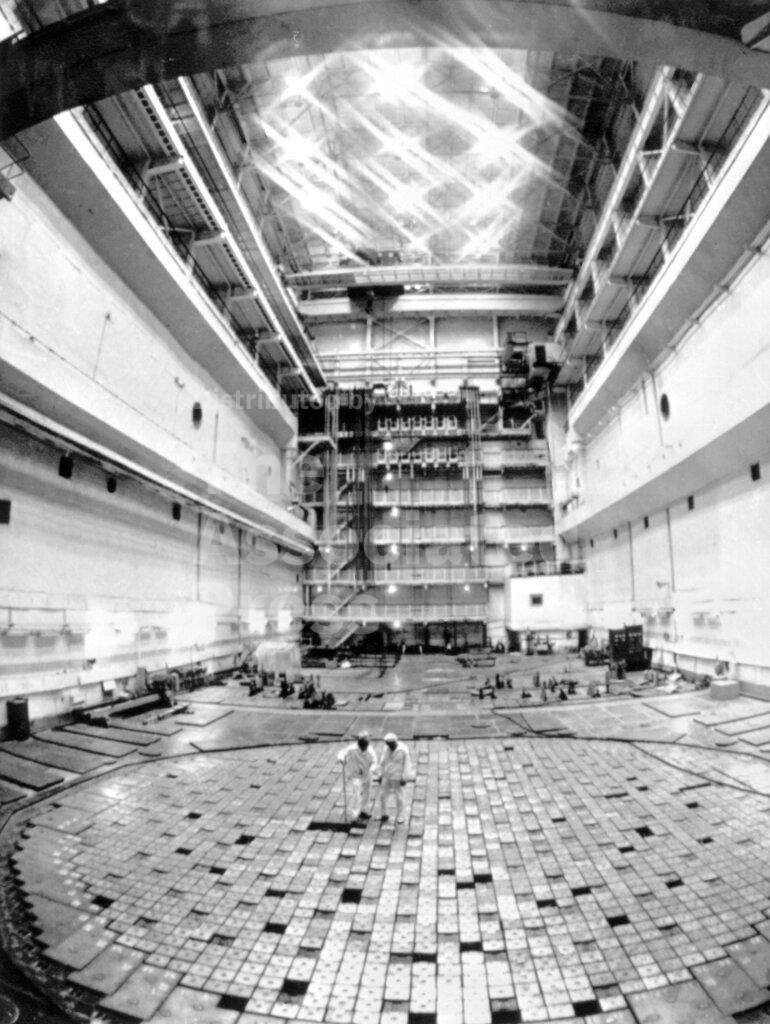
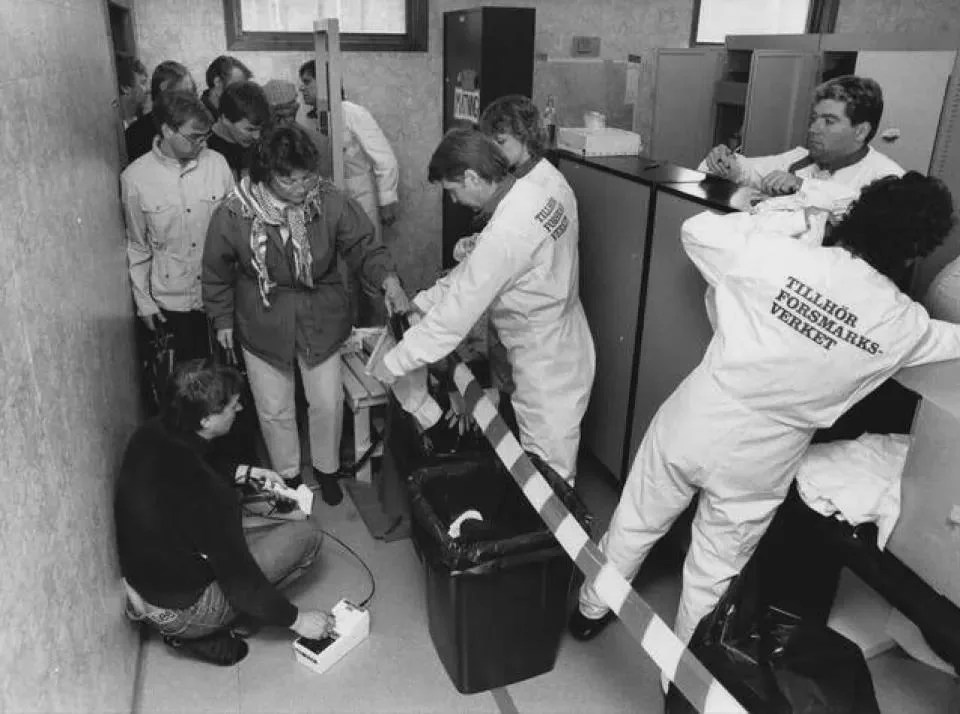
In the early morning hours at Forsmark Nuclear Power Plant, Cliff Robinson, a chemist originally from the UK, went through his usual routine after breakfast. As he returned from the washroom, he casually passed through a radiation monitor — and triggered the alarm.
He was baffled. He hadn’t even been inside any controlled zone.
Robinson tried again. The alarm blared again. A third attempt — silence. He and the technician shrugged it off: surely a calibration error.
But Cliff’s unease didn’t fade.
As Robinson resumed his duties monitoring radioactivity, strange scenes unfolded. Workers lined up at the checkpoint; no one could pass without triggering alarms. The three reactor blocks were scanned — all clean. The grounds were checked — still no local radiation leak.
Something was wrong, but no one yet knew how wrong.
An alarm goes off at a Swedish nuclear plant after the soles of shoes worn by a nuclear safety engineer there test positive for radioactivity. On the morning of 28 April, radiation levels set off alarms at the Forsmark Nuclear Power Plant in Sweden, over 1,000 km from the Chernobyl Plant. Workers at Forsmark reported the case to the Swedish Radiation Safety Authority, which determined that the radiation had originated elsewhere. That day, the Swedish government contacted the Soviet government to inquire about whether there had been a nuclear accident in the Soviet Union. The Soviet authorities initially denied it. It was only after the Swedish government suggested they were about to file an official alert with the International Atomic Energy Agency that the Soviet government admitted that an accident had taken place at Chernobyl.
Soviet TV news program Vremya announces a nuclear accident at Chernobyl nuclear power station, 2 days after the event, and that “aid is being given to those affected.” The severity of the accident, which spread discernable radioactive material over Scandinavia, was not immediately clear. But the terse statement, distributed by the Tass press agency and read on the evening television news, suggested a major accident. The phrasing also suggested that the problem had not been brought under full control at the nuclear plant, which the Soviet announcement identified as the Chernobyl station. It is situated at the new town of Pripyat, near Chernobyl and 60 miles north of Kiev. The announcement, the first official disclosure of a nuclear accident ever by the Soviet Union, came hours after Sweden, Finland and Denmark reported abnormally high radioactivity levels in their skies. The readings initially led those countries to think radioactive material had been leaking from one of their own reactors. The Soviet announcement, made on behalf of the Council of Ministers, after Sweden had demanded information, said in its entirety:
“An accident has occurred at the Chernobyl nuclear power plant as one of the reactors was damaged. Measures are being taken to eliminate the consequences of the accident. Aid is being given to those affected. A Government commission has been set up.”
The announcement — the first official disclosure of a nuclear accident ever by the Soviet Union -came hours after Sweden, Finland and Denmark reported abnormally high radioactivity levels in their skies.
The development of nuclear power has been given a high priority in the Soviet Union, and generating capacity has been put into service as fast as the building of reactors and the long lead times for construction of plants allow. At the end of 1985, the Soviet Union had a generating capacity of 28,000 megawatts in civilian nuclear utilities, and nuclear power generation last year was 170 billion kilowatt-hours, or 11 percent of the nation’s total. This placed the Soviet Union in third place in nuclear generation, behind the United States and France. The 12th five-year plan, which began this year, continues to provide for more nuclear plants, mainly in the industrial, densely populated western regions, where fossil-fuel sources are diminishing. Over the five years, 41,000 megawatts is to be added. If fulfilled, the plan would raise nuclear generation to 390 billion kilowatt-hours by 1990, or 20 percent of total power output.
The Soviet reactor accident probably poses no danger outside the Soviet Union, according to American nuclear experts. They said it would be extremely difficult to determine how severe the accident may have been, but added that the environmental damage in Soviet territory might be disastrous. Nevertheless, it appeared that only very small amounts of radioactive material had drifted over Scandinavia from the Soviet Union and that all of it was probably in the form of two relatively innocuous gases, xenon and krypton. Both are in radioactive form, but they disperse rapidly in the atmosphere and soon become so diluted as to be virtually harmless.
Senior European officials say President Reagan will find his principal allies at the Tokyo summit meeting disposed to take fresh steps against international terrorism, but at the same time keen to preserve the annual gathering’s character as a forum for aligning economic policies. According to the officials in various capitals, the rifts within the Western alliance over the American air strike on Libya have made several European leaders eager to limit their differences with Washington and poised them to move well beyond past summit declarations on international terrorism. The three-day summit meeting, assembling the leaders of the United States, West Germany, Japan, Britain, France, Italy and Canada, convenes in Tokyo on Sunday. The most notable switch has come from France, where President Francois Mitterrand has dropped his earlier opposition to discussing terrorism. The French hostages in Lebanon, the relative popularity in France of the American raid, terrorist blows at home — all vaguely mixed with rising resentment against immigrant workers from North Africa — appear to have influenced Mr. Mitterrand.
Two months after he vanished in West Germany, a high-ranking editor of an American-financed radio station reappeared here today and denounced the station as a front for covert intelligence operations against the Soviet Union. The radio official, Oleg A. Tumanov, who was the No. 3 editor at the station, Radio Liberty, refused at a news conference to discuss the circumstances of his disappearance from Munich on Feb. 25 and his return to Moscow. Mr. Tumanov, who was born in the Soviet Union 42 years ago and defected to the West in 1965, said only that he had “lived through a nightmare” for the last 21 years and that “my road back home has been tortuous.” He denied that he had been kidnapped and forcibly returned to the Soviet Union. When pressed to describe his return to Moscow, Mr. Tumanov said, “You have a right to raise questions, and I have a right not to answer.” Mr. Tumanov seemed nervous and agitated, pausing frequently and breathing deeply as he read a prepared statement and answered reporters’ questions at the Foreign Ministry press center. Radio Liberty and its sister station, Radio Free Europe, are financed by Congress and are supervised by the semiautonomous Board for International Broadcasting in Washington.
Secretary General Javier Perez de Cuellar, stating that “no single country should be in a postion in some way to threaten or to blackmail the United Nations,” suggested today that the United States should pay less of the United Nations budget. As the General Assembly met today to discuss ways to slash this year’s budget following drastic cuts in the United States’ contribution, Mr. Perez de Cuellar told reporters, “The United States should reduce its contribution to, I don’t know, 20 or even 15 percent and then some other countries should increase their contribution.” The United States currently is assessed 25 percent of the regular United Nations budget of $830 million. Responding to questions at the annual luncheon of the United Nations Correspondents’ Association, the Secretary General suggested that each of the five permanent members of the Security Council, which have veto power, should pay equal shares of the budget to create what he called a “fair and honest” system.
A man suspected of being the military leader of an outlawed Basque separatist group was arrested Sunday at a highway roadblock near the Spanish border, the police said today. Authorities said the man, Domingo Iturbe Abasolo, 42 years old, known as “Txomin,” was stopped at a police roadblock at Ahetze, on the Atlantic coast 16 miles from the Spanish border. They said he was not armed. Authorities said Mr. Abasalo, suspected of being the leader of the military arm of the separatist group E.T.A., had been hunted by the police since February 1985, when he disappeared from house arrest in Tours in central France. Mr. Abasalo was arrested in June 1982 and served eight months in jail for possession of arms and E.T.A. documents. He was was moved out of the Basque region to Tours in January 1984 as an alternative to being extradited.
The chief state prosecutor said today that two Libyans arrested last week and charged with conspiring to blow up an American officers’ club here had been supplied with explosives by Libyan Embassy personnel. But the Turkish Foreign Ministry said there was no evidence that the Libyan Ambassador was involved in the incident. The prosecutor also denied reports that quoted him as saying “bombs were transported into Turkey in Libyan diplomatic bags.” The prosecutor, Ulku Coskun, said the two arrested Libyans, Ali el-Edjefli Ramadan and Redjep Mohtar Rohoma Tarhuni, had admitted obtaining the explosives from three Libyans. They described two as security guards, and the third as the Istanbul director for the Libyan state airline. Arrest warrants have been issued for all three, the prosecutor said.
Prime Minister Shimon Peres said Israel has engaged in “quiet diplomacy” with Jordan since King Hussein’s February break with the Palestine Liberation Organization. “Some very interesting things have happened,” Peres said in a television interview. “At this stage, it is more in understanding than in agreement.” However, Foreign Minister Yitzhak Shamir contended that the two countries have made little progress toward a peace treaty, adding that relations have not gone beyond the “no war, no peace” that has prevailed since the 1967 Middle East War.
An estimated 10,000 Orthodox Jews, displaying the slogan “Jerusalem Is Not for Sale,” demonstrated against construction of a seven-story Mormon study center that they say will become a base for missionaries. The protest opposite the construction site near the biblical Mount of Olives was one of the largest in a yearlong campaign to stop the $15-million project. Officials of Brigham Young University have given repeated assurances that students and staff will not be allowed to proselytize.
Iranian troops repulsed the latest of a series of Iraqi attacks against their positions on the oil-rich Majnoon Islands in southeast Iraq, Tehran radio reported. “They didn’t capture even one bunker,” Tehran radio said. Iraq used troop-carrying boats in launching the assault through reed-bed canals around the islands, the radio said. There was no independent confirmation of the battle accounts. Iran captured the islands two years ago, and Iraq has mounted several recent counterattacks.
Two students set themselves on fire at Seoul National University during anti-government demonstrations by more than 9,000 people at 11 campuses in South Korea. Hospital officials said the two young men were in serious condition. They reportedly stood atop a three-story building, doused themselves with kerosene and set it ablaze when police moved in to break up the demonstration, focusing on compulsory military training for students.
Japanese Prime Minister Yasuhiro Nakasone today defended Japan’s record in opposing terrorism and said his Government had taken a “most appropriate approach” against Libya by limiting business ties. Mr. Nakasone, who will be the host at the gathering of major industrial democracies in Tokyo next week, said he would seek agreement on a declaration opposing terrorism. But in a luncheon interview with Tokyo-based foreign correspondents, he did not say how strong a statement he would accept, or whether he would go along with one that included a reference to Libya. The Reagan Administration’s determination to pursue a hard line on terrorism has troubled some Japanese officials, who worry that it may be too strong for them and may put them in an awkward situation as conference host.
President Reagan spends most of the day flying to Indonesia and refueling in Guam. President Reagan declared today that the United States must be willing to defend its values and its citizens “unflinchingly” in the face of terrorism. In remarks at a brief rest and refueling stop at Andersen Air Force Base in Guam, Mr. Reagan continued to focus on terrorism as he once again pledged resolve in combatting such attacks. In his speech for American servicemen and their families at the Pacific base, Mr. Reagan said: “Many of you are thousands of miles from your own homes, and as beautiful as Guam is, I know you must miss familiar sights and sounds, and above all, your families and friends. Yet, you’re willing to make that sacrifice, willing because you’ve understood all along what recent events have once again made clear.
The Foreign Ministers of the members of the Association of Southeast Asian Nations gathered today to meet with President Reagan, who was to arrive here Tuesday on the first foreign stop of his 13-day journey of the Far East. Mr. Reagan was to meet with the Foreign Ministers on Thursday before departing the next day for the meeting of the world’s seven leading industrial democracies in Tokyo. Foreign Minister Salvador H. Laurel of the Philippines told reporters at Bali’s Ngurah Rai Airport that during his scheduled meetings with Mr. Reagan and Secretary of State George P. Shultz he hopes to discuss his country’s economic woes and would ask for help in combating the Communist insurgency in the Philippines that has claimed more than 700 lives since February, when Corazon C. Aquino replaced Ferdinand E. Marcos as President.
The United States has informed Australia and New Zealand that it will formally scrap its 35-year old defense commitment to New Zealand if that longtime ally goes ahead with legislation to bar visits by nuclear-armed or nuclear-powered ships, State Department officials said today. Under an arrangement worked out during the visit here of Prime Minister Bob Hawke of Australia two weeks ago, President Reagan and Mr. Hawke will exchange letters affirming that the United States and Australia will together keep the so-called ANZUS treaty alive, the officials said. In line with that policy, the annual meeting of ANZUS foreign ministers has been changed this year to a meeting of Australian and United States officials in San Francisco on Aug. 11 and 12.
Troops from the United States and 171 soldiers from five Caribbean nations prepared to launch weeklong maneuvers culminating in mock invasions of Puerto Rico and Grenada-the latter the island nation stormed by American troops in October, 1983, to crush a coup by radicals. The exercise, called Ocean Venture ’86, will involve a Navy and Coast Guard task force of 14 ships and 10,000 U.S. troops from the Army, Air Force, and Marine Corps, along with National Guard units.
An Ecuadorean army rescue team scaled an Andean mountain and found the bodies of Ecuador’s education minister, his son and four others in the wreckage of a light plane that crashed last Friday. The victims were Education Minister Camilo Gallegos, 50, his son, Camilo, 21, three other ministry officials and the pilot. The Piper Aztec crashed at the 13,000-foot level of Ruminahui mountain, 18 miles southeast of Quito, the capital.
Witnesses said the police in Asuncion, Paraguay used riot sticks and tear gas to disperse a political rally Sunday, and a member of a television crew filming the event reported that journalists were beaten and their equipment wrecked. The rally, which witnesses said was attended by about 1,000 people, was held in front of the home of Domingo Laino, exiled leader of the opposition Authenic Radical Liberal Party. Witnesses said the police, using rubber riot sticks and firing tear-gas grenades, charged the group and struck several people, including the West German Embassy press attaché, Armin Steuer, and the television crewmen -Nikolaus Brender and Peter Wendt, both West Germans, and Jose Antonio Vulin and Eduardo Johnson, both Argentines. The crew was filming the rally for West German television.
Four people, including a policeman, were killed today and six others wounded in shootings and bombings that authorities attributed to leftist guerrillas. A policeman and a member of a heavily armed gang died in a shootout after a robbery at a bakery in southern Santiago. Two policemen were wounded. The police said they captured five members of the gang, who were suspected of being members of the Manuel Rodriguez Patriotic Front, a left-wing guerrilla group fighting the military government. In the town of Villa Alemana, 60 miles north of Santiago, a man and a women died when an explosion tore through a guerrilla “safe house,” the regional governor said. Four people were wounded when two small bombs went off at the University of Santiago and in a public lavatory.
Several university students, their clenched fists raised in defiance, added their voices to angry chants of “Down, Down, U.S.A.!” at a rally held recently in the gritty, time-worn capital of Khartoum to protest American air strikes against Libya. One of the students, who gave his name as Rabei, was asked to explain his hostility toward the United States. “The U.S.A. was Nimeiry’s brother,” said the youth, all but spitting out the name of Gaafar al-Nimeiry, the Sudanese President whose increasing unpopularity helped lead to his overthrow last April. “Now we can talk with our hearts and tell the world that Libya is our brother and that the U.S.A. is not the great friend anymore,” he said.
Two black men were killed in South Africa today, the police reported, and witnesses said black youths stoned a minibus carrying the former French Prime Minister, Laurent Fabius. The two black men were killed, and two white policemen and another black man were wounded in a gun battle shortly before dawn in Alexandra, a black township north of here that was racked by clashes last week, a police spokesman said. He said two officers were hit after the police came under fire from a house and that the police returned the fire. Witnesses said Mr. Fabius, in South Africa to campaign against apartheid, was traveling with former Culture Minister Jack Lang and local church officials when their vehicle was stoned in the Crossroads shantytown near Cape Town.
In what would represent a significant expansion of the doctrine of executive privilege, the Justice Department has told President Reagan that he must support former President Richard M. Nixon’s claim of such privilege in Nixon’s attempt to block the National Archives from releasing more than 2 million pages of his presidential papers this summer. The House Government Operations subcommittee on government information, which plans hearings on the issue today, provided a copy of the opinion.
Michael K. Deaver, the former deputy White House chief of staff, asked today for appointment of an independent counsel to investigate charges that his lobbying activities had violated Federal conflict-of-interest laws. Mr. Deaver, who resigned from the Government last May, made his request in a letter to Attorney General Edwin Meese 3d. Mr. Meese, citing his long friendship with Mr. Deaver, immediately removed himself from the Justice Department’s decision on whether to ask a Federal court to appoint the counsel. The decision will be made by Deputy Attorney General D. Lowell Jensen. Last week the Office of Government Ethics and five Democrats on the Senate Judiciary Committee separately requested appointment of a counsel. Charges against Mr. Deaver are already being investigated by several Congressional committees. Mr. Deaver, who has denied all wrongdoing, wrote: “I believe elementary due process and fairness to me and my family require appointment of an independent counsel. While I’m grateful for the President’s continuing support, the climate has become such that this is the only way to resolve the issue fairly.”
Senator Bob Dole, the majority leader, said today that Congress has become so enmeshed in political maneuvering that it might not be able to produce a Federal budget this year. Mr. Dole, who is openly unhappy with the spending plan being debated on the Senate floor, said, “I don’t know if we’ll get a budget or not, if we can’t change this one some.” The Kansas Republican said that no more than half of the 53 Senate Republicans would back the current proposal, because it calls for almost $19 billion in additional revenue, while slicing $25 billion from President Reagan’s request for military spending. In addition, the proposal eliminates far fewer domestic programs than the President had wanted.
Two House members who were among thousands of Japanese Americans interned without trial in World War II related their experiences today as they urged passage of a bill to compensate the victims of the policy. The witnesses were among about 120,000 Japanese Americans who were ordered off the West Coast by President Roosevelt about two months after Japan’s attack on Pearl Harbor. Today, in tears, Representative Robert T. Matsui, Democrat of California, said the bill was needed so “Americans can look back and say, ‘We were wrong.’ “
Republican and Democratic senators angrily accused Charles L. Heatherly, acting administrator of the Small Business Administration, of trying to dismantle the agency despite a new law extending its life through 1988. Heatherly was grilled for almost 90 minutes by members of the Senate Small Business Committee. Sen. Lowell P. Weicker Jr. (R-Connecticut), the panel’s chairman, declared: “I will not allow this Administration to achieve administratively what it was unable to achieve legislatively. In other words, SBA is not going to be dismantled on my watch.” Heatherly said, however: “I have not been asked by the President to shut down the SBA or dismantle it.” He said that his job was to “make sure all laws and regulations are fully implemented.”
Attorney General Edwin Meese 3d indicated today that a decision on whether to bar former United Nations Secretary General Kurt Waldheim from the United States as a result of his wartime activities was unlikely to come before Sunday’s presidential election in Austria, where Mr. Waldheim is a candidate. The matter “has not even started up the decision-making levels of the department,” Mr. Meese told reporters when asked about an inquiry into charges that Mr. Waldheim might have taken part in war crimes as an German Army officer. Neal Sher, director of the Justice Department’s Office of Special Investigations, has recommended that Mr. Waldheim’s name be placed on an Immigration and Naturalization Service list of people to be excluded from entry because of association with World War II war crimes. Mr. Waldheim has denied involvement in war crimes.
Svetlana Ogorodnikov, who first confessed, then denied, being a spy, said today at the espionage trial of Richard W. Miller that she had never before seen a set of secret Federal Bureau of Investigation documents that he is accused of having passed through her to the Soviet Union. As Mrs. Ogorodnikov, a Soviet emigre, sat on the witness stand, nine documents were shown to her by Mr. Miller’s lawyer, Stanley Greenberg. It was her fifth day of testifying as a defense witness. Mr. Miller is standing trial for a second time; his first trial ended last November in a hung jury. Mr. Miller, the first bureau agent ever charged with espionage, is accused of collaborating in 1984 with Mrs. Ogorodnikov, his admitted lover, and her husband, Nikolay, to pass American counterintelligence secrets to the K.G.B., the Soviet intelligence service.
John A. Walker Jr. testified today that a dissolving marriage led to his decision to provide the Soviet Union with some of the Navy’s most precious secrets. “Marital problems were causing a lot of depression,” he testified in his first public statement about the spying operation that eventually included his brother and his son. “Ultimately I think that’s responsible for me getting into espionage.” He said he had hoped that money from Soviet agents might solve financial problems, saving his marriage.
John A. Zaccaro Jr., son of former Democratic vice presidential candidate Geraldine A. Ferraro, pleaded innocent to a charge of selling cocaine. The Middlebury, Vermont, college senior, who pleaded innocent in February to possession of cocaine with intent to sell, was accompanied to the Middlebury court hearing by his mother and father, John A. Zaccaro Sr. Lawyers for Zaccaro, 22, have filed a motion that the charges be dropped. They say he was singled out for arrest and prosecution.
The defense won permission today to introduce what it considers an important piece of evidence in the murder trial of Stephen M. Bingham, a lawyer accused of helping the black activist George Jackson try to escape from San Quentin Prison in 1971. M. Gerald Schwartzbach, Mr. Bingham’s chief attorney, said in his opening statement a month ago that the evidence, a note written in part by Mr. Jackson, would show that state and Federal agents had made Mr. Jackson a target of assassination. He said the co-author of the note, James Carr, slain after it was written, had been a government provocateur.
Prison guards and police officers with tracking dogs chased down four convicts today after they overpowered a prison guard and fled on horseback through the piney woods of East Texas.. The four inmates were working on plumbing at the maximum-security Eastham Unit Sunday night when they hit a guard and escaped. The four, all serving long terms, were described by officials as “extremely dangerous.” Two, Vernon and Frank Moon, who are brothers, were captured six miles from the prison after tracking dogs picked up their scent, according to Charles Brown of the Texas Department of Corrections. “They told officials,” he said, “that they stole two horses from the prison and rode double until they were forced to take cover because of the weather.” Another fugitive, Robert Charismon, was captured nearly four hours later, half a mile further on. The last fugitive, Monty Mansell, was found in the same area this evening.
The Wilderness Society asserted today that the United States Forest Service was destroying a rare rain forest in Alaska while losing millions of dollars a year by selling its timber at a loss. The Forest Service’s sales of timber from the Tongass National Forest in southeast Alaska are costing the taxpayers over $50 million a year, according to the society, a leading conservation group. It found in a study that the service recovered only 7 cents on every dollar it spent building logging roads and otherwise preparing for timber sales in the Tongass. Meanwhile, the report said, the timbering activities are destroying large areas of what it described as “the only largely intact rain forest left in the world’s temperate zones.”
The Federal Aviation Administration has begun its most aggressive campaign to recruit applicants for trainee jobs as air traffic controllers since 11,000 controllers were dismissed for striking in 1981. Advertisements under the banner “We Need More of The World’s Best,” are scheduled to run in 100 newspapers around the country several times next month, starting Sunday. The $112,000 advertising campaign is being packaged by Miller Communications Inc., an Omaha concern owned by Ken Miller, a former pilot for the singer Willie Nelson.
Iowa state officials ordered Geo. A. Hormel & Co. to award up to $2.2 million in jobless benefits to 500 union meat cutters it fired for refusing to cross another union local’s picket line. A state official said that the workers are entitled to $2.2 million in unemployment compensation for up to 26 weeks. The members of United Food and Commercial Workers Local 431 were fired on February 21 for honoring a picket line of UFCW’s Local P-9, which has been striking Hormel’s Austin, Minnesota, packing plant since last August.
Chicago Mayor Harold Washington’s hopes of winning his first City Council majority today may hinge on the voters in a single ward and a race that came down to a 20-vote decision little more than six weeks ago. Washington’s allies in the aldermanic races must win runoff elections today in both the 26th and 15th wards to give the mayor 25 supporters on the 50-member council. Washington’s then would be the tie-breaking vote on the council.
America’s center of population has edged a little farther west and a little farther south as the long-documented shift from the East Coast continues, the Census Bureau said. The new geographic center of population is now in Washington County, Missouri, about 10 miles northwest of Potosi. That is about 20 miles west and 10 miles south of the population center determined in the 1980 census.
An unmanned Delta rocket was cleared for blastoff Thursday to carry a crucial weather satellite into orbit in the National Aeronautics and Space Administration’s first major launching attempt from Kennedy Space Center in Florida since the loss of the shuttle Challenger. After the usual “flight readiness review,” launch director Charles Gay said that preliminary work for the satellite launching is on schedule.
In the last game of the Pearson Cup competition, the Blue Jays beat the visiting Expos, 5–2, to even the exhibition series at 3 game apiece, with two ties. Scheduling conflicts will prevent next year’s game between the two Canadian rivals.
Major League Baseball:
Fernando Valenzuela pitched a six-hitter and Steve Sax scored on a two-out, bases-loaded balk in the fourth inning by Pittsburgh’s Bob Kipper, giving the Los Angeles Dodgers a 2–1 victory over the Pirates tonight. Mike Marshall added a run-scoring single in the sixth as the Dodgers, who entered the game with a .213 team batting average, won despite getting just four hits. Valenzuela (3–1) struck out nine and walked one in pitching his third complete game. He lost his shutout in the eighth when Sid Bream doubled and scored one out later on Lee Mazzilli’s pinch-hit run-scoring groundout. Kipper (0–2) lasted seven innings and allowed just four hits and one earned run. He struck out two and walked two. The Pittsburgh left-hander retired the first nine batters he faced before Sax laced a double to left-center field in the fourth. After a wild pitch sent Sax to third, Mariano Duncan and Enos Cabell walked to fill the bases. Kipper got Marshall looking at a third strike and Cesar Cedeno popped out to second. But before throwing a pitch to Reggie Williams, Kipper balked when he separated his hands after going to the set position, and Sax scored the game’s first run.
Jerry White and Vince Coleman drove in one run each in the 12th inning to help St. Louis end its seven-game losing streak, as the Cardinals edged the Giants, 5–4. The St. Louis runs in the 12th were unearned because of an error by the pitcher Mark Davis (1–1), who fielded a bunt and dropped the ball as he turned to throw. The Giants scored a run in the bottom of the 12th inning off Greg Bargar and had the bases loaded before Pat Perry saved the victory by retiring Dan Gladden on a long fly to left field. Todd Worrell (1–1), the third of five Cardinal pitchers, got the victory.
Bob Dernier of Chicago doubled with two out in the ninth to drive in two runs and beat San Diego, 4–3. Keith Moreland led off the ninth with a single off Rich Gossage (2-1). Jody Davis singled to center with one out, sending Moreland to third. Gossage then struck out Steve Christmas, bringing up Dernier.
Pittsburgh Pirates 1, Los Angeles Dodgers 2
Chicago Cubs 4, San Diego Padres 3
St. Louis Cardinals 5, San Francisco Giants 4
The prices of blue-chip stocks advanced yesterday, but the bulk of the market was lower as Wall Street turned in its second consecutive session of mixed prices and dull trading. And with trading volume slowing to its worst level since the middle of April, speculators seemed to keep themselves occupied chasing takeover and other rumors. The day’s juiciest speculation involved American Brands, which rose 3 ¾, to 91, in heavy trading while other tobacco stocks were declining in price. The Dow Jones industrial average, which eked out a small gain on Friday, rose 8.18 points yesterday, to close at 1,843.75, thanks to a late afternoon surge that coincided with an improvement in the bond market.
Dow Jones Industrial Average: 1843.75 (+8.18)
Born:
David Krejčí, Czech National Team and NHL centre (Olympics, 2010, 2014, 2022; NHL Champions, Stanley Cup-Bruins, 2011; Boston Bruins), in Sternberk, Czechoslovakia.
Roman Polák, Czech National Team and NHL defenseman (Olympics, 2010; St. Louis Blues, Toronto Maple Leafs, San Jose Sharks, Dallas Stars)
Daniel Taylor, English NHL goaltender (Los Angeles Kings, Calgary Flames, Ottawa Senators), in Plymouth, Devon, England, United Kingdom.
Dillon Gee, MLB pitcher (New York Mets, Kansas City Royals, Texas Rangers, Minnesota Timberwolves), in Cleburne, Texas.
Daniel Moskos, MLB pitcher (Pittsburgh Pirates), in Greenville, South Carolina.
George [Nozuka], Canadian-Japanese R&B singer-songwriter (“Talk To Me”), in New York, New York.
Ryan Saunders, NBA head coach (Minnesota Timberwolves, 2019), in Medina, Minnesota.

