Athens under the Swastika
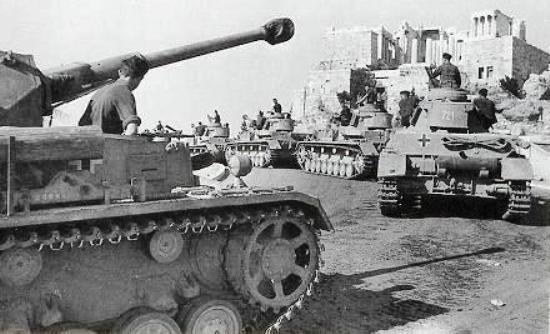
The Wehrmacht High Command announces: “In a bold aerial assault, paratroops seized the isthmus and the city of Corinth on the morning of April 26. Large numbers of British were taken prisoner; the rest fled south. Following violent attack and pursuit fighting, German armored division spearheads pursued the fleeing British and marched into Athens at 9:25 A.M. today. The swastika flag has been hoisted over the Acropolis. The Leibstandarte “Adolf Hitler”, in a turbulent advance, has reached the Bay of Patrai west of the Pindos Mountains, forced its way across the bay and penetrated the Peloponnese.”
German troops marched into Athens. German 2nd Panzer Division captured Athens, raising the Nazi German flag above the Acropolis as a sign of victory. They captured intact large quantities of petroleum, oil, and lubricants, several thousand tons of ammunition, ten trucks loaded with sugar, and ten truckloads of other rations in addition to various other equipment, weapons, and medical supplies; surrendered Greek officers were allowed to retire to their homes with their sidearms without being interned as prisoners of war. German 5th Panzer Division moved across the Corinth Canal all day and Leibstandarte SS Adolf Hitler Regiment crossed onto the Peloponnese Peninsula in southern Greece at Patras at 1730 hours. 4,200 Allied troops were evacuated from beaches south of Athens.
In an event of worldwide importance, on 27 April 1941 the Wehrmacht enters and occupies Athens at 09:25. German soldiers immediately climb up to the Acropolis beside ordinary tourists and raise the Swastika flag. The Wehrmacht troops, fueled by vast supplies of oil and related valuable items captured in the capital, continue south, pursuing the retreating Commonwealth troops.
Operation DEMON, the British evacuation from mainland Greece, continues. The British take off 4,200 troops from Raphina and Raphtis. There is some unhappiness among the Greek troops awaiting evacuation in the Peloponnese, as the British take off their own troops and leave the Greek Cretan 5th Division behind.
The 1st SS Panzer Division Leibstandarte SS Adolf Hitler (“LSSAH,” still of brigade-size) completes its crossing of the Gulf of Patras to take the key port of Patras at 17:30. However, it is an empty victory because the British forces have chosen to evacuate from other ports such as Nafplio. In addition, Wehrmacht troops advancing through Athens already have advanced into the Peloponnese and relieved the Fallschirmjäger (German paratroopers) of Operation Hannibal that was holding the Gulf of Corinth. While the rapid LSSAH advance south from Ioannina across the Gulf of Patras was an outstanding technical achievement, in a military sense it becomes essentially superfluous. However, it greatly enhances the reputation of the formation, and plans are made to expand it to division size.
The German 5th Panzer Division advances rapidly south through Athens and down to the Corinth Canal. It throws across a temporary bridge on or about this date and heads south toward the fleeing British.
Slamat disaster: The Dutch troopship Slamat and the British destroyers Diamond and Wryneck were sunk in air attacks by Stuka dive bombers. At 0400 hours, Dutch passenger liner Slamat departed Nauplia in southern Greece with 211 crew and 500 evacuating Allied troops; Slamat and escorting destroyers HMS Diamond and HMS Wryneck were all sunk by German Stuka dive bombers at 0700 hours. While the British troops largely escape the Wehrmacht ground forces, they are not quite so lucky with the Luftwaffe. Nine Junkers Ju 87 Stukas of Sturzkampfgeschwader 77 attack a troop convoy fleeing from Nafplio in the Peloponnese. They bomb and sink Dutch troopship Slamat, which is part of a convoy carrying 3,000 British, Australian and New Zealand troops (the Slamat only has a portion of them). Two Royal Navy destroyers, HMS Diamond and Wryneck, pick up as many survivors as they can, but as they head to Suda Bay, Crete, the Luftwaffe Stukas sink them, too. A total of roughly 1,000 British troops perish, with only 8 troop and 11 crew survivors from the Slamat, 20 from the Diamond, and 27 from the Wryneck.
The 4th New Zealand Brigade have fought off the Germans and embarked this night but some groups at Kalamata and Nauplion have been captured.
German Deputy Chief of Staff Friedrich Paulus arrived in Libya. General Friedrich Paulus was dispatched to North Africa to exert some control from High Command over Erwin Rommel, who had been disregarding most orders from Berlin. Despite recent military successes in North Africa, the German high command has become increasingly leery of Lieutenant General Erwin Rommel’s conduct of operations there. Among the concerns is Rommel’s decision to stage a major offensive before receiving all of the troops en route to Tripoli — the fact that the offensive was wildly successfully does not enter into this assessment. Rommel repeatedly disregards orders sent by either the OKH and his Italian military superiors. The Germans cannot know this now, but that is one of the keys to Rommel’s successes since the British are reading German communications but Rommel just disregards them. When the OKH orders something and then Rommel does something else, the British are caught flat-footed.
To assuage their concerns, the OKH (Oberkommando des Heeres, army high command) sends staff officer Friedrich Paulus, a Deputy Chief of the General Staff, to Tripoli to investigate the situation. Paulus later recalls that he was offered command of the Afrika Korps in place of Rommel, but turned it down. However, Paulus does assume control of operations during his tenure in the theater and cancels a planned offensive against Tobruk pending his later approval.
In the field, the Germans consolidate their recent gains in the south. Gruppe Herff sets up outposts at Sidi Suleiman, about ten miles east of the British lines. Some of its units are sent north through Sollum in preparation for a renewed attack on Tobruk — which depends upon General Paulus’ approval.
German medium and dive bombers attacked Tobruk, Libya, destroying 4 anti-aircraft guns (killing 8); 1 German aircraft was lost. After these losses, the British moved the anti-aircraft guns to conceal positions while dummy guns were constructed in the old anti-aircraft gun positions.
Winston Churchill made a radio broadcast reporting on the war situation. “When I spoke to you early in February many people believed the Nazi boastings that the invasion of Britain was about to begin. Now it has not begun yet, and with every week that passes we grow stronger on the sea, in the air and in the number, quality, training and equipment of the great armies that now guard our island,” Churchill said. Returning to the line in that February speech asking for the “tools” to “finish the job,” Churchill said that “that is what it now seems the Americans are going to do. And that is why I feel a very strong conviction that though the Battle of the Atlantic will be long and hard and its issue is by no means yet determined, it has entered upon a more grim but at the same time a far more favourable phase..” Churchill warns that if Egypt is not held, blood will flow and he will “shoot the generals.”
He has a somber tone, as Churchill knows that Greece is lost and the British have lost their last foothold on the European mainland. He crows about the inability of the Germans to invade Great Britain, noting that
“…with every week that passes we grow stronger on the sea, in the air and in the number, quality, training and equipment of the great armies that now guard our island.”
Of Middle East Commander General Archibald Wavell, he notes that “we cheered in good days and will back through the bad.” He then turns to the Axis leaders and Italian leader Mussolini a “whipped jackal” and Hitler “that bad man” prone to “raving outbursts.” He essentially places all of England’s hopes on America, concluding with an Arthur Hugh Clough poem that has the last line, “But westward, look, the land is bright.”
Local Abyssinian forces loyal to Emperor Haile Selassie capture Socota from the Italians.
Heinrich Himmler inspected the Mauthausen Concentration Camp in Austria. Mauthausen is a Category III camp and perhaps the most brutal in the entire system. 9The Death Camps are not yet in operation…)
After a brief stop in Maribor/Marburg and a return trip to Graz on the 26th, Adolf Hitler embarks on his command train “Amerika” for the trip back to Berlin.
Visiting Australian Prime Minister Robert Menzies meets with US Ambassador to Great Britain John Gilbert Winant. Menzies writes in his diary that Winant agrees with him that, in terms of the news media, “most stuff going to the USA is of German origin.” The AP, for instance, continues to obtain photographs from Germany through its Lisbon contacts. Menzies jots down that “news to America badly handled.” Churchill muttered darkly during his BBC broadcast about supposed tensions between Australia and England due to German propaganda, and if Menzies’ private thoughts are any indication, such tensions do indeed exist.
France must step from economic collaboration with Germany to “political cooperation,” the Nazi-dominated press in Paris asserted today in suggesting the contents of Reichsführer Hitler’s latest proposals to the Vichy Government.
The Croatian Ustashi militia kills an unknown number of civilians in the Serbian town of Gudovac. There is no love lost between the Croats and the Serbs, with the Croats firmly in the German camp while the Serbs back Great Britain.
Diplomatic efforts continue to defuse the tensions in Iraq, where the Rashid Ali government refuses to allow additional British troops into the country. The British ambassador informs Ali’s government that additional troops are at sea and bound to arrive at Basra any day. Within Iraq, the British troops are secure but unable to travel by land between their bases. However, their airlift capability is unimpeded, so the British airlift elements of the British 1st Battalion of King’s Own Royal Regiment from RAF Shaibah to RAF Habbaniya, where Iraqi troops have assembled.
The Luftwaffe raids Portsmouth with 38 bombers.
RAF Bomber Command: Day of 27 April 1941
18 Blenheims on coastal patrols attacked shipping but without scoring hits. 6 Blenheims, 2 Hampdens and 1 Stirling attempted cloud-cover raids to industrial targets in Germany; 2 Blenheims bombed Osnabruck and 2 Hampdens attacked targets in Holland. No losses.
Operation DUNLOP: 24 Hurricanes delivered from carrier, HMS Ark Royal: 23 arrive in Malta.
The Luftwaffe attacks Australian artillery positions in Tobruk in preparation for the planned assault. The Luftwaffe employs level bombers to attract anti-aircraft fire while Junkers Ju 87 Stukas pound the anti-aircraft guns. The attack is successful, with four guns destroyed and 8 killed at a cost of one bomber. The Australian defenders set up dummy gun emplacements and move the artillery.
U-110, commanded by Kapitänleutnant Fritz-Julius Lemp, sank British steamer Henri Mory (2564grt) 330 miles WNW of Blaskets, near Achill Head. At 0130 hours on 27 April 1941 the unescorted Henri Mory (Master Joseph Havard) was hit on the starboard side in the after end of the engine room by one torpedo from U-110 while steaming on a non-evasive course at 4 knots in fine and clear weather about 330 miles west-northwest of Blasket Islands, Ireland. The ship had been dispersed from convoy SL-68 on 21 March, went to Bermuda and then proceeded independently to the UK because the vessel was too slow to join a transatlantic convoy, barely able to make 6 knots and later further reduced due to troubles with its boiler tubes. The crew of 30 men and two gunners (the ship was armed with two 90mm and three machine guns) began to abandon ship in the lifeboats, but had difficulties to so in the very dark night and a heavy swell caused the port lifeboat to drift away unoccupied. Henri Mory sank in less than four minutes and only a few survivors managed to escape the suction of the sinking ship. The master, 25 crew members and two gunners were lost. The port lifeboat was boarded by the cook and he was soon thereafter joined by the chief officer, who was exhausted from swimming to it and could only get aboard after 20 minutes. In the meantime, the U-boat picked up a Russian sailor who clung to wreckage from the upper bridge and subsequently went alongside the lifeboat. The Germans asked the chief officer the usual questions about the name of the ship, cargo and routing and then transferred the rescued man to the boat with a bottle of cognac. He had been interrogated while aboard, given a good drink of cognac and two packs of cigarettes. However, the Germans somehow misidentified the ship as André Moyrand. When U-110 left the area at about 0200 hours the commander shouted: Goodbye, you will be picked up shortly. Tell Winston Churchill there is a war on. Despite the sea anchor and attempts to keep the head to the wind with oars and sails, the lifeboat was riding the easterly swell beam on until daylight as the occupants were all exhausted. No more survivors were found at the sinking position, but in the afternoon a raft with one man aboard was seen about a mile away. Until darkness they attempted to reach the raft but this was prevented by the heavy swell and lack of strength of the three survivors. The lifeboat was circled twice by a British Catalina flying boat in the morning of 29 April and the next day a corvette was seen about four miles away, but the chief officer and the two crew members were eventually picked up by HMS Hurricane (H 06) (LtCdr H.C. Simms, RN) in position 54°01N/17°17W at 1545 hours and landed at Gourock in the evening of 1 May. The survivor on the raft was rescued after eight days by the British steam merchant Lycaon. The 2,564 ton Henri Mory was carrying iron ore and was bound for Barrow, England.
U-147, commanded by Oberleutnant zur See Eberhard Wetjen, sank Norwegian steamer Rimfakse (1134grt) in 60-10N, 8-54W. At 0242 hours on 27 April 1941 the unescorted Rimfakse (Master Ivar Lønne) was struck on the port side in the after part of #2 hatch by one torpedo from U-147 about 130 miles northwest of Scotland and sank by the bow with a heavy list to port within two minutes. Eleven crew members were lost. The Germans tried to question the survivors in the water but got no answers. The master and seven survivors managed to get on a raft, but they were not able to help others that were crying for help in the dark. At dawn they reached another raft by paddling, distributed themselves on the rafts and tied them together. Later that day, the survivors were picked up by Hengist and taken to Scrabster. The 1,334 ton Rimfakse was carrying coal and was bound for Patricksfjord, Iceland.
U-552, commanded by Oberleutnant zur See Erich Topp, sank British trawler Commander Horton (227grt) in 62N, 16W. At 0210 hours on 27 April 1941 the Commander Horton (Master Ernest Lewis) was torpedoed and sunk by U-552 southwest of Iceland. The 227-ton Commander Horton was sunk on her way to the Icelandic fishing grounds.
U-552 later sank British steamer Beacon Grange (10,160grt) in 62-05N, 16-20W. At 1612 hours on 27 April 1941 the unescorted Beacon Grange (Master Alfred Byford Friend) was torpedoed and sunk by U-552 south of Iceland. Two crew members were lost. The master, 73 crew members and eight gunners were picked up by the Belgian trawler Edouvard Anseele, transferred to HMS Gladiolus (K 34) (LtCdr H.M.C. Sanders, DSC, RNR) and landed at Londonderry. The 10,119 ton Beacon Grange was carrying ballast and was bound for Buenos Aires, Argentina.
Auxiliary fighter catapult ship HMS Patia (5355grt, Cdr D. M. B. Baker RD RNR) was sunk by German bombing near 20.G Buoy, Coquet Island. Baker, T/Lt C. S. Nicholls RNVR, and T/Sub Lt (E) B. K. Prim RNR, and eighteen ratings were killed on the ship. A rating died of wounds on the 28th and T/A/Sub Lt W. Kirkham RNVR, died of wounds on the 29th. Lt F. J. Owen RNR, T/Lt E. L. Riley RNVR, and P/T/Lt B. E. T. Williams RNR, and thirteen ratings were missing. T/Lt (E) E. Jones RNR, T/Paymaster Sub Lt J. McDonald RNR, T/Sub Lt (E) E. H. Maddock RNR, and T/Surgeon Lt A. Watt RNVR, were wounded.
Destroyers HMS Somali and HMS Bedouin departed Scapa Flow at 1745 to search for a submarine reported by aircraft in 59-16N, 7-23W. The destroyers were recalled at 23330 and arrived back at Scapa Flow at 0500/29th.
Destroyers HMS Tartar, HMS Eskimo, and HMS Brocklesby departed Scapa Flow at 2030 for Rosyth. Destroyer Tartar was to boiler clean at Rosyth. Destroyers Eskimo and Brocklesby were to escort minelayer HMS Agamemnon from Rosyth. The two destroyers and the minelayer departed Rosyth at 1940/29th for Loch Alsh.
Destroyer HMS Farndale arrived at Scapa Flow to work up at 1000.
Sloop HMS Rosemary was damaged in a collision with British steamer Carrick Macross (754grt) at Milford Haven. The sloop was repaired at Milford Haven from 28 April to 6 June.
British steamer Celte (943grt) was sunk by German bombing in 61-20N, 11-00W. The entire crew were rescued.
Submarine HMS Usk (Lt G. P. Darling) was lost on a minefield near off Cape Bon. Darling, Lt D. W. Leggatt, Lt D. A. O’Hare, Lt V. L. Darbyshire, and the twenty eight ratings of the crew were lost with the submarine.
Submarine HMS Torbay unsuccessfully attacked a steamer off Cape Ferrato.
French steamer SNA.7 was sunk on a mine off Cape Bon.
To relieve congestion in Crete, convoy GA.14 departed Suda Bay with commando ship Glengyle, troopships Egyptian Khedive Ismael (7290grt), British Salween (7063grt), British Dilwara (11,080grt), British City of London (8956grt), and Dutch Costa Rica (8672grt). Troopship Costa Rica was sunk by German bombing north of Crete in 35-54N, 23-49E while this convoy was forming. The entire crew and all passengers were rescued by light cruiser HMS Phoebe and destroyers HMS Hero, HMS Hereward, and HMS Defender. The convoy was escorted by anti-aircraft cruisers HMS Coventry and HMS Calcutta, destroyers HMAS Stuart, HMAS Vendetta, HMAS Waterhen, and HMAS Vampire, and sloop HMS Flamingo. Destroyer HMS Wryneck was supposed to be in this force, but at this time it was not known she was lost. Destroyer HMS Griffin was sent north to attempt to locate destroyers HMS Diamond and HMS Wryneck and found a life raft carrying one officer and forty eight ratings. Light cruisers HMAS Perth and HMS Phoebe and destroyers HMS Decoy, HMS Hasty, HMS Nubian, HMS Hereward, HMS Hero, and HMS Defender covered the convoy, and arrived at Alexandria on the 29th.
During the night of 27/28 April DEMON continued. Light cruiser HMS Ajax and destroyers HMS Kingston, HMS Kimberley, and HMS Havock, assisted by three Greek caiques, lifted 4200 troops from Raphina and Raphtis.
Greek steamer Evanghelos Georgiou (441grt) was sunk by German bombing at Kithera.
Greek steamer Astir (1350grt) was sunk by German bombing at Kapsalion.
Greek steamer Tassos (333grt) was sunk by German bombing at Hermione.
Greek steamer Fragiscos (441grt) was sunk by German bombing in the Greek Archipelago.
Greek steamer Hollandia (1759grt) anchored at Hermione with engine trouble on the 23rd. She was sunk by German bombing at Hermione, near Nauplia Bay.
Greek steamer Danapris (2113grt) was damaged by German bombing at Piraeus. The steamer was repaired by the Germans for their use.
Greek steamer Ypanis (1459grt) was sunk by German bombing at Stylis. She was refloated in 1942 and was repairing at Piraeus when she was scuttled on 11 October 1944.
Heavy cruiser HMS Dorsetshire departed St Helena.
Light cruiser HMS Dauntless departed Singapore.
Ocean boarding vessel HMS Maron intercepted five French steamers, escorted by a patrol vessel at 27-07N, 14-40W. The Admiralty directed that the convoy should be allowed to proceed. The convoy, escorted by auxiliary patrol vessel Aspriant Brun, departed Casablanca on the 24th and arrived at Dakar on 2 May.
Convoy OB.315 departed Liverpool, escorted by destroyers HMS Bulldog., HMS Chelsea, HMS Mansfield, and HMS Verity and corvette HMS Larkspur. On the 29th, destroyer Bulldog was detached and minesweepers HMS Seagull and HMS Sharpshooter joined. Destroyer Verity was detached on 1 May and destroyers Chelsea and Mansfield on 3 May. The remainder of the escort was detached on 4 May when the convoy dispersed.
Convoy SL.73 departed Freetown escorted by armed merchant cruiser HMS Esperance Bay for the day only and corvettes HMS Clematis, HMS Crocus, HMS Cyclaman, and HMS Marguerite to 6 May. Destroyer HMS Duncan escorted the convoy from 29 April to 1 May. On 3 May, light cruiser HMS Dragon joined to 6 May. Destroyers HMS Boadicea to 25 May, HMS Columbia to 25 May, and HMS St Francis to 21 May and ocean boarding vessels HMS Hilary and HMS Registan, both to 25 May joined on 19 May. On 20 May, destroyer HMS St Clair for the day only, sloop HMS Egret to 25 May, and corvettes HMS Arrowhead, HMS Hepatica, HMS Snowberry, and HMS Spikenard, all to 25 May, joined, and arrived at Liverpool on 25 May.
The Defense Mediation Board’s efforts to settle the coal mine stoppage collapsed today and board officials said it planned no further action. W. H. Davis, chairman of the panel which considered the dispute, said it had recommended unanimously that President Roosevelt’s proposal for reopening the mines be accepted. This recommendation was accepted by the United Mine Workers (C.I.O.) and the northern bituminous coal operators, Davis added, but rejected by the southern operators. Davis declared “there is no further step for the mediation board to take.”
A House battle over regulation of labor relations in the national defense emergency and a Senate committee fight over convoys face Congress this week. Investigations of the defense program will continue on both sides of Capitol Hill and the House Ways and Means Committee will begin public hearings tomorrow on the program to increase taxes by $3,600,000,000.
The women’s division of the Committee of Americans told Secretary of the Treasury Morgenthau today that it is high time something be done about the U.S. dime. The group wants the image of Benjamin Franklin, America’s patron saint of thrift, engraved on the dime and insisted in a letter to the treasury secretary that his government “stop minting the emblem of fascism on American dimes.”
Leaders of American business tonight prepared their most optimistic reports in years for presentation at the twenty-ninth annual meeting of the Chamber of Commerce of the United States, opening here tomorrow. The business reports, to be presented for six geographical areas of the United States at an opening session tomorrow on the subject, “Business and Defense Activities,” were said to reflect the best business conditions since the boom year of 1929.
Representatives of the Congress of Industrial Organizations and the American Federation of Labor announced tonight that they had agreed to a three-point “formula” proposed by the National Defense Mediation Board for ending a thirteen-day work stoppage which has crippled production of shells for Great Britain and the United States at the Buffalo plant of the American Car and Foundry Company.
Emphasizing that every minute is precious in “this fateful hour,” John D. Rockefeller Jr., in a letter made public yesterday, urged that President Roosevelt take immediate action to see that American war materials and foodstuffs are “laid down at Britain’s door,” and that Nazi and Communist fifth columns, which he blamed for some recent disputes between industry and labor, are eliminated from our defense program.
Ernest W. Gibson Jr., national chairman of the Committee to Defend America by Aiding the Allies, urged tonight the use of American convoys in the Atlantic and said he believed the step would bring no declaration of war from Germany.
Senator Burton K. Wheeler of Montana reiterated today that President Roosevelt had destroyed American neutrality and prepared the nation “for a declaration of war.”
Major League Baseball:
The Giants touch Hugh Casey for 11 hits in 6 innings, but Lee Grissom fires 3 hitless frames as the Dodgers top the Giants, 7–5, to go 4–0. Casey is 3–0, with all his wins coming against the Giants. Cookie Lavagetto is 4-for-4. With this triumph, their sixth in a row, the Dodgers wrenched their arch foes from the Polo Grounds out of first place and for an hour or so occupied that select spot themselves. A little later, unhappily. came returns from the West that showed the Cardinals had vanquished the Cubs, a result that not only lifted the St. Louisans over the Giants, but put them in first place by 13 percentage points.
The St. Louis Cardinals pounded Bill Lee and rookie Paul Erickson from the mound with an extra-base barrage today and went on to sweep the two-game series from the Cubs, 8–5, before 18,678 fans. The defeat was Chicago’s fifth in six games. Morton Cooper went the route for St. Louis, pitching steady ball after Right Fielder Bill Nicholson had jarred him for a home run following two walks in the first inning. It was Nicholson’s fourth homer of the year. Cooper allowed only two other hits until the eighth and eight in all.
Bucky Walters evened accounts today with the Pirates, who had knocked him off the mound in his first start of the season, by twirling the Reds to a 3–2 victory. Bucky gave six hits, a single followed by Elbie Fletcher’s home run in the first inning bringing both Pittsburgh runs. Truett Sewell went the whole way for Frankie Frisch’s crew and likewise allowed six hits, but lost his own ball game on a wild pitch that let in the winning run in the sixth.
The Cleveland Indians swung into first place today as Bob Feller, aided by Jeff Heath’s seventh-inning homer, tamed the Tigers, 2–1, before 31,728 fans in Cleveland Stadium. The Indians were trailing after Charlie Gehringer’s single had brought in Frank Croucher in the third for Detroit, but Hal Trosky opened the seventh with a double, then Heath lifted a ball into the lower right-field stands, scoring what proved to be the pay-off run. Feller struck out five batters, Hank Greenberg twice, but issued three bases on balls. Rowe fanned three and walked none.
The Washington Senators beat the New York Yankees, 6–3. Hurling his first game against his old mates and his second in the livery of Bucky Harris’s Senators, Sundra, under the protection of a 12-hit battering to which Washington subjected Atley Donald, Steve Peek and Charley Stanceu, snapped a 4-game winning streak of the Yankees, flipped the Senators to their first victory at Yankee Stadium since 1939 and dropped the McCarthymen into second place behind the Indians.
Bill Posedel, making his first start this season, held the Phillies to four hits and rapped three himself today to give the Bees an 8–3 triumph. It was Boston’s first victory after four straight defeats. When they tallied in the second the Bees broke a string of twenty-one consecutive scoreless innings. They totaled fourteen hits. Posedel, who had had a sore arm, was deprived of a shutout when Ben Warren walloped a home run in the ninth with two on base.
The White Sox took advantage of the Browns’ inability to hit in the clutch today and came from behind to win, 7–6, for their second successive one-run victory over the St. Louis club. The Browns were unable to hold a first-inning three-run lead and the Sox moved out in front in the seventh. Both teams scored two in the ninth, when the Browns had the bases loaded twice, once with none out. A double play ended the game.
The scheduled game between the Philadelphia A’s and the Red Sox at Boston was postponed due to rain. The game will be made up as part of a doubleheader on May 27.
New York Giants 5, Brooklyn Dodgers 7
St. Louis Cardinals 8, Chicago Cubs 5
Pittsburgh Pirates 2, Cincinnati Reds 3
Detroit Tigers 1, Cleveland Indians 2
Washington Senators 6, New York Yankees 3
Boston Bees 8, Philadelphia Phillies 3
Chicago White Sox 7, St. Louis Browns 6
The Soviet Government published an exchange of telegrams with Japan in connection with ratification of their neutrality pact today. In the exchange both countries promised a continued improvement in their relations.
A strong Chinese counter-offensive south of Chuki, important point on the Chekiang-Kiangsi railway, cost the Japanese upward of 4,000 casualties and forced them to fall back to the north, Chinese Central News Agency reports declared tonight. The agency said the counter-attack followed a Japanese attempt to trap Chinese forces in the region in a four-column onslaught supported by fifty planes. The Japanese recently swept in force into Chekiang Province in a move interpreted by some observers as striking at a Chungking supply route.
William C. Bullitt, former Ambassador to Soviet Russia and to France, declared here tonight that the Chinese were fighting our battle on what is “literally — in a strategic sense — our Western front” and called on the American people, “for our own salvation,” to give all the aid in their power not only to the Chinese but to the British.
The well-known political expert, Masanori Ito, today suggested that Foreign Minister Yosuke Matsuoka visit Washington in an effort to conclude a Japanese-American non-aggression treaty. The foreign minister proved his ability in face-to-face negotiations by obtaining a neutrality pact with Russia during his recent visit In Moscow, Ito said. If the foreign minister should go to Washington, the commentator said the main purpose of his mission would be “to induce the United States to understand the essentially peaceful meaning of Japan’s proposed Greater East Asia sphere of mutual peace and prosperity.”
American, British, and Dutch military officials concluded a meeting in Singapore to develop a strategic plan for combined operations against Japan in the event the Japanese attacked the United States. The officials reached an agreement on a combined operating plan of local defense forces in the event of war with Japan. Captain William R. Purnell, Chief of Staff to Admiral Thomas C. Hart, Commander in Chief Asiatic Fleet, was the senior U.S. representative. The United States, which sent only junior officers led by Captain William R. Purnell to the meeting, takes the plan lightly, with the U.S. War and Navy Departments rejecting the plan. The British, Dutch and Australians, who already are at war with Germany but not yet Japan, take the plan extremely seriously.
Born:
Lee Roy Jordan, NFL linebacker NFL Champions, Super Bowl VI-Cowboys, 1971; Pro Bowl, 1967-1969, 1973, 1974; Dallas Cowboys), in Excel, Alabama (d. 2025).
Bob Dillabough, Canadian NHL and WHA centre and left wing (Detroit Red Wings, Boston Bruins, Pittsburgh Penguins, Oakland Seals, WHA: Cleveland Crusaders), in Belleville, Ontario, Canada (d. 1997).
Jennings Michael Burch, American writer (“They Cage the Animals at Night”), in Manhattan, New York, New York (d. 2013).
Judith Blegen, American opera singer (The Magic Flute — “Papagena”), in Lexington, Kentucky.
Naval Construction:
The Royal Navy Fairmile B-class motor launch HMS ML 249 is commissioned.
The Royal Navy Hunt-class (Type II) escort destroyer HMS Farndale (L 70) is commissioned. Her first commanding officer is Commander Stephen Hope Carlill, RN.

