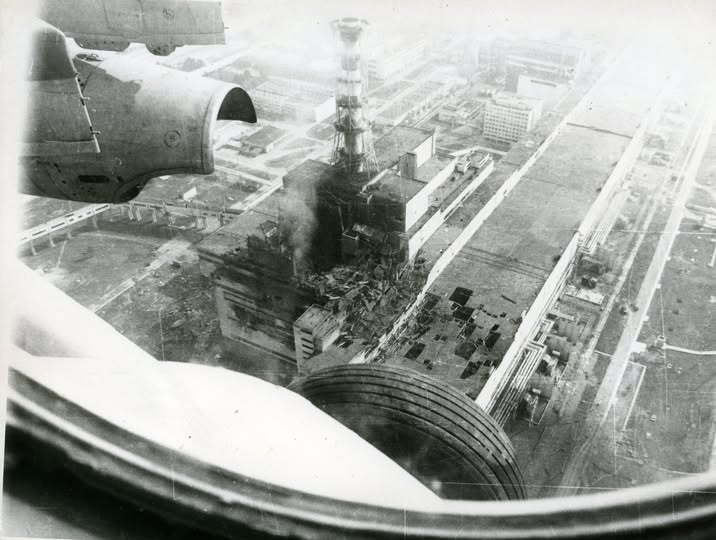
The day after the reactor explosion, the Soviet government ordered the evacuation of Pripyat, though they initially attempted to cover up the severity of the disaster. Soviet authorities began evacuating 30,000 residents from Pripyat, one day after the Chernobyl nuclear reactor explosion. Pripyat inhabitants were asked to evacuate on April 27, 1986 at 14:00:
“For the attention of the residents of Pripyat! The City Council informs you that due to the accident at the Chernobyl Power Station the radioactive conditions in the city of Pripyat and its vicinity are deteriorating. The Communist Party, its officials and the armed forces are taking necessary steps to combat this. Nevertheless, with the view to keep people as safe and healthy as possible, the children being top priority, we need to temporarily evacuate the citizens to the nearest towns of the Kiev region.
“For these reasons, starting from April 27, 1986, 14:00 each apartment block will be able to have a bus at its disposal, supervised by the police and the city officials. It is highly advisable to take your documents, some vital personal belongings and a certain amount of food, just in case, with you. The senior executives of public and industrial facilities of the city have decided on the list of employees needed to stay in Pripyat to maintain these facilities in a good working order. All the houses will be guarded by the police during the evacuation period. Comrades, leaving your residences temporarily please make sure you have turned off the lights, electrical equipment and water and shut the windows. Please keep calm and orderly in the process of this short-term evacuation.”
To expedite the evacuation, residents were told to bring only what was necessary, and that they would remain evacuated for approximately three days. As a result, most personal belongings were left behind, and residents were only allowed to recover certain items after months had passed. By 15:00, 53,000 people were evacuated to the Kiev region. The next day, talks began for evacuating people from the 10 km zone. Ten days after the accident, the evacuation area was expanded to 30 km. The Chernobyl exclusion zone has remained ever since, although its shape has changed and its size has expanded.
The recent spate of terrorist attacks against Americans and other victims has left in its wake a long trail of both casualties and question marks. Almost every day there is a mysterious new bombing, and often a previously unheard of group claims responsibility. Radical Governments in Libya, Syria and Iran often praise these attacks and, at the same time, insist they had nothing to do with them. What groups or states are behind these terrorist bombings? How are they connected? How are the terrorist gunmen or bombers recruited? How are the killings or bombings organized? And is this terrorism motivated by political grievances, or has it simply become another tool of international relations for some states? The evidence needed to answer these questions conclusively remains sketchy. But interviews in recent months with Arab, American and European diplomats in the Middle East and elsewhere, as well as with American, Arab and Israeli security experts, provide some clues about the terrorist forces that the United States and many of its allies are now facing. In the view of many of these sources, the actual links between the various radical Arab and Iranian groups and state intelligence organizations that have in effect declared war on the United States appear to be very loose. The bonds that unite these extremist organizations tend to be more ideological than operational, they say. That is, they occasionally gather for what the experts describe as joint “pep rallies,” but when it comes to operations in the field they usually prefer to act alone.
Americans living in Europe have become accustomed to a lot of things in the last two weeks. They include mile-long lines outside military bases while cars are checked for bombs; soldiers, some wielding automatic weapons, riding along with the kids on school buses; United States Government buildings surrounded by old drain pipes, broken-down dumpsters — anything bulky enough to deter car-bomb attacks. Old Glory does not wave in a lot of places where it used to; many American Legion halls and American churches and schools have decided it is just too dangerous to show the colors. At the United States’ Rhein-Main Air Base near Frankfurt, a soldier sits in a turret beneath a sign that reads: “Welcome to Rhein-Main: The Gateway to Europe.” He is pointing a machine gun straight at all comers.
An anonymous tip from nationalist sources probably prevented a very large Irish Republican Army car bomb from exploding in Belfast’s city center as hundreds of Protestants marched past in annual parades, the police reported today. A police spokesman said the anonymous phone call warning of the car bomb possibly came from an I.R.A. supporter who knew about the car bomb and was appalled at the possible death and injury it could have caused to people marching in the parade. Police patrols found an abandoned car with over 200 pounds of homemade explosives packed in the trunk and British army bomb disposal experts defused and dismantled the car bomb.
Referring pointedly to her Government’s readiness to allow the use of British bases in the American raids on Libya, Prime Minister Margaret Thatcher contended today that the United States had an obligation to fight the terrorism of the Irish Republican Army by agreeing to an extradition treaty that has been held up for months in the Senate Foreign Relations Committee. “What is the point,” Mrs. Thatcher asked, “of the United States taking a foremost part against terrorism and then not being as strict as they can against Irish terrorism, which afflicts one of their allies?” The delay on the extradition treaty has become a sore point in British-American relations in the aftermath of the raid, with critics of Mrs. Thatcher’s decision saying that the United States was highly selective in its battle against terrorism and indifferent to the problems of its allies. The critics have maintained that President Reagan’s backing for the rebels in Nicaragua is an example of “state-supported terrorism” and have stressed that Irish gunmen get more support from America than they do from Libya.
A British tourist was shot dead yesterday in the Arab section of Jerusalem while visiting a religious shrine revered by some Protestants as the site where Jesus was buried, the Israeli police said. In another incident on the other side of the world, the Mexican police Saturday night defused and removed an “explosive device” weighing more than 20 pounds from a car parked on a side street in downtown Mexico City, near both the United States Embassy and a Sheraton hotel. It was not immediately clear whether either incident was part of the wave of terrorist attacks against Americans and Britons that has come in response to the American air strike against Libya on April 15, an action that Britain supported. Groups supporting the Libyan leader Colonel Muammar el-Qaddafi vowed after the United States attack, made in response to what was described as Libyan involvement in earlier terrorist actions, to take revenge on American targets “around the world.”
The ethnic Albanian majority in the autonomous Yugoslavian province of Kosovo is feared by the minority population of Serbs and Montenegrins, who believe the Albanians are seeking to drive them out of the province. A 1981 fire that gutted the medieval nunnery of the Serbian Orthodox Patriarchate in Pec, a center of Serbian national feeling, has been officially ascribed to bad construction. An aged nun at the Patriarchate said she and her sisters were convinced that the fire had been set to chase them from Kosovo. But she said the nuns would never leave, and three Serbian or Montenegrin visitors agreed with her.
Secretary of State George P. Shultz today advocated the use of “disruptive” covert action against Libya as a possible alternative to more military retaliation for new terrorist attacks. In an interview on the CBS News program “Face the Nation,” Mr. Shultz listed possible options for the United States and said that “covert action is something that we need to be using.” It was the first time that he had publicly discussed the covert side of the American efforts to unseat Colonel Muammar el-Qaddafi. When Mr. Shultz was asked to be specific about covert action tactics, he declined but said, “It is certainly intended to be disruptive.”
Iraq said its planes set fire today to oil installations on Iran’s Kharg Island oil export terminal and also hit a vessel off the Iranian coast in the Persian Gulf. Iraq has reported more than 100 raids on the island in the last eight months to disrupt Iranian oil exports. A military spokesman said earlier that Iraqi planes hit a vessel off the coast, the second reported attack on a ship 24 hours. Shipping sources in the gulf said the 16,015-ton Iranian tanker Minab had radioed a distress call saying it was on fire after it had apparently been hit in a missile attack. The oil products carrier appeared to have been the victim of Iraq’s morning strike, but there has been no confirmation of an earlier Iraqi claim to have hit another vessel.
About 100 Afghan rebels may have died in a battle this month for an important rebel supply base near the border with Pakistan, a Western diplomat in New Delhi said. He said many Soviet and Afghan Government soldiers also died. Soviet and Afghan Government forces briefly overran the base, but the rebels later recaptured it, according to the diplomat. He said the battle over the base at Jawar, Afghanistan, in Paktia Province, was one of the fiercest of recent years. He said the base was severely damaged by bombardments. Reports of the battle were sketchy and in some cases contradictory, according to the diplomat, who said his information was based on reports from leaders of some Afghan guerrilla groups. According to the diplomat, the Jawar base, where cliffs are honeycombed with caves sheltering as many as 300 guerrilla fighters, has been a well-known rebel transit post. In addition, the base was said to have machine and repair workshops, a communications center, a fuel depot, a jail and a hospital.
President Babrak Karmal of Afghanistan did not appear in Soviet television reports of celebrations today marking the anniversary of the 1978 Communist coup, adding to speculation about his whereabouts and standing. According to reports from Afghanistan, Mr. Karmal went to the Soviet Union on March 30, though his reasons for making such a trip were not specified. The Russians have never reported his presence, suggesting that he may have come for medical treatment or other personal reasons. There have been no public indications since of his whereabouts. As general secretary of the ruling People’s Democratic Party, Mr. Karmal should have attended the celebrations. Reports from Pakistan said that Mr. Karmal was not named by the Kabul radio two days ago in a report on a meeting of the Afghan party’s Politburo. The Communist Party daily Pravda criticized the Afghan leadership today for not making changes fast enough.
Somebody asked Emperor Hirohito a few months ago what he thought about Halley’s Comet, with all its attendant fuss. The Emperor paused and, according to press reports, replied that he thought it nice that he got a chance to see it again. That brought a chuckle from some Japanese. For them, the response encapsulated much of what comes to mind when they think about the Emperor — that he is unassuming, not given to many words and keenly interested in scientific matters. And old. He will turn 85 on Tuesday, a special birthday because Japan has chosen that day for a national celebration of his 60 years on the Chrysanthemum Throne.
No one has waited longer to become Japan’s Emperor than the 52-year-old Crown Prince, Akihito. But when he ascends to the Chrysanthemum Throne occupied by his father for the last six decades, Akihito will symbolize many of the changes that Japan has gone through since World War II. He is the product of attempts to make the imperial family seem more down to earth. In 1959 Akihito became the first Crown Prince to marry a commoner, Michiko Shoda, daughter of a wealthy industrialist. The Crown Prince and Princess further broke with imperial tradition by insisting that their three children live with them.
Riot policemen fired tear gas to disperse more than 1,000 South Korean student demonstrators in the central city of Chongju today after an opposition rally calling for electoral reform. The trouble started when students who had taken part in the rally and a subsequent march through Chongju ignored appeals to disperse from rally organizers and the police, who up to that point had watched discreetly from the sidelines. Hurling rocks and gasoline bombs, the students, wearing white headbands with anti-Government slogans, tried to break through ranks of riot policemen in battle gear. The policemen replied with tear gas and charged into the fleeing demonstrators, arresting about 20 and beating several others, witnesses said. No serious injuries were reported.
President Reagan rejected a claim by Ferdinand E. Marcos that he is still the rightful President of the Philippines, White House officials said. Mr. Reagan spoke by telephone to Mr. Marcos soon after Mr. Reagan arrived in Honolulu on the second day of his 13-day trip to the Far East for a meeting with foreign ministers of Southeast Asian countries in Indonesia and to attend the annual economic summit meeting in Tokyo May 4 to 6. The phone conversation was the first direct contact between Mr. Reagan and Mr. Marcos since the deposed President fled the Philippines February 26. White House officials said Mr. Marcos’s claim to the presidency was turned down gently, but firmly.
Ferdinand E. Marcos told followers that he was “ready to fight” and that they should keep demonstrating in his behalf without violence. The deposed President spoke by telephone from his house in Hawaii to a rally in Manila attended by 10,000 people. The call lasted nearly 20 minutes. Mr. Marcos did not refer to the telephone call that he received earlier from President Reagan.
Relations between Australia and Indonesia, only recently improved after years of mistrust, have been set back unexpectedly in the last two weeks, according to officials in both countries. The cause is a series of sharp responses by Jakarta to an Australian newspaper article about President Suharto of Indonesia and his reported wealth. Australian journalists have been barred from working in Indonesia, the Australian Government has been lectured by Jakarta on its failure to control this country’s free press, Canberra’s military planes have been denied refueling stops en route to other Southeast Asian nations, and Australian tourists, suddenly and unexpectedly told they needed visas, have been turned back from the island of Bali. Australia’s Prime Minister, Bob Hawke, who has overridden objections within his Labor Party to build better relations with Jakarta, called Indonesia’s recent actions capricious. The Australian Embassy in Jakarta lodged a protest.
France exploded an underground nuclear device today at its Mururoa test site, its first test of the year and 73rd at the South Pacific atoll since 1975, the New Zealand Government said. Prime Minister David Lange said the test, which was monitored by New Zealand scientists at the country’s Rarotonga seismological station on the Cook Islands, “highlights the need for a comprehensive nuclear test ban treaty to be concluded as quickly as possible.”
Haiti’s ruling military-civilian council said today that the police, in shooting into a crowd of thousands of marchers on Saturday, displayed “a normal reaction” in guarding a military post against “an attempted invasion.” Seven people were killed. The Government, in two communiques, expressed its “strongest regrets” to the victims’ families. But it said that the incident had been provoked by “agitators” and that an investigation was under way to find “the bad-intentioned individuals who are at the origin of the incident.” The League of Former Political Prisoners, which organized the demonstration with Government approval, said in a statement that it also believed the disorder had been started by unidentified “agitators.” But the league criticized the security forces for their “violent and brutal reaction.”
The Nicaraguan Army said today that it killed or wounded 1,000 rebels this year. The chief army spokesman, Captain Rosa Pasos, said there were no more than 300 government casualties in the same period. No breakdown of dead and wounded was given for either side. Captain Pasos said that in the last month small groups of insurgents had entered Nicaragua from bases in Honduras, bringing the number of rebels inside Nicaragua to 1,800. Most of the fighting has taken place in the northern provinces of Jinotega and Matagalpa, Captain Pasos said. Reporters were invited to visit a military hospital in the northern region last week and were told it was 65 percent full. Many of the patients said they had been wounded in recent fighting. Captain Pasos said the army was dealing severe setbacks to the rebels and cited an operation last month in which Government forces entered Honduras to attack rebel camps. The Defense Ministry said 350 insurgents were killed in the operation. “We’re better prepared, better organized than last year, and we’re responding to the mercenaries with harder blows,” she said.
Three branches of the Chilean armed forces want a plebiscite that is scheduled for 1989 to be converted into a free and open election for a new president, according to Chileans close to military leaders. But they said that while the navy, air force and national police supported such a move, the army, whose position will be decisive, remains noncommital. “The army also thinks along these lines,” said a former high official of the Government of Gen. Augusto Pinochet, “but they want, above all, to avoid a split within the institution. “So they want to try to convince Pinochet to make his own decision to step aside,” he said. “The problem is that no one in the army is capable of saying that to Pinochet.” As now contemplated under the 1980 Constitution, the voting scheduled for January or early February 1989 would approve or reject a single candidate proposed by the four military commanders. That candidate could be General Pinochet, who is commander in chief of the army as well as President. He would serve an eight-year term and step aside in 1997 for a freely elected president. A congress would be freely elected in 1990.
Seven million people have been spared starvation in Ethiopia by “a remarkable success story of international relief,” but serious problems remain, a congressional report said today. “Ethiopia has been pulled back from the brink of what threatened to become one of the great human tragedies of modern times,” said the report to the Senate Judiciary subcommittee on Immigration and Refugee Policy. Although about a million of Ethiopia’s 43 million people died in the famine, “the American people can know that their assistance not only got through to the people in need, but that it made a difference between life and death for millions,” the report said. But it also said the famine produced thousands of orphans and hundreds of thousands of refugees.
The Federal Aviation Administration graduated 91 students from its academy in Oklahoma City this week, rookies the agency needs in its efforts to rebuild the ranks of controllers who direct the nation’s air traffic. Nearly five years after President Reagan dismissed 11,000 striking controllers, dealing a stunning blow to organized labor, the aviation agency is still struggling to get the controller force back to full strength. Officials concede that the flow of air traffic in the United States has been delayed at times since the strike, in part because of a shortage of controllers. Meanwhile, the Reagan Administration and Congress have disagreed over whether efforts to rebuild the controllers’ ranks were moving fast enough. Critics in Congress assert that the Administration has not done its best to reach even the goals set by the F.A.A. Some lawmakers have charged that the Administration has engaged in a dangerous game of words and numbers when discussing the number of controllers.
The President and First Lady take a walk together on the beach near the house in Hawaii they are staying at.
President Reagan spends his “free day” catching up on paperwork and homework.
Senator Pete V. Domenici (R-New Mexico), chairman of the Senate Budget Committee, rejected a plan that conservative senators are drafting to bring a pending $1-trillion fiscal 1987 budget more in line with what President Reagan wants. Domenici, appearing on NBC’s “Meet the Press,” made his comments as the Senate prepared for its second week of budget debate. An alternative being drafted by Senator Phil Gramm (R-Texas) would add about $10 billion for military spending over a bipartisan proposal before the Senate and increase domestic spending cuts. Domenici dismissed Gramm’s plan, saying: “I would predict, as I’ve told him, that it won’t get 30 votes.”
John Doe, as he is being called in legal documents, is a former Chicago resident who wants his two young daughters to visit him in San Francisco, where he now lives. But what might have been a rather straightforward visitation case of the type regularly heard by courts has been complicated by Mr. Doe’s homosexuality and his former wife’s concern that he might somehow expose their daughters to AIDS. Susan Doe, as his former wife is being called, has charged that Mr. Doe is at a high risk of developing AIDS himself. Accepting that, Judge Richard H. Jorzak of Cook County Circuit Court ordered Mr. Doe last November to undergo a blood test that detects antibodies to the virus that causes acquired immune deficiency syndrome, indicating exposure to the deadly affliction. Mr. Doe has refused.
Amid criticism from the right, some self-described mainstream Republicans have held their first national convention in Chicago. Representative Jim Leach of Iowa, founder of the group, the Republican Mainstream Committee, was among those who applauded the growth of the Republican Party under President Reagan, but expressed concern that conservative ideologues might try to force progressives and moderates out of the party. “The question is whether we should have a party that is exclusive or inclusive,” Mr. Leach said, warning that overreliance on one strain of political philosophy might weaken the Republican Party by making it vulnerable to extremism.
Railroad company officials say they expect to restore service for 25,000 commuters Monday after winning a court order forcing sympathy strikers back to work, a spokesman said today. “They would be in contempt of Federal court if they did not comply,” said F. Colin Pease, a spokesman for Guilford Transportation Industries Inc. The company owns the struck Maine Central Railroad and the Boston & Main railroad, which operates the commuter service. On Saturday, Federal District Judge Robert E. Keeton issued the temporary restraining order against the sympathy strike that halted service to and from Boston’s North and South Stations. The order applies to members of 11 unions who walked off the job Friday in solidarity with track maintenance workers represented by the Brotherhood of Maintenance of Way Employees. The order does not affect the track workers’ union, which is embroiled in a dispute over staff cuts with the Maine Central Railroad and has been on strike since March 3.
The president of largest teamsters local in Cleveland formally announced today that he would challenge Jackie Presser as head of the 1.9 million-member national union. In announcing the campaign today, the local president, C. Sam Theodus, said leaders should be chosen by the rank and file of the International Brotherhood of Teamsters, “not any outside elements, whoever they are.” Mr. Theodus, the 55-year-old leader of the 5,200 members of Local 407, is the only challenger to Mr. Presser. The teamsters president, who is 59, is seeking re-election for a five-year term at the union’s convention May 19–23 in Las Vegas. Mr. Presser, who is also secretary-treasurer of Local 507, also in Cleveland, was the focus of a three-year Federal investigation of allegations that Local 507 paid employees who did no work, but the United States Justice Department said last summer that it had declined to prosecute him.
Many bank tellers receive only cursory instructions on what to do in the event of robbery, one of the fastest-growing crimes, a Justice Department agency said. At most bank offices, security training is minimal and consists of verbal instructions presented on the job, the National Institute of Justice said. Of 358 Indiana banks, 163 were robbed 223 times during the 30-month period a study covered. “Beyond some general instructions to cooperate with the offender and to notify the police as soon as it is safe, many tellers simply do not know what to expect or what to do,” said the report, titled, “The Robbery of Financial Institutions.”
More than 80 years ago, the National Bureau of Standards was established to standardize American weights and measurements and to supply the nation’s industries and regulators with studies and statistics on materials and manufacturing processes so that American consumers could be assured of safe goods of high quality. Since then, in its specially equipped laboratories, the bureau has run thousands of tests on cement, wood, plastic and upholstery, as well as products made of those materials and others, to determine the quality of their engineering and the degree of their safety in use. It has then submitted the results to manufacturers, other Government agencies and organizations that write safety codes. The bureau does not enforce regulations, but it still gets credit for saving countless lives.
United Methodist bishops gather in Morristown, New Jersey, this week to act on a proposed sweeping denunciation of nuclear weapons and the longtime U.S. policy of nuclear deterrence. “It is a crisis that threatens to assault not only the whole human family, but planet Earth itself, even while the arms race cruelly destroys millions of lives in conventional wars, repressive violence and massive poverty,” the working draft says. Two years in the making, the revised document would constitute the strongest condemnation yet of nuclear arms by a major body of church overseers.
An 11-foot-rise in Great Salt Lake over the last four years is transforming northern Utah’s biggest asset into the area’s biggest potential menace. The lake sometimes overflows, covering Interstate highways and railroad tracks, inundating buildings and threatening sewage treatment plants along the shore. Thousands of jobs and billions of dollars in investments will be lost if the lake continues to overflow, according to people who have the most to lose from the lake’s steady rise.
Three of the world’s top 20 advertising agencies are combining in a first-of-its-kind merger to create, for the time being at any rate, the largest such company. BBDO International, the Doyle Dane Bernbach Group and Needham Harper Worldwide signed the merger agreement Friday night. Yesterday they announced their plans for a holding company to handle about $5 billion a year in advertising billings. “We want to be nothing less than advertising’s global creative superpower,” said Allen G. Rosenshine, chairman and chief executive officer of BBDO. His agency created the Pepsi-Cola advertising that won every top prize in last year’s major ad competitions. For advertising clients who need extra creative resources, Mr. Rosenshine said, the new set-up will give them the option of avoiding a lengthy search for a new agency.
Eighteen men, all Nigerian nationals accused of obtaining credit cards or numbers by searching mailboxes and trash cans, are to be arraigned Monday on charges stemming a two-month undercover operation. The suspects, 15 of whom were named in a Federal indictment Thursday, were arrested Friday on charges of possession of stolen mail, the postal authorities said.
The Great Salt Lake is getting even Greater, transforming northern Utah’s biggest asset into the area’s biggest potential menace. The briny lake has risen 11 feet in the last four years, sometimes overtopping Interstate highways and railroad tracks, inundating buildings and threatening sewage treatment plants along the shore. Unless something is done soon, say people who have the most to lose from the lake’s steady rise, thousands of jobs and billions in investments will be lost, and Salt Lake City, which likes to consider itself the crossroads of the West, would become the end of the line, as roads are submerged and tracks washed out. Meanwhile, the lake has spread from 1,640 square miles to 2,450 square miles, surpassing Delaware in size by almost 400 square miles and making any map more than four years old obsolete.
Federal health officials are investigating a possible link between cigarette smoking and chromosome damage that could lead to early detection of people likely to get lung cancer or other smoking-related diseases. Thirty cigarette smokers and 30 others who don’t smoke are enrolled in the study being conducted by the national Centers for Disease Control in Atlanta. A similar study in China involving cigarette-smoking men is under way at the Shanghai First Medical College.
The world’s longest surviving heart-lung transplant patient was in critical condition after operations to repair a blood vessel and stop internal bleeding, a hospital spokeswoman said in Scottsdale, Arizona. Mary Gohlke, who received the transplant in 1981, had tripped and fallen in her home earlier in the week and was admitted to Scottsdale Memorial Hospital on Thursday. She remains in critical condition. Gohlke, 50, who suffered cardiopulmonary hypertension, received the transplant at the Stanford Medical Center in Palo Alto.
Thunderstorms spread over the nation’s midsection yesterday, a day after they unleashed tornadoes in Minnesota, Nebraska and Iowa, killing a 4-year-old girl. The girl, identified as Joni DeBoer of Lyon County, Iowa, was killed when winds sucked her out of pickup truck as her family fled a funnel cloud. At least seven people in the two states were reported injured by winds. The winds also rippled and tore the plastic roof of the Metrodome in Minneapolis, interrupting a baseball game. The storms stretched from northwest Texas across western Oklahoma, Kansas, eastern Nebraska, northwest Missouri, Iowa, Minnesota and western Wisconsin. Twisters damaged at least 28 farms in northwest Iowa, eight in southwest Minnesota and two in Nebraska, the authorities said.
“Captain Midnight” (John R MacDougall) hacks into and interrupts HBO.
Revival of Neil Simon, Cy Coleman, and Dorothy Fields’ musical “Sweet Charity” starring Debbie Allen and Bebe Neuwirth, opens at the Minskoff Theatre, NYC; runs for 368 performances, and 4 Tony Awards.
Major League Baseball:
Cecil Fielder, a rookie, hit a two-run homer and George Bell and Rance Mulliniks added home runs today to lead Jim Clancy and the Toronto Blue Jays to an 8–0 victory over the Baltimore Orioles. Bell and Jesse Barfield led a 13-hit assault on four Baltimore pitchers. Ken Dixon (2–1) was the loser. Clancy (2–1) struck out four, walked one and allowed nine hits to get his first shutout in three years and first complete game of the season. With one out in the second, Bell hit his fourth home run of the season. Barfield followed with a single and Fielder sent a long home run into the left-field seats. Mulliniks hit his home run with two out in the third.
In a barnburner in Chicago, the Cubs score 5 runs in the 8th inning and hold on for a 12–10 win over the Expos. Jody Davis has 2 homers for the Cubs, including a 4th inning grand slam. Davis drove in five runs with two home runs, including a grand slam, and Steve Christmas hit a two-run double in the eighth inning to give Chicago the victory. With Chicago trailing by 9–7, Davis hit a home run with one out in the eighth inning off Jeff Reardon (2–2). Chris Speier, who earlier hit a two-run homer, singled and Jerry Mumphrey followed with a single. Christmas hit his two-run double, Shawon Dunston followed with a double that scored Christmas and Leon Durham added a run-scoring single. The Cubs’ Ray Fontenot gained his first victory of the season.
Detroit downed the White Sox, 4–1. Lou Whitaker hit a two-run triple in the sixth inning to break a pitching duel between the Tigers’ Jack Morris and Joel Davis. Morris (3–2) allowed six hits, walked one and struck out six to turn in his first complete game of the season. Davis (1–1) had a one-hitter until the sixth inning when Detroit scored three runs.
Bob Knepper pitched a four-hitter and became the first to win four games in the National League as Houston shut out Cincinnati, 6–0. Knepper (4–0) struck out four and walked two. Houston has won 10 of its last 12 games. John Denny (1–2) was the loser. The loss was Cincinnati’s third straight and seventh in its last eight games.
Bill Russell singled home two runs and scored once today to lead a 13-hit attack and propel the Los Angeles Dodgers to a 7–4 victory over the Atlanta Braves. The 13 hits were a season-high for Los Angeles. The Dodgers, at 7–13, are off to their worst start since 1927. Jerry Reuss (1–0) was the winner. Zane Smith (1–2), who had pitched a two-hitter against Los Angeles earlier in the week, was the loser. Russell’s two-out single broke a 2–2 tie in the third inning. With one out, Mike Marshall and Cesar Cedeno singled. Russell then blooped a single behind first base to make it 4–2. Russell stole second and scored from there on Dave Anderson’s hit to deep short.
Ruppert Jones hit a homer, singled twice and scored three runs and Reggie Jackson doubled, singled twice and drove in two runs to lift California to an 8–7 victory over the Twins at the Metrodome. California, which also got a home run from Bob Boone, had 14 hits against four Minnesota pitchers. With the score tied 5–5, Jones led off the fourth inning with a check-swing infield hit off Roy Smith (0–2), and California went on to score three runs in the inning. California’s rookie reliever, T. R. Bryden (2–0), was the winner.
The Indians beat the Yankees, 9–7. After Bob Tewksbury, the Yankees’ effective rookie pitcher, left the game with Cleveland yesterday, the club’s media-relations director, Harvey Greene, announced that Tewksbury had slight soreness in his right forearm but that it was “not serious.” Wrong. Tewksbury’s slight soreness turned out to be severely serious for the Yankees because his 4–2 lead became a 9–7 loss created by his replacements, Brian Fisher and Dave Righetti. First Fisher squandered the 4–2 lead by allowing all four runners he faced in the seventh inning to reach base. A two-run single by Joe Carter, the last batter he pitched to, tied the game. Then Righetti wasted a new 7–5 lead by giving up four runs in the eighth, the last two on a double by Brett Butler, who fouled off seven 3–2 pitches before connecting.
Rick Langford turned in his best performance in four years, allowing a single and two walks in seven innings, and Jay Howell completed the combined two-hit shutout as Oakland edged the Mariners, 1–0. Langford (1–2) had a no-hitter until the sixth inning, when Spike Owens lined a one-out single to right field. The Oakland starter struck out seven batters. Howell struck out five batters in relief. Oakland scored the only run of the game in the second inning off Mike Morgan (1–2).
The Pirates hammered the Phillies, 13–5. Bill Almon hit a home run and doubled twice to drive in four runs as Pittsburgh ended a five-game losing streak by beating Philadelphia, which committed five errors. Pittsburgh, which had 15 hits, got seven runs in the second inning against Steve Carlton (1–3). Johnny Ray ended his 13-game hitting streak, and Mike Bielecki (1–0) weathered Philadelphia rallies in the fourth and sixth innings for his first victory since beating Philadelphia last October 5.
Tony Gwynn hit two home runs and drove in three runs to lead San Diego to a 6–4 win over the visiting Giants. Gwynn singled in the first inning as San Diego took a 1–0 lead. He hit a two-run homer in the third inning and added a homer, his third of the season, in the seventh for a 6–0 lead. Dave Dravecky (2–1) was the winner. Mike Krukow (3–1) was the loser.
The Mets win their 9th consecutive game 5–3 at St. Louis, and in the process end John Tudor’s 18-game winning streak at Busch Stadium. Not even the pitching machine named John Tudor could stop the march of the Mets today as they streaked past the St. Louis Cardinals, for their ninth straight victory and the Cardinals’ seventh straight loss. It was the first time that anybody had beaten Tudor in a regular-season game since last July 20, when he was outpitched by Fernando Valenzuela in Los Angeles. Since then, he had won 14 straight. It was also the first time anybody had beaten him in Busch Memorial Stadium since April 22 last year, when the Mets nailed him. Since then, he had won 18 straight games at home. Kevin Mitchell hit his first Major League home run for the Mets.
Bobby Witt struck out 11 batters, a Texas record for rookies, and Don Slaught hit a two-run homer as Texas triumphed over Milwaukee, 6–2. Witt (2–0) walked six and scattered three hits in seven innings. Juan Nieves, Milwaukee’s rookie pitcher, suffered the loss. Slaught hit his two-run homer in the bottom of the second.
The scheduled game between the Boston Red Sox and the Royals at Kansas City was postponed due to rain. The game will be made up as part of a doubleheader on August 12.
Toronto Blue Jays 8, Baltimore Orioles 0
Montreal Expos 10, Chicago Cubs 12
Chicago White Sox 1, Detroit Tigers 4
Cincinnati Reds 0, Houston Astros 6
Atlanta Braves 4, Los Angeles Dodgers 7
California Angels 8, Minnesota Twins 7
Cleveland Indians 9, New York Yankees 7
Seattle Mariners 0, Oakland Athletics 1
Philadelphia Phillies 5, Pittsburgh Pirates 13
San Francisco Giants 4, San Diego Padres 6
New York Mets 5, St. Louis Cardinals 3
Milwaukee Brewers 2, Texas Rangers 6
Born:
Jenna Coleman, British actress (“Doctor Who”), in Blackpool, Lancashire, England, United Kingdom.
Elena Risteska, Macedonian pop singer and songwriter (“Ninanalna”; “Million Dollar Player”), in Skopje, Macedonia, Yugoslavia (now North Macedonia).
Trindon Holliday, NFL kick and punt returner and wide receiver (Houston Texans, Denver Broncos, Tampa Bay Buccaneers, San Francisco 49ers), in Baton Rouge, Louisiana.
Matt Keetley, Canadian NHL goaltender (Calgary Flames), in Medicine Hat, Alberta, Canada.
 History Diaries