The Battle of the Corinth Canal was fought, resulting in German victory. Two battalions of the German 2nd Parachute Regiment under Colonel Sturm seize the bridge over the Corinth Canal. The bridge was undamaged when it fell into German hands, but a stray British anti-aircraft shell set off an explosive charge on the structure and it collapsed. This affords a welcome respite for the retreating British troops, because no German heavy weapons can follow them for some time. By the end of the day, however, German engineers would erect temporary crossings at this point of the canal.
By 26 April 1941, the British are racing for the Greek ports to effect a complete evacuation from the Greek mainland, while the Germans are racing just as fast to stop them. It is another “Dunkirk” situation, and this time the Germans don’t want to fail to trap their prey. The British Army stages a minor delaying operation at Thebes during the day as they fall back on Athens. The Germans press on toward Athens during the night.
German paratroopers (Fallschirmjäger) stage Operation HANNIBAL (there were other operations of the same name). This is a brilliant military operation, but like many other such efforts during World War II, it achieves less in military terms than its brilliant execution might imply.
Colonel Sturm leads 52 parachute engineers (Fallschirmpioniere) under Leutnant Häffner in a daring drop in the region of the Corinth Canal on the Peloponnesos. The canal provides a handy place to stop the British retreat toward Patras and other ports on the Peloponnesos, and also a good place to stockpile fuel for the advancing panzers. Supported by the 1st and 2nd Battalions of Fallschirmjager Regiment 2 (FJR 2) under respectively Hauptmann Kroh and Hauptmann Pietzonka, the Fallschirmpioniere embark on 25 April in Plovdiv on 270 Junkers Ju 52s and in gliders. They stop to refuel in Larissa, and in at 05:00 on the 26th they take off for the mission. They drop at 07:00.
They seize the bridge over the Corinth Canal. The British, almost certainly informed of Operation HANNIBAL by Ultra intercepts, have artillery positioned and registered. The British manage an extremely lucky shot when a shell hits demolition charges that the Germans already have removed from the bridge and placed in a pile — but not actually taken off the bridge yet (a huge “rookie” error). The bridge, already in German hands, collapses into the Corinth Canal, preventing the Germans from bringing panzers across (once they arrive via Athens) until it can be replaced (which is not accomplished until the 28th). The fuel for the panzers, being brought to the Corinth Canal by a tanker, has to be re-routed to Piraeus and laboriously transferred into barrels which can be brought into the Peloponnesos. One British unit, the 4th New Zealand Brigade, is cut off east of the bridge, but it heads to Port Raphti on the Greek east coast for evacuation. The Germans only lose eight engineers in the operation, but the results barely even warrant that.
The main German advance is stopped at Thebes for the day.
The 1st SS Panzer Division Leibstandarte SS Adolf Hitler (“LSSAH,” still at brigade-size at this time) has been at the forefront of the German advance into Greece (Operation Marita), and today it embellishes its reputation as the most aggressive unit in the Wehrmacht. The LSSAH, racing down the west coast of the Greek mainland along the Pindus mountains from Ioannina, reaches the Gulf of Patras. At this point, all that stands between the German troops and cutting off the bulk of the retreating British/Imperial troops in the Gulf, as the key port of Patras lies just to the south.
General Sepp Dietrich orders the LSSAH to cross the gulf by any means necessary, so the LSSAH commandeers every fishing trawler and coaster that it can find and so that it can gains a foothold on the Peloponnesos in conjunction with paratrooper landings at Corinth. This process begins today and continues on the 27th. While this is a fantastic technical accomplishment that enhances the reputation of the “Blitzkrieg,” the crossing achieves less than might appear because the LSSAH (and paratroopers) cannot bring panzers, artillery, and other heavy equipment with them. The British, meanwhile, are not dependent upon Patras and the other ports of the Peloponnesos and are evacuating many troops from the east coast of the mainland and points south. Wehrmacht troops advancing south through Athens, in fact, are only a day or two away from the LSSAH foothold.
German columns advancing in the west of Greece have reached Missolonghi.
At night troops of the armoured brigade were embarked from Athens beaches and 8,300 troops including the 16th and 17th Brigades from Kalamata, while 12,950 were evacuated from beaches on the Peloponnese Peninsula.
4,300 men were evacuated from Nauplia.
8,300 men were evacuated from Raphtis and Raphina.
8,650 men were evacuated from Kalamata.
To the north in Yugoslavia, British destroyer HMS Defender evacuated the crown jewels of Yugoslavia.
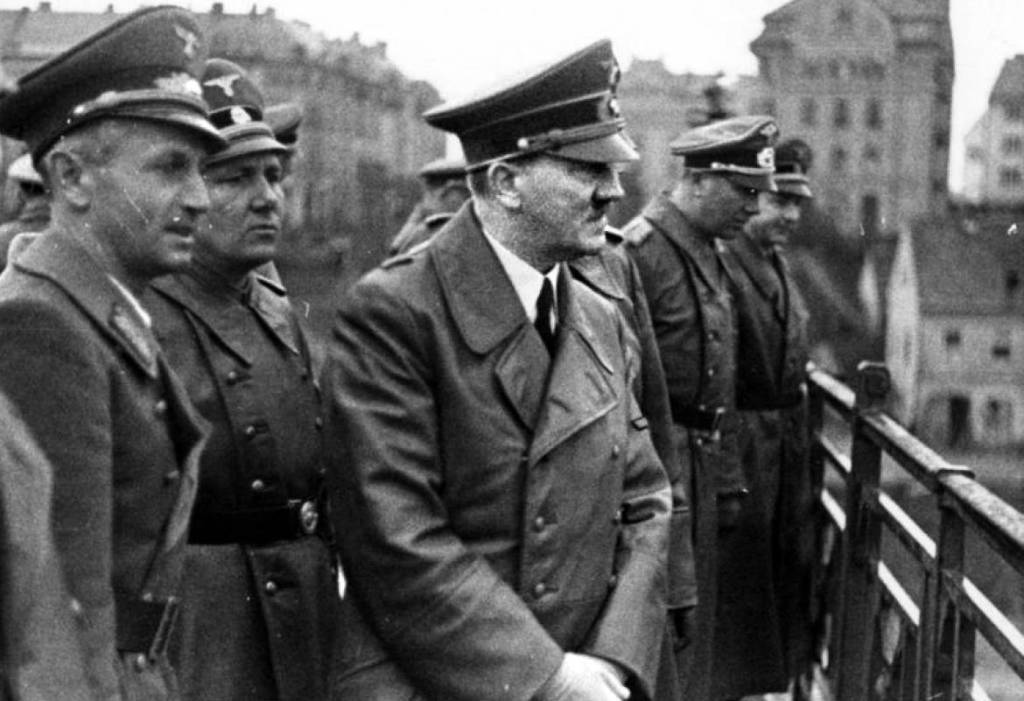
Adolf Hitler has been camped in his command train “Amerika” in Austria throughout Operation Marita. Today, he takes his train from a little station near Graz (Monichkirchen) into Yugoslavia. He disembarks and proceeds by motorcar to Maribor (in German, Marburg). Here, he states:
“Make this land German again for me.”
After a rapturous reception there (this is a pro-German province), Hitler gets back on his train and heads back to Graz for another happy welcome. Among other things, Hitler visits with his old history teacher, Professor Leopold Poetsch, who Hitler claims in “Mein Kampf” inspired his love of history.
Rommel’s forces crossed the Egyptian border today, with three motorized columns of Italian troops breaking through to the thinly defended “Hellfire Pass” at Halfaya. German troops attack British and Australian positions at Halfaya Pass on the Libyan-Egyptian border. Allied troops held the pass all day, but after dark they withdrew to Buq Buq, Egypt.
300 miles to the west, the garrison at Tobruk has withstood two more assaults by Rommel’s tanks and taken over 2,000 prisoners. Lieutenant General Erwin Rommel retains a shaky grasp on Tobruk, where the Australians continue to hold out in large numbers. Rommel attempts to solidify his control over the vital port by sending three motorized columns of German and Italian troops from Group Herff from south of Sollum through Halfaya Pass on the border with Egypt. The Axis troops cross the border into Egypt after the British withdraw during the night, but don’t advance much further at this time. Holding the pass enables Rommel to focus more on tightening his grip on Tobruk.
At Tobruk itself, the Australians stand firm, repelling German and Italian assaults and taking numerous prisoners. The Australians make some moves to widen their perimeter with tank and infantry advances, but the German artillery and panzers stop them cold. The German defense is aided by a sandstorm which “blew all day.”
Prime Minister Winston Churchill sends a sharp cable to Commander of the British Mediterranean Fleet Admiral Andrew Cunningham. Churchill remarks to Cunningham that “you do not appreciate” British grand strategy in the Mediterranean (which is an odd thing to say to the man most responsible for implementing that strategy). Churchill further states that some of Cunningham’s previous comments about strategy are “really not justified.” There is a lecturing, churlish tone throughout the message which perhaps reflects the great difficulty the British forces in Greece are facing — an operation that was virtually solely Churchill’s responsibility and which he ordered for political reasons against almost unanimous opposition in the military.
British freighters Clan Chattan, Clan Campbell, Clan Lamont, Empire Song, and New Zealand Star, carrying 295 tanks for Egypt, departed from the Clyde in Scotland, United Kingdom in Operation Tiger. They were escorted by battleship HMS Rodney, cruiser HMS Naiad, destroyer HMS Havelock, destroyer HMS Hesperus, and destroyer Harvester.
South African 1st Brigade captured Dessie, Abyssinia, in northern Ethiopia, taking 4,000 Italians who spend the rest of the war as POWs. Dessie, 130 miles south of Amba Alagi, is a key blocking position for the Italian holdouts in the mountains. The Indian 29th Infantry Brigade, meanwhile, reaches Amba Alagi today from the north.
Visiting Australian Prime Minister Robert Menzies lunches with former British Prime Minister Lloyd George at the latter’s farm at Churt, Surrey. They agree that the government has numerous command deficiencies, such as that Churchill is “acting as the master strategist, without qualification” and that CIGS General John Dill is “timid as a hare.” Basically, they take a dim view of Churchill and his appointments and policies.
One must observe that Menzies blows hot and cold on Churchill, and seems to blow the coldest when furthest away from him. About Hitler, however, Lloyd George is very complimentary, and (according to Menzies’ diary) believes that “the Germans in their hearts like us much more than the French ever did.” Naturally, this is the sort of attitude at this time that only an elder statesman could get away with, regardless of any merit it may hold.
General Lord Gort was appointed Governor and Commander-in-Chief of Gibraltar.
Severe rationing was imposed for potatoes in The Netherlands.
Turkish President İsmet İnönü left Ankara at 10 o’clock tonight for Thrace on a special train. The object of his journey was not revealed, but no secret was made of his departure and large crowds were present. It is assumed for the moment that the object of this trip is to inspect the army in Thrace in its new positions.
General Georgy Zhukov, the recently appointed Soviet Chief of Staff, ordered a creeping mobilization to begin, in response to widespread evidence that German forces were moving eastward.
The Luftwaffe (KG 55) attacks Bristol and Liverpool (92 aircraft).
RAF Bomber Command: Day of 26 April 1941
25 Blenheims on sea sweeps off Germany and Norway. 1 ship was damaged but 3 aircraft were lost while attacking convoys.
RAF Bomber Command: Night of 26/27 April 1941
Hamburg
28 Hampdens and 22 Wellingtons. 1 Hampden lost. Cloud and heavy defences made bombing difficult 44 aircraft claimed to have bombed but Hamburg records indicate approximately 16 bomb loads only in the city with no fires caused, 6 people killed, 12 injured and 121 bombed out.
4 Wellingtons attacked Emden without loss.
Luftwaffe pilot Wolfgang Falck, Kommodore of Nachtjagdgeschwader 1, attends a briefing in Hamburg (ironically bombed during the night). He learns about new airborne radar systems being developed, including the Morgenstern, Flensburg, and SN-2 (Lichtenstein) systems. The Nachtjagdfliegerdienst coincidentally scores its 100th night victory.
Light cruisers HMS Galatea and HMS Arethusa departed the Iceland Faroes patrol when relieved by heavy cruiser HMS Exeter and light cruiser HMS Nigeria.
Heavy cruiser HMS Suffolk departed Scapa Flow with destroyers HMS Echo and HMS Active at 1630 to relieve heavy cruiser HMS Norfolk on Denmark Strait patrol. The ships arrived at Hvalfjord at 0700/28th. Heavy cruiser Norfolk arrived at Scapa Flow on the 30th.
Armed merchant cruisers HMS California, HMS Alaunia, and HMS Derbyshire arrived at Greenock on the 26th.
Destroyer HMS Antelope departed Portsmouth at 2130 to join the Home Fleet, arriving at Scapa Flow at 1300/27th.
Destroyers HMS Intrepid and HMS Impulsive departed the Humber to join the Home Fleet replacing destroyers HMS Cossack and HMS Zulu, being transferred to the Plymouth Command.
Anti-aircraft ship HMS Alynbank departed Methil at 1700 and provided cover for convoy EC.11 from May Island to Pentland Firth. The ship returned to Scapa Flow after the duty.
Leading Airman A. C. Holley of 14 EFTS Elmdon was killed when his Tiger Moth crashed in practice forced landing at Knowle FLG, Bristol.
Finnish steamer Lapponia (1172grt) was damaged by mining off Aalborg. The steamer sank, but was later raised and repaired at Aalborg.
Submarine HMS Upholder destroyed German cargo ship Arta, which had been grounded on Kerkenah Bank since being badly damaged in a torpedo attack by Captain Mack’s destroyers on the 16th.
Light cruiser HMS Ajax departed Alexandria to join Vice Admiral, Light Forces.
Corvettes HMS Hyacinth and HMS Saliva and minesweeping trawler HMS Muroto were withdrawn from Piraeus. En route to Suda Bay, they swept the approaches to Nauplia.
British steamer Scottish Prince (4917grt) was damaged by German bombing in 36-07N, 24-30E. The steamer was assisted by Australian destroyer HMAS Vampire and sloop HMS Grimsby. The steamer arrived at Alexandria on 12 May, badly damaged on her starboard side.
Operation DEMON continued during the night of 26/27 April. Raphina and Raphtis: commando ship Glengyle, steamer Salween, anti-aircraft cruiser HMS Carlisle, and destroyers HMS Nubian, HMS Decoy, and HMS Hasty. A lighter A.6 ferried troops from the beaches to the ships. Nauplia and Tolon: commando ship Glenearn, troopships Slamat and Khedive Ismael, anti-aircraft cruiser HMS Calcutta, and destroyers HMS Isis, HMS Hotspur, HMS Griffin, HMS Diamond, and HMS Havock. Commando ship Glenearn was bombed en route. She was towed to Kissamo Bay by destroyer Griffin. Ship Glenearn was towed from Kissamo Bay by sloop Grimsby and later netlayer HMS Protector to Alexandria arriving on 1 May. To compensate for the loss of the Glenearn, light cruisers HMS Orion and HMAS Perth and destroyer HMAS Stuart were sent at 1700 from Suda Bay to carry for the commando ship. Light cruiser Perth and destroyer Stuart proceeded to Tolon. Light cruiser Orion proceeded to Nauplia. At Nauplia, light cruiser Orion embarked 300 troops lifted off the beach at Tolon by destroyer Stuart. Midshipman D. F. Swithinbank was unable to return to cruiser Orion before sailing. He was later able to escape and rejoin British forces. Midshipman (E) J. O. Wigg was wounded and one rating was killed and five ratings were missing. Troopship Slamat was late in getting away from Nauplia in the morning and delayed the convoy’s sailing.
Troopship Slamat was hit by bombs and wrecked in 37-01N, 23-10E. Destroyer HMS Diamond was left behind to rescue survivors. Destroyers HMS Wryneck, HMAS Vendetta, and HMAS Waterhen were sent out to assist the Nauplia group at this time. Destroyer Wryneck, sent to assist destroyer Diamond, arrived just as troopship Slamat capsized.
Both destroyers HMS Diamond (Lt Cdr P. A. Cartwright) and HMS Wryneck (Lt Cdr R. H. D. Lane Rtd) were sunk by German bombing later in the day. Destroyer HMS Griffin picked up twenty seven survivors on the 27th. Warrant Engineer Waldron, which was wounded, and twenty two other survivors reached Suda Bay in a Wryneck whaler on the 29th. There were no more survivors from the three ships. Waldron and forty one ratings from destroyer Wryneck and eight soldiers survived the loss of the three ships. There were only five survivors from steamer Slamat. Two hundred and sixty three officers and men were lost in the two destroyers. The entire crew, Cartwright, Lt O. Carr, Lt J. W. Marshall,Sub Lt M. W. Disney-Roebuck, T/Lt (E) H. C. E. St. Clair-Miller,A/Gunner (T) J. Shanks,T/Sub Lt C. A. Wood RNVR, P/T/Surgeon Lt J. M. Watson, MRCS, LRCP, and one hundred and forty one ratings, were lost on destroyer Diamond. Lane, Lt R. L. Davies, Midshipman P. B. Peck, P/T/Surgeon Lt G. T. R. Watt, MB, ChB RNVR, sub Lt K. H. Jackson, T/Lt R. O. Griffiths RNVR, Gunner J. W. McCracken, and one hundred and seven ratings were lost on destroyer Wryneck. Destroyers HMAS Vendetta and HMAS Waterhen relieved destroyers HMS Isis and HMS Hotspur which were escorting troopship Khedive Ismael. Destroyers Isis and Hotspur then ran on to Suda Bay.
Destroyer HMS Havock carried the Army HQ and also the Flag Officer Attached Middle East at Nauplia and took them to Monemvasia. The destroyer was then to escort merchant ship Santa Barbara from Monemvasia. However, the steamer was sunk by bombing before the destroyer arrived. From Kalamata sailed troopships City of London, Costa Rica, and Dilwara, light cruiser HMS Phoebe, destroyers HMS Hero, HMS Hereward, and HMS Defender, and sloop HMS Flamingo. Destroyer HMS Defender embarked the Yugoslav crown jewels for transport to Alexandria. Cruiser Phoebe and destroyers Hero and Hereward returned empty. Light cruisers HMS Orion and HMAS Perth and destroyer HMAS Stuart arrived at Suda at 1100 with 2000 men. 4300 men were evacuated from Nauplia. 8300 men were evacuated from Raphtis and Raphina. 8650 men were evacuated from Kalamata.
Gunboat HMS Ladybird bombarded Gazala airdrome.
Gunboat HMS Aphis bombarded an enemy column in the Halfaya Pass.
Greek torpedo boat RHS Kydonia was sunk by German bombing at Morea.
Greek steamer Maiotis (1712grt) was sunk by German bombing in the Aegean. The steamer was later salved and taken to Trieste.
Greek steamer Maria Stathatou (6303grt) was sunk by German bombing at Mylos.
Greek steamer Zakynthos (960grt) was sunk by German bombing off Monemvasia.
British troopship Empire Trooper departed Gibraltar, escorted by corvette HMS Primula, for Freetown.
Submarine HMS Taku departed Gibraltar for patrol in the Tyrrhenian Sea.
Submarine HMS Union departed Gibraltar for Malta, arriving on 4 May.
Convoy WS.8 A of steamers Highland Chieftain (14,135grt), Empress of Asia (16,909grt), Dominion Monarch (27,155grt), Reina Del Pacifico (17,702grt), Empress of Russia (16,810grt), Strathaird (22,281grt), Sobieski (11,030grt), New Zealand Star (10,740grt), Clan Campbell (7255grt), Clan Lamont (7250grt), Clan Chattan (7262grt), Abeekerk (7889grt), Aronda (4062grt), Empire Song (9228grt), and armed merchant cruiser HMS Pretoria Castle departed the Clyde. Steamers Clan Chattan, Clan Campbell, Clan Lamont, Empire Song, and New Zealand Star were detached to Gibraltar on 2 May as the TIGER convoy for the Mediterranean. Light cruiser HMS Naiad and destroyers HMS Havelock, HMS Hesperus, and HMS Harvester were in the convoy escort for the voyage to Gibraltar. Destroyers HMS Beagle and HMS Eridge escorted the convoy from 26 April to 30 April when they joined convoy SL.71. Destroyers HMCS Ottawa, HMCS Restigouche, HMCS Saguenay, ORP Legion, ORP Piorun, and HMS Hurricane escorted the convoy from 26 to 29 April. Battleship HMS Rodney departed Scapa Flow on the 26th to escort the convoy. The battleship was relieved by battlecruiser HMS Repulse from Gibraltar. Battlecruiser Repulse arrived at Gibraltar with the three H.class destroyers on 5 May. Light cruiser Naiad was detached from the convoy and arrived at Gibraltar on 4 May. On 2 May, light cruiser HMS Mauritius joined the convoy. On 5 May, destroyers HMS Duncan and HMS Wishart joined the convoy and on 6 May, destroyers HMS Highlander and HMS Boreas joined the convoy. On 9 May, the convoy arrived at Freetown with armed merchant cruiser Pretoria Castle, light cruiser Mauritius, and the four destroyers. The convoy departed Freetown on 14 May. The convoy was joined by liner Imperial Star (10,733grt) which had proceeded independently to Freetown from the UK. Liner Highland Chieftain did not depart with the convoy. She sailed on 15 May escorted by armed merchant cruiser HMS Cilicia to overtake the convoy. The convoy from Freetown was escorted by destroyers Highlander, Wishart, Duncan, and Boreas from 14 to 16 May. Light cruiser Mauritius was with the convoy until relieved by heavy cruiser HMS Hawkins on 24 May. Armed merchant cruiser Pretoria Castle was with the convoy from 24 to 27 May when the convoy arrived at Durban. Troopship Strathaird was detached to Capetown arriving on 24 May and then proceeded to rejoin the Durban section the next day. Troopships Imperial Star, Strathaird, and Empress of Asia arrived at Capetown on 24 May. Heavy cruiser Hawkins and steamers Empress of Russia, Aronda, Sobieski, Dominion Monarch, Strathaird, Reina Del Pacifico, and Abbekerk arrived at Durban on 27 May. Steamers Sobieski, Aronda, Strathaird, Empress of Russia, and Abbekerk departed Durban on 31 May escorted by heavy cruiser Hawkins. The steamers arrived at Aden on 10 June and ships proceeded independently to Suez.
Convoy OG.60 departed Liverpool escorted by destroyers HMS Rockingham, HMS Vanquisher, and HMS Viscount, sloops HMS Deptford and HMS Londonderry, corvettes HMS Fresia, HMS Hibiscus, HMS Pimpernel, and HMS Rhododendron, and anti-submarine yacht HMS Philante. Corvette Rhododendron was detached that day. The remainder of the escorts, less sloop Deptford, were detached on the 30th. The convoy was joined en route by Dutch submarine O23. Convoy OG.60 arrived at Gibraltar on 10 May escorted by sloop Deptford and submarine O23. British steamer Mountpark (4648grt) was sunk by German bombing in 56-17N, 12-21W. Six crewmen were lost on the steamer.
Informed quarters said tonight the White House had made cautious inquiries as to what would be the senate’s attitude toward legislation authorizing convoys to beleaguered Britain. As a result, it was said, an informal canvass was made which indicated that 45 senators, three less than a majority of the present membership of 95, were given at this time to oppose such legislation. Included in this tentative list, one legislator said, were 25 of the senate’s 28 Republicans. Most of these have been recorded as likely supporters of a resolution by Senator Tobey, New Hampshire Republican, to put congress on record against use of the navy to guard the transportation of war materials across the Atlantic.
The U.S. Neutrality Patrol now extends to the latitude line near Rio de Janeiro, Brazil. This frees up British escorts, who have had to move further and further west as U-boats and Kriegsmarine surface raiders extend their operations in that direction.
The U.S. Navy inaugurated carrier task group patrols when the aircraft carrier USS Wasp (CV-7) (embarked squadrons: VF 72, VS 71, and VS 72) and departed Hampton Roads accompanied by the heavy cruiser USS Quincy (CA-39) and destroyers USS Livermore (DD-429) and USS Kearny (DD-432). U.S. Navy Task Group 2, as the force was designated, would steam 5,292 miles before it arrived at Bermuda on May 12. This is the first use of the aircraft carriers on this patrol.
The defense mediation board removed the threat of an immediate strike in 61 General Motors’ plants Saturday night but apparently made scant progress toward ending the tie-up of the bituminous coal mines. Two strikes in California, however, were settled with wage concessions, a 21-day walkout of A.F.L. machinists affecting 148 shops with an estimated $27,500,000 in defense orders, and a 10-day C.I.O. strike at the San Leandro plant of the Caterpillar Tractor Co. A board panel conferred with representatives of the coal miners and operators until 1:35 a.m. today and then adjourned until 1 p.m. No comment was available from any of the conferees. The General Motors strike was averted after the board requested that production be kept going during negotiations.
The White House announced President Roosevelt had cancelled plans for a trip to Warm Springs, Georgia, because of the shutdown in soft coal mining. President Roosevelt abandoned today his plan for a vacation at Warm Springs, Georgia, due to the pressure of public business, and left for a weekend cruise on the Potomac River with a small party of friends on the Presidential yacht Potomac. Accompanying Mr. Roosevelt on the yacht are the Postmaster General and Mrs. Frank C. Walker; Rear Admiral Ross T. McIntire, Surgeon General of the Navy, and Mrs. McIntire, Harry L. Hopkins and Miss Marguerite A. Le Hand, personal secretary to the President. They plan to return to the Capitol tomorrow evening. Mr. Early said that among the President’s approaching engagements were his trip to Staunton, Virginia, next Sunday to participate in the dedication of the restored birthplace of Woodrow Wilson.
Tax experts figured today that the tax collector will take $1 out of every $4 of the national income in the coming fiscal year. National income is expected to climb to a record $90,000,000,000 in the 12 months beginning next July 1. But the taxes also are slated to reach the unprecedented figure of $22,000,000,000 counting federal, state and local levies. This means that taxes will consume about 25 percent of all the money paid out to Americans during the period for wages, dividends, royalties, rents, interest and individual business profits.
The big shipbuilding program which is under way will require about 310,000 additional workers, Secretary of Labor Perkins said today. In February, she reported, about 250,000 were employed in commercial and navy yards.
Broadening of the Selective Service Act to include provisional induction into the Army of men with remediable phyical defects and their immediate transfer to hospital care for curative therapy followed by a period of convalescence and induction for full military service was suggested yesterday by Colonel Samuel J. Kopetzky, chief of the medical division of the New York City Selective Service, in a report to Colonel Arthur V. McDermott.
Major League Baseball:
The Red Sox got off to a bad start today but settled down behind the gilt-edge relief pitching of Bill Fleming to overcome a seven-run deficit and score an 8–7 victory over the Athletics. Fleming, who came to the rescue after Woody Rich had yielded seven runs in the first three innings, checked Philadelphia with only one hit the rest of the way. The big gun in the Athletics’ drive was Bob Johnson’s homer with two on base in the five-run third inning.
The Brooklyn Dodgers took their fifth straight, defeating the Boston Bees, 7–0. Behind the three-hit pitching of lean Curt Davis, the Flatbush idols pasted three hurlers for eleven hits for their fifth shut-out victory of the season, their fourth over the Bees. Whit Wyatt hurled two of the whitewashings, one over the Bees and one against the Phillies, while Luke Hamlin and Kirby Higbe pitched the other two. Brooklyn pitchers have allowed only one run in the last thirty-seven innings.
The Chicago Cubs are the first team to install an organ within a ballpark. With Roy Nelson at the keyboard, the Cubs hit sour notes, losing 6–2 to the St. Louis Cardinals’ Max Lanier, who spun a two-hitter. Nelson has to stop playing at 2:30 when the radio pregame shows begin. Rules at the time forbade songs from the ASCAP song publishing service from being played over the radio — even in the background — without compensation.
Johnny Vander Meer took another long step on the comeback trail today by holding the Pirates hitless for six innings while the Reds banged away for a 10–3 victory, their first at home this season. The southpaw, who spent a pair of bad years after hanging up two successive no-hitters in 1938, had the Pirates befuddled until Jeep Handley beat out an infield hit in the seventh. Then Vander Meer let up and coasted in, giving the Pirates four singles and all their runs in the eighth and letting Frankie Gustine blast a triple in the ninth.
Big Buck Newsom lost only five games all last year while capturing twenty-one, but the Indians sent the Detroit ace to the showers today in his third consecutive setback. The 6–3 triumph, the second in a row for comeback-bound Mel Harder, who needed Clint Brown’s able relief help for the last two innings, and it gave the Indians three victories in their four starts against the Tigers.
Collecting ten hits, the Yankees downed the Senators, 8–3, for their fourth straight victory. In stretching their longest winning streak of the young campaign the Yankees wasted little time or ceremony. They rushed over four runs on Sid Hudson in the first round. In the seventh inning Hudson’s two errors paved the way for four more runs.
The Phils beat the Giants, 7–6, in an eleven-inning game. With the bases full, two out and Cliff Melton, fifth New York pitcher, opposing John Podgajny, also a relief hurler, the Giants’ towering lefthander ran the count to three balls and two strikes. Then with 2,265 frigid Philadelphia fans letting out one jubilant bellow, Melton tossed one more ball, forcing in the winning run.
Edgar Smith, portly southpaw pitcher of the White Sox, makes a habit of beating the Browns, and he did it again today, 2–1, doling out only three hits. A walk and Walter Judnich’s double scored the Browns’ lone run in the fourth inning. George Caster, who offered stalwart opposition to Smith, yielded a run in the second on a walk and Mike Kreevich’s triple. Billy Knickerbocker doubled in the next inning, stopped at third on Luke Appling’s single and scored the winning run while the Browns were working a double play on Joe Kuhel’s grounder.
Philadelphia Athletics 7, Boston Red Sox 8
Boston Bees 0, Brooklyn Dodgers 7
St. Louis Cardinals 6, Chicago Cubs 2
Pittsburgh Pirates 3, Cincinnati Reds 10
Detroit Tigers 3, Cleveland Indians 6
Washington Senators 3, New York Yankees 8
New York Giants 6, Philadelphia Phillies 7
Chicago White Sox 2, St. Louis Browns 1
The way was paved today for the twenty-one American republics through a unified policy to take over more than 160 idle foreign ships in ports of the Western Hemisphere when the Inter-American Economic Advisory Committee adopted unanimously a resolution recognizing the right of each of them to take over the vessels.
The Japanese occupation of the coastal ports of Ningpo, Taichow, Wenchow and Foochow is a move inspired more by considerations connected with Japanese plans for southward aggression than by the desire to increase the effectiveness of the blockade of China, the military spokesman said in a recent review of the military situation.
A dozen United States marines and an equal number of Italian marines staged a brief but hectic free-for-all fist fight early today in the Majestic Ballroom, a Shanghai dance hall.
Committing himself unequivocally to the cause of the German-Italian-Japanese alliance, Foreign Minister Yosuke Matsuoka at a mass meeting in Hibiya Hall this afternoon told the Japanese people that Germany and Italy were working in perfect cooperation to create a better world and indictated his confidence in and their success.
American, British, and Dutch military officials continued to meet in Singapore to develop a strategic plan for combined operations against Japan in the event the Japanese attacked the United States.
General Douglas MacArthur, from his command post in the Philippines, issues a plan for the seizure of New Britain, New Guinea, and New Ireland upon the outbreak of war. The objective would be to envelop the military base of Rabaul, currently in Australian hands but assumed to be in Japanese possession shortly after the outbreak of war.
[Ed: This is complete fantasy. In reality, MacArthur does not have the resources to even hold the Philippines.]
Dow Jones Industrial Average: 116.43 (-0.15)
Born:
Gary Cuozzo, NFL quarterback (NFL Champions-Vikings, 1969 [lost Super Bowl IV]; Baltimore Colts, New Orleans Saints, Minnesota Vikings, St. Louis Cardinals), in Montclair, New Jersey.
Bruce MacGregor, Canadian NHL and WHA centre and right wing (Detroit Red Wings, New York Rangers; WHA: Edmonton Oilers), in Edmonton, Alberta, Canada.
John Mitchell, American classical composer, organist, church music director, and opera coach, in Hollywood, California.
Naval Construction:
The Royal Navy Roberts-class monitor HMS Abercrombie (F 109) is laid down by Vickers Armstrong (Newcastle-on-Tyne, U.K.); completed by Parsons.
The Kriegsmarine (German Navy) Type VIIC U-boat U-381 is laid down by Howaldtswerke AG, Kiel (werk 12).
The Kriegsmarine (German Navy) Type IXC U-boat U-513 is laid down by Deutsche Werft AG, Hamburg (werk 309).
The Royal Canadian Navy Flower-class corvette HMCS Halifax (K 237) is laid down by the Collingwood Shipyards Ltd. (Collingwood, Ontario, Canada).
The Royal Navy “P”-class (Second Group) minesweeping trawler HMS Prodigal (T 187) is launched by Uniao Fabril (Lisbon, Portugal).
The Royal Canadian Navy Bangor-class (Diesel-engined) minesweeper HMCS Transcona (J 271) is launched byMarine Industries Ltd. (Sorel, Quebec, Canada) .
The Kriegsmarine (German Navy) Type VIIC U-boat U-753 is launched by Kriegsmarinewerft (KMW), Wilhelmshaven (werk 136).
The Kriegsmarine (German Navy) O 21-class U-boat UD-5 (originally the Dutch HNLMS O-27, captured during the 1940 invasion) is launched by Wilton-Feijenoord (Schiedam, Holland).
The Royal Navy MMS I-class motor minesweeper HMS MMS 39 (J 539) is commissioned.
The Royal Navy Isles-class minesweeping trawler HMS Copinsay (T 147) is commissioned. Her first commander is Skipper Edward Robert Harris, RNR.
The Kriegsmarine (German Navy) Type VIIC U-boat U-81 is commissioned. Her first commanding officer is Oberleutnant zur See Friedrich Guggenberger.
The Kriegsmarine (German Navy) Type VIIC U-boat U-432 is commissioned. Her first commanding officer is Oberleutnant zur See Heinz-Otto Schultze.
The Royal Canadian Navy Flower-class corvette HMCS Nanaimo (K 101) is commissioned. Her first commanding officer is A/Lieutenant H. C. C. Daubney, RCNR.
The Royal Canadian Navy Flower-class corvette HMCS Rimouski (K 121) is commissioned. Her first commanding officer is T/Lieutenant John Willard Bonner, RCNR.
The Royal Navy Black Swan-class sloop HMS Erne (U 03) is commissioned. Her first commanding officer is Lieutenant Commander Henry Maxwell Darell-Brown, RN.

