Черно́быль (Chernobyl)
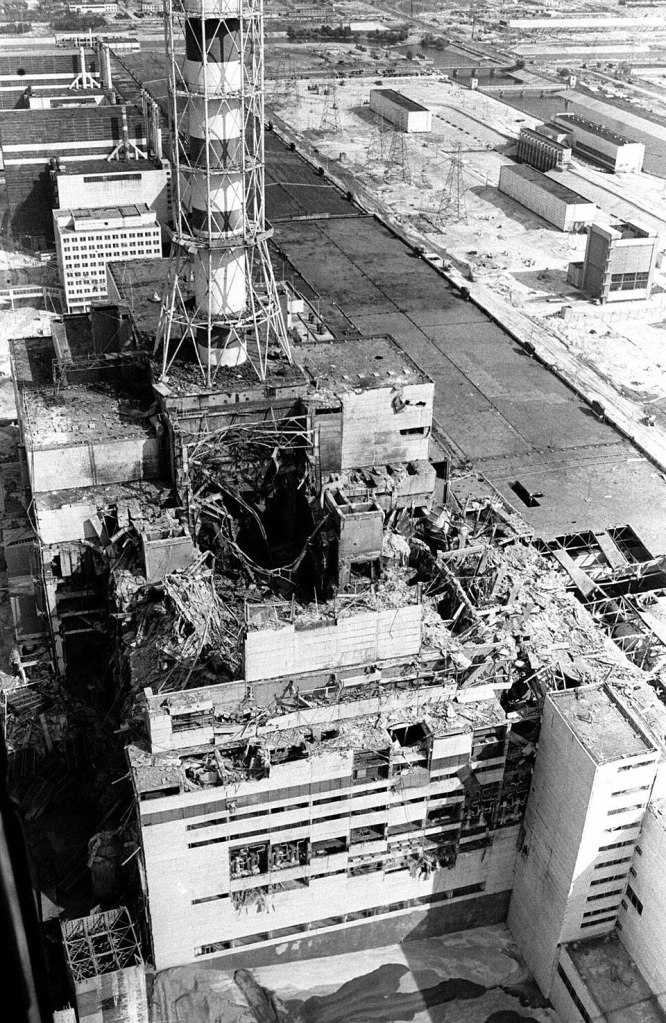
The world’s worst nuclear disaster occurred when Reactor 4 at the Chernobyl Nuclear Power Plant in the Soviet Union exploded. The explosion occurred during a safety test, releasing massive amounts of radiation. While initially concealed by Soviet officials, the catastrophe immediately killed dozens, caused widespread contamination, and signaled a major shift in global nuclear policy. A routine, 20-second shutdown test led to a power surge and chemical explosion at 1:23 AM. Two workers died instantly, and 28 firefighters/workers died from acute radiation sickness within weeks. Soviet authorities initially did not admit to the disaster, only responding after Swedish authorities detected high radiation levels.
Reactor no.4 of the Chernobyl Nuclear Power Plant, located near Pripyat, Ukrainian SSR, Soviet Union (later Ukraine), exploded. With dozens of direct casualties and thousands of health complications stemming from the disaster, it is one of only two nuclear energy accidents rated at the maximum severity on the International Nuclear Event Scale, the other being the 2011 Fukushima nuclear accident. The response involved more than 500,000 personnel and cost an estimated 18 billion rubles (about $84.5 billion USD in 2025). It remains the worst nuclear disaster and the most expensive disaster in history, with an estimated cost of $700 billion USD.
The disaster occurred while running a test to simulate cooling the reactor during an accident in blackout conditions. The operators carried out the test despite an accidental drop in reactor power, and due to a design issue attempting to shut down the reactor in those conditions resulted in a dramatic power surge. The reactor components ruptured and lost coolant, and the resulting steam explosions and meltdown destroyed the reactor building. This was followed by a reactor core fire that spread radioactive contaminants across the Soviet Union and Europe. A 10 km exclusion zone was established 36 hours after the accident, initially evacuating around 49,000 people. This was later expanded to 30 km, resulting in the evacuation of approximately 68,000 more people.
Following the explosion, which killed two engineers and severely burned two others, an emergency operation began to put out the fires and stabilize the reactor. Of the 237 workers hospitalized, 134 showed symptoms of acute radiation syndrome (ARS); 28 of them died within three months. Over the next decade, 14 more workers (nine of whom had ARS) died of various causes mostly unrelated to radiation exposure. It is the only instance in commercial nuclear power history where radiation-related fatalities occurred. As of 2005, 6000 cases of childhood thyroid cancer occurred within the affected populations (15 of them fatal), “a large fraction” being attributed to the disaster. The United Nations Scientific Committee on the Effects of Atomic Radiation estimates fewer than 100 deaths have resulted from the fallout. Predictions of the eventual total death toll vary; a 2006 World Health Organization study projected 9,000 cancer-related fatalities in Ukraine, Belarus, and Russia.
The nearby city of Pripyat was not immediately evacuated and the townspeople were not alerted during the night to what had just happened. However, within a few hours, dozens of people fell ill. Later, they reported severe headaches and metallic tastes in their mouths, along with uncontrollable fits of coughing and vomiting. As the plant was run by authorities in Moscow, the government of Ukraine did not receive prompt information on the accident.
A commission was established later in the day to investigate the accident. It was headed by Valery Legasov, First Deputy Director of the Kurchatov Institute of Atomic Energy, and included leading nuclear specialist Evgeny Velikhov, hydro-meteorologist Yuri Izrael, radiologist Leonid Ilyin, and others. They flew to Boryspil International Airport and arrived at the power plant in the evening of 26 April. By that time two people had already died and 52 were hospitalized. The delegation soon had ample evidence that the reactor was destroyed and that extremely high levels of radiation had caused a number of cases of radiation exposure. In the early daylight hours of 27 April, they ordered the evacuation of Pripyat.
Pripyat was abandoned and replaced by the purpose-built city of Slavutych. The Chernobyl Nuclear Power Plant sarcophagus, completed in December 1986, reduced the spread of radioactive contamination and provided radiological protection for the crews of the undamaged reactors. In 2016–2018, the Chernobyl New Safe Confinement was constructed around the old sarcophagus to enable the removal of the reactor debris, with clean-up scheduled for completion by 2065.
As he began a 13-day trip to Asia, President Reagan declared today that the world’s “dictators and terrorists” had to be prepared for the consequences if they perpetrated “cowardly acts” against Americans. The warning was made in remarks to members of the United States Pacific Command at Hickam Air Force Base here after Mr. Reagan arrived from Los Angeles. Before he left California, he indicated in his weekly radio address that his Administration was determined to remain involved in economic and security matters in the Pacific. Denouncing the continued Vietnamese occupation of Cambodia, Mr. Reagan said Vietnam’s refusal to withdraw damaged its own interests.
Senior Reagan Administration officials say that since the American bombing of Libya on April 15, no consensus has developed within the Government on how far to go in repeating such attacks to counter an expected rise in anti-American terrorism around the world. Since the raid, President Reagan has warned that the United States is ready to use its military power to retaliate again if there are new attacks. But in interviews in recent days, White House and State Department officials expressed concern that the public support that developed for the bombing of Libya would not necessarily be repeated if Washington became engaged in a regular pattern of tit-for-tat retaliatory raids. Such raids might be mounted not only against Libya but also against such nations as Syria and Iran, which are believed by the Administration to support terrorist groups. “Libya was a relatively easy target, and we lost one F-111,” a State Department official said. “Syria and Iran are more dangerous. We probably won’t get away with such minimal losses. I wonder how long the polls will show a high approval rating in this country if the losses begin to mount without any evidence of ending terrorism.”
The government of Colonel Muammar el-Qaddafi is enmeshed in a bout of unusual self-criticism over the poor military fight it put up against the American air raid. Colonel Qaddafi, said by Eastern bloc sources here to be upset by his forces’ performance, has asked for a quick critique of what went wrong by a team of Yugoslav and Czechoslovak military advisers. A column in Jamahiriya, an official weekly newspaper, said on Friday: “It is high time that Libya put its house in order. We have to examine ourselves to see how we behaved hour by hour during the crisis, to see who was confused, who panicked, who made mistakes, who ran and who stood firm.” Western diplomats and Eastern military sources said there had already been unconfirmed reports of a shakeup inside the military because of the poor showing. Those reports, added to the study asked by Colonel Qaddafi and the newspaper column, may herald a purge of some commanders, the diplomats said. The significance of the criticism and a possible purge goes beyond military matters. Its larger impact may be political, several sources said.
Italy ordered Libya today to cut its diplomatic staff in Rome by 10 and severely restricted the movement of those Libyan diplomats who remain. The move was announced by the Italian Foreign Ministry, which also said Italy would deny entry to any Libyans expelled by other countries of the European Community on suspicion of involvement in terrorism. Italy’s action was aimed at bringing itself into compliance with a series of sanctions against Libya approved Monday by the community’s foreign ministers.
The Conference on Disarmament, which ended its spring session here this week, has made modest progress toward a treaty that would ban the production, storage and use of chemical weapons, Western diplomats say. The diplomats said the 40-nation conference had moved toward a middle ground on two of the issues dividing Washington and Moscow: the commercial chemicals to be covered under the ban, and verification of the destruction or dismantling of weapons plants. Nevertheless, Washington and Moscow, the main producers of chemical weapons, remain far apart on the crucial question of the Reagan Administration’s proposal for “on challenge” inspections to verify compliance.
Soviet President Andrei A. Gromyko, reported to be hospitalized with a high fever, is back at work, according to the Soviet news media. Reports of his ill health were fueled when he failed to attend last week’s Kremlin ceremony commemorating the 116th anniversary of the birth of Soviet founder V.I. Lenin. Reports in the party newspaper Pravda, and from the official news agency Tass, said Gromyko, 76, attended Friday’s meeting of the Presidium of the Supreme Soviet. Gromyko, who served as foreign minister for 28 years before becoming Soviet president last July, is believed to have coronary problems.
British troops shot and killed a leading Irish Republican Army gunman in Northern Ireland as he and an accomplice prepared to launch an attack on security forces, officials said in Belfast. Sinn Fein, the legal political wing of the outlawed IRA, identified the dead man as Seamus McElwaine, 25, a convicted double murderer. He was serving a life sentence when he broke out of Maze Prison near Belfast along with 37 others in September, 1983. McElwaine’s companion, who sources identified as Kevin Lynch, was in serious condition with gunshot wounds.
Chancellor Helmut Kohl of West Germany today strongly defended Kurt Waldheim, the former United Nations chief, and called critics of Mr. Waldheim’s wartime role arrogant. Mr. Kohl told the Austrian state radio that he had been shocked by accusations against Mr. Waldheim, his “old personal friend,” who is running for the Austrian presidency in the May 4 election. Mr. Kohl said he was speaking personally and stressed that he did not wish to interfere in the election campaign in the neighboring country. But he made his comments while attending a meeting in Salzburg with Mr. Waldheim and leaders of the Austrian People’s Party, which is backing Mr. Waldheim, and which has close relations with Mr. Kohl’s Christian Democratic Union.
Norwegian naval vessels and aircraft combed the inner reaches of the Hardanger Fjord in search of a foreign submarine that was spotted during daylight from a low-flying plane. A Defense Ministry spokesman said the military had neither seen nor heard the unidentified submarine since Friday when it was spotted near Varaldsoy, an island 20 miles inside the fjord.
The Iranian Navy said today that it had briefly stopped an American merchant vessel in the Persian Gulf in the second such incident since Iran began to check ships for cargo bound for its war enemy, Iraq. In Washington, the Defense Department and the State Department had no comment on the report. Commander Mohammad Hossein Malekzadegan of the Iranian Navy told the newspaper Ettelaat that the American ship, the Ingenious, was stopped Friday, as was a New Zealand ship. “Since they were carrying no goods for Iraq, they were permitted to continue their journey,” he said. The only previous reported case of an American ship being stopped was the cargo vessel President Tyler on January 12. The United States Government expressed “deep concern” over that incident but conceded Iran’s right to check international shipping for supplies for its war enemy.
Money is flowing out of Japan to the rest of the world, through investments ranging from automobile plants in Michigan to United States Treasury bonds to loans for petroleum development in the South China Sea. Japan has become the world’s premier supplier of money, fueled by profits from exports and huge pools of domestic savings.
China is suffering “numerous problems” as a result of its seven-year-old program to introduce market-oriented economic policies, according to a Central Intelligence Agency report made public today. Among the economic setbacks are a decline in grain production in 1985 — the first in five years — a deterioration in the country’s balance of trade and a tripling of the inflation rate, to 8.8 percent. Production of such consumer items as washing machines, television sets and refrigerators increased more than 50%, the CIA said. Grain output dropped 7%, the result of reduced acreage, flooding and bureaucratic confusion. In issuing the report, prepared for the Joint Economic Committee of Congress, a committee member, Senator William Proxmire, Democrat of Wisconsin, said the C.I.A. study “provides the basis of a more sober view of Chinas’s economic situation.” “China is not yet a successful example of market socialism or modified capitalism,” he said, “and it remains to be seen whether there will be further significant loosening of economic controls.”
Eight people died and dozens were wounded today when troops fired on a crowd of 10,000 Haitians who had marched through the capital after a memorial service for political victims, an army officer and hospital sources said. A spokesman for the hospital morgue said four people died of gunshot wounds and four were electrocuted after soldiers fired in the air, severing a power line that fell on the crowd and added to the panic. Other reports said the power line had been pulled down by demonstrators, but a marcher said it fell after being hit by gunfire. The incident, the most violent in Haiti since a popular revolt led to the fall of President Jean-Claude Duvalier on February 7, occurred after a memorial service for tens of thousands of people said to have been killed during the almost three decades that Mr. Duvalier and his father, Francois, held power. An overflow crowd of about 2,000 people attended the service, a mass at 7:30 AM at Sacre Coeur Cathedral. Witnesses said the crowd then marched from the cathedral toward Fort Dimanche, a police post that was used as a political prison under the Duvaliers. Critics of the Duvaliers say as many as 50,000 people died at the fort while the Duvaliers ruled Haiti. Some 8,000 people, including many angry youths, joined the march as it made its way through Port-au-Prince, the Haitian capital. They arrived at the fort at about 11:30 AM.
About 150 Haitians stranded on an uninhabited Bahamian island were on their way back to Haiti after being rescued by the U.S. Coast Guard. Coast Guard Lt. Warren Haskovec said that the cutter Bear picked up the emigrants from Cay Lobos, about 250 miles south of Florida, after each was interviewed by agents of the Immigration and Naturalization Service at the request of the Bahamian government. Haskovec said the Haitians, who all seemed to be in good health, were expected to arrive back at Port-au-Prince today.
Diplomats from several Latin American countries are trying to revive the stalled Contadora peace process in Central America out of concern that if Congress approves more aid for the Nicaraguan rebels, it will then become all but impossible to achieve peace in the region. After talks among 13 Latin American countries that broke up April 7 when agreement could not be reached over the so-called Contadora draft peace treaty, diplomats from several countries have been working behind the scenes seeking to try to keep the treaty alive. The draft treaty was written last September, and the group has been meeting in various countries since then in an effort to get the countries to sign it. The treaty calls for an end to foreign support of subversion as well as internal reconciliation and the formation of democratic governments.
Amid growing alarm at the impact of drugs on their own societies, Latin American nations have joined the United States in preparing a strategy to combat narcotics trafficking throughout the Americas. The United States already works with several governments in the region to fight the drug trade, but a conference here this week under the auspices of the Organization of American States marked the first time the problem had been tackled at a hemispheric level. The main instrument for action will be a new Inter-American Commission for Drug Control, modeled after the Inter-American Commission on Human Rights. It will coordinate various aspects of the war against narcotics, including enforcement, the judicial role, eradication and education.
U.S. special envoy Philip C. Habib told Panamanian President Eric A. Delvalle that the Reagan Administration is willing to try to find a way to gain passage of the Contadora peace plan. The 45-minute meeting was “very positive,” Foreign Minister Jorge Abadia Arias said. He said Habib had expressed “in a very clear and precise way” U.S. interest in “adding flexibility” to the Administration’s position on peace efforts by the Contadora Group-Mexico, Colombia, Venezuela and Panama.
Ecuadorean air force planes and helicopters, under the personal direction of President Leon Febres Cordero, searched the cloud-shrouded Andes for a missing plane carrying Education Minister Camilo Gallegos and four other government officials. Gallegos’ 21-year-old son was also on board. The Piper Aztec is believed to have gone down near the 19,352-foot Cotopaxi volcano, 25 miles southeast of Quito, the capital. The plane was on a 50-minute flight to Puyo in Pastaza Province, 100 miles southeast of Quito. Mr. Gallegos, 50 years old, was traveling to the region to sign several school building contracts. The others on the plane were Education Ministry officials Ivan Mesec, Ernesto Velasquez and Milton Arteaga.
The Sudan’s new Parliament, the first to be democratically elected in almost two decades, held its first session today. Its first legislative act was to give the country’s interim military rulers 10 more days in power until a proposed national unity government could be formed. Thousands of people crowded the streets in celebration. Jubilant crowds carried banners welcoming democracy and condemning the one-party rule of former President Gaafar al-Nimeiry, who was overthrown by the military last April.
The chairman of a coalition of four Liberian opposition parties has been arrested on charges of sedition, the private Monrovia radio station Elwa reported today. The radio, monitored in Ivory Coast, said the opposition figure, Gabriel Kpolleh, was detained in Monrovia on Friday. A five-man committee set up to investigate allegations he had made against General Samuel K. Doe’s Government had recommended only the day before that the probe be dropped to ease national reconciliation. Mr. Kpolleh, a 43-year-old schoolteacher and a presidential candidate in last October’s controversial elections, had accused the government of preparing to fake a coup in order to crack down on the opposition.
Along a dirt street in the South African black township of Alexandra northeast of Johannesburg, a yellow Volkswagen passenger van lies on its side, gutted and blackened by a recent fire. Next to it, a sooty bed frame and coiled springs form the other half of a roadblock. It is like this all along the dirt street, which is known as 17th Avenue. The crushed husks of Toyotas and Peugeots lie turned on their roofs like dead insects. Large blocks of cement sledge-hammered from concrete drainage pipes clutter the dirt road, both potential projectiles and troubling obstructions to the young boys in dirty shirts kicking an undersized soccer ball around. Farther on, three young boys without smiles pulled metal beams across the road. Night was coming on. Alexandra is one of the areas near Johannesburg in which black people are allowed to live. When the Government announced earlier this week that laws controlling where blacks could live would be eliminated, it actually meant that blacks living in rural areas could move to townships like this.
White House officials say that when Michael K. Deaver was deputy White House chief of staff he adamantly urged that a special envoy on the acid rain issue be appointed, as was sought by Canada, according to a report to Congress. The report was compiled by the White House counsel and given to Congress’s General Accounting Office, which is investigating the possibility that Mr. Deaver, who became a lobbyist for Canada after leaving the White House, violated Federal law on conflicts of interest. The G.A.O. is looking into Mr. Deaver’s role in White House meetings on Canada’s desire for an acid rain agreement with the United States. The meetings took place two months before he left the White House and signed a $105,000 contract to lobby for Canada. Mr. Deaver has denied any wrongdoing.
The President and First Lady leave Washington, D.C. for Hawaii.
Although there are months of testimony and dozens of witnesses to come, the Government’s case against Jerry A. Whitworth, who is charged with espionage, may reach a peak in the coming week with the anticipated testimony of the prosecution’s most crucial witness, John A. Walker Jr. Mr. Walker, who has acknowledged heading a spy ring for the Soviet Union, is to testify against Mr. Whitworth as part of an agreement made with the Government when he pleaded guilty to espionage charges in Baltimore last October. Prosecutors say Mr. Walker recruited Mr. Whitworth, a longtime Navy friend, as a spy in 1973. In the first four weeks of the trial, prosecutors have presented a strong but circumstantial case that Mr. Whitworth, a former Navy radioman, stole or copied sensitive information regarding Navy cryptography equipment and the material used to decode messages, a portion of a classified Navy warfare contingency plan for the Middle East, information regarding the Navy’s communications satellite system and message traffic between ships and their land bases. Mr. Whitworth has denied the espionage charges and has pleaded not guilty. Evidence presented so far has included a classified document found in Mr. Whitworth’s home and handwritten notes and diagrams detailing cryptography equipment, the satellite communications system and a secret warfare publication for Navy air forces that were found in Mr. Walker’s home and bore the fingerprints or handwriting of Mr. Whitworth.
Officials of Atlanta’s predominantly black Spelman College said they will sell approximately $1 million worth of the women’s school’s holdings in companies that do business in South Africa. The announcement came the day after a rally at which Atlanta Mayor Andrew Young urged Spelman’s trustees to vote for the divestiture. School Treasurer Jonathan Smith, a senior vice president of the New York investment firm Mitchell Hutchins Inc., said that the remainder of the school’s $41-million endowment is in real estate, other international investments, bonds and cash.
The president of Teamsters Union Local 407 in Cleveland said he plans to run against Jackie Presser for the presidency of the 1.7-million-member national union, it was reported. C. Sam Theodus said he will have his name placed in nomination at the union’s convention in Las Vegas next month, the Cleveland Plain Dealer reported. Theodus has said that he is opposed to the union’s election process, by which presidents of locals automatically become delegates to the national convention that names the remaining 2,000 delegates.
A federal judge in Boston ordered 3,500 striking transportation workers back to work, temporarily ending a walkout that had stranded an estimated 25,000 commuters for one day. The 10-day restraining order, issued by U.S. District Judge Robert Keeton, will restore commuter service that halted Friday on lines in and out of the city operated by the Boston & Maine Railroad for the Massachusetts Bay Transportation Authority.
Tremendous expansion in sales of deadly weapons among nations has prompted a growing number of Americans to favor a U.N. resolution against such traffic. The latest Gallup poll found that 61% of Americans would approve of a resolution requesting all nations to refrain from giving or selling arms to other nations — up 9 percentage points since 1981. The findings also suggested that, while Americans tend to favor a militant U.S. posture in dealing with immediate, “brush fire” situations-such as the recent bombing raid on Libya and the 1983 Grenada incursion — they are less bellicose on long-range, global affairs.
Authorities in Missouri said that a trail of spent ransom money led them to the unemployed man they have arrested and charged with murdering a bank president’s wife and shooting her husband and another bank officer. Roy G. White, 40, was held without bond in the Texas County Jail on murder and assault charges in the slaying of Wanda Byler and the shooting of her husband, James Byler, and the other bank executive, Kay Jordan, police said.
Congressional panel recommended today that drug manufacturers be prohibited from giving free samples of their products to physicians. The panel said some physicians sold pharmacists the medicines, which thus ended up in an uncontrolled distribution system. Representative John D. Dingell said the recommendation, and others in a report issued today, were aimed at halting what he called the diversion of medicines of questionable potency and safety “into the hands — and, indeed, the bloodstream — of American consumers.”
A ban on a speech to a school by an American living in Nicaragua has been overturned by a Federal magistrate on the ground that it violated students’ rights of free speech. The magistrate, Harvey Schlesinger, ordered St. Augustine High School on Friday to reschedule the speech. Fred Royce, a diesel mechanic from Jacksonville who has been teaching in Nicaragua, now scheduled to speak Monday, was to have spoken April 7. Otis Mason, the superintendent of schools, canceled the speech, saying several people had objected because of Nicaragua’s leftist Government. He said students would not be required to attend the speech.
In the fast-growing city of San Diego, 16 miles north of Mexico, hospitals say they are being swamped by the cost of treating illegal aliens. At a political forum last week, candidates vying for seats on the San Diego County Board of Supervisors battled to outshout one another over who would work hardest to crack down on illegal aliens. John Duffy, the Sheriff, suggests how to cope with what he describes as a soaring crime problem caused by illegal aliens: bring in the Marines. “Illegal aliens are gradually affecting the quality of life as we know it,” Mr. Duffy told a reporter recently. “Now,” according to a court decision, he said, “we have to admit illegal aliens into our colleges, which means my grandchildren may not be granted entry because of an illegal alien, and they’ll probably require her to be bilingual.”
An influential panel of Bishops of the United Methodist Church, the third largest church body in the United States, has drafted a pastoral letter denouncing the use of nuclear weapons and the doctrine of nuclear deterrence. “We have said a clear and unconditioned ‘no’ to nuclear war,” the letter says, “and to any use of nuclear weapons.” The four-page message, titled “In Defense of Creation: the Nuclear Crisis and a Just Peace,” is to be reviewed, debated and voted on Tuesday at a regular semiannual meeting of the United Methodist Council of Bishops in Morristown, New Jersey. United Methodist officials said they expected the letter to be approved without substantial changes and then disseminated outside the church and among its 9.4 million members. The pastoral letter and an accompanying 100-page “foundation document” reject the concept of nuclear deterrence as unacceptable. The foundation document also says the concept of an ethically justifiable war, which originated with Saint Ambrose and Saint Augustine in the fourth and fifth centuries, is inapplicable to nuclear warfare. In addition, it affirms that the nuclear arms race adds to social injustice in the world.
A former official of the Church of Scientology, testifying at the trial of his suit charging the church with fraud, says church staff members engaged in a pattern of lies, tricks and deception in efforts to keep him from disclosing how the organization operates. The former official, Larry Wollersheim, who says the church should pay him $25 million in damages because it ruined him financially and emotionally, has spent three weeks testifying before a Superior Court jury here. For its part, the church has sought to describe Mr. Wollersheim as a draft-evading hippie dropout whose bad temper led him to become a wife-beater and a malcontent. The church contends he had a history of mental illness predating his encounter with Scientology.
The great flood of last November that washed away farms, houses, people, trucks, livestock and highways in the dark of night has already produced stories throughout Pendleton County, West Virginia from which legends arise. There was the young pastor of God’s Missionary Church, Jacob Moyer, who risked his life fording Roaring Creek to reach a stranded family. Once there, he prayed that the water would recede. It did, and only after the family had crossed the creek and reached high ground did the water rise again in a violent gush, sweeping away homes on both sides. On a farm in the North Fork Valley, Mamie Vance Sites, 87 years old, who was too ill to be moved, begged her husband and three sons to escape while they could. They refused. The water rose almost to the second floor of their home as huge logs battered its sides and carried away two first-floor rooms, along with the stairway. The family was found the next morning with the house still standing, although precariously.
The grumbling of Alaska’s Augustine Volcano prompted school and church groups to cancel weekend clam digs, and authorities warned against camping on Kenai Peninsula beaches because of the danger from new eruptions. The 4,025-foot volcano southwest of the peninsula was releasing steam, and scientists said that a violent eruption is imminent.
Experimental aircraft Piasecki PA-97 Helistat — a combination of 4 helicopters and a blimp — crashes during first test flight, killing one pilot, at US Naval Air Station in Lakehurst, New Jersey.
Actor and body builder Arnold Schwarzenegger (39) weds American journalist and newscaster Maria Shriver (30); they divorce in 2011.
The Firestone World Bowling Tournament of Champions won by Marshall Holman.
Major League Baseball:
The rookie catcher John Stefero drove in four runs with a single and a three-run homer tonight, leading the Baltimore Orioles to an 11–5 victory over the Toronto Blue Jays. Stefero’s homer, his first as a major leaguer, followed a run-scoring single by Fred Lynn that broke a 5–5 tie in the eighth. The Toronto reliever Tom Henke (2–1), the fifth Blue Jays pitcher, surrendered all six Baltimore runs in that inning. Henke struck out two of the first three batters he faced, but then allowed six straight Orioles to reach safely.
Mitch Webster singled home Tim Raines from second base in the eighth inning to give Montreal a 4–2 victory over the Cubs at Wrigley Field. With one out in the eighth and the score tied at 2–2, Raines walked and stole second. Webster then blooped a single to center off the reliever George Frazier (0–1). Mike Fitzgerald hit a home run in the ninth to give Montreal a 4–2 lead.
Jerry Hairston’s sacrifice fly in the 11th inning gave the Chicago White Sox a 5–4 victory in Detroit. Carlton Fisk led off the 11th by drawing a walk on a full-count pitch from Bill Campbell (0–1), the third Detroit pitcher. Fisk stole second and went to third when Campbell bobbled Bobby Bonilla’s sacrifice bunt for an error. One out later, Hairston hit a fly ball to right that got Fisk across with the deciding run. Bob James (1–1) worked the last two and one-third innings and picked up the victory.
Billy Hatcher scored from third base on a passed ball with two out in the ninth inning tonight, giving the Houston Astros a 1–0 victory over the Cincinnati Reds. The victory was Houston’s ninth in its last 11 games. Jose Cruz led off the ninth with a single off Bill Gullickson (0–2), and Hatcher went in as a pinch-runner. One out later, Hatcher stole second and Kevin Bass received an intentional walk. After Denny Walling forced Bass, Alan Ashby was at bat with a 2–1 count when the catcher Bo Diaz allowed a high pitch to tip off his glove for a passed ball. The play made a winner of Mike Scott (2–2).
Al Nipper allowed four hits and Bill Buckner hit his first home run of the season to give Boston a 6–1 victory in Kansas City. Nipper (2-2) pitched his second complete game. He allowed two hits — singles by the Royals’ Willie Wilson in the sixth and Frank White in the seventh — after the first inning. Boston took a 2–0 lead in the top of the first. Dwight Evans singled to right and went to second when Darryl Motley misplayed the ball. Wade Boggs followed with a run-scoring double to right-center. Boggs scored one out later when Jim Rice doubled off Bret Saberhagen (1–2).
Andres Thomas’ two-out 10th-inning single off Los Angeles reliever Ed Vande Berg scored Ozzie Virgil from second base, giving Atlanta a 5–4 victory over Los Angeles. Bob Horner opened the inning with a single to left off Vande Berg, 0-2, and Virgil grounded into a force play with one out. Ken Oberkfell advanced Virgil to second with a single to right and Thomas, who entered the game at shortstop in the eighth inning, lined a pitch to center to make a winner of reliever Bruce Sutter, 1-0.
The game between the Angels and Twins is delayed for 9 minutes when strong winds tear a hole in the Metrodome roof, causing suspended lights and speakers to sag toward the field. The roof is reinflated and California rallies for 6 runs in the 9th to win 7–6. Wally Joyner’s two-out, two-run home run — California’s third homer of the inning — capped the rally from a 6-1 deficit and gave the Angels the victory.
On a typical day at the Stadium, Ed Whitson was supposed to pitch but did not; John Montefusco, who was not supposed to pitch ever again because of an injury, pitched brilliantly, and Lou Piniella unleashed his torrid temper at an umpire and was expelled for the first time as the manager. The series of events almost but not quite dwarfed the outcome of the game, a 3–2 victory for the Indians that halted the Yankees’ winning streak at six games. Piniella, at least, had made it to his 17th game as manager. Last season Yogi Berra was dismissed after No. 16. Piniella, however, was not in a mood to celebrate his longevity. Neither the loss nor the ejection upset him terribly, but the Whitson situation did. “I’m so tired of answering these questions,” Piniella said, flashing the momentary rage that he occasionally displayed as a player. “I’m tired of talking about the same thing all the time. That’s all I get asked about here.” Whitson cited intestinal problems and a soreness in his rib cage as the reason he did not pitch.
Joaquin Andujar pitched one-hit ball for six innings to get his second American League victory as the A’s beat Seattle 5–3. Andujar (2–1), Steve Ontiveros and Jay Howell combined on a four-hitter. Ontiveros pitched one perfect inning, and Howell worked the last two, yielding two runs in the eighth when Jim Presley singled and Ken Phelps had a pinch-hit home run. Andujar retired the last 11 batters he faced, after Bob Kearney’s line single to left field opening the third inning.
The Phillies edged the Pirates, 6–5. Rick Schu hit two home runs and Chris James’s two-run homer, his first in the major leagues, broke a seventh-inning tie and gave Philadelphia the lead for good. Mike Schmidt lined a two-run double during the Phillies’ four-run seventh and became the team’s career runs batted in leader with 1,288. The previous record of 1,287 was held by Ed Delahanty. Trailing by 5–2, the Pirates scored twice in the eighth on Bill Almon’s run-scoring single and Mike Diaz’s bases-loaded walk. off Kent Tekulve. Schu, who hit a homer in the third inning, hit another in the ninth that made it 6–4.
The Giants beat the Padres in extra innings, 3–2. Will Clark’s home run with two out in the top of the 10th inning gave San Francisco the victory and spoiled a 13-strikeout performance by San Diego’s Eric Show. Bob Brenly’s two-run homer in the second inning put the Giants in front, but Graig Nettles had a two-run homer for the Padres that tied the game in the fourth. Giants starter Roger Mason
allowed four hits, walked one and struck out seven in the six innings. But one of the hits was Nettles’ homer.
When you’re hot, you’re hot. And the Mets stayed red-hot today as they beat the St. Louis Cardinals, 4–3, for the third straight time, for their eighth straight victory over all and for the Cardinals’ sixth straight loss. They pounced on Danny Cox in the first inning of his first appearance of the year and swatted out four runs. Then they sat on a lead behind the nearly perfect pitching of Sid Fernandez, who carried a one-hitter into the ninth inning. And finally they were driven to dramatic highs when the Cardinals staged a rousing rally in the ninth: four hits, two runs across, the tying and winning runs on base with only one out. Then Terry Pendleton rammed a hard, skimming shot through the middle that looked for all the world like the game-tying hit. But, remember, the Mets are hot. Wally Backman, who had been shaken up the inning before by a jarring, flying slide by Ozzie Smith, made the play that saved the game and the streak. He made a diving stop behind second base, flipped the ball to Rafael Santana for the force-out, and Santana fired to first to turn a spectacular double play that ended the game.
The Milwaukee Brewers routed the Texas Rangers, 10–2. Robin Yount’s two-run single capped a five-run Milwaukee fifth inning and rookie Billy Jo Robidoux hit a three-run homer. Tim Leary picked up his second victory in three decisions for the Brewers. He went six innings, giving up nine hits before he was relieved by Jaime Cocanower.
Toronto Blue Jays 5, Baltimore Orioles 11
Montreal Expos 4, Chicago Cubs 2
Chicago White Sox 5, Detroit Tigers 4
Cincinnati Reds 0, Houston Astros 1
Boston Red Sox 6, Kansas City Royals 1
Atlanta Braves 5, Los Angeles Dodgers 4
California Angels 7, Minnesota Twins 6
Cleveland Indians 3, New York Yankees 2
Seattle Mariners 3, Oakland Athletics 5
Philadelphia Phillies 6, Pittsburgh Pirates 5
San Francisco Giants 3, San Diego Padres 2
New York Mets 4, St. Louis Cardinals 3
Milwaukee Brewers 10, Texas Rangers 2
Born:
Morgan Cox, NFL long snapper (NFL Champions, Super Bowl 47-Ravens; Pro Bowl, 2015, 2016, 2019, 2020, 2022: Baltimore Ravens, Tennessee Titans), in Collierville, Tennessee.
Mortty Ivy, NFL linebacker (Pittsburgh Steelers), in Monroeville, Pennsylvania.
Died:
Broderick Crawford, 74, American actor (“All the King’s Men”, “Highway Patrol”), after a series of strokes.
Bessie Love, 87, American actress (“Broadway Melody”, “Isadora”).
 History Diaries