King Peter II abandons Yugoslavia and flees to Athens. He departs from Kopino Polje airport in Niksic, Montenegro, thence to Paramythia, the site of a top-secret RAF airfield (near the Yugoslav/Albanian border) previously used (in February) by Foreign Secretary Anthony Eden and CIGS John Dill. Prime Minister (and Yugoslav Chief of Staff) Dusan Simovic and other top military and government leaders also flee separately. The Yugoslav gold reserves also are flown out. Initially the King went with his government to Greece, Jerusalem, the British Mandate of Palestine, and then to Cairo. He went to England in June 1941, where he joined numerous other governments in exile from Nazi-occupied Europe. The King completed his education at Cambridge University and joined the Royal Air Force.
King Peter’s plane is escorted by a German-made Royalist Yugoslav Air Force Dornier Do17K of 209 eskadrila. It is a rare case of a Dornier Do 17 being used by the Allies, but not the only one, as Dornier exported several before the war. Prince Paul, due to his favoritism toward the Axis, had purchased 40 Savoia-Marchetti bombers from Italy and 69 Dorniers and numerous Bf 109s from Germany. Somewhat incongruously, the German planes were used against the Luftwaffe, with the Yugoslavs losing 4 Dorniers in the air and 45 on the ground. Two Dornier Do 17Ks escape from Yugoslavia and serve with the RAF in Egypt.
The Yugoslav government is under no illusions. It is considering asking the Germans for a ceasefire. Some accounts state that they request one late today.
Belgrade is occupied by the Germans. Within a few hours, Jewish shops are looted, and within a few weeks all Jewish communal activity is forbidden
The Battle of Kleisoura Pass ended in German victory. The battle was fought over the narrow pass that crosses between Mt. Vitsi and Mt. Siniatsiko, between elements of the Greek 20th Infantry Division which were occupying the pass and the German Leibstandarte SS Adolf Hitler, a mechanized infantry unit of brigade level. The pass was strategically important for it stood on the main Allied defensive line (Mt.Vitsi– Mt. Siniatsiko– river Aliakmon – Mt. Olympos), behind which passed the withdrawal route of the Greek army engaged against the Italians in Albania.
The German 1st SS Panzer Division Leibstandarte SS Adolf Hitler (“LSSAH,” still only brigade-size during the battle for Greece) is through the Klidi and Kleisoura Passes by 14 April 1941. It now is pursuing the retreating British and Greek armies south. The German 9th Panzer Division comes up against the new Allied blocking position at Siatista Pass, but such is the disarray on the Allied side that only one battalion of the 82nd Regiment of the 12th Greek Division is in place to delay them.
Spearheads of the 9th Panzer Division reached Kozani. The 9th Panzer Division also established a bridgehead across the Haliakmon river, but an attempt to advance beyond this point was stopped by intense fire from British forces.
The British strategy right now still is to stop the Germans, not to evacuate. They put forces into three main zones: the Olympus Pass, the Servia Pass, and the Platamon tunnel sector west of Olympus. In effect, the British have abandoned the Aliakmon Line even though they still have scattered units trying to hold it. The British organize “Savige Force” under Brigadier S. G. Savige with 1st Armored Brigade and 17th Australian Brigade to defend their left flank.
The Yugoslavian Zetska Division had been leading the advance to the west against the Italian positions in Albania, but the sudden appearance of German forces on its flank has compelled it to retreat. Today, it sits on the Pronisat River, watched carefully by the Italian 131st Armored Division Centauro. Because of this withdrawal, the Greek forces in Albania are now completely cut off. However, the Italians in Albania are very quiet.
The Greek Epirus Army continued to withdraw from Albania, and German 73rd Infantry Division attempted to block it at Kastoria Pass, resulting in heavy fighting. The Greek withdrawal extended across the entire Albanian front, with the Italians in hesitant pursuit. Italian motorized troops reoccupied Koritza (Korçë), southeastern Albanian communications center, just after noon in a drive toward Phlorina, the key Greek city 40 miles to the east forming the hinge of the Greek-British defense line, it was announced by the Italian High Command officially tonight. Some Fascist units drove onward in pursuit of retreating Greek troops and were nearing the Greek frontier, it was said. The Italians abandoned Koritza November 22, when the Greeks counter-invaded Albania after pushing the Fascists out of Greece. Today, the ninth Italian army after 11 days’ hard fighting regained it. Devastating work by Italian bombers aided in the drive, the Italians, said. Fast columns of Bersaglieri on motorcycles and in armored cars entered Koritza at 12:30 p.m. today and captured “numerous prisoners and arms of every kind, including several batteries of cannon,” it was said. A correspondent of the official Italian news agency, Stefani, said the population, which had been “obliged to submit to cruel vexations” during Greek occupation, welcomed the Fascist troops with flags and flowers, according to the Italians.
German forces enter Katerini, Greece. On the eastern coast of Greece, the German advance was halted at Platamon between Mount Olympus and the Aegean Sea. The Germans smash the southern Yugoslavian army and pour through the Monastir Gap, cutting off the Greek army in Albania. King Peter II of Yugoslavia fled to Athens, Greece as German troops advanced on his capital; in the evening, the Yugoslavian government asked General Ewald von Kleist of the German 1st Panzer Group for a ceasefire.
Britain’s imperial forces have fallen back to new positions along the northern Grecian battle line, the British War Office acknowledged last night, and the Nazis alleged that the British expeditionary force was in flight from Greece. Soldiers were embarking, the official German news agency DNB claimed, not only at numerous harbors but along the shores of the open sea. British troop transports aggregating 30,000 tons were said by this same source to have been sunk by dive bombers in the Athenian harbor of Piraeus, and other transports and supply ships totaling 80,000 additional tons were claimed to have been damaged. The British made no immediate official answer to this.
The formation of ‘Savige Force’ under the command of Brigadier S. G. Savige is completed. Savige Force is to protect the British left flank by blocking the routes leading from Grevena and Metsovon via Kalabaka into the Larissa plain. 1st Armoured Brigade is combined with 17th Australian Brigade to form the force.
British Colonel Oakley-Hill, an old Albanian hand, has been trying to organize the Albanian resistance. With the situation rapidly changing, he is recalled. Resistance efforts, however, will continue.
Visiting Australian Prime Minister Menzies is concerned, and he notes the situation tersely in his diary:
“The position in Libya becomes worse, and Egypt is threatened. In Balkans, the Yugoslavs are going to collapse, and as the Greeks have not withdrawn their Albanian divisions, the Aliakhmon line will probably be turned and our Greek position rendered untenable.”
At the War Cabinet meeting, Menzies disagrees with Churchill’s strategy to hold Tobruk as a rallying point. Menzies views the War Cabinet as “deplorable” and Churchill as a “dictator” who cows his ministers into submission. Menzies, who has been planning to leave for several decides, decides to remain for a couple more weeks to participate in “grave decisions” that will be made about his homeland’s troops.
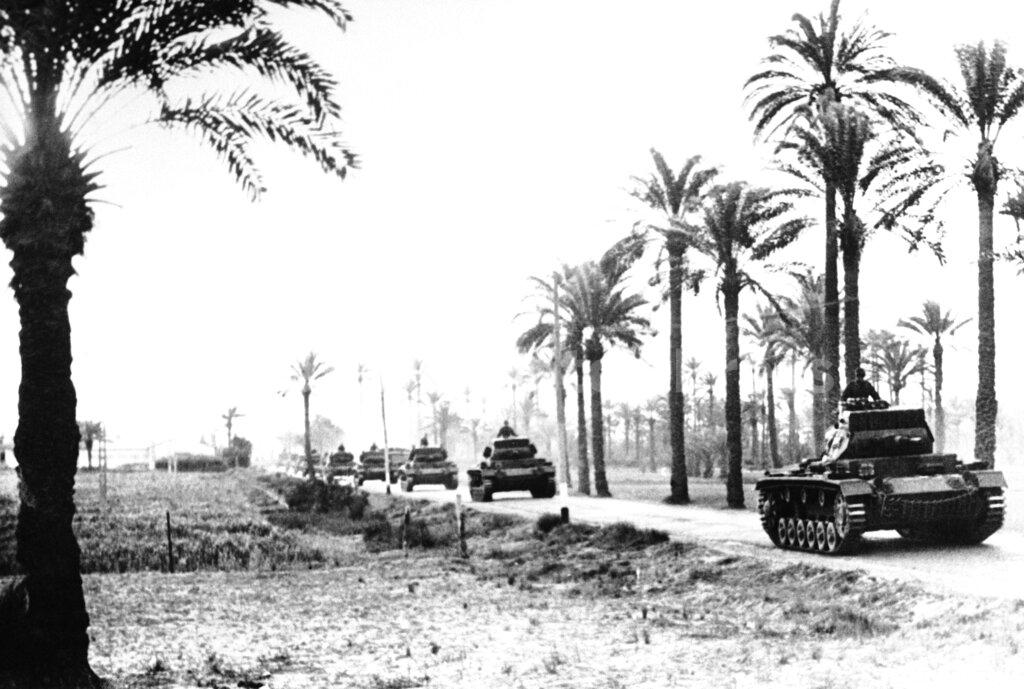
At Tobruk, Libya, German infantry filled anti-tank ditches and cutting wires at the El Adem road starting at 0230 hours, with the work interrupted periodically by Allied fire. At 0520 hours, 36 tanks of German 5th Panzer Regiment moved through the gap created by the infantry, but were halted by British guns and dug-in Crusader tanks 2 miles beyond the line. In the fiercest battle he has faced so far in this campaign, Rommel saw his tanks withdraw from Tobruk’s hastily prepared defenses under a withering hail of fire from British anti-tank guns and heavy artillery; and then watched them literally chased back into the desert in confusion by tank attacks on his flanks. Although his Afrika Korps had managed deep penetration into what earlier reconnaissance had selected as a “weak spot”, their light tanks were no match for British gunnery. 17 were knocked out before General Olbrich, the Panzer commander, ordered the withdrawal. At 0730 hours, the Axis offensive was called back after losing 16 tanks and 400 men (150 killed, 250 captured). The indications are that Rommel is coming to the limit of his supply lines. His men are tired and his tanks are badly in need of servicing. The prospect here is of a long siege so long as Tobruk can be supplied from the sea.
Today is the first coordinated German attack on Tobruk, and it is a complete flop. It starts well enough when German sappers cut defensive wires and fill in the Italian-built anti-tank ditch at 02:30. Then, supported by heavy machine-gun fire, they advance. At 04:30/05:20, 38 Afrika Korps tanks break through the first line of fortifications and into the Tobruk perimeter. Supported by Junkers Ju 87 Stukas, they make good progress at first. The Australian defenders, though, have been told to let the tanks pass so they can trap the accompanying infantry.
The British have artillery sited on the spot and knock out 17 of his 5th Panzer Regiment tanks of Group Olbrich (General Olbrich). The remaining panzers withdraw at 07:30 into the desert in disarray, but the 8th Machine Gun Battalion which follows them in is trapped. The 8th loses about 900 men to death or capture, leaving it with a strength of only about 300 men (casualty estimates for this action vary widely, but those figures are from the Germans themselves, though they may include some earlier casualties, too). General Rommel is furious at the failure to capitalize on the initial breakthrough and will sack General Streich, commander of the 5th Light Division, as a result.
The German prepare for a siege. They bring up the Italian Trento Division and put it under the command of the Brescia Division. They also put Detachment Schwerin in the line, along with most of the 5th Light Division. A second attack scheduled for 18:00 is canceled, an indication of the depth of the fiasco in the morning. The Afrika Korps also goes over to the defense of Bardia/Sollum/Sidi Oma. The RAF has complete air superiority, and forward Detachment Knabe is bombarded by Royal Navy gunboat HMS Gnat and its accompanying two destroyers in the Bay of Sollum. Royal Navy gunboat HMS Aphis bombards Bardia.
The Luftwaffe is doing what it can. It attacks the Gnat in the Bay of Sollum and badly damages it, killing one sailor. The Gnat makes it to port in Mersa Matruh, then proceeds to Port Said. Lieutenant General Rommel requests control over Luftwaffe operations in Libya by X Fliegerkorps.
Australian infantry outside Tobruk, Libya reported the sighting of a number of “long-barreled guns on strange carriages”. This was the first indication that the Germans were deploying the dreaded 88-mm anti-tank gun in the Western Desert (although on this occasion the guns were soon withdrawn when German infantry failed to create a gap). The guns are not used and are there to exploit the expected breakthrough into Tobruk (German 88’s, as they are routinely called, also are used as ground artillery and even, in a dire emergency, as anti-tank weapons). General Rommel used the guns in an anti-tank role at Arras in May 1940, so he is well aware of their versatility. They are sort of a halfway ground between tanks and artillery, with many mounted on vehicles. Their chief drawback, however, is that they have no armor protection and are vulnerable not just to artillery and tanks, but even to rifle fire.
Corporal John Edmondson of 2/17th Battalion of Australian 9th Division led a bayonet charge at Tobruk, Libya despite being shot in the stomach and neck, later dying of these wounds. He would be awarded a Victoria Cross.
In the air, British, German, and Italian fighters engaged in combat in the air while 40 German Stuka dive bombers attacked the Tobruk harbor.
The Luftwaffe bombs and damages 4691-ton British hospital ship HMHS Vita off Tobruk. Reports indicate that 8 German planes attack it and that a bomb deflects off her rear mast (with very high-resolution pictures you can see that it is bent backward slightly) and explodes just off her side, opening her plates and flooding her engine room (thus no damage is visible above water). The Vita, carrying 430 patients, makes it to Tobruk, where it sinks on 22 April 1941. While mistakes happen in war, committed by both sides, hospital ships are clearly marked and off-limits to all attacks. No, these are not especially famous incidents, but if you attack a hospital ship, that’s a war crime whether it gets a lot of media attention or not.
Today, Egyptian King Farouk sends Hitler a secret personal note through his ambassador in Tehran. Farouk states that “he was filled with admiration for the Fuhrer” and was “certain that the Germans are coming as liberators” and would “soon liberate Egypt from the British yoke.” But Egypt was not the only goal, important as it was. The Grand Mufti also met with Hitler around this time and wished “the elimination of the Jewish national home in Palestine.”
Egypt is the cornerstone of the British position in the Mediterranean. It is more important than Gibraltar. The Suez Canal enables them to bring in troops from their dominions in India, Australia, New Zealand and their other holdings in Asia to counter the German and Italian positions in North Africa and the Balkans. It also is a potential British escape route for their massive forces in Greece and North Africa. In fact, seizing Egypt is the fundamental goal of German military policy in the Mediterranean, the heart of Adolf Hitler’s “Peripheral Strategy.”
Hitler has been cultivating his ties to the Arab world for years. For instance, he gave King Farouk of Egypt a Mercedes Benz 540k sports cabriolet for the king’s wedding in 1938. The Grand Mufti of Jerusalem also is on close personal ties with Hitler, while Rashid Ali in Iraq is eyeing the British at the Habbaniyah airbase near Baghdad and wishing them to be gone. King Farouk without question is the monarch in position to help further Hitler’s war aims in the Mediterranean Basin.
The mere fact that Farouk feels confident enough to send this (top secret) sign of dissatisfaction with British hegemony over his country is telling. It suggests that the British hold on Egypt — and elsewhere in the Arab world — may be weakening.
British gunboat HMS Aphis bombarded Bardia, Libya, while gunboat HMS Gnat bombarded German troops at Sollum, Egypt. German aircraft damaged HMS Gnat, killing 1.
Churchill tells the Ministry of Information to stop publishing the demoralizing weekly figures for shipping losses.
The German authorities order that any Jew leaving the Lodz ghetto is to be shot on sight.
The first major mass arrest of Jews in Paris, France took place. The 1st massive German raid in Paris rounded up 3,600 Jews.
The so-called “Antwerp pogrom” occurred when some 200 followers of the Vlaams Nationaal Verbond (“Flemish National Union”), Volksverwering (“People’s Defense”), Anti-Jewish League and other pro-Nazi anti-Semitic groups burned two synagogues in the Oosten straat, smashed the windows of Jewish-owned shops, damaged religious symbols and harassed the Jewish population.
RAF Bomber Command: Day of 14 April 1941
16 Blenheims attacked Leyden and Haarlem power stations. 14 Blenheims on shipping patrols; a convoy off Holland was bombed. 1 Blenheim lost.
RAF Bomber Command: Night of 14/15 April 1941
Brest
94 aircraft — 46 Wellingtons, 25 Hampdens, 20 Whitleys, 3 Stirlings — but bombing was poor because of cloud. No losses.
The RAF has a tragic accident when a Halifax bomber crashes at Tollerton, near RAF Linton on Ouse. The engineer apparently shuts off the engines accidentally. Two of the crew are injured.
The RAF bombs the Italian port of Valona (Vlore) with Swordfish torpedo bombers of RAF No. 815 Squadron. They sink 3329-ton Italian freighter Luciano and 1228 ton Italian freighter Stampalia. The British lose a Swordfish, with one man killed and two becoming prisoners.
U-52, commanded by Kapitänleutnant Otto Salman, sank Belgian steamer Ville de Liege (7430grt) in 59-50N, 29-30W. At 0117 hours on 14 April 1941 the unescorted Ville de Liège (Master C.P. Peterson) was hit aft by one of two torpedoes fired by U-52 about 700 miles east of Cape Farewell. At 0210 hours, the ship sank burning after being hit by a G7a coup de grâce at 0130 hours. The master, nine crew members and two passengers were the only survivors. The 7,430-ton Ville de Liège was carrying general cargo, including steel, wool, wheat, and bacon and was bound for Liverpool, England.
Anti-aircraft ship HMS Alynbank departed Scapa Flow at 0900 to join convoy WN.13 in the Pentland Firth and cover it to Methil, where they arrived at 1500/15th.
Submarine HMS Urge departed Portsmouth for Gibraltar where she arrived on the 23rd.
Gunboat HMS Aphis bombarded Bardia.
Gunboat HMS Gnat bombarded Sollum, supported by destroyers HMAS Stuart and HMS Griffin, which were detached from the light cruiser HMAS Perth force returning to Alexandria. Gunboat Gnat was attacked by German bombers and badly damaged. The gunboat was able to proceed under her own power to Mersa Matruh. One rating was killed. Gunboat Gnat arrived at Alexandria on the 16th and was sent on to Port Said for repairs. Destroyers Stuart and Griffin arrived at Alexandria on the 15th.
Italian submarine Sirena attacked two destroyers in 36-07N, 24-15E north, northwest of Cape Spada without success at 2337.
British steamer Clan Cumming (7264grt) was sunk on a mine in Eleusis Bay, in 37-49N, 23-38E. The steamer had been damaged earlier in the day by German bombing. Seventy seven crew members were taken prisoner. Thirty six crewmen were rescued.
British hospital ship Vita (4691grt) was damaged by German bombing off Tobruk. The ship was attacked by eight German aircraft. Destroyers HMAS Waterhen and HMAS Vendetta and tug St Issey was sent to assist the hospital ship. The hospital ship was returned to Tobruk. Hospital ship Vita at Tobruk was again attacked and damaged on 21 and 22 April.
Turkish steamer Trabzon (2485grt) was sunk by German bombing at Laurium (Daidaro nisos) while en route from Istanbul to Piraeus for repairs.
During the night of 14/15 April, Swordfish torpedo bombers sank Italian steamers Luciano (3329grt) and Stampalia (1228grt) at Valona.
Battleship HMS Queen Elizabeth arrived at Gibraltar at 0900 and light cruisers HMS Sheffield and HMS Dunedin arrived at 0700. Light cruiser Dunedin later that day departed for Freetown.
Submarines HMS Torbay, HMS Taku, and HMS Undaunted departed Gibraltar for Malta. When submarine Taku was attacked by an Italian submarine in 36-14N, 4-14W, submarines Taku and Torbay were recalled to Gibraltar.
Convoy AN.27 of four British and six Greek ships departed Port Said and Haifa. A strong wind prevented three of the four ships in the Alexandria section from sailing. Destroyers HMS Isis and HMAS Vampire were sailed to intercept the Port Said and Haifa section and escort the single ship from Alexandria. Destroyer HMS Hereward, which arrived at Alexandria with convoy GA.12 on the 15th, departed with the other three ships of AN.27 on the 15th to join the convoy which turned back to meet them. Destroyer Hereward then joined convoy ASF.25 to return to Alexandria. On the 16th, when the decision to evacuate Greece was made, four motor transport ships of convoy AN.27 were ordered to return to Alexandria. Destroyer HMS Hotspur from Alexandria and destroyer HMAS Vendetta from the Inshore Squadron were ordered to meet these four ships. Destroyer HMAS Voyager was sent in place of destroyer Vendetta. These four ships and destroyer Voyager were recalled to Alexandria on the 18th. Anti-aircraft cruiser HMS Carlisle departed Alexandria and joined convoy AN.27 on the 17th, and arrived at Suda Bay on the 18th.
President Roosevelt greeted crowds today at the annual Easter egg rolling on the White House lawn, threw out the first ball at the opening game of the season between the New York Yankees and the Washington Senators and conferred with several official visitors. He sent to Congress a request for $728,767,000 in supplementary appropriations for the War Department for the 1941-42 fiscal year.
The Senate received the minority report of the Appropriations Committee opposing an $800,000 subsidy for the American Export Air Lines in the Treasury-Post office Bill and recessed at 12:17 PM until noon tomorrow.
The House heard discussion of the defense-labor situation, heard Representative Hamilton Fish criticize Administration foreign policies, received Representative James W. Wadsworth’s bill to amend the securities laws and adjourned out of respect to the late Senator Sheppard at 1:24 PM until noon tomorrow.
American policy in both Europe and Asia today was declared “unchanged” by the new Russian-Japanese “neutrality” pact, which was viewed officially as merely formalizing a relationship long existing between the two eastern powers. Secretary of State Hull expressed the government’s attitude towards the pact in a formal statement which declared its significance “could be overestimated” and that it came as no surprise. “The agreement,” he said, “would seem to be descriptive of a situation which has in effect existed between the two countries for some time past. It therefore comes as no surprise, although there has existed doubt whether the two governments would or would not agree to say it in writing.”
Secretary Morgenthau said today that as of March 15 he handed over to Harry Hopkins the responsibility of acting as liaison officer between the Administration and the foreign purchasing commissions. Mr. Hopkins is secretary of the President’s special war committee, composed of Mr. Roosevelt and the Secretaries of War. Navy, State and Treasury. He will deal with all requests for aid under the Lend-Lease act. Stabilization loans, however, which are another form of aid, will continue to be the responsibility of Mr. Morgenthau. Although Mr. Hopkins continues to have his headquarters at the White House, he has opened an office in the Federal Reserve Building and established there the nucleus of a staff which he took over from the Treasury. It includes Philip Young, special assistant to the Secretary, Oscar Cox, assistant to the general counsel for the Treasury, and about twelve of their associates.
William S. Knudsen, director general of the Office of Production Management, and two other officials of the agency will visit Boston tomorrow as part of a program to spur defense production in New England by spreading the work “into every suitable existing plant,” the OPM announced today.
Pan-American solidarity for hemispheric defense was said by Vice President Wallace in an address at a luncheon at the Pan American Union in Washington today to be one of the most vital forces in the world. The luncheon marked the observance of Pan- American Day.
A strike in the steel industry, backbone of the national defense program, which had been scheduled. for midnight tonight, was averted yesterday as the major steel producers granted an increase of 10 cents an hour, retroactive to April 1, in the basic wage rate and the other companies began falling into line. The move to assure fulfillment of armament contracts without stoppages caused by labor disturbances was initiated by the Bethlehem Steel Corporation, which announced the pay rise for 90,000 employees to representatives of the C.I.O. Steel Workers Organizing Committee and of the Bethlehem Employee Representation Plan at Johnstown, Pennsylvania. Shortly afterward the United States Steel Corporation, employing 250,000 wage workers, or more than a third of the steel industry’s total, signed a new agreement, covering the Carnegie-Illinois Steel Corporation and four other of its subsidiaries, with the S.W.O.C. at Pittsburgh. The agreement provided for the wage increase and for vacations with pay but preserved the “open shop” policy of the company, the union yielding key demands on this point.
An agreement in the wage negotiations between Northern operators of the Appalachian region and the United Mine Workers appeared in sight yesterday as a result of the personal intervention in the situation of Secretary of Labor Frances Perkins.
Secret talks between Iceland and the U.S. Iceland agree not to resist U.S. forces replacing the British forces on Iceland.
A U.S. Marine Corps garrison designated Marine Detachment, 1st Defense Battalion, was established at Palmyra Atoll. Legally, this is the southernmost point in the United States because it is an incorporated territory. It operates under the jurisdiction of the US Department of the Navy and is the center of the Palmyra Island Naval Defensive Sea Area established by President Roosevelt on 14 February 1941.
The U.S. Army Air Corps places an order for 2,000 Stinson (a division by now of Vultee Aircraft) Model 74s. 324 will be ultimately delivered as O-49 (later redesignated L-1) Vigilant light observation and liaison aircraft.
The 45th Boston Marathon is won by Leslie Pawson in 2:30:38; his third victory in the event.
Major League Baseball:
Opening Day
With the only game scheduled in sweltering Washington, writers for The Sporting News predict Cincinnati to repeat in the National League and Cleveland to win the American League. President Franklin Roosevelt tosses out the first ball, and then the Yankees score single runs in the 1st, 4th, and 5th innings off Dutch Leonard to win, 3–0. Mario Russo allows three hits and drives in a run with a double to win. Phil Rizzuto, like Russo a graduate of New York’s Richmond Hills High School, is hitless in his debut, but fields flawlessly.
New York Yankees 3, Washington Senators 0
The British cargo ship, Fort Stikine, carrying 1,400 tons of explosives and 124 gold bars worth £1 million, caught fire in Bombay harbor, India and exploded, showering the docks with blazing debris. The blast and tidal wave which followed sank four ships and damage a further eleven, one of which, a troopship, was hurled out of the water and onto the roof of a warehouse. Half an hour later, the wreck of the Fort Stikine was devastated by a second massive explosion which threw debris 3,000 feet into the air and over a square mile of the docks and city. The two explosions killed 231 and injured a further 476. The bodies of more than 500 dock workers and civilians were also recovered, another 1,000 people simply disappeared and 2,000 were hospitalized. Eleven ships were lost. In 1960 a dredger working in the harbor recovered a single gold bar.
Author Ernest Hemingway and his wife Martha Gellhorn, ostensibly in Asia as tourists (there’s a war on!), meet with Chinese Kuomintang leader Chiang Kai-shek in Chungking.
Informed political quarters revealed tonight that, while the Russo-Japanese agreements were being concluded, Moscow had assured the Chinese Government that its fundamental policy of aid to China was not affected.
Following up the conclusion of a pact of friendship and neutrality between Russia and Japan and their mutual recognition of each other’s spheres of influence in former Chinese territory, the Japanese press today began to prepare for an expected Japanese diplomatic offensive.
Australian light cruiser HMAS Sydney embarked Australian delegates for the ABDA conference and departed for Singapore, arriving on the 19th. The light cruiser returned to Australia. The ABDA conference was held at Singapore from 21 to 27 April. The conference was presided over by the British Commander in Chief Far East Air Chief Marshal Sir Robert Brooke-Popham. Attending were Commander in Chief China Vice Admiral Sir Geoffrey Layton, KCB DSO, Chief of the General Staff Netherlands East Indies Major General H. ter Poorten, representatives of Australian, New Zealand, British Indian armed forces, and Captain William R. Purnell, USN, Admiral Hart’s Chief of Staff.
Dow Jones Industrial Average: 118.89 (+0.29)
Born:
Pete Rose, MLB second baseman and first baseman (World Series Champions, 1975 [MVP], 1976-Reds, 1980-Phillies; All-Star, 1965, 1967–1971, 1973–1982, 1985; Cincinnati Reds, Philadelphia Phillies, Montreal Expos) and manager (Reds), later banned from MLB for gambling, in Cincinnati, Ohio (d. 2024).
Frank Cipriani, MLB outfielder (Kansas City A’s), in Buffalo, New York (d. 2022).
Jim Wilson, NFL guard and tackle (San Francisco 49ers, Atlanta Falcons, Los Angeles Rams), in Pittsburgh, Pennsylvania (d. 2009).
Bob McCammon, Canadian ice hockey coach (Philadelphia Flyers 1978-84, Vancouver Canucks 1987-91), in Kenora, Ontario, Canada (d. 2021).
Died:
Corporal John Edmondson, 26, Australian recipient of the Victoria Cross (killed in action at Tobruk).
Guillermo Kahlo, 69, German-Mexican photographer and father of Frida Kahlo.
Lucien Abrams, 70, American impressionist painter (Fruit and Feather Flowers, Déjeuner en Provence).
Naval Construction:
The Royal Navy Isles-class minesweeping trawler HMS Kintyre (T 165) is laid down by the Ardrossan Dockyard (Ardrossan, Scotland); completed by Plenty.
The Royal Indian Navy Basset-class minesweeping trawler HMIS Lucknow (T 267) is laid down by Alcock Ashdown & Co.Ltd. (Bhavnagar, India).
The U.S. Navy Accentor-class coastal minesweeper USS Endurance (AMc-77) is laid down by the Gibbs Gas Engine Co. (Jacksonville, Florida, U.S.A.).
The U.S. Navy Accentor-class coastal minesweepers USS Paramount (AMc-92) and USS Peerless (AMc 93) are laid down by the Delaware Bay Shipbuilding Co. (Leesburg, New Jersey, U.S.A.).
The Royal Navy “S”-class (Third Group) submarine HMS Sea Rover (P 218) is laid down by the Scotts Shipbuilding & Engineering Co. (Greenock, Scotland).
The U.S. Navy Cleveland-class light cruiser USS Mobile (CL-63) is laid down by the Newport News Shipbuilding and Dry Dock Co. (Newport News, Virginia, U.S.A.).
The Royal Navy Isles-class minesweeping trawler HMS Sluna (T 177) is launched by Cochrane & Sons Shipbuilders Ltd. (Selby, U.K.); completed by Amos & Smith.
The Royal Navy Bangor-class (VTE Reciprocating-engined) minesweeper HMCS Chedabucto (J 168) is launched by the Burrard Dry Dock Co. Ltd. (Vancouver, British Columbia, Canada).
The Royal Navy Flower-class corvette HMS Samphire (K 128) is launched by the Smiths Dock Co., Ltd. (South Bank-on-Tees, U.K.).
The U.S. Navy “O”-class submarine USS O-9 (SS-70) is recommissioned at Philadelphia, Lieutenant Howard Joseph Abbott, USN, commanding. She will be sunk by mechanical failure on 20 June 1941, 15 miles off Portsmouth, New Hampshire, at latitude 42-59-48 N, longitude 70-20-27 W, with the loss of 34 officers and men, and struck from the Naval Register, 23 October 1941.
The Sjøforsvaret (Royal Norwegian Navy) destroyer HNoMS St Albans (I 15), formerly the HMS St. Albans (I 15), and originally the U.S. Navy Clemson-class USS Thomas (DD-182), is commissioned. Her first commanding officer in Norwegian service is Orlogskaptein (Commander) Gunnar Hovdenak.
The U.S. Navy submarine USS Gar (SS-206), lead boat of her class of 6, is commissioned. Her first commanding officer is Lieutenant Donald McGregor, USN.

