EL DORADO CANYON
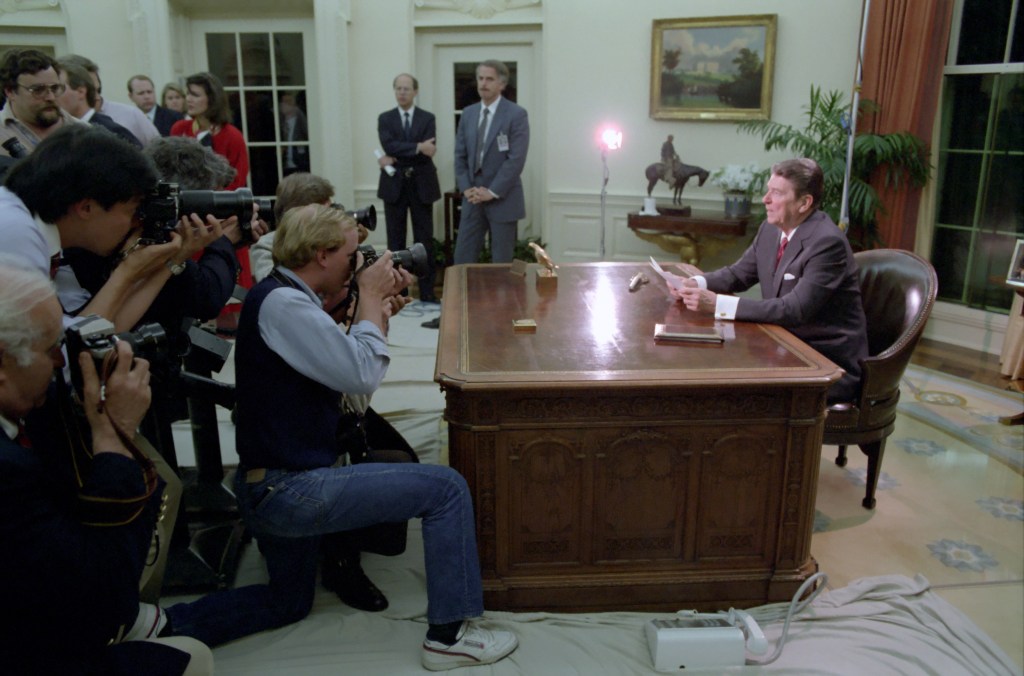
The U.S. launches Operation EL DORADO CANYON against Libya. The United States conducted a series of air strikes on Monday night against what the White House called “terrorist centers” and military bases in Libya. President Reagan, in a nationally broadcast speech, said the American forces had “succeeded” in their mission of retaliating against Libya for what he termed the “reign of terror” waged by Colonel Muammar el-Qaddafi, the Libyan leader, against the United States. Defense Secretary Caspar W. Weinberger said later that one United States plane, an F-111 with a crew of two, “is not accounted for at this time.” But he declined to say if the plane had been shot down. The Libyan radio, monitored in London, said that three United States aircraft had been shot down and that Libyans had killed their pilots and crew. Mr. Reagan said: “Today we have done what we had to do. If necessary we shall do it again.”
The French Foreign Ministry said the French Embassy in Tripoli was hit in the bombing raid, but a spokesman said no one was injured. Foreign reporters in Tripoli, after a Government-conducted tour of a residential district today, said that the rear of the French Embassy was heavily damaged, with windows blown out, and that five or six houses in the district were also damaged. A Libyan Government spokesman said an unknown number of civilians had been killed.
In his address on Monday night, Mr. Reagan said the American attack was a retaliation for what he asserted was the “direct” Libyan role in the bombing on April 5 of a West Berlin discotheque frequented by American servicemen. One American soldier and a Turkish woman died, and more than 200 people were wounded, including 50 other servicemen. “We believe that this pre-emptive action against his terrorist installations will not only diminish Colonel Qaddafi’s capacity to export terror, it will provide him with incentives and reasons to alter his criminal behavior,” said a grim-faced Mr. Reagan. An Administration official said five military targets near Libya’s two major cities, Tripoli and Benghazi, were attacked.
For nearly 10 minutes, the night sky was ablaze with explosions from missiles and tracers as the American planes soared out of the distance. Hours later, doctors said 60 to 100 wounded civilians had come to a hospital. It was not known how many people might have been killed, and the doctors did not offer an estimate. Bombs fell on an upper-middle-class neighborhood that included the French Embassy. When reporters toured the area after daybreak, it was littered with broken glass, collapsed walls and destroyed cars. The reporters saw one body. The target appeared to be a communications building with a large antenna on top and several antennas behind it. The building’s function was not clear, and officials would not say.
Officials said tonight that the United States attack on five Libyan targets was a complex operation that involved separate attacks by Air Force and Navy planes and the use of aircraft for refueling, intelligence and electronic jamming, The operation involved two strikes on separate regions of Libya, the officials said. In one attack, Pentagon officials said, 18 United States Air Force F-111 bombers left England and attacked three targets near Tripoli. The targets were the military side of the Tripoli airport; a port section called Sidi Bilal, where Libyan commandos are trained, and the military barracks called el-Azziziya. In a separate attack, 15 A-6 and A-7 aircraft from the Coral Sea and the America, the two United States Navy aircraft carriers in the central Mediterranean, attacked two Libyan bases near Benghazi, Defense Secretary Caspar W. Weinberger said. They included an air base called Benina and a barracks called Jamahiriya.
Secretary of State George P. Shultz said tonight that Libyan agents had been deployed around the world for attacks against United States embassies in as many as 30 countries. At a news conference after the announcement of the American bombing attacks on Libya, Mr. Shultz said the raids had been necessary to deter Libya from future terrorist attacks and to retaliate for the bombing on April 5 of a West Berlin discotheque frequented by American soldiers. He said that “we have reports and indications, quite substantial evidence, of Libyan efforts to attack — varying degrees of certainty on the evidence -up to 30 of our embassies.” Mr. Shultz said all United States embassies had been placed on special alert. Secretary of Defense Caspar W. Weinberger said United States military installations around the world were also on alert.
President Reagan said today that the Western European allies had assisted the United States in its military attack. against Libya, but according to other high officials the action was hampered by a lack of cooperation, notably from France. According to Secretary of State George P. Shultz and Defense Secretary Caspar W. Weinberger, the degree of cooperation ranged from Britain’s allowing American air bases there to be used to France’s refusal to let the American planes fly through its airspace. “With respect to our allies, we have a variety of opinions,” Mr. Shultz said in the White House briefing room. Mr. Weinberger said Prime Minister Margaret Thatcher of Britain had allowed the use of the air bases. But Mr. Weinberger said the pilots had to use a more dangerous route to avoid flying over countries that had barred the use of their airspace. He suggested that several countries had not cooperated, but in response to a question, he singled out France.
Mr. Weinberger, in showing the flight path on a map, said that the circuitous route was 2,800 nautical miles, 1,200 miles more than a direct route. “Obviously, if we had permission to fly a direct route, we would not have subjected the pilots to such a long flight,” he said. In response to a question whether the United States sought and was refused permission to fly over France, he responded, “I think that is a fair description.” When asked whether countries other than France had refused permission to fly over their territory, Mr. Weinberger said, “No, that would have been the direct route,” an allusion to French airspace. Mr. Weinberger said that in addition to having to fly a longer route, pilots had to take evasive actions to avoid detection.
Congressional leaders generally expressed support today for President Reagan’s attack on Libya, but a leading Democrat warned that the raid could lead to more violence. “The United States,” said Senator Richard G. Lugar, Republican of Indiana, “has responded in an appropriate and a proportional manner to the terrorist attack on our citizens and soldiers in Berlin.” But after meeting for more than two hours this afternoon with President Reagan and his advisers at the Old Executive Office Building, Senator Robert C. Byrd of West Virginia, the Democratic leader, registered a strong dissent from that view. “I’m concerned about this approach we’re taking,” said Senator Byrd, one of about a dozen leaders who was briefed by the Administration in extraordinary secrecy before the raid began.
Common Market countries blamed Libya for recent terrorism. At an emergency meeting in The Hague held before reports of a United States raid on Libyan targets, ministers of the 12 European Economic Community countries decided to reduce the size of Libyan embassies in Europe and to restrict the movements of Libyan diplomats. The measures were announced at the end of the emergency meeting of the 12 Common Market Foreign Ministers that was held before it was reported today that American warplanes had struck at targets in Libya. In a joint statement announcing the restrictions on Libyan diplomats, the foreign ministers also called for an end to “further escalation of military tension,” a clear reference to American preparations to strike militarily at Libya.
President Reagan approved a plan by the Joint Chiefs for the bombing strikes against Libya a week ago. But they said Mr. Reagan was prepared to call off the attack if both the Libyan Government and American allies had been willing to make major policy changes. Shortly after President Reagan returned to Washington on April 6 from an Easter vacation at his California ranch, he approved a plan by the Joint Chiefs of Staff for surgical bombing strikes against Libya. Senior Administration officials said the plan was designed to retaliate for a terrorist bombing at a discotheque in West Berlin in which an American soldier had been killed and 50 other Americans wounded. The officials recalled tonight that while the approval represented an order for the bombing by American planes in Libya that took place today, the strikes were, in effect, placed on hold while several steps were taken. These included building the case that Libya had been behind the attack in Berlin, and preparing American naval and air forces to carry out such a raid.
The Soviet press agency Tass said today that the United States had committed “state terrorism” with its air strikes against Libya but that it was too early to speak of consequences. The agency, monitored in London, said: “American imperialism has perpetrated a new bloody crime: From words — rude and inadmissible verbal attacks against Libya and its leadership — from military demonstrations and provocations against that sovereign and freedom-loving country, Washington has moved to naked aggression.”
The Soviet chief of staff, Marshal Sergei F. Akhromeyev, confirmed that Moscow intends to resume nuclear testing after a U.S. blast in the Nevada desert last week. He told a news conference that the Soviets’ eight-month-long, unilateral testing hiatus, formally ended last Friday, had caused a certain setback to Soviet military power. But he added: “The political gains in the struggle for a halt to nuclear testing… were greater than the purely military setback we suffered.”
The chief U.S. delegate to the 35-nation Conference on Disarmament in Europe, meeting in Stockholm, said that time is running out for an agreement. The delegate, Ambassador Robert Barry, accused the Soviet Union of dragging its feet at the conference, which opens a six-week session beginning today. Barry’s gloomy assessment appeared to reflect a souring of U.S.-Soviet relations, following a brief period of euphoria after last November’s summit meeting.
United States Government experts said today that the Soviet Union had recently tested its largest new land-based missile, but that the test had apparently failed and that there were indications the missile might have exploded. The missile, a successor to the SS-18, had not been previously flight-tested, according to officials familiar with intelligence reports. The failure, earlier this month, is thought to have occurred during the first flight test.
The Soviet Union suggested a meeting between its leader, Mikhail S. Gorbachev, and Chinese leader Deng Xiaoping as a way to improve relations between the two Communist countries. The Tass news agency said the idea was brought up during talks in Moscow between Foreign Minister Eduard A. Shevardnadze and Chinese Vice Foreign Minister Qian Qichen. Tass said the Soviets believe the potential for cooperation is vast. The Chinese delegation left for Peking without comment on the proposal.
A man died in Belfast, Northern Ireland today after being hit by a plastic bullet fired by the police during clashes last month between Protestant demonstrators and security forces, the police said. The death of Keith White, 20 years old, raised the prospect of a new outbreak of violence between the police and Protestant militants, who are angry over a British-Irish accord on the province and what they see as the police role in carrying it out. The accord gives the Dublin Government a voice in the affairs of Northern Ireland. After the death was announced, a Protestant committee announced a 20-minute protest strike for Tuesday.
Simone de Beauvoir died at a Paris hospital at the age of 78. Miss de Beauvoir was for many years a central figure in left-wing French intellectual circles and was an author whose work included “The Second Sex,” a provocative and influential polemic on women.
Vladimir Horowitz returned to the Soviet Union 61 years after he had left it, saying he was going to Germany to study music. Mr. Horowitz, who had long vowed never to return to his homeland, is scheduled to give a recital in Moscow on Sunday and one in Leningrad a week later.
A Syrian-sponsored force of 200 militiamen was formed today to take up positions around two Palestinian refugee districts in southern Beirut where Palestinians and Shiite Muslims have fought two weeks of gun battles. A communique issued by leaders of the force said it would be deployed on Tuesday in key posts around the Sabra and Shatila districts. The measure is part of an effort to stem lawlessness in West Beirut, the largely Muslim part of the capital, and to stop the harassment of foreign teachers and educational institutions. The force is made up of militiamen from four leftist factions — the Progressive Socialist Party, a largely Druse group; the Baath Party, supported by Syria; the Communist Party, which is Soviet-oriented, and the National Syrian Social Party. It will be supervised by a 12-member Syrian military contingent.
Libyan officials are interceding on behalf of the nation’s senior Roman Catholic prelate, held by a “revolutionary committee” in Benghazi, an Italian diplomat said. The diplomat quoted the officials as saying that Bishop Giovanni Martinelli is being treated well but that they have been denied a visit with him as well as with the three Franciscan friars and a nun who were seized last week. The diplomat said the four are being questioned for unknown reasons by the revolutionary committee, one of many semi-autonomous Libyan groups.
At least 46 people were killed early this morning when people attending a religious festival stampeded on a crowded bridge leading across the Ganges River in this holy northern Indian city, festival authorities said. The incident occurred on the next-to-last day of a 10-week religious festival, Kumbh Mela, that has drawn millions of Hindus to this small city in the Himalayan foothills to bathe in the Ganges River. Authorities said four million people thronged the city today alone for the festival, during which bathing for the purification of sins is considered particularly effective.
A double-decker ferry sinks in stormy weather in Bangladesh, killing 200.
A high-ranking United States naval delegation has resumed talks here on the sale of sophisticated technology to the Chinese Navy. Naval experts accompanying Adm. James D. Watkins, Chief of Naval Operations, spent the weekend reviewing proposals for a sale that would include turbine engines similar to those that power many United States Navy vessels, as well as anti-submarine equipment that would include torpedoes, sonar and possibly helicopters. The package could run into hundreds of millions of dollars, placing it on a par with a $550 million sale to China of military aviation electronics that was announced last week. At a news conference at which he disclosed the resumption of talks on the naval deal, Admiral Watkins gave no indication when the negotiations might be concluded.
Prime Minister Yasuhiro Nakasone said today that expansionary economic policies and measures to encourage imports should lead to a decline in the Japanese trade surplus with the United States by fall. At the end of two days of talks with President Reagan, the Prime Minister also said that Japan’s annual economic growth rate would be increased by seven-tenths of 1 percentage point just from the measures his Government intends to enact this month. The moves are part of a program that the Japanese say they are undertaking to shift from an export-oriented economy to one more dependent on domestic growth. Officially, Washington is welcoming the new Japanese actions as an important shift in direction, and the strategy was praised today by Mr. Reagan as he bade goodbye to his guest in ceremonies in the sunlit White House Rose Garden.
The police clashed today with supporters of former President Ferdinand E. Marcos, hours before members of his party met in an unofficial session of the National Assembly, which has been abolished by President Corazon C. Aquino. Hospitals reported 60 people hurt in the clash this morning, including nine with gunshot wounds, after the police moved to disperse a group of Marcos loyalists who had been protesting the removal of a Marcos supporter as mayor of a Manila district. The police said there was gunfire from the demonstrators, and some of those who were injured said the police had fired on them. Firebombs and rocks were reportedly thrown as the police moved in on the crowd, which had been holding a sit-in at the city hall for the San Juan district.
The chief prosecutor of 26 men in the assassination of opposition leader Benigno S. Aquino Jr. urged the Philippine Supreme Court to declare a mistrial, charging that deposed President Ferdinand E. Marcos acted to “whitewash the case” against his former military chief, General Fabian C. Ver, and 24 other soldiers. In a memorandum filed with the court by attorney Manuel Herrera, Marcos is quoted as telling judges and prosecutors, “Thank you for your cooperation; I know how to reciprocate,” after summoning them to the presidential palace three weeks before the trial began in February, 1985.
A group of anti-Government Cubans, now living in exile, testified at a conference in Paris over the weekend that they were tortured and otherwise abused during long terms of imprisonment in Cuba. Eight men and three women appeared at a conference that its organizers said was intended to show that there was systematic abuse of political prisoners in Cuban jails. The session was organized by Armando Villadares, an exiled Cuban poet who spent 22 years in jail. The witnesses read testimony in which they described brutal and frequent beatings, long periods of solitary confinement, food and water deprivation, and unsanitary and overcrowded conditions. One witness, Ana Lazara Rodriguez, told the panel she spent 18 years in various prisons after being arrested in 1961 for taking part in anti-Government protests while she was a 19-year-old medical student.
Americans are uncertain about which side the United States is backing in Nicaragua and only one out of four supports President Reagan’s request for $100 million in aid to the rebels who are trying to overthrow the Nicaraguan Government, according to the latest New York Times/CBS News Poll. With the approach of another key vote by the House of Representatives on the President’s proposal, majorities of those polled accepted his argument that Nicaragua is a risk to American interests, but opposed his remedy of $100 million in aid. Only 38 percent knew that Washington was supporting the guerrillas and not the Government. That confusion extended to the nature of Nicaragua’s Government, which is aligned with the Soviet Union; just 20 percent said it was Communist, 19 percent said it was a right-wing dictatorship and 49 percent said they didn’t know. Nevertheless, after questions about the Reagan aid plan had been asked, a more defined image of Nicaragua seemed to emerge. Fifty-nine percent of the 1,601 adults interviewed by telephone from April 6 through 10 answered yes when asked if they thought the Nicaraguan Government would provide the Soviet Union with military bases, and 56 percent agreed that Nicaragua constituted a threat to the security of other Central American countries. The survey’s margin of sampling error was plus or minus three percentage points.
President Reagan today sharply criticized House legislative maneuvers over his request for aid for Nicaraguan rebels, saying the tactics could put “the lives of countless young Nicaraguans in jeopardy” and render a “verdict of shame on us all.” Mr. Reagan said those engaging in such actions “served only to damage this nation’s foreign policy.” The President’s comments underscored the view within the White House that the debate over the aid he requested has entered a critical period in which the House seems to be preparing to approve the measure but to hobble it with conditions. Specifically, White House officials and Republican leaders in Congress warned that House Democrats would amend the measure to prevent military aid from being provided or would attach it to a $1.7 billion supplemental appropriations bill that includes many items Mr. Reagan opposes. Such a linkage would force the aid measure back to the Senate, which has already approved it. Reconsideration could cause a lengthy delay in providing the aid, the officials said.
Sudan’s two large centrist parties, Umma and the Democratic Unionists, took early leads as the counting of general election ballots ended in many districts. The Democratic Unionists won 15 and Umma won 10 of the 32 seats declared in early tallies, while the fundamentalist National Islamic Front took 4 seats. Sudan is electing an interim constituent assembly.
Bishop Desmond Tutu, the outspoken opponent of apartheid and Nobel peace laureate, was elected the first black Anglican Archbishop of Cape Town this evening. As Archbishop, he will be the titular head of the Anglican Church in South Africa. “Our church has decided that this is the person to be titular head,” Bishop Tutu said. “People have to read whatever signals they want in that.” As head of the Anglican Church, the fourth largest church in South Africa, the Archbishop of Cape Town commands great authority when he speaks on social and political as well as religious issues. The election of the 54-year-old Bishop Tutu will, in the view of many here, give him one of the most important forums in the country for his vigorous advocacy of the abolition of apartheid and the transition to black rule.
Last week Bishop Tutu called on foreign countries and businesses to impose punitive sanctions on South Africa in an effort to force it to eliminate its system of racial separation. There was considerable speculation that the move jeopardized his chances for being elected successor to Archbishop Phillip Russell, who is to retire in August. But his election came in just one day, far sooner than religious experts had predicted. Indeed, Bishop Tutu said there had been none of the acrimony in the Elective Assembly that many people had expected. “First of all, I want to indicate from all accounts the Elective Assembly was a happy occasion,” Bishop Tutu said. “There was no recrimination.”
Salvage crews off the Florida coast have recovered a burned-out section of the booster rocket joint whose rupture is thought to have led to the destruction of the space shuttle Challenger, the Navy said yesterday. The discovery provides the first tangible evidence that a failure of the joint, whose questionable design had worried rocket engineers for nearly a year before the January 28 explosion, caused the disaster, which took the lives of seven astronauts. After discovery of the crew cabin, which was hauled ashore last month, the search for the booster joint was the top priority for the flotilla of surface ships and submarines still combing the ocean floor off Cape Canaveral. The wreckage, a 4,000-pound section of the aft-center segment of the rocket, was recovered early Sunday morning by the salvage vessel Stena Workhorse and an unmanned submersible working in 560 feet of water. Along one edge, where a tang fits into a groove on an adjacent rocket segment, a 2-foot-wide hole is evident, burned through the hardened steel of the rocket casing.
President Reagan’s nominee for a Federal district judgeship in Alabama says he has “no intention” of withdrawing from consideration for the post despite growing evidence that support for him on Capitol Hill may be waning. “It would to be wrong to turn tail and run when you are criticized,” said the nominee, Jeffrey B. Sessions 3d, now the United States Attorney in Mobile, Alabama. The Sessions nomination has become entangled in charges and denials of racism. In hearings before the Senate Judiciary Committee last month Mr. Sessions, who is white, was asked sharp questions by Democrats about his stewardship as a Federal prosecutor, in particular his prosecution last year of three blacks in Perry County, Alabama, who were acquitted of voting fraud, and racial remarks that witnesses said he had made.
President Reagan participates in a ceremony to present the National Security Medal to Lieutenant General Lincoln D. Faurer.
President Reagan participates in a briefing for the Associated General Contractors of America.
The Federal Aviation Administration, using a new reporting system, found a record number of incidents in which aircraft nearly collided in midair last year. The figures released today showed 777 such incidents, 31.9 percent more than were reported in 1984. The number of reported near-collisions involving major commercial air carriers rose to 35 from 20, an increase of 75 percent, the air safety agency said. But the agency said it felt it was “impossible to compare 1985 to previous years.” The 589 near-collisions it reported for 1984, it said, “underestimates” the true number because of “deficiencies” in the previous reporting system. The new reporting system, in use since February 1985, provides for more centralized data collection, deadlines for completion of reports on near-collisions and quarterly audits by F.A.A. regional offices.
The Federal Aviation Administration has ordered a modification of all Boeing 747 jetliners, in an effort to prevent further accidents such as the one that killed 520 people aboard a Japan Air Lines jumbo jet last year, officials said. The FAA directive requires that a cover plate be placed over an access door in the tail section of the plane to keep a rush of pressurized air from damaging the tail and critical control lines if the rear cabin wall fails, as it apparently did before the Japan Air Lines crash.
Marine and Army troops based at Camp Lejeune and Fort Bragg in North Carolina have taken part in the activities of a white supremacist, paramilitary organization based in the state, according to police officials and a private organization that monitors such groups. Law-enforcement officials say they do not know if the number of military personnel involved exceeds a handful, or what kind of role they play. But Lieut. J. D. Harrell, a special operations officer with the police department in Fayetteville, North Carolina, said at least four Marines and some Army soldiers have attended rallies or other activities of the White Patriot Party, whose members train with weapons and wear military fatigues. Until last year the group was known as the Confederate Knights of the Ku Klux Klan.
The only adult MOVE member who escaped the fiery confrontation with Philadelphia police in May was sentenced to prison after being convicted of rioting and conspiracy. Ramona Africa, 30, was sentenced to 16 months to seven years in prison. Judge Michael Stiles said that she will be eligible for parole in six months. Six MOVE adults and five of their children died, 61 houses were destroyed and 250 neighbors were left homeless when a fire, sparked by a bomb dropped from a police helicopter, raged through the middle-class neighborhood.
Citing policy disputes, the United Transportation Union, the nation’s largest union of railroad employees, has left the A.F.L.-C.I.O. It is the first union to do so in nearly 20 years. The decision of the union, which represents about 90,000 conductors, trainmen and firemen, follows a finding by an A.F.L.-C.I.O. committee that it improperly tried to recruit members of other unions. Officials of the American Federation of Labor and Congress of Industrial Organizations say that the transportation union mounted a yearlong campaign to represent Amtrak service workers who are now members of the Hotel Employees and Restaurant Employees Union, the Brotherhood of Railway and Airline Clerks or the Transport Workers Union. A provision of the federation’s charter is intended to keep member unions from competing with each other in organizing drives, and last November an A.F.L.-C.I.O. umpire ruled that as a result of the organizing campaign, the transportation union was subject to a number of sanctions, including permission for others to attempt to organize the transportation union’s workers.
Leaders of Hormel’s striking meatpackers were freed in Austin, Minnesota, after posting $5,000 bail on charges stemming from last Friday’s violent demonstration. They then attended a union hearing on whether the local should be punished for defying its parent union. Jim Guyette, president of Local P-9 of the United Food and Commercial Workers union, and Ray Rogers, the local’s chief strategist in the eight-month-old strike, were charged with helping to organize the protest action, in which 17 people were arrested and eight police officers hurt slightly.
A meat-processing union acted to end an eight-month strike by a dissident local at the Hormel company’s plant in Austin, Minnesota. The international union held a daylong hearing in Minneapolis to determine whether the local should be placed in receivership and its officers dismissed.
A young woman collapsed into sobs on the witness stand today as she described how an intruder shot her husband in the head, raped her while her husband lay dying, then sodomized their 8-year-old son. The woman, whose name was barred from publication by judicial order, identified the defendant, Richard Ramirez, as her attacker, pointing to him in court. “Right there,” she said. “That man, the man in blue,” she said. Mr. Ramirez, who is accused in a series of nighttime murders and assaults, and who wore a blue jumpsuit, the jail uniform, to court, stared at the woman and grinned. The woman, born in Bangkok, had difficulty testifying at length in English. The woman, whose name was barred from publication by judicial order, was the 96th witness to testify in the case against Ramirez, who is accused of 14 murders and 54 other felonies in nighttime attacks in Los Angeles.
The Norfolk, Virginia, school board voted unanimously to end 15 years of busing for racial balance and return to a system of neighborhood elementary schools next fall, an effort to stem white flight to surrounding cities. “The question is how do we maintain a stably desegregated school system for the next 20 years,” said Thomas G. Johnson Jr., chairman of the school board. Henry L. Marsh III, lawyer for busing supporters, said that he would seek a federal court injunction against the plan, which would leave enrollments at 10 of the 35 elementary schools virtually all black.
Senator Russell B. Long, son of the Kingfish, is considering running for governor of Louisiana in 1987, after 36 years in the Senate. Mr. Long, a Democrat who is not seeking re-election to the Senate seat he won in 1948, is being urged by political leaders, newspaper editorials and ordinary citizens to seek the office once held by his legendary father, Huey, and his Uncle Earl, at a time when the state has been shaken by economic hardship and charges of political corruption in the governor’s office. A spokesman, Bob Mann, said the 67-year-old Senator was giving serious thought to the race, but would not decide until after the state’s Senate primary on September 27. “He thinks he’d do a good job,” said Mr. Mann. “He’s probably the kind of person Louisiana needs in the governor’s office. The thing that has really encouraged him are the more than 300 letters he has received from grassroots people urging him to run.”
Seventy-eight demonstrators were arrested at Yale University in New Haven, Connecticut, before campus employees leveled a shanty village erected to protest Yale’s investments in South Africa. Afterward, more than 700 people shouted anti-apartheid slogans at a rally. The protesters promised to keep pressuring the university to divest at least $350 million worth of stocks. The shantytown symbolized the homes of poor blacks in South Africa.
The collapse of world oil prices is creating a political clamor in the Southwest for the Reagan Administration to help rescue the domestic oil and gas industry. But there is little agreement, philosophically or economically, about what should be done. Ideas range from diplomatic pressure on foreign producers to tax relief for the industry to a tariff on imported oil. The Administration’s reluctance to help the region, which strongly backed President Reagan, has stirred deep feelings of betrayal, even among many staunch conservative Republicans. “There is a complete disdain for us,” said Marvin Zeid, a Houston oilman. “The economy in the rest of the country is benefiting so much from our misfortunes that they are saying why rock the boat.” Mr. Zeid said he had moved from being a Republican to political independent as a result.
Senator Jesse Helms’s National Congressional Club, which has transformed North Carolina politics in the last decade, has encountered hard going in its attempt to hold onto the state’s second Senate seat. The fund-raising organization’s candidate is a Helms protege, David B. Funderburk, a 41-year-old professor at Campbell University in Buies Creek, which has served as a think tank for the radical right in this state. Mr. Funderburk, who served for three years as United States Ambassador to Rumania, has called for the ouster of Secretary of State George P. Shultz and has accused the State Department of “working hand-in-glove with Communist tyrants” in Eastern Europe. His opponent for the Republican nomination is an exemplar of an older, gentler strain of Southern Republicanism, Representative James T. Broyhill, who has served in the House since 1962. Mr. Broyhill, the 58-year-old scion of a furniture-manufacturing family, was given a 70 percent rating by the American Conservative Union and an 81 percent rating by the Americans for Constitutional Action in 1984.
Two top executives of the Millipore Corp. were among four men who died when the company’s helicopter collided with a small plane at 2,000 feet over Holliston, Massachusetts, authorities said. The two men aboard the plane escaped with minor injuries. The helicopter dead included John Mulvany, 47, president and chief executive of the high-technology company, and Adrian Reti, 48, vice president. Witnesses said the plane, a four-seater, caromed off the helicopter, glided silently away and made an emergency landing two miles away in a marsh.
An intense snowstorm interrupted spring in the northern plains. With snow more than a foot deep, record cold and winds gusting up to 90 mph, North Dakota state workers got the day off, classes at scores of schools were canceled and travelers were stranded. Five people died when their plane crashed in blizzard-like conditions in Nebraska, and one traffic death was blamed on the weather. The eastern edge of the storm carried heavy rain that threatened to cause flooding in the eastern Dakotas. Thunderstorms caused damage in Arkansas and Oklahoma.
21st Academy of Country Music Awards: Alabama, George Strait, and Reba McEntire win.
Major League Baseball:
Willie Wilson triggered a six-run eighth inning with his third consecutive single today as the Kansas City Royals beat Boston, 8–2, spoiling the Red Sox’s home opener. The Royals, held to six hits and two runs for seven innings, jumped on the starter Dennis (Oil Can) Boyd (0–1) and the reliever Bob Stanley in turning a close game into a rout. The left-hander Charlie Leibrandt (1–0), a 17-game winner last year, was the winner. Wilson started the Royals’ eighth with a single to center and took third on George Brett’s single to right-center. Hal McRae hit a slow roller to the left of the mound and Wilson easily beat the shortstop Ed Romero’s throw home, putting the Royals ahead, 3–2. McRae reached on a fielder’s choice and gave way to the pinch-runner Dwight Taylor. Frank White doubled off the third baseman Wade Boggs’s glove, scoring Brett and chasing Boyd. Steve Balboni and Darryl Motley followed with run-scoring singles off Stanley.
The California Angels bested the Seattle Mariners, 7–6. Darrell Miller singled in Brian Downing from third base in the bottom of the ninth inning to give California the victory. The losing pitcher, Pete Ladd (1–1), opened the inning by hitting Downing with a pitch. George Hendrick, who had three hits and a walk in the game, hit a grounder under the glove of the shortstop Spike Owen for an error as Downing took third. Miller then got his second hit of the game and second run batted in to make a winner of the reliever Donnie Moore (1–0).
The Detroit Tigers downed the Chicago White Sox, 10–8. Darrell Evans hit a two-run homer and singled to trigger a six-run sixth inning for Detroit. Lance Parrish and Harry Spilman also hit home runs for the Tigers, while Greg Walker hit a pair of solo homers for the White Sox. Evans, the major league leader last season with 40, hit his third home run in the fourth inning after Spilman singled. But Walker hit his second homer in the bottom of the fourth. Dan Petry (1–1) was the winner and Richard Dotson (0–2) took the loss.
The Texas Rangers crushed the Milwaukee Brewers, 10–1. Ed Correa pitched eight strong innings and Texas had four home runs in a 15-hit attack on four pitchers to beat Milwaukee. Correa (1–1), the youngest player in the major leagues at 19 years old, gave up three hits, struck out five and walked seven.
The Oakland A’s beat the Minnesota Twins, 7–6. Carney Lansford’s two-run single capped a three-run rally by Oakland in the seventh inning. Oakland, which trailed by 6-3 after five innings, spoiled a two-homer night by Tom Brunansky. The Twins had eight hits, seven for extra bases. Keith Atherton (1–0) pitched one and a third innings in relief of the starter Jose Rijo to get the victory.
The Mets opened their home season in Shea Stadium yesterday with pomp and circumstance, three marching bands, two Mayors of New York, a crowd of 47,752 and Dwight Gooden firing the fast one on the mound at the St. Louis Cardinals. The Mets even staged a ninth-inning rally that shook down the memories of last year’s opener, when Gary Carter dispatched the Cardinals with a home run in the 10th inning. And they revived the memories of the great chase of 1985, which the Cardinals finally won after a rousing race down the stretch. But on this otherwise festive and spring afternoon, the favorable omens took some strange turns as the sunshine faded into dusk and the teams grappled for 4 hours 21 minutes through 13 long and suspenseful innings. And in the 13th, the Cardinals suddenly jammed four runs across the plate with the help of a two-run error at third base and sent the Mets to a 6–2 defeat in their first appearance in New York in six months.
The Pittsburgh Pirates defeated the Philadelphia Phillies, 3–1. R. J. Reynolds doubled in the winning run in the 10th inning and Joe Orsulak singled in another. With one out in the 10th, the pinch-hitter Steve Kemp walked. Rafael Belliard ran for Kemp and scored on Reynolds’s double to right-center field off Steve Bedrosian (1–1). Reynolds then scored on Orsulak’s single to center. Cecilio Guante (1–0), who has appeared in four of the Pirates’ five games, was the winner, allowing one hit in two innings. Jim Winn pitched the 10th and gained his first save.
With a twisted left knee, San Diego’s Bruce Bochy knew it would be difficult to run the bases. But after hitting a game-winning pinch-hit homer leading off the 11th inning to give the Padres a 4-3 victory over Los Angeles on Monday night, Bochy found it easy to go into his home run trot. “When something like this happens and the crowd goes wild, you don feel it,” said Bochy, who sustained the injury Sunday in a game against the Reds. “I had to hit it out to make it the first.” The game was the eighth straight one-run decision for both teams, a major league record for the start of the season.
The Orioles edged the Blue Jays, 2–1. Alan Wiggins and Rick Dempsey hit run-scoring doubles and Mike Boddicker pitched a four-hitter as Baltimore spoiled Toronto’s home opener with a victory. Boddicker, trying to bounce back from a disappointing 12–17 record in 1985, struck out six and walked two.
Kansas City Royals 8, Boston Red Sox 2
Seattle Mariners 6, California Angels 7
Detroit Tigers 10, Chicago White Sox 8
Texas Rangers 10, Milwaukee Brewers 1
Oakland Athletics 7, Minnesota Twins 6
St. Louis Cardinals 6, New York Mets 2
Pittsburgh Pirates 3, Philadelphia Phillies 1
Los Angeles Dodgers 3, San Diego Padres 4
Baltimore Orioles 2, Toronto Blue Jays 1
The Dow Jones industrial average closed above the 1,800 level yesterday for the first time in April as stock prices, reacting again to falling interest rates, scored moderate gains. But volume slowed to 106.7 million shares, the lowest since January 20, the holiday marking the Rev. Dr. Martin Luther King Jr.’s birthday, when only 85.3 million changed hands. Volume on Friday was 139.4 million shares.
Dow Jones Industrial Average: 1805.31 (+15.13)
Born:
Max Unger, NFL center and guard (NFL Champions, Super Bowl 48-Seahawks, 2013; Pro Bowl, 2012, 2013, 2018; Seattle Seahawks, New Orleans Saints), in Kailua-Kona, Hawaii.
Cory Gearrin, MLB pitcher (Atlanta Braves, San Francisco Giants, Texas Rangers, Oakland A’s, Seattle Mariners, New York Yankees, Minnesota Twins), in Chattanooga, Tennessee.
Morenike Atunrase, WNBA guard and forward (San Antonio Silver Stars), in Shreveport, Louisiana.
Quianna Chaney, WNBA guard (Chicago Sky), in Baton Rouge, Louisiana.
Anne Watanabe, Japanese model and actress (“Platinum Data”, “Midsummer’s Equation”), in Tokyo, Japan.
Died:
Simone de Beauvoir, 78, French author and feminist (“The Mandarins”; “The Second Sex”; “She Came to Stay”), of pneumonia.

