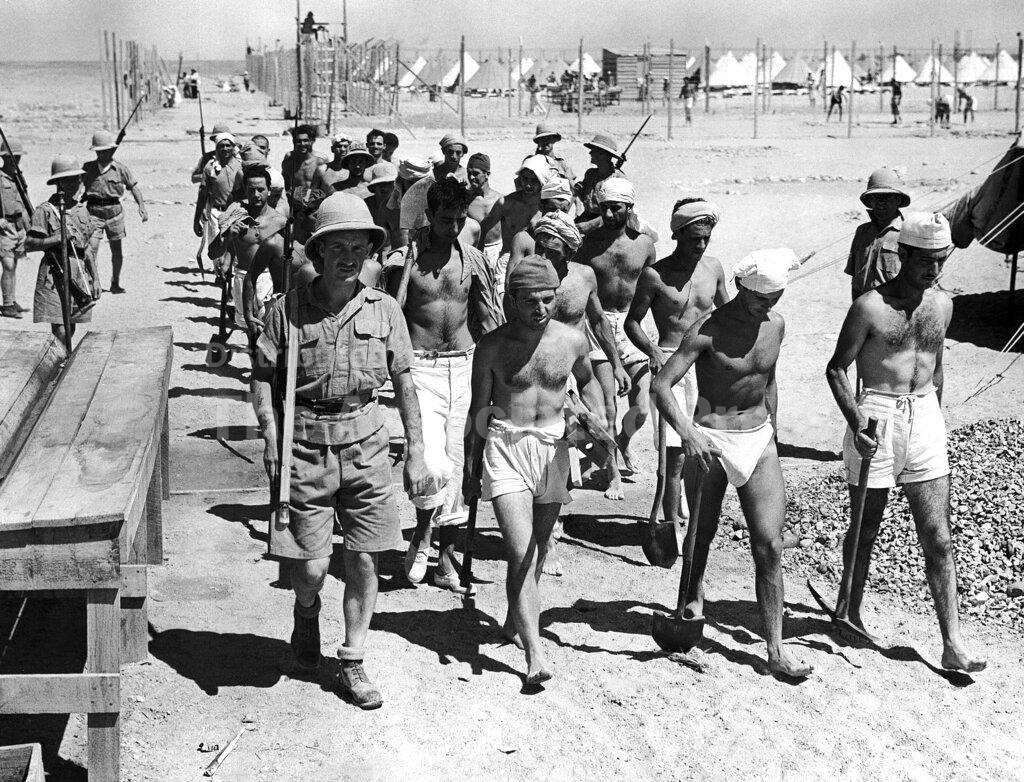
The British 7th Armored Brigade moved into the desert to outflank Italian forces at Sollum, Egypt and to cut the road to Bardia, Libya, as the latter port was subjected to carrier aircraft attack by HMS Illustrious. Meanwhile, the first groups of Italian prisoners of war began to arrive by truck at the British headquarters at Mersa Matruh, Egypt.
The British on 12 December 1940 continue mopping up the remnants of the Italian garrisons in Egypt. The only Italian presences remaining in Egypt are near the border outside Sollum, and in the area of Sidi Omar. The Western Desert Force pursues the fleeing Italians along the coast road (the Via Della Vittoria) toward Halfaya Pass and Fort Capuzzo in Libya. Some British forces cross the border, and Fort Capuzzo in Libya is next on the Operation Compass list.
The British 7th Armored Brigade heads through the desert to outflank Sollum and cut the road to Bardia. Sollum, which appears inconspicuous on the map, actually is extremely important to the British because it has a small port, and the Royal Navy has complete control of the sea and can use it to supply further advances.
The Italians leadership is in a panic. Marshal Graziani signals Mussolini that Libya may be next to fall, and Italian troops may be required to withdraw the 10th Army all the way to Tripoli.
Italian prisoners of war were declared tonight by a British spokesman to be falling so rapidly by thousands into British hands that the problem of feeding and eventually moving them out of the desert is becoming troublesome. The day’s operations were twofold: Around Sidi Barrani, the Italian base that fell two days ago, the British were occupied with clearing up a battlefield which had extended over 200 square miles. Those Fascists who had escaped the British encirclement — and their number was said here to be small — were being pursued westward toward Italian Libya, harassed by the Royal Air Force and the Royal Navy as well as the land forces.
Altogether, the Italians have lost 38,289 troops. Some of these are dead and wounded, but the vast majority are taken as prisoners. They also lose 73 tanks, 237 guns, 1000 other vehicles — and all of Egypt+. The British to date have lost 634 casualties and no equipment.
The Royal Navy (monitor HMS Terror, gunboats Aphis and Ladybird, and battleships Ramillies and Warspite) bombards the Italian bases in Libya before sunrise. Several of these ships then return to Alexandria. Aircraft carrier HMS Illustrious — a thorn in Mussolini’s and Hitler’s side — sends aircraft to bomb Italian barges at Bardia.
The Royal Navy has another big task now: evacuating all the Italian POWs from Egypt. Destroyer HMS Janus begins the process, taking 200 POWs from Mersa Matruh to Alexandria. Destroyer HMS Juno also embarks 450 Italians. The Mediterranean fleet begins sending other ships such as HMS Chakla, Fiona and Protector to Sidi Barrani for the same purpose.
The Greek southern army has crushed “desperate” Italian resistance in the region of Tepeleni and has stormed the heights to the northeast of that town, capturing a considerable number of Italy’s Alpine troops, a government spokesman said tonight. The drive toward both Tepeleni and the coastal town of Chimara went on without setback, he added. There were unconfirmed reports that an Italian colonel of Alpine troops was one of those who had fallen in the day’s fighting. “The news,” said the spokesman “is very good from all sectors of the front and our army is continuing its advance.
The weather in the Albanian mountains is brutal. The Greeks continue to make small gains. I Corps moves forward in the direction of Himarë. II Corps continues gaining ground between the Aöos and the Apsos rivers, approaching Klisura. Greek V Army Corps advances toward Mount Tomorr, where it hopes to act as a link between Greek II and II Corps.
Hungary and Yugoslavia signed the Treaty of Eternal Friendship. In Belgrade, the foreign ministers of Hungary and Yugoslavia signed a treaty of “eternal friendship” between the two countries. While Yugoslavia is unwilling yet to sign the Tripartite Pact with Germany, it inches slightly closer to doing so. Cvetkovic’s Yugoslavian government and Teleki’s Hungarian government sign a “Treaty of Eternal Friendship” with Hungary. Hungarian Foreign Minister Count Csaky arrives in Belgrade for the signing, greeted by Yugoslav Foreign Minister Aleksandar Cincar-Markovic. They sign the treaty at the Hungarian Embassy, and it provides:
“They wish to place their neighborly feelings, mutual esteem, and confidence on a solid and durable basis which will serve their mutual interests and Danubian peace and prosperity.”
Given that Rumania at this point essentially is a German satellite, this is an indication of which way Yugoslavia may be heading — but it isn’t quite in the German orbit yet.
Philippe Pétain received an invitation from Adolf Hitler to attend the ceremony in which Napoleon II’s remains were to be returned from Austria to the Les Invalides cemetery in Paris, France.
Refugee ship Salvador, a small Bulgarian schooner sailing from Burgas and denied entrance to Palestine by the British, sinks in a violent storm in the Sea of Marmara near Istanbul. The ship, crowded with Jewish refugees, takes with it about 230 people (there are 223 Jewish graves at Mount Herzl, Jerusalem), including 66 children. Some 125 survivors are deported back to Bulgaria, while 70 others board the transport Darien.
General JBM Hertzog resigns from the South African government. He had been the prime proponent of a neutral stance in the war, but that has proven to be an unpopular position within the government. Jan Smuts, his former coalition partner, now leads the South African government. Following his replacement, Hertzog tried to form a new coalition with Daniel Malan’s opposition Purified National Party to create the Herengde Nasional Party. However, Hertzog stood for equal rights between British South Africans and Afrikaners, and that was unacceptable to his erstwhile partners.
Reports are arising once again that the evacuation schemes put in place by the government (Operation Pied Piper) are being thwarted by families and the evacuated children themselves. During the war’s first winter, children are getting homesick and parents are bringing their children home for the holidays — to stay permanently, despite the danger.
The evacuations, incidentally, are not free — the children’s parents must pay every week 10 shillings and sixpence (53p; equivalent to £27 today, roughly $35) for the first unaccompanied child, and 8 shillings and sixpence for any subsequent children. The host families — many of whom have no choice but to accept children — theoretically use those sums to provide for the evacuees. While it is tempting to view host families as only too happy to shelter endangered children, human nature intrudes at every turn, and many host-evacuee relationships are disasters. All of this means that children are finding their way back into their at-risk cities right when the Luftwaffe is mounting some of its most effective and devastating attacks.
At this time, British citizens have a variety of news sources that give different perspectives on events. Aside from the BBC, there are English-language broadcasts, more or less daily, from both “Station DJA” in Hamburg and from Sweden (on medium wave band at 265 meters (1.13 MHz). The Swedish broadcasts are brief (five minutes) and focus on Scandinavia, but they give a fairly neutral version of the daily news. The Hamburg broadcast is by “Lord Haw-Haw” and his colleagues and is pure German propaganda — but many listen anyway just to see what the enemy’s message is that day.
The George Cross is Gazetted for Sub-Lt Peter Victor Danckwerts (1916-84), RNVR, who had only handled mines under instruction when, after just five weeks in the services, he disarmed 16 mines in 48 hours.
The German Ambassador to Madrid sends Foreign Minister Ribbentrop a lengthy telegram marked “Strictly Secret.” It recounts the 7 December meeting between Admiral Canaris, head of the Abwehr, and Generalissimo Franco. The report notes that Franco refuses to enter the war for the following reasons:
— The British would seize the Canary Islands, Azores, Madeira, the Cape Verde Islands, and Guinea;
— Spain has insufficient foodstuffs and transports for war, particularly of rail cars to support troop movements;
— Imports are insufficient for military preparations due to the war situation;
— Even if the Canary Islands were not invaded, they have supplies for only six months, and they could not be re-supplied.
Canaris then asked whether another date, after the proposed date of 10 January 1941, would be acceptable. Franco replied in the negative, though he did make the lukewarm gesture of stating that he personally would overseeing “Spain’s preparations” for such an assault, including a new large-bore mortar (“Mortar 240”).
The report reveals why General Keitel canceled all preparations for Operation Felix, the proposed assault on Gibraltar, so abruptly on 10 December. It also suggests why Hitler also found his meeting with Franco at Hendaye on 22 October so frustrating. Franco’s bad-mouthing of his country’s capabilities is simply a veil for his covert reasons for avoiding collaboration with Germany.
The real reason for Franco’s unwillingness is revealed in contemporaneous internal Spanish military documents. They quite shrewdly conclude that the Axis is in no position to defeat the British at this time and that only the capture of Alexandria would shift the balance of power in the Mediterranean. This same sort of political calculation will recur with Finnish Marshal Mannerheim in two year’s time when he similarly demurs on aggressive action until the Wehrmacht removes Leningrad as a Soviet redoubt. Recent Italian reversals in Albania and now Egypt similarly have cast shadows upon Axis prospects over the long term.
The first draft of Directive 21, the plans for the invasion of the Soviet Union, are completed today and submitted to General Jodl. This draft has the codename “Fritz.” The name Fritz is chosen because it is the name of planner Lieutenant Colonel Bernhard von Lossberg’s eldest son and basically is just a placeholder. Hitler is not going to leave Fritz as the codename for long.
The planning process for what turns into Operation Barbarossa is convoluted and confuses even experts. There actually are two entirely different plans being prepared. This is the OKW (Military High Command) plan; the OKH (Army High Command) also has its own plan, which it presented to Hitler on 5 December. The OKH plan basically has three axes of advance, or prongs, in the north, center, and south of the front, but with the greatest emphasis on the central (Moscow) line of advance. The army generals feel that Moscow is the most important objective in the Soviet Union and should be taken first.
This version of the invasion, the OKW/Hitler plan, shifts greater weight to the attacks on Leningrad and Kyiv. The Army plan, while not the “official” plan, is being used by the army for logistical planning purposes regardless of what the OKW (and, by extension, Hitler) intends. This may seem like a subtle distinction, but, as an example or perhaps an exaggeration of what is going on, the army is putting its best divisions where it wants to strike — toward Moscow — in favor of weaker forces heading toward Hitler’s objectives further north and south.
In essence, there are two completely separate plans being prepared, and internally the army is disposing of its forces in favor of its own plan — changes which for all intents and purposes will decide what actually happens during the invasion. In other words — the army covertly is ignoring what Hitler is going to issue in his upcoming directive. There will be insufficient time to reallocate forces once the army has them in position for its own plan, and, in any event, it would be extremely inefficient to shift things around once the troops are at their jump-off points.
That said, not all of the army generals favor the army’s plan, as they also think the main weight of the advance should be in the north, to link up with the Finns at Leningrad and then head south to Moscow. The southern prong, though, raises little enthusiasm in anyone besides Hitler, who is lusting after the economic resources there.
Hitler eventually realizes what is going on — when isn’t entirely clear — and tells the army leaders that they can start out with their plan, but once the boots are hitting the ground and early gains are made, his plan will take over and the army group weightings will shift. Those who view Hitler as an all-powerful warlord in control of everything going on in his military may not grasp the subtle undermining of his intent throughout the Operation Barbarossa planning process.
Looking ahead, this goes a long way toward explaining Hitler’s growing resentment toward his generals as a group and will explain why some generals seemingly inexplicably are dismissed and replaced (such as Fedor von Bock — but we’ll get to that down the road) on what otherwise seems to be a whim. It also will go a long way toward explaining what cripples the German invasion in August 1941.
Separately, the 102 Infanterie Division is formed in Wehrkreis VIII from parts of the 8 and 28 Infanterie Divisions. It becomes part of the XX Korps/11th Army.
The first of four nights of heavy German bombing of Sheffield, England known as the Sheffield Blitz began. British monitoring stations detected X Verfahren radio beams being laid across northern England, United Kingdom, and suspected a German attack would take place on the city of Sheffield. In the evening, 13 He 111 bombers of Kampfgruppe 100 arrived over the Sheffield suburbs of Norton Lees and Gleadless at 1941 hours, dropping 16 SC50 high explosive bombs, 1,009 B1 E1 ZA incendiaries, and 10,080 B1 E1 incendiaries. Shortly after, three groups of German bombers, the main force, attacked. The first group was consisted of 36 Ju 88 bombers and 29 He 111 bombers; the second group was consisted of 23 Ju 88 bombers, 74 He 111 bombers, and 7 Do 17 bombers; the third group was consisted of 63 Ju 88 bombers and 35 He 111 bombers. The 280 German aircraft heavily damaged the city center and residential districts through the night through 0400 hours on the next day.
While officially the Battle of Britain may be over, for many in England this month is the worst bombing experience they yet have faced. It only seems to be getting worse, too, with the shorter days giving the Luftwaffe plenty of nighttime hours to launch carefully planned attacks.
The Luftwaffe returns full force tonight. KG 100 leads off with 13 Heinkel He 111s, followed by literally hundreds of Junkers Ju 88, Heinkel, and Dornier Do 17 bombers. Altogether, 280-336 bombers (accounts vary) attack Sheffield throughout the night in three main waves, winding up their attacks at 04:00. However, the bombers miss the center of town, and there are no reports of extensive damage to militarily or economically vital facilities. That said, the city is a mess, with transportation crippled and many left homeless.
This is a continuation of the Germans’ most recent strategy of targeting mid-sized cities and towns rather than just focusing on London and Liverpool. As with many of these raids, the citizens can expect a follow-up raid, whether it be tomorrow night or several nights hence. This is the first night of the “Sheffield Blitz.”
The Luftwaffe also mounts smaller raids at London, Liverpool and many smaller towns throughout the country. The Luftwaffe loses less than a handful of bombers.
This attack is particularly interesting because the British, as at Coventry, have some idea that it is going to take place. During the day, British monitoring stations detect X Verfahren radio beams, and British military intelligence correctly assesses that they cross at Sheffield. However, as at Coventry, no special precautions are taken such as warnings or evacuations.
The RAF authorizes “Operation Intruder” in Operational Instruction No. 56. These will be night attacks on Luftwaffe airfields by Blenheim Mk 1F fighters of RAF No. 23 Squadron.
RAF Bomber Command dispatches 1 Blenheim in daylight to Emden turned back.
RAF Bomber Command dispatches 15 Hampdens and Whitleys overnight; the force was recalled. One aircraft did not receive signal and bombed Duisburg. No losses.
The RAF operates offensively against the Italian bases in Libya. Blenheim bombers based in both Malta and Alexandria raid Castel Benito, Benina and El Adem. They are virtually unopposed, as the Italian Fiat CR 42 biplane fighters are brushed aside by the modern RAF Hurricanes.
RAF ace Douglas Bader is awarded the Distinguished Flying Cross (DFC) for his services during the Battle of Britain. His unit has compiled 62 aerial victories.
No. 3 RAAF’s Gloster Gauntlet Mk II fighters are retired on grounds of antiquity and lack of spare parts.
U-96, commanded by Kapitänleutnant Heinrich Lehmann-Willenbrock, in attacks on convoy HX.92 sank Swedish steamer Stureholm (4575grt) northwest of Flannan Island and Belgian steamer Macedonier (5227grt) in 57‑52N, 08‑42W.
At 0156 hours, U-96 fired a G7e torpedo at the Stureholm (Master John Olof Gunnar Berner) in convoy HX.92 and observed a hit in the stern and the sinking of the vessel after eleven minutes. The launch of four lifeboats was also observed by the U-boat but no survivors were ever found. The 4,575-ton Stureholm was carrying steel and scrap iron and was bound for Hull, England.
At 0431 hours the unescorted Macedonier (Master Lucien M. Fontaine) was struck between #4 and #5 holds by one G7e torpedo from U-96 about five miles northwest of St. Kilda, Outer Hebrides. The ship, armed with one 4in gun, had been in station #12 of convoy HX.92 which was scattered earlier that night after the ship of the convoy commodore was sunk. The crew immediately abandoned ship in two lifeboats as the ship quickly settled aft, sinking by the stern six minutes after being hit. Four crew members were lost. The boats remained in the vicinity until dawn, rescued two men clinging to wreckage and then set sail. A Hudson aircraft spotted the survivors about five hours after the attack and directed the Icelandic trawler Súlan to the boats. They were picked up and landed at Fleetwood on 15 December. The 5,227-ton Macedonier was carrying 6800 tons of phosphates and was bound for Billingham.
Aircraft carrier HMS Formidable joined the Home Fleet at 1430 at Scapa Flow escorted by destroyers HMS Douglas, HMS Keppel, and HMS Vimy. Formidable detached with heavy cruiser HMS Norfolk to Freetown as Force K and departed Scapa Flow on the 18th.
Light cruiser HMS Edinburgh arrived back at Scapa Flow. She had left Home Waters on the 17 November to escort convoy WS.4B.
Anti-aircraft cruiser HMS Curacoa arrived at Scapa Flow at 1515 after convoy WN.51 escort.
Anti-aircraft ship HMS Alynbank departed Methil at 2230 to escort convoy EN.40.
In a minelaying mission to Brest, a Swordfish of 812 Squadron was lost and P/T/Sub Lt (A) E. M. Hamilton, RNVR and P/T/Midshipman (A) P. N. Lofts, RNVR, were killed.
Aircraft carrier HMS Illustrious aircraft bombed Italian barges off Bardia.
Destroyer HMS Janus after refueling gunboats HMS Aphis and HMS Ladybird evacuated 200 prisoners of war from Mersa Matruh to Alexandria.
Destroyer HMS Juno arrived at Alexandria from Mersa Matruh on the 13th with 450 prisoners of war.
Armed boarding vessel HMS Chakla and netlayer HMS Protector departed Alexandria for Sidi Barrani with supplies and to embark prisoners of war.
Armed boarding vessel HMS Fiona, off Gavdo Island, also proceeded to Mersa Matruh to embark prisoners of war.
Monitor HMS Terror and minesweeper HMS Bagshot arrived at Alexandria.
Australian light cruiser HMAS Perth arrived at Aden for escort duty in the Red Sea until 22 December. The light cruiser passed through the Suez Canal on the 23rd and arrived at Alexandria on the 24th for duty with the Mediterranean Fleet.
Australian light cruiser HMAS Hobart departed Aden for Fremantle where she arrived on the 28th.
Submarine HMS Proteus, which had arrived at Gibraltar on the 9th, departed Gibraltar for refitting at Portsmouth, arriving on the 20th.
Convoy OB.258 departed Liverpool escorted by destroyers HMS Vanquisher, HMS Viscount, HMS Whitehall, and HMS Winchelsea and corvettes HMS Gentian and HMS Hibiscus. The escort was detached on the 15th.
Convoy FN.358 departed Southend, escorted by destroyer HMS Vivien and sloop HMS Londonderry. The convoy arrived at Methil on the 14th.
Convoy BS.10B departed Suez. The convoy was joined on the 14th by light cruiser HMAS Perth, anti-aircraft cruiser HMS Carlisle, and destroyer HMS Kingston. Indian sloop HMIS Indus joined on the 17th. The convoy was dispersed on the 17th.
Lord Lothian (Philip Henry Kerr, 11th Marquess of Lothian), the British Ambassador to the US, passes away unexpectedly at age 58 from uremic poisoning. A controversial figure, Lord Lothian did more to curry American support in the first year of the war than anyone but Winston Churchill. He “set the ball rolling” toward unlimited US support of the British war effort so that, by the time of his passing, the momentum was virtually unstoppable. Lord Lothian, British Ambassador to the United States, dies in Washington, D.C. President Roosevelt, at sea in heavy cruiser USS Tuscaloosa (CA-37), sends telegram to King George VI of England expressing his regrets at Lord Lothian’s passing. “I am very certain,” Roosevelt informs the King, “that if he had been allowed by Providence to leave us a last message he would have told us that the greatest of all efforts to retain democracy in the world must and will succeed. The unexpected death of Lord Lothian in the midst of burdensome duties as British ambassador created the possibility tonight that a United States warship might transport his body through the Atlantic war zone to his embattled homeland. Both British and American officials, however, awaited word from Lothian’s relatives in England before arranging a funeral for the 58-year-old bachelor diplomat, who died of uremic poisoning at 2 a.m. (E.S.T.). Secretary of State Hull, calling at the sprawling red brick embassy to extend condolences, offered “all facilities at our disposal.”
Several things stand out about Lord Lothian’s tenure:
— He was the prime mover behind Lend Lease, and it was Lord Lothian who planted the idea of unlimited credit in President Roosevelt’s mind (and Roosevelt is on the record as contemplating the idea by this date);
— He was the only member of the British government during his lifetime to take affirmative steps (in July 1940) to explore any avenues of peace (which irritated Churchill, who immediately put a stop to it);
— He brought up the delicate subject of Great Britain’s looming bankruptcy, making everyone unequivocally aware of England’s financial issues (on 23 November 1940), causing temporary consternation in the financial markets but getting the issue front and center so it could be solved.
In some ways, Lord Lothian was not a “team player” in the sense of marching in lockstep with the Foreign Office. However, he was extremely farsighted, a realist who knew what should be done and did it (albeit not always in the most tactful way) regardless of what his superiors felt was tactful. He “advanced the ball” when it needed to be done. Largely forgotten, Lord Lothian was one of the Allies’ unsung heroes of World War II.
Secretary of the Treasury Henry Morgenthau told his press conference today that he would not consider making a loan to Britain, or to any country covered by the Johnson Act, without specific Congressional authority; but he declined to say whether he planned to ask for legislation that would permit such a loan.
The Duke of Windsor will leave Miami at 8:30 o’clock this morning in a United States Naval plane for an unannounced destination, it was learned. The understanding is clearly that the former Edward VIII is to meet President Roosevelt somewhere in the Caribbean. The news was confirmed by Captain Vyvyan Drury, aide de campe to the Duke after all officials attached to the Windsor party had persistently denied or avoided comment on rumors of the prospective trip. Originally the Windsors were to leave here this afternoon. The post-operative condition of the Duchess’ jawbone, however, delayed their departure until Monday at the earliest.
In a report drawn up by army officers they report that all is not well with the draft and the equipment of the conscripts. The army lacks not only arms and ammunition for such a force, but housing facilities and all items of equipment down to shoe strings. The army lacks barracks and tent camps to house the men. It lacks uniforms, shoes and other items of clothing. Strikes are holding up the progress of the defense program.
Despite the large contracts for airplanes let in the last few months by the Army, this branch of the service is expected to receive only about fifty new combat planes of the first-line fighting type this month and a slightly larger total in January. The Army is receiving far larger numbers of training and auxiliary planes, and the Navy also is receiving some shipments, but official figures prepared by the War Department indicate that the United States does not now have, and will not have for a long time to come, any considerable striking power in the highly important air force. According to schedules, the Army was to receive ninety-five first-line fighting planes in the month of December, on the basis of contracts made before September 1, and 132 next month. However, President Roosevelt recently established “a rule of thumb” by which half of the new production is released for export to Great Britain.
The ninety-five combat planes to be delivered in December, and divided with Great Britain, include ten heavy bombers, thirty medium bombers, twenty-seven light bombers, twenty-one interceptor pursuit planes and seven one-engine pursuit planes, the classifications in first-line fighting aircraft. Deliveries in January, subject to the same expected division as between the American and British air forces, are scheduled to comprise twelve heavy bombers, thirty-four medium bombers, fifty-one light bombers, twenty-two interceptor planes and thirteen one-engine planes.
The fact that the American public would be ready to write off the British World War debt in exchange for islands or territory in the area of the Panama Canal is shown by a nationwide survey just completed by the American Institute of Public Opinion, Dr. George Gallup, its director, reports.
Defending the Wage and Hour Law, the government told the Supreme Court today that the new statute was “a valid exercise of the commerce power” of Congress.
A charge by Representative Leland M. Ford, California Democrat, that the C.I.O. was doing all possible to “destroy” the national defense program brought from Representative Voorhis, California Democrat, today the reply that such “wild statements” endangered national unity. The exchange climaxed a house debate which was touched off when Representative Taber, New York Republican, asserted that the defense program was not progressing as fast as it should because workmen were being assessed “exorbitant fees” in order to obtain jobs. The “most important thing” President Roosevelt would do, Taber declared, would be to “put the government’s house in order” by giving more authority to the defense commission.
The American Farm Bureau federation recommended today revisions in the federal farm program which would eliminate “woeful duplication” in administration and employ government loans to peg prices of basic commodities at higher levels. The federation, closing its annual convention, insisted that new measures be inaugurated to improve the farmers’ economic position, which, it asserted, was being made increasingly difficult because of “restrictive trade barriers” and “ever extending price controls by other groups.”
Counsel for the Ford Motor Company said today that the company would not consent, as requested by the United Automobile Workers (C.I.O.), to a bargaining election among 100,000 production workers.
Washington sends Gee Walker to the Red Sox for Doc Cramer. Walker is then packed off to Cleveland with pitcher Jim Bagby, outfielder and catcher Gene Desautels for catcher Frank Pytlak, Odell Hale and pitcher Joe Dobson. At the end of the War, on December 12, 1945, Bagby will return to the Red Sox. Boston also buys Pete Fox from Detroit.
General Claude Auchinleck becomes British Commander-in-chief, India. This post is a typical warm-up spot for future leaders in North Africa.
Vichy-France established diplomatic relationship with the Japanese-sponsored puppet state of Manchukuo.
Undeclared border warfare between French Indo-China and Thailand was reported today to have spread to the interior of both territories, with raids and counter-raids by rival air forces. Officials here said that yesterday aircraft had raided Saravani, In the center of this French colony, and that a retaliatory attack was made immediately on Undorn and Sakolakon airports, about thirty-five miles inside Thailand. Indo-Chinese officials said that three tons of bombs were unloaded by their pilots and that huge fires were started at both places. The extent of the damage at Saravani was not disclosed. It was announced here, meanwhile, that communications had been re-established with Bangkok, the Thai capital, but officials said there was little prospect of a break in the diplomatic deadlock precipitated by Thai territorial claims. Hanoi officials reiterated their willingness to attempt a negotiated settlement, but said Bangkok had shown no willingness to receive a Vichy-appointed peace and boundary commission. The commission was named in October.
A Thai communiqué issued in Bangkok today asserted that the Thai High Command was willing to withhold further attacks in the two-month-old undeclared. border warfare with French Indo-China if the French would agree to do likewise. The communiqué also reiterated. Thailand’s readiness to define the frontier in accordance with international practice if the French would send negotiators to Bangkok.
Having received the secret papers recovered from freighter “Automedon” in the Indian Ocean, German Ambassador to Tokyo Admiral Wenneker gives a copy to Vice Admiral Kondo, Vice Chairman of the Japanese Naval General Staff. The documents are Top Secret assessments by the British War Cabinet regarding British defenses in the Pacific (Hong Kong and Singapore, primarily) and the British negotiating posture in the theater: appeasement.
Needless to say, these papers are of inestimable value to the Japanese, and they are extremely appreciative. Admiral Wenner writes in his diary:
“Kondo repeatedly expressed to me how valuable the information in the War Cabinet memorandum was for the navy. Such a significant weakening of the British Empire could not have been identified from outward appearances.”
This information swiftly goes to the Japanese naval attaché in Berlin, Captain Yokoi, per Hitler’s orders (a copy has been sent to Berlin on the trans-Siberian railway). Yokoi sends a condensed version to Tokyo, which the US intercepts but can’t decipher until 1943. Many consider this German/Japanese intelligence coup to be a major step toward war in the Pacific. Even if the Japanese would have attacked the western powers on the same date, this intelligence certainly affects Japanese planning on how and where they attack.
Rear Admiral John M. Smeallie, Commandant Sixteenth Naval District and Commandant Cavite Navy Yard, is hospitalized at Caracao, Philippine Island, after attempted suicide (see 27 December). Admiral Smeallie’s worsening condition results in his being ordered to Naval Hospital, Mare Island, California, for further treatment, and ultimately to the naval hospital in Washington, D.C.
Dow Jones Industrial Average: 132.14 (+0.38)
Born:
Dionne Warwick [as Marie Dionne Warrick], American singer (“Walk on By”, “I Say a Little Prayer”, “Do You Know the Way to San Jose?”), actress and television show host, in East Orange, New Jersey.
Tom Brown, NFL safety (NFL Champions, 1965-1967; Super Bowl Champions, Super Bowl I, 1966, Super Bowl II, 1967-all Packers; Green Bay Packers, Washington Redskins), known for his game-winning interception in the 1966 NFL title game, AND MLB pinch hitter, outfielder, and first baseman (Washington Senators), in Laureldale, Pennsylvania (d. 2025).
Shirley Englehorn, American golfer (Women’s PGA Championship, 1970), in Caldwell, Idaho (d. 2022)
Sharad Pawar, Indian politician (founded Nationalist Congress Party in 1999), in Pune, Maharashtra, British India.
Died:
Philip Kerr, 11th Marquess of Lothian, 58, British politician, diplomat and newspaper editor.
Naval Construction:
The Royal Navy Bangor-class (Turbine-engined) minesweeper HMS Middlesbrough (J 164) is laid down by William Hamilton & Co. (Port Glasgow, Scotland); completed by Parsons. She is transferred to the Royal Indian Navy before completion and commissions as the HMIS Kumaon (J 164).
The Royal Navy Hunt-class (Type III) escort destroyer HMS Hatherleigh (L 53) is laid down by Vickers Armstrong (Newcastle-on-Tyne, U.K.); completed by Parsons. She is transferred to the (Greek) Royal Hellenic Navy before completion and commissions as the RHS Kanaris (L 53).
The Royal Fleet Auxiliary fleet support tanker RFA Brown Ranger (X 69; later A 169) is launched by Harland & Wolff (Govan, Scotland).
The Royal Canadian Navy Bangor-class (VTE Reciprocating-engined) minesweeper HMCS Chignecto (J 160) is launched by North Vancouver Ship Repairs Ltd. (Vancouver, British Columbia, Canada).
The Royal Navy “M”-class destroyer HMS Martin (G 44) is launched by Vickers Armstrong (Newcastle-on-Tyne, U.K.); completed by Parsons.
The Royal Navy Fairmile B-class motor launch ML 133 is commissioned.
The Royal Navy Assurance-class tug HMS Restive (W 39) is commissioned.
The Royal Navy Bangor-class (Reciprocating-engined) minesweeper HMS Romney (J 77) is commissioned. Her first commanding officer is Commander Eric Ronald Arthur Farquharson, RN.
The U.S. Navy 70-foot Elco patrol motor torpedo boat USS PT-17 is commissioned.
The Royal Navy “U”-class (Second Group) submarine HMS Urge (N 17) is commissioned. Her first commanding officer is Lieutenant Edward Philip Tomkinson.
The Вое́нно-морско́й флот СССР (ВМФ) (Soviet Navy) Project 26bis (modified Kirov-class) light cruiser Maxim Gorkiy is commissioned.
 History Diaries