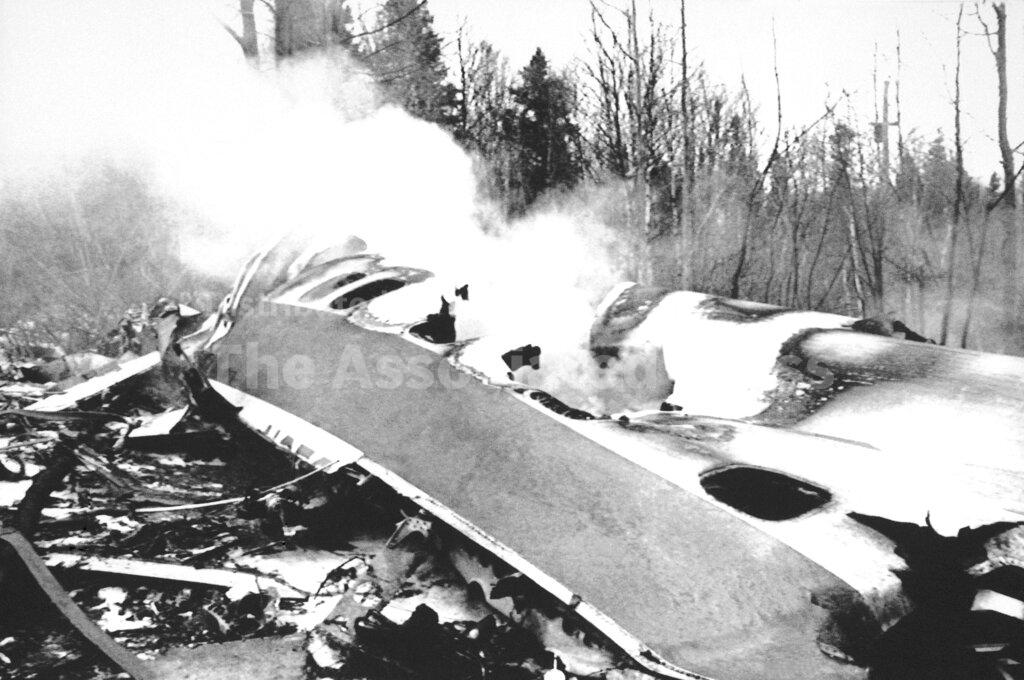
An air crash killed all 258 people aboard, all but eight of them American soldiers heading home for Christmas. The chartered airliner, Arrow Air Flight 1285R, due in Fort Campbell, Kentucky, crashed on takeoff at the Gander, Newfoundland, international airport.The soldiers were returning to Fort Campbell, Kentucky, from Cairo by way of Cologne, West Germany, after a six-month tour of duty with the international peacekeeping force in the Sinai Peninsula. The other eight dead were believed to be crew members. American and Canadian officials said there were no preliminary indications of sabotage. In Washington, the chief Pentagon spokesman, Robert Sims, said the crash was probably the worst American military air disaster ever. Canadian officials said the death toll was the highest ever in a crash on Canadian soil.
A United States military spokesman said the soldiers were members of 502d Infantry of the 101st Airborne Division, with most thought to be from the Third Battalion. Their relatives and friends had been preparing a brass-band welcome for them at Fort Campbell. The plane, a DC-8 operated by Arrow Airlines of Miami, faltered as it lifted off from the runway, plowed through a spruce and birch forest and exploded. The crash occurred just before daybreak, at about 6:45 AM local time (5:15 AM Eastern Standard Time).
Relatives and friends of the 250 members of the 101st Airborne Division due in Fort Campbell, Kentucky, were overcome by shock and disbelief. The Army set up a family assistance center to console them. The banners had been hung in the post gymnasium and the division band was prepared to play at a ceremony welcoming 250 members of the 101st Airborne back from almost six months in Sinai. But when Colonel John P. Herring went before a gathering of about 200 people at 9 this morning, the banners were down and the band instruments still in their cases. His message was grim. Yes, he told them, a plane that crashed in Gander, Newfoundland, was the one that had been chartered to bring their husbands, fathers, fiances and friends home.
Then, the methods the Army has developed to handle casualties and grief in wartime were put into motion for this unexpected peacetime tragedy. A family assistance center was set up to comfort the relatives of the probable victims, even though positive identification of the dead is not expected before next week. Two chapels were kept open all night with clergymen available for anyone who wanted to visit. Officers of the famed airborne division, which has headquarters at this sprawing base in the rolling hills astride the Tennessee-Kentucky border, described the mood on the post as one of “shock and disbelief.”
Arrow Air, whose plane crashed in Newfoundland yesterday, was one of 16 airlines receiving significant penalties after a government inspection of 327 American carriers in early 1984. The Miami-based company was barred by the Federal Aviation Administration from carrying out expansion plans pending the correction of shortcomings found by the inspectors. The problems were cleared up later in the year and the restrictions lifted. The deficiency found most worrisome by the aviation agency was in procedures that allowed for overly long deferral of maintenance. Other problems included inadequacies of training and operations manuals, and failure to keep proper training records.
The accident was investigated by the Canadian Aviation Safety Board (CASB), which determined that the probable cause of the crash was the aircraft’s unexpectedly high drag and reduced lift condition, most likely due to ice contamination on the wings’ leading edges and upper surfaces, as well as underestimated onboard weight. A minority report stated that the accident could have been caused by an onboard explosion of unknown origin before impact, with one of these dissenting investigators later telling a United States congressional committee that a thin layer of ice could not bring down the aircraft. The dissenting report led to delays in changes to de-icing procedures, and a thin layer of ice caused the deadly crashes of Air Ontario Flight 1363 in Canada in 1989 and USAir Flight 405 in 1992. The report also noted the inadequacy of the data from the antiquated foil-tape flight data recorder, which recorded only airspeed, altitude, heading, and vertical acceleration forces. The plane also took off with a non-functioning cockpit area microphone. There were no steps on any of the standard checklists to test the microphone’s functionality, despite the existence of a button in the cockpit for that sole purpose. The defect went undetected for an indeterminate number of flights leading up to the accident flight, and thus the cockpit voice recorder (CVR) did not record any useful data.
Soviet leader Mikhail S. Gorbachev said his country has dismantled the launchers for SS-20 missiles that he previously said had been withdrawn from standby alert in Europe, Tass news agency said. In Paris in October, Gorbachev said missiles that had been on standby alert west of the Ural Mountains had been removed. These missiles were in addition to the 243 SS-20s already deployed on Soviet territory in Europe.
A U.S.-Soviet environmental accord was approved by President Reagan and Mikhail S. Gorbachev at their meeting in Geneva last month, Administration officials said. The agreement ranges from the monitoring of global air pollution to an exchange of wild animals. The accord was reached in Moscow just before the summit meeting as a result of negotiations between delegations headed by Lee M. Thomas, administrator of the Environmental Protection Agency, and Yuri A. Izrael, chairman of the Soviet Government’s State Committee for Hydrometeorology and Environmental Control. A joint statement issued in Geneva after the summit meeting said consultations on new cooperative projects in the environmental field were to be held next year in Moscow and Washington.
A telephone call from Yelena Bonner to her husband, Andrei D. Sakharov, in the Soviet Union, was cut short by intentional static when she tried to say she had seen films of him made with hidden cameras, Bonner’s daughter said. The daughter, Tatiana Yankelevich, said the two reassured each other about their health during their first conversation since Bonner left the Soviet Union on December 2 for medical treatment in the West. Bonner, in Newton, Mass., told her husband that she has had minor surgery to remove a tumor from her lower lip. Tests will be conducted to determine if it is malignant.
A KGB unit abducted 12 Lebanese extremists and killed one of them after gunmen executed one of four Soviet hostages in Beirut in October, the London Daily Mail said. Quoting intelligence sources from an unidentified country, the Mail said that the KGB team sent the body back to the group’s leader with a message saying, “Release our three hostages or we will shoot yours one by one.” The four Soviets were kidnapped September 30, and two days later the body of one was found shot to death.
The State Department said today that Americans would replace substantial numbers of Soviet citizens working at the United States Embassy in Moscow. Some foreign nationals employed at embassies in Eastern Europe will also be replaced, but to a lesser extent, the spokesman, Charles Redman, said. He said the purpose was “to counter intelligence threats against our embassies abroad.” Drivers, guards and mechanics are among the workers involved. A total of 205 Soviet nationals work at the embassy in Moscow and 29 others at the consulate in Leningrad, which is also affected by the move. The State Department has been under pressure from Congress to dismiss all foreign nationals as a safeguard against espionage. The department resisted, saying it could cause personnel problems and cost $17 million to $18 million.
The North Atlantic Treaty Organization, in an effort to cut defense costs, announced formal agreement today on a plan for cooperation in development of new conventional weapons systems. Noting that the new legislation in the United States to force a balanced Federal budget would bring pressure for stringent reductions in expenditures, Secretary of State George P. Shultz told allied foreign ministers that the new arms development plan “was an idea whose time has come.” NATO called for such cooperation as long ago as 1950, but the idea did not take hold because the various armed forces favored their own national suppliers. David M. Abshire, the United States Ambassador to NATO, said 11 companies in 7 countries were building competing antitank weapons. Eighteen companies in 7 countries are designing and producing ground-to-air weapons, he said. And 16 companies in 7 countries are working on air-to-ground weapons.
A former Italian intelligence official being held in jail in New York City has been indicted with others in Italy on a new charge of “masterminding” the 1980 bombing of the Bologna train station that killed 85 people. The former official, Francesco Pazienza, denied the charge in a telephone call yesterday from the Federal Metropolitan Correctional Center. He attributed the accusation to “disinformation” that he said enemies had spread to discredit him. The new indictment, announced Wednesday in Bologna, follows an earlier charge, which Dr. Pazienza has also denied, that he and others conspired to cover up responsibility for the bombing by right-wing terrorists by blaming the attack on leftists.
The new director of a United Nations agency providing care for nearly two million Palestinian refugees has warned that his agency faces the worst financial crisis of its history and that further cutbacks in services will bring increased instability in the Middle East. Speaking in the New York office of the United Nations Relief and Works Agency for Palestinian Refugees in the Near East, the agency’s new Commissioner General, Georgio Giacomelli, said, “Either we get the money or we cut the programs.” Mr. Giacomelli, an Italian, joined the agency in November after Olof Rydbeck of Sweden retired. The agency’s programs focus on providing education and medical care for refugees in Jordan, Lebanon, Syria and the Israeli-occupied West Bank and Gaza. The agency began as a temporary organization in 1949, but today its schools and clinics are a seemingly permanent feature of the Middle East. The agency has an annual budget of about $200 million and a roster of some 17,000 Palestinian employees.
The only surviving suspect in the hijacking of the Egyptair Boeing 737 forced to Malta last month was formally charged today with 16 counts of hijacking, murder and assault. The police brought the suspect, Omar Mohammed Ali Rezaq, 22 years old, a Lebanese-born Palestinian, to the Valletta Law Courts under heavy escort and Magistrate Carmelo Farrugia Sacco ordered a police officer to read 16 counts against him. The murder charges were for the killing of two women shot during the hijacking. One was an American, Scarlett Rogenkamp, 38, of Oceanside, California, and the other an Israeli, Nitzen Mendelson, 23. Egyptian commandos stormed the airliner on November 24. Fifty-eight other people aboard the plane, including at least two hijackers, were killed in the raid.
The U.S. is sharing less intelligence data with Israel since Jonathan Jay Pollard, an American Navy analyst, was arrested November 21 on charges of spying for Israel, according to a senior Pentagon official. The official, Richard L. Armitage, Assistant Secretary of Defense for International Security Affairs, explained in an interview that a resumption of close intelligence relations would have to wait until an American team in Israel has finished questioning Israeli officials involved in the case. “In some areas there has been a slowdown in intelligence cooperation -not in vital areas,” Mr. Armitage said in answer to a question. “And we’re waiting the results of the Pollard fact-finding investigation.” He said American officials assume that “full cooperation will be forthcoming” in accordance with a statement to that effect by Prime Minister Shimon Peres.
West Beirut and other Muslim areas of Lebanon were paralyzed by a one-day strike called to protest sharp price increases triggered by a government cut in fuel subsidies. Shops, banks and restaurants were closed, and protesters marched through the streets of West Beirut, blocking roads with burning tires. Fuel prices have doubled since Nov. 30, when Finance Minister Camille Chamoun, a Christian, slashed state subsidies to keep the economy from collapsing. Meanwhile, West Beirut remained peaceful as a cease-fire held.
Said Rajaie-Khorassani, the Iranian delegate, said today that he would attend a Security Council meeting on the Iran-Iraq war if the Council were to adopt the position voiced by Secretary General Javier Perez de Cuellar of the United Nations. The United Nations chief has condemned the use of chemical weapons and the bombing of civilian targets in the war. The Iranian said at a news conference that if the Security Council accepted these statements, “I will just greet the president of the Security Council and, if he holds a meeting regarding our issue, I will attend that meeting.” Iran has refused to acknowledge past resolutions of the Security Council on the ground that they favored Iraq.
Iranian officials said today that the Iraqi Air Force had started using a new antipersonnel rocket apparently capable of killing people within 40 yards of the point of impact. Such a rocket was said to have been used Tuesday in an air attack on this town near the Iran-Iraq border. The raid reportedly killed 14 people and wounded 30.
Nearly three years after seizing power in a coup, Lieutenant General H. M. Ershad has yet to succeed in arranging an election to legitimize his rule in Bangladesh, according to politicians and diplomats here. Aides to General Ershad say he plans to hold an election next spring, and that his newly built political organization should propel him to victory as an elected President of Bangladesh. But General Ershad, who declared himself President in 1983, has scheduled elections three times in recent years, only to call them off after the collapse of negotiations with opposition leaders on the terms of the voting. Each time, the opposition leaders have said they would boycott the election rather than participate in balloting they considered neither free nor fair.
A House subcommittee today cited for contempt of Congress two New York men who refused to answer questions on purported holdings in the United States of President Ferdinand E. Marcos of the Philippines and his wife, Imelda. The contempt action, approved by 6 votes to 3, cited Joseph Bernstein, a lawyer who helps foreigners invest in the United States, and his brother, Ralph Bernstein, who is the head of a New York City real estate company. The two have been linked in court records and published reports to real estate transactions involving the Marcoses. Both refused to testify in closed hearings before the House Foreign Affairs subcommittee on Asian and Pacific affairs on Wednesday night on the ground of the attorney-client privilege. Ralph Bernstein is not a lawyer.
Corazon Aquino vowed today, on her first presidential campaign tour, to obtain justice for her slain husband and “all the victims” of President Ferdinand E. Marcos. Tens of thousands of Filipinos cheered her. Mr. Marcos remained in Manila, scoffing at opposition expectations of victory. “I do not, of course, expect them to win,” he told a group of farmers at the presidential palace, adding that “there is not one single survey out of about 100” where the opposition is projected to win. Mrs. Aquino spoke to more than 7,000 people who filled a school playground in this provincial capital 55 miles south of Manila. With her on the trip was former Senator Salvador Laurel, her vice presidential running mate and a native of the province. Mrs. Aquino said: “I am not out to seek revenge, but I want justice for all the victims of Marcos. I will go to all corners of the Philippines to appeal to the people because only you can give me the justice I’m looking for.”
Left-wing guerrillas accepted an invitation from El Salvador’s National University to participate in a peace debate with the government, provided their safety is guaranteed. The rebel radio station said that the Farabundo Marti National Liberation Front, the guerrillas’ umbrella organization, is willing to attend the debate, proposed for Saturday. The Salvadoran government has not yet responded to the university’s invitation.
A Nicaraguan rebel leader said this week that the Nicaraguan Democratic Force, the largest of the groups trying to overthrow the government in Managua, had obtained “about 20” portable SA-7 antiaircraft missiles, which he said were purchased this year. Aristides Sanchez, a member of the directorate of the Democratic Force, said in an interview here on Monday that his forces had suffered heavy casualties in several encounters with Soviet-built attack helicopters. But he said said the insurgents’ acquisition of the SA-7’s, which are also of Soviet manufacture, had made them optimistic about their ability to defend themselves against the attack helicopters, known as MI-24’s. “Now, the Sandinistas know that our units travel with SA-7’s and that one of their helicopters can be hit by a rocket at any moment,” Mr. Sanchez said.
Vice Admiral John M. Poindexter, President Reagan’s new national security adviser, made a swing through Central America today, including a stop in Tegucigalpa to plead with the Honduran military to permit the transit of aid to Nicaraguan rebels. American Embassy officials said Admiral Poindexter met for two hours this afternoon at the United States military base at Palmerola with General Walter Lopez Reyes, the Honduran chief of staff.
Hortensia de Allende, the widow of the Chilean President who died in a 1973 coup, began a speaking tour in Boston today after being allowed to come to the United States despite initial Government objections. Supporters said the tour represented a setback for the current State Department practice of denying visas to aliens whose politics it dislikes. Mrs. Allende, whose husband, Salvador Allende Gossens, a Marxist, was overthrown in September 1973 in a right-wing military coup, had accepted an invitation to speak in 1983 from several academic institutions here, but was denied a visa on the grounds that her presence in the United States “would be prejudicial to the public interest,” according to James P. Callahan, a spokesman for the Bureau of Consular Affairs.
South African riot police charged into a crowd and broke up an anti-apartheid candlelight protest by 600 white and mixed-race demonstrators in a white suburb of Cape Town, officials said. Two whites and a mixed-raced man were arrested, but no injuries were immediately reported. Meantime, police in Cape Town released 12 anti-government activists from seven weeks of detention, but two of those freed were served with orders restricting their movements and barring them from taking part in activities of the United Democratic Front, the largest of South Africa’s anti-apartheid groups.
A South African troop carrier struck a land mine today near the border with Zimbabwe. A soldier was slightly wounded in the explosion, the sixth such blast in two weeks. Army officers said they believed the mine was planted at the same time as five others that exploded on November 26 and 27, killing a black farm laborer and wounding six others. The land mines were of a Czechoslovak type once used by guerrillas in the war against white rule in what was then Rhodesia and is now Zimbabwe. The South African Defense Force said the mine that exploded today was planted in the middle of a dirt road near Messina. Soldiers found and defused four other land mines after the explosions last month. They have conducted daily security patrols along the border with Zimbabwe since then. The South African authorities have attributed the mine attacks to the outlawed African National Congress, which seeks to overthrow the government.
The House and Senate, deadlocked over federal spending in 1986, tonight adopted a stopgap money bill to keep the government running through Monday. The move came late in the day, against a midnight deadline, as the House and Senate grappled with fiscal and other measures, including a major farm bill, left unfinished after their agreement Wednesday on a budget-balancing measure. That measure, which President Reagan signed this morning, calls for reducing the deficit in steps, to zero by 1991. While hailing it as a “landmark,” Mr. Reagan said the measure had “constitutionally suspect provisions” that called for Congress to share in duties that he said belonged to the executive branch. Representative Mike Synar, Democrat of Oklahoma, filed a lawsuit challenging the measure’s constitutionality. Both Democratic and Republican lawmakers said the measure shifted power toward the executive branch. House Speaker Thomas P. O’Neill Jr. said, “There is no question that Congress has given up power.” Republicans in the House continued to resist the President’s tax legislation, and Mr. O’Neill said he would not allow a vote unless the President could promise at least 50 Republican votes for the revision bill. The stopgap money bill approved this evening, first by the House and then the Senate, is to finance some Government operations through 6 PM Monday. The White House said Mr. Reagan was expected to sign the bill Friday morning.
The budget must be balanced by 1991, under a bill signed by President Reagan.
Congressional negotiators agreed on a major commodity program in the 1985 farm bill, deciding to operate the Government’s sugar price-support program at no cost to the taxpayers. The action would cut sugar import quotas held by third-world countries by one third.
President Reagan attends a Cabinet Council meeting to discuss the 1987 budget.
President Reagan calls Major General Burton Patrick, Commanding Officer of the 101st Airborne Division, who lost 250 men in a plane crash earlier that morning.
Attorney General Edwin Meese III was formally asked under the Ethics in Government Act by the House Judiciary Committee to seek a special prosecutor to investigate possible wrongdoing by Reagan Administration officials in a dispute over Superfund documents. Committee Chairman Peter W. Rodino Jr. (D-New Jersey) wrote Meese that a special prosecutor is especially needed in this case because some of the allegations involve former Justice Department officials.
$50 billion in domestic spending cuts must be made in the next fiscal year to reduce the deficit to the level specified in the measure signed by President Reagan, according to James C. Miller 3d, the Federal budget director.
Health and Human Services Secretary Margaret M. Heckler said she has given preliminary approval to a regulation allowing radiation treatment of fresh fruits and vegetables, provided they carry a label that they have been “picowaved.” The department said Heckler approved the expansion of radiation treatment, calling it “a proven, safe method to protect fresh fruits and vegetables from insects, and to inhibit spoilage and extend shelf life.” The regulation now goes to the White House Office of Management and Budget for approval.
Forty-four people, a bank and two companies were accused in federal indictments of being involved in drug and money-laundering rings possibly linked to the torture-slaying in Mexico of U.S. Drug Enforcement Administration agent Enrique Camarena Salazar. Almost $34 million in drug-related assets have been seized in the case and more is being sought, Assistant U.S. Atty. Charles Lewis said. Indictments returned this week in San Antonio and unsealed Wednesday were the result of a two-year investigation by a Houston-based task force created in 1983. Twenty-six people were arrested Wednesday and more arrests were expected, Lewis said.
A federal judge hearing a lawsuit on behalf of illegal Salvadoran aliens today accused government lawyers of withholding details of torture and killings in the Central American country. “If somebody in El Salvador did that, that would be normal,” Federal District Judge David Kenyon said. “But if someone in our own government were to do it, that could be disturbing.” Judge Kenyon is hearing a lawsuit that seeks to force immigration agents into advising illegal aliens from El Salvador who are arrested of their right to request political asylum. Allen Hausman, a Justice Department attorney, has conceded that the government is withholding State Department reports on the frequency of killings, torture and unwarranted detention of civilians in El Salvador. He said Secretary of State George P. Shultz would declare the documents state secrets to keep them out of court and out of the hands of attorneys representing Salvadoran refugees.
Leszek Kapsa, the Polish ship’s cook who jumped ship at Cleveland nearly two weeks ago was granted political asylum by the U.S. Immigration and Naturalization Service. Kapsa, 27, a cook aboard the Ziemia Lubelska, left the cargo ship December 1 and applied for political asylum three days later accompanied by Sen. Howard M. Metzenbaum (D-Ohio). INS officials said Kapsa feared he would be persecuted if he returned to Poland.
Upjohn Co. of Kalamazoo, Michigan, has completed testing of a drug touted as a cure for baldness and this month will ask the U.S. Food and Drug Administration to approve prescription sales of the drug, the company said. Under the name Loniten, the drug has been prescribed for years to control high blood pressure. As a baldness cure, it will be called Minoxil [later becomes Minoxidil]. “It’s still experimental,” said Jan Ausderheide, an Upjohn spokeswoman. It takes the FDA about two years to decide, she noted.
Governor Dick Thornburgh ended weeks of suspense today by announcing he would not challenge his fellow Republican, the incumbent Senator Arlen Specter, for his seat next year. Since June, Mr. Thornburgh, 53 years old, had been urged to run by conservatives who believed Senator Specter was too liberal for the Republican Party. In announcing his decision not to seek the Senate seat in the 1986 Republican primary, Mr. Thornburgh cited the possibility of a divisive primary contest as a major factor.
A federal court jury in Brooklyn convicted New York state Supreme Court Justice William Brennan of taking bribes of more than $47,000 to fix cases ranging from gambling to attempted murder. The jury of nine women and three men returned its verdict of “guilty on all counts” against the Queens jurist. The 26-count indictment charged Brennan with racketeering, receiving bribes, interstate travel in aid of racketeering, fraud by interstate telephone, attempted extortion and conspiracy to engage in a racketeering enterprise.
A man who requested action on a traffic ticket pulled a toy gun and took two attorneys hostage in a judge’s chamber in Chicago, but surrendered two hours later with a guarantee he could visit his hospitalized daughter. “The key (to a peaceful resolution) was his daughter,” said Deputy Police Chief Charles Pepp. Pepp said medical records showed the man, identified as Alvin Byndom, had been diagnosed previously as schizophrenic.
The deal for General Electric to buy the RCA Corporation, the biggest non-oil merger in American history, took just 34 days to put together. The six days before the announcement involved frantic, often round-the-clock discussions at a lower Manhattan law firm, at General Electric’s headquarters in Fairfield, Conn., and finally at General Electric’s Waldorf Towers suite.
Officials at a Houston hospital where bacterial infections in the newborn intensive care unit have killed one baby and made 25 others ill say that the infections were probably spread by doctors and nurses who failed to wash their hands. Although staff members are expected to wash their hands after treating each patient, when an emergency case comes in “they don’t always,” Dr. Garcis-Prats, deputy director of nurseries at Jefferson Davis Hospital, said Wednesday. “They opt to treat the sick patient. That’s probably the most logical explanation of what happened.” The infections were noticed in November. Dr. Garcis-Prats said 12 of the infants required treatment with antibiotics. He said the infant who died was “a very small” premature boy.
The steamer Mississippi Queen collided with a tugboat at dusk today and was run aground to keep from sinking, but no injuries were reported among the stern-wheeler’s 431 passengers and crew, officials said. The 272 passengers were given life vests to put over their formal attire and evacuated from the 379-foot excursion boat by tugboats and ferries after the collision at 5:25 P.M. 50 miles upriver from New Orleans.
The City Council of Commerce, Georgia has voted to cancel Friday’s Christmas parade rather than allow the Ku Klux Klan to participate. City officials had said earlier that they could not turn down the Klan’s request to enter a float because the group met all legal requirements.
Anne Baxter died eight days after suffering a stroke in Manhattan. The actress won a supporting Academy Award for her 1946 performance in “The Razor’s Edge” and was most closely identified as a scheming young actress in the 1950 movie “All About Eve.”
With the onset of colder weather, all three strains of influenza that caused the flu in the past now are circulating in the United States, the national Centers for Disease Control reported today. The flu strain A(H3N2), considered the most virulent of the three and the same type that caused pandemics in the 1950’s and 1960’s, is causing widespread illness throughout Alaska. Absentee rates of 20 percent were reported in some school systems, where outbreaks of influenza have been occurring for three weeks.
Ice-coated roads in Texas yesterday caused scores of traffic accidents and forced school closings as a storm swept out of the southern Rockies on a path that curved northward toward the lower Middle West. High winds and record cold brought wind-chill readings as low as 55 degrees below zero to the Great Plains, and whipped snow into blinding clouds. In Vermont, up to six inches of snow fell overnight. In Fort Worth rain froze on overpasses for the second straight day. At 7:30 AM the police said they were working on 75 accidents. Cold, snow and fog nationwide have caused 23 deaths since Sunday. The storm brought the threat of heavy snow to parts of Kansas, Missouri, Arkansas, Illinois and Ohio. In the San Joaquin Valley in California temperatures were expected to drop into the mid-20’s for the third night. Growers said the frost has not seriously damaged the citrus crop. A tenth of an inch of snow fell Wednesday in Phoenix, the first measurable snow there since February 2, 1939. The snow soon turned to rain.
The Yankees trade pitcher Joe Cowley and catcher Ron Hassey to the White Sox for pitcher Britt Burns (18–11) and minor leaguers Mike Soper and Glen Braxton. Hassey will come back to New York before the season’s start. A degenerative hip condition ends Burns’ career before he has a chance to pitch for the Yanks.
The Indians sign free agent Tom Candiotti to a AAA contract. Candiotti (9–13 at Vancouver), who has been throwing a knuckler less than a year, will lead the American League in complete games (17) in 1986.
Dow Jones Industrial Average: 1511.24 (-0.46)
Born:
Andrew Ladd, Canadian NHL left wing (NHL Champions, Stanley Cup, 2006-Hurricanes, and 2010-Blackhawks; Carolina Hurricanes, Chicago Blackhawks, Atlanta Thrashers, Winnipeg Jets, New York Islanders, Arizona Coyotes), in Maple Ridge, British Columbia, Canada.
Jonathan Goff, NFL linebacker (New York Giants), in Atlanta, Georgia.
David Veikune, NFL defensive end (Cleveland Browns, Denver Broncos), in Anchorage, Alaska.
Chris Jennings, NFL running back (Cleveland Browns), in Whittier, California.
Joel Karekezi, Rwandan film director (“The Mercy of the Jungle”), in Rubavu, Rwanda.
Died:
Anne Baxter, 62, American actress (“The Razor’s Edge”; “All About Eve”), and singer, dies of a stroke.
Ian Stewart, 47, Scottish keyboardist, road manager, and co-founder of the Rolling Stones, dies of a heart attack.
 History Diaries