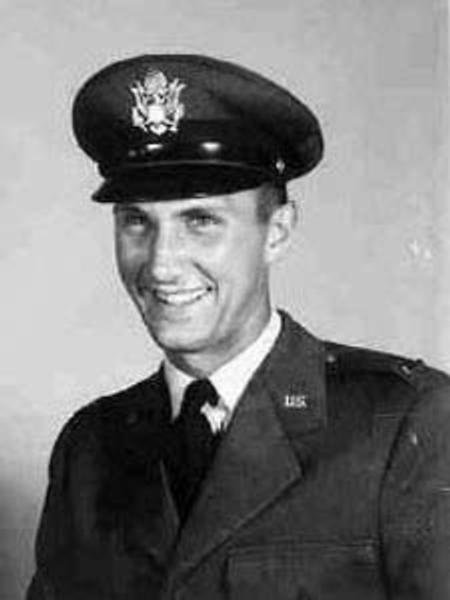
The President of the United States of America takes pride in presenting the Air Force Cross (Posthumously) to Captain Walter Frank Draeger, Jr., United States Air Force (Reserve), for extraordinary heroism in connection with military operations against an opposing armed force as Pilot of an A-1 Skyraider in action on 4 April 1965, over North Vietnam. On that date, Captain Draeger volunteered to fly as a Fighter-Advisor with the Vietnamese Air Force into an area of known heavily concentrated anti-aircraft artillery. He participated in a highly successful bombing mission of a vital Việt Cộng target, contributing materially to its destruction. On the return flight from the primary target, Captain Draeger’s flight leader was shot down by hostile ground fire. Captain Draeger immediately called or search and rescue assistance. Although completely alone and within range of the hostile ground fire, he orbited the area of his downed flight leader until the unarmed search and rescue aircraft arrived in the vicinity. Upon arrival in the area, over which Captain Draeger was flying protective cover, the unarmed rescue aircraft requested fire suppression assistance. Captain Draeger commenced a firing pass to allow the rescue aircraft to safely enter the area. With complete disregard for his own personal safety, he made the strafing run into the hostile fire. Ignoring the air bursts from shore batteries, Captain Draeger pressed his attack and, in so doing, sacrificed his own life. Through his extraordinary heroism, superb airmanship, and aggressiveness in the face of hostile forces, Captain Draeger reflected the highest credit upon himself and the United States Air Force.
Captain Draeger is memorialized on the Courts of the Missing at the National Memorial Cemetery of the Pacific. He is honored on the Wall at Panel 1E, line 100.
During a U.S. Air Force strike on the Thanh Hóa Bridge, Vietnam People’s Air Force MiG-17 fighters attacked a formation of U.S. Air Force F-105 Thunderchief strike aircraft, shooting down two F-105s. Captain James Magnusson and Major Frank Bennett were both killed when their jets, the first aircraft lost in air-to-air combat by either side during the Vietnam War, were downed.
North Vietnamese MIG fighter planes shot down two United States Air Force jets that were taking part in a bombing attack on a bridge yesterday. The MIG’s appeared during one of four attacks by planes of the United States Air Force. and Navy and the South Vietnamese Air Force on bridges and roads in North Vietnam. The assault by the MIG’s marked the first clash between Communist and American planes in Vietnam.
The drowned body of one American pilot was later found at sea. Search operations were continuing for the second American flier, military sources said. One Vietnamese A-IH Skyraider, piloted by an American, was downed by fire from a Communist vessel. The pilot has been given up as dead. Other aircraft were also known to have been destroyed by ground fire, but details were withheld while the search continued.
The supersonic jet interceptor aircraft that accompanied the American bombers did not appear in time to head off the four MIG-15 and MIG-17 jets that downed the two American F-105 fighter-bombers. The F105 is about twice as fast as the old MIG’s. Major General Joseph H. Moore. commander of the Second Air Division, said United States planes had returned the fire of the MIG’s, which he said bore North Vietnamese markings. But he added, “We didn’t knock down any.” The general said the attacks by the MIG’s were “not unexpected.” He adde, “We have felt that at some point they would feel bold enough to try out their aim.”
An American mission spokesman said, however: “We have obviously entered a new phase.” Asked why the American jet bombers, with their greater speed, had not pursued the MIG’s during the first attack. General Moore replied that the pilots had been instructed to continue with their bombing mission and leave pursuit to the interceptor aircraft, which turned out to be too far north to be effective. MIG’s were first sighted in the air Saturday, but there is still no definite information on whether shots had been exchanged. A United States military spokesman announced yesterday that an American F-100 and an F-105 were also shot down by ground fire Saturday, making a total of at least six American aircraft lost in two days.
General Moore said four MIG’s appeared about 11:20 this morning after the 50 American Air Force bombers had been over the target for about half of the 50 minutes they spent at the site. The strike was the second against a large rail and vehicle bridge near Thanh Hóa that a United States Air Force raid had failed to destroy. General Moore said yesterday’s strike, while it did not destroy the steel bridge, made it unusable. The Air Force planes also struck a thermal power plant near the bridge. General Moore, who described the installation as both industrial and military, said it was about 15 percent destroyed
Until the bombing of bridges Saturday, all targets in North Vietnam had been specifically military supply bases, ammunition dumps, radar installations and troop barracks Fifteen minutes after the first MIG attack, two MIG’s made a pass at some American F-100 rescue aircraft in the target zone. The United States jets unsuccessfully pursued the MIG’s. A little later three MIG’s were observed. General Moore said he did not know whether they were from the first attack group. He said Communist batteries around Thanh Hóa included 37-mm, and 5-mm guns, possibly guided by radar. The South Vietnamese Air Force struck a second bridge, named for the North Vietnamese President, Hồ Chí Minh, this afternoon south of Đồng Hới.
A Vietnamese spokesman said the 350-foot bridge, which linked the provincial capital of Đồng Hới with military installations throughout the 17th Parallel border zone, was destroyed. The attack was made by 2 propeller-driven A-1H Skyraiders, some of them flown by American advisers The Skyraiders were supported by 16 United States jets for flak suppression. The third and fourth strikes against the North yesterday were made by United States Navy planes from the aircraft carriers Coral Ses and Hancock of the Seventh Fleet. A Navy spokesman said five railroad cars and 24 trucks were hit. A total of 45 Skyraiders and Skyhawks flew Armed reconnaissance missions over Highway 1. the major north-south route in North Vietnam, from the demilitarized zone to Thanh Hóa, where the United States Air Force was striking the bridge.
The two F-105’s that were downed today were said to have been caught with full bomb loads and thus were not so maneuverable or so fast as they would have been had they been free of their heavy bombs.
The Defense Department announced today that United States air strikes in the last two days had made “impassable” three bridges that were “vital links in the North Vietnamese transportation system supporting Communist guerilla operation in South Vietnam and Laos.”
[Ed: In point of fact, the U.S. never succeeded in choking off the Hồ Chí Minh Trail supply routes, at least not more than momentarily.]
In Đà Nẵng, Vietnamese policemen apprehended a Việt Cộng agent who had four pounds of plastic bomb material hidden in a portable radio frame. He was picked up in the Grand Hotel, which Americans frequent. He told the police three of his accomplices had also been instructed by the Communists to attempt to blow up American installations in Đà Nẵng.
Việt Cộng guerrillas blew up a passenger train about 10 miles northeast of Saigon today and first reports said many Vietnamese were killed or injured.
Australia Prime Minister Robert Menzies says that the U.S. intervention in Vietnam is an act of moral courage, in that Americans have accepted the challenge to “human freedom.’
Mayor Willy Brandt of West Berlin was barred by the East German police from traveling on the autobahn to his own city today. The Mayor’s car was turned back at a control point near the town of Lauenburg, 174 miles from Berlin, as the Communist regime stepped up its harassing tactics in reprisal for. a scheduled meeting of the Bundestag in West Berlin Wednesday. The Bundestag is the lower house of the West German Parliament. Tonight the East German Government announced that Bundestag Deputies and “other persons” who planned to take part in the meeting would be barred from the land corridors to West Berlin. The announcement, made by the East German press agency A.D.N., made no mention of barring air traffic.
Mayor Brandt said the East German officials had acted with “boundless impudence” in turning him back at the border. It was the first time a governing Mayor of West Berlin had been prevented from passing through East Germany to the city. The Mayor had been returning from the northern city of Lübeck in West Germany, where he visited his mother, who is ill. Later in the day he arrived in Berlin from Hamburg by plane. Mayor Brandt was not the only motorist left fuming by the East German tactics. At the Helmstedt-Marienborn control point farther south, hundreds of autos were kept waiting in a line stretching back two miles. The Communist authorities saw to it that only 10 cars an hour passed into East German territory for the trip to Berlin.
Waiting time to get through the Helmstedt checkpoint exceeded three hours. The East German guards forced motorists to get out of their cars and open their baggage for inspection. At one point last night the waiting time was about seven hours. The East German Government has acknowledged that its harassment techniques on the Berlin autobahns are a direct reprisal for the scheduled Bundestag meeting. East Germany contends that West Berlin is not a part of West Germany and that the Bundestag has no right to assemble there. The East German authorities had indicated before the weekend that they would not permit members of the West German Parliament to drive through their territory. Last Thursday the wife and secretary of a Deputy were denied passage on the autobahn. The Allied commandants in Berlin formally protested Monday on the action against Mr. Brandt, Reuters said.
President Sukarno and Ellsworth Bunker agreed today that the United States and Indonesia should try to minimize some of the irritants that have resulted in a grave deterioration in their relations. Mr. Bunker, a former ambassador who is here as a special envoy of President Johnson, met with the Indonesian President and Dr. Subandrio, the Foreign Minister, for two hours and 45 minutes at the Merdeka (Freedom) Presidential Palace. It was Mr. Bunker’s second meeting with Mr. Sukarno since his arrival last Wednesday. Dr. Subandrio said after the meeting that the talks had brought “an agreement to disagree” on specific issues, but that this “should not mar the relationship between both sides. Even if we cannot reach an agreement on all specific issues,” he said, “then at least we should minimize irritations on both sides.”
The largest plant in the world that both produces electric power and removes the salt from sea water will be formally turned over to the United States Navy in a few days. The ceremony will mark a definitive milestone in making the United States naval base. here completely independent of Fidel Castro’s Cuba. The base now generates all its own electricity and processes all its fresh water from the sea. The Cuban “commuters” working on the base, who once numbered thousands, have been reduced to 561. Jamaican laborers under 120-day contracts have been imported to replace the Cubans. All food and other supplies — much of them once bought in Cuba — now come to the base by ship or plane.
Seven shofars sounded piercingly seven times yesterday afternoon on East 67th Street as a symbolic reminder of the collapsing wall at the Battle of Jericho and in denunciation of the Soviet Government’s suppression of Jewish religious and cultural rights. 3,000 Jewish men and women marched in protest of Soviet treatment of Jews in the Soviet Union.
Italy’s biggest labor organization, the Communist-dominated General Confederation of Italian Labor, has confirmed in a four-day congress here its unwillingness to cooperate with government economic planning for anything less than an all-out Marxist state.
Soviet party chief Leonid I. Brezhnev and Premier Alexei N. Kosygin entrained for Warsaw to sign a new friendship and mutual assistance treaty with Poland.
Communist China and the Soviet Union were reported today to be negotiating large wheat purchases from Argentina.
Ban on flying over Western Uganda along the troubled Congolese border has been extended in some places to a strip 100 miles wide. Operators of commercial and private aircraft have been warned they may be shot down without warning if they venture into the area.
Prince Philip said today his role as husband of Queen Elizabeth II prevented him from indulging in small pleasures like visiting a pub or catching a movie.
President Johnson named today a 12-man special Presidential committee to study tile possibilities and implications of expanding United States trade with Eastern Europe and the Soviet Union.
American, British and French airplane manufacturers were reported today to be competing intensely to sell supersonic fighter planes to Saudi Arabia.
The coronation of Palden Thondup Namgyal as the King of Sikkim took place at a Buddhist chapel in Gangtok, the capital of the protectorate of India, as Sikkim’s 170,000 citizens were permitted to watch on a special television circuit. Palden, who had succeeded upon the death of his father, Tashi Namgyal, on December 2, 1963, was crowned Chogyal and his wife, the former Miss Hope Cooke of San Francisco, wore the crown of the gyalmo (Queen consort). The monarchy would be abolished almost ten years to the day afterward, on April 10, 1975, and Sikkim would become the 23rd state of India.
The first model of the new Saab Viggen fighter aircraft plane is unveiled. The prototype will make its first flight in February, 1967. The Saab 37 Viggen was a single-seat, single-engine multirole combat aircraft designed and produced by the Swedish aircraft manufacturer Saab. It was the first canard-equipped aircraft to be produced in quantity and the first to carry an airborne digital central computer with integrated circuits for its avionics, arguably making it the most modern/advanced combat aircraft in Europe at the time of introduction. The digital central computer was the first of its kind in the world, automating and taking over tasks previously requiring a navigator/copilot, facilitating handling in tactical situations where, among other things, high speeds and short decision times determined whether attacks would be successful or not, a system not surpassed until the introduction of the Panavia Tornado into operational service in 1981. 329 aircraft were produced in a number of variants, all for the Swedish Air Force.
Congress moves tomorrow into what could be the single most important week of the session, with action scheduled on medical care for the aged and aid to the nation’s schools. Seldom have two such major bills come up for floor action in a single week. Both are being pushed vigorously by President Johnson. The $1.3 billion school-aid bill, already passed by the House, is expected to reach the Senate floor on Wednesday and could become law before the end of the week. The House is expected to begin debate Wednesday on a bill to provide medical care for the aged and increases in Social Security benefits. Waiting in the wings, once the Senate completes action on the school bill, will be the Administration’s voting-rights legislation.
The Senate Judiciary Committee faces a Friday deadline for reporting the voting-rights bill to the floor. It is possible, but not likely, that Senate action on the school legislation will be completed in time for floor debate to begin Friday on voting rights. Mike Mansfield of Montana, the Senate majority leader, said today that he thought the school bill “will take us at least through Friday, maybe even Saturday.” Senator Mansfield and other Democratic leaders hope to steer the school-aid bill through the Senate without change. This would avoid having to send the bill to conference to work out differences with the House. The school bill cleared a Senate Education subcommittee Thursday in exactly the same form in which it passed the House. The full Senate Labor and Public Welfare Committee is scheduled to act Tuesday, in time for floor action Wednesday.
Blacks worshiped at one previously all-white church in Montgomery, Alabama today, but two churches refused to admit two other groups.
KKK Imperial Wizard Robert Shelton said the Ku Klux Klan would neither accept nor heed the “megalomaniac” mandates of President Johnson.
The chairman of the House Committee on Un-American Activities said his group is turning up evidence of systematic planning of violence in some Klan organizations.
Senator John L. McClellan, Democrat of Arkansas, has asked President Johnson to designate Vietnam a combat zone for income tax purposes to give American military men there the same exemptions that were afforded men in the Korean war.
President and Mrs. Johnson surprised a Hagerstown (Maryland) Baptist minister and his congregation when they showed up for Sunday morning services.
Four cave explorers were trapped by a flooding underground stream in a cave in Arkansas. Rescuers believed they were above water level.
The president of the National School Boards Association told the convention in Boston that school board members may as well face up to the fact of increasing involvement of the federal government in education.
A new skirmish in the long battle over future manned bombers is scheduled in the Senate this week.
The Democratic National Committee said today that the Republicans had tried to exploit racial and ethnic prejudices in the 1964 campaign and failed utterly.
The first nuclear reactor in outer space went into full operation and the Atomic Energy Commission announced that the success “represents a significant advance in this country’s space and atomic energy program.” The first atomic-power reactor for a spacecraft was whirling methodically around the globe every 112 minutes today, churning out a 600-watt flow of electricity in a historic test.
New York Mayor Wagner urged the printers and publishers last night to continue to make “every conceivable effort” to settle their dispute and avoid a strike that might affect seven of the city’s daily newspapers.
Born:
Robert Downey Jr., American actor (‘Tony Stark’ – Marvel Universe movies, “Iron Man”, “Avengers”), in Manhattan, New York, New York.
Elaine Zayak, former U.S. figure skater who overcame the loss of part of her left foot to win the women’s world figure skating championship in 1982; in Paramus, New Jersey.
Jessie Tuggle, NFL linebacker (Pro Bowl, 1992, 1994, 1995, 1997, 1998; Atlanta Falcons), in Spalding County, Georgia.
Tony Burse, NFL running back (Seattle Seahawks), in Lafayette, Georgia.
Chad Stark, NFL running back (Seattle Seahawks), in Decorah, Iowa.

