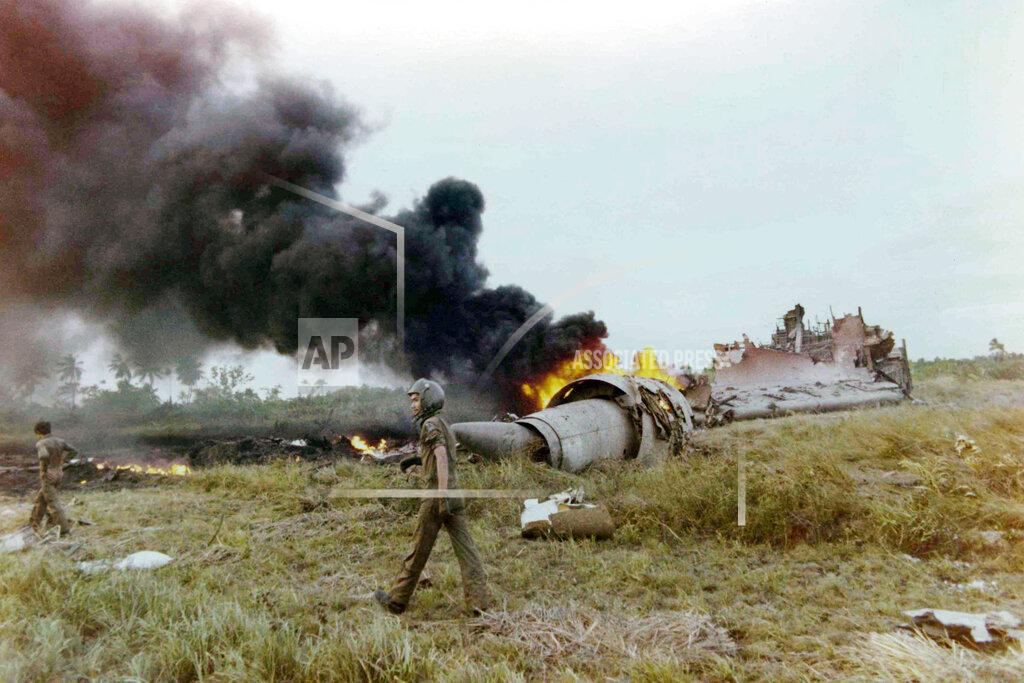
A major U.S. airlift of South Vietnamese orphans begins with disaster, as an Air Force C-5A cargo jet crashes shortly after take-off, killing more than 100 children. Two thousand others, most of them orphans of U.S. servicemen, are eventually taken to the United States for adoption. The first military Operation Babylift flight crashed 27 minutes after takeoff, killing 144 of the 305 people on board, including 78 of the 243 children. Two cargo doors blew off of the jet, largest in the world at the time, as it reached 23,000 feet during the evacuation of civilians in the closing days of the Vietnam War.The first flight was aboard a U.S. Air Force Lockheed C-5A Galaxy heavy lift transport, serial number 68-0218, piloted by Captains Dennis W. Traynor III and Tilford Harp.
A medical team from Clark Air Base, The Philippines, commanded by First Lieutenant Regina Claire Aune, Nurse Corps, United States Air Force, was aboard when the huge transport plane landed at Tan Son Nhut Air Base in Saigon. When it was discovered that there would be about 250 orphans aboard, many of them sick or injured, another medical team from a C-141 Starlifter volunteered to accompany Lieutenant Aune’s team for the outbound flight.
When the Galaxy took off from Saigon at 4:00 p.m., there were 328 people aboard, including flight crew, medical teams, orphans and their escorts, as well as other U.S. personnel.
The C-5A quickly climbed to 23,000 feet (7,010 meters). Just a few minutes after takeoff, the locks of the rear loading ramp failed. Explosive decompression hurled people and equipment throughout the airplane which instantly filled with fog. Lieutenant Aune was thrown the entire length of the upper deck. The airplane was severely damaged with two hydraulic systems inoperative and many flight control cables severed.
The pilots could only control the airplane with engine thrust. They began an emergency descent and turned back to Tan Son Nhut.
Unable to maintain flight, at about 4:45 p.m., the Galaxy touched down in a rice paddy two miles short of the runway at 270 knots (500 kilometers per hour). It slid for a quarter mile, became airborne for another half mile, then touched down and slid until it hit a raised dike and broke into four sections. 138 people were killed in the crash.
Although herself seriously injured, Lieutenant Aune began evacuating the children. When rescue helicopters arrived, they were unable to land close to the wrecked transport, so the children had to be carried.
After she had helped to carry about eighty babies, Regina Aune was unable to continue. She asked the first officer she saw to be relieved of her duties and then passed out. At a hospital it was found that she had a broken foot, broken leg and broken vertebra in her back, as well as numerous other injuries.
Regina Aune became the first woman to be awarded the Cheney Award by the Air Force, which was established in 1927 and is awarded “to an airman for an act of valor, extreme fortitude or self-sacrifice in a humanitarian interest, performed in connection with aircraft, but not necessarily of a military nature.“
11 members of the crew of the Galaxy were among the dead, including Captain Mary Therese Klinker, Nurse Corps, United States Air Force.
Mary Therese Klinker was born at Lafayette, Indiana, 3 October 1947. She was the daughter of Paul Edward Klinker and Thelma Mary Deane Klinker. She attended Central Catholic High School in Lafayette, graduating in 1965. She then enrolled at St. Elizabeth’s School of Nursing, also in Lafayette. She graduated as a Registered Nurse, May 1968. On graduation, Miss Klinker worked for St. Elizabeth’s.
Miss Klinker joined the United States Air Force, 9 January 1970, and was commissioned as a lieutenant in the Nurse Corps. She qualified as a flight nurse and was promoted to the rank of captain. In 1974, Captain Klinker was assigned to the 10th Aeromedical Evacuation Squadron, Travis Air Force Base, Fairfield, California.
Captain Mary Therese Klinker, Nurse Corps, United States Air Force, 10th Aeromedical Evacuation Squadron, was the last United States service woman to die in the Vietnam War. Captain Klinker was posthumously awarded the Airman’s Medal and the Meritorious Service Medal. She is buried at St. Boniface Cemetery in her home town of Lafayette, Indiana.
Colonel Regina C. Aune had a very impressive career in the Air Force. She earned a master of Science in Nursing degree, and a Ph.D. She served as Chair of the Department of Nursing Research, Commandant of the Graduate School of Nursing and Deputy Brigade Commander at the Uniformed Services University of the Health Sciences. Aune commanded the 437th Medical Operations Squadron and the 437th Medical Group, Charleston AFB, the 377th Medical Group, Kirtland AFB, the 59th Medical Group, Lackland AFB, and the 386th Expeditionary Medical Group, Kuwait in support of Operation IRAQI FREEDOM. She retired in 2007, and passed away, 27 March 2024.
The pilots, Captain Dennis W. Traynor III and Captain Tilford W. Harp, were both awarded the Air Force Cross for what General Paul Carlton, Commander, Military Airlift Command, called “one of the greatest displays of airmanship I have ever heard related.”
A vast southward movement of North Vietnamese troops was reported in Saigon as Communist units carried out probing actions along South Vietnamese government defense lines in an arc around Saigon. But no major battles or further government military reverses were reported. In fact, a military spokesman announced that the government had now re‐established contact with the coastal cities of Nha Trang, Phan Rang and Phan Thiết, which had previously been reported abandoned to the Communists without a fight. According to some Western officials, the Saigon Government assumed that the cities were lost when commanders, soldiers and refugees fled.
At Nha Trang, the most important of the three and the reported scene of looting by government troops Tuesday and Wednesday, the commander of a small artillery unit retreating through the city reportedly called Saigon by radio and asked permission to assume command. This surprising request was granted, and the South Vietnamese Air Force sent small teams to each of the three places yesterday to reopen communications facilities. But how long the isolated troops there could hold out against the large Communist forces nearby appeared uncertain. Western intelligence officials, meanwhile, were reporting that North Vietnam was now believed to be moving all but one of its eight reserve divisions into South Vietnam.
The commitment of almost all of Hanoi’s troops to the South, these analysts say, appears particularly ominous because it comes at a time when the balance of power has already been tipped in the Communists’ favor. North Vietnam, whose infantry divisions usually consist of 8,500 men at full strength or more if support units are added, is estimated to have 20 divisions excluding the reserve units inside South Vietnam. By contrast South Vietnam, which has fielded divisions of 12,500 men at full strength, has only 7 of its 13 left. Six divisions have disintegrated over the last three weeks as large sections of the country have been abandoned, and their tanks, artillery and even trucks have been lost.
Intelligence specialists have long looked upon Hanoi’s reserves as an accurate indication of the Communists’ military intentions. When the North Vietnamese staged a major offensive in the spring of 1972, for example, it was preceded by large‐scale infiltration in the South of those troops. But analysts say they have never before detected Hanoi sending so many of its reserves southward. During the American military involvement, the Communists usually held more back for defense against a possible American threat to North Vietnam.
The movement south is believed to have begun in late February or early March with the 341st Reserve Division. One regiment or more of that division has already arrived in Bình Long Province, north of Saigon, while another element is said to have turned up in Quảng Ngãi Province, on the north-central coast, and to have contributed to the Communists’ quick success there 10 days ago. Two more reserve divisions are believed to have started south in the first week of March, just as the Communists began their current offensive. But now, analysts say, movement of four more divisions have also been detected.
It was not immediately clear how many of these divisions had actually crossed the demilitarized zone that used to separate North and South Vietnam. Once inside South Vietnam, the new troops presumably can be moved quickly along the new roads the Communists have seized along the northern coast and in the Central Highlands. Beside the probing actions reported on the Saigon defense perimeter, the Saigon command also announced scattered fighting in the populous Mekong River delta south of the capital. The Saigon military spokesman said that government forces there had killed 57 Communists while losing three killed and 32 wounded. The spokesman reported also that Communist gunners had fired four 122‐mm. rockets in Cần Thơ, wounding four persons. Cần Thơ is the largest city and economic center of the fertile delta.
The United States Embassy in Saigon said yesterday that refugees were still able to leave the beaches in the Phan Rang area, 160 miles northwest of Saigon, late Thursday, afternoon. The embassy reported that fishing boats and other small craft had brought more than 1,400 refugees out to the United States Navy amphibious cargo ship USS Durham and 80 others to the USS Dubuque, a Navy landing transport dock. It was said to be first participation in the evacuation by the four‐ship Navy task force that President Ford ordered into Vietnamese waters six days ago. The other American ships that have been evacuating refugees from the north and central coasts for the past week are civilian freighters chartered by the United States Government, and a Navy-owned freighter with a civilian crew.
United States military sources say that the North Vietnamese have almost completed preparations for the final battle in the Saigon area and that they doubt strongly that the Saigon garrison has sufficient troops or weapons to launch a spoiling attack that could seriously interfere with the northerners’ operational plans.
The North Vietnamese forces are massing in the Saigon area, the American sources say, without any sign of effective interference by the South Vietnamese Air Force. Shortages of transport, especially helicopters, the sources believe, will prevent the three South Vietnamese divisions on hand from carrying out a mobile, counterattacking defense. Official Saigon claims of a revival of military activity around the coastal ports of Cam Ranh, Phan Rang, Than Thiết and even Nha Trang are regarded with some skepticism. Sustained counter‐actions by troops in those areas could buoy morale, but there is no expectation that such actions would influence the main battle developing in the Saigon area.
The Southern troops in the coastal area, according to reports reaching Washington, have lost most of their heavy weapons and have used up their fuel and much of their ammunition. They may be able to divert some of the North Vietnamese units that are moving south, but this diversion is unlikely to affect Communist plans for Saigon. The North Vietnamese, analysts estimate, have now deployed about 15 divisions in the campaign, leaving two in North Vietnam and one guarding communications along the frontier. The total manpower is estimated at 350,000, including 100,000 support troops. Six divisions have been identified in the Saigon sector, but there is a strong probability that two other divisions have been moved into the area.
The North’s divisions were said to be prepared for “high-intensity” operations. Their usual infantry complement of three regiments, or about 10,000 men, has been augmented by tank battalions and additional field and antiaircraft artillery and combat engineer units. Hopes for a successful defense of Saigon have risen slightly as a result of the arrival of approximately 18,000 men of the Marine and First and Second Infantry Divisions, extricated from the northern part of the country. These troops are now being re‐equipped. Originally, the three divisions were regarded as among the best in the South Vietnamese armed forces.
American officers with experience in Vietnam are highly doubtful about the prospects of the South maintaining a prolonged defense of the capital and eventually “turning the war around,” despite the assertion by General Frederick C. Weyand, the Chief of Staff, that the Saigon forces retain the capability of defeating the North. Had the Saigon forces been able to hold the coastal ports, one military source said, there might have been a possibility of reversing the tide. But the collapse in those ports, even more than the earlier collapse in the Central Highlands, has freed sufficient North Vietnamese troops to build up an overwhelming force in Military Region III, around Saigon, and Military Region IV in the Mekong River delta.
Four United States Navy aircraft carriers are standing by in the Western Pacific to evacuate American citizens and some South Vietnamese, but President Ford has not issued orders for the carriers to proceed to Vietnamese waters, administration officials said. The carriers and two-thirds of a Marine division based on Okinawa make up the evacuation forces, the officials said. The carriers earmarked for the evacuation operation are the USS Coral Sea, now in port in the Philippines; the USS Midway, at sea near Japan; the USS Enterprise, about half way between the Philippines and Indochina, and the USS Hancock, nearing Subic Bay in the Philippines en route to the Indochina area. The Pentagon had announced the Hancock’s orders several weeks ago in connection with the deteriorating situation in Cambodia. Already on station in the Gulf of Siam is the helicopter carrier USS Okinawa.
Officials said that there were now 5,000 to 6,000 Americans in South Vietnam. The contingency plans, they explained, also called for the evacuation of 2,000 South Vietnamese employes of the American Embassy. They said hundreds of American citizens were leaving South Vietnam by commercial and military aircraft.
The chairman of the Consultative Council of the South Vietnamese Provisional Revolutionary Government (the Việt Cộng) today denounced the United States government’s evacuation of refugees as a maneuver allowing it to continue interfering in South Vietnam.
A South Vietnamese Air Force major and three fellow officers commandeered a military plane yesterday and flew to Singapore with 52 South Vietnamese refugees, authorities said. The Singapore Government held all 56 as illegal immigrants. A Home Affairs Ministry statement said that the major took over the plane in South Vietnam and brought it into the Singapore airport without clearance. It was later impounded by authorities. Airport sources said the major, who was not identified, had asked for permission to land, saying his plane, a Hercules C‐130, was off course and running out of fuel. The Vietnamese chargé d’affaires here, Trương Bửu Điện, said the 52 passengers were “all refugees,” including children. The statement by Singapore authorities said all 56 aboard the plane had been imprisoned and arrangements were being made for their repatriation.
In policy discussions in the Ford Administration, the Defense Department is arguing against further large-scale arms shipments to Saigon until the South Vietnamese forces demonstrate a will to fight.
South Vietnam premier Trần Thiện Khiêm resigned, and was replaced by Nguyễn Bá Cẩn. President Nguyễn Văn Thiệu of South Vietnam named a new Premier to head a “government of war and national union” and said it intended to defend the country’s remaining territory against the Communists. Speaking over television and radio, he called upon the United States “to meet its commitments to South Vietnam.”
“The American people as well as the American Congress must see now that they have got to do something for the people of South Vietnam to keep from earning the label of traitors,” Mr. Thiệu declared. The new Premier is Nguyễn Bá Cẩn, speaker of the lower house of Parliament. The other ministers were yet to be named. Mr. Thiệu said the Americans had recently told him that with a supplementary appropriation of $300‐million, the war could be won soon. “I said that this is absurd,” the President went on. “Three hundred million dollars would be enough for only 30 days of fighting. “It is especially absurd, considering that the Americans, who fought the Communists for six years with billions and billions of dollars, have withdrawn, leaving us behind to continue fighting without money and without B‐52’s.”
Mr. Thiệu conceded that the recent catastrophic reverses suffered by his armed forces were partly the result of “cowardice and the lack of determination of a number of our military leaders.” He ascribed part of the blame to the United States Congress. “Decreased United States aid during the past two years has seriously affected the morale of our troops as well as the faith of the Vietnamese people in American promises,” he said. He also blamed foreign news agencies, publications and radio stations, especially the British Broadcasting Corporation and the Voice of America. He charged that the B.B.C. and the Voice of America had “spread rumors by the Communists and saboteurs in our ranks, as a result of which we lost several provinces” in the northern part of the country.
For the first time since the 1973 War Powers Resolution had taken effect, an American President delivered the required report to Congress about military action. President Ford advised of his sending of U.S. Marines, ships, and helicopters to evacuate refugees from South Vietnam. As of 2009, there had been 127 reports made under the law.
The Final Battle draws nigh in Phnom Penh.
The first main insurgent units of the force that captured the southern Mekong River town of Neak Luong earlier this week have begun to move north toward the capital of Phnom Penh, according to reports from the field and aerial observations taken by the Cambodian command. These units apparently total more than 2,000 men, but 5,000 to 6,000 are expected to follow. Since Tuesday, when the Mekong River town 38 miles southeast of Phnom Penh fell, American and Cambodian military officials here have been expressing concern over a northward movement of insurgents who had besieged Neak Luong for more than two months. The thin lines of government troops are already stretched on all fronts around the capital. But they are particularly thin in the south because there had been virtually no insurgent pressure there.
But late Thursday, Government units in the province capital of Takhmau, less than six miles south of Phnom Penh, were hit by heavy fire from 105‐mm. artillery and 120‐mm. mortars, weapons new to this southern region. “They are moving, there is no question about it,” said General Dien Del, military commander of the Second Division and governor of Kandal Province, of which Takhmau is the capital. He said the insurgents were coming up by boat, bicycle, and on foot, mostly by night, bringing with them much of the heavy artillery that had been trained on Neak Luong.
As a result, he said, two days ago he requested five battalions to reinforce his positions, but had received no response from the command. One of his key battalions was pulled away weeks ago to defend the key front north of Pochentong Airport, the capital’s last supply link with the outside world through the American airlift of rice, fuel and ammunition. Since the Mekong River was blocked by insurgent action in January, the defense of the airport and the capital’s northern areas has had top military priority. As a result, no troops have been available for General Dien Del’s region.
Sitting in his command bunker, the artillery banging incessantly 100 yirds away, the general said that he and other field commanders had asked that 30 battalions be brought in from the provincial capitals. A few will be, he said, but probably not enough. There are simply not enough troops or transportation anywhere in the country to make such mass movements feasible. On Route 1, 16 miles southeast of Phnom Penh — the farthest it is possible to drive in any direction these days — soldiers and field officers said that there had been a strange quiet over the last 36 hours.
Over the last several weeks, even months, the insurgents have been making slow but steady progress toward each of their successive objectives. They have effectively sealed the Mekong, although it took a blistering two‐month siege to make sure that it would remain sealed. Over a number of weeks, they pushed into rocket and artillery positions within range of Pochentong Airport. And now, they appear to be preparing for further assaults. The pressure north and northwest of the airport has slackened a bit in recent days. A small insurgent attack in this area was repulsed during the night and the government lines were re‐established, according to American military observers. Through mid‐afternoon 28 rockets fell on the airport, but the American supply airlift continued. On the east bank of the Mekong, government troops abandoned a small position across from Phnom Penh.
Portugal’s armed forces virtually imposed a constitution on the country, with all essential power in the hands of their governing body, the High Council of the Revolution, exclusively a military body of 28 officers. A draft of the constitution was accepted by all the major political parties campaigning for the election of a constituent assembly. With a pact of sorts concluded today between the parties and the armed forces, the elections were in effect turned into a plebiscite for the armed forces’ plan to run Portugal for a provisional period of three to five years and place the country “irreversibly on the road that will lead it to Portuguese socialism.” The document was handed to the parties on Wednesday. They gave their answer this afternoon and the plan is expected to be published next week.
The Communist party, faithful to its policy of support for the armed forces, backed the plan without reservation. The Socialists, the centrist Popular Democratic party and the conservative Social Democratic Center had reservations, but they yielded rather than face the prospect of becoming political outcasts accused of betraying the revolution. The parties still hoped that the elections would give them a legitimacy that they now owe solely to the armed forces as a result of the coup of April 25 last year. Some of this hope is based on the belief that the armed forces themselves are split and that strong moderating forces still exist within them. At the moment, it is the most radical wing that predominates, following the so‐called rightist military uprising on March 11 and the subsequent purge. A few hours after the uprising, the High Council, heavily weighted to the left, was formed.
At least 20 people were killed and 80 injured in the Lithuanian SSR, in what is still the worst rail disaster in Lithuania. At 5:35 in the evening local time, near the village of Žasliai, passenger Train 513 on the Vilnius–Kaunas Railway hit a cargo train from behind, rupturing a tank car which had not fully been pulled off the main track. The locomotive and the first passenger car of Train 513 derailed, but the third car and its passengers slid into the fire, which spread to two other passenger cars.
Several thousand young East Germans are going east this spring to build a large pipeline for natural gas in the Soviet Union. In terms of full‐scale economic cooperation the project is a first for the countries of Eastern Europe. Six months ago the East German Communist party secretary, Erich Honecker, pledged to the Soviet leadership that 5,800 young East German workers would be sent for the construction job. Last weekend the first group of 450 young men left East Berlin in automobiles and truck convoys for the town of Kremenchug, on the Dnieper River in the Ukraine, their future place of work.
This time a year ago, Constantine Stamoulis had 15 crews working on construction projects. Today, the building contractor employs only one crew of five men. This is a sign of the times in Megara, a country town of 17,000 about 22 miles west of Athens. In choosing a mayor, the people want someone who will bring more jobs here, regardless of political leanings. Last weekend, Greece held the preliminary round of her first municipal elections in almost 11 years. In districts where no candidate won a majority, such as Megara, the top two will compete in a runoff this Sunday.
Premier Yitzhak Rabin of Israel, in an interview for American television, says that his country has asked the International Red Cross to try to bring about an agreement under which Israel, Egypt and Syria would refrain from striking at one another’s population centers if a new war erupts. Mr. Rabin reported the request when asked in an interview with John Chancellor of NBC‐TV about the modern long-range weapons now available to the Arabs and Israel. President Anwar el‐Sadat of Egypt, interviewed by Mr. Chancellor a tew days later, said that Egypt would use missiles against Israeli cities only if Israel fired missiles at Egyptian cities first. Asked about a Red Cross initiative on an agreement to spare population centers, Mr. Sadat said that he would consider it.
Thousands of grim Arabs crowded the main square in Riyadh today after reports had spread through the Middle East that King Faisal’s assassin was to be beheaded there at midday. Saudi policemen made no attempt to contain the crowd, whose size and somber mood showed how deeply the killing here last week shook this capital and the depth of feeling for retribution against the assassin, Prince Faisal ibn Musad. A hush spread through the crowd in the Dira Square as a door swung open in the arabesque facade of the palace of Riyadh’s Governor, Prince Salman. He is said to be keeping Prince Faisal, a nephew of King Faisal, prisoner somewhere in this city of 400,000. But the figure who strode forth, in scarlet braid and khaki, was only a police sergeant who observed the crowd until it dispersed, subdued and disappointed.
More than 100,000 health workers on Monday will begin visiting each of the 110 million households in the 550,000 cities and villages of India in a program to wipe out smallpox in that country by the end of May. The mammoth household vaccination and disease detection program will cap a World Health Organization-sponsored effort that not only has virtually stopped one of the most serious epidemics of smallpox on the subcontinent, but also has moved epidemiologists one step closer toward their goal of eradicating the viral scourge from the world. Smallpox now is reported from just two other countries, Ethiopia and Bangladesh. World health officials predicted today that health workers would stop the disease in these two countries by September.
President Park Chung Hee told South Koreans today that political troubles at home might tempt the North Korean Communists to initiate hostilities against the South as they did in 1950. Mr. Park said that North Korea might view the South’s “dissension and chaos” as “signs of internal weaknesses.” Stressing the need for stronger internal unity, the 58‐year‐old President declared that if another war broke out in the Korean peninsula, “we should be ready to defend every inch of our country by ourselves.” Mr. Park delivered the speech before a group of government officials today at the provincial capital of Kwangju, 175 miles south of here. He also stressed the need for government officials to maintain a strict discipline, a caution that they should stay away from corruption.
A Filipino opposition leader began a hunger strike today in protest against the martial law government, which has kept him in prison for‐30 months. Before President Ferdinand E. Marcos imposed martial law in September, 1972, Benigno Aquino Jr. was secretary general of the opposition party and its chief contender for the presidential elections slated to take place in 1973. This week the government reopened hearings before a military commission on its charges that between 1965 and 1971 Mr. Aquino conspired to murder a village chieftain and to overthrow the government. Conviction on either charge could bring a death sentence. The once hefty and fiery opposition leader — thinner now and more restrained — fought to suspend the military trial or, as an alternative, to absent himself from it. The commission denied his request. Under martial law, the commission trying him is subject to review by the president.
The Rhodesian Government has released the Rev. Ndabaningi Sithole, the black nationalist leader, from detention to attend next week’s meeting of the Organization of African Unity in Dar es Salaam. Announcement of the release was made tonight in a nationwide radio and television broadcast by the Prime Minister, Ian D. Smith. Mr. Smith said that he had acted following a request made to him by the president of the African National Council, Bishop Abel Muzorewa, supported by the South African Government and by those whom he called the four northern Presidents. It was learned later that he meant President Kenneth D. Kaunda of Zambia, President Julius K. Nyerere of Tanzania, President Seretse Khama of Botswana and the President-elect of Mozambique, Samora Machel.
The national unemployment rate rose substantially in March to 8.7 percent of the labor force and the number of “discouraged workers” — those who have stopped looking for work — reached a record figure of 1.1 million, the Labor Department said. The number of the unemployed was the highest since 1940 and the rate was highest since 1941. The March figures also showed the smallest monthly loss of jobs since last September. This may indicate “a weakening of the forces of recession,” according to the Commissioner of Labor Statistics, who emphasized, nevertheless, that “the unemployment situation is extremely serious.”
President Ford, responding to the official announcement that the unemployment rate is now 8.7 percent of the nation’s labor force, said that he would recommend a further extension of unemployment benefits. He said that when Congress returns from its Easter recess, he would propose legislation that would extend the benefits under two emergency programs.
The Rockefeller Commission investigating the Central Intelligence Agency has received “no credible evidence” that the C.I.A. had any involvement in the assassination of President Kennedy or that Lee Harvey Oswald was not, as the Warren Commission found, the lone assassin, the panel’s executive director said today.
The Republican National Committee heard today the bids of six cities for the party’s national convention in August, 1976, but it still awaits word from the man whose preference could be decisive, President Ford. New York, which made an energetic appeal yesterday for the Democratic convention, did not apply before Mary Louise Smith, the Republican chairman and the Republican Selection Committee. City officials have indicated, however, that if New York wins the Democratic convention, it will offer the same facilities, including Madison Square Garden as a convention hall, to the Republicans. San Francisco, on the other hand, made a formal presentation to the Republicans today and indicated that it might also bid for consideration later by the Democrats. The five cities that have now made full dress bids for both party conventions — each said to be worth $5‐million in direct spending — are Los Angeles, Miami Beach, New Orleans, Kansas City and Cleveland.
Federal Judge Fred J. Nichol who presided last year over the trial of two militant Indian leaders involved in the takeover of Wounded Knee, S.D., has accused the Federal Bureau of Investigation of withholding information from Federal prosecutors on the bureau’s use of informers during the take-over.
The Minnesota Supreme Court issued today an order that will require most of the state’s active lawyers and judges to take 45 hours of legal refresher courses every three years.
The jury in the Attica murder trial recessed late tonight after deliberating for a second day without being able to reach a verdict. The jurors were sequestered for the night and asked to resume at 9:30 AM tomorrow.
In the face of what they said was unfavorable treatment by the federal government, the six New England Governors agreed today to draft a plan for partial self-reliance in energy.
Members of the Council of Bishops of the United Methodist Church voted here today to oppose an amendment to the United States Constitution that would outlaw abortion. Thie opposition is in response to Catholic support of such an amendment.
Bill Gates and Paul Allen incorporated Micro-Soft, Inc., in Albuquerque, New Mexico. Microsoft is founded as a partnership between Bill Gates and Paul Allen to develop and sell BASIC interpreters for the Altair 8800
British sitcom “The Good Life” starring Richard Briers, Felicity Kendal, Paul Eddington and Penelope Keith debuts on BBC One.
Rock musician Steve Miller is arrested for burning his girlfriend’s clothes.
Kentucky had a healthy center in Artis Gilmore to night and that was the difference as the Colonels defeated the New York Nets, 108-99, in a playoff for the American Basketball Association Eastern Division title.
The Boston Red Sox send recently acquired Mario Guerrero to the St. Louis Cardinals for a player to be named later. On July 4, the Cards will name Jim Willoughby to go to Boston.
The stock market, confronted with the news of another rise in the unemployment rate, finished lower yesterday for the fifth consecutive session.
Dow Jones Industrial Average: 747.26 (-4.93, -0.66%)
Born:
Scott Rolen, MLB third baseman (Hall of Fame, inducted, 2023; World Series Champions-Cardinals, 2006; All-Star, 2002-2006, 2010, 2011; NL Rookie of the Year 1997; Philadelphia Phillies, St. Louis Cardinals, Toronto Blue Jays, Cincinnati Reds), in Evansville, Indiana.
Kevin Weekes, Canadian NHL goaltender (Florida Panthers, Vancouver Canucks, New York Islanders, Tampa Bay Lightning, Carolina Hurricanes, New York Rangers, New Jersey Devils), in Toronto, Ontario, Canada.
John Jones, NFL tight end (Baltimore Ravens), in Cleveland, Ohio.
Randy Kinder, NFL running abck (Green Bay Packers, Philadelphia Eagles), in Washington, District of Columbia.
Kisha Ford, WNBA guard and forward (New York Liberty, Orlando Miracle, Miami Sol), in Baltimore, Maryland.
Thobias Fredriksson, Swedish cross-country skier, in Dals Rostock, Sweden.
Delphine Arnault, French billionaire businesswoman and executive vice president of the Louis Vuitton company; in Neuilly-sur-Seine, France.
Pamela Ribon, American screenwriter and author, in Bloomsburg, Pennsylvania.
Died:
Pierre Galopin, 43, French Army Commandant and negotiator who had been kidnapped on August 4 by rebels while in Chad, was hanged after the a trial by the rebels.

