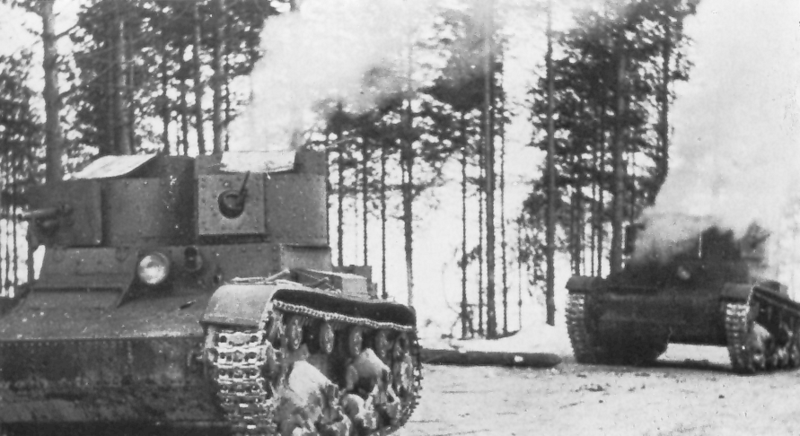
The Finns are counterattacking. Finnish ski troops are able to move through the forests, whereas the Soviets are confined to the roads. Even Soviet Division that have ample ski equipment do not have men trained to use it. The Soviet tanks are a liability in the forests, hard to maintain in the brutally cold weather and restricted to the roads. They also are often left unprotected by sufficient infantry, as the Soviets do not believe in a combined-arms approach.
Colonel Hjalmar Siilasvuo has the Soviet 163rd Rifle Division surrounded at Suomussalmi. His troops have the only way in, the Ratte road, barricaded, but there still is no sign of any Soviet relief effort. He and his men wait.
At Taipale, the Soviets continue trying to smash through the Finnish defenses using only one division. By the end of the day, the Soviet commanders decide to bring in another division, the 10th Rifle Division, and more tanks and artillery. It will take a day or two for these to arrive.
The Finnish defenses at Kollaa also are holding. This is the linchpin of the entire Mannerheim Line and it is well-defended.
At Tolvajärvi, north of Lake Ladoga, the Finnish commander, Colonel Paavo Talvela, sees an opportunity to trap some Soviet troops by sending his troops across the frozen lakes Hirvasjärvi and Tolvajärvi. He sends one group in the north, consisting of two battalions, to attack the Soviet 718th Rifle Regiment. While the attack fails, it draws off Soviet reserves needed in the south. There, a Finnish battalion of the Finish 16th Regiment fends off a Soviet attack in the morning and goes on the offensive as planned.
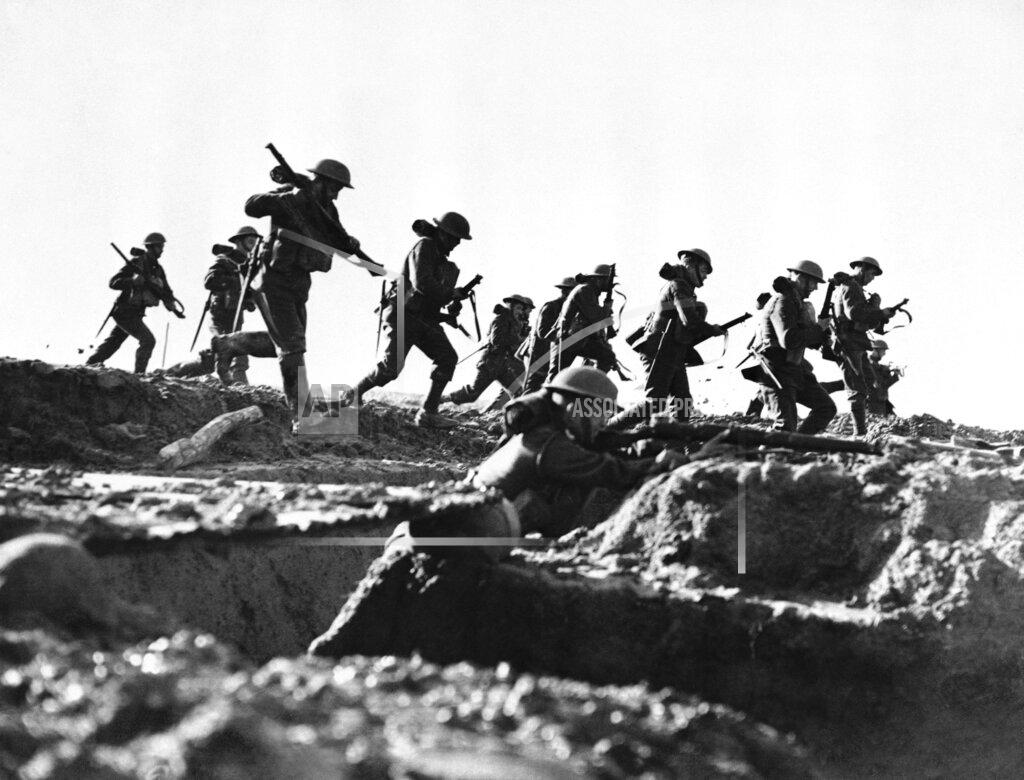
The Battle of Tolvajärvi was fought, resulting in Finnish victory. Group Talvela’s Detachment Pajari begins its successful offensive at Tolvajärvi. Soviets suffered heavy casualties near Tolvajärvi, Finland as Finnish troops savaged two Soviet divisions.
The Finnish plan was to encircle the Soviet division by two pincer-attacks over the frozen lakes Hirvasjärvi and Tolvajärvi. The northern attack over Hirvasjärvi was to begin at 08:00 and the second would start when the first had brought results. This was later changed and both attacks were to begin at 08:00. Preparations for the attack were slowed by a skirmish with two Soviet battalions at the Battle of Varolampi Pond on the night of 10–11 December.
The Soviet main effort was to make a front assault with two regiments 609th and 364th over the Tolvajärvi lake onto the Finnish positions of the 16th regiment near Tolvajärvi village, while the Soviet 718th regiment was to make a 20 km (12 mi) flanking maneuver from the north to the Finnish rear across thick wooded areas.
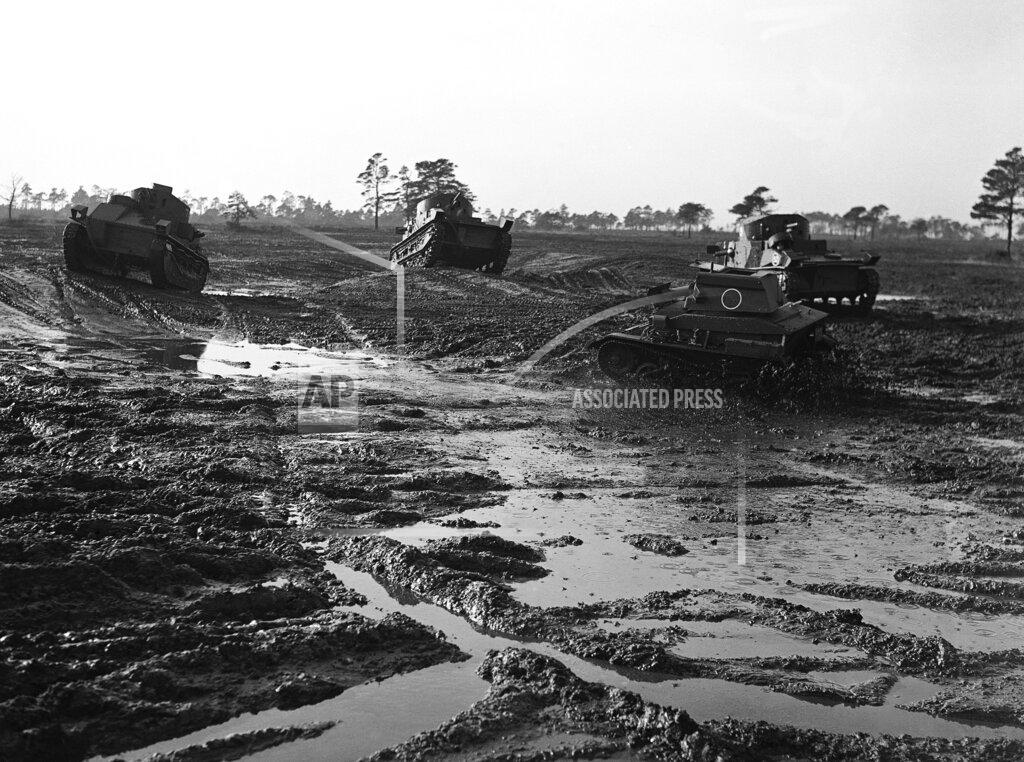
There was a thick fog over a single narrow unimproved rural muddy road towards Tolvajärvi that was winding amongst some dozens of small lakes. Just before the battle a big snow storm brought some 40–50 cm (16–20 in) of snow. Due to thick fog, aviation did not take part in the battle. Due to mud, many tanks got stuck and also did not actively participate in the battle and were lost during withdrawal.
The northern group consisting of two battalions soon met Soviet resistance. In fact, they met the Soviet 718th Rifle Regiment of the 139th Rifle Division, which was preparing to make its own attack on the Finnish flank. By noon, the Finnish troops withdrew to their own lines. Although this attack did not fulfill its objectives, it prevented the 718th from attacking the Finnish flank, and also from sending reinforcements to the south.
While the second battalion of the Finnish 16th (infantry) Regiment (II/JR 16) was preparing to attack along the road, it was interrupted by an attack from the Soviet 609th Regiment. The Finns were still able to attack after they got some artillery support. The Finnish attack continued towards a hotel located on a thin isthmus between the two lakes. Pajari decided to commit his reserves in a pincer attack at the Soviet troops around the hotel. In the end, the hotel was captured and in it were found a dead Soviet regimental commander and all the regiment’s papers.
The Finns withdrew over the lakes for the night. In the morning, Colonel Talvela demanded a new attack and the Soviet 139th Rifle Division was pushed back and later (20–22 December) destroyed around Ägläjärvi (now Yaglyayarvi in Russia) (some 20 km (12 mi) east from Tolvajärvi). Contact was also made with the Soviet 75th Rifle Division, which had been sent as reinforcements.
Finnish losses were over 100 dead and 250 wounded. The Soviet losses are thought to be over 5,000 dead and a lot of equipment: the guns of two artillery batteries, AT-guns, some twenty tanks (amongst others T-26s) and 60 machine guns. The battle was an important offensive victory for the Finns and was very important for the morale of the whole Finnish Army. No major battles were fought in this region after the successful Finnish counter-attack. Only a few shots were fired occasionally. The Finns held the line to the end of the Winter War.
Two commanders from Finnish side were promoted. Paavo Talvela was promoted from colonel to major general on 18 December 1939. Aaro Pajari was promoted to colonel on 18 December 1939. General Belyaev was dismissed from commanding on 16 December 1939, but preserved his rank. In June 1940 after re-attestation he was granted the rank of major general.
The Soviet troops in the far north at Petsamo are being screened only lightly by the Finns, but there is really nowhere for them to go in the round-the-clock darkness of the Arctic winter.
The Finns launch a series of attacks against the Soviet 8th Army. Finnish attacks near Kollaa meet with less success.
The only Soviet bright spot is at Salla, in the waist of the country. The Soviets are consolidating their advance there, ridding the town of the remaining Finnish troops, and planning their next move west.
Soviet troops launch reconnaissance probes at Summa in the central section of the Isthmus.
The Soviet Union rejected a League of Nations appeal for an armistice with Finland and mediation of the dispute.
League of Nations condemns Soviet attack against Finland.
The Soviets debate leaving the League of Nations. The issue is seen as a question of integrity versus gain.
The Finnish mass to bar the slicing of the nation. They report that 2,000 of their foe are slain as the Soviets push a three-way drive from the east.
At Ilomantsi, Detachment A’s advance from Oinaansalmi to take Möhkö 4 km to the east grinds to a halt due to command problems.
The Finnish cargo ship Wilpas was torpedoed and sunk by the Soviet submarine ShCh-311.
At Suursaari, the Finnish motor torpedo boats Raju and Isku lay the first offensive mine fields in front of Suursaari harbour.
Finland wins authorization to buy 43 Brewster Buffalo fighter aircraft from the USA.
Adolf Hitler postponed the decision to invade France to 27 December 1939; if he was to launch the attack, the date of action was to be 1 January 1940. Since the decision was to be made after Christmas, he permitted the granting of Christmas leave.
Raeder reports to Hitler regarding his meeting with Norwegian pro-Nazi leader Vidkun Quisling. Admiral Raeder, who supports an invasion of Norway, tells Hitler about a meeting with pro-German Norwegian politician Vidkun Quisling. Hitler is intrigued and agrees to meet Quisling.
Hitler orders the production of sea mines and ammunition doubled.
Two years forced labor is made mandatory by the Germans for all male, Polish Jews between the ages of 14 and 60. Labor camps are soon set up throughout the General Government and in the Warthegau (Wartheland).
Nazis renew their drive on the Forbach sector. Outposts are assaulted in a sharp offensive, but the French hold.
King Carol informed that British guarantee does not protect Rumania from Soviet Union, but Rumania must not seek German support.
The Secretary for Air in the UK announces that 57 attacks have been made on German submarines.
RAF bombers attack German bases at Borkum in the Frisian Islands.
RAF bombers attack German bases at Sylt in the North Frisian Islands.
The Admiral Graf Spee arrives off the River Platte estuary late in the day and spots the British Force G waiting for him. Captain Langsdorff is under orders to avoid combat. Since he is at the end of a long cruise after four months at sea, he takes those orders lightly, as some damage can be repaired in port while the engines are serviced. He dumps the Arado seaplane, removes extraneous equipment and prepares for battle. It is a fateful decision.
Kriegsmarine destroyers conduct minelaying operations along British coast.
The German Cruiser Köln and other warships screened minelayers during a mining mission.
German liner Bremen arrives at Bremerhaven from Murmansk, having evaded the British blockade. Bremen (51000 tons) was intercepted by submarine HMS Salmon but the submarine observed the then current rules of engagement and surfaced to order Bremen to heave-to. However, a German Dornier Do-18 flying boat appeared and HMS Salmon was forced to dive and Bremen escaped.
Destroyer HMS Duchess collides with battleship HMS Barham and, cut in half, sinks nine miles off the Mull of Kintyre, Scotland. There are only 25 survivors and 124 perish.
U-13 laid a mine barrier off the Firth of Tay, which later claimed one ship sunk.
The British steam merchant Marwick Head struck a mine and sank south of North Caister Buoy off the eastern coast of England in the North Sea (52° 40’N, 1° 46’E). At 08.15 hours the Marwick Head (Master J.J. Thain) struck a mine, laid on 5 December by U-59 and sank 0.5 miles south of North Caister Buoy. Five crew members were lost. The master and four crew members were picked up from a raft by a patrol trawler and landed at Great Yarmouth. The 496-ton Marwick Head was carrying coal and was bound for London, England.
The Greek cargo ship Dionyssios Strathatos sank in the Atlantic Ocean (58°31′N 21°55′W).
The Swedish cargo ship Torö struck a mine and sank in the Baltic Sea (55°20′ N, 13°04′ E). There were no casualties.
The Yugoslavian cargo ship Vidovodan ran aground off Natuna Island and was wrecked.
On U-23, two later aces of the U-boat war, Otto Kretschmer and Adi Schnee, fired two torpedoes at a rock, which appeared in the darkness to be a warship.
Convoy OB.52 departs Liverpool.
Convoy HX.12 departs Halifax for Liverpool.
The War at Sea, Tuesday, 12 December 1939
On Northern Patrol, three cruisers were between the Orkneys and the Faroes, and four cruisers between the Faroes and Iceland. There was no patrol in the Denmark Strait on this date. Light cruisers COLOMBO and DRAGON arrived at Scapa Flow.
Submarine SALMON sighted German liner BREMEN (51,731grt) at 0930 in 57 37N, 05 15E, but British submarines were not permitted to sink merchant ships without warning at this time. Instead, SALMON attempted to stop her 70 miles SSW of Lister Light in 57-00N, 5-45E, but BREMEN ignored her and an arriving German Do.18 aircraft forced SALMON to dive. BREMEN arrived safely at Wesermünde midday on the 13th.
Submarine UNDINE arrived at Blyth for repairs until the 23rd.
Destroyers EXMOUTH, ECHO and ECLIPSE departed the Clyde to escort battleship BARHAM. Meanwhile BARHAM and destroyers DUCHESS and DUNCAN, which had departed Gibraltar on the 6th for service with the Home Fleet, were 9 miles west of the Mull of Kintyre when DUCHESS (Lt Cdr R C M White) was run down at 0437 in an accidental collision with BARHAM. Struck abreast the forecastle, DUCHESS capsized and then exploded killing many men in the water. She sank at 0503 with the loss of Lt Cdr White, Lt G W Murray, Lt (E) O P Tilden, Lt J M L Scholfield, Commissioned Gunner H P Gordon, Py/Midshipman C L Kretschmer RNR and 124 ratings. Only Py/Lt J R Pritchard RNVR and 22 ratings were rescued by ECHO and ECLIPSE. EXMOUTH and DUNCAN screened BARHAM’s entry into the Clyde while ECLIPSE and ECHO stood by at the location of the sinking until daylight.
Auxiliary patrol trawler EMILION (201grt) was damaged in a collision with Spanish steamer MONTE NAVAJO (5754grt) near the Goodwin Buoy. She sustained slight damage and the Spanish ship continued without taking any action.
Destroyers SOMALI, BEDOUIN, MASHONA, and ILEX arrived in the Clyde.
ARRIVAL OF CANADIAN TROOP CONVOY TC.1
Destroyers ESKIMO, BEDOUIN, MASHONA, SOMALI, KANDAHAR, KHARTOUM, KINGSTON, KASHMIR, FEARLESS, ILEX, IMPERIAL and IMPULSIVE departed the Clyde to sweep ahead of Canadian troop convoy TC.1 as it approached the British Isles and bring it into the Clyde. However, IMPERIAL was held up and did not join, and destroyer MATABELE joined the escort force at sea.
Submarine SALMON and RAF Coastal Command aircraft sighted German destroyers HERMANN KÜNNE, FRIEDRICH IHN, ERICH STEINBRINCK, RICHARD BEITZEN and BRUNO HEINEMANN in the North Sea en route to the Tyne on a minelaying mission. Admiral Forbes, concerned for the safety of convoy TC.1, departed Greenock with battleships WARSPITE, BARHAM, battlecruiser HOOD, and destroyers INGLEFIELD, ICARUS, IMOGEN, IMPERIAL, ISIS and FOXHOUND on the 13th. Destroyers FORESTER and FIREDRAKE departed Loch Ewe and joined the force off the Mull of Kintyre.
Heavy cruisers BERWICK, DEVONSHIRE and light cruiser GLASGOW on Northern Patrol patrolled in 53 55N, 25 00W to cover the convoy. Light cruisers SOUTHAMPTON and EDINBURGH departed Rosyth, called at Scapa Flow, proceeded to Fair Island Channel and then patrolled between the Shetlands and the Faroes. Destroyers AFRIDI, MAORI and NUBIAN departed Rosyth and swept north at 25 knots.
Light cruisers DIOMEDE, CARDIFF, CERES and DELHI on Northern Patrol were to concentrate 10 miles 180° from Myggenoes Light in the Faroes, where they were joined by light cruisers COLOMBO and DRAGON which were proceeding to patrol stations.
Submarines SEAHORSE, STURGEON, UNITY and L.23 departed Blyth around midnight on the 12th/13th, SUNFISH and SNAPPER departed Harwich on patrol, and SHARK, already on patrol, was moved to a position off the mouth of the Jade River.
Convoy TC.1’s only incident of the voyage occurred on the 17th off Northern Ireland in 55-30N, 6-54W as the convoy neared its destination. Outward-bound liner SAMARIA (19,597grt) entered the eastbound convoy in fog and collided with aircraft carrier FURIOUS, carrying away several antennas and lifeboats and grazing liner AQUITANIA. On arrival in the Clyde, FURIOUS and battlecruiser REPULSE returned to the command of Admiral Forbes, who reached the Clyde on the 17th after escorting TC.1 into port.
GERMAN DESTROYER MINELAYING OFF THE TYNE
HERMANN KÜNNE, FRIEDRICH IHN, ERICH STEINBRINCK, RICHARD BEITZEN and BRUNO HEINEMANN laid the minefield off the Tyne near Newcastle during the night of the 12th/13th. On the return, HEINEMANN had a fire in her turbine room and had to stop, STEINBRINCK standing by, but she was able to restart and carry on. Destroyers IHN and STEINBRINCK later suffered equipment defects and were detached to Wilhelmshaven. Eleven Allied merchant ships grossing 18,979 tons were sunk and destroyer KELLY and a large tanker badly damaged in the field:
On the 13th, Belgian steamer ROSA (1146grt) 6½ miles off the Tyne Breakwater; one crewman was lost.
On the 13th, minesweeping trawler WILLIAM HALLET (202grt, Skipper C W Hannant RNR) 3½ miles ESE of St Mary’s Light.; eight crew went missing with the one survivor, First Fireman C Hobson, picked up by trawler BEN ARTHUR (201grt).
On the 14th, tankers INVERLANE (9141grt) and ATHELTEMPLAR (8939grt) from convoy FN.54 were badly damaged at 1140 in 55 05N, 01 07W. INVERLANE lost 37 men from her crew of 40 and went ashore at Roker, near Whitburn Steel. The forepart of the ship was refloated, towed to the Tyne on the 17 December 1940 by fleet tug BANDIT, and later to Scapa Flow where she was sunk as a blockship on 30 May 1944. ATHELTEMPLAR lost two crew and 38 were rescued, but survived to be sunk in September 1942. Destroyers MOHAWK and KELLY had departed the Tyne earlier on the 14th to join sloop FLAMINGO which had been escorting FN.54 on anti-submarine patrol, and were dispatched to assist INVERLANE and ATHELTEMPLAR 13 miles off the mouth of the Tyne.
At 1530/14th, minesweeping trawler JAMES LUDFORD (506grt, Lt Cdr H R J Lewis Rtd and Chief Skipper D Macarthur RNR) was lost in the Tyne. There was only one survivor, and both officers and 15 ratings were lost. Until JAMES LUDFORD was mined, it was believed the damage to the tankers was caused by a submarine.
On arrival, KELLY herself struck a mine in 55-05N, 01-02.5W at 1617/14th which exploded just astern and damaged her propellers, rudder and after spaces. She was taken in tow by MOHAWK, later relieved by a tug which originally had been sent to tow ATHELTEMPLAR. Escort vessel WOOLSTON and sloops GRIMSBY and WESTON screened the withdrawal. Captain Mountbatten, who led the 5th Destroyer Flotilla on KELLY, transferred to sister ship KELVIN which had completed on 27 November and was working up at Portland. KELLY was repaired in the Tyne by mid-February 1940, but on the day of her degaussing trials, was involved in two minor collisions – with a tanker at the dock and while backing off with a drifter in the channel – and did not return to duty until 28 February.
Still on the 14th, auxiliary patrol trawler EVELINA (202grt, Skipper J W Cowling RNR) and anti-submarine trawler SEDGEFLY (520grt, Chief Skipper R W Stocks RNR) off the Tyne. There were no survivors from either trawler, EVELINA losing one officer and eight ratings and SEDGEFLY one officer and fifteen ratings.
On the 15th, Norwegian steamer RAGNI (1264grt) in 55 02N, 01 12W; six crew went missing and 13 survivors were rescued. Just 20 minutes after RAGNI, Norwegian steamer H C FLOOD (1907grt) was lost in 55 02N, 01 12W; four crew were lost and 17 survivors rescued.
On the 15th, Norwegian steamer STRINDHEIM (321grt) in the Tyne in 52-02N, 1-17.5W; nine crew were lost and two survivors rescued.
On the 16th, steamer AMBLE (1162grt) was badly damaged in 54 52N, 00 48W, with 17 survivors rescued by escort vessel WALLACE. AMBLE drifted ashore between Whitburn and Sunderland, was refloated and towed to Sunderland on the 25th, but later broken up.
On the 19th, Danish steamer JYTTE (1877grt) 18 miles east of Souter, in the Tyne; ten crew were lost and eight survivors picked up by Danish steamer AVANCE (1582grt).
Convoy FN.53 departed Southend, escorted by destroyer WHITLEY and sloops FLAMINGO and STORK, and arrived in the Tyne on the 13th.
Trawler VALERIA (189grt) reported sighting a suspicious vessel near 5A Buoy off Lowestoft, course ESE. Polish destroyer ORP BŁYSKAWICA was dispatched to assist, but ordered to return to Harwich at daylight if no contact was made.
The 20th Destroyer Flotilla was re-formed for minelaying duties for the first time since the First World War.
Lt R H M Heriot-Hill, Petty Officer M Fortrum, Leading Airman M McLoughlin (RAF) and Air Mechanic L Moorhead were killed when their Walrus of 754 Squadron struck a balloon cable near Southampton.
British minefield SC was laid on the 12th, 18th and 27th December, 16 January and 14 February by auxiliary minelayer HAMPTON westward of Folkestone Gate.
Convoy OB.52 departed Liverpool escorted by destroyers WINDSOR and WALPOLE until the 14th. OA.52 did not sail.
Convoy FN.53, after being delayed a day by weather, was escorted from the south by destroyer GREYHOUND with close escort by escort vessel WHITLEY, sloops FLAMINGO and STORK. The convoy was especially important as it included six tankers.
Russian submarine ShCh.322 damaged German steamer HELGA BOGE (2181grt) with gunfire, four miles north of Revalstein.
U-13 laid mines off Dundee in the Firth of Tay, on which one ship was sunk.
Steamer MARWICK HEAD (496grt) was sunk ½ mile S of North Caister Buoy on a mine laid by U-59 on the 5th; five crew were lost.
Swedish steamer TORO (1467grt) was sunk on a mine 35 miles S of Copenhagen, off Malmo between Trelleborg and Falsterbo in 55 20N, 13 04E.
Convoy HX.12 departed Halifax at 1000 escorted by Canadian destroyers HMCS SAGUENAY and HMCS SKEENA. At 1800/14th, they handed the convoy over to an ocean escort consisting of French submarine PASTEUR which detached on the 20th, and armed merchant cruiser AUSONIA, which left on the 25th. PASTEUR was joined by French large destroyer VALMY and sloop GAZELLE on the 23rd, and later arrived at Brest. Destroyers WANDERER and WALKER escorted the convoy from the 24th to 27th, when it arrived at Liverpool on the 27th.
Convoy SLF.12 departed Freetown escorted by armed merchant cruiser CILICIA and arrived at Liverpool on the 25th.
ALLIED HUNTER GROUPS
Allied Hunter Groups in the South Atlantic were disposed late on the 12th as follows:
Force G – Heavy cruiser EXETER, light cruiser AJAX and the New Zealand HMNZS ACHILLES off the Uruguay coast near Rio de la Plata.
Force H – Heavy cruisers SUSSEX and SHROPSHIRE sweeping off the west coast of Africa.
Force I – Aircraft carrier EAGLE, heavy cruiser CORNWALL, light cruiser GLOUCESTER arrived at Durban on the 12th, low on fuel, after chasing into the Indian Ocean on a false raider report. EAGLE and GLOUCESTER were expected to need a week to boiler clean at Simonstown.
Force K – Aircraft carrier ARK ROYAL and battlecruiser RENOWN in the Pernambuco area.
Force X – Aircraft carrier HERMES, French heavy cruisers DUPLEIX, FOCH, and British destroyers HARDY, HOSTILE and HERO were north of St Paul Rocks. British light cruiser NEPTUNE joined Force X on the 12th.
Additionally, heavy cruiser CUMBERLAND was in the Falklands, boiler cleaning and refitting on short notice. Sister ship DORSETSHIRE was at Simonstown, preparing to relieve heavy cruiser EXETER on the South America Station. Submarine SEVERN was halfway between St Helena and Bahia en route to the Falklands, and sister CLYDE approaching Dakar.
President Roosevelt said today that the Administration was contemplating no relaxation of its policy against giving aid to belligerent nations and did not consider the extension of a $10,000,000 credit to Finland to aid its civilian population to be a modification of that policy. With his explanation of Administration policy the President coupled the observation that since none of the money to be advanced through the Export-Import Bank for Finland’s benefit was to be used for purchasing war materials, there was no ground for assuming that any relaxation of the Neutrality Act restrictions on dealing with belligerents was contemplated. Although some saw in the President’s remarks the implication that neither Finland nor any other victim of international aggression would be aided by the Administration in purchasing war materials in the United States, Mr. Roosevelt was not specific on the point. Such assistance would be within the letter of the Neutrality Act until the President found that the nation. concerned was at war and invoked. the embargo provision.
President Roosevelt said today that he intends to ask Congress next month to extend the life of the Reciprocal Trade Agreements Act, chief of the changes in the United States foreign policy started by himself and Secretary Hull. It would expire by its own terms in June. The President’s statement was made in answer to questions at his press conference. Many recent political weather signs have indicated that the effort to renew the Trade Act would precipitate a bitter controversy. Mr. Roosevelt nodded in recognition of an increase in attacks on the reciprocal trade program by Republicans and Democrats, particularly from Western farm areas. He added that he undoubtedly would ask for an extension of the law because of its promise to continue the increase of export trade for the United States.
Workers on WPA relief projects have no right to strike against the Federal Government, nor to create a disturbance or disrupt the peace, President Roosevelt said today. In this respect he put WPA workers in the same category as Federal employees in Washington and upheld the right of groups to organize for the advancement of their particular interests. The President did not amplify his statement. It was made in reply to a question about his stand on the matter in which the interrogator cited events in Minneapolis, where a strike of workers on WPA projects following wage cuts was attended by rioting, two deaths and several convictions.
Mr. Roosevelt paused momentarily as if considering the implications of the reply he was about to give. Then he said that the right of relief workers to organize was as valid as that of Federal employees here who were members of one of two or three organizations. It was as a corollary thought that the President added that workers on relief rolls had neither the right to strike nor to create what he termed commotions, nor to disturb the peace. He explained that this was his offhand opinion and a question of common sense.
The President’s statement came after an announcement yesterday by David Lasser, head of the Workers Alliance, that his organization would not tolerate “the Ohio relief scandal” and that he would organize a march of the Cleveland WPA workers on the State Capitol at Columbus if necessary to change the attitude of State authorities. Earlier the same day the President blamed Governor Bricker and the Ohio Legislature for Cleveland’s relief crisis. Mr. Lasser made his statement as he left the White House after conferring with the President on a proposal to increase Federal relief rolls by 1,000,000 persons and to provide $50,000,000 immediately for surplus food distribution to the needy.
The threat to march on Columbus elicited a statement today from Representative Dudley White, Republican, of Ohio, in which he described the plan as a “disgusting example of the propaganda of agitation for the benefit of long-range plans that the Soviet Government has for social revolution. The spectacle of the notorious agitator with Communist leanings, David Lasser, emerging from a White House conference with the President to announce that he intends to lead his left-wing group of Workers Alliance members in a march on the office of Governor Bricker, is enough to make the blood of every American boil,” said Representative White.
Senator Taft of Ohio, aspirant for the Republican Presidential nomination, laid down tonight four “principles” for a party prográm for 1940, having as the chief features demands for a balanced national budget in “about two years” and for development of private enterprise through an administration friendly to business. In an address before the Republican Club of Massachusetts, he criticized New Deal spending and administration of internal affairs, but declared that there was no conflict between Republicans and the Administration on the principles of “adequate preparation for defense and the keeping out of war.”
Influenza and pneumonia begin their seasonal increase.
Congressman Carl Mapes dies at age 64. This Michigan Representative was in New Orleans listening to oil regulation bill hearings.
Actor Douglas Fairbanks Sr. passes away in his sleep at 56 of a heart attack.
Chinese 5th War Area (western Anhwei, northern Hupei, and southern Honan with 22nd, 29th, 31st, and 33rd Army Groups) opens offensive around Chienchiang, Pailochi, Hsientao, Loyangtien, and Hsuchiatien.
Chinese 9th War Area (northwest Kiangsi, Hupei south of Yangtze River, and Hunan with 1st, 15th, 19th, 27th, and 30th Army Groups) opens attacks around Wanshoukung, Tacheng, Kulopu, Shihtoukang, Kaoyushih, Hsiangfukuan.
Chinese 9th War Area captures Chungyang, Wanling, Puling, Hsiaoling, Mankanling, Chienchow, and Paitzechiao and cuts Japanese lines of communications.
The Japanese say the Nazis have new weapons. Germany possesses new weapons that have aroused the wonder and interest of two Japanese generals, one of whom hinted that novelties in chemical warfare might be expected when the war began in earnest next Spring.
Dow Jones Industrial Average: 146.93 (-0.12)
Born:
Rogelio Onofre, Filipino sprinter (Olympics, 1964), in Tarlac, Philippine Commonwealth.
Died:
Douglas Fairbanks, Sr., 56, American actor (“The Mark of Zorro”, “3 Musketeers”, “Robin Hood”), of a heart attack.
Carl E. Mapes, 64, American politician (Rep.-R-Michigan, 1913-1939).
Naval Construction:
The Kriegsmarine (German Navy) Type IID U-boats U-141 and U-142 are laid down by Deutsche Werke AG, Kiel (werk 270 and 271).
The Royal Navy Hunt-class (Type I) escort destroyer HMS Cottesmore (L 78) is laid down by Yarrow Shipbuilders Ltd. (Scotstoun, Scotland).
The Royal Navy Tree-class minesweeping trawler HMS Bay (T 77) is launched by Cochrane & Sons Shipbuilders Ltd. (Selby, U.K.); completed by Amos & Smith.
The Royal Navy Tree-class minesweeping trawler HMS Elm (T 105) is launched by A & J Inglis Ltd. (Glasgow, Scotland); completed by Aitchison Blair.
The Royal Navy Hunt-class (Type I) escort destroyer HMS Atherstone (L 05) is launched by Cammell Laird Shipyard (Birkenhead, U.K.).
The Royal Navy Hunt-class (Type I) escort destroyer HMS Hambledon (L 37) is launched by Swan Hunter and Wigham Richardson Ltd. (Wallsend-on-Tyne, U.K.); completed by Wallsend.
The Royal Australian Navy armed merchant cruiser HMAS Manoora (F 48) is commissioned. Her first commanding officer is Commander Arthur Henry Spurgeon, RAN.
The Вое́нно-морско́й флот СССР (ВМФ) (Soviet Navy) “M” (Malyutka)-class (3rd group, Type XII) submarine M-94 is commissioned.
The Вое́нно-морско́й флот СССР (ВМФ) (Soviet Navy) “M” (Malyutka)-class (3rd group, Type XII) submarine M-96 is commissioned.
The Kriegsmarine (German Navy) Type VIIB U-boat U-50 is commissioned. Her first commanding officer is Kapitänleutnant Max-Hermann Bauer.
The Royal Navy “K”-class destroyer HMS Kipling (F 91) is commissioned. Her first commanding officer is Lieutenant Commander Aubrey St. Clair-Ford, RN.
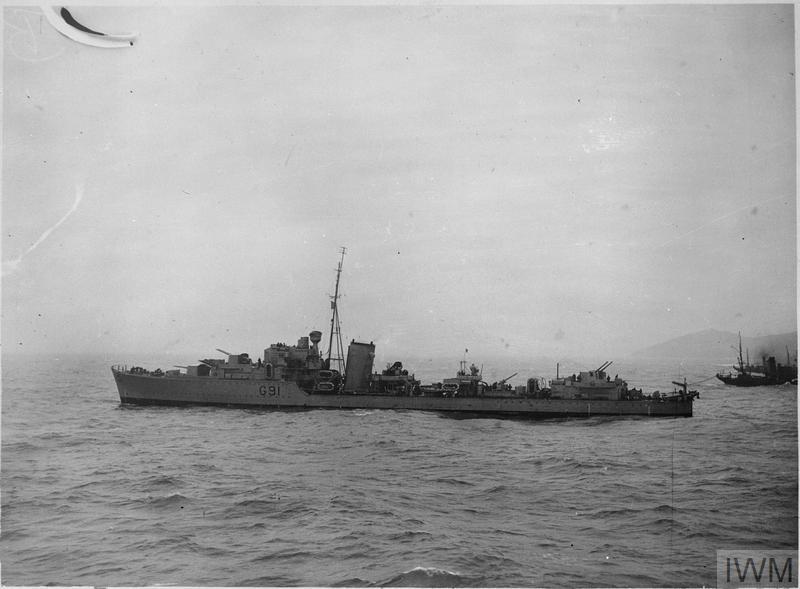
After working up the ship’s crew and a period of defect rectification at the Barclay Curle shipyard on the Clyde, Kipling joined the 5th Destroyer Flotilla of the Home Fleet on 4 February 1940.
On 11 October 1940, Kipling, along with another six destroyers, escorted the battleship HMS Renown to bombard the French port of Cherbourg . At dawn on 23 May 1941 HMS Kelly and HMS Kashmir were retiring at full speed round the west of Crete. After surviving two heavy air attacks they were overtaken at 7.55 AM by a formation of twenty-four dive-bombers. Both ships were quickly sunk, with a loss of 210 lives. Fortunately the destroyer Kipling was near by, and, despite continuous bombing, rescued from the sea 279 officers and men, including Lord Louis Mountbatten, while she herself remained unscathed. Next morning, while still fifty miles away from Alexandria, and crowded from stem to stern with men, she ran completely out of fuel, but was safely met and towed in.
On 17 December 1941, she was lightly damaged by splinters from a 203 mm round from the Italian cruiser Gorizia during the First Battle of Sirte. The British assessment concluded instead that Kipling was hit by near-misses from 320 mm shells fired by the battleships Andrea Doria and Giulio Cesare. Her wireless aerials were knocked down, her structure, hull and attached boats holed. One crew member was killed in action. On 28 December 1941 Kipling sank the German submarine U-75.
Lost 11 May 1942.
Kipling was attacked by German Ju 88 bombers of Lehrgeschwader 1 north-west of Mersa Matruh in Egypt on 11 May 1942 and sunk by Joachim Helbig. HMS Kipling (Cdr. Aubrey St. Clair-Ford, DSO, RN) was bombed on 11 May 1942 shortly after 2000 hours by German Ju 88 aircraft north-west of Mersa Matruth in the eastern Mediterranean in position 32°38’N, 26°20’E. She sank almost immediately. Twenty-four of the crew were killed or missing. Two ratings died later of wounds sustained during the sinking of the ship.
Battle Honours: ATLANTIC 1939 – NORWAY 1940 – CRETE 1941 – MEDITERRANEAN 1941 – MALTA CONVOYS 1941-42 – LIBYA 1941-2 – SIRTE 1942
 History Diaries