Ten U.S. servicemen are among 16 killed when an U.S. Air Force transport plane crashes at Tân Hiệp, South Vietnam. Smoke streamed from the port engine of a United States Army transport plane as it took off today with 16 men aboard. Seconds later it crashed in a dry rice paddy and all those aboard died in the burning wreckage. Ten Americans perished in the crash, the worst American military air disaster in South Vietnam. The rest were Vietnamese servicemen. All had been bound for Saigon, 25 miles to the northeast. “Apparently it was a mechanical failure,” a United States officer said of the crash. However, unofficial sources raised the possibility that the crash might have been caused by enemy ground fire.
The toll of American dead since the United States began backing South Vietnam’s war against Communist guerrillas on a massive scale in December, 1961, thus rose to at least 228. Of these 131 are classed as combat deaths and the rest are attributed to other causes. Only the fact that the pilot had been impatient to leave averted a higher toll in the crash of the twin‐engine Caribou, a Canadian‐built utility craft prized for its ability to take off and land on short strips. The pilot waved away five United States soldiers, visitors from Clark Air Force Base in the Philippines, who were trotting across the Tân Hiệp airstrip to get a lift to Saigon. As the plane climbed, the control tower radioed the pilot that an engine was on fire. “He seemed to get control of the fire for a moment, probably with his carbon dioxide containers,” a witness said. “The plane seemed to wheel around. It got up to about 100 feet and then plunged down over the tree line two miles away with the engine blazing again.”
The United States announces it is freezing all assets of North Vietnam and barring any further financial and commercial transactions between the two countries. It was taken, the Treasury said, “at the recommendation of the State Department, in the light of the continued Việt Cộng Communist aggression in [South] Vietnam.” The announcement added: “Since the so‐called ‘National Liberation front of South Vietnam’ was created by the Communist regime of North Vietnam, and is based in and controlled by North Vietnam, this blocking action applies equally to all transactions with that puppet organization.” A treasury spokesman said North Vietnamese assets in the United States were “very small, practically none.”
Talks between the Laotian rightist‐neutralist side and the pro‐Communist Pathet Lao, aimed at reaching agreement on a coalition government, were reported deadlocked today. A Pathet Lao spokesman said his group would never recognize the merger of the rightists and neutralists announced last week by the neutralist Premier, Prince Souvanna Phouma. The spokesman said the Pathet Lao could not go along because the 1962 Geneva agreement was based on the existence of three political factions in Laos and called in a coalition of all three. Prince Souvanna Phouma returned to Vientiane last night after talks with the pro‐Communist leader, Prince Souphanouvong.
President Makarios of Cyprus has suffered a major diplomatic setback as a result of last week’s Greek Cypriote attack in the St. Hilarion Castle area of the Kyrenia Mountain range, in the view of diplomatic informants here. The diplomats believe that the military move damaged the previous good relations between the United Nations and Archbishop Makarios and his Government. Furthermore, it has galvanized the United Nations into assuming a more forceful attitude with respect to the peace‐keeping operation. The attack also angered the Governments of Greece, Britain and the United States. It came as a surprise even to Athens, with which Archbishop Makarios, leader of the Greek Cypriote community, was supposed to have had the closest cooperation.
It is known on the most reliable authority that both the Greek Premier, George Papandreou, and the Foreign Minister, Stavros Kostopoulos, telephoned the archbishop last week to stop the operation. A key Greek Cypriote official conceded that the government here had been taken aback by the vehemence of the reaction from key capitals abroad. He contended that the operation in the mountains was “minor” and therefore need not have been “cleared” with Athens. The attack took place against Turkish Cypriote positions west of the castle, which dominates the Kyrenia Pass. The official Greek Cypriote position was that it was designed to halt harassment by the Turkish Cypriotes of Greek Cypriote villages near the pass.
Most observers believe, however, that the ultimate aim was to capture the Kyrenia Pass, northern terminal point of Turkish Cypriote control of the important highway linking Kyrenia on the northern coast to Nicosia. The fighting in the mountains has died down to sporadic shooting of little consequence. The operation, as one Greek Cypriote official put it, has “moved from the military to the diplomatic sphere.” As the island passed its fifth consecutive day without major violence, Sakari S. Tuomioja, the United Nations mediator, met with Archbishop Makarios to acquaint him with the views of the Greek and British governments on a Cyprus solution. Mr. Tuomioja has just returned from a trip to Athens and London.
Two British paratroopers were killed and 10 wounded today in a clash with dissident tribesmen 60 miles north of Aden. The casualties were suffered when a combined force of Royal Marine Commandos and a paratroop company scrambled down from the rocky ridges they had been holding and forced their way eastward five miles or more to root out the insurgent tribesmen. Guerrilla attacks by tribesmen have been interfering with traffic on one of the main overland trade routes in the federation The British have charged that tribesmen from over the Yemen border have been making incursions into the federation with substantial military aid from the United Arab Republic.
At least six tribesmen were found dead and one was taken prisoner in the engagement today. The marines occupied the new heights set as their objective but a parachute company was pinned down in a circular stone village on the lower slopes. Parachute troops had charged the village early in the day and cleared it but were unable to go farther because of fire from positions held by tribesmen. The company later fought its way out to occupy nearby ridges. The higher ridges dominate a wadi, or valley, running northeast from the British base camp and landing strip at Thumair. The Arabs had entrenched themselves on both sides of this wadi because it has been used for traffic.
Royal Air Force fighter planes have been pounding the tribesmen behind rocks and in caves and gave close support in the clash today. Armored cars, scout cars and 105‐mm. howitzers also bumped eastward along an alternate route. The operation began with a diversion to the south. Infantry then duplicated the move of 45 Royal Marine Commandos scaling the ridges to join the commandos. As the new troops arrived, the marines and a company of the Third Battalion Parachute Regiment, which was also on the heights, began to descend the rock faces to the east. The infantry is now established on the peaks. They were supplied by helicopters until the wind prevented it. Unless the tribesmen counterattack, this phase of the overall operation — the possession of peaks in the area — is over.
The Soviet Union, which in the past has denounced the European Common Market as an expression of “monopoly capitalism,” is believed to be getting ready to adjust its relations with the six‐nation economic organization. The Russians, according to reliable sources, have started to put out feelers about establishing relations with the Common Market, or, as it is officially known, the European Economic Community. The speculation among Western diplomats is that the Russians in the not‐distant future will accredit a mission to the Brussels headquarters of the economic community, as capitalist industrial countries already have. The Russian interest appears to be an application of the maxim: “If you can’t lick ’em, join ’em.”
The government of Israel announced that it had completed construction of the National Water Carrier of Israel, an irrigation project for increased usage of the Jordan River. On January 16, Egypt’s President Nasser and the leaders of 12 other Arab nations had declared that they would divert the three main tributaries of the river away from Israel. After warnings from the United States, the Soviet Union and the United Nations, the Arab nations dropped their diversion plans and made no further objections to the Jordan Waters project.
The Castro regime announced today the discovery of an arms cache it said had been hidden in the waters off Pinar del Rio’s north coast by United States agents. Newspapers reported that United States‐made rifles, pistols, explosives and Cuban currency worth $15,000 had been found in nine metal boxes and eight waterproof drums that were lashed together and left in the shallows, secured by a line to a tree on the shore. According to the press, the weapons were for use of anti-Castro saboteurs, commandos and guerrilla forces.
In Washington, qualified sources said the weapons had been dropped for the underground in 1961. It was believed that the announcement of the discovery at this time indicated that Cuba feared a new attack from the United States.
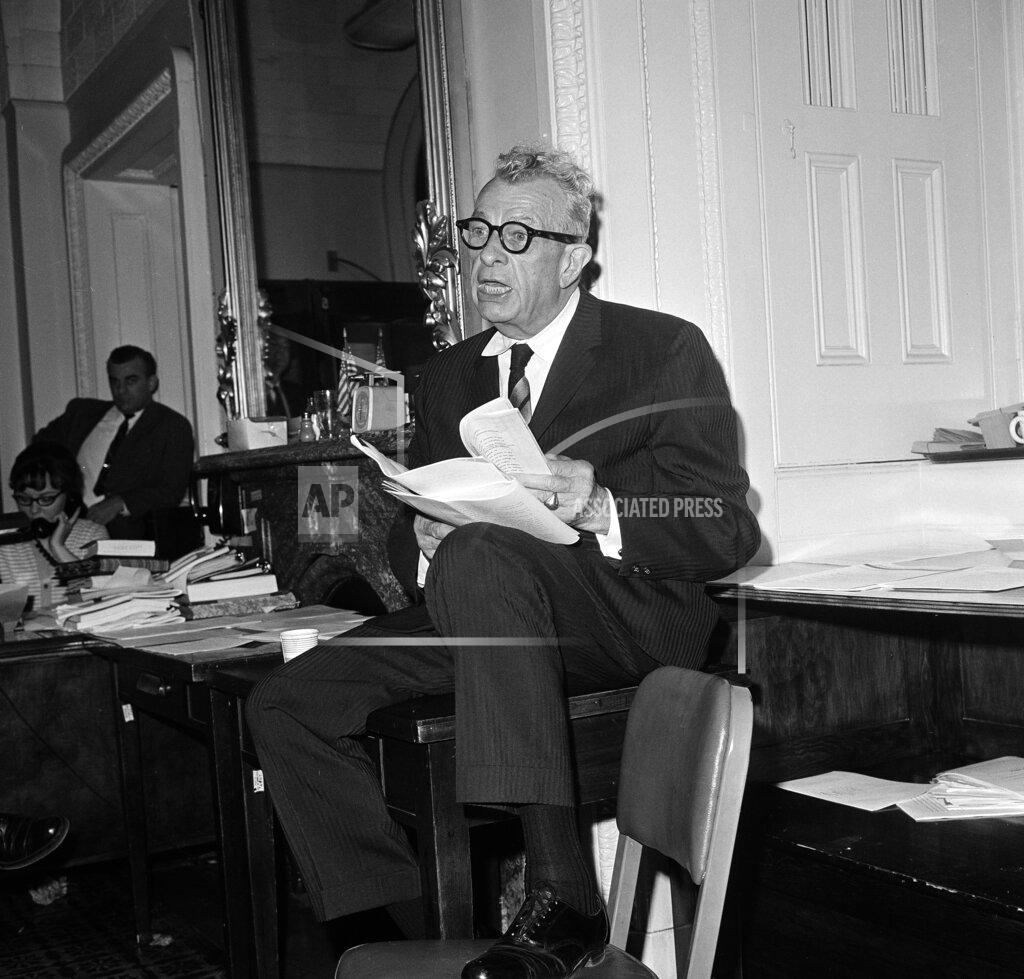
Senate leaders and Justice Department officials reached substantial agreement today on some technical amendments to the House‐passed civil rights bill. After the meeting, the first of several, Senator Everett McKinley Dirksen of Illinois, the Republican leader, said that “a good deal of agreement” had been reached. Mr. Kirksen said that about 40 amendments were discussed this morning. All were technical in nature and were designed to clarify the bill, or, as Senator Leverett Saltonstall, Republican of Massachusetts, put it, “purify” the measure. All the amendments except one were the product of what Mr. Dirksen called “my team — the Dirksen bombers.” They will be offered to the Senate later by Mr. Dirksen.
Senator George D. Aiken, Republican of Vermont, suggested the remaining amendment, which would make financial and business undertakings owned by religious organizations subject to the fair employment section of the bill. This would mean that such church‐affiliated businesses would not be able to make religion a condition of employment, as the House bill permits. Mr. Dirksen said that his staff had divided his proposed amendments into three classes — A, B and C — in ascending order of probable controversy.
Of the clarifying amendments considered today, he said, the Justice Department wanted to think longer about only “a couple.” Tomorrow morning the same conferees will take up the 15 to 18 amendments in Class B. Later in the week they will move on to those in Class C “with real clout in them,” Mr. Dirksen said. One of the “real clout” amendments will deal with Title II, banning discrimination in places of public accommodation. Mr. Dirksen was expected to disclose this amendment today but did not do so.
It is Mr. Dirksen’s hope, and that of the bipartisan civil rights leaders and the Justice Department as well, that agreement can be reached on a package of amendments in each category. When these packages are assembled, Mr. Dirksen will present them, one by one, to the full Republican conference. If he can get general approval of his party, he will call up each package in turn for floor votes. Mr. Dirksen does not expect the Administration or the civil rights coalition to agree to some of his amendments. These he will offer separately.
In this procedure, Mr. Dirksen’s objectives are threefold: to tidy up the language of the bill where there is confusion, to eliminate or change some of the bill’s provisions that he finds objectionable, and to make the bill palatable to about seven or eight Republicans whose votes will be necessary to shut off the Southern filibuster. Closure of debate requires the approval of two‐thirds of the Senators present and voting. Late tomorrow the Senate is expected to begin voting on amendments providing for jury trials in civil rights cases. These will be the first votes on the substance of the bill. The leaders had hoped to dispose of the issue before the end of the week. This now seems doubtful because President Johnson has invited the Senators of the states he will visit to accompany him on an Appalachian tour Thursday and Friday.
Governor Matthew E. Welsh won the Democratic Presidential preference primary in Indiana tonight, but Governor George C. Wallace of Alabama was getting about 29 per cent of the Democratic vote. In winning, Governor Welsh, who ran as a stand‐in for President Johnson, captured the state’s 51 votes at the Democratic National Convention for the President.
In the Alabama Democratic primary, Governor Wallace’s state of 10 unpledged electors overwhelmingly defeated a slate pledged to support the Democratic Presidential nominee. Senator Stephen M. Young won the Democratic nomination in Ohio and Representative Robert Taft Jr. will oppose him in November. In Oklahoma, Bud Wilkinson easily won the Republican Senate nomination.
In the Indiana Republican Presidential primary, Harold E. Stassen, former Minnesota governor, now a lawyer in Philadelphia, made a surprisingly good showing in losing to Senator Barry Goldwater of Arizona. Mr. Stassen got about a quarter of the Republican vote, duplicating the performance of Senator Margaret Chase Smith of Maine against the Arizonan in the recent Illinois primary.
Several leading Republican liberals are indicating to associates and friends that they may sit out the Presidential campaign if their party nominates Senator Barry Goldwater of Arizona. Senator Jacob K. Javits of New York, confirming his own reported expressions on that score, said yesterday: “I will not commit myself to support Senator Goldwater if he is the nominee. I’m an American first, then a Republican.” As yet, Mr. Javits is the only nationally prominent Republican to acknowledge that politically unorthodox position publicly. Others refused yesterday to be quoted directly on the delicate political matter but said they might “speak out in due course.”
Mr. Javits said that his position was strongly approved by many with whom he discussed it in the last few days. The Senator indicated that a number of party figures and rank‐and‐file Republicans had signified eagerness to join a movement of party members who might turn their backs on Mr. Goldwater should he be the party candidate. It was also understood that several county chairmen and Republican organization officials had vehemently criticized the Javits position in private and had urged him to modify it or, at least, stop “passing the word.”
In the campaign next fall, the implied opposition of well-known liberal Republicans could hobble Mr. Goldwater in such crucial urban states as New York, California, Michigan and Pennsylvania and could ensure President Johnson’s re‐election, Mr. Javits and others are being told. Meanwhile, Republican party unity is suffering considerable strain. A National Committee official said yesterday that the unusually blunt and long‐range opposition of liberals to Senator Goldwater could cause conservative Republicans to react in kind.
The New York Congressional delegation charged today that the Army was threatening to provide unfair competition for the atomic reactor New York State plans to build. The delegation’s bipartisan Steering Committee called for a Congressional investigation of the nuclear reactor that the Army wants to install at its proving ground in Aberdeen, Maryland. The Army, the committee declared, has abandoned its plans for a reactor of advanced design approved by Congress and has substituted a facility “virtually identical” to the one being advanced by the New York State Atomic Research and Development Authority.
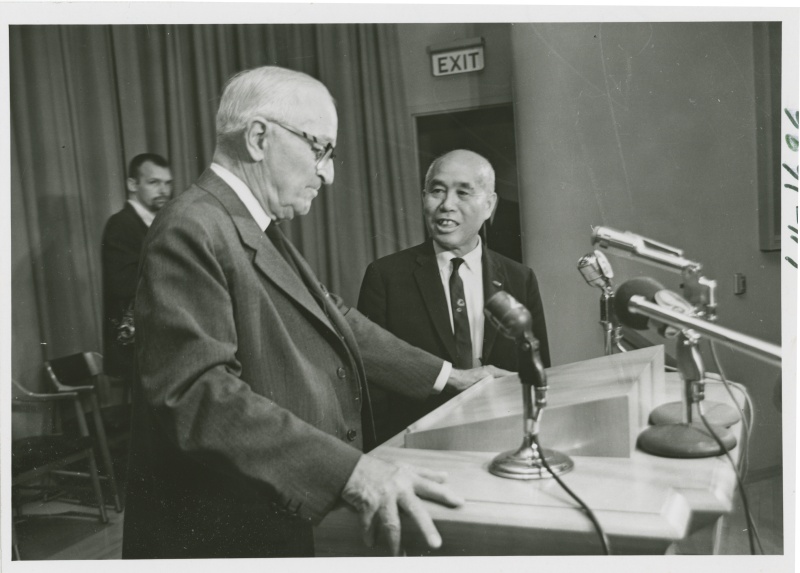
Eight Japanese who survived the atomic bombing of Hiroshima and Nagasaki met today with Harry S. Truman, the man who ordered bombs dropped to end World War II. The group, with four interpreters, met the former President in the auditorium of the Truman Library in Independence, Missouri. Mr. Truman told the visitors: “It is very nice of you to come here under the circumstances. I’m very happy to have you take a look inside the library so you can see what this country has to offer.”
Takuo Matsumoto, the 76-year‐old president of the Shizuoka Women’s College near Tokyo, acted as spokesman for the group. He told Mr. Truman: “The decision was a very heavy responsibility on your part. It was wartime.”
Mr. Truman said: “The object was to end the war in such a way that not a half million more people would be killed on each side and that many injured. When you run a war, the objective is to win. I think we have shown that we keep no bitter feelings.”
Hall of Fame catcher Roy Campanella (41) weds long-time friend Roxie Joynes.
To foil Sadaharu Oh, the Hiroshima Carp use an exaggerated shift that places all fielders in right and center, leaving left field unguarded. Oh responds by hitting a 400-foot home run to right field.
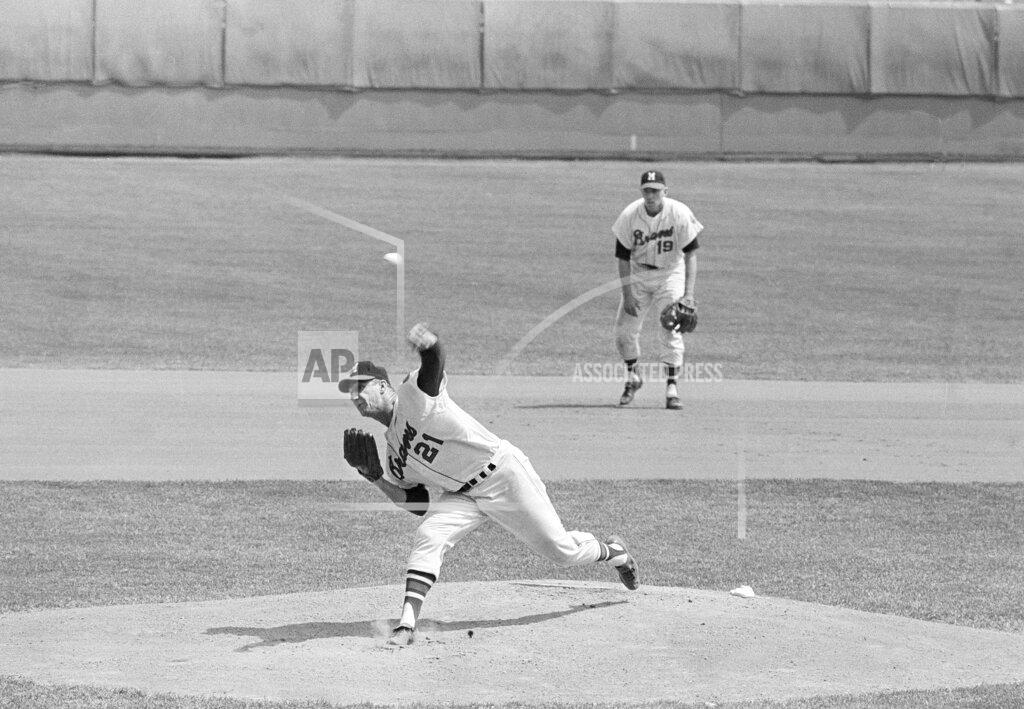
The Green Bay Packers traded all-pro center Jim Ringo, and a reserve fullback, Earl Gros, to the Philadelphia Eagles today. They received a linebacker, Leroy Caffey, and the Eagles’ No. 1 choice in the National Football League draft next December.
Dow Jones Industrial Average: 826.63 (+2.80).
Born:
Heike Henkel, German track athlete and Olympic gold medalist in the women’s high jump, 1992; in Kiel, Schleswig-Holstein, West Germany.
Bob Buczkowski, NFL defensive end (Los Angeles Raiders, Phoenix Cardinals, Cleveland Browns), in Pittsburgh, Pennsylvania (d. 2018, from an accidental drug overdose).
Dexter Clark, NFL defensive back (Detroit Lions), in Dermott, Arkansas.
Lorraine McIntosh, Scottish pop singer (“Deacon Blues”) and actress, in Cumnock, East Ayrshire, Scotland, United Kingdom.
Died:
Howard Zahniser, 58, American environmentalist who authored the Wilderness Act of 1964, died of heart disease two months before Congress passed the legislation.




 History Diaries