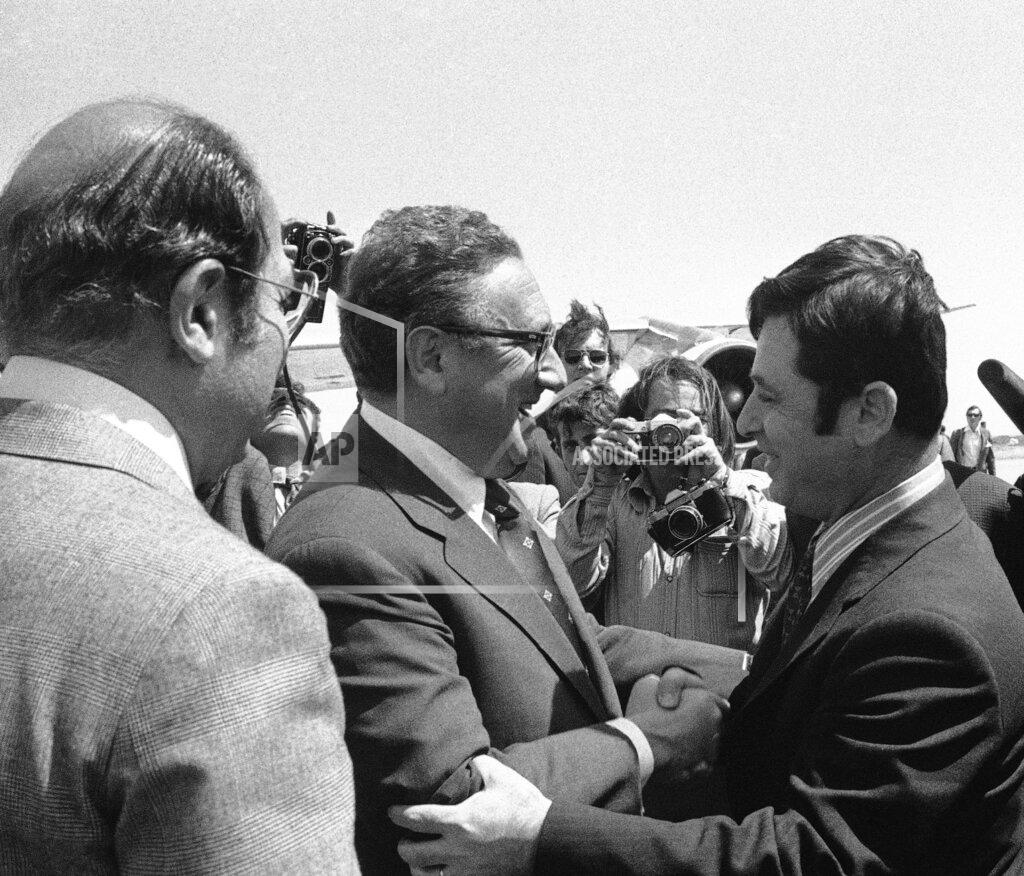
Secretary of State Kissinger flew to Amman, Jordan, from Tel Aviv after urging Israeli leaders to draw up a new cease-fire line that he could propose to Syria when he returns to Damascus on Tuesday in his continuing search for an agreement on the separation of Syrian and Israeli forces. Newsmen aboard Mr. Kissinger’s Air Force Boeing 707 jet on the way to Amman from Tel Aviv were told that the Secretary’s mediation efforts had entered a crucial phase. A senior American official said that although “a considerable step forward” had been taken in narrowing differences between Israel and Syria, it remained doubtful whether Mr. Kissinger would be able to conclude the disengagement agreement during this Middle East trip.
Officials left open the strong possibility that he might return to Washington after about a week or 10 days without a formal agreement, but with progress made on reducing differences. It would be left to other officials to further negotiate the problems, with Mr. Kissinger probably returning to this area in about three weeks. The officials stressed, however, that Mr. Kissinger had not given up his efforts to obtain an agreement, and that the possibility of one still existed. Much depends on what happens in the next few days, they said. At the same time, newsmen were told that despite contrary reports from Israel, Syria had “definitely” decreased her military activity on the Golan Heights in keeping with an apparent understanding reached with Mr. Kissinger on Friday night in Damascus. After discussions with King Hussein of Jordan today and tomorrow morning, Mr. Kissinger returns to Israel tomorrow afternoon to receive the new Israeli ideas.
The Israeli Cabinet met today to discuss where to draw the demarcation line between the Israeli and Syrian forces in the Golan Heights, but no decision was made at the meeting. The Israelis, who had offered previously to return most of the land taken in last October’s war, were urged by Mr. Kissinger to make a compromise offer to include more territory including some land in the sector seized in the June, 1967, war, which includes the town of El Quneitra. The Syrians, who have agreed to talk about where the disengagement line should be placed when Mr. Kissinger returns to Damascus, had originally asked for a sizable part of the Golan Heights territory taken in 1967, in addition to all the land taken by Israel last October.
Sporadic tank and artillery exchanges were reported by an Israeli military spokesman today along the length of the Golan Heights cease fire line despite a reported Syrian commitment to Secretary of State Kissinger to scale down the fighting. The spokesman added that although the intensity of the fighting had been somewhat reduced today, Israel had detected “no great difference” from the pattern of previous days. In addition to the tank and artillery duels, the spokesman said, the Syrians fired salvos of Katyusha rockets against Israeli positions in the southern part of the occupied territory. No Israeli fatalities were reported during the day, but a military source observed that it was still “very possible to get killed on the Golan today.” A communiqué late tonight reported that eight Israeli soldiers had been wounded in Syrian shelling that continued into the evening.
The reported Syrian promise to curb the fighting along the cease fire line was to have taken effect at 6 PM yesterday. Despite the continued shelling today, official Israeli sources expressed hope that the military situation would ease in the next few days. Meanwhile, the Israeli Cabinet met for four and a half hours this afternoon to hear a report by Premier Golda Meir on the indirect negotiations with Syria. As head of the Government’s negotiating team, Mrs. Meir had presided earlier at a three-hour meeting with Mr. Kissinger before the Secretary departed for an overnight visit to Jordan, He is due back in Jerusalem tomorrow afternoon. After more talks with Israeli leaders tomorrow night, he is expected to travel to Damascus on Tuesday. A Government spokesman reported this evening that the Cabinet had taken no operative decisions other than to authorize the negotiating team to continue its contacts with Mr. Kissinger.
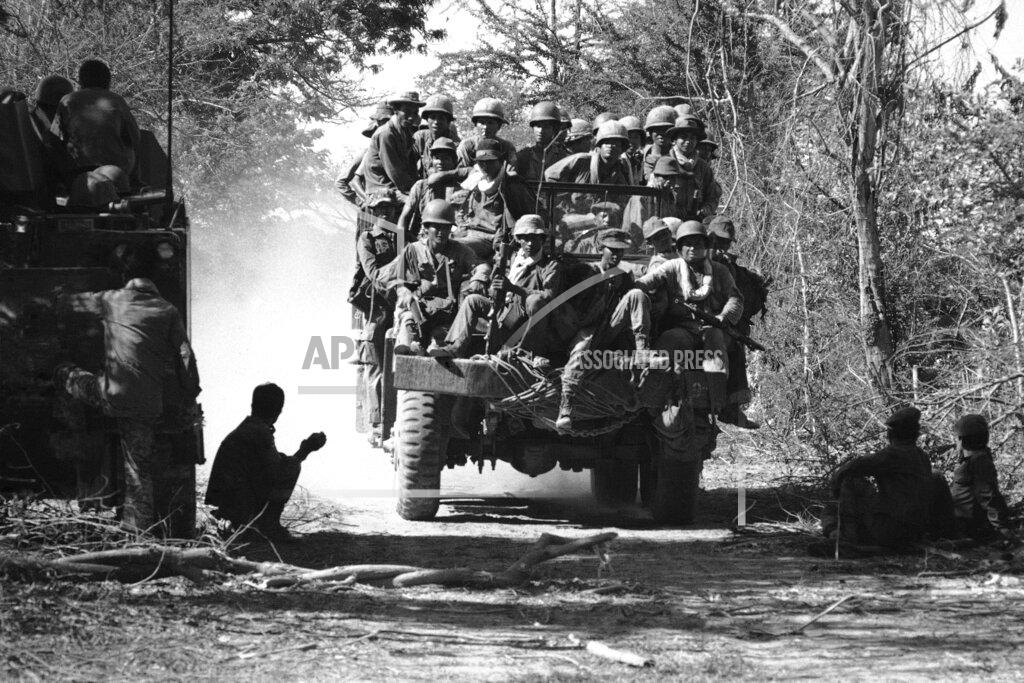
South Vietnamese troops and tanks drove four miles into Cambodia in a new operation before being stopped by heavy Việt Cộng and North Vietnamese resistance. Field officers said more than 500 government troops and about 40 tanks pushed across the Cambodian frontier along Highway 1 some 35 miles northwest of Saigon. Because it pledged in the Paris peace agreement not to fight in Cambodia, South Vietnam has yet to admit its forces have crossed the border. Field‐level officers said that more than 500 government soldiers and about 40 tanks had pushed across the Cambodian frontier along Route 1 about 35 miles northwest of Saigon.
“They didn’t tell us we were going into Cambodia,” said one of the officers. “I only knew because suddenly the signs were written in Cambodian, and the highway markers said how far it was to Phnom Penh.” The officers said that the Communists had set up a defense line at Bavet, a village four miles inside the Cambodian frontier. When government troops came up against heavy Việt Cộng and North Vietnamese fire, they pulled back about half a mile and called in artillery and air strikes, the officers said.
In the first round of voting in the French presidential election, François Mitterrand of the Parti socialiste received a plurality of the vote (over 11 million, and more than 43% of the votes cast, and Valéry Giscard d’Estaing of the Fédération nationale des républicains et indépendants (FNRI) finished second (8.3 million and 32.6%). Jacques Chaban-Delmas, the candidate of the Gaullist party, which has governed France for 16 years, ran a weak third among 12 candidates. Since no candidate received at least 50 percent of the votes cast, a runoff election between the top two finishers — Mitterrand and Giscard — was held two weeks later, on May 19. The vote had been prompted in the wake of President Georges Pompidou’s death on April 2.
The Communist party has emerged from suppression to become the strongest and best-organized political force in the new Portugal being shaped after the military coup. The party, calling itself “the major Anti-fascist” movement, reaffirmed its bid for a share of power in the projected provisional government. It is generally agreed that the Communists have a head start over other political groups. During the repressive years the Communists were understood to have maintained a structure and discipline with thousands of party activists in factories, offices and schools. At the rare times when opposition activity was allowed, such as when elections were held, these activists came to the surface, though they were not identified as Communists. They were members of “democratic forces” such as the electoral commission that ran the opposition campaign for the National Assembly last fall.
The Communists’ main rival, the Socialist party, acknowledges that it is operating under handicaps—a lack of professional party workers, of deep roots in the working class and of disciplined organization. The party came into formal being in‐exile, with Mario Soares, an oppositionist lawyer, becoming secretary general while he lived in Paris. The two leftist parties are working, together officially. Each recognizes that it cannot gain power alone. The Socialists recognize their inferior strength at the grass‐roots level, and Mr. Soares is intent on building popular support to be able to deal with the Communists on a more equal footing.
The Portuguese military junta, still seeking a balance between what it considers the proper exercise of freedom and its abuse, issued a warning against direct action by public employees trying to oust superiors with strong links to the old regime.
A roaring crowd of several thousand whites jammed the plaza in front of the city hall in Lourenco Marques, the capital of Mozambique, and demanded that the junta in Lisbon keep Mozambique Portuguese.
Defense Secretary James Schlesinger said that European nations would be likely to cut their armed forces if the United States were to pull out troops. Schlesinger also said in an interview in U.S. News and World Report that detente with the Soviet Union does not allow a general reduction in arms.
British Prime Minister Harold Wilson accused Conservative Party opponents in Parliament of muckraking and of taking “refuge in petty points about personalities.” Addressing 10,000 persons at a Glasgow rally, Wilson was apparently reacting to critics of deputy party leader Edward Short and other Labor Party leaders. Short recently admitted receiving $575 some 11 years ago from a former Northern England planning chief now jailed for corruption.
West German Chancellor Willy Brandt’s Social Democrats held their ground in the Saarland state elections, although opposition Christian Democrats scored big gains against other minor parties. The Social Democrat state chairman said the vote showed the party, rocked recently by a spy scandal, was recovering strength in the wake of defeats in Schleswig-Holstein and Rhineland-Palatinate.
A bomb exploded in the yard of the Belfast home of Northern Ireland Protestant leader William Craig, causing what police described as “fairly extensive” damage. Craig was away on a fishing trip in County Fermanagh at the time of the blast. His wife and two children, who were in the house, were reported shaken. but not injured.
Canadian air traffic controllers voted 57% in favor of a proposed work contract, thus avoiding a strike which would have closed the nation’s airports. Controllers at Montreal and Victoria, British Columbia, airports, who had threatened to walk out regardless of the national vote, decided at the last minute to remain on the job.
In India, eight people were killed and 50 injured in rioting between Hindus and Muslims in New Delhi at the Sadar Bazar. The riot was the worst in Delhi since India had achieved independence in 1947. Hindus and Muslims battled with guns, stones and fire bombs in the Sadar Bazar section of New Delhi after a fistfight between a Hindu and Muslim flared into a full-scale riot. Police said at least five persons were killed but observers said the toll was higher. Ambulances sped through the old section of the city evacuating an undetermined number of wounded, including two high police officials and 10 firemen who suffered gunshot wounds while trying to put out fires set by looters.
Americans influential in national policy decisions have begun to debate the issue of relations with Cuba again after a lapse of more than five years. Although senior administration officials insist that no change is imminent in this country’s boycott of Cuba, some of those officials say that resumption of the debate signifies an important policy change.
Airport workers in Mexico City discovered a leaking container of nitric acid in the cargo hold of a Boeing 707 that was preparing to depart on a flight to Tijuana with 75 passengers and a crew of six. The acid had damaged suitcases and was eroding the aluminum floor when it was discovered. The airport authority said that the acid “could have eaten through the fuselage and caused the jet to explode in midair.”
General Alexander M. Haig Jr., the White House chief of staff, suggested that “excesses and distortions” in investigating Watergate scandals might lead to “the cure being worse than the illness.” He said on the “Issues and Answers” television program of the American Broadcasting Companies that he was not condoning “what alleged wrong-doing may have occurred” in the Watergate case, but said that the time had come “to bring this matter to a conclusion.”
Mr. Nixon’s chief lawyer, James D. St. Clair, also appeared on a news interview program — “Meet the Press,” carried by the National Broadcasting Company. The President spent the day at his Camp David retreat in the Maryland mountains and returned tonight to the White House. The House Judiciary Committee, meanwhile, is scheduled to begin three days of private hearings on Wednesday or Thursday to review in detail the confidential findings of its staff in the panel’s impeachment inquiry. Mr. St. Clair indicated that in releasing more than 1,200 pages of the transcript of tapes made in the Presidential offices and over White House telephones, Mr. Nixon had placed the guarding of the Presidency above the assuring of justice in the Watergate criminal trials.
The erosion of power — of men who control events gradually overcome by those events — leaps out from the huge transcript of White House conversations that President Nixon made public last week. Just two months before the Presidential elections — on Sept. 15, 1972, when the released transcripts begin — the President was as relaxed and confident as any man could be who has tasted bitter, unexpected defeat and sweet victory in a long political life. He was about to be re‐elected, despite the Shadow of Watergate, by one of the largest margins in history. Seven months later — on April 17, 1973, when the released transcripts end — he was clinging to his high office, speaking of the “agony” of his political life in phrases touched by desperation.
Investigators for the Senate Watergate committee, inviting an immediate clash over President Nixon’s newly revived claim of executive privilege, have again summoned Fred Buzhardt, the White House counsel, to testify in secret about a controversial $100,000 campaign contribution from Howard Hughes, sources said. Last month, Mr. Buzhardt testified before the Senate panel for more than three hours about the cash contribution from Howard R. Hughes, the billionaire recluse, without invoking either executive privilege or attorney‐client privilege, the sources said. The money, in $100 bills, was given to Charles G. Rebozo, one of the President’s closest friends, in 1969 and 1970.
General Haig, the White House chief of staff, precipitated what could be another major confrontation during testimony last Thursday by invoking executive privilege and refusing to answer Senate questions about the $100,000. General Haig, who was accompanied by James D. St. Clair, Mr. Nixon’s special Watergate Counsel, gave the committee a Presidential letter ordering him “not to testify about any information received or activities undertaken while you served chief of staff …” It was the first use of executive privilege by a high‐level White House aide since last May 22, when the President — in a televised speech about Watergate — promised that “executive privilege will not be invoked as to any testimony concerning possible criminal conduct or discussions of possible criminal conduct in the matters presently under investigation, including the Watergate affair and the alleged coverup.”
The General Accounting Office has raised questions about the legality of a proposed accounting procedure that would allow the Defense Department to give South Vietnam $266 million more in military aid.
Senator Walter F. Mondale (D-Minnesota) said he would introduce legislation that would impose a moratorium as of July 1 on the acquisition of pipelines, refineries and marketing outlets by the nation’s 15 largest oil companies. The bill would seek to identify those companies “that clearly possess dominant market control in the industry and whose continued increase in vertical integration would further diminish competition,” Mondale said. He said that in 1970 the companies controlled 87% of all domestic crude oil reserves, 80% of the crude oil refining capacity and 73% of gasoline retailing.
More than 85,000 persons jammed into Spokane’s Expo ’74 on opening day-35,000 more than expected and general manager Peter Spurney cautiously predicted that the original attendance projection of 4.85 million might be exceeded before the exposition ends in six months. The original projection for the fair to break even was conservative, Spurney said. “We have continually said that if the fair was in a major urban area we would get 30 million persons,” he said.
The men who drill most of the country’s wildcat oil wells said they are worried they won’t get the equipment needed to keep a recent surge in exploration alive. Members of the Independent Petroleum Association of America complained at their semiannual meeting in Denver that the major oil companies had stockpiled vitally needed steel products and created a shortage that was severely limiting the ability of the small independents — who drill about 75% of all exploratory wells in untested areas to find oil. Government and industry officials said they hoped the shortage would be eased by the end of the year.
A wildcat strike forced the Kansas City, Missouri, Star to quit experimenting and go ahead with its plans to convert to a computerized operation. An eight-page news section with a circulation of more than 400,000 was printed by supervisory personnel and employees from the news, business, circulation and advertising departments. The bulk of the paper was made up of regular features that had been printed before a dispute that resulted in the firing of 98 pressmen and 30 mailers. In the nation’s capital, meanwhile, the Washington Post cut its circulation by 105,000 and eliminated 32 pages of news and advertising, including 12 pages of White House transcripts on Watergate, because of what the paper said were production delays caused by a slowdown of union printers.
Carter’s General Store is the only store for a quarter-mile around in its Ozone Park South Jamaica neighborhood of pleasant frame homes in Queens, New York. It sells groceries, beer, and soft drinks. It sells newspapers, too, but the two men who came in at 9:23 PM last night probably never noticed the headline of the Muhammad Speaks issue on display: “The Judgment Nears.” They confronted Elwood Carter, the 32‐year‐old owner, with a sawed‐off shotgun and an opened clasp knife. But, Mr. Carter, latest of embattled citizens standing up against crime, got out one of his three revolvers and shot them both — and when they fled to a car after his gun jammed, followed outside with a shotgun, killing one and wounding the other. “After you spend 10 to 15 hours a day in here, the aggravation you go through, I just got tired of it, I made up my mind I’m not working for free,” Mr. Carter said.
Police in Daly City and San Francisco, California arrested eight Chinese-American youths in connection with the execution-style slaying of a 15-year-old San Francisco boy. The body of Lincoln Louie, 15, was found yesterday on the slopes of San Bruno Mountain. His hands were tied behind his back and he had been shot twice in the head. “We’re investigating the possibility that those we arrested are members of the Wah Ching gang,” a police spokesman said. Wah Ching gang members, he added, are mostly recent immigrants from Hong Kong, and are believed responsible for an outbreak of violence in San Francisco’s Chinatown during the past four years.
Malcolm Arnold’s Symphony No. 7 was publicly performed for the first time, premiered by London’s New Philharmonia Orchestra at the Royal Festival Hall.
The championship of Ireland’s National Hurling League was won by Cork GAA over Limerick GAA, 6-15 to 1-12 (equivalent to 33 to 15 based on 3-points for a goal and 1 point for shots above the crossbar.
David Pearson won the 1974 Winston 500 at Alabama International Motor Speedway in Talladega, Alabama. Three members of Gary Bettenhausen’s pit crew were injured, one seriously, when Grant Adcox crashed into Bettenhausen’s car in the pit.
Born:
Nate Hemsley, NFL linebacker (Dallas Cowboys, Carolina Panthers), in Willingboro, New Jersey.
Sheri Sam, WNBA guard and forward (WNBA Champions, 2004-Storm, 2008-Shock; WNBA All-Star, 2002; Orlando Miracle, Miami Sol, Minnesota Lynx, Seattle Storm, Charlotte Sting, Indiana Fever, Detroit Shock), in Lafayette, Louisiana.
Seiji Ara, Japanese auto racer (24 Hours of Le Mans, 2004), in Chiba, Japan
Died:
Abu Bakar Ri’ayatuddin Al-Mu’azzam, 69, hereditary ruler of the Sultanate of Pahang in Malaysia for more than 40 years, beginning in 1932. Abu Bakar was succeeded by his son, Ahmad Shah Al-Musta’in Billah ibni Almarhum, who would later serve as the monarch of Malaysia from 1979 to 1984.


 History Diaries