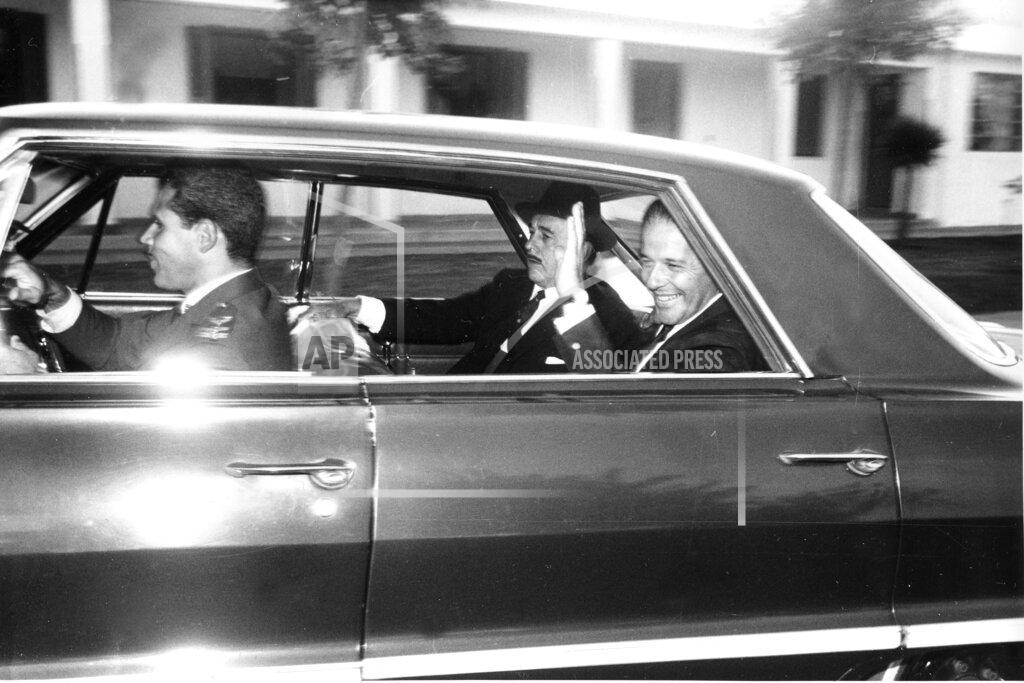
Deposed President João Goulart leaves Brazil under threat of arrest, and moves into a life of exile in Uruguay, and later Argentina. Goulart landed in the military airfield of Pando 20 miles north of Montevideo today in a small plane. General Assis Brasil, an aide, was with him. Mr. Goulart was informally received by Senator Eduardo Victor Haedo, former President of the National Council of the Government, the sub‐secretary of National Defense, and members of the staff of the Brazilian Embassy. He stayed only a few minutes at the airport. He said he was grateful to the people and Government of Uruguay. He showed base authorities his personal documents and said he had come for political asylum, which had already been extended by the Uruguayan Government, United Press International reported.
Brazil’s military leaders pressed today for the complete elimination of Communist influence in the government. Seven state Governors as well as the top military men joined in calling on Congress for the immediate election of a high-ranking military man as interim President. The Governors, meeting here during the evening, threw their support to General Humberto Castelo Branco, 63‐year‐old Army Chief of Staff, for President to serve out the term of the deposed João Goulart. The term runs to January 31, 1966.
The Governors and the military chiefs who led the revolt that toppled Mr. Goulart from power last Wednesday night made it plain that they want Congress to act quickly. There were indications that Congress would be asked to vote Tuesday or Wednesday. The interim President will immediately replace Ranieri Mazzilli, the president of the Chamber of Deputies, who was sworn in as acting President of the country Thursday. Mr. Mazzilli took office in the constitutional line of succession by agreement of the leaders of the anti‐Goulart coup. An election must be held this month.
Mr. Goulart was ousted on the ground that he permitted wholesale Communist infiltration of the government and was seeking to set himself up as a leftist dictator. He gained asylum in Uruguay early today. General Castelo Branco played one of the decisive roles in urging the Army to push the ousting of Mr. Goulart to preserve democracy in Brazil. A veteran of World War II combat service in Italy, he began his army career as a private.
Signs of a deep political rift appeared today in the two‐month‐old South Vietnamese Government of Major General Nguyễn Khánh. The Interior Minister, Hà Thúc Ký, submitted his resignation. He was reported to be dissatisfied about his lack of freedom to run his ministry. Five other members of the 18‐member Government of South Vietnam were reported to be on the verge of handing in their resignations. There was no indication that Premier Khánh had accepted Mr. Ký’s resignation, or of what he might do if others also decided to withdraw. A senior member of the Cabinet said the Government planned to hold a general election within two to six months.
Political observers here, who have been expecting a shake‐up in the Khánh Government for several weeks, said reports of a wave of resignations probably reflected General Khánh’s pressure on his ministers as much as it did any effort of theirs to embarrass his administration. “Now that he is certain that the United States is behind him, he is moving to make certain that his Cabinet will do whatever he wants,” one observer declared. The explanation given for the resignation of Mr. Ký from the Interior Ministry indicated that General Khánh had not allowed the minister to make appointments that normally fell within sphere of his job. These included the naming of a director general of police and security, and province and district chiefs — key positions in this country of strongly centralized government.
General Khánh appointed the present director general of police and security before Mr. Ky assumed his post. According to press reports here today, the government feared that Mr. Ký would have named to key police, provincial and district posts members of his own Đại Việt movement. Đại Việt is a right‐wing organization. Many of its followers suffered under the regime of President Ngo Dinh Diem despite the movement’s anti‐Communist policy.
In a clash at the Phước Tân outpost, six U.S. troops are wounded, 12 ARVN and 15 Việt Cộng are killed. A United States military spokesman said casualty figures were preliminary and probably would run higher on both sides when the final count was made. The fight raged all day Saturday and continued until nearly dawn Sunday, with air force planes dropping more than 100 flares to light the battlefield. Three helicopters were shuttling casualties from the site this morning to nearby Tây Ninh where planes were standby to evacuate them.
The fight began when an estimated 200 enemy guerrillas attacked the government outpost at Phước Tân, 12 miles from the provincial capital of Tây Ninh, early yesterday. The government responded by hurling about 700 helicopter-borne troops into a counter‐attack. The helicopters were met by a hail of machine-gun fire.
A United States Army lieutenant and sergeant and eight Vietnamese, including three children, were wounded yesterday when terrorists threw a grenade into a parked jeep, the government reported today. The incident occurred in the provincial capital of Bến Tre in the Mekong River Delta, 50 miles south of Saigon. It was the first terrorist incident since February in which Americans were wounded. Saigon also complained to the International Control Commission that Communist Việt Cộng guerrillas had attacked six civilian buses since March 5, killing 31 passengers and kidnapping and robbing others.
A Cambodian military delegation headed by Lieutenant General Lon Nol arrived in Moscow today on a 10‐day official visit. General Nol, who is Deputy Premier, Defense Minister and commander in chief of the armed forces, was received at the airport by Marshal A. A. Gechko, Soviet First Deputy Defense Minister.
President Makarios informed Turkey tonight that Cyprus had terminated the treaty that bound Greece, Turkey and Cyprus together for their common defense. A note was handed to the Turkish Ambassador, Dr. Mazhar Ozkol, by President Makarios, who had summoned the envoy to the presidential palace. As the note was addressed to Premier İsmet İnönü, it will have to be conveyed to him before the Premier’s official reply can be known. Premier İnönü has expected the Cypriote move and has been ready for some time to respond with a quick rejection of President Makarios’s unilateral attempt to undo the alliance. The disagreement between the Greek Cypriote leader and the Turkish Premier is over a treaty provision for a permanent contingent of 650 Turkish soldiers to be stationed on the island.
On Christmas Day, when fighting between Greek and Turkish Cypriotes was at its worst, Turkish troops left their camp on the edge of Nicosia and took up positions supporting the besieged Turkish community. The Greek Cypriotes had all but closed a ring around the walled city of Nicosia. Only the northern route was open and Turkish soldiers moved into this gap. The Turks have been there ever since, straddling the road to Kyrenia from Orta Keyu to Geunyeli.
President Makarios has gradually been able to bring about the defeat or neutralization of isolated Turkish communities throughout the island, but he has not been able to make a dent in the Turkish enclave from Nicosia northward. Most of the Turkish population on Cyprus is in the enclave now, and they are in better position to defend themselves than anywhere else on the island. The Greek Cypriotes have been deterred from making a major attack on the enclave only by the presence of Turkish troops. President Makarios has asked Turkey to move her troops back to their base. The request was turned down by Premier İnönü, who said they would move from their positions only when constitutional order had been restored.
President Johnson left the door open today for Washington to discuss with Panama possible revisions in the perpetuity clause under which the United States controls the Canal Zone. The question of whether the crucial clause in the 1903 treaty would be discussed in the coming talks with Panama was raised at an impromptu news conference held by the President in the White House. “I would not want to anticipate the specifics of these discussions before the Ambassadors meet,” the President said. “We have made it very clear in our agreement that we would discuss the problems that exist between the two nations, without any precommitments or without any preconditions. As those discussions progress, we will be kept informed and I will let you know anything that I can let you know.”
The United States and Panama signed an agreement yesterday ending their 11‐week‐old dispute and moved to resume diplomatic relations and to name special ambassadors to seek “the prompt elimination of the causes of conflict between the two countries.” The Panama Canal treaty is the chief issue between the two Governments and this will be the main topic in the discussions that are expected to open here late this month.
Venezuela has proposed that the coming conference of Western Hemisphere foreign ministers formally authorize the American states to use armed force and other drastic measures in the event of new aggression by Cuba. The proposal, contained in a confidential draft resolution prepared for the ministerial parley, was submitted to other hemisphere governments last week. The prospects for a ministers’ conference soon seemed fairly dim when the Venezuelans circulated their proposal. But sudden changes in the hemisphere’s political picture in recent days have improved this possibility. Diplomats said that it might be possible to hold the conference early in May and that Buenos Aires would be a likely site for it. Venezuela has asked that the conference on Cuba be held in conjunction with a conference on the problem of recognizing American regimes resulting from coups d’état.
About 12,000 Belgians marched in protest today against the strike of physicians that has paralyzed medical services throughout the country since Wednesday. The demonstrations were without incident, but elsewhere a number of physicians’ homes were smeared with black paint and several smashed windows were reported. Two doctors in Brussels told the police they received threatening telephone calls today. Two physicians in Mons reported the receipt of anonymous letters warning that their homes would be bombed if the strike continued. Brussels officials described conditions as “increasingly tense” as hospitals in Belgium’s largest city were filled to overflowing.
Most of the country’s 10,000 practicing physicians have closed their offices and left their hospital posts in protest against the new national health insurance law. All but a few hundred doctors have left the country to escape possible reprisals from wrathful trade union members. The doctors have condemned the new insurance program on the ground that it would be the first step toward fully socialized medicine. It provides for a schedule of fees that would replace the private‐fee arrangements doctors have been making with their patients up till now.
After 15 years the British family doctor, backbone of the National Health Service, is beginning to com‐ plain loudly about his own ailments. He is saying that he has become an underpaid and overworked pill‐pusher, a “signpost to the hospital” who is forced to spend most of his time filling out forms. He says that the complicated fee system of the health service discriminates against him and in favor of hospital services and consultants. There are 23,000 physicians in the system. Their complaints have increased in volume and, in the last few months, have achieved unison through the militant, newly organized General Practitioners Association.
The U.S. Senate failed to muster a quorum today and was forced to suspend the civil rights debate until Monday. It was the first time in nearly two years that the Senate had been unable to function. Senator Mike Mansfield of Montana, the Democratic leader, angrily assailed the mass absenteeism as “a travesty on the legislative process.” “In order to prevent this situation from turning into a farce,” he declared, “I now move to recess until Monday morning next at 10 AM.” The recess was taken at 11:40 AM., 40 minutes after the opening gavel.
With 51 of the 100 Senators needed to provide a quorum, only 39 had answered “Present.” A second roll‐call was taken on the Mansfield motion to recess, and 41 Senators voted as the motion carried, 27 to 14. The absentees included most of the bill’s 19 Southern opponents, only two of whom answered the quorum call. Four more showed up to vote for the recess. Many supporters of the bill were also absent, despite extraordinary efforts of floor managers to keep a quorum on hand at all times without relying on the 19 Southerners.
Wisconsin’s Presidential preferential primary, to be run off Tuesday, is not expected to decide who will be this nation’s next President, but it may indicate how much political dynamite is in the civil rights bill now under debate in the United States Senate. Representative John W. Byrnes, is unopposed as a favorite son candidate on the G.O.P. ballot. On the Democratic ballot Alabama’s Governor George C. Wallace is running against Wisconsin’s Democratic Governor John W. Reynolds, who heads a ticket pledged to support President Lyndon B. Johnson. Mr. Reynolds has leveled his attacks on the segregationist views of Governor Wallace. Mr. Wallace, has largely ignored his Wisconsin counterpart, and concentrated his fire on the civil rights bill and has championed states’ rights.
Governor Wallace’s foray into the northern Presidential primaries is winning him a feverish following in Alabama. He is using these supporters to help build a political machine that threatens to eliminate moderates from public life and make the state a pure Dixiecrat enclave. Mr. Wallace has used every resource of his office, including awarding and withholding contracts, to build his political faction and cut off support of the national Democratic party. Office holders who oppose the Governor’s plan for unpledged Presidential electors have found themselves opposed for re‐election by Wallace men. Yet, relatively few citizens in the state seem aware of what is happening. Mr. Wallace is held in such awe that his political enemies — who say privately he is building a political machine — have virtually cut off public criticism of his actions.
Memphis, Tennessee has all the ingredients to make it a racial trouble spot: Old South traditions, a large and restless Black population and thousands of grumpy segregationists who have migrated from the Mississippi delta and the Arkansas lowlands. Yet it has made more progress toward desegregation with less strife than any other major city in the Deep South. This has been accomplished largely through the efforts of a self‐appointed biracial committee that has worked so quietly behind the scenes that many Memphians do not know it exists. Members of the Memphis Committee on Community Relations agree that this success hinges on conditions peculiar to the nation’s cotton capital, which now claims a metropolitan population close to a million.
President Johnson said today that the nation had “every reason to be very pleased” with first‐quarter economic figures. He said he thought his party would benefit from this at the ballot box next November. “That means all Democrats,” Mr. Johnson said at a news conference in the Cabinet Room of the White House. Among other evidence Mr. Johnson adduced to show that the state of the economy was good was the prediction that in the first quarter of this year the international balance of payments “looks as though it could be almost balanced off without any loss”. Mr. Johnson cited no figures on the balance of payments, and said there were still two or three weeks of figures to be projected before the quarterly result was positive.
The New Hampshire primary has catapulted Ambassador Henry Cabot Lodge into first place in the preference of Republican rank and file voters, the Gallup Poll indicates. He polled 42% in the latest national survey.
Senator Barry Goldwater (R-Arizona), campaigning in the San Francisco area, said Ambassador Henry Cabot Lodge can’t possibly win the GOP nomination, and even if he could, he wouldn’t be able to win the Presidential election.
Almost overlooked in the scramble for the Republican Presidential nomination is the battle that looms over the 1964 Republican platform. Will it be a Goldwater platform, or a Rockefeller platform, or something in between?
One of a series of expert studies cited today by a Senate subcommittee calls for consideration of converting New York and other naval shipyards to a new industrial framework applying Japanese techniques. Another study forecasts trouble for certain sections of the country, certain industries and certain jobholders — especially scientists and engineers — in view of an anticipated drop in military spending. The studies were gathered by the Senate Subcommittee on Employment and Manpower and released in a single volume. The subcommittee, headed by Senator Joseph S. Clark, Democrat of Pennsylvania, has been investigating means of attaining full employment in the country. Public hearings on the subject were held by the subcommittee last year.
The study, by Glenn L. Schiever, concerned the possible conversion of the New York Naval Shipyard in Brooklyn as an example of the country’s entire naval shipyard complex. With facilities worth more than $3 billion, the 11 naval shipyards‐ in the country are said to be the largest of the purely defense industrial operations in the United States. They are exceeded only by four privately owned manufacturing concerns — General Motors, Ford, DuPont, and United States Steel. Secretary of Defense Robert S. McNamara has said the naval shipyards offer too much capacity. He has indicated some of them will be shut down. Studies on shipyard closings are now being conducted by the Pentagon.
General Douglas MacArthur was gripped in an ever-deepening coma and Army doctors said only a miracle could save him.
The next round of a competition to design s supersonic airliner is expected to start on time on May 1 despite the creation this week of a Presidential board to advise on the financing of the plane, informed sources said today. There has been confusion and apprehension here that creation of the advisory committee would delay a program that has remained on time since it began last June. This apprehension is shared even by the Federal Aviation Agency, which has been directing the Government-industry program to develop the 2,000-mile-an-hour jet by the early nineteen seventies. However informed sources here said the new group’s primary purpose was to solve the long-range problem of cost-sharing between Government and industry. The Government estimates that developing the plane will cost $1 billion.
A major breakthrough in the use of television tape to make home movies and also to record programs from the screen was demonstrated here yesterday by the Fairchild Camera and Instrument Corporation. The tape recorder will sell to the consumer for less than $500. A children’s show, a golf match, a Hollywood situation comedy and commercials were electronically recorded from the screen on TV tape and then played back immediately through a conventional receiver.
With a mobile hand camera selling for about $150, Charles Tobias, vice president and general manager of Fairchild’s Winston Research division said, members of a family should also be able to make an hour‐long home television movie for $15 or $20. They would then be able to see themselves on their own TV set. The quality of the reproduced TV images was on a par with the original scenes that came over the air. For the first time a demonstration of taped TV for home use met the layman’s practical test: it was no strain to watch. Heretofore no United States company has offered a picture tape recorder for less than $11,500.
Three high school friends in Hoboken, New Jersey — Tony Conza, Peter DeCarlo and Angelo Baldassare — opened the first Blimpie submarine sandwich restaurant.
Stephen Sondheim’s musical “Anyone Can Whistle” opens at Majestic Theater, NYC; runs for 9 performances.
Beatles’ “Can’t Buy Me Love” single goes #1 in the U.S. & stays #1 for 5 weeks. The Beatles held the top five positions in the Billboard Top 40 singles in America, an unprecedented achievement. The top songs in America as listed on April 4, in order, were: “Can’t Buy Me Love”, “Twist and Shout”, “She Loves You”, “I Want to Hold Your Hand”, and “Please Please Me”. “No one had ever done anything even close to this before,” an author would note later, “and it is doubtful the conditions will ever exist for anyone to do it again.” The Beatles also held the 31st, 41st, 46th, 58th, 65th, 68th and 79th spots in Billboard’s Hot 100.
Born:
Jeff Faulkner, NFL defensive end, defensive tackle, and nose tackle (Kansas City Chiefs, Indianapolis Colts, Phoenix Cardinals, New Orleans Saints, Washington Redskins, New York Jets), in St. Thomas, U.S. Virgin Islands.
Robbie Rist, American actor (Oliver-“Brady Bunch”) and musician, in Los Angeles, California.
David Cross, American standup comedian; in Atlanta, Georgia.



 History Diaries