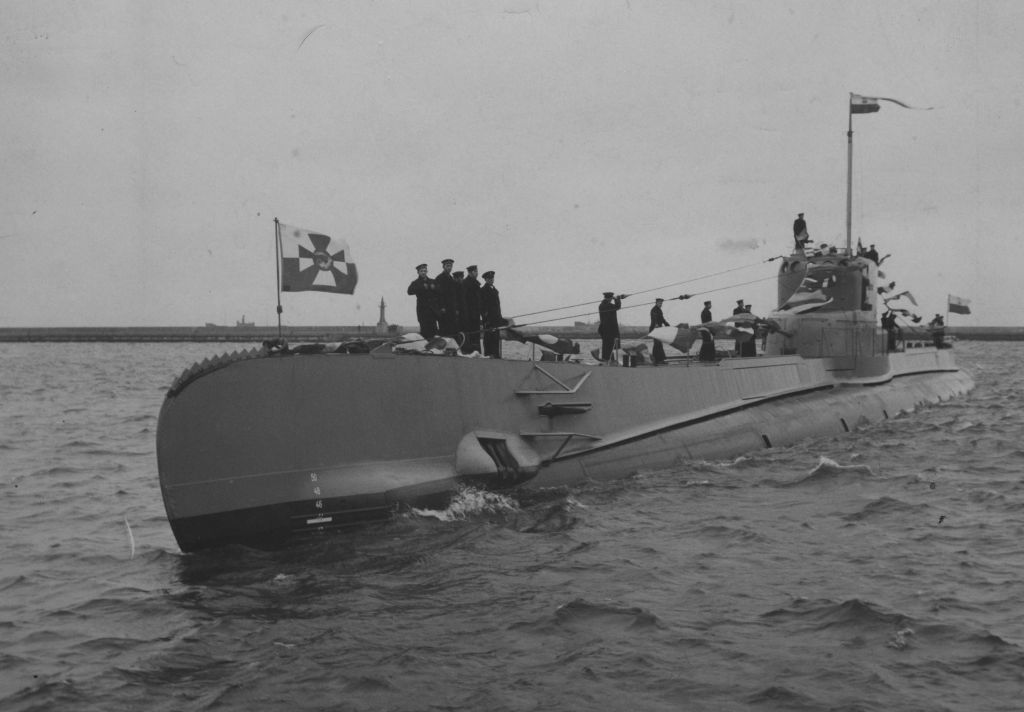
At the beginning of the invasion of Poland Orzeł was docked in Oksywie. As per the Worek Plan, the submarine was deployed on patrol in a designated strategic zone of the Baltic Sea. The crew received orders to attack the pre-dreadnought Schleswig-Holstein, should it leave Danzig. With the situation rapidly deteriorating, Orzel abandoned its sector on 4 September and began to withdraw into the Baltic Sea. The submarine was attacked by the German minesweepers M3 and M4 and was damaged but evaded destruction that evening.
Orzel’s crew decided to head to Tallinn, Estonia as a result of the damage. Orzeł reached Tallinn on 14 September 1939. On 15 September the captain, Lieutenant-Commander Henryk Kloczkowski, was forced to leave the submarine to undergo hospital treatment for an unknown illness he had been suffering from since 8 September. Under the Hague Convention of 1907, section XIII, Article 12, “belligerent ships” could enter a neutral port but were forbidden from remaining there for “more than twenty-four hours.” At the insistence of Germany, the Estonian military authorities boarded the ship, interned the crew, confiscated all the navigation aids and maps, and commenced removing all her armaments. However, only fifteen of her twenty torpedoes were removed before the hoist cable parted; this was because it had been secretly sabotaged by her new commander, former chief officer, Lieutenant Jan Grudzinski.
The crew of Orzeł conspired to carry out a daring escape. Around midnight on 18 September, the submarine’s Estonian guards were overpowered, the mooring lines were cut, and Orzeł got under way. The alarm was raised, and her conning tower was peppered by machine-gun fire. Running half-submerged, Orzeł ran aground on a bar at the harbor mouth, where artillery fire damaged her wireless equipment. Grudzinski managed to get the boat off the bar by blowing her tanks, and she proceeded out of the Gulf of Finland, intending to sail for a British port, the crew having heard a radio report that the Polish submarine Wilk had been welcomed in Britain.
Orzel escaped from Tallinn with two Estonian guards on board as hostages. The Estonian and German press covering the Orzeł incident declared the two captured guards missing at sea. Grudzinski set them ashore in Sweden, providing them with clothing, money, and food for their safe return to homeland. The Polish crew believed that “those returning from the underworld deserve to travel first class only”. The escape of the submarine Orzeł was used by the Soviet Union and Germany to challenge Estonian neutrality.
Since Orzeł’s navigational charts had all been removed by the Estonian authorities, Captain Grudzinski resolved to stop a German ship and take her charts. However, the only German vessels encountered were warships rather than merchantmen. The submarine’s sole remaining navigational aid was a list of lighthouses, and using these as a reference, Orzeł followed a course along the Baltic coast, around Denmark, and out into the North Sea, where she came under attack by British as well as German forces, since without her wireless equipment she had no means of identifying herself.
Forty days after she had originally sailed from Gdynia, Orzeł made landfall, off the east coast of Scotland. She lay on the bottom until emergency repairs were made to the radio, then surfaced to transmit a message in English. A Royal Navy destroyer then came out and escorted her into port, to the surprise of the British who had thought her sunk already weeks earlier.
Orzeł sank no enemy vessels during her journey from Estonia to Britain, but Soviet authorities blamed her for sinking the Soviet tanker Metallist in Narva Bay on 26 September, and used the incident as a pretext for the Soviet invasion of Estonia.
After a refit, Orzeł was assigned to the Royal Navy’s 2nd Submarine Flotilla and was assigned to patrol missions. Shortly after noon on 8 April 1940 she sank the 5,261 GRT clandestine German troopship Rio de Janeiro off the small harbor village of Lillesand in southern Norway, killing hundreds of German troops intended for the invasion of Norway. Rio de Janeiro was heading to Bergen in order to take part in the initial landings of Operation Weserübung – the invasion of Norway and opening move of the Norwegian Campaign. News that several hundred German soldiers were rescued by the Norwegian Navy and some had admitted their intention to occupy Norway reached the Norwegian parliament that evening, but the news was dismissed and no steps were taken to alert their Navy or Coast Guard of the impending invasion. Two days later Orzeł fired a torpedo at a German minesweeper V 705; however, she was forced to dive before the sinking of the German ship could be confirmed. The ship was not damaged by the torpedoes.
Lost sometime in late May or early June 1940.
On 23 May 1940, Orzeł departed on its seventh patrol in the central North Sea. On 1 and 2 June, radio messages were transmitted from the Rosyth Naval base ordering the boat to alter its patrol area and proceed to the Skagerrak (the strait separating Norway and Sweden from the Danish Jutland peninsula). No radio signals had been received from her since she had sailed, and on 5 June Orzeł was ordered to return to base. No reception was acknowledged. On 8 June 1940 the submarine was officially declared lost. The true cause is unknown, although it is commonly believed Orzeł most likely struck a British or German sea mine in or near the Skagerrak. The Admiralty stated in 1962 that Orzel had been lost in a British minefield in position 57°00N, 03°40E on 25 May. That minefield had only recently been laid there, and it was admitted that it had not been possible to inform all of the allied ships, including Orzel, about the existence of that new minefield. (Presumably it was not possible to inform ships which were already at sea when the minefield was laid). That Admiralty statement is held in the National Archives in file ADM 199/1925. It is also worth mentioning that British acoustic stations heard a loud noise that day, which was assumed to have probably been something hitting a mine.
Generalissimo Francisco Franco’s legionary (Spanish and Italian) corps, advancing on Girona, has occupied Sils, twelve miles from its objective, thus gaining a firm footing in Girona Province.
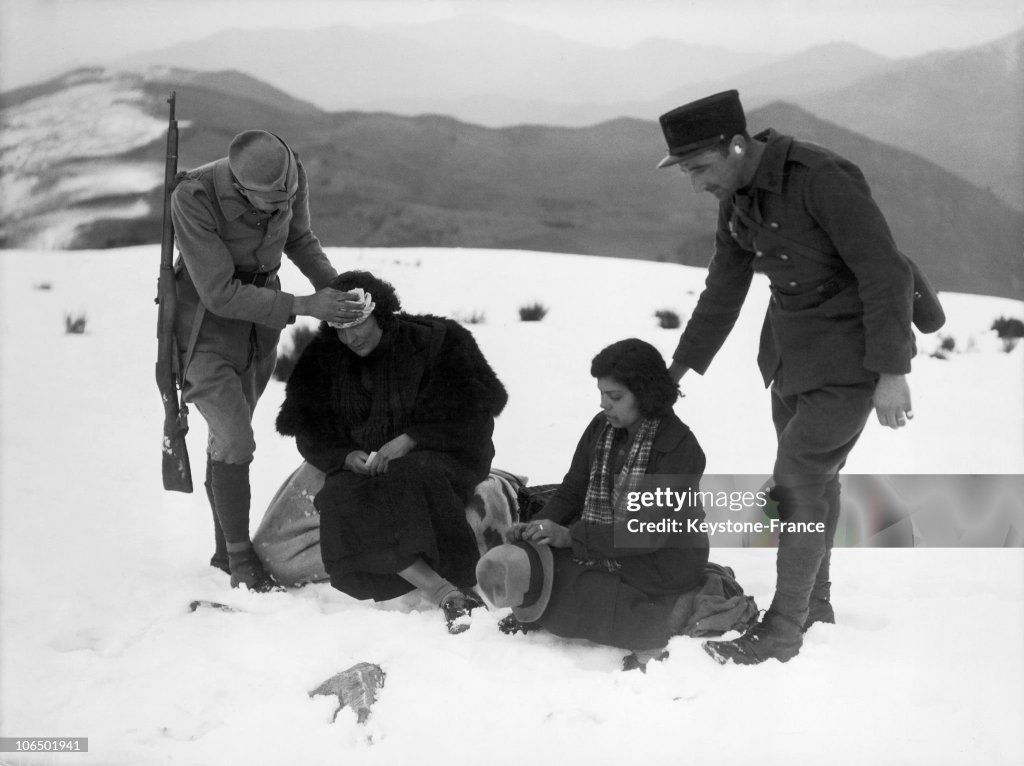
Spanish Insurgents reported at noon today they had occupied the pivotal town of Berga, twenty-three miles south of Puigcerda, a Catalan border town. After taking Berga, the Insurgents said, they were moving light mobile forces into the snow-covered Pyrenees to attack Puigcerda and Seo de Urgel.
With the full backing of the Spanish Cortes, Premier Juan Negrin today urged government forces on to a new stand against the Insurgent armies driving northward through Catalonia. The army in the upper Pyrenees and the forces along the coast were reported in communication with each other along a continuous front running through the Montseny Mountains below Girona.
In Vich tonight, Generalissimo Francisco Franco’s troops were reported to have advanced ten miles northeastward toward the Sierra de San Gregorio, between Vich and Girona. Persons in Vich said just enough resistance had been offered by the Republicans (Loyalists) before they moved out last evening to cover their retreat. Republican efforts to prevent the Nationalists (Insurgents) from driving them daily closer to the French border seem confined to blowing up bridges along the few roads running northward. It now appears likely that General Garcia Valiso’s Maestrazgo army corps, which captured Vich, may push quickly across the Sierra de San Gregorio to join forces with the Moroccan Army Corps, led by General Juan Yagüe and the mixed Spanish and Italian legionary forces moving northeastward along the coast and the Tordera River Valley toward Santa Coloma de Farnes and Girona. Four planes in good condition were abandoned at Vich by the Republicans among a large quantity of war material. President Manual Azaña of the Spanish Republic has been a resident of Vich for about three months. He is said to have left only a week ago when Barcelona fell. A photostatic copy of a telegram dated December 24, found in Premier Juan Negrín’s office in Barcelona, published this morning in the Vanguardia, advised Señor Azaña that the Nationalists had broken through the Republican lines in the Seros sector of the Segre front and deplored “the manifestly bad conduct” of two Republican divisions in this sector, resulting in their “total disintegration.”
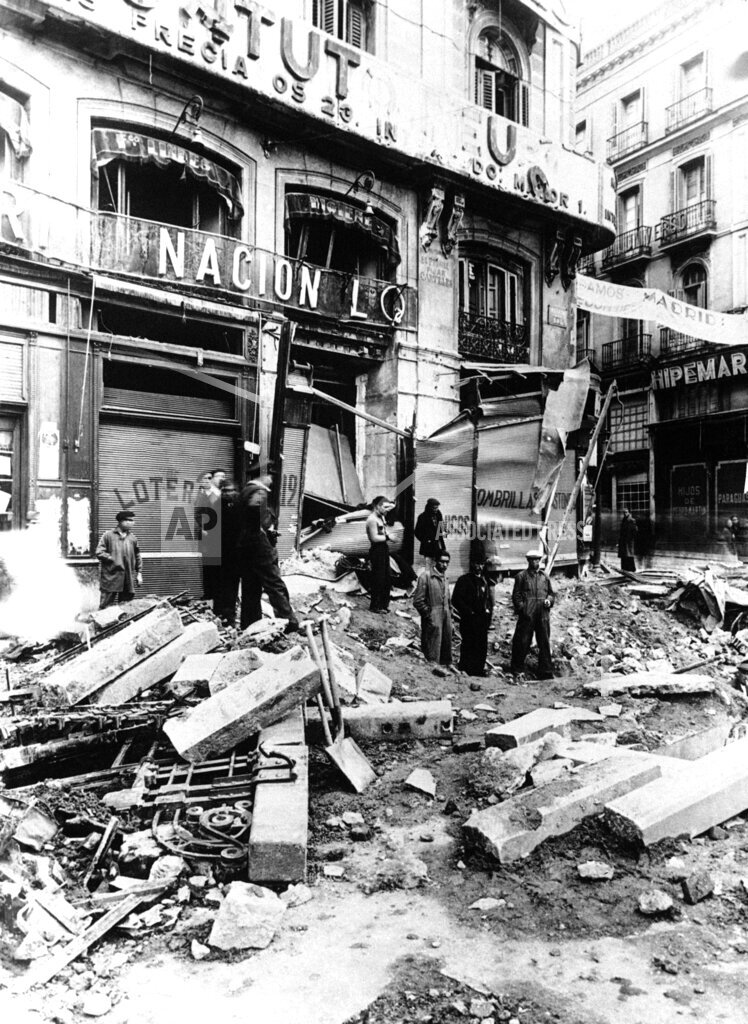
Eleven persons were killed and twenty-seven injured today when five Savoia bombers raided Valencia, dropping about 100 bombs.
Generalissimo Francisco Franco’s foreign minister Francisco Gómez-Jordana Sousa promised that they would pardon Republican soldiers who surrendered.
The first Republican government leader seized by Insurgent police in a series of arrests here was described today as Eduardo Barriobero, former president of the Popular Military Tribunal. José Giminez Arnau, chief of the Insurgent press service, said he would be charged with murder. Insurgents accused Señor Barriobero of having extorted money from wealthy residents of Barcelona after the outbreak of the civil war by threatening them with death before firing squads. Insurgent officials also arrested men identified as Luis Pomares, a former judge of the Republican Tribunal; a prosecutor named Elola and a judge of the Naval Courts, Fernando Berenguer, among a large number of persons described in Generalissimo Francisco Franco’s records as “having stained their hands with the blood of their brothers.” It was believed many of them would face firing squads within the next few weeks. Thus far no executions have been reported in Barcelona since its capture a week ago. Insurgent authorities estimated today that 3,000,000 persons in the Barcelona area would have to be fed by relief agencies for at least another month.
The Republicans formally asked Britain and France to help negotiate a ceasefire.
The German press, in acrimonious attacks on Mr. Roosevelt, called him “Peace Enemy No. 1” and accused him of using secrecy on relations with democratic powers as a means of evading Congressional intervention. One section of the press asserted he had recently entered into binding commitments abroad.
In Rome also the President was called an enemy of peace and Virginio Gayda wrote that if the frontier of the United States was extended to the Rhine it would be necessary for Italy and Germany to extend their frontier to the Panama Canal.
The British Minister for Civilian Defense announced in the House of Commons that, in case of war, the country would be divided into twelve independent districts, each with a virtual dictator. The House also was told that gas masks for babies, as well as small children, were being prepared.
Hungary broke relations with the Soviet Union. Hungary joins the Anti-Comintern Pact with Germany, Japan, and Italy.
The Rumanian Premier appoints Armand Calinescu as Vice Premier and temporary War Minister.
Hitler is expected to ask France and Britain to peacefully return former German colonies.
A British Army requirement is issued for a tank with Christie suspension, 40mm turret armour, a 2-pdr main gun and BESA machine gun. This led to the Crusader.
IRA terrorists bomb two underground stations in London.
Belgian Premier Spaak is beaten and bloodied by ex-soldiers because he appointed a man convicted of wartime treason to a seat in the Academy of Medicine. Speak’s condition is not serious.
Demands arose from several quarters today that President Roosevelt clarify his foreign policy, under which he is reported to have decided on aiding the democracies of Europe by helping France and Great Britain arm. Insistence in Congress on definition of the reports emanating from the secret conference the President held Tuesday with the Senate Military Affairs Committee came mainly from Republicans. It suggested that the minority was preparing to oppose every detail of legislation which might bear on foreign relations, unless the President set forth his purposes. In the President’s defense, Secretary Ickes said that the United States would not be drawn into war under this Administration, and Secretary Morgenthau denied that the stabilization fund was being used directly or indirectly to help France or any other country to finance purchases of munitions or any merchandise here.
Congressional action on the $725,000,000 relief appropriation for the Works Progress Administration through June 30 was completed today when the House adopted the conference report, agreed to by the Senate. The voice vote came after a sharp debate in which the leaders of the rival camps of the Democrats resumed the fight that started two weeks ago when the relief bill was first considered in the House. The Republicans said little, and offered no opposition to the report. They went along with Representative Woodrum, Democrat, of Virginia, in a successful attempt to recede from the House amendment requiring that WPA wage differentials be held to 25 percent between different sections of the country. The wage differential amendment, the only one on which the Senate and House conferees were not in complete agreement, was voted by the House two weeks ago during the revolt staged by Southern Democrats, aided by the Republicans. The amendment was rejected on a roll-call by 252 to 140. Efforts were in progress tonight to deliver the enrolled bill to the White House early tomorrow, since the present WPA appropriation is nearly exhausted. The Senate gave Vice President Garner permission to sign the resolution during a recess of the Senate, so that no time would be lost in getting the measure to the President.
The U.S. Assistant Secretary of War calls present defense plans merely a first step.
Former president Herbert Hoover accuses President Franklin Roosevelt of expanding foreign policy powers without approval.
The Dewey Bill backs evidence seizure without a warrant, but limits wiretapping.
Several members of the House denounce the Dies Committee, which is investigating “un-American” activities.
Unanimous approval of the House Rules Committee was given today to a resolution continuing the Dies committee to investigate un-American activities and appropriating $100,000 to complete its work. The vote followed renewed charges by Representative Dies that “New Deal” departments had sought to wreck the investigation and that the Department of Justice, in its new investigation into subversive activities, had “sought to intimidate” the witnesses heard by the Dies committee in hearings which began last August. Mr. Dies asserted that Department of Justice agents had engaged in “investigating my witnesses” rather than conducting an inquiry into Communist, fascist and Nazi group activities. This statement was followed by expressions sympathetic to the continuation of the Dies group, and Representative Cox of Georgia clinched the victory by moving for an executive session. The final argument for the resolution was made by Mr. Dies, who also is a member of the Rules Committee. He replied to charges made during two days of hearings by members of Congress that he had been unfair in proceedings, that he had “smeared” innocent persons with the “taint” of communism, and that he had refused to permit persons who were attacked an opportunity to refute the testimony.
A five-year fight between the Tennessee Valley Authority and private utility companies nears resolution.
A jury hears testimony in the conspiracy trial of Frank Hayes, the mayor of Waterbury, Connecticut
President Franklin Roosevelt pleads for aid to Chile.
After a major fire in Syracuse, New York was all but extinguished in the Collins Block, the building collapses killing nine firemen.
Mexico City faces electrical outages until summer, as the waters that fuel its hydroelectric plants are at their historical lows.
Reports emerge of heavy fighting as the Japanese army moves up the Yangtze River towards Ichang in four columns. The Japanese forces now appear to be engaged in what may develop into a major offensive up the Yangtze Valley toward Ichang. Foreign quarters at Ichang report evidence of extensive hostilities between that city and Hankow in that many wounded are arriving at Ichang. Local reports say that the Japanese are driving up the Yangtze Valley in four columns. One is said to have retaken Chingshian and to be now engaged by the Chinese in heavy fighting outside Chunghsiang. Another is at Tienmen, a third striking at Kienli and the fourth attacking Lungkangcheng, where it is said to have been repulsed.
Some tension is reported in Ichang. Once the concentration center for Chinese machinery and general supplies evacuated from Hankow, Ichang has recently been cleared of its most valuable material and is no longer of major importance to the Chinese. If the new Japanese activity in the Yangtze Valley really means an offensive against Ichang it is considered unlikely that the Japanese will continue beyond the city at present because of the low level. of the Yangtze. This has made navigation by all except the smallest vessels impossible and has virtually halted all except junk traffic through the gorges above Ichang.
Meanwhile, renewed military activity in other sectors was also reported here. A new Japanese drive against Wuning in Kiangsi Province was said to be under way, while heavy reinforcements at Samshui, west of Canton, were believed to indicate a possible push westward from that point. Some quarters believed, however, that the Samshui moves might be designed to screen a contemplated invasion from Pakhoi. Poison gas detachments with equipment were said to have been included in the reinforcements at Samshui. In the north and northwest, on the other hand, an attack upon Sian, “the gateway to Russia,” is not considered imminent by General Chen Chien, a high military commander interviewed here. While stating that he did not mean that an invasion of Shensi was impossible, General Chen said: “The Japanese strength in Shansi and Honan at present is insufficient for a northwest invasion, according to the best considerations of strategy. But the Japanese often defy reason and logic.” General Chen estimated the Japanese strength in Shansi and the Paotow region of Suiyuan as between 120,000 and 140,000 with another 30,000 in Northern Honan. He declined to reveal the Chinese strength there, but said: “The Japanese know that we are strong and they will think soberly before attempting a new drive.”
General Chen confirmed reports that he had ordered the destruction of the walls of all cities in the first war area that might be a hindrance to Chinese guerrillas, since they had no artillery to blast the Japanese out of fixed positions. He believes that the Japanese have virtually reached the limit of their ability to penetrate China. “They have forty-six divisions in all and thirty-two of them are in China,’ he said. “They cannot move the remaining fourteen to China for new campaigns without dangerously weakening their strength at home and in Manchuria.” Denying that General Wu Pei-fu had accepted a position as a Japanese “puppet” administrator, the Chinese spokesman declared he still was refusing the post until Japan really returned political power to China. The spokesman denied that General Wu had sent out a circular telegram urging peace between China and Japan. He charged that the questions and answers reported to have been exchanged at an interview between General Wu and foreign correspondents at Peiping were fabrications of Domei, the Japanese news agency.
Japanese submarine I-63 sank in Bungo Channel after a collision with another submarine during maneuvers. Six of the crew were standing on the bridge at the time of the collision and were able to swim to safety; the other 81 perished.
The Japanese Empress awaits the birth of her child; midwives are standing by.
Dow Jones Industrial Average: 144.34 (+1.91).
Born:
Dale T. Mortensen, American economist (Nobel Prize, 2010), in Enterprise, Oregon (d. 2014).
Died:
Amanda McKittrick Ros, 78, Irish writer.
Naval Construction:
The Marynarka Wojenna (Polish Navy) submarine ORP Orzel (85 A) is commissioned. Her first commanding officer is Komandor podporucznik (Commander) Henryk Wincenty Kloczkowski, ORP.
The U.S. Navy destroyer USS Benham (DD-397), lead ship of her class of 10, is commissioned. Her first commanding officer is Lieutenant Commander Thomas Francis Darden, Jr., USN.



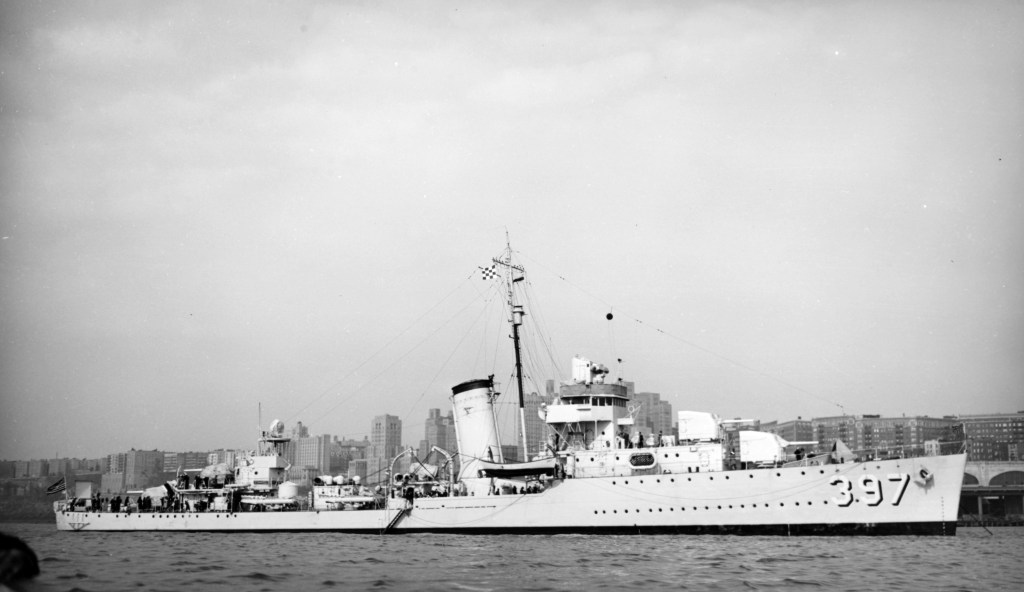
Assigned to the U.S. Atlantic Fleet, Benham patrolled off Newfoundland during most of 1939 and then shifted to the Gulf of Mexico. Ordered to the Pacific, she arrived at Pearl Harbor 14 April 1940. After alternating between Californian and Hawaiian waters, the destroyer served as an escort for Enterprise during the delivery of Marine planes to Midway Atoll on 28 November to 8 December 1941, thus missing the Japanese attack on Pearl Harbor. Benham served with Enterprise and Saratoga task forces off Hawaii and with Task Force 16 during the Doolittle raid on Tokyo, 8 to 25 April 1942. She continued operating with TF 16 through the Battle of Midway, 3 to 6 June, during which she rescued 720 survivors from the aircraft carrier Yorktown and 188 from the destroyer Hammann; landings on Guadalcanal and Tulagi, 7 to 9 August, and the Battle of the Eastern Solomons, 23 to 25 August.
Lost 15 November 1942.
Benham joined Task Force 64 on 15 October as a part of the naval covering force off Guadalcanal. During 14–15 November, she took part in the Naval Battle of Guadalcanal, and at 00:38 on 15 November she took a single torpedo in her bow which severed everything forward of her bridge. Benham stayed afloat, making slow headway towards Guadalcanal during the 15th but, by 16:37, further progress was impossible and her crew abandoned ship. Gwin picked up the survivors, and sank the hulk at 19:38 by shell-fire.
Benham received five battle stars for her service in World War II.
 History Diaries