Overextended and short of supplies, the German 3.Panzerkorps evacuated Rostov-on-Don, Russia due to lack of supplies; the city was reoccupied by Soviet forces later on the same day. 3.Panzerkorps withdraws to the Mius river 30 miles (48 kilometers) to the west. The events of 28 November 1941 are decidedly mixed for the Wehrmacht. With Adolf Hitler in Berlin attending the funeral of Luftwaffe ace Colonel Werner Mölders, the Wehrmacht leaders in the Army Group South sector make their move to evacuate Rostov-on-Don. While German III Panzer Corps, commanded by General der Kavallerie Eberhard von Mackensen, has not yet been forced out of the city, everyone realizes that may not last very long. Soviet South Front, led by General Yakov Cherevichenko, has brought in twenty-one divisions and obviously is planning something. The German corps has only two divisions in Rostov, 1st SS Panzer Division Leibstandarte SS Adolf Hitler (Sepp Dietrich) and the 13th Panzer Division, and Mackensen already has reported that they are worn out from endless fighting. The divisions are at only half to two-thirds of their normal strength. In addition, the German supply situation is catastrophic and the divisions are short of everything. Accordingly, during the day First Panzer Army commander General Ewald von Kleist orders Mackensen to evacuate the city. This is accomplished by nightfall.
Hitler does not learn of the withdrawal from Rostov on the 28th, most likely because the Wehrmacht does not go out of its way to tell him. After the Mölders funeral, Hitler boards his command train “Amerika” and begins the journey back to his headquarters in East Prussia. While traveling through the night, Hitler does not receive any communications about the withdrawal and has no reason to think that one is being made. Field Marshal Gerd von Rundstedt, commander of Army Group South, understands that Hitler may not approve the order but tells von Kleist’s to order Mackensen to withdraw anyway. Since Hitler is unaware of the order to withdraw, he is not able to countermand it before it is executed. Everything is planned as much around Hitler’s unavailability as it is the situation in Rostov. It is a perfectly timed operation… against both the Red Army and the Führer.
The Soviets are counterattacking all around Moscow in order to disrupt German plans, and those battles are having the intended effect. West of Moscow, Soviet Western Front launches a powerful counterattack against the German 4th Army (Field Marshal Günther von Kluge). Von Kluge’s forces are able to stop the Red Army, but this scrambles its own plans to launch an offensive against the Soviet capital beginning on 2 December. South of Moscow, at Tula, General Leo Freiherr Geyr von Schweppenburg’s XXIV Motorized Corps moves forward to attack Tula from the north and east while XLII Army Corps attacks from the west. However, von Schweppenburg’s troops have to make a move parallel to the front along a narrow corridor to get into position for the attack and are subjected to fierce artillery fire from the city. The Soviets also are attacking the exposed German position north of Moscow at Tikhvin with the 52nd and 54th Armies by attacking the flanks of the long salient to the city in an attempt to cut off the garrison. Continuing Soviet counterattacks are not dislodging the German troops anywhere, but the endless pressure is definitely wearing them down.
Northwest of Moscow, the German attack is going better than elsewhere. Early in the morning, the Seventh Panzer Division (General Baron von Funck), led by Hasso von Manteuffel’s rifle regiment, captures and crosses the Jakhroma (Yakhroma) bridge across the Moscow/Volga canal. A sergeant in Manteuffel’s unit later remarks:
“I was participating in the assault across the Moscow-Volga canal near Jakhroma and withessed our “little one” (Manteuffel) switch off the Muscovites’ power in the power station of Jakhroma. He was the first in the attack and the last to retreat.”
The sergeant’s comment about the “retreat” is telling because the German forces do not remain in place for very long. While Manteuffel’s men hold a bridgehead throughout the day, some panzers that cross the bridge to support them are driven back to the other side by 10:00. The Soviet defenders of the 1st Shock Army unleash a torrent of fire that includes air attacks and Katyusha rocket launchers. Now within about 20 miles of the Kremlin, this is the closest that the Wehrmacht gets.
The Finnish 8th Division ends its offensive in the northern part of the Maaselka Isthmus. Also battles in Kestenga cease and a quiet phase begins.
Allied convoy PQ.4 arrived at Arkhangelsk, Russia.
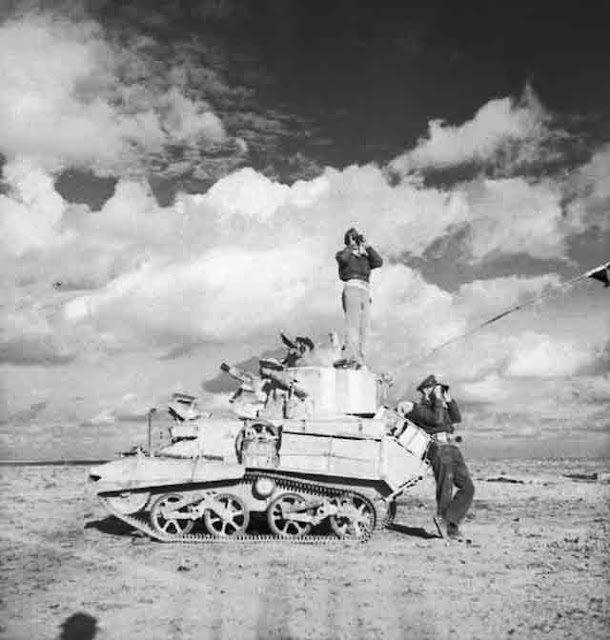
British 7th Armored Division attacked German 15th Panzer Division with numerical superiority, but the Germans continued to press on toward Tobruk, Libya. Nearby, commanding officer of the German 21st Panzer Division General Johann von Ravenstein was captured by troops of the New Zealand 2nd Infantry Division. German tank forces renew the fighting around Sidi Rezegh. The link between the New Zealand infantry and the Tobruk garrison. This battle will continue over 3 days resulting in heavy losses to both sides and one of the New Zealand brigades is forced out of the action. The Germans overrun the New Zealand 24th Battalion and capture the New Zealand Main Dressing Station.
German officer Johann von Ravenstein was captured at Point 175 by New Zealand soldiers.
22,000 Italian troops in Ethiopia, under General Nasi, surrender to the British. Mussolini’s East African Roman Empire has thus ceased to exist.
Grand Mufti of Jerusalem Haj Amin al-Husseini arrived in Berlin, Germany. The Grand Mufti was in Iraq when the British invaded earlier in the year and only reached Berlin after a very difficult and roundabout journey. He professes his loyalty to the German cause and offers to enlist Arab soldiers to fight beside the Wehrmacht. Adolf Hitler promises the Mufti that upon German conquest of Palestine, the Jewish population will be exterminated. Britain and Russia are both power bases of Jewry, Hitler said, and he will carry on the fight until the last traces of Jewish hegemony is eliminated. The German Army will in the future break through the Caucasus into the Middle East and help to liberate the Arab world. Germany’s only other objective in the region will be the annihilation of the Jews.
Al-Husseini sought a public German-Italian declaration supporting Arab independence and opposing the establishment of a Jewish national home in Palestine, while offering Arab military cooperation. Hitler declined to issue an immediate public declaration — stating it would be delayed until German forces reached the southern Caucasus — but assured the Mufti of secret alignment and shared opposition to the British and Jewish presence.
A state funeral was held for Werner Mölders in Berlin, Germany.
Joachim von Ribbentrop met with Hiroshi Oshima in Berlin, Germany, promising that Germany would declare war on the United States should Japan and the U.S. enter a state of war; Ribbentrop, however, did not know Japan was planning on starting the war soon.
While being shadowed by German submarine U-95, Dutch submarine O-21 fired two stern torpedoes at its stalker 125 miles east of Gibraltar, sinking the German boat; 35 were killed, 12 survived and captured.
Paris: Rue Championnat. A grenade attack is made on a military traffic post. 2 soldiers and a Frenchman are killed and 7 wounded.
Battleship HMS King George V, aircraft carrier HMS Victorious, heavy cruiser HMS Norfolk, and destroyers HMS Ashanti, HMS Tartar, HMS Eskimo, HMS Somali, HMS Matabele, HMS Echo, and HMS Escapade departed Hvalfjord at 1400 for Scapa Flow, arriving on the 30th at 1200.
Light cruiser HMS Edinburgh departed the Faroes — Iceland patrol for Scapa Flow, where she arrived on the 29th.
Heavy cruiser HMS Cumberland departed the Denmark Strait patrol, upon relief by heavy cruiser HMS Suffolk, for Hvalfjord, where she arrived later that day.
Destroyers HMS Fury and HMS Foresight departed Londonderry at 1300 for Scapa Flow, arriving at 0930/29th.
Minelayer HMS Menetheus, escorted by destroyer HMS Lancaster, laid minefield SN.25B.
German steamer Henny (764grt) was lost on a mine near Memel.
German steamer Gerda Ferdinand (3727grt) foundered north of Stockholm.
Dutch submarine HNLMS O.21 sank U-95, commanded by Kapitänleutnant Gerd Schreiber, east of Gibraltar in 36-21N, 03-27W. The submarine rescued the German commanding officer, three other officers, and eight ratings. Thirty three crewmen were lost in the submarine. The submarine arrived back at Gibraltar on the 28th. During its career the U-95 sank 8 ships for a total of 28,415 tons and damaged 4 ships for a total of 27,916 tons.
Force K of light cruisers HMS Aurora and HMS Penelope and destroyers HMS Lance and HMS Lively departed Malta to intercept enemy destroyers thought to be departing Benghazi. No contact was made and Force K returned to Malta on the 29th.
T/Sub Lt (A) E. H. Walshe RNVR, and T/Sub Lt (E) J. H. Lewis of 828 Squadron from HMS St. Angelo, were taken prisoner after their Albacore aircraft was lost after a night attack on Castel Benito.
Italian steamer Priaruggia (1196grt) was sunk by British bombing at Benghazi.
Convoy SC.57 departed Sydney, CB escorted by corvettes HMCS Battleford, HMCS Kamsack, and HMS Shawnigan, and minesweeper HMCS Nipigon. Corvettes HMCS Kamsack, and Shawnigan and minesweeper Nipigon were detached on the 30th when relieved by corvettes HMCS Arvida, HMCS Fennel, HMS Polyanthus, HMS Primrose, HMCS Sherbrooke, and HMCS Trail. Corvette HMCS Fennel was detached on 1 December and destroyer HMCS Ottawa joined. Corvettes HMS Alisma, HMS Kingcup, and HMS Sunflower and anti-submarine trawlers HMS Lady Elsa and HMS Le Tiger joined on 9 December. Destroyer HMCS Ottawa and corvettes HMCS Arvida, HMCS Battleford, Polyanthus, Primrose, HMCS Sherbrooke, and HMCS Trail were detached on 9 December. Destroyers HMS Sabre and HMS Skate joined on 10 December. Destroyers Sabre and Skate, corvettes Alisma, Kingcup, and Sunflower, and the trawlers were detached on 13 December. The convoy arrived at Liverpool on 15 December.
In Washington, President Roosevelt conferred today with the Secretaries of State, War and Navy, the Chief of Naval Operations and the Army Chief of Staff; discussed Japanese-American relations at his press conference, signed a proclamation designating December 15 as “Bill of Rights Day,” and departed for Warm Springs, Georgia.
The Senate was in recess. Its Judiciary Committee approved the Connally Labor bill.
The House passed an amended Price Control Bill and adjourned at 8:31 PM until noon on Monday. The Labor Committee approved the Norton bill to curb strikes. The Public Buildings and Grounds Committee approved a $300,000,000 authorization for defense housing.
Secretary of State Hull tells Finland he is not sure to what extent “Finnish policy is a menace to all America’s aims for self-defense” because “. . . every act of the Finnish Government since the delivery of its note has confirmed our apprehensions that it is fully cooperating with the Hitler forces.”
In proclaiming December 15 as Bill of Rights Day, President Roosevelt declared today that the loss of fundamental human liberties in other countries has given Americans “an unalterable determination” not to see them lost or curtailed in the United States.
Legislation empowering the government to take over a defense plant when production is interrupted was approved by senate and house committees today after the administration dropped the idea of compulsory arbitration of labor disputes. The House Labor Committee approved a “middle-of-the-road” measure for arbitration of labor disputes and a “cooling-off period,” after which a plant would be taken over if agreement failed. The Senate Judiciary Committee voted the Connally bill providing for the freezing of existing labor relationships, with the exception of wages, in any plant or industry which the government seizes. The Senate committee reported its bill a few minutes after the House group voted its measure. Neither bill includes the compulsory arbitration section drafted in the so-called Administration measure by Representative Ramspeck of Georgia earlier in the week after a conference between President Roosevelt and legislative leaders.
A tattered remnant of the administration’s price control bill was passed by the house tonight after President Roosevelt’s forces, facing a complete rout, compromised on many points with a coalition of Republicans and Democrats. Climaxing what many members said privately was the most confused legislative situation they had experienced, the revamped bill was sent to the senate by a roll call vote of 224 to 161 after a Republican effort to send it back to the House Banking Committee had been defeated by a standing vote of 171 to 134.
Spokesmen for the nineteen railway labor unions offered today to call off nationwide strike plans if all of the 1,200,000 railway employes received wage increases of at least $1 a day.
Confidence that none of the steel companies operating captive coal mines would refuse to abide by the decision of President Roosevelt’s arbitration board on the union shop issue was expressed in circles close to the arbitrators last night after telegrams had been received from most of the companies involved in the dispute.
Opposition to the two veterans’ pensions bills passed by the House and pending before the Senate Finance Committee was reaffirmed by the National Economy League today in a joint statement by H.G.W. Sundeloff, executive director, and Willard D. Arant, research director.
Complete approval of Wendell L. Willkie’s position in supporting President Roosevelt’s policy of all-out aid to the nations fighting Hitler has been expressed by the Massachusetts Republican State Committee, Mr. Willkie was informed yesterday.
Wendell L. Willkie will represent William Schneiderman, secretary of the Communist party of California, before the United States Supreme Court when the highest court of the land meets during its January term to hear an appeal taken by the Communist leader against decisions of two lower Federal courts revoking his citizenship.
Counsel for the Ferguson-Oman Company, builders of the shell-loading plant at Milan, Tennessee, charged today that witnesses who told the Senate Defense Investigating Committee of alleged waste and extravagance were prejudiced.
War conditions and the lengthened hours of work in defense industries have reversed the downward trend of tuberculosis, a movement which in recent years had given rise to the hope that this disease might join in the near future the group of maladies that no longer offer a serious menace to health.
Major General Henry H. Arnold reported today that the Army Air Force possessed 2,500 or more modern, combat type war planes, despite the diversion of American-made aircraft to Britain and elsewhere.
The service comedy film “Keep ‘Em Flying” starring Abbott and Costello was released.
The ominous Japanese-American situation reached a new point of gravity today with the capital’s most authoritative quarters asserting in effect that America’s last word has been said and the question of peace in the Pacific depends upon Tokyo’s next move. At the same time, the only indication of what that move would be was a continuation of troubled reports from the Orient. They told of Japanese troops massing in Indo-China and of preparations in Thailand for defense against attack. Japanese newspapers defended the course of their government and said dispatch of an expeditionary force into Indo-China had been justified by events. Officially, it was said here negotiations with the Japanese representatives had not broken down completely. However, President Roosevelt entrained at mid-afternoon for a rest at Warm Springs, Georgia. It was felt he would not have left the capital it there remained any prospect of improving relations between Washington and Tokyo by continuation of the discussions.
The Japanese Ambassador Nomura Kichisaburo sends a message to Tokyo stating that headlines are appearing in the newspapers saying ” Hull Hands Peace Plan to Japanese,” and “America Scorns a Second Munich.” The papers say that it is up to Japan either to accept the American proposal with its four principals, or face war, in which latter case the responsibility would be upon Japan.”
Secretary of State Cordell Hull again warns U.S. officials of an imminent Japanese attack.
In California, Headquarters Western Defense Command at the Presidio of San Francisco issues a SECRET message to the commanding Generals of the Northwest Sector, Pacific Coastal Frontier Northern California Sector, Pacific Coastal Frontier Southern California Sector, Pacific Coastal Frontier:
It appears that negotiations with Japan have failed….It is desired that Japan commit the first overt act…..take precautions….do not alarm civilians or disclose your intent…..
In view of the above, the following measures are to be taken: a. Harbor entrance control posted…24 hour manning… b. One gun battery each harbor on continuous alert… c. Harbor defense …co-operate with Naval district commands d. Protection against sabotage and other subversive activities has been intensified.
Take the following measures:
a. Complete sector plans under Rainbow 5.
b. Designate two Reserve battalions and motor transport to CG, Ninth Corps Area. c. Have Rainbow 5 reconnaissance put into effect. d. Keep personnel on duty at HQ. at all times. e. Take precautions against sabotage or subversive activity.
Limit distribution of this document to minimum essential officers.
The Communication Intelligence Summary for 28 November states:
“General. -Traffic volume normal. Communications to and from South China and between Mandates and Empire very heavy. No tactical traffic seen. As has been previously reported the suspected Radio Intelligence net is very active and is becoming more so. The TOKYO plotting activity addressed more messages to the Radio net than previously and most of these sent for information to the Major Commanders. Much traffic also was directed to NRE0 (the TOKYO D. F. Command) from all eight stations in the Mandates and OMINATO. This Command also originated messages of high precedence to the Major Fleet Commanders. This activity is interpreted to indicate that the Radio Intelligence net is operating at full strength upon U. S. Naval Communications and is getting results. TOKYO originators were active with messages of high precedence to the Commander in Chiefs of the Second and Third Fleets and Combined Air Force. The Navy Minister sent to Alnavs. The Chief of the Naval General Staff sent one to the Chief of Staffs of Combined Air Force, Combined Fleet, Fourth Fleet, Third Fleet, French Indo-China Force, Second Fleet and RNO PALAO. The BUAERO sent one to Chief of Staff Fourth Fleet info IMIESI and 11th Air Corps at SAIPAN.
Combined Fleet. -No indication of movement of any Combined Fleet units. Commander in Chief Second Fleet originated his usual number of dispatches to Third Fleet and Combined Air Force. The units paid particular attention to by the Commander in Chief Second Fleet were CARDIVS Five and Seven and DESRONS Two and Four and SUBRON Five. No traffic today from the TAKAO (CA).
Third Fleet. -Little activity from Third Fleet units save for the Commander in Chief. The impression is growing that the First Base Force is not present with the bulk of the Third Fleet in SASEBO but it is not yet located elsewhere. The Army Commander in TAIHOKU is still holding communications with the commander in Chief Third Fleet. Two Third Fleet units arrived at BAKO and are apparently returning to KURE from BAKO.
Fourth Fleet. -Bulk of Fourth Fleet still at TRUK. The Commander in Chief Fourth addressed message to the Sixth Base Force at JALUIT and the Fourth Base Force at TRUK. Yokohama Air Corps is at RUOTTO and WOTJE and held communications with AIRRON Twenty-Four and KAMOI.
Sixth China. -SAMA sent several messages to shore addresses in the Empire. SAMA also addressed the OMURA AIR CORPS in several messages which went for information to SAIGON and TOKYO. TAKAO radio station addressed the Chiefs of Staff Combined Fleet, Second Fleet, the French Indo China Force and Combined Air Force. TAKAO Air Corps addressed SUKUGAWA Air Corps and YOKOSUKA Air Corps. A representative of a HAINAN office now at SAIGON originated several messages to the Naval Bases at SASEBO and KURE. The Commander in Chief China Fleet originated more traffic than usual and addressed his fleet collectively for infor mation to the Commander in Chief Second and Commander in Chief Third Fleets.
Submarines. -Except for the mention of SUBRONS Five and Six in two dispatches there was no submarine activity today.
American aircraft carrier USS Enterprise departed Pearl Harbor accompanied by battleships USS Arizona, USS Nevada, and USS Oklahoma of Battleship Division 1, heavy cruisers USS Chester, USS Northampton, and USS Salt Lake City of Cruiser Division 5, Commander Destroyer Flotilla 2 in light cruiser USS Detroit, and destroyers USS Henley, USS Helm, USS Blue, USS Bagley, USS Mugford, USS Ralph Talbot, USS Jarvis, and USS Patterson of Destroyer Squadron 4 and destroyers USS Balch, USS Gridley, USS Craven, USS McCall, USS Maury, USS Dunlap, USS Fanning, USS Benham, and USS Ellet of Destroyer Squadron 6. The battleships, light cruiser Detroit, and Destroyer Squadron 4 were detached out of sighted of land for exercises and the aircraft carrier with Cruiser Division 5 and Destroyer Squadron 6 to Wake Island. On 4 December, twelve Marine F4F Wildcat aircraft of VMF-211 were flown off to Wake.
The air echelon of U.S. Marine Fighter Squadron 211 secretly flies 12 F4F-3 fighters from Ewa to Ford Island for further transfer to USS Enterprise. Later on the same day, USS Enterprise sails for Wake Island in TF-8 (Vice Admiral William F. Halsey, Jr.) to ferry the USMC F4Fs (VMF-211) to the atoll. Occasioned by the “war warning” of the previous day, the deployment is part of eleventh-hour augmentation of defenses at outlying Pacific bases. Halsey approves “Battle Order No. 1” (28 November) that declares that Enterprise is operating “under war conditions.” “Steady nerves and stout hearts,” the carrier’s captain concludes, “are needed now.” Supporting PBY operations will be carried out from advanced bases at Wake and Midway.
Seaplane tender USS Wright (AV-1), arrives at Wake Island, with Marine Aircraft Group 21 people to establish an advance aviation base. U.S. Navy Commander W. S. Cunningham relieved U.S. Marine Corps Major James P. S. Devereux as the overall commanding officer of Wake Island. 9 U.S. Navy officers and 58 sailors arrived with Cunningham aboard Wright.
U.S. passenger liner President Harrison, chartered for the purpose, sails from Shanghai, China, with the 1st Battalion, 4th Marine Regiment (Lieutenant Colonel Curtis T. Beecher, USMC) and regimental staff (Colonel Samuel L. Howard, USMC) embarked, bound for the Philippines. “Stirring scenes of farewell,” U.S. Consul Edwin F. Stanton reports to Secretary of State Hull, accompany the marines’ departure.
Brereton requests permission to conduct high-altitude photo reconnaissance of Takao in Southern Formosa. MacArthur demurred, citing “the War Department instructions to avoid any overt act” and directed that all Army reconnaissance, including that conducted in co-operation with the Asiatic Fleet, be limited to two-thirds the distance from Luzon to Formosa.
MacArthur met with Hart and Sayre at 3:30 pm at Sayre’s office to discuss messages received by all three from their respective Departments. Hart and Sayre later stated that MacArthur is buoyant and positive that war would not break out before the beginning of 1942.
Arnold cables Brereton to “take steps” to protect personnel and equipment against subversive activities.
4:30 PM Brereton suspends alert but orders all units on war readiness status.
During their storm-fraught passage to rendezvous with the river gunboats proceeding from Shanghai to Manila, submarine rescue vessel USS Pigeon (ASR-6) experiences steering casualty; minesweeper USS Finch (AM-9), which loses both anchors in the tempest, stands by to render assistance, and eventually, after three tries, manages to take the crippled ship in tow the following day.
Cruiser USS Marblehead arrives at Tarakan, Borneo, Dutch East Indies.
Force “G”, HMS Prince of Wales (53) and HMS Repulse (34) arrive at Colombo, Ceylon. They will form the British Far East Fleet based at Singapore, along with the destroyers HMS Encounter (H 10) and Jupiter (F 85). The carrier Indomitable (92) was scheduled to join them, but was damaged on the 3rd when she ran aground while training in Jamaica, West Indies.
The Imperial Japanese Navy light cruiser HIJMS Naka arrived at Mako, Pescadores islands.
With no active proposals on the table from either side, negotiations have broken down between the United States and Japan. The Japanese Foreign Ministry in Tokyo sends a coded message to Ambassador Nomura in Washington, who has suggested submitting another peace proposal:
“Well, you two Ambassadors have exerted superhuman efforts but, in spite of this, the United States has gone ahead and presented this humiliating proposal. This was quite unexpected and extremely regrettable. The Imperial Government can by no means use it as a basis for negotiations. Therefore, with a report of the views of the Imperial Government on this American proposal which I will send you in two or three days, the negotiations will be de facto ruptured. This is inevitable. However, I do not wish you to give the impression that the negotiations are broken off. Merely say to them that you are awaiting instructions and that, although the opinions of your Government are not yet clear to you, to your own way of thinking the Imperial Government has always made just claims and has borne great sacrifices for the sake of peace in the Pacific. Say that we have always demonstrated a long-suffering and conciliatory attitude, but that, on the other hand, the United States has been unbending, making it impossible for Japan to establish negotiations. Since things have come to this pass, I contacted the man you told me to in your #1180 [b] and he said that under the present circumstances what you suggest is entirely unsuitable. From now on do the best you can.”
The United States military “Magic” decoding unit is reading the Japanese diplomatic codes almost in real-time, so both sides understand that the situation is extremely grave. The Japanese fleet is at sea and heading toward Hawaii, but the Americans do not know this.
Dow Jones Industrial Average: 114.66 (-0.98)
Born:
Laura Antonelli, Italian actress (“Wifemistress”, “Divine Nymph”), in Pola, Istria, Italy (d. 2015).
Norm Beaudin, Canadian NHL and WHA right wing (St. Louis Blues, Minnesota North Stars; WHA: Winnipeg Jets), in Montmartre, Saskatchewan, Canada.
J.D. Garrett, AFL halfback (Boston Patriots), in Natchitoches, Louisiana (d. 2012).
Reed Bohovich, NFL tackle (New York Giants), in Buffalo, New York (d. 2011).
Fritz Fisher, MLB pitcher (Detroit Tigers), in Adrian, Michigan.
Jessie Smith, American session and touring vocalist (Ike & Tina Turner Revue; The Mirettes; Dr. John), in Clarksdale, Mississippi (d. 2021).
Naval Construction:
The Royal Navy Fairmile B-class motor launch HMS ML 394 is laid down by Le Blanc Shipbuilding (Weymouth, Canada).
The Royal Navy YMS-1-class auxiliary motor minesweeper HMS BYMS 2008 (J 808) is laid down by the Wheeler Shipbuilding Corp. (Whitestone, Long Island, New York, U.S.A.).
The U.S. Navy YMS-1-class auxiliary motor minesweeper USS YMS-25 is laid down by the Greenport Basin and Construction Co. (Greenport, Long Island, New York, U.S.A.).
The U.S. Navy Auk-class minesweepers USS Seer (AM-112), USS Sentinel (AM-113), USS Staff (AM-114), and USS Skill (AM-115) are laid down by the American Shipbuilding Co. (Lorain, Ohio, U.S.A.).
The Royal Navy Flower-class (rev.) corvette HMS Musk (K 289) is laid down by the Morton Engineering and Dry Dock Co. (Quebec City, Quebec, Canada), She is transferred under reverse lend-lease to the United States Navy on completion and commissions as USS Might (PG-94).
The Kriegsmarine (German Navy) Type VIIC U-boat U-272 is laid down by Bremer Vulkan-Vegesacker Werft, Bremen-Vegesack (werk 37).
The Royal Navy LST (Mk 2)-class landing ship, tank HMS LCT 164 is launched by Redpath Brown (Meadowside, Scotland, U.K.).
The Royal Navy Isles-class minesweeping trawler HMS Inchmarnock (T 166) is commissioned. Her first commanding officer is Lieutenant Commander Stanley Darling, RANVR.
The Kriegsmarine (German Navy) Type IXC U-boat U-164 is commissioned. Her first commanding officer is Korvettenkapitän Otto Fechner.
The U.S. Navy Gleaves-class destroyer USS Ellyson (DD-454) is commissioned. Her first commanding officer is Lieutenant Commander John Bartholomew Rooney, USN.
9…

