THIS IS A WAR WARNING…
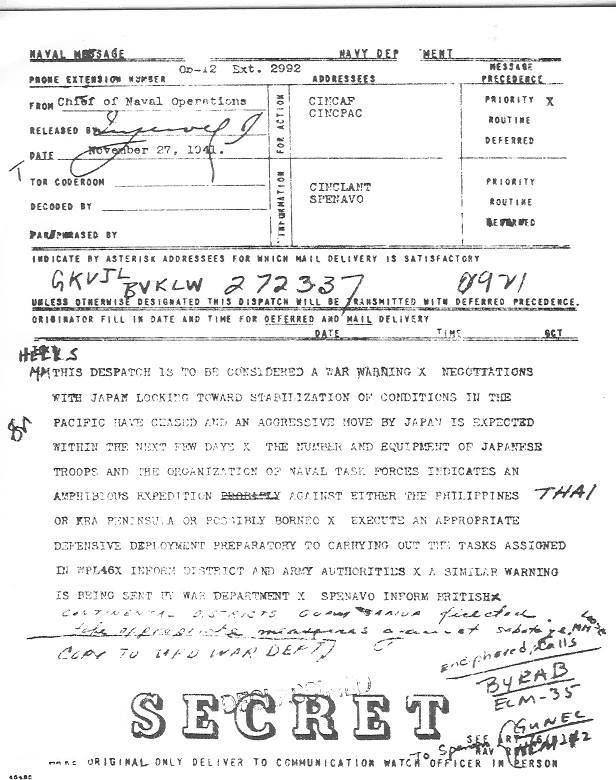
The U.S. Navy Chief of Naval Operations, Admiral Harold R. Stark, sends the following message to the commanders of the Asiatic Fleet, Admiral Thomas C. Hart, and Pacific Fleet, Admiral Husband E. Kimmel: “This dispatch is to be considered a war warning. Negotiations with Japan looking toward stabilization of conditions in the Pacific have ceased and an aggressive move by Japan is expected within the next few days. The number and equipment of Japanese troops and the organization of naval task forces indicates an amphibious expedition against either the Philippines, Thai or Kra Peninsula or possibly Borneo. Execute an appropriate defensive deployment preparatory to carrying out the tasks assigned in WPL46. Inform District and Army authorities. A similar warning is being sent by War Department. Spenavo inform British. Continental districts, Guam, Samoa directed take appropriate measures against sabotage.”
In Russia, German SS Reich Division captured Istra west of Moscow while 7th Panzer Division advanced to the Moskva-Volga canal at Yakhroma east of Moscow. The forward-most German troops were reported within 19 miles of the Soviet capital, and noted the sighting of the Kremlin. Fighting near Kashira has been continuing for the past 3 days. Guderian’s forces will not be able to continue the advance toward Moscow unless reinforced.
The sound of the guns from the battle raging in front of Moscow can be heard clearly in the capital tonight. The Germans are only 25 miles away. They have broadened the wedge that they have driven into the Russian forces northwest of the city and are claiming to have captured the town of Klin. They are however, still being held at Tula, south of Moscow.
The seriousness of the situation is reflected in an order of the day broadcast to the Red Army today, urging the soldiers to hold on; “The enemy has advanced nearer to Moscow. The situation is increasingly difficult but we must, and can, stand the strain.”
The order went on to say that Hitler is putting everything into his last thrust, which he hopes will bring him to the gates of the city, and, recalling the French at Verdun, it demanded: “You must fight to the last. The enemy shall not pass.”
In their advance toward Moscow under extremely difficult wintry conditions, units of 9.Armee reach the Volga Canal 60 miles (97 kilometers) northwest of the Soviet capital. Some armed patrols have penetrated the western suburbs of the city and got a good look at the Kremlin.
The only unit to reach/cross the Volga Canal was the 7 Pz.Div. of LVIPz.K./3rd Pz.Armee. They cross the canal today at Yachroma, about 30 miles North of Moscow.
The Battle of Rostov ended in Soviet victory.
The German 1st Panzer Group is retreating toward Taganrog as the Soviets reoccupy Rostov-on-Don.
Allied convoy QP.3 departed Arkhangelsk, Russia and convoy PQ-5 departed Hvalfjörður, Iceland.
The Siege of Tobruk ended in Allied victory when the besieged garrison was relieved by the British 8th Army. New Zealand 2nd Division supported by 90 tanks penetrated the German encirclement of Tobruk, Libya and broke into the besieged city. Tanks of German 15th and 21st Panzer Divisions moved in to counterattack, but Australian and British troops halted it during the day; German tanks would attempt to close in on the city after sundown.
As the German 21st Panzer Division withdrew to the west for resupplying, the 15th Panzer Division captured Sidi Azeiz, Libya, taking 700 prisoners.
German submarine U-559 sank Australian sloop HMAS Parramatta 40 miles northeast of Tobruk, Libya at 0046 hours, killing a total of 138 men.
The Italian garrison at Gondar, Abyssinia surrendered as the British 12th (African) Division captured two mountain passes overlooking the town. The last Italian forces in Ethiopia have surrendered. After holding out for nine months, aided by the mountains and the rains, General Nasi’s battle-hardened troops were overwhelmed today. The British have taken 11,500 Italian and 12,000 native troops prisoner. At 7,000 feet above sea level — in bitter cold — the King’s African Rifles were advancing through clouds. By midday the battle had been decided, but there was almost a massacre when Ethiopian Patriots got into Gondar before the East Africans. Fowkes had to send in armoured cars to rescue the Italian prisoners. British and South African aircraft fly their last sorties when thirty planes drop 12,000 pounds of bombs on the Italian positions around Gondar.
During a raid on the Blackheath Park District of Dublin, Ireland in search of IRA terrorists, the police arrested Abwehr agent Hermann Görtz who had parachuted into Ireland in May 1940. He had been living in hiding after losing his codebooks and currency escaping the police in an earlier raid. Görtz would spend the remainder of the war in Athlone prison but would then take poison, in 1947, when informed that he was to be deported to the British occupation zone in Germany.
Two days of riots in Copenhagen follow the Danish government’s signing of the anti-Comintern pact in Berlin.
Hitler meets in succession with high officials from Spain, Hungary, Italy, Croatia, Bulgaria, Finland and Rumania.
The Free French General Georges Catroux proclaims Lebanon’s independence.
The first flight of a Griffon-engined Spitfire is made. This is a Mk.IVDP 845 with a Griffon IIB engine. It is soon redesignated Mk.XX.
RAF Bomber Command, Night of 27/28 November 1941
Düsseldorf
86 aircraft – 41 Wellingtons, 34 Hampdens, 6 Manchesters, 5 Stirlings. 1 Hampden and 1 Wellington lost.
52 aircraft claimed to have bombed the target and started large fires in the railway yards. Düsseldorf reports only 2 high-explosive bombs and 200 incendiaries, fire and damage at a water-purification plant, light damage to housing, no casualties.
Cologne reports bombs and damage to 119 properties, with 4 people killed and 15 injured.
Minor Operations: 6 Wellingtons and 1 Stirling to Ostend, 5 Hampdens minelaying off Wilhelmshaven. No losses.
In Libya, German pilot Otto Schulz took off, shot down a British Bristol twin-engine aircraft, and landed safely near Gazala, Libya all within three minutes. Several British SAS personnel were killed aboard the Bristol aircraft.
Australian sloop HMAS Parramatta (A/Cdr J. H. Walker, MVO RAN) was sunk on the 27th by U-559, commanded by Kapitänleutnant Hans Heidtmann, off Bardia. On 25 Nov 1941 the HMAS Parramatta (L 44) and HMS Avon Vale (L 06) left Alexandria escorting the ammunition ship Hanne to Tobruk. About midnight on 26 November the ships were about 25 miles north of Bardia, in a pitch dark and raining night. The merchant was confused about her route into Tobruk and the sloop came alongside to hail the route by megaphone. While they steamed at about three knots, U-559 fired at 0012 hours a spread of three torpedoes from a distance of 2000 meters at the merchant and the escort, but missed. At 0046 hours, another torpedo was fired from a distance of 1500 meters at the escort, which broke in two after the hit and immediately sank. The HMAS Parramatta (L 44) (LtCdr Jefferson H. Walker MVO RAN) was hit amidships by the torpedo, which caused a explosion in the magazine. The ship was torn apart, rapidly rolled to starboard and sank. About 30 survivors, including two officers clung to a raft that floated between debris. Two seamen saw a shadow in the distance and decided to take a chance and swim towards it. After three quarters of a mile and near exhaustion they were picked up at 0305 hours by HMS Avon Vale (L 06), which already had rescued 19 survivors from wreckage. She then searched a wide area for the raft and other survivors, but the search was fruitless. However, three other survivors landed at the Libyan coast and were rescued by British troops. 138 men lost their lives, including all officers.
Heavy cruiser HMS Suffolk departed Hvalfjord for the west Denmark Strait patrol.
Light cruiser HMS Edinburgh departed Hvalfjord for the north Faroes-Iceland patrol area.
Heavy cruiser HMS Kent changed to the south Faroes-Iceland area patrol area.
Destroyer HMS Beaufort departed Scapa Flow at 0800 for the Clyde to boiler clean prior to transfer to the Mediterranean. The destroyer arrived in the Clyde at 0700/28th.
Destroyer HMS Inglefield departed the Humber at 0900 for Scapa Flow following her refitting. The destroyer arrived at Scapa Flow at 0530/28th.
Destroyer HMS Brighton departed Scapa Flow at 1800 on completion of docking and repairs. The destroyer was to rendezvous with convoy DS.17 in position 16½ miles 192° from Skerryvore at 1100/28th.
Destroyer HMS Montrose departed Scapa Flow at 2100 to rejoin the Nore Command following her working up period. The destroyer was to provide additional escort for convoy FS.659 en route. At 2200, destroyer Montrose was ordered to investigate an RDF contact to the east of the Orkneys. This was found to be British fishing trawler Port Arthur.
German raider Komet departed Cherbourg early on the 27th, escorted by torpedo boats T.7, T.4, and T.11 and minesweepers M.10 and M.153. The cruiser spent the day in Le Havre and departed that night with the three torpedo boats, five minesweepers, and six R boats. Early on the 28th, the Dover Command was involved in attacking the merchant cruiser off Boulogne and Dunkirk as it returned to Germany. MTB.218, MTB.219, MTB.221, and MTB.56 had departed Dover and proceeded to number 8 buoy. MTB.45, MTB.44, MTB.47, and MTB.48 had departed Dover and proceeded to S.buoy. MGB.14 and MGB.41 had departed Ramsgate and proceeded to V buoy. En route MTB.221, MTB.56, and MTB.48 developed engine troubles and returned to harbour. Cruiser Komet was undamaged, but MTB.219 damaged one of the escorts which was last seen with three R boats standing by. The Coxswain of MTB.219 was wounded and later died of wounds. Torpedo boat T.4 was damaged by fire from T.12, and a dud fired by one of the minesweepers. One of the MTBs caused personnel casualties on the torpedo boat with machine gun fire, wounding four, including the commanding officer. T.7 was also hit by machine gun fire, causing three dead and three wounded. The German ship arrived in Hamburg on the 30th after a cruise in which she sank 6 1/2 ships (seven sinkings were shared) for 42,959grt).
Light cruisers HMS Ajax and HMS Neptune with destroyers HMS Kingston and HMS Kimberley as Force B departed Alexandria on the 27th for duty at Malta, where they arrived on the 29th. Light cruisers HMS Naiad and HMS Euryalus and destroyers HMS Hotspur and HMS Griffin as Force C departed Alexandria in company for cover for the first part of the voyage. They were to sweep off Cyrenaica then return to Alexandria on the 28th.
British steamer Hanne (1360grt), carrying ammunition for Tobruk, departed Alexandria on the 25th escorted by destroyer HMS Avonvale, Australian sloop HMAS Parramatta, and South African anti-submarine whalers HMSAS Southern Maid, HMSAS Southern Sea, and HMSAS Southern Isle.
Submarine HMS Proteus sighted a submarine sixty miles northwest of Alexandria late on the 27th. However, the reported was delayed and not received until 0800/28th. Destroyers HMS Griffin and HMS Hero were sent to hunt in the area, despite the lateness of the report. Later destroyers HMS Hasty and HMAS Nizam, returning from a supply run to Tobruk, joined the hunt.
Submarine HMS Upholder unsuccessfully attacked a northbound tanker off eastern Tunisia.
Submarine HMS Trusty unsuccessfully attacked an unescorted tanker off Argostoli.
Submarine HMS Utmost arrived at Malta after patrol off Del Armi.
Polish submarine ORP Sokol arrived at Malta after patrol off Navarino.
Convoy ON.41 departed Liverpool, escorted by corvettes HMS Calendula, HMS Celandine, HMS Gentian, HMS Honeywuckle, HMS Periwinkle, and HMS Rose. Corvette Periwinkle was detached on the 28th. Destroyer HMS Vanoc joined on the 29th and destroyer HMS Caldwell on the 30th. Destroyers Caldwell and Vanoc and corvettes Calendula and Rose were detached on 4 December when relieved by American destroyers USS Babbitt, USS Leary, USS Mayo, USS Nicholson, and USS Schenck. Corvette Honeysuckle was detached on 5 December and corvettes Celandine and Gentian on 6 December. The American destroyers were detached on 10 December. Corvette HMCS Lethbridge was with the convoy on 11 December when the convoy was dispersed.
Convoy PQ.5 departed Hvalfjord at 1030 with steamers Briarwood (4019grt), Empire Stevenson (6209grt), Soviet Petrovski (3771grt), Trehata (4817grt), Chumleigh (5445grt), Soviet Komiles (3962grt), and St. Clears (4312grt), escorted by minesweepers HMS Sharpshooter, HMS Hazard, and HMS Hebe. Light cruiser HMS Sheffield departed Seidisfjord early on the 30th and joined the convoy in 70-20N, 5-00W at 0900/30th. The light cruiser continued with the convoy to 7 December, when she was detached to Murmansk. Minesweepers Hazard and Hebe were detached on 7 December with light cruiser Sheffield and proceeded to Murmansk, arriving at 1030 on 8 December. Minesweepers HMS Bramble and HMS Seagull departed Murmansk on 5 December and joined the convoy on 7 December. They escorted the convoy with minesweeper Sharpshooter to its arrival at Archangel on 13 December.
Convoy QP.3 departed Archangel with steamers Soviet Andre Marti (2352grt), Empire Baffin (6978grt), Hartlebury (5082grt), Orient City (5095grt), Soviet Revolutsioner (2900grt), Soviet Arcos (2343grt), Harpalion (5486grt), Soviet Kuzbass (3109grt), Queen City (4814grt), and Temple Arch (5138grt). Minesweeper HMS Hussar escorted the convoy from 27 November to 9 December and minesweeper HMS Gossamer escorted the convoy from 27 November to 10 December. These minesweepers took Russian ships to Kirkwall on dispersal of the convoy. Steamers Arcos and Kuzbass returned to Archangel with defects. Destroyers HMS Bedouin and HMS Intrepid, carrying officers and other ranks of RAF 151 Wing from Operation STRENGTH, departed Murmansk at 1500/27th to join the convoy and provide escort at 1200/28th to 2 December at 1400. Light cruiser HMS Kenya, carrying 200 personnel from 151 Wing which had arrived in Operation STRENGTH, departed Murmansk on the 28th. The cruiser joined the convoy at daylight on the 29th and escorted the convoy to 3 December. The convoy was dispersed on 3 December at 0300 in 73-45N, 19-00E. The British ships proceeded to Seidisfjord. They were escorted from Seidisfjord to Kirkwall from 9 to 12 December by British trawlers HMS MacBeth and HMS Hamlet. Destroyers Bedouin and Intrepid arrived at Scapa Flow at 1700 on 5 December. Light cruiser Kenya arrived at Rosyth on 6 December for repairs and to disembark two RAF personnel. Minesweeper Hussar arrived at Scapa Flow at 1600 on 9 December. Minesweeper Gossamer arrived at Scapa Flow at 1200 on 11 December, carrying Soviet Commodore Egipko, who was to be the liaison officer with the Home Fleet, to be accommodated in battlecruiser HMS Renown.
Convoy HX.162 departed Halifax, escorted by destroyers HMCS Annapolis and HMCS Hamilton and corvette HMCS Cobalt. The escorts were detached on the 29th when relieved by American destroyers USS Charles F. Hughes, USS Lansdale, USS Madison, USS Sturtevant, and USS Wilkes. The American group was relieved on 7 December by destroyers HMS Caldwell and HMS Vanoc and corvettes HMS Calendula, HMS Gentian, and HMS Honeysuckle. These escorts, less destroyer Caldwell, were detached on 10 December. Destroyer Caldwell and the convoy arrived at Liverpool on 11 December.
In Washington today, President Roosevelt received Laurence A. Steinhardt, Ambassador to Russia; conferred with Admiral Kichisaburō Nomura, the Japanese Ambassador, Saburō Kurusu, special Japanese envoy, and Secretary Hull on Far Eastern affairs; discussed negotiations for settlement of the scheduled rail strike with members of the Railway Emergency Fact-Finding Board, and conferred with Secretary Wickard, Donald M. Nelson and Admiral Ernest J. King, commander of the Atlantic Fleet. He sent to the Senate the nomination of George H. Messersmith to be Ambassador to Mexico.
The Senate passed the District of Columbia Rent Control Bill, approved the treaty with Canada for additional diversion of water from the Niagara River, confirmed the nomination of James H. Rowe as an assistant to the Attorney General and adjourned at 12:35 PM until noon on Monday. A Judiciary subcommittee continued hearings on the Connally labor bill.
With the House in recess, its Labor Committee continued hearings on the labor bill.
An all-out campaign by organized labor to block enactment of anti-strike legislation was taking shape yesterday as four congressional committees pressed consideration of such measures. After both C.I.O. and A.F.L. spokesmen declared emphatically to congressional groups they opposed any anti-strike legislation whatsoever, the C.I.O. called on all its unions to send from three to ten representatives to a meeting In Washington Monday to “take whatever action may be necessary” regarding pending legislative proposals.
Some spokesmen for industry joined leaders of labor today in opposing compulsory arbitration of labor disputes as originally proposed in an Administration bill to end work stoppages in defense industries, and the elimination of this section was predicted.
The fourteen non-operating railroad unions prepared tonight to join the five operating brotherhoods in going out on strike in the event of an adverse verdict by the President’s emergency fact-finding board, which will open hearings tomorrow on the disputed new agreement between the carriers and labor.
William L. Batt, Director of Materials of the Office of Production Management, warned labor last night that “a widespread national anger” was arising throughout the country because of strikes in defense productions, but contended that passage of anti-strike legislation by Congress was not the way to handle the situation.
Senator Truman, Missouri Democrat, chairman of the Senate Defense Investigating Committee, today charged the War Department’s quartermasters’ division apparently promoted officers for “waste and extravagance” instead of court-martialing them. Truman made his remarks during an inquiry into construction of the Wolf Creek shell-loading plant at Milan, Tennessee. He had previously described testimony of alleged waste at the project as “shocking.” While the cost of the project was originally estimated at $20,000,000, the committee has received evidence $51,000,000 already has been spent although it still is unfinished.
Speaker Rayburn and Representative McCormack, majority leader of the House, appeared before an unannounced meeting of the Banking and Currency Committee today and are said to have urged passage of a price control bill.
The American Legion and other veterans’ organizations supported before a Senate sub-committee today two bills to broaden the World War pension program, but another witness said that the measures would involve enormous expenditures for “training camp heroes who never smelled gunpowder.”
Joint government-industry action to speed production of high octane gasoline to provide fighting planes with uninterrupted supplies of this fuel, which increases the power of engines by 25 percent, was announced today by Secretary Ickes, under a new program designed to meet the needs of the air forces of the United States and “other democratic nations.”
President Roosevelt sent to the Senate today the nomination of George S. Messersmith to be Ambassador to Mexico. The career diplomat will succeed Josephus Daniels, who has asked to be relieved.
One passenger was killed and at least thirteen persons were injured today when the New York-to-Florida Tamiami Champion train of the Atlantic Coast Line was derailed near Hortense, Georgia today.
Destroyer USS Babbitt (DD-128), with TU 4.1.5, escorting convoy HX.160, depth charges a sound contact.
U.S. freighter Nishmaha rescues 72 survivors (five of whom succumb to their wounds) from British light cruiser HMS Dunedin, sunk by German submarine U-124 on 24 November. Nishmaha transports the survivors to Trinidad.
In baseball, New York Yankees center fielder Joe DiMaggio is named American League Most Valuable Player. His 56-game hitting streak edges out Ted Williams and his .406 batting average for the award (291 for DiMaggio and 254 for Williams).
By an exchange of notes between Foreign Minister Dr. Enrique de Ruiz-Guinazu and United States Ambassador Norman Armour this evening, the United States Government undertakes to buy, through the Metals Reserve Company, all of Argentina’s production of tungsten for three years up to a maximum of 3,000 short tons yearly of pure tungsten oxide.
American Admiral Husband E. Kimmel and Lieutenant General Walter Short were sent warning messages advising that negotiations with Japan had reached a stalemate and that Japan might take hostile action at any moment. The Philippines, the Kra Peninsula and Borneo were listed as among the potential sites of a Japanese attack, but Hawaii was not.
U.S. Army Chief of Staff General George Marshall warned U.S. Army Hawaii and Philippine Departments that attacks on Malaya, Philippine Islands, and Dutch East Indies were now a possibility.
The army’s Hawaiian department went on the alert tonight, with soldiers guarding public utilities, radio stations, public buildings and bridges of this major military base. , Soldiers doing guard duty turned out in field equipment, including steel helmets and bayonets. The alert was much like others of the series held for training purposes, but never before with the international situation in the Pacific at such an acute stage.
Husband Kimmel met with Joseph Rochefort at Pearl Harbor, U.S. Territory of Hawaii in the late afternoon to discuss possible moves Japan might take should Japan and United States continued to head toward a military conflict. Rochefort believed that the main Japanese thrust would be toward the South Pacific, and the Hawaiian Islands did not seem to be in direct danger for now.
American radio intelligence analysts stationed in the Philippine Islands reported their suspicion that, contrary to the findings of their counterparts in the Hawaiian Islands, the Japanese warships detected to have been recently moved into the Marshall Islands were likely to take actions eastward rather than southward. Also, they concluded that main Japanese carrier force was still at Sasebo, Japan rather than in the Marshall Islands.
USN Communication Intelligence Summary, 27 November:
“General. -Traffic volume a little below normal due to poor signals on the frequencies above 7000 kcs. Tokyo-Takao (Formosa) circuit unreadable on mid-watch. Some tactical traffic intercepted from carriers. Bako, Sama, and Saigon active as originators, addressing traffic to each other and to the Chiefs of Staff of Second, Third Fleets and Combined Air Force. Bako addressed the Chief of Staff Third Fleet information Destroyer Squadrons Four and Five and Chief of Staff Second Fleet. The main Tokyo originator today was the Intelligence activity who sent five dispatches to the major commanders. The Direction Finder activity was very high with all stations sending in bearings including the Marshall Islands Stations which has been silent for the past four days.
- Combined Fleet. -No further information as to whether or not Destroyer Squadron Three is in Hainan area but is believed to be still with Cruiser Division Seven in that area. There is still no evidence of any further movement from the Kure-Sasebo area. The Chief of Staff Combined Fleet originated several messages of general address. He has been fairly inactive as an originator lately. CinC. Second Fleet originated many messages to Third Fleet, Combined Air Force and Bako.
- Third Fleet. -Still holding extensive communication with Baka, Sama South China Fleet and French Indo China Force. The use of WE addresses is increasing, those occurring today were: “DAIHATIFUTABUTAISANBOTEU” (in Taihoku) “KOROKUKITISIKI” “KIZUKEYAMASITABUTAI” (in care of Ryujo) “HEIZEUKAIGUNDAIGONREUSEU” There is nothing to indicate any movement of the Third Fleet as yet.
- Fourth Fleet. -CinC. Fourth Fleet frequently addressed dispatches to the defense forces in the Mandates. Jaluit addressed messages to the Commander Submarine Force and several submarine units. The Saipan Air Corps held communication with Jaluit and CinC. Fourth Fleet. The Civil Engineering Units at IMIEJI and ENIWETOK were heard from after being silent for weeks. Chitose Air Corps is in Saipan and Air Squadron Twenty-four is still operating in the Marshalls. No further information on the presence of Carrier Division Five in the Mandates.
- Air. -An air unit in the Takao area addressed a dispatch to the Koryu and Shokaku. Carriers are still located in home waters. No information of further movement of any Combined Air Force units to Hainan.
Submarines. -Commander Submarine Force still in Chichijima Area.”
Accelerated Japanese military preparations in Indo-China for a possible stab into adjoining Thailand were reported last night in Washington where Japanese-American efforts to settle the crisis in the Pacific apparently were deadlocked. Japanese Ambassador Nomura and the special envoy, Saburo Kurusu, talked with President Roosevelt less than 24 hours after they had been handed a set of basic principles which the United States considers essential to keeping the peace in the Pacific. Secretary of State Hull also had given them suggestions for the practical application of these principles in the Far East and one of them was understood to be a request for withdrawal of Japanese forces in Indo-China.
The Fourth U.S. marines ended a 14-year stay in Shanghai today amid a tearful sendoff which extended the entire three-mile route of their march from barracks through main streets of the International Settlement to the customs jetty. There they boarded tenders and went out to the liner President Harrison, scheduled to sail this afternoon. The first group of marines left yesterday aboard the President Madison
President Roosevelt and Secretary of State Hull decide to present a stiff note of final terms to the Japanese. It requires recognition of the Nationalist Chinese Government, the withdrawal of Japanese troops from China and Indonesia. The U.S. promises to negotiate new trade and raw materials (oil and scrap metal) agreements.
Franklin Roosevelt traveled to Warm Springs, Georgia, United States for a belated Thanksgiving holiday break.
Dr. Vannevar Bush, head of the Office of Scientific Research and Development, forwarded the third National Academy of Sciences report that agreed with the British Committee MAUD report that an atomic bomb was feasible to U.S. President Franklin D. Roosevelt.
U.S. passenger liner President Madison, chartered for the purpose, sails from Shanghai, China, with the 2d Battalion, 4th Marine Regiment (Lieutenant Colonel Donald Curtis, USMC) embarked, bound for the Philippines (see 28 November).
War Department cables USAFFE at 7:30 pm Washington time that negotiations have broken down and warning that the Japanese might initiate hostile actions without warning, but further advising that the U.S. did not wish to initiate hostilities. MacArthur immediately replies that “everything is in readiness for the conduct of a successful defense” and detailing the measures taken by the Army both on its own and in co-operation with the Navy.
8:00 pm: Unidentified aircraft spotted at high altitude over central Luzon by Iba radar. All FEAF units placed on alert.
Ickes and LaGuardia (US Civil Service Co-Ordinator) opined that all civil defense in the Philippines was the responsibility of the High Commissioner and that the Commonwealth government had no role to play in this.
Hart authorizes reconnaissance flights over Japanese troop convoys.
Japanese Prime Minister Hideki Tojo rejected the American counter-proposal for peace.
The Japanese news agency Dōmei Tsushin said that “there is little hope of bridging the gap between the opinions of Japan and the United States..”
Destroyer Yuzuki arrived at Haha Jima, Japan.
Dow Jones Industrial Average: 115.64 (-0.29)
Born:
Eddie Rabbitt, American songwriter (“Kentucky Rain”), and country singer (“I Love a Rainy Night”), in Brooklyn, New York, New York (d. 1998).
Al Raffo, MLB pitcher (Philadelphia Phillies), in San Francisco, California.
Naval Construction:
The Kriegsmarine (German Navy) Type IXC/40 U-boat U-192 is laid down by AG Weser, Bremen (werk 1038).
The U.S. Navy Fletcher-class destroyers USS Jenkins (DD-447) and USS La Vallette (DD-448) are laid down by the Federal Shipbuilding & Drydock Co. (Kearny, New Jersey, U.S.A.).
The U.S. Navy Bogue-class escort carrier USS Nassau (AVG-16, later ACV-16, then CVE-16) is laid down by the Seattle-Tacoma Shipbuilding Corp. (Seattle, Washington, U.S.A.).
The Kriegsmarine (German Navy) Type VIIC U-boats U-605 and U-606 are launched by Blohm & Voss, Hamburg (werk 581).
The U.S. Navy ammunition ship USS Lassen (AE-3) is commissioned. Her first commanding officer is Commander Russell S. Berkey.
The Royal Navy MMS I-class motor minesweeper HMS MMS 60 (J 560) is commissioned. Her first commanding officer is T/Lieutenant H T Armstrong, RNVR.
The Royal Navy White 73-foot-class motor torpedo boat HMS MTB 201 is commissioned.
The Kriegsmarine (German Navy) Type VIIC U-boat U-598 is commissioned. Her first commanding officer is Oberleutnant zur See Gottfried Holtorf.
10 Days to Pearl Harbor…

