The Sinking of HMS Barham
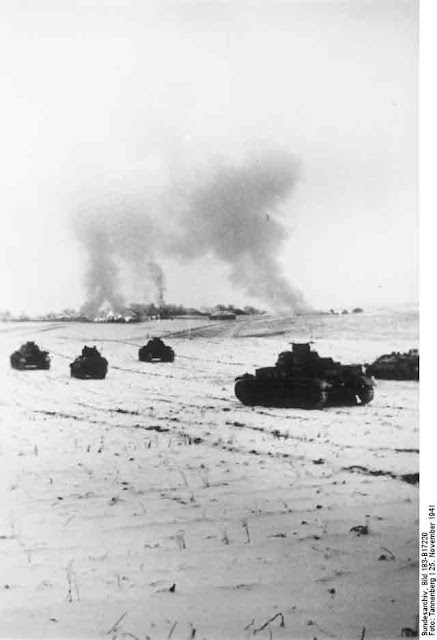
General Guderian’s men continue to put pressure on the Red Army units defending Tula, but it is an increasingly hopeless battle. Today, the 17th Panzer Division (Brigadier General Rudolf Eduard Licht) approaches Kashira, about 50 km north of Venev, which looks impressive on the map as it is a great deal closer to Moscow than Tula. However, Lictht’s advance causes as many problems as it solves, because it is extremely difficult to supply his panzers. Meanwhile, the bulk of Guderian’s forces are making no progress at all on the direct road to Moscow through Tula. The Germans only control the territory within reach of their guns, with large stretches in between their isolated forces virtually undefended. This gives the Red Army units the ability to cross between the different Wehrmacht positions. The 239th Siberian Rifle Division, for instance, escapes from the 29th Motorized Division near Epifan, southeast of Tula, simply by driving around the German units. Lacking strong infantry support, the German effort south of Moscow is turning into the equivalent of tank raids rather than a full-fledged offensive.
North of Moscow, the German 18th Army continues to hold the strategically important city of Tikhvin despite brutal winter weather and increasing Red Army attacks. The commander of the 18th Army, Colonel General Georg von Küchler, accepts the inevitable after his men have made no progress since taking the city and orders them to cease all offensive operations. This leaves the most advanced German troops isolated at the tip of a dead schwerpunkt (spearhead) with long supply lines that are open to Soviet assault from both the north and south.
German 2nd Panzer Division was halted by British-built Matilda tanks of the Soviet 146th Tank Brigade at Peshki, 35 miles northwest of Moscow. 30 miles west of Moscow, German 10th Panzer Division and SS Reich Division attacked Istra, which was being defended by Soviet 78th Rifle Division.
In Berlin, Finland signs the Anti-Comintern Pact. Germany invited Finland to adhere to the pact in early November, but there was considerable reluctance in Finland to do so. It was thought that Finnish adherence would worsen the relations with the Western Allies. On the other hand, Finland is very dependent on German deliveries of food supplies, and had just requested 175,000 tons of grain. In the end, the Finnish government decided that joining the pact is the lesser of two evils, because adequate level of food supplies has to be secured for the duration of winter.
Renewal for five years of the Anti-Comintern Pact of 25 November 1936 at Berlin, by Germany, Japan, Italy, Hungary, Spain, Manchukuo, Bulgaria, Croatia, Denmark, Finland, Rumania, Slovakia, and the Japanese puppet Nanking regime in China.
Soviet patrol vessel CKP-25 rammed German submarine U-578 in the Arctic Sea, causing light damage.
The British Operation CRUSADER, an offensive whose goal is to liberate Tobruk, has been going badly since its start on 21 November. British 7th Armored Division of Eighth Army has been pummeled by General Erwin Rommel’s panzers and fierce artillery fire by well-sited Italian gunners. On 24 November Rommel decided to launch a counteroffensive, and today, 25 November 1941, he sets in motion more forces whose aim is to relieve a trapped German garrison at Bardia and threaten British lines of communication back into Egypt. This is known as General Rommel’s “dash to the wire” because it sends Afrika Korp panzers behind the British outposts to the area of the Egyptian/ Libyan border where a wire barricade stretches inland from the coast.
With part of Afrika Korps and the Italian Ariete Division already heading toward Sidi Omar, the 15th Panzer Division today heads northeast toward Sidi Aziz. To their shock, the German tankers find no enemy to be seen and their only opponents the omnipresent RAF Desert Air Force. The 5th Panzer Division of the 21st Panzer Division hits the 7th Indian Brigade at Sidi Omar, but are fought off with great difficulty by the 1st Field Regiment of the Royal Artillery. The German tanks try again, but the Royal Artillery picks the panzers off over open sights at 500 meters and destroys or damages almost all of them. It is a brilliant defensive victory by the British caused by their valor and the overconfidence of the panzer commanders. The rest of the 21st Panzer Division heads unmolested to the border at Halfaya, the key to the vital coastal road.
The Germans reach the area west of Sidi Aziz by sunset, but they have taken heavy tank losses during the day. They have only 53 panzers remaining with no possibility of reinforcement. The 5th New Zealand Brigade is located further up the coast between the panzers and their closest supply dumps, posing a logistical problem. The Germans camp here for the night and prepare to bypass the New Zealanders on the 26th in order to liberate Bardia and resupply.
Australian troops from Tobruk linked up with advancing New Zealand forces at Ed Duda, Libya. After dark, Erwin Rommel conducted an inspection of the front, got lost, and was forced to wait until daybreak to find his way back.
Air Marshal Sir Arthur Tedder, the British RAF Commander-in-Chief, Middle East, informed Oliver Lyttelton, Winston Churchill’s Minister of State for the Middle East, that General Alan Cunningham was not confident in winning the CRUSADER battle in Libya. The following day Cunningham was relieved as Eighth Army commander. Neil Ritchie would take his place on the following day.
Captain James Jackson was posthumously awarded the Victoria Cross for organizing defenses at Tobruk, Libya, where he was killed by a mortar splinter.
German submarine U-331 torpedoed British battleship HMS Barham in the Mediterranean Sea, which went down after a magazine ignited. Fewer than 400 of her crew of 1,258 survived.
One of the paradoxes of the war in North Africa is that it is actually won at sea. The Royal Navy has done a very efficient job of disrupting supplies sent from Naples to Tripoli. Today, however, the Germans take their revenge when U-331 (Kptlt. Hans-Diedrich Freiherr von Tiesenhausen) somehow evades the Royal Navy destroyer screen and pumps three torpedoes into battleship HMS Barham. The Barham sinks quickly and takes the better part of 1000 men with her.
Captain C. E. Morgan, commanding nearby HMS Valiant, gave an account of the sinking of HMS Barham:
“Our battleships were proceeding westwards line ahead, with the Valiant immediately astern the Barham and with a destroyer screen thrown out ahead of the battlefleet. At 4.23 p.m., carrying out a normal zigzag, we turned to port together, thus bringing the ships into echelon formation.
Suddenly, at 4.25, I heard a loud explosion, followed by two further explosions a couple of seconds later. Fountains of water and two enormous columns of smoke shot skywards. The smoke formed an enormous mushroom, gradually enveloping the whole of the Barham, except the after part, which was subsequently also blotted out as the ship slid into a vast pall of smoke.
As the explosions occurred the officer on watch gave the command “ Hard to port,” to keep clear of the Barham.
Fifteen seconds later I saw a submarine break the surface, possibly forced there by the explosion. Passing from left to right, the submarine was apparently making to cross the Valiant’s bows between us and the Barham. He was only about seven degrees off my starboard bow and 150 yards away, though he must have fired his torpedoes from about 700 yards.
As the periscope and then the conning tower appeared I ordered “ Full speed ahead, hard starboard.” But, with the helm already hard to port, I was unable to turn quickly enough to ram him before he crash-dived only 40 yards away on our starboard side. The submarine was visible for about 45 seconds, and, simultaneously with our ramming efforts, we opened fire with our starboard pom-poms. He was so close, however, that we were unable to depress the guns sufficiently and the shells passed over the conning-tower.
I then gave the order “Amidships” again to avoid turning into the Barham, which was still underway with her engines running but listing heavily to port. As we came upon her beam she heeled further about 20 or 30 degrees, and through the smoke, I could see all her quarter-deck and forecastle. Men were jumping into the water and running up on the forecastle.
The Barham was rolling on a perfectly even keel with neither bows nor stern sticking into the air. For one minute she seemed to hang in this position; then, at 4.28, she suddenly rolled violently, her mainmast striking the’ surface of the sea sharply a few seconds later.
I saw water pouring into her funnels. There followed a big explosion amidships, from which belched black and brown smoke intermingled with flames. Pieces of wreckage, Hung high into the air, were scattered far and wide, the largest piece being about the size of my writing-desk.
I immediately ordered “ Take cover ” as the wreckage started flying, and that was the last we saw of the Barham, which had run almost’ a mile since the moment she was hit. When the smoke cleared the only signs left were a mass of floating wreckage.
…
The 35,000-ton ship disappeared with unbelievable suddenness; it was only 4 minutes 35 seconds exactly from the moment the torpedoes struck until she had completely disappeared.”
Moscow: Vyacheslav Molotov, the Soviet foreign minister has sent an impassioned Note to all the non-Axis powers protesting against Germany’s barbaric treatment of Russian prisoners of war. Broadcasting from embattled Moscow, Mr. Molotov claimed that “prisoners have been tortured with red-hot irons, their eyes have been poked out, and their ears and noses ripped open. They have been tied to tanks and pulled to pieces. He went on to accuse the Germans of the systematic extermination of Russian prisoners by shooting, beating and starvation: “The German High Command has ordered that Soviet prisoners shall be given worse and less food than prisoners of other countries. In the early morning, whatever their state of health, they are roused by blows with sticks and clubs and driven out to work. In one day alone in the Chernukhinsk camp in the Ukraine 95 prisoners were shot.”
These appalling revelations are by no means the full story of German cruelty towards Russian prisoners. Many PoWs are being gassed in experiments to find the most efficient methods of exterminating the Jews. Over 18,000 Russians have been killed at Sachsenhausen concentration camp since the invasion started.
The first mass shooting of the Ninth Fort massacres took place near Kaunas, Lithuania.
German Jews in Netherlands declared stateless (lose their nationality).
Adolf Hitler met with Grand Mufti of Jerusalem Mohammad Amin al-Husayni, agreeing on the need for the elimination of the “Jewish element”.
Regulations are issued by the German government concerning confiscation of the property of Jews who are deported.
The Jager Report (issued on 1 December 1941) noted that 9 adult male, 46 adult female, and 8 children, all Jews, were killed in Vilnius, Lithuania for a total of 63 people. Additionally, 1 Polish national was also executed for possession of arms.
General Robert Odic, until recently commander of the French Air Force in North Africa, said today he had resigned to join the Free French forces because the Germans were undermining the French will to resist in North Africa.
A small British patrol landed on the coast of Normandy Sunday night, it was announced today in reply to a Berlin communiqué, quoted by Reuters, in which the Germans asserted that such action had been attempted, but had been “repulsed by German coastal defenses with heavy losses.”
Tadda Ridge is captured by the British from the Italians near Gondar, Ethiopia.
An earthquake described as “the most violent recorded since 1755,” when 50,000 persons died in Lisbon, early tonight shook this capital and the Madeira and Azores archipelagos hundreds of miles out in the Atlantic, but first reports said only slight damage was caused and no casualties were reported.
The first Italian Macchi C.202 Folgore fighters reached Libya. These Folgores (the most successful Italian fighter to see extensive wartime service) belonging to the 1° Stormo Caccia Terrestre, rapidly established, over the Western Desert, an ascendancy over the opposing RAF Hawker Hurricane and Curtis P-40 fighters.
RAF Bomber Command, Day of 25 November 1941
6 Blenheims bombed Morlaix airfield. 3 Stirlings to Germany turned back. No aircraft lost.
RAF Bomber Command, Night of 25/26 November 1941
Brest
11 Halifaxes and 7 Stirlings; smoke-screens concealed the German warships. No losses.
Cherbourg
17 Wellingtons and claimed a large fire in the dock area. No losses.
Light cruiser HMS Sheffield departed Scapa Flow for Seidisfjord for escort duty with convoy PQ.5. In heavy weather on the 26th, the cruiser was forced to heave to. The cruiser was able to arrive on the 27th.
Convoy ON.40 departed Liverpool, escorted by anti-submarine trawlers HMS Coventry City and HMS Lady Madeleine. The convoy was joined on the 26th by sloop Commandant Detroyat, corvettes HMS Heather and HMS Narcissus, and anti-submarine trawler HMS Arab. Destroyers HMS Beagle and HMS Boadicea joined on the 27th. The escorts were detached on the 30th when relieved by destroyers HMCS Columbia and HMCS Skeena and corvettes Aconit, HMCS Galt, HMCS Shediac, and HMS Wetaskiwiin. The convoy was dispersed on 4 December.
Minesweeper HMS Fitzroy departed Scapa Flow for the Faroes to resume minesweeping duties.
British drifter Fisher Girl (85grt, T/Electrician J. W. Parsons RNVR) was sunk by German bombing at Falmouth Harbour.
Armed patrol trawler HMS Jacques Morgand (155grt) was sunk by German bombing at Falmouth.
Convoy OG.77 departed Liverpool escorted by sloops HMS Black Swan and HMS Fowey and corvettes HMS Campion, HMS Heliotrope, HMS La Malouine, and HMS Mallow. On the 26th, destroyer HMS Harvester escorted the convoy through the day. She was then detached and proceeded to Gibraltar, arriving on 2 December. Corvette Mallow was detached on the 28th and corvettes HMS Bluebell, HMS Carnation, HMS Myosotis, and HMS Stonecrop joined the escort. Destroyers HMS Hesperus and HMS Harvester departed Gibraltar on 7 December and joined the escort on 9 December. Destroyer HMS Highlander proceeded to the escort after completing current duties. Destroyer Harvester was recalled on 10 December. Escorts were detached to accompany ships proceeding to Portuguese or Spanish ports on 9 December. The escorts detached rejoined the convoy. Sloop HMS Deptford and corvettes HMS Vetch, HMS Samphire, HMS Penstemon, and HMS Convolvulus departed Gibraltar on an anti-submarine sweep on 9 December and joined the convoy on 13 December for additional escort. The convoy arrived at Gibraltar on 13 December.
British troopships Royal Ulsterman and Royal Monarch arrived at Gibraltar, escorted by destroyers HMS Wishart and HMS Vidette.
Soviet destroyer Leningrad was mined off Hango. The destroyer was repaired.
German auxiliary patrol vessel Vp.412 (trawler Bremerhaven, 416grt) was sunk near St Pol by a British motor torpedo boat. The vessel was later salved and returned to service as Vp.805.
Battleship HMS Barham (Captain G. C. Cooke) was sunk by U-331, commanded by Oberleutnant zur See Hans-Diedrich von Tiesenhausen, in 32-34N, 26-24E off Sollum. Of the ship’s complement, 862 died; 449 survivors, including Vice Admiral Pridham Wippell were rescued by destroyers HMS Jervis, HMS Jackal, HMAS Nizam, which rescued 168 men, and HMS Hotspur. Battleships HMS Queen Elizabeth and HMS Valiant and destroyers HMAS Napier, HMS Griffin, HMS Hasty, HMS Decoy, HMS Hotspur, and HMS Kipling arrived at Alexandria at 1000/26th. Destroyers Jervis, HMAS Nizam, and Jackal arrived at Alexandria at 1400. After the loss of battleship Barham, submarine HMS Otus was withdrawn from operational duties for use as an anti-submarine warfare training ship.
Destroyer HMS Thrasher sank Italian armed merchant cruiser Attilo Deffenu (3510grt) near Brindisi in 40-37N, 18-27E from a Patrasso — Brindisi convoy of steamers Caterina Madre (4019grt) and Resurrectio (979grt).
Submarine HMS Thunderbolt sank German steamer LVII with gunfire off Cape Malea.
Destroyers HMS Wishart and HMS Vidette with troopships Royal Scotsman, Royal Ulsterman, and Ulster Monarch arrived at Gibraltar after departing Freetown on the 17th. The troopships were originally escorted by destroyer HMS Velox and corvette HMS Clover. The corvette was later relieved by destroyer HMS Vimy.
Destroyers HMS Laforey, HMS Legion, HMS Lightning, HMS Gurkha, and HNLMS Isaac Sweers departed Gibraltar at 0400 and destroyers HMS Wishart and HMS Bradford departed at 1630 to carry out an anti-submarine sweep. On the 27th, destroyer Legion attacked a submarine contact in 35-40N, 07-26W.
In Washington, President Roosevelt at his press conference today announced that William C. Bullitt would go to the Near East as his special representative, that he had requested reconvening of his Emergency Fact-Finding Board to work out a solution of the threatened railroad strike, and denounced an article carried in the November 17 issue of TIME magazine concerning President Aguirre of Chile, who died today. He conferred with railway labor, management and government officials about the threatened strike, and had a conference with Secretaries Hull, Stimson and Knox, General Marshall and Admiral Stark.
The Senate was in recess. A Judiciary subcommittee continued hearings on the Connally Labor Bill; a Banking and Currency subcommittee heard support for a bill to provide credit for small business men; the Joint Economy Committee discussed proposed cuts in road funds.
The House debated the Price Control Bill and adjourned at 6:33 PM, until noon tomorrow.
Legislation to stop defense strikes by invoking compulsory arbitration enforced by stiff penalties took shape in the house today. Acting Chairman Ramspeck, Georgia Democrat, of the house labor committee said he hoped to have such a measure ready by Friday and disclosed that It sprang from a conference between President Roosevelt and 11 house members at the White House last night. Neither he nor any of the other conferees would say definitely whether the president had recommended or opposed such a far-reaching step but Ramspeck predicted that the chief executive would sign it.
President Roosevelt announced today that he was sending William C. Bullitt, long his chief Ambassador in Europe, to the Near East battle area as special Presidential representative. Mr. Bullitt, a close personal friend of the President’s, will gather information at first hand, in Libya, the Nile River Basin, the Red Sea and Persian Gulf areas and, perhaps, in Palestine. Diplomatic circles regarded it as not unlikely that he also would visit Turkey. The President explained to his press conference that Mr. Bullitt would gather information at first hand, find out what was needed. and return. In response to a query, Mr. Roosevelt said laughingly that the special envoy would make his headquarters in a plane.
The Administration today served notice on Finland that her war against Russia, with the consequent threat to the Murmansk-Moscow supply line, was directly “harmful to the interests of the United States.” This warning was sounded in a statement by Henry L. Stimson, Secretary of War, who used the military argument to support numerous diplomatic statements heretofore made by Cordell Hull, Secretary of State and successor to Mr. Stimson in the State Department. Buttressing Secretary Stimson’s warning was another by Major General James H. Burns, deputy lend-lease administrator and recent visitor to Russia, who expressed the belief that “all of Finland’s well-wishers in the United States regret” this action and wish “to see it terminated as soon as possible.”
In a move to avert the nation-wide railroad strike set to start December 7. President Roosevelt has called his Emergency Fact-Finding Board of five men. The board was asked today to convene here Thursday or Friday at the latest and open new hearings Friday. Each side will have a day in which to present arguments and a report by the board is sought by December 1. In announcing the step at his press conference the President said that some facts had developed since the board filed its original recommendations.
Vultee Aircraft, Inc., is negotiating for the stock holdings of Major Reuben H. Fleet in the Consolidated Aircraft Corporation as a preliminary to a prospective merger of the two companies, which have a backlog of defense orders totaling about $1,000,000,000.
The U.S. Army Air Force contracts with Consolidated Aircraft (later Consolidated Vultee and then Convair) to produce two prototypes of a new experimental bomber. Consolidated is an experienced military plane manufacturer, having built the successful B-24 Liberator heavy bomber and the PBY Catalina. The overall wing area of the new plane is to encompass just under 5000 square feet and hold six engines placed at the back of the wings to push its 163-foot fuselage. This is a massive design that dwarfs current bombers, and the plane is designed to be able to fly from the continental United States, bomb targets in Europe, and then return without landing or refueling. The fixed fee payable to Consolidated is approximately $800,000 for each prototype and the first plane is scheduled to be ready by mid-1944. This plane ultimately is developed and becomes the B-36 Peacemaker.
Lou Boudreau, 24, becomes the Cleveland Indians’ player-manager.
Jerónimo Méndez became acting President of Chile upon the death of Pedro Aguirre Cerda.
For several days, United States Secretary of State Cordell Hull has been preparing a modus vivendi agreement to restart stalled peace talks with the Japanese. This is a counter-proposal to the Japanese Proposal B submitted on 21 November which was completely unacceptable to the Americans. The modus vivendi would prohibit “any advance by force” in the Pacific — an obvious restriction on Japanese ambitions — and require a Japanese withdrawal from southern French Indochina. In exchange, the United States would resume limited trade with the Japanese to the extent of $600,000 worth of cotton, oil “for civilian needs” and medical supplies. The agreement by its terms would only last for three months and would be a stop-gap measure to reach a longer-lasting agreement.
The U.S. War Council debates this very mild counterproposal on the 25th and decides that it would make sense to submit this modus vivendi to the Japanese. The obvious alternative is war, and the Army and Navy want more time to prepare for that. However, the decision to submit this counterproposal to the Japanese — who it is expected would take it — does not lie with the U.S. War Council. Only one man can make that decision. Hull, who personally thinks the modus vivendi is pointless, schedules a meeting with President Roosevelt for the 26th.
The United States consulate today again urged all Americans to leave Japan promptly. Similar advice was reported given to Americans in China. The Japanese foreign office announced that the Japanese steamer Tatsuta Maru, scheduled to go to Los Angeles, California, and Balboa, C. Z., this month, would not sail until December 2. This would enable more Americans to depart aboard her. The Tatsuta Maru will sail with sealed orders in a locked box; on the morning of the 7th, her officers will arm themselves and reverse course for Japan.
Declaring that no amount of negotiating between the United States and Japan could succeed because Japan’s word and her Emperor’s signature to an agreement were worth no more than Hitler’s, Lin Yutang, Chinese novelist, said yesterday that this country must fight Japan as the only means of carrying out President Roosevelt’s declared aims to defeat Hitler.
American submarines USS Triton (SS-201) and USS Tambor (SS-198) arrive off Wake Island on simulated war patrols.
Henry Stimson noted in his diary that, during a cabinet meeting, Franklin Roosevelt thought Japan was likely to attack the United States in as soon as one week, and it would provide Roosevelt the reason to take the United States into the war.
A shipment of 24 crated Curtiss P-40E’s arrived in Manila.
Continuing the campaign for total national mobilization while the American — Japanese negotiations are still hanging fire. Premier Hideki Tojo delivered a speech yesterday before a mass rally of the Imperial Rule Assistance Association that was broadcast country a highly organized defense state-wide. He appealed to the nation to unite in self-sacrifice and determination for the construction of in order to “tide over the gravest crisis Japan has faced in all her glorious 1,000-year history.” The rally took place on the fifth anniversary of the conclusion of the anti-Comintern pact, and the Japanese Foreign Office announced prolongation of the pact for another five years and adherence of the Nanking regime to it, together with the European satellites of Germany. “With the task of establishing a new order in East Asia as the basis of her national policy,” said the Foreign Office announcement, “Japan feels keenly the increasing necessity of safeguarding against the Comintern [Communist International], and the renewal and extension of the pact is, therefore, a source of profound congratulation.”
Admiral Yamamoto Isoroku, Commander-in-Chief, Combined Fleet, issues Operations Order No. 5: “The Carrier Striking Task Force will immediately complete taking on supplies and depart with utmost secrecy from Hitokappu Bay (Etorofu Island, Kurile Islands) on 26 November and advance to the standby point (42 N, 170 W) by the evening of 3 December.” The standby point is about 1,380 nautical miles (2 557 kilometers) north-northwest of Pearl Harbor, Territory of Hawaii and 728 nautical miles (1 348 kilometers) south-southwest of Dutch Harbor, Unalaska Island, Aleutian Islands, Territory of Alaska.
Japanese troop transports en route to Malaya were sighted off Taiwan.
Dow Jones Industrial Average: 116.96 (-0.34)
Born:
Kenny Graham, AFL-NFL safety (AFL All-Star, 1965, 1967–1969; San Diego Chargers; Cincinnati Bengals, Pittsburgh Steelers), in Texarkana, Texas (d. 2023).
Mike Ryan, MLB catcher (Boston Red Sox, Philadelphia Phillies, Pittsburgh Pirates), in Haverhill, Massachusetts (d. 2020).
Ralph Haben, American politician (Speaker of the Florida House of Representatives, 1980–1982), in Atlanta, Georgia (d. 2026).
Riaz Ahmed Gohar Shahi, Indian Muslim Sufi spiritual leader, in Dhok Gohar Shah, British India.
Died:
Pedro Aguirre Cerda, 62, President of Chile.
Naval Construction:
The U.S. Navy SC-497-class (110-foot wooden hull) submarine chaser USS PC-665 (later SC-665) is laid down by the Dachel-Carter Shipbuilding Corp. (Benton Harbor, Michigan, U.S.A.).
The U.S. Navy PC-461-class (173-foot steel hull) submarine chaser USS PC-560 is laid down by the Jeffersonville Boat and Machine Co. (Jeffersonville, Indiana, U.S.A.).
The Royal Navy Isles-class minesweeping trawler HMS Manitoulin (T 280) is laid down by the Midland Shipyards Ltd. (Midland. Ontario, Canada).
The Kriegsmarine (German Navy) Type VIIC U-boat U-230 is laid down by F. Krupp Germaniawerft AG, Kiel (werk 660).
The Kriegsmarine (German Navy) Type VIIC U-boat U-670 is laid down by Howaldtswerke Hamburg AG, Hamburg (werk 819).
The Royal Navy “T”-class destroyers HMS Terpsichore (R 33) and HMS Termagant (R 89) are laid down by William Denny & Brothers (Dumbarton, Scotland).
The U.S. Navy YMS-1-class auxiliary motor minesweeper USS YMS-21 is launched by the Greenport Basin and Construction Co. (Greenport, Long Island, New York, U.S.A.).
The Royal Navy MMS I-class motor minesweeper HMS MMS 90 (J 590) is launched by John Morris (Gosport, England, U.K.). She is transferred to the Вое́нно-морско́й флот СССР (ВМФ) (Soviet Navy) in late 1942, becoming the T 108.
The Royal Navy MMS I-class motor minesweeper HMS MMS 46 (J 546) is commissioned. Her first commanding officer is T/Lieutenant John Giles Raven, RNVR.
The Royal Navy Isles-class minesweeping trawler HMS Shiant (T 170) is commissioned. Her first commanding officer is T/Lieutenant John Hector Davis, RNR.
The Royal New Zealand Navy Isles-class minesweeping trawler HMNZS Scarba (T 175) is commissioned. Her first commanding officer is Lieutenant Commander Peter Phipps, DSC, RNZNVR.
The Kriegsmarine (German Navy) Type IXC U-boat U-510 is commissioned. Her first commanding officer is Korvettenkapitän Karl Neitzel.
The Royal Navy Flower-class corvette HMS Loosestrife (K 105) is commissioned. Her first commanding officer is T/Lieutenant Andrew Alan Campbell, RNR.
12…

