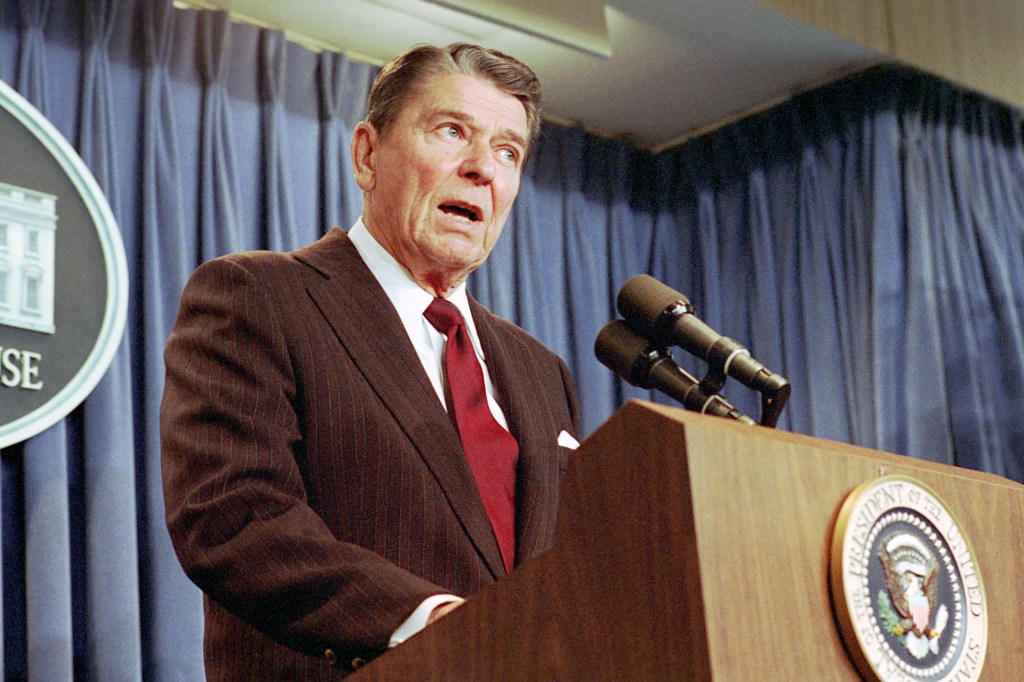
President Reagan said today that he had not been in full control of his Administration’s Iran policy, and the White House said that as a consequence up to $30 million intended to pay for American arms had been secretly diverted to rebel forces in Nicaragua. At the same time, the President announced that two men he held responsible — Vice Admiral John M. Poindexter, the national security adviser, and Lieutenant Colonel Oliver L. North, a member of the admiral’s staff — had left their posts. With the Administration already in turmoil over the earlier disclosure of clandestine arms shipments to Iran, and with speculation rampant about a major overhaul of the White House staff, the President’s statement seemed to deepen a sense of disarray. By all accounts, Mr. Reagan now faces the most serious crisis in his six-year Presidency. Mr. Reagan stunned legislators and ranking Administration officials by announcing in a televised session with reporters that he had not been “fully informed” of some details of the Iran operation and that Admiral Poindexter and Colonel North were leaving after “serious questions of propriety had been raised.” Mr. Reagan said that, “although not directly involved,” Admiral Poindexter had “asked to be relieved of his assignment” and would return to Navy duties. Colonel North, the President said, “has been relieved of his duties on the National Security Council staff.” Colonel North was widely reported to be the central figure in the Iran arms deal. After Mr. Reagan’s announcement, Attorney General Edwin Meese 3d said the Justice Department was still investigating how Nicaraguan rebel forces, known as contras, received “somewhere between $10 and $30 million” paid to “representatives of Israel” funneling the arms to Iran.
Congressional leaders expressed astonishment today at the latest disclosures about United States dealings with Iran and vowed to investigate the Administration’s actions. The leaders asserted that several laws had probably been violated when funds paid by Iran for weapons were transferred to the Nicaraguan rebels. The leaders also said Congress would probably approve legislation next year cutting off aid to the Nicaraguan rebels and would see to it that the head of the National Security Council would have to be confirmed by the Senate. But the biggest question on Capitol Hill today was whether President Reagan and his chief aides had known about the operation.
The Reagan Administration’s assertions that Israel made unauthorized arms shipments to Iran and that only two officials in Government knew that money was being diverted to the Nicaraguan rebels were immediately challenged today by knowledgeable officials, intelligence experts and members of Congress. Sources familiar with Iran arms dealings disclosed that Israel’s 1985 arms shipments were flown to Iran by a company with close links to the Central Intelligence Agency. Later that year — before the Administration acknowledged any role in the Israeli shipments — American and Israeli officials met to negotiate the price to be paid by Jerusalem for replacing missiles sent to Iran, these sources said.
After six years of seeming invulnerability, President Reagan has been grievously damaged by the crisis over secret arms shipments to Iran. With a unanimity rare in Washington, leading Republican and Democratic politicians agreed today that the disclosure of payments to the Nicaraguan rebels and the departure of two White House aides had probably hurt the Administration more than it helped. Some think the damage may be irreparable. A week of almost unrelieved criticism of Mr. Reagan’s secret decision to send arms to Iran, and of startling public bickering among senior Administration officials, has created the image of a President isolated, stuck with an unpopular policy and uncharacteristically defensive. The disclosures today produced a sensation in Washington unmatched, perhaps, since the days of the Watergate crisis.
Secretary of State George P. Shultz was given control of American policy toward Iran by President Reagan today, ending the National Security Council staff’s secret dealings, the State Department said. Aides said that Mr. Shultz was notified of the decision at the White House meeting at which officials were also told that money from the secret sale of arms to Iran had been diverted to the Nicaraguan insurgents. The State Department officials said that giving Mr. Shultz direction of the Iran policy — combined with last week’s Presidential directive ending arms sales to Iran — met Mr. Shultz’s demands and insured that he would not resign at this time. But some officials said they were not sure how long he would actually remain, given the strains with others in the Government.
The disclosure today of an operation to provide Nicaraguan rebels with millions of dollars from sales of American arms through Israel to Iran, raises questions under several criminal statutes and other laws. It also compounds the complex web of legal issues previously raised by the Reagan Administration’s secret arms sales to Iran without notifying Congress as various noncriminal statutes appeared to require. Whether criminal charges could be brought against anyone involved in the Iran-Israel-Nicaragua connection would depend both on other facts that are not yet clear and on interpretations of very general laws in the context of a highly unusual situation. In addition, the revelations today by Attorney General Edwin Meese 3d added fuel to the previously unrelated demands by House Democrats for an “independent counsel” or special prosecutor to investigate possible Administration violations of Congressional restrictions on aid to the Nicaraguan rebels.
In its first official comment on the Iran affair, the Israeli Government announced early today that it had transferred arms to Iran “upon the request of the United States” and did not know that some of the payments for these weapons had been channeled to the Nicaraguan rebels. After a meeting that lasted past midnight, Prime Minister Yitzhak Shamir, Foreign Minister Shimon Peres and Defense Minister Yitzhak Rabin issued a statement that said: “The Government of Israel confirms that it helped transfer defensive arms and spare parts from the United States to Iran upon the request of the United States.” “The payment for this equipment was made directly by an Iranian representative to a Swiss bank, in accordance with instructions from the American representatives,” it added. “These funds did not pass through Israel. The Government of Israel was surprised to learn that supposedly a portion of these funds was transferred to the contras. If such a transaction took place, it had nothing to do with Israel and the Government of Israel had no knowledge of it. Israel did not serve and would not have served as a channel for such a transaction.”
A Saudi Arabian arms dealer played a central role in financing the Iranian purchase of United States weapons, Israeli and American sources said today. The sources said the Saudi arms dealer, Adnan Khashoggi, who is close with several Israeli arms dealers, was a key figure in putting the deal together, which involved having arms transferred by Israel to Iran on behalf of the United States. Some American and Israeli sources say they believe Mr. Khashoggi may have been acting either tacitly or explicitly on behalf of the Saudis. Saudi Arabia, these sources say, may have been tacitly prepared to underwrite the arms purchases by Iran because it feared that Tehran might ultimately defeat Iraq in the Persian Gulf war and it wanted to have a link with Teheran as insurance.
Alton G. Keel Jr., who was propelled into the post of acting national security adviser today, is described by associates as a bright and hard-working staff man who provides indispensable support to his superiors but has seldom taken a visible leadership role himself. Over the last four months, Dr. Keel has served as deputy assistant to the President for national security affairs, a post to which he had barely become acclimated when his boss, Vice Admiral John M. Poindexter, resigned today. White House press officials said today that Dr. Keel was unavailable for interviews and had no statement to make.
A sister of an American captive in Lebanon, long a critic of Administration policy on the hostage issue, has written a letter to President Reagan in support of his Iran initiative and expressed “a deep sense of shame” that she had not spoken out sooner. Peggy Say, sister of Terry A. Anderson, the 39-year-old captive chief Middle East correspondent of The Associated Press, wrote the embattled President that his “example of strength and courage in the face of criticism and censure prompted me to stand up and be counted as one more person that believes you pursued the right and just course.” Mrs. Say, reached by telephone at her home in Batavia, N.Y., said none of yesterday’s developments, including the resignation of the President’s national security adviser, Vice Admiral John M. Poindexter, had changed her mind.
Oliver North’s secretary, Fawn Hall, smuggles documents out of his office by hiding them in her boots and behind her skirt. “I took the copies of the altered documents, folded them, and placed them inside my boots,” she later recounted. Then she ran into another official’s office and stuffed some computer memos down her back. “I asked if he could see anything in my back,” she said of Colonel North, whom she had called and insisted that he come to the White House once she discovered that not all the papers had been shredded, “and he said no.” Later, when she and Colonel North were in a car together, she took the papers out and gave them to him.
The wife of a well-known dissident who has spent more than 20 years in prison, labor camps and internal exile said today that the K.G.B. had urged her to apply for emigration for her family. The woman, Larisa Bogoraz, who is the wife of Anatoly Marchenko, said she had refused unless she was allowed to discuss the matter with her husband in the prison of Chistopol, where he is serving his current term. She last visited him in April 1984, three years after he began serving a 10-year prison term, to be followed by five years in exile, for anti-Soviet agitation and propaganda. Miss Bogoraz said that agents of the K.G.B., the internal security agency, had told her Friday that she would not be allowed to see Mr. Marchenko. On Monday, at a second meeting, she handed over a written statement saying she would not file for emigration unless she could consult her husband. She was told to await a reply soon. Twice before, the Soviet authorities have urged Mr. Marchenko to emigrate, but he has refused. The Marchenkos have a 13-year-old son, Pavel.
Muscovites, already enduring a Government crackdown on vodka consumption, face a new problem: a coffee shortage. Except at stores that cater to foreigners, there hasn’t been a coffee bean in the Soviet capital for more than a month. Instant coffee, always in short supply, is no more available. Although Russians remain primarily tea drinkers, and coffee is considered a luxury even when available, the shortage has become a subject of considerable lament and speculation, with citizens phoning one another hoping for a tip about where to find the elusive commodity or to speculate about why it disappeared.
Muslims in the Israeli Parliament called for international troops to protect Arabs in Jerusalem, and a no-confidence motion against the government for its handling of recent disturbances was debated. Prime Minister Yitzhak Shamir, however, was quoted on Israel Radio as rejecting the call for U.N. troops as unnecessary. U.S. Consul General Morris Draper said he would convey to Washington the Muslim leaders’ demand for U.N. protection. He said the U.S. “deeply regrets the violence” that has rocked Jerusalem since Jewish seminary student Eliyahu Amedi, 22, was stabbed to death last week. Three Palestinians were arrested in that case.
President Chaim Herzog announced today that he would make a visit next year to West Germany, the first by an Israeli President. Israeli Prime Ministers have visited West Germany in the past, and Israel and West Germany maintain strong ties in the areas of trade, tourism and joint scientific projects. The plan was criticized by several members of the Israeli Parliament. “The time has not come yet,” said Eliahu Ben-Elissar, a Likud lawmaker who fled Nazi-occupied Poland in 1942. “Sometime, I don’t know when, but not in this generation.” Another Member of Parliament, Shevah Weiss of the Labor Party, urged the President to reconsider his decision. Mr. Weiss said, “If it’s decided already, I recommend the President go only to Dachau concentration camp, and give a speech reminding them that some of them are still to blame and all are still responsible, and then return home.” The state visit, planned for sometime around April of next year and already approved by the Israeli Cabinet, is to reciprocate the visit made here in October 1985 by President Richard Von Weizsacker of West Germany, the President’s spokesman said. “The President believes that the visit can strengthen consciousness of the Holocaust, which he feels has diminished in recent years,” a statement said.
Thousands of Shia Muslim militiamen were locked in house-to-house combat with Palestinian guerrillas for control of Maghdousheh, a hilltop town in southern Lebanon. Police said there were dozens of casualties. They said Shia Amal militiamen stormed back into the town and retook two thirds of it and most of the surrounding bluffs, after losing ground Monday, in the Palestine Liberation Organization’s largest operation in southern Lebanon since the Israeli invasion in June, 1982.
Ahmed Zaki Yamani, who was dismissed last month as Saudi Arabia’s oil minister, has been ordered by King Fahd not to leave the country, the Financial Times of London reported. The respected financial daily, which gave no source for its front-page story, said Yamani’s passport had been taken away. The Associated Press reported that when it telephoned Yamani’s residences in Saudi Arabia, his assistants gave evasive replies about his whereabouts. The paper said Yamani, who was Saudi Arabia’s oil minister for 26 years and a key figure in the Organization of Petroleum Exporting Countries, was dismissed after expressing strong reservations about the king’s call to restore the price of oil to $18 a barrel immediately, without any production cuts.
Iraqi warplanes flew their longest mission in more than six years of war today, rocketing Iran’s Larak Island oil export terminal in the southern Persian Gulf and setting two tankers ablaze. The raid, which was confirmed by Lloyd’s of London insurance exchange, was the first against Larak, one of two makeshift terminals established at the gulf’s southern end because of frequent Iraqi raids that have disrupted traffic at the main Iranian export facility on Kharg Island in the northern gulf. The attack came six hours after reports that Iranian jets raided a French-operated oil platform off the United Arab Emirates, killing at least five workers. Warplanes that witnesses said were U.S.-made F-4 Phantoms raided the platform in the Abu Al Bakoosh oilfield near Iran’s Sassan field about 30 miles from the United Arab Emirates. Iran has Phantoms in its air force, but Iraq has only Soviet and French combat planes. Iran’s Government-run news outlets, also monitored in Nicosia, made no mention of the attack. The United Arab Emirates said the casualties included 5 dead, 24 wounded and 10 missing. An Iraqi communique said Larak, 750 miles from Iraq’s southern air bases, was “turned into an island of wreckage and fire.” Gulf shipping sources, speaking on condition of anonymity, identified the ships hit at Larak as the 69,000-ton Iranian tanker Tabriz, the 120,000-ton Cypriot tanker Antarctica and an Iranian “mother ship” identified only as Terminal 18. They said the Tabriz and the Antarctica were set afire. The insurance exchange Lloyd’s of London said several hours after the raid that the Antarctica continued “burning fiercely.”
Muslim rebels shot down at least 17 Soviet and Afghan government aircraft across Afghanistan this month, Western diplomats said in New Delhi, India. The diplomats also reported intense fighting last week in Kandahar and said the Soviets may be having trouble supplying their garrisons there. The reports could not be independently confirmed as Western journalists have rarely been allowed into Afghanistan since the Soviet Union invaded in December, 1979.
Prime Minister Rajiv Gandhi welcomed Mikhail S. Gorbachev today as a “crusader for peace” and began four days of talks that are expected to lead to increased Soviet military and economic assistance to India. Mr. Gorbachev, making his first visit to an Asian country since taking office, was greeted by tens of thousands of people lining the streets, waving banners and applauding nearly three decades of Soviet-Indian friendship. An Indian spokesman later quoted the Soviet leader as saying that it was “the kind of reception I haven’t had anywhere.” Mr. Gorbachev’s wife, Raisa, meanwhile, visited an exhibit of artifacts to be shipped for a “Festival of India” in Moscow next year like one that toured the United States in 1985.
Sikh separatists armed with submachine guns burst into a Sikh policeman’s home in Watanwali village during his engagement party and opened fire, killing the officer, his parents and three relatives and wounding a fourth person, Indian authorities said. They said that three of the four gunmen have been identified as among the most wanted of the Sikh radicals, who are fighting for an independent Punjab, the only state in predominantly Hindu India where Sikhs are in the majority. The assailants fled the village in a jeep.
The Government of President Corazon C. Aquino said tonight that it might be within two days of signing a cease-fire agreement with Communist rebels. Peace talks, broken off after the killing of a left-wing labor leader nearly two weeks ago, resumed this afternoon, less than 48 hours after the President said the talks would be called off if no accord was reached by Sunday. Tonight, after eight hours of talks, the leader of the Government team, Agriculture Minister Ramon V. Mitra, told reporters, “I like to think we have just one more meeting, and then make an announcement.” He implied that the final meeting would take place Wednesday and that an agreement would be announced Thursday. “We are so close,” he said.
After days of threats and coup plots and angry divisions, the Philippine armed forces may at last be moving toward unification and professionalization, according to Filipinos and Western military analysts. “In a way, this may have been helpful,” a young Philippine lieutenant said of the events of the last week. “Issues have been raised. The President has responded. Now the military can move back into the background where it belongs and perform what the Government wants to be implemented.”
Five Soviet soldiers who deserted in Afghanistan said here today that Soviet diplomats here had told them they could return home without penalty. But one of the five, Sergei Busov, said at a news conference that the deserters had told the diplomats they preferred to stay in Canada. The meeting was arranged by Canadian Government authorities, which had helped the deserters leave the custody of the insurgents in Afghanistan.
President Jose Napoleon Duarte of El Salvador said today that the destruction caused by an earthquake there on Oct. 10 threatened the “consolidation of democracy” in his country. “The damage brought by seven years of war and seven years of economic crisis is not comparable to the damage caused in only seven seconds of the earthquake,” Mr. Duarte said in a speech to the General Assembly. Mr. Duarte made his remarks as he appealed for increased emergency financial aid to El Salvador. The General Assembly will hold a pledging conference Wednesday to raise money for the earthquake’s victims. The earthquake killed 1,500 people and left 300,000 homeless, causing a total of almost $2 billion in damage, Mr. Duarte told the Assembly. He outlined a rehabilitation plan that will include payments to help the homeless build temporary shelters and replace materials lost by business.
The Government decided today to put Jean-Bedel Bokassa, the deposed self-proclaimed Emperor, on trial in the Central Appeals Court instead of the sports stadium where he crowned himself in 1977. “We want an orderly trial, with discipline and calm, not a spectacle,” Justice Minister Bernard Belloum said. Mr. Bokassa, whose trial is to begin Wednesday, is accused of several crimes, including multiple killings and cannibalism.
P.W. Botha was accused by the white opposition Progressive Federal Party of blocking a report that called for some racially mixed neighborhoods. The party boycotted a meeting of the President’s Council. Liberal opponents of South African President Pieter W. Botha’s government walked out of a top advisory body, protesting that apartheid reforms had come to an end. Three Progressive Federal Party representatives on the all-party advisory council said they left because the government is stalling on plans to open up racially zoned living areas. They walked out after Pretoria vetoed the opposition party’s demand for a public debate in the council on the advisory body’s report on the Group Areas Act, a cornerstone of apartheid.
Immigration officials urged employers around the country today to comply voluntarily with a new law that prohibits the hiring of illegal aliens. At a news conference, Alan C. Nelson, the Commissioner of Immigration and Naturalization, disclosed plans for enforcing the law, which President Reagan signed November 6. Mr. Nelson said that employers should immediately declare their “intention to hire only legal workers” but should not “discharge present employees or refuse to hire new employees based on foreign appearance or language.” Under the law, illegal aliens may obtain legal status, or amnesty, if they can show that they entered the United States before Jan. 1, 1982, and have resided here continuously “in an unlawful status” since then. Aliens, such as foreign students or tourists, would generally be ineligible for the amnesty if they were in the United States legally for any part of the time after January 1, 1982. “The legalization program will not be used as an enforcement tool or to locate illegal aliens,” Mr. Nelson said. “Its sole purpose will be to approve those who are legally qualified to remain in the United States.”
President Reagan hosts a luncheon in honor of the U.S. Supreme Court Justices.
Oil drilling in Alaska is at issue. The dispute over whether oil drilling should be allowed within Alaska’s Arctic National Wildlife Refuge is a classic example of how two opposing sides can look at an environmental question and arrive at different answers. The basic facts are reasonably simple. Acting under a Congressional mandate, the Interior Department has surveyed the 1.5 million-acre coastal plain and concluded that there is a major oil and gas field beneath it. The department also concluded that extracting the oil and gas would not cause major harm to the wildlife within the refuge and recommended that the whole area be leased to provide needed energy for national security and economic growth.
The Food and Drug Administration has rejected a petition to ban the artificial sweetener NutraSweet, dismissing a consumer group’s concerns that it might trigger seizures or eye problems, it was disclosed Monday. A lawyer for the Consumer Nutrition Institute argued in July that medical records of more than 80 NutraSweet users who suffered epileptic seizures provided enough evidence to justify removing the widely used product from the market pending further testing.
New orders for durable goods dropped 6 percent in October, the biggest decline in two and a half years, the Commerce Department reported today. Economists said the slump was more severe than expected but was mitigated by the fact that more than half of it reflected reductions in the volatile military equipment component. The October decline also followed a sharp increase in September. Nonetheless, today’s data pointed to continued economic weakness in coming months, particularly in the battered manufacturing sector. That sector has been a source of increasing concern for Federal Reserve officials, who must decide whether to lower interest rates to encourage growth.
The briefing officer at the Army’s First Special Operations Command ticked off accomplishments, then defects to be fixed. “Based on the original plan,” Lieut. Col. Andrew S. Dulina said, “we’re about halfway there.” Colonel Dulina was taking the measure of the command’s progress against milestones laid out in Army plans developed in 1984 and 1985. The plans are key elements in a long-term effort by the Reagan Administration to expand and improve the unconventional forces in all the military services.
A 38-year-old Philadelphia man was arrested in Washington, D.C., in an alleged conspiracy to illegally export arms, munitions and high-tech navigational systems to Syria, Libya, Iran and other countries, authorities said. Kevin Gilday, of Kevin Gilday & Associates, was ordered held without bond by U.S. Magistrate Jean Dwyer. In addition, Rosemary Loughery of Mt. Holly, New Jersey, an associate of Gilday, was being held as a suspect. A hearing on charges of violating the Arms Export Control Act and the International Traffic in Arms Regulations was scheduled for today. Arrest warrants have also been issued for two foreign nationals believed involved.
Hundreds of law enforcement officers hunting a man described as a “Rambo survivalist type” suspected in a series of robberies in North Carolina and Florida surrounded a rugged area in Edneyville, North Carolina, after a deputy was ambushed and shot in the face. “He’s not one that’s going to give up,” Edneyville police officer Gary Swain said of the suspect, believed to be Michael John Shornock, 21, of Swansboro, North Carolina. “Apparently, he lays in wait until an officer approaches, then he fires and runs a further distance and waits again,” said Captain Tom Hatchett of the Henderson County Sheriff’s Department.
Reputed former mob chief Joseph Bonanno was indicted by a federal grand jury in New York on charges of criminal contempt for refusing to testify about the Mafia’s ruling commission, prosecutors said. The 82-year-old Bonanno served 14 months in prison for civil contempt rather than testify about the commission. He was released on October 31, when the government rested its case against eight men accused of participating in the commission. All were convicted.
More than 58,700 General Motors Corporation workers were told to stay home today because of mounting assembly plant layoffs. A strike by 7,700 workers at the Delco Electronics plant in Kokomo, Indiana, ended Saturday, but it caused a parts shortage that is likely to last until early December, said John Mueller, a spokesman for the automobile maker. Counting today’s layoffs, about 70,000 non-striking workers have been idled at one time or another because of the Delco strike.
N. W. Ayer was suspended from entering into any new contracts with the Army or any other agency of the Government’s executive branch. The Army cited allegations that Ayer had been involved in bid-rigging.
Decisions by more and more companies to subcontract work to outside suppliers, including nonunion and overseas sources, have become a highly contentious issue in labor-management relations. Because a company can pay outside workers less in wages and benefits than its own workers would receive, management has increasingly been willing to confront unions over the issue. A strike that was settled last weekend at a General Motors subsidiary in Kokomo, Ind., involved a dispute over subcontracting and the transfer of some radio work to Mexico. From the makers of automobiles and agricultural equipment to companies that handle building security and maintenance, from university faculties to the Federal Government, the trend is widespread.
In a major victory for organized labor, negotiators for the Toyota Motor Corporation and 16 American building trades unions reached an agreement today calling for the hiring of union workers to construct an $800 million automobile assembly plant in Kentucky. Union and Japanese officials hailed the agreement as a boon to labor relations in Kentucky and elsewhere in the United States. But officials representing construction companies said the pact discriminated against nonunion workers and vowed to attempt to block it in the courts.
A special team from the Federal Department of Energy said today that Rockwell International should have shut two plants at the Hanford Nuclear Reservation here when an internal auditor called for a shutdown for security reasons. In addition to breaches of security, the team’s report found that a “lack of discipline” in handling plutonium and outdated operating charts had compromised safety at the plants, which produce plutonium for nuclear weapons. The plants were closed by the department October 8 because workers were not observing safety precautions. They will remain closed at least until January, which means Hanford will fall 25 percent short of its 1986 plutonium production goals, officials said.
Crews reopened a road today to free nearly 1,000 weekend skiers who were stranded for two nights near Mount Baker in the state of Washington. They took the action as residents of flooded communities returned home after soggy weather that took two lives. Heavy rains and melting snow caused more than a dozen rivers to flood. In the Snoqualmie River Valley east of Seattle, it was called the worst flooding since 1959, and emergencies were declared in King, Lewis, Whatcom and Snohomish counties.
A major art collector will not donate his collection to create Beverly Hills’ first modern art museum as he had agreed. The collector withdrew his pledge after months of conflict over school budget deficits.
North Carolina hospitality awaited 209 Vietnamese refugees when they arrived in Greensboro. Church volunteers served hot meals and showed the refugees their new homes.
California is preparing to translate into practical terms a new law making English the official language of the state, a measure that could lead to sweeping changes in the way schools do their teaching and the way the state conducts its daily business. The new California law, which changes the State Constitution, orders the Legislature to “make no law which diminishes or ignores the role of English” and permits any individual or business to sue to enforce the law. One immediate effect, say its critics, is that the state could be tied up in endless, costly legal battles. Critics, primarily Hispanic and Asian civil rights groups, assail the new law as too broad and say divisiveness and resentment could result if citizens are required to use only English when dealing with the police, the courts and health agencies.
Surgeons used steel rods, clamps and leg-bone grafts to create a section of lower spine to support a 4-year-old boy who was born with only a partial spinal column, a doctor said. Dr. Alvin H. Crawford, who presided over the complex surgery on Clifford E. McIntyre IV at Children’s Hospital Medical Center in Cincinnati, said the operation provided experience in a developing medical field. The boy was born with only his upper spine because of a rare congenital defect called sacral agenesis.
U.S. District Judge Robert J. Ward dismissed a libel suit against conservative writer William F. Buckley Jr., ruling that it was within his freedom of speech to describe a right-wing publication as bigoted. Ward said the suit by Liberty Lobby Inc. and its founder, Willis A. Carto, was “entirely lacking in merit.” The conservative Washington-based Liberty Lobby publishes a weekly paper called the Spotlight. In a 1983 autobiography, “Overdrive: A Personal Documentary,” Buckley wrote: “The Spotlight’s distinctive feature is racial and religious bigotry.”
A New Mexico magazine is accused by other journalists of unfairness in arranging and publishing a psychological commentary on Governor Toney Anaya. Its headline is “The Secret Side of Toney Anaya.”
A new era in communications is nearing. A.T.&T.’s engineers are installing the first trans-Atlantic underwater fiber-optic cable. When completed in 1988, it will stretch 3,600 nautical miles.
Nike Inc. of Beaverton, Oregon, and Superior Toy and Novelty Corp. of Kansas City, Mo., recalled about 25,000 stuffed toy bears because their eyes could detach, thus posing a choking hazard to children. The bears were imported by Superior for Nike and distributed with Nike athletic shoes Sept. 4 to 14 by Mervyn’s stores. The firms, in cooperation with the U.S. Consumer Product Safety Commission, urged consumers to return the bears to Mervyn’s for a $5 credit on Nike footwear.
Major League Baseball:
Jose Canseco wins the American League Rookie of the Year Award, becoming the first A’s player to do so since Harry Byrd in 1952.
The Dow Jones industrial average moved closer to record levels yesterday as stock prices rallied despite some bad news about the economy. The blue-chip index rose 6.05 points, to 1,912.12, its fifth consecutive gain and its best closing level since September 4. The upturn, which started the day after the 43-point drop on November 18 that was touched off by the Ivan F. Boesky insider-trading case, has placed the Dow within easy reach of the record 1,919.71 it set September 4. Peter DaPuzzo, senior executive vice president at Shearson Lehman Brothers Inc., said that since the Boesky case was disclosed on November 14, the leadership in the stock market had shifted from takeover stocks to cyclical issues, like high-technology shares. “The best leadership we’ve had in a long time,” Mr. DaPuzzo added.
Dow Jones Industrial Average: 1912.12 (+6.05)
Born:
Amber Hagerman, American kidnapping and murder victim, basis of the Amber Alert system, in Arlington, Texas (d. 1996).
Katie Cassidy, American actress and scream queen (“A Nightmare on Elm Street”, “Arrow”), in Los Angeles, California.
Cole Escola, American comedian, actor and playwright (“Oh, Mary!”), in Clatskanie, Oregon.

