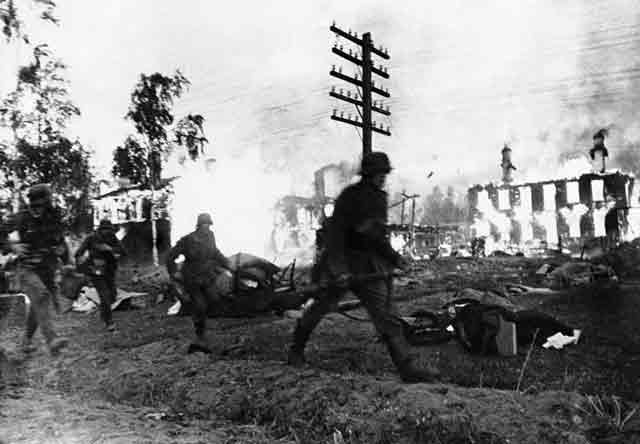
German 1st Panzer Army expended tremendous effort and took many chances to capture Rostov-on-Don only a few days ago, but on 24 November 1941 the local commanders on the scene decide to evacuate it. The drive to Rostov required the Wehrmacht to open a long corridor to the city which is wide open to attack from the north. Soviet 9th and 37th Armies seize the opportunity and attempt to cut off the German spearhead in the city, but General Ewald von Kleist recognizes the danger and plans with Army Group South commander Field Marshal Gerd von Rundstedt to pull his troops out before he loses them. This withdrawal will require Adolf Hitler’s permission, which he is unlikely to give — unless it is presented to him as a fait accompli. Figuring out how to do this will require a lot of thought and planning.
Hitler wants Rostov held at all costs. The city is considered the “gateway to the Caucasus,” and holding it would somewhat salvage the lofty goals for Operation Barbarossa in the spring. For the time being, III Corps in the city can hold out, but not for long. At OKH headquarters, General Franz Halder more-or-less agrees with the Führer:
“The situation north of Rostov is serious but not critical at the moment. At some points, the enemy is pressing against our new positions. The right wing of Seventeenth Army [just to the north of 1st Panzer Army] has to fight off serious attacks. The Italians are still doing nothing.”
The danger is that the Soviets break through the Seventeenth Army front and then wheel down to the coast of Azov, cutting the 1st Panzer Army’s only line of retreat. So far, that hasn’t happened — but it still might. It will be the first time that the Wehrmacht has been forced to retreat from a major objective so the decision cannot be taken lightly.
Elements of German LVI Panzer Corps captured Rogachevo, Russia, north of Moscow. To the south of the Soviet capital, XXIV Panzer Corps captured the road junction at Venyov 30 miles east of Tula.
“Life Certificates” issued to some Jews of Vilna, the rest are exterminated.
The SS establishes a new camp at the fortress town of Terezin in occupied Czechoslovakia, about 90 miles (145 kilometers) north of Prague (called the Protectorate of Bohemia and Moravia since its formal incorporation into the Greater Reich). The camp, called Theresienstadt, is intended as a hybrid transit point and long-term Ghetto for Holocaust victims. It is euphemistically called a “retirement settlement” for Jewish elders and, at least at first, is a “show camp” for the Red Cross and others. The first trainload of residents, 342 young Jewish men, arrive today, the first of thousands, and make the 1.5-mile (2.4 km) walk from the train station. Conditions are brutal, the inmates are terribly mistreated, and people die as a matter of course even though technically Theresienstadt is not an extermination camp. When the Red Cross visits, dummy stores, cafes, schools and gardens are set up. Jews deported here are usually eventually sent on to extermination camps. Some 150,000 Jews pass through on their way to the extermination centers.
Lieutenant General Erwin Rommel launched an attack to the Libyan-Egyptian Border. Rommel, believing the British Armour destroyed, ignores the New Zealand Division and advances along the Trig el Abd to the Egyptian border. German and Italian tanks advanced and split the British XXX Corps in Libya, but Allied aircraft halted the attack. The offensive was uncoordinated and achieved little. During the “Dash to the Wire” Rommel and his senior commanders lose touch, and the British rear echelons panic. The Germans take losses they cannot afford and their hold on the British armour becomes slack.
The British Operation Crusader in North Africa that began on 21 November has turned into a wild melee with the outcome completely in doubt. British 7th Armored Division of Eighth Army has taken horrendous tank losses, and overall the British have lost about 350 tanks and had another 150 severely damaged. General Erwin Rommel has a couple of advantages over German generals everywhere else in the Wehrmacht:
•He has complete freedom of action and the Allies cannot predict his movements by decoding his radio transmissions;
•The Italian troops under his command are fighting hard and effectively.
Rommel has freedom of action because the Wehrmacht is focused on the Eastern Front and considers the North Africa Theater to be an unimportant sideshow. How he manages to get vital assistance from his Italian allies, though, is unclear.
Today, after several brilliant attacks that have blunted the British offensive, Rommel counterattacks hard by sending elements of Afrika Corps and the Italian Ariete Division toward Sidi Omar. This is known as “The Dash to the Wire” because the panzers are heading toward the wire barrier at the border. The main goal of the attack is to relieve trapped German troops at Bardia and then destroy British lines of communication from Egypt. Rommel plans to broaden the attack on the 25th by adding the 15th Panzer Division. Operation Crusader thus has turned into two separate offensives going in opposite directions, one by the British to the west and the other by the Axis forces to the east. Both can’t be successful, so a potentially decisive moment is brewing at the Egyptian/Libyan border.
The Italian passenger ferry Hercules was torpedoed and sunk in Heraklion harbour by the British submarine Triumph.
German U-boat U-124 sank British cruiser HMS Dunedin 650 miles east of Natal, Brazil at 1521 hours, hitting her with two torpedoes. 236 were killed; 250 survived the sinking, but only 67 would survive the entire ordeal, succumbing to wounds, drowning, and shark attacks. U-124 (Kptlt. Johann Mohr), on its seventh patrol out of Lorient, is operating roughly midway between Natal, Brazil and Monrovia, Liberia when it spots 4800-ton Royal Navy cruiser HMS Dunedin (Captain Richard Stratford Lovatt, RN). Dunedin has been searching the South Atlantic for German raider Atlantis as part of a three-cruiser task force. U-124 is on its way to refuel from supply ship Python but can’t pass up the opportunity to attack. Dunedin’s lookouts spot U-124’s periscope but lose track of it again. After much maneuvering, Mohr pumps two out of three torpedoes into the cruiser’s starboard side, causing it to sink quickly. There are about 250 men in the water, but Mohr only surfaces, circles the area, and then leaves without offering any aid. By the time U.S. freighter Nishmaha passes by three days later, only 72 men are left on six floats. Another five men perish from exposure on the way to the port at Trinidad. A total of four officers and 63 ratings survive to see land again.
British landing ship HMS Prince Leopold landed 90 men of British No. 9 Commando battalion at Butte de Houlgate, France, who captured some classified documents and immediately returned to Britain aboard the same ship.
German 4th Motor Torpedo Boat Flotilla attacked Allied convoy FS.654 off East Anglia, England, United Kingdom, sinking British tanker Virgilia (23 killed, 17 survived) and Dutch ship Groenlo (10 killed).
During the war, no German prisoner of war escaped from the U.K. Many believe that Luftwaffe Oberleutnant (First Lieutenant or Flying Offiver) Franz Von Werra is the most notable escapee but von Werra made his escape in Canada, where he is sent as a POW. (There were 21 POW camps in Canada.) The most audacious attempt is made by Leutnant Heinz Schnabel and Oberleutnant Harry Wappler today. The two Luftwaffe officers are prisoners in Camp No.15 near Penrith, Northumberland, England, (formally the Shap Wells Hotel). Forging papers that identifies them as two Dutch officers serving in the RAF, they make their way to RAF Carlisle, a flying training base, located 2 miles (3,2 kilometers) north of Carlisle, Cumberland. Without difficulty they enter the station and with the help of a ground mechanic start the engine of a Miles Magister, of which there are 50 parked around the airfield. Taking off, they headed southeast for the North Sea and the Netherlands, a distance of some 365 miles (587 kilometers) to the Dutch coast. Over the North Sea they realize they could not make the Netherlands because the maximum range of a Magister is 367 miles (591 kilometers) on full tanks. Rather reluctantly they decide to turn back and land in a field about 5 miles (8 kilometers) north of Great Yarmouth, Norfolk, England, on the coast. Back at Camp No. 15 again, the two daring escapees are sentenced to 28 days solitary confinement.
Louis Lipsky, chairman of the governing council of the American Jewish Congress, today charged the British Government with “delays, evasive speech and unconvincing excuses” in reply to an offer by Jews “to organize a Jewish military unit under its own name and flag in the English service.”
RAF Bomber Command, Day of 24 November 1941
4 Stirlings on cloud-cover raids to Germany but only 1 aircraft bombed ships off the Frisians. No losses.
Light cruiser HMS Dunedin (Captain R. S. Lovatt, OBE) was sunk by U-124, commanded by Kapitänleutnant Johann Mohr, in 3S, 26W, north of Pernambuco. In November 1941 the Admiralty learned from decrypted Enigma messages that the German armed merchant raider Atlantis (Schiff 16) (Kpt z.S. Rogge) and the supply ship Python operated in the South Atlantic and ordered the three cruisers HMS Devonshire (39), HMS Dorsetshire (40) and HMS Dunedin (D 93) to track them down independently. On 22 November, HMS Devonshire (39) (Capt R.D. Oliver, DSC, RN) encountered the Atlantis, which was refueling U-126 (Bauer) north of Ascension. The raider scuttled herself and the U-boat was not able to attack the cruiser, but then started a rescue operation for the survivors. Two days later the survivors were transferred to the Python, which was then ordered to refuel U-124. In the afternoon on the same day, U-124, on her way to the rendezvous, sighted the unescorted HMS Dunedin (D 93) (Capt R.S. Lovatt, RN), steaming a zigzag pattern at 17 knots east of St. Paul’s Rock. The U-boat raced ahead of the ship´s path and dived for a submerged attack. The lookouts on the cruiser saw the periscope at 1450 hours and changed course to chase the U-boat, but the course of the U-boat was misinterpreted so HMS Dunedin (D 93) turned away. The approaching U-124 suddenly came to the surface for a brief moment, but remained unseen. The forward hydroplanes jammed and the LI had trouble to get the boat under control. As Mohr was able to see through his periscope again the cruiser was not in sight, but then he spotted the vessel at a range of over three miles, which was now well past of a favourable attack range. Mohr decided to fire a spread of three torpedoes at 1521 hours. After 5 minutes and 23 seconds, two torpedoes struck the cruiser, which rolled first to port then to starboard before sinking stern first after 17 minutes. The first torpedo struck amidships and wrecked the main wireless station. The second torpedo struck further aft, probably near the quarters of the officers, dismounting the after 6in gun and blowing away the starboard screw. About 250 survivors managed to leave the ship by jumping overboard. They rescued themselves onto seven Carley floats and floating debris. The U-boat surfaced and circled the survivors for about ten minutes but then left. Only 72 survivors were still alive on the six floats found by the American steam merchant Nishmaha, en route from Takoradi to Philadelphia, three days after the sinking. Many survivors drowned, some died of their injuries, others died of exhaustion and some were bitten and killed by sharks. Five of the rescued men died before the merchant ship reached Trinidad, thus only four officers and 63 ratings survived the sinking.
The U-Boat supply tender Python picked up the crew of the German commerce raider Atlantis, which had been sunk on November 22. The crew had been rescued up the U-126 and was being towed in four overcrowded steel boats and five rubber rafts. The Python then set sail for France.
On 1 December, the Python (Kptlt Lueders), refueling UA (Eckermann) and U-68 (Merten), was found by the third cruiser HMS Dorsetshire (40) (Capt A.W.S. Agar, VC, DSO, RN) in 27°53S/03°55W. Both U-boat immediately submerged and UA fired five torpedoes at the cruiser but missed. The Python scuttled herself after the first shots were fired by the cruiser. An operation was started by both U-boats to rescue the 414 survivors from Python and Atlantis and took their floats in tow. Two days later, U-129 (Clausen) took over the whole crew of Python and U-124 (Mohr) joined the other boats on 5 December. Between 14 and 18 December, the most survivors from Atlantis were transferred to the Italian submarines Luigi Torelli (KKpt de Giacomo), Enrico Tazzoli (KKpt Fecia di Cossato), Giuseppe Finzi (KKpt Giudice) and Pietro Calvi (KKpt Olivieri) and were taken to St. Nazaire. All survivors arrived in French ports between 23 and 29 December.
Heavy cruiser HMS Cumberland departed Hvalfjord for Denmark Strait patrol.
Battleship HMS Resolution, escorted by destroyers HMS Berkeley and ORP Kujawiak, departed Plymouth for Scapa Flow to work up. The ships arrived at Scapa Flow on the 27th.
Light cruiser HMS Kenya, destroyers HMS Bedouin and HMS Intrepid, and Soviet destroyers Gremyahchi and Gromki departed Murmansk to sweep for German shipping between Nodkyn and Vardo in Operation AR. The ships shelled Vardo at 0731 on the 25th. The ships arrived at back Murmansk later on the 25th.
Destroyer HMS Punjabi departed Scapa Flow at 1200 for the Tyne to carry out refitting. The destroyer arrived at 0730/25th.
Destroyer HMS Icarus departed Scapa Flow at 2330 for Hvalfjord to join the Commander in Chief Home Fleet. The destroyer arrived at Hvalfjord at 0830/27th.
Landing ship Prince Leopold, escorted by MGB.316, MGB.312, MGB.314, and MGB.317, landed troops on the coast of Normandy in Operation SUNSTAR. After information was gained, the ships returned to Portsmouth.
T/Sub Lt (A) L. A. C. Michell RNVR, was killed when his Albacore of 767/769 Squadrons crashed near Abroath during exercises.
Submarine HMS Seawolf unsuccessfully attacked a convoy of steamers Asuncion, Graziella, and Wendingen in 70-30N, 30-30E in Syltefjord.
British steamer Ardenza (933grt) was damaged by German bombing in 54B, ten miles southeast of Orfordness. The steamer arrived at Great Yarmouth on the 25th.
German motor torpedo boats S.50, S.51, S.52, S.109, and S.110 of the 4th Motor Torpedo Boat Flotilla attacked convoy FS.654east of Orfordness. British tanker Virgilia (5723grt) was sunk by S.109 three miles north east of Hearty Knoll Buoy. Twenty three crewmen, including seven gunners, were missing on the tanker. Seventeen survivors were picked up by ML.150 and ML.152. Dutch steamer Groenlo (1984grt) was sunk by S.52 one and a half miles 28° from 52E Buoy. One crewman was killed and nine crewmen were missing. British steamer Blairnevis (4155grt) was damaged by German motor torpedo boat S.51 off Hearty Knoll, 52-20N, 1-59E. The steamer was beached at Great Yarmouth Roads. She was refloated and towed to London on 16-17 December for repairs. The crew had abandoned ship and ML.150 rescued the crewmen. Destroyers HMS Westminster and HMS Southdown both reported sinking German S-boats.
Battleships HMS Queen Elizabeth, HMS Valiant, and HMS Barham and destroyers HMS Jervis, HMS Griffin, and HMS Decoy departed Alexandria to support operations by Force K. Five other destroyers were still oiling when the Fleet departed. The Fleet encountered destroyers HMS Farndale, HMS Avonvale, and HMS Eridge in the searched Channel and these destroyers escorted the Fleet until relieved at 2245 by destroyers HMAS Napier, HMAS Nizam, HMS Kipling, HMS Jackal, and HMS Hasty which had completed fueling. Force K with light cruisers HMS Aurora and HMS Penelope and destroyers HMS Lance and HMS Lively departed Malta on the 23rd to intercept Italian convoys. Light cruisers HMS Ajax, HMS Neptune, HMS Naiad, HMS Euryalus and destroyers HMS Kandahar, HMS Kingston, HMS Kimberley, and HMS Hotspur departed Alexandria to act as Force B, but did not make any contact. Force B swept the coast of Cyrenaica during the night of 25/26 November and arrived at Alexandria at 1800/26th. Italian submarine Settimbrini was sighted Force K at 0503 on the 25th. Italian convoys were ordered into the nearest ports. However, the German steamer convoy did not receive the order and was intercepted by Force K. On the 24th, both German steamers were sunk and torpedo boat Cassiopea was damaged by splinters. Force K arrived back at Malta at 0730/25th.
Submarine HMS Triumph sank Italian tug Hercules (632grt) and damaged German steamer Norburg off Heraklion.
Submarine HMS Olympus departed Gibraltar with aviation petrol and other stores for Malta.
Submarine HMS Clyde arrived at Gibraltar after escort duties with RFA oiler Dingledale. On the 25th, the oiler and corvettes Jonquil and Coreopsis arrived at Gibraltar.
Dutch submarine HNLMS O.21 sank Italian coastal steamer Unione (216grt) northeast of Troca in 41-06N, 10-02E.
Today in Washington, the White House announced that contingents of the United States Army would protect bauxite deposits in Dutch Guiana. President Roosevelt met with Democratic Congressional leaders in the morning and tonight conferred with a Congressional bipartisan group on anti-strike legislation. His callers included Attorney General Biddle, Budget Director Smith and Secretary Knox.
The Senate received the Connally bill to make the “hot oil” law permanent, recommitted the treaty with Canada revising the Niagara River Diversion Agreement, received the Thomas (of Utah) bill to prohibit defense industry strikes and recessed at 1:40 PM until noon Thursday. A judiciary subcommittee heard Maritime Commissioner Land approve the Connally labor bill; the Agriculture Committee heard an appeal for aid for distressed cotton growers.
The House considered price-control legislation, heard a discussion of the defense labor situation, received the Patman bill to curb defense industry strikes and adjourned at 5:30 PM until noon tomorrow. The Labor Committee began hearings on legislation to curb defense strikes; the Banking and Currency Committee agreed to an amendment of the price-control bill.
A bipartisan group of congressmen meeting with President Roosevelt and labor and Justice Department executives reached a consensus tonight that labor legislation should be taken up promptly, that it should provide for a “reasonable” cooling-off period before strikes and that the chief executive should have the power to inaugurate compulsory arbitration if necessary.
Secretary of State Cordell Hull conferred for two hours tonight with envoys of Great Britain, Australia, China and the Netherlands as “peace-or-war” talks between the United States and Japan entered a phase of uncertainty. It was the second meeting in three days among the five powers most vitally interested in the delicate Far Eastern situation. Hull has not met with the Japanese diplomats Saburo Kurusu and Admiral Kichisaburo Nomura since Saturday, a few hours after the first conference of the ABCD powers, and there was no indication how soon he would resume conversations with them.
The House began consideration of price control legislation today, and while divergent opinions were expressed over what means should be adopted to protect the public during the war emergency there was general admission that a broad measure was necessary to prevent runaway inflation. Only an hour before the debate started the Banking and Currency Committee, by a vote of 14 to 9, restored to the bill an amendment, desired by the Administration, providing for licensing of businesses to sell commodities for which price ceilings have been established. This would compel compliance, as a license would be revoked for selling above the ceiling price. The amendment specifically exempted farmers, purveyors of newspapers, books and periodicals and sellers of radio time. Restoration of the amendment was criticized on the floor by both sides and it was conceded to have injected a controversial angle.
The U.S. Supreme Court decided Edwards v. California. The U.S. Supreme Court laid down the doctrine today that relief to the needy and interstate migration are matters of national concern and struck down an effort by California to deal independently with the problem. But sharing interest with the decision itself was a rebuke to the court delivered by its newest member, Justice Jackson, in a separate opinion which contended that the tribunal consistently had failed to uphold the privileges of individual citizens against state abridgement, The court held unconstitutional a so-called “anti-Okie” law which made it a misdemeanor to help an indigent of another state to enter California, which has comparatively high relief benefits and old age pensions. A score of other states have similar statutes. Justice Byrnes, writing his first opinion since his appointment last summer, delivered the majority decision. He based the ruling solely on the ground that California’s action violated the constitutional provision which gives congress the right to regulate interstate commerce and said that it therefore was unnecessary to deal with other constitutional considerations. There was no dissent as to the result but four justices took exception to this narrow manner of deciding the question. The primary point, in their view, was that the indigent involved in the case, Frank Duncan of Spur, Texas, was a citizen of the United States and that his citizenship gave him the right to go freely from state to state. No condition of poverty, they said, could affect this right. Justice Douglas wrote a separate concurring opinion on this point, in which Justices Black and Murphy joined, and Jackson wrote another which was far more outspoken. Jackson declared that the hope of Imparting “vitality” to American citizenship through adoption of the fourteenth amendment to the constitution “soon shriveled in the process of judicial Interpretation.”
“Rebellious” border counties that want to secede from California and Oregon selected “Jefferson” today at the name of their proposed forty-ninth state and announced plans for a taxless government. Gilbert Gable of Curry County, Oregon, regarded by secessionists as the governor-to-be of the projected new state, said there would be no income, sales or liquor taxes in “Jefferson.” This campaign would be periodically resurrected over the next 75 years.
The Senate returned to its Foreign Relations Committee today for further study a new treaty with Canada permitting the diversion for power purposes of additional water from the Niagara River. The action was taken after several Senators said the language of the agreement might be construed as giving sanction to development of the St. Lawrence seaway and power project. Chairman Connally of the Foreign Relations group said there was no foundation for this view. but agreed that the treaty might go back to his committee, which, he said, would take additional testimony from State Department officials.
Destroyer USS DuPont (DD-152) in North Atlantic with TU 4.1.6, escorting convoy HX.161, is damaged in collision with merchant ship Thorshovdi.
The comic strip “Gordo” by Mexican-American cartoonist Gus Arriola first appeared.
The United States government announced the takeover of the defense of Dutch Guiana in South America as a precaution against the Germans securing the use of the French base at Dakar in Africa. The United States today announced the dispatch of American troops to Dutch Guiana to guard vital bauxite mines against the axis, and Senator Connally, Texas Democrat, predicted that this country may soon take over island of Martinique. A White House announcement said the colony of Surinam (another name for Dutch Guiana) furnishes more than 60 percent of the requirements of this country’s aluminum industry and that the ore was vital as well to “all nations resisting aggression.”
The Japanese Foreign Office has sent a new communication to its mission negotiating with the United States Government in Washington, and a new development is expected “very shortly,” Domei, Japanese news agency, said tonight.
Although a formal announcement by the Foreign Office that the liner Tatuta Maru would sail for Los Angeles and Balboa, C.Z. before the end of the month, and various 0other indications, both in Washington and Tokyo, served to revive hopes for a successful conclusion of the American-Japanese negotiations, the Japanese Government continued to speed up the creation of a wartime military, economic and financial structure in preparation for the worst.
Admiral Harold R. Stark, the USN Chief of Naval Operations, sends the following message to Admiral Thomas C. Hart, Commander-in-Chief Asiatic Fleet in the Philippine Islands; Admiral Husband E. Kimmel, Commander-in-Chief Pacific Fleet in the Territory of Hawaii; Rear Admiral Charles A. Blakely, commander of the Eleventh Naval District at San Diego, California; Vice Admiral John W. Greenslade, commander of the Twelfth Naval District at San Francisco, California; Vice Admiral Charles S. Freeman, commander of the Thirteeth Naval District at Seattle, Washington; and Rear Admiral Frank H. Sadler, commander of the Fifteenth Naval District in the Canal Zone:
NOVEMBER 24, 1941, MESSAGE TEXT:
THE CHIEF OF STAFF IS IN AGREEMENT WITH THE ESTIMATE PRESENTED HEREWITH AND REQUESTS THAT YOU INFORM THE SENIOR ARMY OFFICER IN YOUR AREA COLON CHANCES OF FAVORABLE OUTCOME OF UNITED STATES DASH JAPANESE NEGOTIATIONS ARE VERY DOUBTFUL PERIOD THIS SITUATION TOGETHER WITH STATEMENTS OF JAPANESE GOVERNMENT AND MOVEMENT OF THEIR MILITARY AND NAVAL FORCE INTIMATE IN OUR OPINION THAT SURPRISE AGGRESSIVE MOVEMENT IN ANY DIRECTION INCLUDING ATTACK ON PHILIPPINES OR GUAM IS A POSSIBILITY STOP THIS INFORMATION MUST BE TREATED WITH UTMOST SECRECY IN ORDER NOT TO COMPLICATE A TENSE SITUATION OR PRECIPITATE ACTION END STARK.
Stark adds, “Chief of Staff (of the U.S. Army, General George C. Marshall) has seen this dispatch concurs and requests action addresses to inform senior Army officers their areas. Utmost secrecy necessary in order not to complicate an already tense situation or precipitate Japanese action. Guam will be informed separately.”
Hart relayed Navy Department message to MacArthur.
Philippine President Quezon stated publicly that Roosevelt and Sayre should be “hanged from lampposts” because of their inattention to Philippine civil defense.
Gerow drafts memorandum to Marshall advocating that “a modus vivendi” be reached with Japan.
Admiral Stark sends appeal to FDR to urge him to continue negotiations to allow war preparations to continue.
Time Magazine had Admiral Hart on its cover; the article called him “the indispensable oldster.”
A mysterious bomb explosion which wrecked the American consulate at Saigon, French Indo-China, added today to the tension arising from the Far Eastern developments. There was no clue to the perpetrators of the bombing. Although the United States has looked askance at Japanese infiltration into Indo-China, there was nothing to indicate whether the bombing was the work of Japanese extremists. A preliminary investigation indicated that the bomb was placed on a floor just outside the consulate office, where it exploded last night. A report from Consul Sidney H. Browne said there was no injury to personnel or to the official archives, but that inner walls and other parts of the consulate were blown down.
British troopship Awatea departed Singapore with 420 crewmembers for troopship Empress of Russia. The troopship was escorted by light cruiser HMS Dragon to 66-14N, 98E where light cruiser HMS Glasgow relieved light cruiser Dragon. Light cruiser Glasgow escorted troopship Awatea until 27 November and the troopship arrived at Colombo on the 28th.
Dow Jones Industrial Average: 117.3 (+0.26)
Born:
Pete Best, British rock drummer, original drummer for The Beatles (1960-1962), in Madras, British India.
Donald “Duck” Dunn, bass guitarist (Stax; Booker & The MG’s; The Blues Brothers), songwriter and producer, in Memphis, Tennessee (d. 2012).
Gary Boyle, British rock and jazz-fusion guitarist (The Echoes; Isotope), in Patna, British India.
Wayne Lamar Jackson, American soul and R&B trumpeter (Mar-Keys; The Memphis Horns), in West Memphis, Arkansas (d. 2016).
Naval Construction:
The U.S. Navy Adroit-class minesweeper USS Despite (AM-89) is laid down by the Dravo Corp. (Pittsburgh, Pennsylvania, U.S.A.).
The Royal Navy Algerine-class (Turbine-engined) minesweepers HMS Onyx (J 221) and HMS Mutine (J 227) are laid down by Harland & Wolff Ltd. (Belfast, Northern Ireland).
The U.S. Navy SC-497-class (110-foot wooden hull) submarine chaser USS PC-529 (later SC-529) is laid down by the Mathis Yacht Building Co. (Camden, New Jersey, U.S.A.).
The Kriegsmarine (German Navy) Type VIIC U-boat U-706 is launched by H C Stülcken Sohn, Hamburg (werk 766).
The Royal Canadian Navy Fairmile B-class motor launch HMCS ML 051 is commissioned.
The Royal Canadian Navy Fairmile B-class motor launch HMCS ML 056 is commissioned.
The Royal Canadian Navy Fairmile B-class motor launch HMCS ML 058 is commissioned.
The Royal Canadian Navy Fairmile B-class motor launch HMCS ML 072 is commissioned.
The Royal Canadian Navy Fairmile B-class motor launch HMCS ML 073 is commissioned.
The Royal Navy harbor defence motor launch HMS HDML 1088 is commissioned.
The Royal Navy MMS I-class motor minesweeper HMS MMS 80 (J 580) is commissioned. Her first commanding officer is T/Lieutenant David John Morris, RNR.
The U.S. Navy Accentor-class coastal minesweeper USS Defiance (AMc-73) is commissioned.
The Royal Navy Isles-class minesweeping trawler HMS Eday (T 201) is commissioned. Her first commanding officer is T/Lieutenant Walter Youlle Surtees, RNR.
The Royal Canadian Navy Bangor-class (VTE Reciprocating-engined) minesweeper HMCS Red Deer (J 255) is commissioned. Her first commanding officer is T/Lieutenant Arthur Moorhouse, RCNR.
13…

