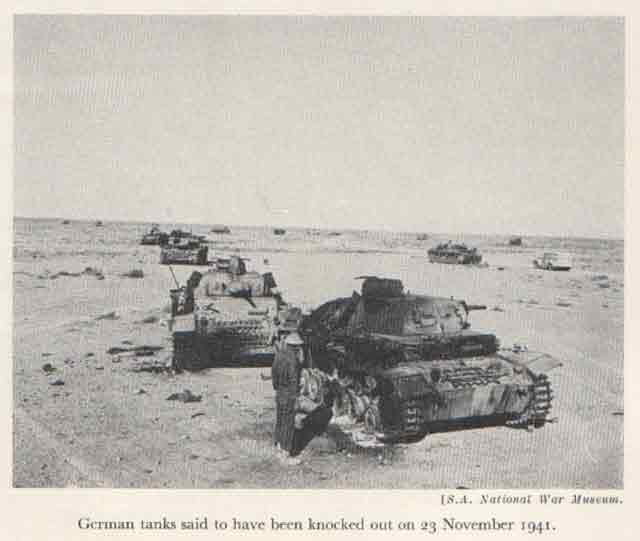
The Germans consider the North African campaign to be a sideshow to the main event in the Soviet Union. However, it is a very serious affair to the British, and they are determined to rescue their encircled comrades in Tobruk. General Erwin Rommel finally is in full legal command of Afrika Corps after Italian authorities in Rome bow to the inevitable and agree to put Italian XX Mobile Corps (Ariete and Trieste Divisions) under his direct command early in the day. The two sides have been “mixing it” for several days now without any sign of a final decision, and Rommel decides to try for the win. He orders a concentric attack on the British 7th Armored Division southeast of Tobruk by having his panzers advance from the north and the Italian Corps Gambara from the south. The German commander on the spot, however, General Cruewell, has no faith in the Italians. He crafts his own plan (before receiving Rommel’s orders at 04:30) to send his panzers south and then attack with them toward the north — thereby not relying on the Italians.
The German attack launches at 07:30, a bit later than planned, and the 4th South African Armored Cars unit sees it coming over five or six miles. However, the 8th Army Headquarters does not believe the report and tells the South Africans that they are mistaken. This enables the panzers to advance virtually unmolested while they could still be brought under artillery fire. The panzers of the 15th Panzer Division blast through startled British supply columns and keep going. This unexpected attack into the British rear echelons causes panic and chaos, and only scattered British units are in a position to return fire. These British units do, however, at least slow the Germans, but the action is an unqualified German success — until General Cruewell inexplicably decides to withdraw to regroup. This enables the British also to recover somewhat, but the panzers renew their advance around noontime and finally do link up with the Italians. The day turns into a disaster for Eighth Army, and recriminations ring out in Cairo as Lieutenant-General C.W.M. Norrie in command of 30th Corps ponders ways to salvage the situation over coming days. The day is a brilliant success for General Erwin Rommel, but the British are still very much in the fight.
In the south the New Zealand Division attacks and captures the headquarters of the Afrika Korps and much of German General Erwin Rommel’s communications equipment. Due to heavy British losses, Major General Alan Cunningham, General Officer Commanding Eighth Army, loses confidence and General Sir Claude Auchinleck, Commander in Chief Middle East Command, comes forward to watch the tactical moves closely.
British Captain Philip Gardner led two Matilda tanks in the rescue of the crews of two armored cars pinned under enemy fire at Tobruk, Libya, becoming wounded in the process. He was later awarded the Victoria Cross award.
The 7th Panzer Division captured the key road junction of Klin northwest of Moscow. The German offensive in the Moscow sector continues. The Wehrmacht makes more progress toward Moscow on 23 November 1941, capturing Klin in Moscow Oblast (the capture of cities can take days, some sources place the city’s complete capture on 24 November). The panzers now are 85 km (53 miles) northwest of Moscow, the closest of any German forces.
The attack on Klin is a major German success that results from five days of increasing pressure and an envelopment from three sides — north, west, and south. The German 7th Panzer (Generalmajor Hans Freiherr von Funck) and 106th Infantry Divisions attack Klin from the west while 6th Panzer and 14th Motorized Divisions attack from the north. The Red Army defends in the north with the 107th Motorized Rifle and 5th Tank Divisions and in the west with the remains of a cadet regiment and the 25th Tank Brigade. Southwest of Klin, most of the German 2nd Panzer Division and 35th Infantry Division also advance, taking Gorki (six kilometers south of Klin) and then turn north to help capture the city. At the same time, part of the 2nd Panzer Division turns south toward Solnechnogorsk, fighting off Soviet counterattacks. The Red Army has men fighting fiercely, but are overwhelmed by superior German firepower.
The Soviet forces on the western axis of Klin are too weak to combat German panzers moving towards them from three directions. Late in the day, the Stavka finally allows them to retreat to Klin’s southwestern outskirts rather than be surrounded. The 2nd Panzer forces destroy over two dozen Soviet tanks and secure intact several bridges over the Moscow/ Volga canal. The day winds up with the Soviets pushed back about 2-4 km south of Solnechnogorsk (about 35 km from Moscow) and panzers fighting in the center of Klin.
General Franz Halder and Army Group Center Commander Field Marshal Fedor von Bock have a telephone conversation in which they feel cautiously optimistic at the day’s events. Halder writes in his diary:
“Situation on the northern wing of Army Group Center is good. Klin taken. Now we must try to get the rest of the entire front in flux by putting on pressure from the north.”
Halder’s comment reveals both success and failure. The success at Klin is good, but only if it can shake the entire front loose. Everywhere else around Moscow, the Wehrmacht is at a standstill despite optimistic plans.
South of Moscow, at Tula, General Guderian’s panzers are no longer moving forward, and Halder even poses the rhetorical question, “What can Guderian still accomplish?” The problem for the Germans is that an envelopment of Moscow requires progress in more than one direction — and the only troops still moving forward are in the north. Unless Guderian can break the Red Army resistance and continue north on the Moscow highway, it is highly unlikely that just one arm of a pincer movement can accomplish the gigantic task of taking Moscow.
Over the past week, the Soviets have made some tentative experimental crossings of Lake Ladoga to supply Leningrad. The city’s more than one million inhabitants otherwise are getting virtually no supplies. Since those experimental crossings were successful, today the Soviets run a major convoy of 60 trucks which bring in 33 tons of flour and 2.5 tons of other supplies across the frozen lake. The hazards of driving across include the ice breaking under the heavily laden trucks, which does happen occasionally, and occasional shells falling nearby from German artillery on the south shore. However, Russian truck drivers are tough and used to taking risks that would be considered unacceptable elsewhere. In any event, they have no choice, as everyone understands the result of refusing to follow orders.
Even these successful truck convoys may be too late. Leningrad is in very poor shape. It requires about 600 tons of supplies per day for the survival of its people, but this is out of the question, and it hasn’t received any supplies except those few tons that can be flown in for weeks already. Looking ahead, the situation is a virtual mirror image of the situation the Germans will face in Stalingrad, though even worse because of the larger population in Leningrad. There really is no good solution for the people of Leningrad, as there is no way out for all but a relative handful of VIPs and not enough food for those who remain. Even if the city were to surrender — which is absolutely out of the question — the population knows it would be mistreated by the Germans and perhaps be treated even worse than they are already. So, the city holds out and people starve to death.
German Luftwaffe II./KG 55 departed Kirovograd, Ukraine for Saint-André-de-l’Eure, France for rest and refitting.
The German ambassador in Japan Eugen Ott warned Germany that the Japanese military seemed to be on the verge of a war, its military preparing to move southward. He was not aware of Japan’s plans to attack the United States.
RAF Bomber Command, Night of 23/24 November 1941
Lorient
51 Hampdens and 2 Manchesters. Fires were seen in the vicinity of the docks. No losses.
Dunkirk
36 Wellingtons and 1 Stirling; only 7 aircraft bombed the primary target. No losses.
Minor Operations: 11 Stirlings to Brest, 4 O.T.U. sorties. No losses.
Monitor HMS Erebus with destroyers HMS Witch and HMS Vanquisher departed Scapa Flow at 1230 to carry out practices west of the Orkneys, then proceed to Londonderry on completion. The ships arrived at Londonderry at 0900/25th.
Heavy cruiser HMS Kent departed Hvalfjord to replace heavy cruiser HMS Norfolk on the Faroes — Iceland patrol. Heavy cruiser Norfolk proceeded to Hvalfjord, arriving on the 24th.
Destroyers HMS Foresight, HMS Fury, and HMS Forester departed the Biscay patrol to join convoy SL.92 and then proceed to Londonderry. The destroyers joined the convoy on the 24th. On the 25th, destroyers Fury and Foresight departed the convoy for Londonderry, arriving on the 27th. They departed Londonderry on the 28th and arrived at Scapa Flow on the 29th to join the Home Fleet. Destroyer Forester departed Londonderry on the 29th and arrived at Scapa Flow on the 30th to join the Home Fleet.
Heavy cruiser HMS Hawkins, escorted by destroyer HMS Blencathra, arrived at Portsmouth from the East Indies. The heavy cruiser was refitting at Portsmouth from 7 December to 7 May.
Swedish steamer Hedda (1498grt) was sunk on a mine north of Borkum. The entire crew was rescued.
Landing ship Glenroy, with supplies for Tobruk, was damaged by an aerial torpedo in 31-40N, 26-28E. She was taken in tow by anti-aircraft cruiser HMS Carlisle, escorted by destroyers HMS Avonvale and HMS Eridge and beached at Mersa Matruh. The troops on the landing ship were transferred to destroyer HMS Farndale which carried them to Tobruk. Destroyers HMAS Napier, HMAS Nizam, HMS Kipling, HMS Jackal, and HMS Hasty were ordered to assist the landing ship. Sloop HMS Flamingo and tug HMS St. Issey departed Alexandria. Ship Glenroy was refloated on the 27th and taken in tow by tugs St. Issey and St. Monace. Escorted by destroyers, two anti-submarine trawlers, later reinforced by destroyer Avonvale, and later by destroyers Farndale and Eridge, the landing ship arrived at Alexandria on the 29th.
British tanker Toneline and steamer Gebil Kebir departed Tobruk escorted by destroyer HMS Heythrop, Australian sloop HMAS Yarra, and three anti-submarine trawlers.
While light cruiser Cardona was returning from Benghazi, Italian steamer Adriatico (1976grt) departed Reggio, unescorted for Benghazi. Italian steamer Vinicolo departed Trapani for Tripoli. Italian steamer Bosforo (3567grt), escorted by destroyer Strale, departed Benghazi to return to Brindisi. Italian steamer Fabio Filzi (6836grt) with destroyers Usodimare and Saetta departed Trapani for Tripoli. Destroyer Sebenico and torpedo boat Centauro joined the steamer from Tripoli. German steamers Maritza (2910grt) and Procida (1842grt), carrying fuel for the Luftwaffe and escorted by Italian torpedo boats Lupo and Cassiopea, departed Piraeus for Benghazi.
T/Sub Lt (A) A. J. C. Willis RNVR, was killedwhen his Hurricane of 806 Squadron from HMS Grebe crashed at Bir el Gu.
Dutch submarine HNLMS O.21 unsuccessfully attacked a convoy in the Tyrrhenian Sea.
Corvette HMS Geranium arrived at Gibraltar, escorting steamer Empire Panther, after refitting in the UK.
Reductions in the Federal budget for next year totaling $1,783,000,000 were recommended by the National Economy League today in a study prepared for submission to the joint Congressional-Executive Committee on Reduction of Non-Essential Federal Expenditures. The league listed the places where it believed reduction could be made and pointed out that these fell chiefly in the fields of farm payments, work relief, youth aids and public works. If such reductions could be accomplished, the report said, it would mean a saving of $52 a year in taxes to the average family. The report added that the cost of the defense program in the present fiscal year amounts to $515 per average family and added: “There is no magical way of meeting this cost. It can be met only by (1) taxes, (2) defense bonds, (3) reduction of non-essential spending, and (4) price inflation, which is a cruel and insidious form of taxation. The first three must be pressed to the uttermost if the fourth is to be held to the minimum.
The questions of how to check inflation through price control and how to prevent strikes in defense industries will be practically the only subjects before Congress this week. The price-control method of checking inflation will be before the House in the form of an emasculated Administration bill reported several weeks ago by the House Banking and Currency Committee. It is expected to have practically a full week’s consideration from the House and the bill’s final form is any man’s guess. The Senate Judiciary Committee will consider a bill by Senator Connally designed to amend the Selective Service Act so as to put teeth in government action to prevent strikes in defense industries, but progress on this naturally will be slow, and dependent on the general strike situation. The Price Control Bill will come. before the House tomorrow under what is called an “open” rule which will permit the offering of numerous amendments.
President Roosevelt was represented tonight as hopeful of following up the settlement of the captive mine strike with an agreement within the next two or three days, which would avert the threatened nationwide railroad strike. This would allow him to spend a delayed, though traditional, Thanksgiving at Warm Springs, Georgia, his “second home.” The President expected a report tomorrow or Tuesday on the progress made in the rail labor-management negotiations, which are to be resumed tomorrow in response to a personal appeal from the President at a 90-minute conference yesterday. He asked that both sides make every possible effort to compose their differences on the wage issue so as to prevent a strike of 1,150,000 men set for December 7.
Contracts have been let for more than 75 per cent of the allocation of $7,000,000,000 for lease-lend aid to Britain and her Allies under the first lease-lend law, Edward R. Stettinius Jr., Lease-Lend Administrator, stated today.
Summer Welles, Under Secretary of State, pledged today that after the war the United States would join with other governments to find permanent homes in new lands for millions made homeless by oppression and conquest.
Dr. John R. Steelman, chief of the U. S. conciliation service, announced tonight a threatened strike of 15,000 long line telephone workers which would have affected long distance communications in 42 states had been averted. The agreement reached in the presence of Dr. Steelman and Aaron Horvitz, U. S. conciliation commissioner, provided for wage increases totaling $3,000,000 annually and the setting up of two boards, both headed by Horvitz, to make further wage adjustments and study geographic wage differentials. The dispute involved the American Telephone & Telegraph communication system and the Federation of Long Lines Telephone Workers, an independent union.
The O.P.M. today forbade use of lead and tin foil for packaging tobacco products, chewing gum, candy, beverages, typewriter ribbons, films and friction tape after next March 15. Donald M. Nelson, O.P.M. priorities director, ordered manufacturers of foil for such purposes to cut their output immediately to one-third of the amount they manufactured in the first three months of 1941.
Labor and management representatives held separate meetings today on the railroad wage dispute, presumably considering proposals and counter-proposals put forward in previous joint conferences. There was no word, however, as to what suggestions for breaking the impasse and averting a nationwide rail strike were under consideration, nor when another Joint meeting would be held. The belief grew in the capital, however, that this week would see a settlement of the dispute or some further government action.
After a one-day truce, the Steel Workers Organizing committee (C.I.O.) today went on strike again at the Columbia Steel Co., biggest steel plant in the west which holds $5,000,000 In defense contracts. Picket lines returned to the plant and the company halted all operations as the union membership, meeting at the Pittsburg, California, ball park, rejected a company wage proposal and voted unanimously to resume the strike. With wage negotiations deadlocked, the company said the next move was up to the union; the union said the next move was up to the company.
Senator Robert F. Wagner, sponsor of the National Industrial Recovery Act and the Wagner Labor Relations Act, and regarded as one of the staunchest friends of labor in public office, warned labor last night that public opinion would not tolerate any strikes In defense Industries and declared that during the emergency all labor disputes should be settled by arbitration.
TU 4.1.6 (Commander Gilbert C. Hoover) assumes escort duty for convoy HX.161; the convoy will not be attacked by U-boats during its passage (see 24 November).
U.S. Army troops arrived in Dutch Guiana and occupied the region on behalf of the Dutch government-in-exile in order to protect bauxite (aluminum) mines.
The conversations between the United States and Japan, it was learned today, have reached a critical phase. Both sides have indicated a willingness to reach a “truce” in their long-range economic-strategic war; both sides have made suggestions about the terms on which they are prepared to reach a limited agreement.
The obvious acceleration of United States-Japanese negotiations in Washington is being followed in Japan with somewhat nervous suspense that, except for continued exhortations to maintain national unity and prepare for the worst, has led to a pause in the hectic publicity barrage with which Japan sought to press her side of the case. But the five-power [United Kingdom, Australia, China, Netherlands, United States] conference Saturday in Washington has produced a painful impression since Japan would prefer to deal with the United States alone.
Japanese carriers made a rendezvous at Hitokappu Bay, Kurile Islands, Japan in preparation for the Pearl Harbor attack. On the other side of the International Date Line, Joseph Rochefort reported to his superiors that his cryptanalytic team had detected a Japanese submarine squadron moving into the Marshall Islands.
Carrier Striking Task Force Operations Order No. 1 is issued stating that the “The Carrier Striking Task Force will proceed to the Hawaiian Area with utmost secrecy and, at the outbreak of the war, will launch a resolute surprise attack on and deal a fatal blow to the enemy fleet in the Hawaiian Area. The initial air attack is scheduled at 0330 hours, X Day. Upon completion of the air attacks, the Task Force will immediately withdraw and return to Japan and, after taking on new supplies, take its position for Second Period Operations. In the event that, during this operation, an enemy fleet attempts to intercept our force or a powerful enemy force is encountered and there is danger of attack, the Task Force will launch a counterattack. The second unit, the Midway Bombardment Unit (the 7th Destroyer Division less the 2nd section), will depart from Tokyo Bay around X-6 Day and, after refueling, secretly approach Midway. It will arrive on the night of X Day and shell the air base. The unit will then withdraw and, after refueling, return to the western part of the Inland Sea. The oiler Shiriya will accompany the bombardment unit on this mission and will be responsible for the refueling operation.”
Nine Japanese submarines of the 3rd Submarine Unit, Advance Group, Pearl Harbor Strike Force, depart Kwajalein Atoll today and arrive off the Hawaiian Islands on 6 December. One of the submarine, HIJMS I-8, is carrying a “Glen” seaplane (Kugisho E14Y1, Navy Type 0 Small Reconnaissance Seaplane); on 7 December HIJMS I-8 will be stationed about 45 nautical miles (83 kilometers) southwest of Oahu Island, seven of the boats will be stationed about 25 nautical miles (46 kilometers) south of Oahu and one boat will be stationed 100 nautical miles (185 kilometers) west of Oahu.
A bomb exploded at the U.S. consulate in Saigon, causing considerable damage but no injuries.
Submarine HIJMS I-68 departed Kwajalein, Marshall Islands for her first war patrol in the Hawaii Islands area.
Destroyer HIJMS Yuzuki departed Sakaide, Shikoku, Japan, escorting a troop convoy.
Born:
Simon Nolet, French Canadian NHL right wing (Stanley Cup-Flyers, 1974, NHL All-Star, 1972, 1975; Philadelphia Flyers, Kansas City Scouts, Pittsburgh Penguins, Colorado Rockies), in Saint-Odilon-de-Cranbourne, Quebec, Canada.
Franco Nero [Francesco Sparanero], Italian actor (“Camelot”; “Force 10 from Navarone”; “Letters to Juliet”; “Django”), in Parma, Italy.
Derek Mahon, Irish poet (“A Disused Shed in Co Wexford”), in Belfast, Northern Ireland, United Kingdom (d. 2020).
Died:
Henrietta Vinton Davis, 81, American actress and elocutionist.
Naval Construction:
The Kriegsmarine (German Navy) Type IXD2 U-boat U-847 is laid down by AG Weser, Bremen (werk 1053).
The Royal Canadian Navy Bangor-class (VTE Reciprocating-engined) minesweeper HMCS Goderich (J 260) is commissioned. Her first commanding officer is T/Lieutenant Reginald Ray Kenney, RCNR.
14…

