The III Panzer Corps, led by the 1st SS Panzer Division “Leibstandarte SS Adolf Hitler” (LSSAH) under Josef “Sepp” Dietrich, captures Rostov-on-Don on 21 November 1941. This is a major feat, achieved by forming a wedge to the southeast against fierce Red Army opposition. Dietrich is Adolf Hitler’s former personal bodyguard and an aggressive commander, but he does not have any formal military training. This works in Dietrich’s favor in this offensive because it is a very risky endeavor, exposing his forces in three directions to counterattacks that could trap his men far from the main German troop concentrations to the west.
The Red Army is regrouping in an attempt to reclaim the battered city.
Far to the north, the winter weather finally has frozen Lake Ladoga sufficiently for surface traffic across it. The trip from the nearest Soviet-held town is 40 miles round-trip. Captain Murov’s horses and wagons make the first risky trip across carrying flour, sugar, and other foodstuffs in 24 hours. This becomes the “Road of Life.”
South of Moscow, General Guderian’s attempt to bypass Tula is making a little progress every day, and today shows some small gains. General Karl Weisenberger’s LIII Army Corps takes Uzlovaya, southeast of Tula. This gives Colonel Heinrich Eberbach’s dwindling panzers some flank protection. However, it does nothing to help the all-important drive to reach the road to Moscow north of Tula. The Stavka decides that they need someone new in charge of the 50th Army, so the chief of the Red Army General Staff, Marshal Boris Shaposhnikov, appoints Lieutenant General Ivan Vasilievich Boldin. Boldin sets out for Tula, where he will arrive on the 22nd through the narrow opening north of the city that the Soviets still hold. A Siberian division armed with T-34 tanks has also joined the battle near Venev, 60 miles south of Moscow.
The fortress of Sebastopol, the last Russian stronghold in the Crimea following the German breakthrough into the peninsula, has also fought off all attempts to penetrate its defenses. It is becoming the Russian Tobruk.
Heinz Guderian wrote Franz Halder from Russia, noting the miserable cold and fierce Soviet resistance.
The horse-drawn sleigh team returned to Leningrad, Russia from Kobona, bringing back flour, sugar, and fat across the frozen Lake Ladoga for the first time since the city was surrounded.
Albert Speer, Chancellor Adolf Hitler’s chief architect and minister for armaments and war production, asks for 30,000 Soviet prisoners of war to use as slave laborers to begin a massive Berlin building program. These slave laborers will come in handy for Hitler’s “new” Berlin. Speer wants to begin construction even as the war wages. Despite the drain on resources Hitler agrees. Speer beguiles the Fuhrer with models of a Great Hall for the Chancellery and a grand office for Goring. But as the war turns against Germany, the rebuilding plans are scrapped. When the war is over, Hitler is dead, and Speer is tried as a war criminal at Nuremberg, the site of his grand parade, and sentenced to 20 years in Spandau prison in Berlin.
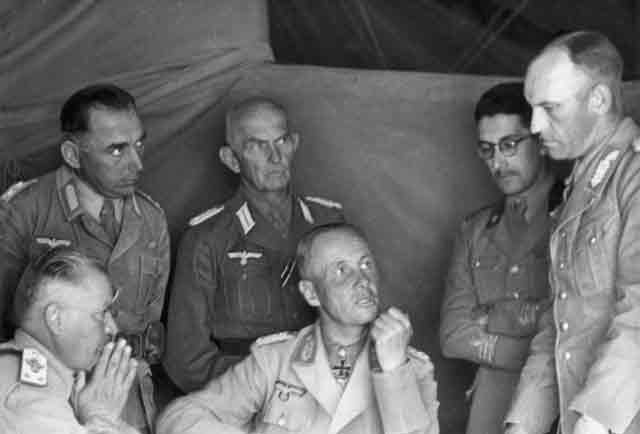
The Allied garrison at Tobruk, Libya attempted a breakout to link up with the main attack force coming from Egypt, which engaged with German 15th Panzer Division in a large-scale tank battle that would last for the next three days near Sidi Rezegh. The British 7th Armoured Division is caught by the Germans at Sidi Rezegh. The 4th and 22nd Armored Brigades are not there yet. The breakout attempts from Tobruk are halted. New Zealand forces crossing the border from Egypt capture Fort Capuzzo. Pressed for fuel, Erwin Rommel dispatched Italian cruiser Cardona from Brindisi, unescorted, to bring fuel to Benghazi.
The 70th Infantry Division was to break out from Tobruk on 21 November and cut off the Germans to the south-east. The night before, the garrison gapped the wire, planted and marked minefields and put four bridges over the anti-tank ditch. On the evening of 20 November the 14th Infantry Brigade (2nd Battalion Black Watch, 2nd Queen’s), the 16th Infantry Brigade (2nd King’s Own) the 32nd Army Tank Brigade (1/4th RTR, 7th RTR), the 1st, 104th and 107th regiments RHA and 144th Field Regiment RA, with detachments of the 2nd and 54th Field Companies RE and several armoured cars (to lift mines each carrying a sapper) moved up.
The Polish Carpathian Brigade was to mount a diversion just before dawn against the “Pavia” Division. The “Bologna”, “Brescia” and “Pavia” divisions on the Tobruk perimeter were to receive 40,000 rounds from 100 guns. The 7th Armoured Brigade and the 7th Support Group was to advance from Sidi Rezegh and capture part of the ridge above the Trigh Capuzzo, then the 6th RTR was to advance and join the breakthrough force at El Duda. The 7th Support Group consisted of 1st Battalion, King’s Royal Rifle Corps (1st KRRC), 2nd Battalion, The Rifle Brigade, 3rd Field Regiment RA (anti-tank), 60th Field Regiment RA and a battery of the 51st Field Regiment RA.
The Tobruk breakout force attacked with the 2nd King’s Own on the right flank, the 2nd Black Watch in the center and another battalion on the left flank, to capture strongpoints leading to Ed Duda. The Italians were stunned by the massive fire and a company of the “Pavia” Division was overrun in the dark but the “Bologna” Division recovered. By mid-afternoon, the break-out force had advanced some 3.5 mi (5.6 km) toward Ed Duda on the main supply road when they paused, as it became clear that the 7th Armoured Division would not meet them.
The central attack by the Black Watch involved a charge under massed machine-gun fire against strongpoints until it reached strongpoint Tiger. The Black Watch lost an estimated 200 men and its commanding officer. The British pressed on but the attack petered out since the infantry could not capture the “Bologna” Division defenses around the Tugun strongpoint.
The day’s fighting leaves the Axis forces still in control of their critical defense points, but the outlook is grim due to the British advances. New Zealand troops advance across the Egyptian-Libyan frontier and occupy the vacant Fort Capuzzo. Everything is not rosy for the British, however. The British 7th Armored Brigade has lost 132 of its initial force of 160 tanks due to Italian gunners on the heights surrounding the battlefields. Still, the British are attacking and advancing and the Axis forces are defending and retreating, and that is usually a bad omen in the desert for the forces that are defending and retreating.
British Rifleman John Beeley (b.1918), King’s Royal Rifle Corps, left his company on his own initiative and cleared three gun positions before being killed. Brigadier John Charles Campbell (1894-1942), Royal Horse Artillery, showed brilliant leadership under heavy fire, manning guns himself and refusing evacuation when wounded. 2nd Lieutenant George Ward Gunn (b.1912) Royal Horse Artillery, led four anti-tank guns facing 60 tanks; when three were knocked out he fired the fourth himself until he was killed. All three win the Victoria Cross.
British submarine HMS Utmost attacked and damaged Italian cruiser Trieste 10 miles east of Catania, Sicily, Italy at 2312 hours.
Hans-Joachim Marseille was officially awarded the German cross in Gold, but he would not physically receive this medal until 17 Dec 1941.
Allied attacks on Kulkaber, SE of Gondar in Ethiopia, begin again. The Italians give stout resistance before surrendering. Gonar remains held by the Italians.
Minelaying cruiser HMS Manxman departed Scapa Flow for Loch Alsh to boiler clean. The cruiser arrived at Loch Alsh on the 22nd.
Destroyer HMS Punjabi departed Hvalfjord at 0900 for Scapa Flow, where she arrived at 1700/23rd.
Battlecruiser HMS Renown departed Rosyth at 1600, escorted by destroyers HMS Arrow, HMS Vimiera, and HMS Wallace, for Scapa Flow where the battlecruiser arrived at 0900/22nd. The destroyers were detached and returned before entering harbour.
Convoy ON.39 departed Liverpool. The convoy was joined on the 22nd by destroyers HMS Douglas, HMS Leamington, HMS Sherwood, HMS Skate, and HMS Veteran, corvettes HMS Anemone, HMS Thyme, and HMS Veronica, and anti-submarine trawlers HMS St. Elstan, HMS St. Kenan, and HMS St. Zeno, and HMS Vizalma. The destroyers were detached on the 27th and rest of the escorts on the 29th when relieved by American destroyers USS Badger, USS Cole, USS Decatur, USS Livermore, and USS Plunkett and Coast Guard cutter USCGS Campbell. The American ships were detached when the convoy was dispersed on 4 December.
T/A/Sub Lt (A) C. Don RNVR, was killed when his Hurricane of 760 Squadron crashed after engine failure near Shepton Mallet.
British motor launch ML.219 was grounded off Stornoway and was declared a constructive total loss.
British drifter Rowan Tree (91grt) ran aground and capsized at the entrance to Lowestoft Harbour.
German steamer Bessheim (1774grt) was sunk on a mine laid by Russian submarine K-21 on the 10th off Hammerfest.
Italian light cruiser Cardona departed Brindisi, unescorted, carrying gasoline for Benghazi, where she arrived on the 22nd. Early on the 22nd, the cruiser reported an unsuccessful submarine attack, but there are no details of a submarine.
Destroyer HMS Wild Swan departed Gibraltar for Freetown to rejoin the South Atlantic Command.
Anti-submarine trawler HMS Scottish intercepted French fishing ketch Petite Annick 20 miles 280° from Cape Espicehl and sent her to Gibraltar, arriving on the 23rd.
Submarine HMS Urge arrived at Malta after patrol off Cephalonia.
Dutch submarine HNLMS O.21 unsuccessfully attacked a convoy in the Tyrrhenian Sea.
A Shark of 750 Squadron was lost in the sea while on a reconnaisance exercise from Ponta Delgada. T/Lt (A) H. V. Hicks RNVR, was lost.
Convoy HX.161 departed Halifax escorted by destroyers HMCS Annapolis and HMCS Hamilton. The destroyers were relieved on the 23rd by American destroyers USS Bernadou, USS DuPont, USS Lea, USS MacLeish, USS Roe, and USS Woolsey. Corvettes HMS Anemone, HMS Thyme, and HMS Veronica joined on 2 December. On the 24th, destroyer DuPont is damaged in a collision with Norwegian tanker Thorshovdi. On 3 December, the American destroyers were relieved by destroyers HMS Douglas, HMS Leamington, and HMS Veteran. Destroyer Leamington and corvettes Anemone and Thyme were detached on 5 December. Anti-submarine trawler HMS Kirkella joined on 6 December and escorted the convoy into Liverpool, arriving on 6 December.
In Wahsingotn, President Roosevelt signed the $587,000,000 Defense Roads Bill and conferred with A. F. Whitney, president of the Brotherhood of Railway Trainmen, and Alvaney Johnson, president of the Brotherhood of Locomotive Engineers, on the threatened railroad strike. At a press conference he indicated that the United States is not contemplating severing relations with the French Government at Vichy at present. He sent to the Senate the nomination of Brigadier General Philip B. Fleming to be Federal Works Administrator.
The Senate completed Congressional action on the bill transferring War Department construction activities to the Army Engineers Corps and adjourned at 12:12 PM until noon on Monday. A judiciary subcommittee heard testimony on the Connally Labor Bill.
The House passed the District of Columbia Rent Control Bill and adjourned at 1:27 PM until noon Monday. The Rules Committee approved a rule for two days’ debate on the Price Control Bill.
With a final showdown between President Roosevelt and John L. Lewis on the question of reopening the captive coal mines expected this week — end. the Administration sought formal assurance today from all soft-coal operators that they would not demand open shop conditions if Mr. Lewis signs anything less than a union shop contract for the captive mines. This step was taken as violence flared again in the spreading strike, a Senate Judiciary subcommittee started hearings on legislation to commandeer the captive mines and the policy committee of the United Mine Workers of America prepared to meet tomorrow morning for decision on Mr. Roosevelt’s peace proposals.
The U.S. Government undertook a new effort to settle the captive coal mine strike tonight after a day which saw 10 pickets wounded by gunfire and the production of steel curtailed for lack of fuel. William H. Davis, chairman of the Defense Mediation Board, addressed telegrams to commercial mine operators’ associations designed to show that the United Mine Workers union will lose no rights in the commercial mines if it postpones its demand for a “union shop” In the captive mines. (The captive mines are owned by and produce coal for the steel companies.) John L. Lewis, president of the U.M.W., has taken the position that, by the terms of the union’s contracts calling for a union shop with commercial producers, the contracts would be invalidated if it would sign an agreement with the captive mine operators that does not include a union shop clause.
Spokesmen for the War and Navy Departments endorsed today the Connally Bill, which would authorize the government to take over strike-bound defense mines and factories. References to the coal strike were few, but Senator Connally, author of the bill and chairman of the Judiciary Subcommittee which is examining it, opened the hearing with a fling at John L. Lewis and an appeal to labor “to cooperate in advancing the national interests” since “the nation is now facing one of the most critical and dangerous periods of its existence.”
“It seems that in this crisis there are a number of fronts: The Italian front, the Russian front, the Nazi front, the Japanese front and the Lewis front” he said. Then he described his bill as “a very moderate and reasonable measure” intended to meet the present situation and also to provide “a fair standard for the conduct of all relationships between labor and capital during this period of emergency.”
Phillip Murray accepted a second term as C.I.O. president today with a plea to government and business to cooperate with labor in good faith and a declaration that he would fight against any attempt to place legislative “shackles” on union organizations.
Under a rule which will give to the House full freedom to express its views and write its own legislation to control prices, the Rules Committee today sent legislation to the floor. The leadership made it the order of business all next week.
A definite indication was given by President Roosevelt at his press conference today that the United States did not intend to sever diplomatic relations with France, at least for the present, as a result of the dismissal of General Maxime Weygand as commander in North Africa.
Office of the Chief of Naval Operations mistakenly informs Naval Air Station, New York, of the imminent delivery of infantile paralysis serum from Navy Medical Supply Depot, Brooklyn, for further transport to Norfolk by 1000 on the following day and thence to Bermuda. It is soon discovered, however, that no such serum exists in Brooklyn or anywhere east of Milwaukee. Urgent ensuing search locates the needed serum in Milwaukee, whence it is flown to Chicago, where American Air Lines holds a plane to make the necessary connection for the flight to New York (see 22 November).
An agreement for extending the Lend-Lease program to Iceland was signed in Washington D.C. and came into force this same day. The United States also agreed to pay Iceland for fish and oil sent to Britain.
President Roosevelt signed today, but with objections, the $587,000,000 defense roads authorization bill which differed in only minor particulars from a measure which he vetoed August 4.
A shift of emphasis by the Treasury to heavier corporation taxes from a 15 percent income tax on individuals, to be collected at the source, was reported today in connection with the $4,800,000,000 bill which two weeks ago the Treasury asked Congress to enact before January 1.
J. Warren Davis, retired judge of the Third Circuit Court of Appeals, has resigned, and in return impeachment proceedings against him will be dropped, it was stated in Administration circles tonight. The resignation, said to be on President Roosevelt’s desk, will be accepted almost immediately, it was added.
Hailed by Secretary Knox as a symbol of the nation’s will to survive in a world at war, the 35,000-ton battleship Indiana slid into the waters of the James River today from the ways of the Newport News Shipbuilding and Drydock Company, six months ahead of schedule.
The construction of the future Marine Corps Air Station Cherry Point began in North Carolina, United States.
The diplomatic negotiations looking to a readjustment of relations between the United States and Japan struck a snag today, with the result that no meeting of the conferees was held.
The Roosevelt administration has rejected the latest proposals put forward by Saburō Kurusu, Japan’s special envoy. The secretary of state, Cordell Hull, says that U.S. acceptance would be tantamount to “aiding and abetting Japan in her efforts to create a Japanese hegemony in and over the western Pacific.” Hopes of averting war have been weakened by Japan’s warning that time for negotiations is limited. New proposals from Japan’s premier, Hideki Tojo, rule out the use of force by both sides and offer withdrawal from southern Indochina to the northern part of the country. In return Tokyo wants the USA to lift its oil embargo, supply Japan with one million tons of aviation fuel each month and help it to acquire whatever oil it needs from the Dutch East Indies. Relationships between the two countries have been strained since July when the U.S. and Britain imposed an effective oil embargo in retaliation for the Japanese invasion of Indochina. Japan imports 88% of its oil and is estimated to have enough for three years — or 18 months if it goes to war.
The Navy Department sends the following message to the Commanders of the Asiatic and Pacific Fleets. “Have been informed by Dutch Legation that they have received a dispatch as follows: “According to information received by the Governor General of The Netherlands East Indies a Japanese expeditionary force has arrived in the vicinity of Palau. Should this force, strong enough to form a threat for The Netherlands Indies or Portuguese Timor, move beyond a line between the following points Davao (Philippine Islands) Waigeo (Island, Netherlands East Indies) Equator the Governor General will regard this as an act of aggression and will under those circumstances consider the hostilities opened and act accordingly.” Inform Army authorities of foregoing. Request any information you may have concerning development of this Japanese threat against the Dutch East Indies and your evaluation of foregoing information.”
Thus, events are rapidly approaching a crisis point in the Pacific. The real question is not whether hostilities will commence, but when and where. The Dutch have strong naval forces present and a willingness to use them, and it is quite possible that the Pacific flashpoint could have nothing to do with United States forces.
Marshall advises MacArthur that Rainbow-5 had been modified to “include… strong air operations” and authorizing offensive operations; WPO-3 had been suspended. (Received in the Philippines November 22, 1941)
MacArthur ordered B-17’s removed from Clark Field near Manila to Del Monte Field in Mindanao to remove them from the striking range of Japanese aircraft. Brereton reported the aircraft will be moved but this is delayed due to construction at Del Monte and only 17 (some sources say 16 or 18) aircraft were actually moved by the time War breaks out.
FEAF plan submitted to Sutherland, who opposed the movement of the B-17’s to Mindanao. Persistence of FEAF Chief of Staff, Colonel Francis M Brady, swayed Sutherland and he agreed to a temporary shift of these airplanes to the south.
The Provisional Tank Group of the 17th Ordnance Company, U.S. Army, is formed today on Luzon under Colonel (later Brig-Gen) James R. N. Weaver. It comprises of the 192nd Tank Battalion with four companies utilized 54 tanks, with 36 officers and 552 enlisted men, and the 194th Tank Battalion with three companies utilizing 54 tanks, 36 officers and 374 enlisted men. All the tanks are M3’s.
The commander of the 5th Air Base Group reports to FEAF HQ and is told that his unit will be based at Clark Field. He went up to Clark and upon returning, was told to report to Colonel George who asked him to go to Del Monte Field to get it operational. But George warned him that “there were no facilities at all – no hangars, no barrack, no supplies, no nothing.” Within three days, two small inter-island steamers had been acquired and the men and supplies were sailing the 800-miles (1287 kilometers) to Mindanao. Several days later, the two steamers arrived and the men and supplies were unloaded and transferred 18 miles (29 kilometers) to the field.
Joseph Rochefort’s U.S. Navy cryptanalytic team in Pearl Harbor, U.S. Territory of Hawaii detected the arrival of a Japanese submarine squadron in the Marshall Islands.
Destroyer USS Shaw (DD-373) and oiler USS Sabine (AO-25) are damaged in collision in Hawaiian Operating Area. Shaw would remain in drydock until the raid of 7 December.
The extraordinary Diet session, which unanimously passed all thirteen bills submitted to it by the government — including the supplementary budget of 4,315,000,000 yen, provided a forum for policy speeches, and adopted resolutions urging the government to enforce the nation’s immutable policies, regardless of cost, formally closed today.
The Tokyo Foreign Ministry sends the following message to the Japanese Embassy in Berlin, German: “At present, the possibility of peace between Germany and the Soviet Union seems remote. However, it may be that Germany would prefer to avoid being faced with a long term resistance by the U.S.S.R., so that she-Germany-may transfer her entire fighting forces to some other part. On the Soviet side, it seems possible that sentiment for peace may develop when she views the situation from the standpoint of reconstruction. Our relations with the United States may have considerable effect on our southward program, depending, of course, on what turns those relations take. In other words, our relationship with Great Britain and the United States has a great bearing on the future of our national greatness. For this reason, we would like to avoid the rise of any violence at this time. At the same time, we would like to break up the policy of British-U.S.-U.S.S.R. joint action. We would, therefore, welcome, if anything, peace between Germany and the Soviet Union. For the purpose of enhancing our position, we would not be opposed to mediating in a peace, if such a course is possible. Will you, therefore, bearing the above in mind, keep an eye on developments?”
The four submarines of the 1st Submarine Unit, Advance Group, Pearl Harbor Strike Force, depart Kure today. Each submarine is carrying a Glen seaplane (Kugisho E14Y1, Navy Type 0 Small Reconnaissance Seaplane). On 7 December, these four submarines will be stationed about 70 nautical miles (130 kilometers) north of Oahu, Hawaiian Islands.
Japanese Navy acquired luxury ocean liner Hikawa Maru for use as a hospital ship; Hikawa Maru was assigned to the Yokosuka Naval District, Japan.
Dow Jones Industrial Average: 117.05 (+0.37)
Born:
Juliet Mills, actress (“Nanny and the Professor”; “QB VII”), in London, England, United Kingdom.
David Porter, American producer, arranger and songwriter (“Soul Man”; “Hold On, I’m Coming”), in Memphis, Tennessee.
Andrew Love, American saxophonist (The Memphis Horns), in Memphis, Tennessee (d. 2012).
Died:
Henrietta Vinton Davis, 81, African-American elocutionist, dramatist, impersonator and public speaker.
Naval Construction:
The U.S. Navy LCT (Mk 3)-class landing craft, tank USS LCT 388 is laid down by the Mount Vernon Bridge Co. (Mount Vernon, Ohio, U.S.A.).
The U.S. Navy YMS-1-class auxiliary motor minesweeper USS YMS-92 is laid down by the Hubbards South Coast Co. (Newport Beach, California, U.S.A.).
The U.S. Navy SC-497-class (110-foot wooden hull) submarine chaser USS PC-643 (later SC-643) is laid down by the Peterson Boat Works (Sturgeon Bay, Wisconsin, U.S.A.).
The Royal Navy Assurance-class rescue tug HMS Charon (W 109) is launched by Cochrane & Sons Shipbuilders Ltd. (Selby, U.K.).
The Royal Navy MMS I-class motor minesweeper HMS MMS 88 (J 588) is launched by Philip & Son Ltd. (Dartmouth, England, U.K.).
The Royal Navy MMS I-class motor minesweeper HMS MMS 149 (J 649) is launched by Frank Curtis (Par, England, U.K.).
The U.S. Navy SC-497-class (110-foot wooden hull) submarine chaser USS PC-525 (later SC-525) is launched by the Mathis Yacht Building Co. (Camden, New Jersey, U.S.A.).
The Nihon Kaigun (Imperial Japanese Navy) Akizuki-class destroyer HIJMS Teruzuki (照月; “Shining Moon” or “Illuminated Moon”) is launched by the Mitsubishi shipyard (Nagasaki, Japan)
The U.S. Navy South Dakota-class battleship USS Indiana (BB-58) is launched by the Newport News Shipbuilding and Dry Dock Co. (Newport News, Virginia, U.S.A.).
The Royal Navy Fairmile B-class motor launch HMS ML 298 is commissioned.
The Royal Navy Fairmile B-class motor launch HMS ML 446 is commissioned.
The Royal Navy Fairmile B-class motor launch HMS ML 457 is commissioned.
The Royal Navy MMS I-class motor minesweeper HMS MMS 82 (J 582) is commissioned. Her first commanding officer is T/Lieutenant C C Aplin, RNVR.
16…

