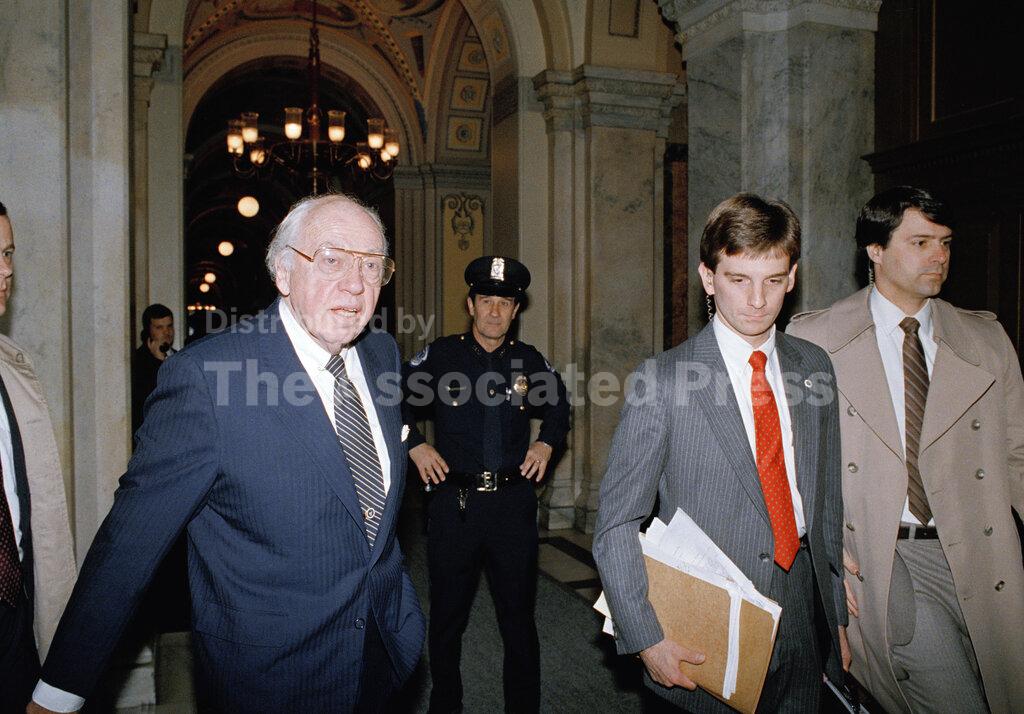
The controversy over the Reagan Administration’s policy toward Iran grew more heated today with reports that Iranian officials had paid at least $12 million for a shipment of 2,008 American-made anti-tank missiles and that the money had been deposited in a Swiss bank account. According to a source familiar with the transaction involving the missiles, known as TOW’s, many of the armaments came from Israeli stockpiles. Israel, in turn, was said to have used the money from the Iranians to pay this country for replacements sent from American stocks. The House majority leader, Jim Wright of Texas, told reporters about the $12 million after he emerged from a closed-door House hearing at which the chief Administration witness was William J. Casey, the Director of Central Intelligence. Congressional sources said the money had been deposited in Switzerland. Secretary of State George P. Shultz, on a trip to Ottawa today, said he had taken part in two “full-scale discussions” with President Reagan and other officials before Mr. Reagan cleared the sale of arms to Iran. But he refused to comment on an assertion that he had been told “repeatedly and often” about details of the operation.
President Reagan met today with Defense Secretary Caspar W. Weinberger as officials sought to dampen reports that a high-level shake-up loomed in the White House because of the controversy over arms shipments to Iran. At the same time, Senate leaders urged a halt to the infighting within the Administration, and some legislators called for an overhaul of the White House staff. On Capitol Hill, the chairman of the Senate Foreign Relations Committee, Richard G. Lugar, Republican of Indiana, said: “The Reagan White House is not falling apart, but it needs to be strengthened. They need to bring in some big leaguers to run things.”
Secretary of State George P. Shultz acknowledged today that he took part in two “full-scale discussions” with President Reagan and other top advisers before Mr. Reagan signed a secret directive in January permitting the sale of arms to Iran. The Secretary refused to comment, however, on a statement by Robert C. McFarlane, the former national security adviser, that Mr. Shultz, despite his insistence that he was given only “fragmentary” information on the arms sales, was “repeatedly and often” told about all the details. Mr. McFarlane made a secret trip to Tehran in May in connection with the arms deals. Mr. Shultz continued to seek to leave the impression that he was largely in the dark about the Iran operation, which was run by the National Security Council staff, aided by the Central Intelligence Agency.
A senior Israeli official said today that the sale of American arms to Iran grew out of Israeli links with the Khomeini Government dating to 1979. The links were later fostered by an unusual relationship between a Saudi billionaire and Israeli businessmen, and they culminated in direct talks between the Reagan Administration and officials in Tehran, the official said. The official stressed that the Iranian-American connection originated with an offer by Israel to act on behalf of the United States. Washington, he said, explicitly accepted the offer. ‘Explicit Approval’ of U.S. In recent days, amid protest in Washington over the Reagan policy, Israeli officials have expressed concern about what they describe as a mountain of erroneous reports about their role, including suggestions that they led an unsuspecting Administration into a diplomatic mess.
A senior Defense Department official today disputed statements by other high-level Administration officials that the United States had backed away from its proposal to Moscow to ban ballistic missiles in 10 years. The official, Richard N. Perle, an Assistant Secretary of Defense, disputed the idea in testimony to the House Armed Services Committee. He also appeared to differ with senior Administration officials about other aspects of the proposal, which President Reagan advanced at the Iceland summit meeting on October 11 and 12. The committee has begun a series of hearings to assess the performance of the Administration at the Reykjavik meeting and to determine the American policy on arms control. Representative Les Aspin, Democratic of Wisconsin, the chairman of the committee, began the hearing by charging that the Administration’s performance in Iceland was “slipshod” and that its arms-control policies since then have been confused. Mr. Perle strongly disputed this. “I reject the notion that Reykjavik was conducted in a slipshod manner,” he said. “There was a great deal of careful deliberation.”
The chief executive of a Swiss chemical concern pledged today to organize and finance a “gigantic” campaign to clean up chemical damage to the Rhine River. The executive, Marc Moret of Sandoz, said the company would call on environmentalists and technical experts for the project. “The restoration of the Rhine takes a very special place,” Mr. Moret said. “Here we are dealing with a project of gigantic proportions.” A fire at the Sandoz chemical plant in Basel on November 1 resulted in serious pollution of the Rhine when 30 tons of chemicals and dyes were washed into the river.
Meanwhile, more than a ton of a mildly toxic herbicide, dichlorphenoxy acetic acid, was spilled into the Rhine in Ludwigshafen, West Germany today in an accident at a BASF chemical plant. Company officials said there was no threat to the environment or human health.
A sharp political ricochet from an Australian courtroom, where Britain’s highest civil servant has been subjected to severe cross-examination for four days, has forced the British Government to order a police investigation of leaks by former high officials in its secret service. The civil servant, Sir Robert Armstrong, who holds the august but normally invisible position of Cabinet Secretary, has been living in an unaccustomed blaze of publicity ever since he flew to Sydney last week after using his attaché case to smash the camera of a newspaper photographer who showed up to record his departure from Heathrow Airport. In Sydney, he has been subjected to the further indignity of having his word challenged as he testified as the chief witness in a British suit aimed at blocking the Australian publication of a book by a former high official in M.I.5, the branch of the secret service that operates against foreign agents.
Officials from South Africa, Mozambique and the Soviet Union are to meet in Zurich on Tuesday to examine the cockpit voice recordings from the plane in which President Samora M. Machel of Mozambique was killed, Swiss and South African officials said today. The officials from the three countries, under Swiss auspices, are to examine the taped conversations between the control tower in Mozambique and the pilot of the Soviet-built Tupolev 134 plane that crashed inside South African territory on October 19, killing Mr. Machel and 33 others.
Gun battles broke out today near Palestinian districts in southern Lebanon, shattering a three-week-old truce between the Palestinian guerrillas and their Shiite adversaries. The police said 16 people were killed and at least 20 wounded in the clashes near the port city of Sidon, The Associated Press reported. Earlier, the police said Palestinian gunmen ambushed a convoy belonging to Amal, the mainline Shiite Moslem movement, on the coastal highway between Sidon and Tyre. The Palestinians destroyed a truck carrying weapons and ammunition and took away the four militiamen escorting the convoy, the police said.
South Korea’s Defense Minister said today that the military did not have tape recordings of North Korean loudspeaker broadcasts that were said to have reported the death of the North Korean leader this week. The broadcasts formed the basis of South Korea’s assertion Monday that the North Korean, Kim Il Sung, had died. That assertion was proved false on Tuesday, when the North Korean leader greeted a state visitor.
Thousands of people fled a small island south of Tokyo on Friday after a volcano burst open, spewing rocks and flames and sending molten lava toward the island’s largest town. The eruptions were accompanied by hundreds of earthquakes, some of them major tremors. “The jolts from the eruption and the earthquakes were beyond words,” an elderly resident told Japanese television. Another said, “It was like being on a boat all day.”
The armed forces Chief of Staff said today that he gave President Corazon C. Aquino a set of military demands last week as part of a move to block a planned coup. After a 90-minute meeting with the President today, the Chief of Staff, General Fidel V. Ramos, said the demands included “immediate replacement of Cabinet officials who have not performed adequately.” Mrs. Aquino’s spokesman, Teodoro Benigno, who read the general’s statement to reporters, said the removal of one or two Cabinet members was a possibility, although he insisted this would not be in response to military demands. He said the powers of Executive Secretary Joker Arroyo, who has been criticized by the military and others, might be cut back with the appointment of a palace chief of staff to “streamline” the affairs of Government.
Thirty people were hurt and at least 20 arrested Thursday in Ciudad Juarez, Mexico when the police fired tear gas to break up an opposition party parade, officials said. Among those arrested in the melee was Gustavo Elizondo, president of the country’s main opposition group, the National Action Party, a party official said. After the arrests, about 1,000 party supporters marched to the Bridge of the Americas, one of four international bridges linking Juarez to El Paso. The National Action Party says the governing Institutional Revolutionary Party committed fraud in elections in the state of Chihuahua on July 6.
President Reagan met today with Haiti’s interim leader, General Henri Namphy, and discussed a $100 million American aid package. General Namphy, who took office after President Jean-Claude Duvalier fled Haiti in February, also met with Vice President Bush and Secretary of State George P. Shultz. As part of General Namphy’s visit, the two Governments agreed to a major training initiative for Haiti that would make available aid over the next five years for training technicians, administrators, medical personnel and business professionals.
The Reagan Administration says the first group of about 70 Nicaraguan rebels has started training under American instructors at an undisclosed site in the United States. But as the program begins, there is concern at the Pentagon that eagerness by Administration hard-liners to show early results from renewed United States aid to the rebels may push them to try too much too soon. The result, many officials fear, could be to risk an early defeat by Nicaraguan Government forces. Pentagon sources say such a danger might be averted only by direct United States military support, which is a prospect that the Joint Chiefs of Staff do not view favorably.
A Nicaraguan rebel leader is a hero in anti-Sandinista circles six years after his death. If there is a name not to mention in this country, it is probably that of Jorge Salazar Arguello. Mr. Salazar was emerging as one of the most potent opposition leaders in Nicaragua when he was killed by the Sandinista police six years ago. At the time of his death, he was apparently involved in a plot to overthrow the Government. Today the Government considers Mr. Salazar, a onetime Sandinista collaborator, to have been a traitor who deserved to die. But with the passage of time he has become something of a hero in hard-core anti-Sandinista circles.
The Central African Republic adopts a constitution.
President P. W. Botha said today that American economic sanctions against South Africa only served the interests of the Soviet Union. “The U.S. has already declared an economic war against us for the most absurd and sanctimonious reasons,” Mr. Botha said. “In doing so they have yet again taken up the sword against us on behalf of the Soviet Union and its goals in this region. I find it revolting and unworthy of a nation such as the United States.”
The Immigration and Naturalization Service has instructed its employees to suspend the deportation of illegal aliens who appear to qualify for legal status under the new immigration law. Alan C. Nelson, the Commissioner of Immigration and Naturalization, issued the instruction in a telegram to employees around the country last week. “Effective immediately and until further notice,” he said, “an alien apprehended in the interior” of the United States “shall be given the opportunity to establish a nonfrivolous claim” to legal status, or amnesty. To qualify, Mr. Nelson said, aliens must demonstrate that they entered the United States before January 1, 1982, and have resided here continuously in an unlawful status since then.
State and local officials around the country say the $1 billion a year the Federal Government has pledged for social services for illegal aliens who gain legal status under the new immigration law may fall far short of the need. They fear that places with many immigrants, such as Los Angeles County and New York City, could face a disproportionate burden of providing welfare, health, education and other non-Federal services to aliens who come under the amnesty. As illegal immigrants, they have been ineligible for many of these services or have been reluctant to apply for fear of discovery. “There is no way $1 billion can cover the huge costs,” said Susan Golding, a San Diego County Supervisor. The county is the main point of entry for Mexican nationals.
President Reagan participates in a ceremony to receive Diplomatic Credentials.
President Reagan places a call to former President Richard M. Nixon.
The head of the Securities and Exchange Commission today defended the agency’s action in permitting Ivan F. Boesky to sell $440 million in stocks while he was negotiating his insider trading settlement with the commission. The action produced an outcry on Wall Street. But the commission’s chairman, John S. R. Shad, said permitting Mr. Boesky to trade was a carefully considered attempt to avoid a market panic. Mr. Shad said in an interview that the S.E.C. fully expected the market to decline in the wake of the settlement. Such a decline would have a sharp impact on Mr. Boesky’s holdings, both because they were made up of especially sensitive stocks and because they were financed with large debts.
Ivan F. Boesky has become the symbol of a fast-money era: a time when high-stakes mergers make front-page news and turn Wall Street deal makers into multimillionaires. And he has changed the face of arbitrage. Through his relentless publicity campaigns, Mr. Boesky became a Wall Street superstar and put the spotlight on a business that had profited royally by remaining in Wall Street’s shadows. Now, by agreeing to pay a record $100 million fine for illegal insider trading, he has brought shame to himself, scandal to his industry and shattered the legend of a man whose financial skills seemed invincible. ‘A Throwback’ “Boesky is a throwback to the speculators of the 1920’s,” said Samuel L. Hayes 3d, investment banking professor at the Harvard Business School. “He represents a new layer of arbitrage that is not traditional arbitrage, but is really speculation. He’s been able to mobilize a great deal of money that looks for profitable deals.”
Federal law-enforcement officials, encouraged by this week’s guilty verdicts in the Mafia commission trial in New York, say they will broaden efforts against labor unions controlled by organized crime. Over the next few years, they say, the Justice Department and the Federal Bureau of Investigation will attempt to take control away from corrupt labor leaders by replacing them with court-appointed trustees. “We want to sever the connection between organized crime and labor,” said one senior Justice Department official. “We’re going after it.”
Seven people, including two Chicago Aldermen, were indicted here today on Federal charges of corruption, fraud, extortion and illegal arms dealings. The indictments, which are expected to influence the outcome of the hotly contested mayoral elections here next spring, were long awaited, and other indictments are expected in coming months. The charges grew out of an undercover investigation by the Federal Bureau of Investigation into municipal corruption in the nation’s third-largest city. A spinoff of the Chicago investigation, which involved bill collection agencies, led to corruption charges against several New Yorkers. The first trial in that case went to the jury today in New Haven.
The Department of Transportation today proposed extending by as many as four years its deadline for installation of automatic restraint systems, such as air bags, in passenger cars. It also modified its restraint requirement. Currently, automobile makers are required to install automatic restraint systems, either air bags or automatic belts, in both the front driver and passenger seats on all cars by the model year 1990. That would be modified under the new proposal, which would require manufacturers to install only manual seat belts on the right front passenger seats if air bags are installed on the driver side.
L. Donald Shields, president of Southern Methodist University in Dallas since 1980, resigned today, capping a tumultuous week at a university facing mounting pressure because of allegations of continued recruiting violations in its athletic program. Dr. Shields cited health reasons for his departure. He was away from work from early October until November 10 because of complications from diabetes. A university spokesman said the pressure of the mounting athletic scandal had aggravated his health problems and made it impossible for him to continue as president. Officials said he had not been asked to resign, and Edwin L. Cox, chairman of the board of trustees, said he accepted the resignation with regret.
The General Motors Corporation and Local 292 of the United Automobile Workers today reached a tentative agreement to end a strike at an Indiana plant that has produced widespread factory shutdowns and layoffs of factory workers. The 7,500 workers at the Delco Electronics factory in Kokomo are to vote on the settlement Saturday afternoon, and union officials predicted it would be approved. The accord, reached about 2 AM today, came as something of a surprise since union officials said late Thursday that bargaining was “at a difficult impasse.”
Negotiations between the United Steelworkers of America and the USX Corporation broke off today and leaders of both sides said they expected the 113-day labor dispute to continue to be a costly and protracted struggle. “I think it’s regrettable for everyone that the steelworkers have refused to recommend our proposal for settlement to their members and our employees,” J. Bruce Johnston, USX’s executive vice president for employee relations, said at a news conference, speaking of the proposed new contract presented to the union in talks over the last several days. “It heightens the risk involved in our commitment to steel.”
Leaders of the European Space Agency and the National Aeronautics and Space Administration met yesterday in Washington to begin talks aimed at overcoming critical differences over sharing the costs and responsibilities for the space station project, American and Western European officials said. The 11-nation European agency, which plans to invest $2 billion in the $8 billion project, was reported to be seeking a larger share of the management and benefits of the space station. The station, the Reagan Administration’s major new space initiative, is scheduled to be constructed in the early 1990’s as an orbital research base for international crews. After a meeting to prepare for detailed negotiations next week, Dr. Reimar Luest, director of the European agency, and Dr. James C. Fletcher, the NASA Administrator, expressed optimism about resolving their differences.
Five million fewer people participated in the 24 tobacco-less hours of this year’s Great American Smokeout than last year, preliminary figures showed. It was the first drop in the program’s 10-year history. Nearly one of every three smokers in the nation joined the daylong Smokeout on Thursday, according to a telephone survey by the American Cancer Society, but the 17.5 million participants fell far short of last year’s record total of 23 million. Until this year, the number of people abstaining from cigarettes and other forms of tobacco for the Smokeout had increased each year since the program began in 1976. The cancer society gave no reason for the plunge but said the number of participants might rise as more thorough surveying of the nation’s 54 million smokers was conducted.
Hawkins County (Tennessee) school officials, stung by a lawsuit over textbooks alleged to be “anti-Christian,” has refused to allow a stage production of “The Diary of Anne Frank.” Robert Mellette, director of Allowance Theater in Raleigh, North Carolina, asked for permission to stage the play at Volunteer High School, saying he wanted to make a statement about what he regarded as a growing national trend toward censorship. But Robert Cooper, the Hawkins County school superintendent, said Thursday that officials refused to allow the play for fear that fundamentalist Christians would want equal time. Seven families from Hawkins County recently won a Federal court ruling over the use of alleged anti-Christian reading books in public schools. The story of Anne Frank, a young Jewish girl who hid from the Nazis in World War II, was among those objected to by the families.
A California appellate court has struck down a ban on hiring women at a summer encampment maintained by the exclusive Bohemian Club, whose members include President Reagan and Vice President Bush. The policy at the Bohemian Grove retreat violates state antidiscrimination laws and is not justified by the privacy rights of club members, a three-judge panel of the First District Court of Appeal said Thursday in a unanimous ruling.
Researchers at Harvard University have retracted publications concerning the discovery of a substance that had been depicted as greatly stimulating the immune system. They said in a letter published today that the data were “not reproducible and are incorrect.”
Researchers have been astounded by the unexpected appearance in Monterey Bay of dozens of blue whales, the world’s largest living creatures, scientists said today. At least 30 of the blue whales, an endangered species, have collected in the bay on the central California coast. So far, they show no signs of leaving. “It’s dramatically exciting,” said Bernd Wursig, a professor at Moss Landing Marine Laboratory. “We just hope it will keep up.” The blue whales were apparently lured to Monterey Bay by an explosion of krill, tiny pink shrimplike crustaceans. A single whale can eat up to 8 tons of krill per day.
A moderate earthquake shook northern California today, causing minor damage but no injuries. The United States Geological Survey said the quake measured 5.2 on the Richter scale and was centered 50 miles south of Eureka, near Petrolia, where the San Andreas Fault goes into the Pacific. There was a second jolt and a number of aftershocks, said Edna King, a survey spokesman. She said the magnitude of the second quake had not been determined. Ellen Wilson, a dispatcher for the Fortuna Police Department, said, “All we’ve had so far is broken windows and most of the downtown businesses have broken windows and shelves damaged.”
After eight years, the issue of complaints about “indecent” language on radio has abruptly re-emerged as a concern of the Federal Communications Commission. In September the agency sent letters to two noncommercial California radio stations directing them to answer listener complaints that their programming violated commission standards. At one station the complaints involved vulgar language and a sexually explicit homosexual play, and at the other the issue was sexually oriented lyrics of a rock song. Last week the owners of WXRK-FM in New York, a commercial station, received a similar letter regarding complaints about the morning broadcast of Howard Stern, an announcer whose on-air patter includes sexual double-entendre, bathroom humor and calculatedly tasteless jokes and insults. The format, which has come to be known as “blue radio” or “shock radio,” has attracted high listener ratings, and similar broadcasts are now aired in Providence, Chicago and other major cities.
A week that started out disastrously for Wall Street as it reeled from the impact of the insider trading scandal ended up not so badly after all, as stock prices posted their second consecutive big gain yesterday. The topsy-turvy week started out with the Dow Jones industrial average falling a total of 56 points on Monday and Tuesday. But the average climbed yesterday by 32.90 points, to 1,893.56, actually putting the blue-chip index 19.97 points ahead of last Friday’s closing level. The rally, in addition, came in grand fashion as the New York Stock Exchange experienced its sixth-busiest session ever, with more than 200 million shares changing hands.
Dow Jones Industrial Average: 1893.56 (+32.90)
Born:
Ben Bishop, NHL goaltender (NHL All-Star, 2016St. Louis Blues, Ottawa Senators, Tampa Bay Lightning, Los Angeles Kings, Dallas Stars), in Denver, Colorado.
Kyle Bosworth, NFL linebacker (Jacksonville Jaguars, Dallas Cowboys), in Irving, Texas.
Colleen Ballinger, American YouTuber and comedian (“Miranda Sings”), in Santa Barbara, California.
Died:
Jerry Colonna, 82, American actor (“Jerry Colonna Show”, “Alice in Wonderland”, “Road to Singapore”).
Marcelino Sánchez, 28, Puerto Rican actor (“The Warriors”), of AIDS.

