The Last Proposal
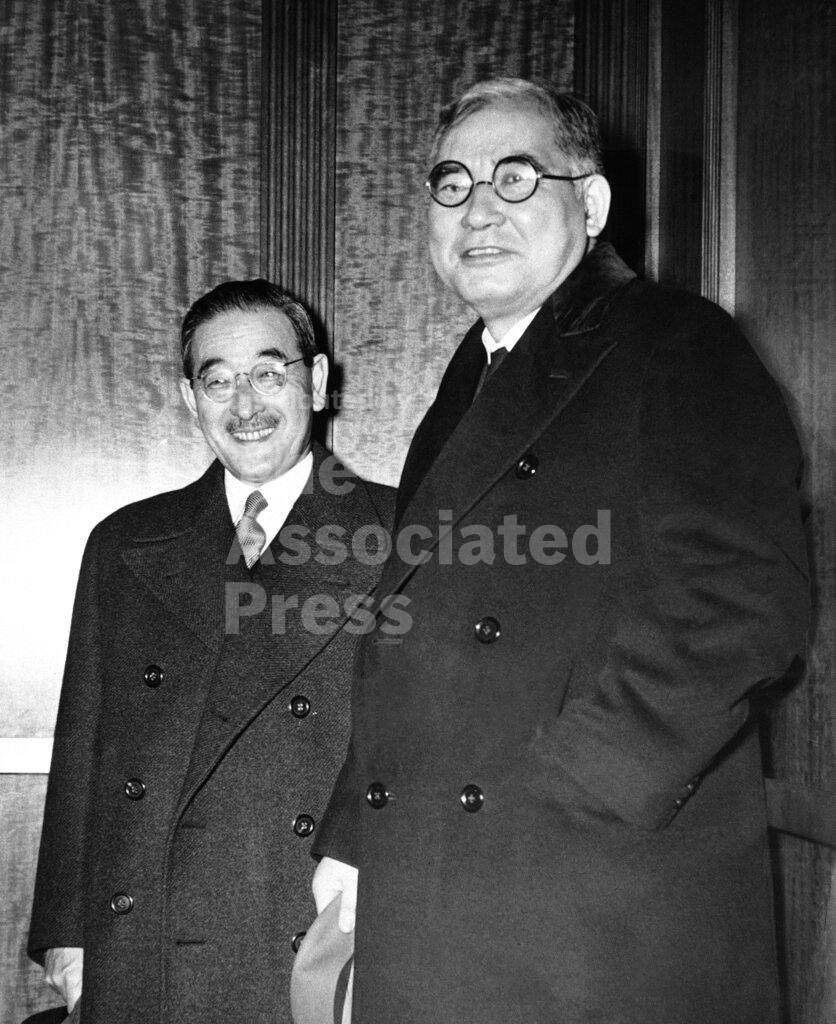
More than any other day’s events until the actual attack on Pearl Harbor, those of 20 November 1941 is conclusive with respect to the likelihood of war in the Pacific Theater. With special envoy Saburō Kurusu now in Washington, D.C., Japanese Ambassador Nomura delivers the final Japanese peace proposal to Secretary of State Cordell Hull. This is “Proposal B,” the U.S. already having rejected proposal A. Both proposals were formulated at the Imperial Conference held in Tokyo on 5 November. The Americans already know from the “Magic” intelligence operation that the peace proposal handed over today is the last one that the Japanese have any intention of making.
In Proposal A, Japan promised to withdraw from China and French Indochina (Vietnam), which is what the Americans want. However, this depended upon Chinese Nationalist leader Chiang Kai-shek signing a peace treaty that would permit the Imperial Japanese forces to remain in parts of China indefinitely. In addition, the Japanese would have agreed to free trade principles which are important to the Americans, and basically cast aside its obligations under the Tripartite Pact.
Proposal B, delivered today, is intended as a last resort but is no more acceptable to Hull and President Roosevelt. It provides that Japan will immediately withdraw all troops from French Indochina and also negotiate a final peace treaty with China — as long as the United States does not interfere. Japan and the United States then together would acquire the Netherlands Indies (Indonesia) and the two nations thereafter would become trading partners and, presumably, allies. It is a sweeping proposal that basically calls for a predatory alliance between the two powers, with the clear implication that Japan and the United States could do similar “deals” in the future.
In his memoirs published in 1948, which may or may not accurately reflect Hull’s thinking in 1941, Hull is dismissive of the proposals. He writes that the Japanese offer:
“put conditions that would have assured Japan’s domination of the Pacific, placing us in serious danger for decades to come.”
Hull goes even further in his memoirs, at least rhetorically, claiming that this Japanese proposal called for “virtually a surrender” by the United States.
Since Hull knows this is the final Japanese proposal, he faces a stark choice of either trying to work with it somehow or knowing that war is going to break out. Both Admiral Harold Rainsford Stark, Chief of Naval Operations, and Brigadier General Leonard T. Gerow, a member of the War Plans Division who is representing the Chairman of the Joint Chiefs of Staff, General George C. Marshall, both offer advice. They counsel Hull to continue trying to find some modus vivendi with the Japanese despite the unacceptability of this plan. Gerow says:
“Even a temporary peace in the Pacific would permit us to complete defensive preparations in the Philippines and at the same time ensure continuance of material assistance to the British — both of which are highly important.”
Despite indicating that the Japanese proposal is insufficient, Hull thus continues the negotiations even though the likelihood of some accommodation is very dim. Hull tasks Gerow, Stark, and their staffs to work up some more drafts of peace proposals over the next few days that might at least keep the negotiations going indefinitely. He promises Nomura that the U.S. will make a counterproposal.
The Japanese, however, are not prepared to wait for Hull’s empty gestures. Foreign Minister Togo Shigenori sends a revealing message to the Japanese Ambassador to Turkey today:
“Insofar as Japanese-American negotiations are concerned, in proceeding upon these negotiations for the adjustment of diplomatic relations on a just basis, conferences have been in progress since the 7th. However, there is a great disparity between their opinions and our own. In the light of the trend of past negotiations, there is considerable doubt as to whether a settlement of the negotiations will be reached. Insofar as we are concerned we have lent our maximum efforts in order to bring about a settlement of the negotiations. However, the situation not permitting any further conciliation by us, an optimistic view of the future is not permitted. In the event that negotiations are broken off, we expect that the situation in which Japan will find herself will be extremely critical. The above is for your information alone.”
Given the rejection of Proposal B by Hull, the Japanese government begins battening down for a likely conflict. All communications are cut with Iturup in the Kuril Islands because of the presence there of the Imperial Japanese Navy carrier fleet which is assembling in Tankan Bay for the attack on Pearl Harbor. The government also makes a number of administrative changes that reflect the need to shift the government to a war posture. These include upgrading Ryojun Military Port (Port Arthur) and the naval base at Mako in the Pescadores Islands to the status of Guard Districts.
German 1st Panzer Army under General Ewald von Kleist seizes a bridge across the frozen Don River, the last natural barrier before the Caucasus. The panzers of 1st Panzer Division Leisbstandarte SS “Adolf Hitler” under the command of Josef “Sepp” Dietrich are fighting in Rostov-on-Don. Things look promising for further advances in the oil fields to Hitler back at the Fuehrer Headquarters. However, the German spearhead, led by III Panzer Corps in Rostov and XIV Panzer Corps guarding its north flank, is elongated and vulnerable. The Red Army prepares forces to the south, east, and north of Rostov for a counterblow.
The daily bread ration in besieged Leningrad, Russia was reduced to 500 grams for military personnel, 250 grams for engineers and technical workers, 125 grams for other workers and children. The situation was hoped to be improving soon, however, as the first successful crossing of the frozen Lake Ladoga was made with horse-drawn sleighs, hoping to bring back food from Kobona.
The two crematoria of Auschwitz Concentration Camp were inactivated for servicing; camp commandant ordered that corpses of prisoners were to be transported to Birkenau (not yet a camp) for burying in mass graves until the servicing was done on 3 Dec 1941.
In Vilnius, Lithuania, 3 prisoners of war were executed as later reported by the Jager Report on 1 Dec 1941.
In North Africa, British Lieutenant General Alan G. Cunningham ordered the Tobruk garrison to break out and link up with XXX Corp.
The British 7th Armoured Brigade repulsed a counter attack launched by the German 90th Light Infantry Division and the Italian Bologna Division. In the afternoon, the British 4th Armoured Brigade engaged with heavier tanks of the German 15th Panzer Division, losing several American-built M3 tanks. After dark, British cruisers HMS Ajax and HMS Neptune and Australian cruiser HMAS Hobart bombarded Bardia, Libya.
On 20 November, the 15th Panzer Division was ordered to Sidi Aziz and thence towards Capuzzo, the 21st Panzer Division was to move north of the Trigh el Abd on Sidi Omar. Nothing but British reconnaissance units was found and then the 21st Panzer Division was stranded, short of fuel and ammunition. Crüwell found that British tanks were moving west along the Trigh el Abd. During the afternoon, the 15th Panzer Division attacked the 4th Armoured Brigade near Gabr Saleh and inflicted another ten tank casualties, reducing it to less than two-thirds its establishment of 164 tanks and forcing the brigade into another retirement.[20] The 22nd Armoured Brigade had been ordered to disengage from the “Ariete” Division and to move east in support of the 4th Armoured Brigade. The 1st South African Division was to take over against the “Ariete” Division and the 4th Armoured Brigade was released from its role as flank guard for XIII Corps.[19] The 22nd Armoured Brigade arrived too late to support the 4th Armoured Brigade. During the night of 20/21 November, Rommel ordered the German tanks north-west for an attack on Sidi Rezegh.
Palestinian leader Amin al-Husseini met with German Foreign Minister Joachim von Ribbentrop in Berlin.
Propaganda Minister Joseph Goebbels says in an article written for next Saturday’s issue of the magazine Reich that the destruction of the British Empire will take more than “a few months.”
The Norwegian government-in-exile officially endorsed the resistance movement Milorg.
One of the ships of Allied convoy PQ.3 struck an iceberg and another developed mechanical problems; both were turned back toward Iceland.
No. 80 Squadron RAF begin using Hawker Hurricane fighter-bombers, the Hurribomber, in the Western Desert.
General Maxime Weygand, Governor-General of Algeria, is removed from his post in North Africa by the Vichy government due to German pressure.
A heavy landing caused the scouting plane of the German commerce raider Atlantis to be put out of action. This deprived the Atlantis of any long range spotting, which may have been useful in avoiding the heavy cruiser HMS Devonshire (39) on November 22.
The British cargo ship Empire Dorado collided with the Greek cargo ship Theomitor in the Atlantic Ocean. Empire Dorado was taken in tow by a Royal Navy ship but sank two days later.
Heavy cruiser HMS Suffolk arrived at Hvalfjord from Denmark Strait patrol.
Light cruiser HMS Sheffield departed Faroes — Iceland patrol for Scapa Flow after being relieved by heavy cruiser HMS Norfolk. Light cruiser Sheffield arrived at Scapa Flow on the 21st.
Monitor HMS Erebus departed Sheerness at 0835 for Londonderry escorted by destroyers HMS Meynell and HMS Walpole, as far as Kinnaird Head. Destroyers HMS Eclipse and HMS Chiddingfold departed Scapa Flow at 0300/22nd to relieve the Erebus escort off Kinnaird Head. Monitor Erebus and destroyer and Chiddingfold arrived at Scapa Flow at 2000/22nd. Destroyer Eclipse was detached to join battleship HMS Nelson’s screen, but was unable to do so because of bad weather. The destroyer arrived at Scapa Flow at 2230/22nd.
Battleship HMS Ramillies, escorted by destroyers HMS Vanquisher and HMS Witch, departed Liverpool at 1330 for Scapa Flow. The three ships arrived at Scapa Flow at 1024 on the 22nd.
Destroyer HMS Faulknor departed the Clyde at 1400 for Londonderry, where she arrived at 2100 that day. On completion of fueling, the destroyer sailed on the 22nd for position 55N, 10W and with destroyers HMAS Norman and HMS Icarus take over screening duties of battleship HMS Nelson from destroyers HMS Zulu, HMS Sikh, and HMS Gurkha. Destroyers HMAS Norman and Icarus departed Scapa Flow at 1500/20th to rendezvous with destroyer Faulknor and battleship Nelson. Destroyer Gurkha arrived at Londonderry on the 21st. Destroyer Zulu and Sikh arrived at Londonderry on the 22nd. Battleship Nelson and destroyers Faulknor, HMAS Norman, and Icarus arrived off Scapa Flow at 1030/22nd. Destroyer HMAS Norman was detached before entering harbour for the Clyde where she was to boiler clean prior to transfer to the Mediterranean. Destroyer HMAS Norman arrived in the Clyde at 0930/23rd.
Light cruisers HMS Ajax and HMS Neptune and Australian light cruiser HMAS Hobart departed Alexandria with destroyers HMS Heythrop and HMS Avonvale, joined at sea by destroyers HMS Farndale and HMS Eridge. The cruisers bombarded the Bardia area during the night of 20/21 November.
Italian convoy C of steamers Napoli (6142grt) and Vettor Pisani (6339grt) departed Naples, escorted by destroyer Turbine and torpedo boat Perseo. The escort was detached at 0023 on the 21st. A second convoy of steamers Iridio Mantovani (10,540grt) and Monginevro (5324grt) departed Naples at 0530/21st, escorted by destroyer Da Recco and torpedo boat Cosenz. The convoys were covered by Italian light cruisers Garibaldi and Abruzzi, and destroyers Aviere, Camicia Nera, Geniere, Corazziere, and Carabiniere, which departed Naples at 0810/21st. Heavy cruisers Gorizia, Trieste, and Trento departed Naples at 1930/21st. Heavy cruiser Gorizia was damaged by splinters from a British bombing raid on Naples shortly before the Italian ships departed. A convoy of steamers Citta Di Tunisi (5419grt) and Citta Di Palermo (5413grt) departed Taranto escorted by destroyers Zeno and Malocello for Benghazi. This convoy was joined by torpedo boat Partenope from Benghazi. A convoy of tanker Berbera (2093grt) departed Brindisi escorted by torpedo boat Pegaso. At 2130/21st, the Naples convoys came under attack by British Malta based aircraft shortly before clearing the Messina Strait. Force K had sailed from Malta at 1300 with British supply ship Breconshire and steamers Sydney Star, Ajax, and Clan Ferguson, escorted by corvette Gloxinia to draw out Italian forces in Operation LANDMARK. The British ships arrived back at Malta early on the 22nd. Battleships HMS Queen Elizabeth, HMS Barham, and HMS Valiant, light cruisers HMS Naiad, HMS Euryalus, and HMS Galatea, and destroyers HMS Jervis, HMS Kandahar, HMS Kimberley, HMS Kingston, HMAS Napier, HMAS Nizam, HMS Kipling, HMS Jackal, HMS Hasty, HMS Hotspur, and HMS Decoy departed Alexandria on the 21st to operate in coordination with LANDMARK to simulate an attack on Tripoli to draw German and Italian air strength away from Halfaya and Bardia.
At noon, the light cruisers HMS Ajax, HMS Neptune, and HMAS Hobart joined the Fleet. The four Hunt-class destroyers escorting had been sent to Alexandria. At dark, the cruisers of the 15th Cruiser Squadron were detached to make W/T reports further to the west to aid in the deception. The Fleet returned to Alexandria at daylight on the 22nd. The 15th Cruiser Squadron arrived back after noon.
Italian heavy cruiser Trieste was torpedoed by Submarine HMS Utmost at 2312 on the 21st in 37-48N, 15-32E. The cruiser was escorted by light cruiser Garibaldi and destroyer Bersagliere to Messina, arriving on the 22nd. Light cruiser Abruzzi was torpedoed by a Swordfish of 830 Squadron at 0038 on the 22nd. LT P. E. O’Brien and T/Sub Lt (A) A. J. Griffith RNVR, of 830 Squadron were shot down. O’Brien was killed and Griffith was rescued by Italian destroyer Pessagno and made a prisoner of war. The light cruiser proceeded to Messina for repairs under her own power and arrived on the 22nd. Light cruiser Abruzzi, her stern blown off, was escorted by light cruiser Garibaldi and destroyers Vivaldi, Da Noli, Granatiere, Fuciliere, Alpino, Corazziere, Carabiniere, and Turbine and torpedo boat Perseo Despite air attacks on the Abruzzi force, particularly on light cruiser Garibaldi, no further damage was done.
At 0100/22nd, the convoys, covered by heavy cruiser Gorizia and destroyer Aviere, was ordered to Taranto in view of continuing attacks. Steamers Vettor Pisano and Napoli were escorted by destroyer Geniere to Taranto. Steamer Iridio Mantovani was escorted to Taranto by destroyer Camicia Nera. Steamer Monginevro was escorted by destroyer Pessagno to Taranto. Destroyers Corazziere, Carabiniere, and Turbine proceeded to Reggio.
Polish submarine ORP Sokol damaged tanker Berbera in 36-53N, 21-28E on the 21st. Tanker Berbera and torpedo boat Pegaso arrived at Navarino on the 24th.
Submarine HMS Thorn unsuccessfully attacked a steamer in the Aegean.
Submarine HMS Ursula arrived at Malta after patrol off Misurata.
Lt W. J. Pangbourne was killed when his Hurricane of 806 Squadron was shot down south of El Adem.
Sloop HMS Stork arrived at Gibraltar from the UK, escorting steamer Empire Barracuda.
Destroyer HMS Maori and corvette HMS Coltsfoot arrived at Gibraltar from the UK. The destroyer had completed refitting at London.
Thanksgiving Day in most of the United States. The three-centuries-old American custom of giving thanks at this time to the Almighty for His blessings was observed today in thirty-two States of the Union, in the District of Columbia and by the armed forces of the United States at many remote spots on sea and land.
The specter of a coming war hangs over America, but even as they listen to the latest news from the Atlantic, Britain, Germany and the Russian front and await the arrival on the west coast of Japan’s special envoy, U.S. citizens are buying their Thanksgiving Day turkeys and shopping early for Christmas. Holiday trade will be up 5 to 15% over last year. But not all the economic news is rosy. Congress and the president are preparing anti-inflationary tax legislation, and Roosevelt is threatening a government takeover of the coal mines.
The usual fevered atmosphere of Washington subsided for a day while the Capital and thirty-two States celebrated the last “early Thanksgiving.” Most officials remained away from their offices and government workers had a holiday. The President ate one of five gift Thanksgiving turkeys in the White House dining room this evening with Mrs. Roosevelt. His only guests were Captain and Mrs. James Roosevelt, his son and daughter-in-law. If it were not for the coal strike Mr. Roosevelt would have carved his Thanksgiving turkey in the dining hall of the Georgia Warm Springs Foundation.
The president, in announcing that he will delay his planned trip to Georgia, blames the coalminers’ strike, but insiders say that he wants to hear what Japan’s special envoy, Saburō Kurusu, has to offer. There is not much optimism, given the tenor of recent statements by Japan’s leaders in Tokyo.
President Roosevelt did get the Neutrality Act amended and he is hearing less and less from “America Firsters”. One restaurant in New York removed a flag belonging to Charles A Lindbergh until, the owner states, “he comes to his senses.”
Reports of new shootings in the captive mine dispute and spread of sympathy walkouts in commercial pits came tonight along with word that troops at Camp Forrest, Tennessee, were standing by for possible strike duty. Earlier, a defense spokesman had aid “the government will not give in, but it doesn’t want to use troops.” This was followed by hints from other defense officials that legislation would be offered shortly for government seizure of the closed workings. Conviction grew that President Roosevelt might soon give congress the go-signal probably next week on a measure authorizing federal operation of the mines and providing for use of Injunctions against labor loafers or pickets interfering with production.
Faced with the spreading “sympathy” stoppages of coal production essential for national defense, President Roosevelt was reported tonight to be nearing the point of cracking down on John L. Lewis to fulfill his “indisputable obligation” to end the walkout of 53,000 men in the captive mines, but he was said to be hopeful that he could avoid use of the Army to break the strike. Neither the President, nor Mr. Lewis, nor the steel companies which own the captive mines holding out against the union shop demand of the United Mine Workers of America offered any public comment on the controversy during the Thanksgiving Day holiday, but the capital heard that many additional commercial mines were expected to be shut down tomorrow as thousands of additional miners take a long weekend to demonstrate the solidarity of their union. The 53,000 striking captive miners had been joined by an estimated 122,000 workers in other soft coal pits covered by contract by Wednesday night, and U. M. W. officials predicted that this number would grow tomorrow since the union leaders are taking no steps to head off the “sympathy” walkouts.
The convention of the Congress of Industrial Organizations called on President Roosevelt today to scrap the no strike stabilization agreement made by the Office of Production Management with the American Federation of Labor on defense construction projects, but killed a demand by supporters of John L. Lewis for the ouster of Sidney Hillman from his post of Associate Director of OPM.
The United States today suspended economic assistance to France’s North African colonies, and broadly hinted diplomatic relations with the Vichy government might be severed because of increasing Nazi domination of French affairs. In announcing “American policy towards France is being reviewed,” Secretary of State Hull made it clear the attitude of the United States would be determined by France’s future action toward Hitler’s schemes “to take over by force or threat of force the sovereignty and control of the French empire.”
A sharp increase in shipments of food and other agricultural products to England was disclosed today as officials made public the first breakdown of supplies actually sent. The Department of Agriculture stated that 1,650,000,000 pounds of agricultural commodities had been turned over to British officials for shipment in the five-month period from April 29 to October 1. They said the products cost $200,000,000. Just before, Toy F. Hendrickson, Administrator of the Surplus Marketing Administration, disclosed that the $500,000,000 mark in lease-lend expenditures for farm products had been passed this week.
Destroyer USS Nicholson (DD-424), with TU 4.1.5, escorting convoy HX.160, depth charges a sound contact at 50°30’N, 50°40’W.
Direct transatlantic air service to Ireland, with planes flying through the war zone, previously banned to American traffic by the Neutrality Act, will be resumed in the immediate future, it was announced yesterday by the Pan American Airways System.
The motion picture “They Died With Their Boots On” opens at the Strand Theater in New York City. Directed by Raoul Walsh, this western drama about General Custer and Little Bighorn stars Errol Flynn, Olivia de Havilland, Arthur Kennedy, Gene Lockhart, Anthony Quinn, Sydney Greenstreet, Regis Toomey and Hattie McDaniel. Appearing on stage is Woody Herman And His Orchestra.
Talks opened in Washington, D.C. between U.S. Secretary of State Cordell Hull, Japanese ambassador Kichisaburō Nomura and special Japanese envoy Saburō Kurusu. The Japanese demanded that the Americans withdraw from China, lift all sanctions directed against Japan and halt the U.S. naval buildup in the Pacific.
After devoting the morning to that European situation Secretary Hull, disregarding the Thanksgiving holiday, met with Admiral Kichisaburō Nomura, the Japanese ambassador, and Saburō Kurusu, special envoy, in another talk designed to find a peaceful solution of Japanese-American tension in the Pacific. The Japanese had received new instructions from their foreign office during the night. These orders were based on developments in the several talks they have already held with President Roosevelt and Hull. After an hour’s talk Kurusu smilingly asserted, “We were making a Thanksgiving call.”
Japanese Ambassador to the United States Admiral Nomura Kichisaburō and Saburō Kurusu, special Japanese envoy to Washington, presented Japan’s Proposal “B” to U.S. Secretary of State Cordell Hull. This plan proposed that Japan would agree to withdraw from Indochina if the U.S. agreed to restore oil trade with Japan. Hull rejected the proposal, but prepared a reply that would enable negotiations to continue.
The transport ship President Coolidge arrives at Luzon with elements of the 27th BG (L) and the 35th PG. Navy Department disapproved Hart’s proposal to keep the Asiatic Fleet in the Philippines but refuses to provide him with further guidance. Hart protests directly to Stark but no response was made.
The 5th Air Base Group also arrives in Manila. This group has been sent to the Philippines to support the 7th Bombardment Group (Heavy), the second B-17 group ordered to the Philippines.
Admiral Thomas C. Hart, commander of the Asiatic Fleet, orders the destroyer tender USS Black Hawk (AD-9) and the destroyers USS Alden (DD-211), Edsall (DD-219), John D. Edwards (DD-216) and Whipple (DD-217) dispatched to Balikpapan, Borneo, the Netherlands East Indies.
HMAS Sydney sank sometime after midnight from the damage sustained in the engagement with German raider Kormoran; all 645 aboard were lost. Kormoran, likewise heavily damaged, was abandoned at 1900 hours and was scuttled three hours later; 81 were killed and 318 survived.
Foreign Minister Togo Shigenori sends a message to the Japanese ambassador in Ankara, Turkey, that includes the following: “Insofar as Japanese-American negotiations are concerned, in proceeding upon these negotiations for the adjustment of diplomatic relations on a just basis, conferences have been in progress since the 7th. However, there is great disparity between their opinions and our own. In the light of the trend of past negotiations there is considerable doubt as to whether a settlement of the negotiations will be reached. Insofar as we are concerned we have lent our maximum efforts in order to bring about a settlement of the negotiations. However, the situation not permitting any further conciliation by us, an optimistic view for the future is not permitted. In the event that negotiations are broken off, we expect that the situation in which Japan will find herself will be extremely critical. The above is for your information alone.”
All communications are cut to Etorofu Island, Kurile Islands. Tankan Bay is the assembly point for the Japanese naval vessels that will attack Pearl Harbor, Territory of Hawaii.
The Japanese-controlled Ryojun Military Port (previously known as Port Arthur; now Lushunkou, Liaoning Province, China), Kwantung Leased Territory in northeastern China was upgraded to the status of a Guard District.
Crown Prince Yi Un was assigned to Guangdong Province, China.
The Japanese naval base at Mako in Pescadores Islands, Taiwan was upgraded to full Guard District status.
The Australian Imperial Forces in Malaya were strengthened today by the arrival of a large contingent, which included infantrymen, airmen, technical auxiliaries and a group of nurses.
Born:
Dr. John, American musician (“Right Place, Wrong Time”; “Such a Night”), in New Orleans, Louisiana.
Died:
Kurt von Briesen, 55, German general (killed by Soviet aircraft near Izium).
Naval Construction:
The Royal Navy LCT (Mk 3)-class landing craft, tank HMS LCT 327 is laid down by Stockton Construction (Thornaby, U.K.).
The Royal Navy Isles-class minesweeping trawler HMS Eriskay (T 217) is laid down by Fleming & Ferguson Ltd. (Paisley, Scotland).
The Royal Navy Round Table-class minesweeping trawler HMS Sir Geraint (T 240) is laid down by J. Lewis & Sons Ltd. (Aberdeen, Scotland).
The Royal Navy light cruiser HMS Minotaur (53), lead ship of her class of 5, is laid down by Harland & Wolff Ltd. (Belfast, Northern Ireland). She will be transferred to the Royal Canadian Navy before completion and commissions in 1945 as HMCS Ontario.
The Royal Navy MMS I-class motor minesweeper HMS MMS 95 (J 595) is launched by Bailey (Hong Kong). She is lost incomplete at Hong Kong in December 1941.
The Royal Navy Bangor-class (Reciprocating-engined) minesweeper HMS Clydebank (J 200) is launched by Lobnitz & Co. Ltd. (Renfrew, Scotland). She is transferred to the Royal Indian Navy on completion and commissions as HMIS Orissa (J 200).
The Royal Navy Hill-class ASW trawler HMS Bredon (T 223) is launched by Cook, Welton & Gemmill (Beverley, U.K.); completed by Holmes.
The Royal Navy Flower-class corvette HMS Poppy (K 213) is launched by Alexander Hall & Co. Ltd. (Aberdeen, Scotland).
The Royal Navy River-class frigate HMS Rother (K 224) is launched by the Smiths Dock Co., Ltd. (South Bank-on-Tees, U.K.).
The Royal Navy aircraft carrier and aircraft depot/maintenance ship HMS Unicorn (D 72), sole ship of her class, is launched by Harland & Wolff Ltd. (Belfast, Northern Ireland).
The Royal Navy Fairmile B-class motor launch HMS ML 461 is commissioned.
The Royal Navy Bangor-class (Turbine-engined) minesweeper HMS Rye (J 76) is commissioned. Her first commanding officer is Lieutenant John Andrew Pearson, DSC, RNR.
The U.S. Navy Folgal 58-foot-class patrol motor torpedo boat USS PT-1 is commissioned.
The U.S. Navy Folgal 58-foot-class patrol motor torpedo boat USS PT-2 is commissioned.
The Kriegsmarine (German Navy) Type VIIC U-boat U-597 is commissioned. Her first commanding officer is Kapitänleutnant Eberhard Bopst.
The Royal Navy Flower-class corvette HMS Bellwort (K 114) is commissioned. Her first commanding officer is T/A/Lieutenant Commander Eric George Donald, RNVR.
17…

