The Loss of HMAS Sydney
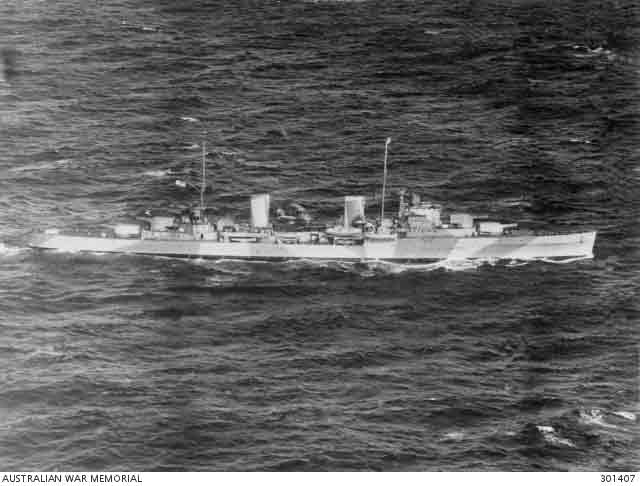
The Australian light cruiser HMAS Sydney (D 48) and the German auxiliary cruiser Kormoran sink each other in a sea battle 170 miles off the coast of Western Australia. The entire crew of 645 officers and men from the HMAS Sydney died while most of the crew of the Kormoran are rescued. German converted auxiliary cruiser Kormoran (HSK-8, Fregattenkapitän (Commander) Theodor Detmers) is nearing the end of a year-long cruise primarily in the Indian Ocean on 19 November 1941when it is sighted by the Sydney (D48, sometimes referred to as Sydney II, Captain Joseph Burnett) roughly 106 nautical miles (196 km; 122 mi) off Dirk Hartog Island (southwest of Carnarvon). Detmers tries to flee, but the Kormoran has temporary engine issues and, in any event, cannot outrun the faster cruiser. The Kormoran is disguised as the Dutch freighter Straat Malakka, which is known to be operating in these waters, but Detmers knows that this disguise cannot withstand scrutiny. After some inconclusive back-and-forth between the two ships that arouses his interest enough to investigate further, Captain Burnett follows standing Admiralty orders to seize all suspected enemy merchantmen and approaches the Kormoran and stops approximately 1,300 meters (4,300 ft) from Kormoran.
From this point forward, events are disputed. The official and most accepted version, supported by the overwhelming preponderance of the evidence, is that at around 17:30, in response to a Sydney signal to “Show your secret sign” (which Detmers did not know), the Kormoran suddenly runs up its Kriegsmarine ensign. A gun battle immediately breaks out. Detmers’ crew has had the advantage of knowing that they may have to open fire and thus has the Sydney targeted, while it is unclear what Sydney’s crew was thinking. The Kormoran’s crew drops the false hull plates hiding its 5.9-inch (15-cm) guns, raises other guns on hydraulic lifts, and launches two torpedoes. Sydney’s crew opens fire at roughly the same time.
The battle lasts for roughly half an hour. The Kormoran’s fire is more accurate and quickly smashes Sydney’s bridge and disables some of its 6-inch (152 mm) main guns. In addition, at least one of Kormoran’s torpedoes hits Sydney near the bow and assures that it will sink. Sydney’s fire, while ineffective at defending the ship, scores enough hits to disable Kormoran and assure that it will sink as well. With Kormoran unable to follow, Sydney sails away at a very slow speed in a cloud of smoke, with Kormoran’s crew continue to score some hits. Both ships sink at around midnight, though nobody is exactly when Sydney goes under.
While Kormoran sinks, it suffers much less damage than Sydney and its crew is able to abandon ship about a half-hour before it explodes in a fireball due to exploding mines that it is carrying. There are 317 survivors, including Detmers, and total Kormoran casualties are six officers, 75 German sailors, and one Chinese laundryman. The survivors are picked up over the next week by Australian ships and land patrols after two of the lifeboats make landfall at a sheep station at 17-Mile Well and Red Bluff. There is not a single survivor of the Australian cruiser and only a very few remnants (some disputed as being from Sydney at all). A total of 645 men perish on Sydney, making it the largest loss of life in the history of the Royal Australian Navy and the largest Allied warship lost with all hands during World War II. The 645 lives lost represent over 35% of all RAN personnel killed during World War II.
While the Kriegsmarine learns about the Kormoran’s loss fairly quickly, it is unable to turn the sinking of Sydney into an immediate propaganda coup because nobody is sure what happened to the other ship, the Sydney. Australian Prime Minister John Curtin finally announces the cruiser’s loss on 30 November 1941, but there are few details to share. While in prison camps, the entire crew of Kormoran receives decorations, with Detmers being awarded the Knight’s Cross of the Iron Cross (Ritterkreuz), three others being awarded the Iron Cross First Class, and the remainder of the crew receiving the Iron Cross Second Class.
Sydney’s story does not end during World War II despite its sinking. It eventually enters a twilight zone of conjecture, conspiracy theories, paranoia, and outright fiction which finally is contradicted by tangible evidence after the wreck is located in March 2008. There are many unanswered questions, including the possible recovery of the remains of a temporary Sydney survivor after they washed ashore on Christmas Island in February 1942. There are many memorials to the crews of Sydney and Kormoran, the most prominent being one for Sydney’s crew on Mount Scott at Geraldton, Australia and one for the dead among Kormoran’s crew in the Laboe Naval Memorial. Disputes and investigations continue, making the battle between HMAS Sydney and auxiliary cruiser Kormoran one of the most enduring mysteries of World War II.
On 19 November 2021, the Australian government announces that DNA testing of the sailor’s remains on Christmas Island established that the corpse was, in fact, a sailor of HMAS Sydney — the only body recovered. He was Able Seaman Thomas Welsby Clark.
Franz Halder noted in his diary that, in a meeting Adolf Hitler held with his top military leaders on this date, Hitler no longer talked about ending the war in 1941; instead, plans for Soviet targets east of Moscow, Russia were made for spring and summer of 1942. Meanwhile, 70 miles west of Moscow, German 4th Panzer Army attempted to penetrate the gap between the Soviet 30th and 16th Armies which were pushed back on the previous day, but stubborn Soviet resistance slowed the German advance in the area of Istra.
In northern Russia, Soviet 4th and 52nd Armies continued to attack Tikhvin, held by the Germans, 120 kilometers east of Leningrad. Meanwhile, near Leningrad, General Feofan Nikolaevich Lagunov drove an American-built M1 Scout Car across the frozen Lake Ladoga and declared it safe to use as a truck route.
German 2nd Motor Torpedo Boat Flotilla attacked Allied convoy FS.650 10 miles east of Lowestoft, England, United Kingdom, sinking tanker War Mehtar and transports Aruba and Waldinge. German torpedo boat S.41 collided with a convoy escort and sank. British destroyer HMS Garth was damaged by friendly fire during the engagement.
The Jager Report (issued on 1 December 1941) noted that 6 prisoners of war and 8 Polish Jews were killed in Vilnius, Lithuania.
British newspaper The Times estimated that 82,000 Polish people had been killed since Poland became occupied.
Italian Ariete Division halt the advance of British 22nd Armoured Brigade at Bir el Gubi, Libya; 40 British Crusader tanks are destroyed or disabled. Elsewhere, British 7th Armoured Brigade continues its advance toward Tobruk, capturing Sidi Rezegh airfield 10 miles south of Tobruk in the process. To the north, tanks of the British 4th Armoured Brigade engage German tanks of the 21st Panzer Division and suffer heavy losses.
On 19 November, 7th Armoured Division was spread out to the south of Tobruk. To the west, the 22nd Armoured Brigade met the Ariete Division at Bir el Gubi: After a sharp action they were forced to withdraw after 25 of its new Crusader tanks were knocked out for an Italian loss of 34 tanks. In the centre the 7th Armoured Brigade and the Support Group advanced to the airfield at Sidi Rezegh, capturing 19 aircraft and menacing the rear of Division z.b.V. Afrika. After the failure of a counter-attack by Division z.b.V. Afrika and the “Bologna” Division the 7th Armoured Division dug in facing south. To the east a battlegroup of the 21st Panzer Division moved to Gabr Saleh and knocked out 23 Stuart tanks of the 4th Armoured Brigade, for a loss of three by nightfall. By attaching the 4th Armoured Brigade to XIII Corps, and letting the 22nd Armoured Brigade to be bogged down against the “Ariete” Division while the 7th Armoured Brigade advanced unsupported towards Tobruk, Cunningham had allowed the British tanks to become dispersed before they met the main Axis armoured force.
The retirement of Sir John Dill as Chief of the General Staff (United Kingdom) was announced. Sir Alan Brooke was designated to succeed him.
Spain and France are cooperating with the Germans in propaganda in Latin America, United States officials reported today. A memorandum outlining German activity in Latin America noted “a very definite lull in German propaganda activities,” and “a corresponding increase of activities by Spanish and to a less extent by French elements.”
HMS Hermes arrived at Simon’s Town, South Africa for a refit.
Heavy cruiser HMS Norfolk departed Scapa Flow for the Faroes — Iceland patrol and then on to Hvalfjord.
Destroyer HMS Antelope departed Scapa Flow at 0900 for Hull to carry out a long refit. The destroyer arrived at Hull at 0900/20th.
Convoy ON.38 departed Liverpool escorted by corvettes HMS Heartsease, HMS Renoncule, and HMS Roselys and anti-submarine trawlers HMS King Sol and HMS St. Apollo. The convoy was joined on the 20th by anti-submarine trawler HMS Cape Warwick. Destroyers HMS Amazon and HMS Foxhound joined on the 21st. Trawler St. Apollo was detached on the 22nd. Corvette HMCS Galt joined on the 24th and was detached on the 25th. The convoy escorts were detached on the 26th when the convoy was joined by destroyer HMS Burnham and corvettes HMCS Algoma, HMCS Chambly, HMCS Dauphin, HMCS Matapedia, and HMS Napanee. The convoy was dispersed on the 30th and the escorts were detached.
Minesweeper HMS Hazard departed Scapa Flow at 0915 for Scrabster to embark stores. The minesweeper then proceeded to join the Kirkwall section of convoy PQ.5 for passage to Hvalfjord. The Kirkwall section of convoy PQ.5 departed Kirkwall at 0930 for Hvalfjord, escorted by minesweepers HMS Sharpshooter and HMS Hebe. The Kirkwall section, escorted by the three minesweepers arrived at Hvalfjord at 1230/23rd.
Minelayer HMS Menetheus, escorted by destroyer HMS Newark, laid minefield SN.25 A.
Anti-aircraft cruiser HMS Cairo, after having escorted convoy BB.101 from Belfast to Milford Haven, suffered a failure of her steering engine. She was able to arrive at Devonport that afternoon for docking which was not completed until early February.
Lt Cdr L. C. D. Ashburner was killed when his Roc of 834 Squadron crashed at Eastleigh.
The German 2nd Motor Torpedo Boat Flotilla attacked convoy FS.650 of fifty nine ships, which had departed Methil on the 18th and was escorted by destroyers HMS Wolsey, HMS Verdun, HMS Widgeon, HMS Kittiwake, and trawler HMS Kingston Olivine, off Great Yarmouth. Destroyers HMS Vesper, HMS Garth, and HMS Campbell were nearby as a support force and MGB.87 followed the convoy. Destroyers HMS Hambedon and HMS Quorn were also at sea. MGB.63, MGB.64, and MGB.67 departed to operate near the German activity, but MGB.63 was forced to return at the start with engine room problems. British tanker War Mehtar (5502grt) was sunk by S.104 in 52-50n, 2-08E. The entire crew was rescued. British steamer Aruba (1159grt) was sunk by S.105 in 52-51N, 2-07-30E. One gunner was missing on the steamer. British steamer Waldinge (2462grt) was badly damaged by S.41 near 55 A Buoy, Smith’s Knoll. One gunner was lost on the steamer. The steamer sank on the 20th. S.41 was damaged in a collision with the convoy escort and was in tow returning to port, when intercepted by MGB.64 and MGB.67. The British were able to board the S-boat, but could not prevent her sinking. Destroyer Garth was seriously damaged when she was accidentally struck by 40mm gunfire from another destroyer in the escort. Destroyer Garth was towed to Harwich. The convoy arrived at Southend on the 20th.
American destroyer USS Leary contacted a U-boat on radar. This was the first instance of such a sighting in the USN.
Destroyer HMS Castleton was damaged by the accidental explosion of a scuttling charge while at sea on escort duty. The destroyer was under repairs at Newport until 20 April 1942.
Submarine HMS Rorqual laid fifty mines off La Rochelle in minefield FD 34. French trawler Coligny (600grt) was lost on the minefield.
Submarine HMS Una arrived at Gibraltar from Holy Loch.
Submarine HMS Osiris arrived at Malta after patrol off Candia.
Italian convoy A departed Tripoli for Naples with steamers Ankara and Sebastiano Venier, escorted by destroyers Maestrale, Oriani, and Gioberti. Due to British naval activity, the convoy in the Messina Strait was diverted to Taranto where they arrived on the 22nd.
Polish submarine ORP Sokol attacked an Italian destroyer of the Aviere class at Navarino. The destroyer was reportedly beached.
In Washington, President Roosevelt today called upon leaders of the U.M.W.A. and the steel corporations to leave the union shop issue in status quo for the emergency or submit it to arbitration. He nominated John M. Carmody to be a member of the Maritime Commission and Captain Thomas C. Kinkaid to be a rear admiral in the Navy for temporary service. His callers included a group of government officials concerned with settling the threatened railway strike and later representatives of the railways and the railway unions. He received Thor Thors, new Minister of Iceland.
The Senate heard Senator Shipstead criticize Secretary Hull’s advice to Finland; passed the bill suspending the Philippine export tax and recessed at. 12:40 PM until noon Friday. The Judiciary Committee considered a recíprocal treaty with Great Britain for certain tax exemptions.
The House passed the bill transferring War Department construction activities to the Army engineers; heard Representative Hoffman criticize the labor committee and adjourned at 1:34 PM until noon Monday. The Rules Committee delayed action on the Price Control Bill; the Agriculture Committee revised the Crop Loan Bill and approved the Fulmer Bill increasing sugar quotas, and the Labor Committee discussed new bills.
President Roosevelt proposed a new formula for ending the strike in captive coal mines today and within a few hours John L. Lewis, on his own behalf, flatly and firmly turned it down. Mr. Roosevelt proposed further discussion of the one issue of the strike which he described as the closed shop be postponed until after the national emergency, or the dispute be submitted to arbitration with the union and mine management agreeing in advance to abide by the result. Lewis replied any formal decision would have to await a meeting of the union’s policy making committee on Saturday, but as far as he was concerned the arrangement was unsatisfactory. The officers of the union, he said, had not authority from the membership to accept anything short of a “union shop” an arrangement under which all employees must join the union. As for arbitration, he added, Mr. Roosevelt’s recent statements had been so “prejudicial” to the claims of the union he doubted an unbiased umpire could be found.
Booed on the floor of the convention of the Congress of Industrial Organizations for their undisguised hostility to Philip Murray, supporters of John L. Lewis retaliated with their fists in Detroit today, beating three pro-Murray delegates and creating what the president of the Detroit C.I.O. Council denounced as a “reign of terror” in the convention headquarters at the Hotel Statler.
Two steps were taken in the House today toward the formulation of legislation aiming to prevent labor stoppages in defense industries. The Labor Committee announced that it would begin hearings Monday on pending bills, and Representative Smith of Virginia obtained unanimous consent to have his bill rereferred from ehe Judiciary Committee to the Labor Committee for consideration.
Secretary of the Navy Frank Knox said today that the first armed American merchant ship will be plying the seas within a week or 10 days but that It probably will take three or four months to outfit all of the vessels which will carry protective weapons. He told a press conference that guns will be installed on merchantmen in both the Atlantic and Pacific under the neutrality revision resolution permitting armed vessels to sail into belligerent ports. He said in response to a question that approximately 1,200 ships are “available” but that he did not know how many would be armed.
Contending that the war had developed into a military stalemate between Germany and Great Britain, Herbert Hoover warned the country tonight that the next great question to come before it would involve the sending of an American expeditionary force overseas.
The Office of Public Opinion Research (OPOR) asked: “If our present leaders and military advisors say that the only way to defeat Germany is for this country to go into the war, would you be in favor of this country’s going into war against Germany?” Yes — 70%, No — 24%, No opinion — 6%.
The ouster of General Maxime Weygand as commander of the French forces in North Africa is expected to lead to the suspension of American aid to that area, at least until its full implications are understood.
Another attack upon Cordell Hull, Secretary of State, for his recent thinly veiled warning that Finland may lose the United States’ friendship unless she makes peace with Russia was voiced in the Senate today by Senator Shipstead, Republican, of Minnesota. Mr. Shipstead said that this advice placed this country in the position of “errand boy for Joe Stalin and Winston Churchill,” and added that “the assertion that Finland’s military operations against Communist Russia constitute a threat to the security of the United States is too preposterous to be taken seriously.”
Strong opposition was reported in the Senate Foreign Relations Committee today to a proposed treaty with Britain providing for exemption of taxation of all British property or transactions in this country connected with defense, in return for a reciprocal exemption on United States defense properties and transactions in Britain.
Yielding to the insistence of the War Department, the board of directors of Air Associates, Inc., sought and obtained yesterday the resignations of F. Leroy Hill, president of the concern, and H.I. Crowe, executive vice president, as a prerequisite to the return of the company’s plant at Bendix, N.J., to its owners.
Destroyer USS Leary (DD-158), with TU 4.1.5, escorting convoy HX.160, depth charges a sound contact.
The Navy’s intensive shipbuilding program dramatically “hit its stride” here yesterday in scenes reminiscent of World War days as one 1,630-ton destroyer went down the ways of the Bethlehem Steel Company yards in Staten Island, the keel of a second man-of-war was laid even before the new ship was fully in the water and preparations were completed for the twin launchings of two more destroyers in near-by Kearny, New Jersey, on Saturday morning.
The United States Government today formally agreed to stabilize the Mexican peso, buy large fixed amounts of Mexican silver and finance an extensive Mexican road-building program. In exchange Mexico agreed to pay $37,000,000 over a period of fourteen years to settle all agrarian and “general” claims of American nationals, to make a trade agreement and to attempt to negotiate a settlement of the petroleum expropriation controversy.
Mexican officials today expressed themselves as highly pleased by the agreement with the United States. It is generally regarded here as a diplomatic victory for Mexico, since Washington has accepted Mexican terms that the American companies twice rejected.
The Japanese embassy in Washington D.C., United States was instructed that, should war be decided with the United States, Japanese public radio broadcast would include the code phrase “higashi no kaze ame” (“east wind rain”), with the Soviet Union “ita no kaze kumori” (“north wind cloudy”), and with the United Kingdom “nishi no kaze hare” (“west wind clear”). This clear preparation for a likely war was intercepted by the Americans.
The situation surrounding the diplomatic conversations looking to an adjustment of relations between Japan and the United States remained completely uncertain today as the Japanese diplomats, Admiral Kichisaburō Nomura, the Ambassador, and Saburō Kurusu, the special envoy, awaited instructions from their government in response to questions arising out of the first two days of discussion.
The outcome of new efforts to reach a Japanese-American understanding on Far Eastern problems remained uncertain tonight. There was no formal meeting between Secretary of State Hull and the Japanese negotiators today, although State Department officials said representatives from both sides might keep in touch for obtaining additional information on certain points. Tomorrow is Thanksgiving Day in the capital and no appointments had been scheduled for Secretary Hull up to an early hour tonight, although his office said he would be at work as usual, either in his home or at the State Department.
Foreign Secretary Anthony Eden said in the House of Commons today that any attack by Japan on the Burma Road would “create a grave situation.” The road, from British Burma through Yunnan Province to Chungking, is one of the principal lines of supply for Generalissimo Chiang Kai-shek’s forces. Reports of the massing of Japanese troops in Northern French Indo-China have aroused fears that Japan may be planning to invade Yunnan Province in an effort to cut the road.
A ground echelon from U.S. Marine Aircraft Group 21 was dispatched to Midway Island to prepare the island to receive aircraft.
Hart informed senior officers of Asiatic Fleet that the war would be fought from Manila.
HMAS Sydney was intercepted by German raider Kormoran 140 miles west of Shark Bay, Australia, with Kormoran firing the first shot at 1730 hours. Both ships were heavily damaged after the 20-minute battle. Sydney subsequently sank with all hands. Off the west coast of Australia at 26-34S, 111-00E, Australian light cruiser HMAS Sydney (Captain J. Burnett RAN) contacted German raider Kormoran, which was able to maintain her disguise. The German ship torpedoed the Australian cruiser and badly damaged her with gunfire. Cruiser HMAS Sydney sank with her entire crew of Burnett, Cdr E. W. Thruston DSC, Lt Cdr J. C. Bacon, Lt Cdr A. M. Wilkinson, Lt Cdr C. A. C Montgomery, Lt Cdr M. M. Singer DSC, Lt E. E. Mayo, Lt I. T. R. Treloar, Lt T. E. Davis, Lt T.G. Brown, T/Lt J. A. Cole RANR, T/Lt A. I. Keith RANR, Cdr (E) L. S. Dalton DSO, Lt Cdr (E) R. D. Handcock, T/Engineering Lt A. W. Wilson RANR, T/Engineering Lt W. T. Anderson, Chaplain the ReverendG. Stubbs, Surgeon Cdr J. R. Hasker, Paymaster Cdr T. F. Maynard, Surgeon Lt Cdr F. H. Genge, Surgeon Lt (D) M. C. Townsend, Paymaster Sub Lt C. M. Mitchell, Paymaster Lt R. E. Ridout RANR, Sub Lt E. R. Eddy, Sub Lt A. E. Byrne RANR, Sub Lt A. V. Eager RANR, A/Sub LtB. A. Elder RANR, P/Engineering Sub Lt A. J. King RANVR, P/Sub Lt F. H. Schoch RANVR, Paymaster Sub Lt J. I. Clifton RANR, Gunner F. L. Macdonald, Gunner (T) J. E. Peterson, A/Gunner J. K. Houston, Warrant Shipwright J. A. E. Fuller, Warrant Engineer W.G. Batchelor, Warrant Engineer F. W. Reville, A/Warrant Engineer A.B. Biggs, Warrant Electrician R. W. Nicolson, Schoolmaster P. F. Skewes, Warrant Supply Officer W. A. Owen, Paymaster Midshipman D. W. McCabe, RAAF Flying Officer R.B. Barrey, 592 RAN ratings, two RN ratings, four NAAFI personnel, five RAAF ratings. The German ship was badly damaged and scuttled by the crew the next day. On her cruise, the German ship sank eleven ships for 68,274 tons. Seventy six crewmen were killed on the German ship. British liner Aquitania also rescued twenty six survivors from the German ship at 0830/24th. British tanker Trocas rescued twenty four more crewmen at 1800/24th. Two hundred and seventy five German survivors reached the Australian coast in the ship’s boats. When there was no contact with the light cruiser HMAS Sydney, Dutch light cruiser HNLMS Tromp departed the Sunda Straits to follow light cruiser HMAS Sydney’s track.
American sailing vessel Del Pidio was sunk on a mine in a prohibited area at the entrance to Manila Bay. Six crewmen were rescued from the vessel.
Japanese newspapers today reported a Japanese-Soviet armed clash last Sunday on Manchukuo’s northwestern border, the second frontier skirish since Japan’s Axis partner, Germany, opened war on Russia. One Russian was killed and two were taken prisoner about thirty miles from Manchuli, Domei reported.
During this month, the excavated fossils of the Peking Man were packed up at the Cenozoic Research Laboratory of the Beiping Union Medical College, and the U.S. Marines stationed in China, who already received orders to be withdrawn, were supposed to bring the bones back to the United States for safekeeping. During the hurried transit between Beiping and the port of Qinghuangdao, the boxes vanished, and had not been found to this day.
One submarine of the Support Group, Advance Group, Pearl Harbor Strike Force, HIJMS I-26, departs Yokosuka. On 7 December, HIJMS I-26 is underway between the Hawaiian Islands and California.
HIJMS Kaga departed Saeki Bay off Oita, Japan for Etorofu Island, Kurile Islands.
HIJMS Shokaku departed the Inland Sea with HIJMS Zuikaku for Hittokappu Bay in the Kurile Islands to join the ships massing for the Hawaii Operation.
Dow Jones Industrial Average: 116.68 (+0.81)
Born:
Tommy Thompson, American politician (42nd Governor of Wisconsin, 1987–2001), in Elroy, Wisconsin.
Dan Haggerty, American actor (“Grizzly Adams”), in Hollywood California, (d. 2016).
Eddie Raynor, New Zealand rock keyboardist (Split Enz; Crowded House), in Lower Hutt, Wellington, New Zealand.
Ivanka Khristova, Bulgarian athlete (Olympic gold medal, women’s shot put, 1976), in Osikovitsa, Bulgaria (d. 2022).
Naval Construction:
The U.S. Navy Adroit-class minesweeper USS Force (AM-99) is laid down by the Penn-Jersey Shipbuilding Co. (Camden, New Jersey, U.S.A.).
The U.S. Navy SC-497-class (110-foot wooden hull) submarine chaser USS PC-664 (later SC-664) is laid down by the Dachel-Carter Shipbuilding Corp. (Benton Harbor, Michigan, U.S.A.).
The Royal Navy Vosper 72-foot motor torpedo boats HMS MTB 279 and HMS MTB 280 are laid down by the Annapolis Yacht Yard Inc. (Annapolis, Maryland, U.S.A.). Both are transferred to the Royal Indian Navy on completion and commission as HMIS MTB 279 and HMIS MTB 280.
The Kriegsmarine (German Navy) Type VIIC U-boats U-641 and U-642 are laid down by Blohm & Voss, Hamburg (werk 617 and 618).
The Nihon Kaigun (Imperial Japanese Navy) Ro-100-class submarines HIJMS Ro-104 and HIJMS Ro-105 are laid down by Kawasaki (Kobe, Hyōgo Prefecture, Japan).
The Royal Navy “U”-class (Third Group) submarine P 47 is laid down by Vickers Armstrong (Barrow-in-Furness, U.K.). She is transferred to the Koninklijke Marine (Royal Netherlands Navy) prior to completion and commissions as HrMs (HNMS) Dolfijn (P 47).
The Royal Navy “U”-class (Third Group) submarine HMS Unruly (P 49) is laid down by Vickers Armstrong (Barrow-in-Furness, U.K.).
The U.S. Navy Fletcher-class destroyer USS Bache (DD-470) is laid down by the Bethlehem Steel Corp. (Staten Island, New York, U.S.A.).
The Royal Navy MMS I-class motor minesweeper HMS MMS 64 (J 564) is launched by Walter Reekie (Anstruther, Scotland, U.K.).
The Royal Navy Isles-class minesweeping trawler HMS Stroma (T 150) is launched by Hall, Russell & Co. Ltd. (Aberdeen, Scotland).
The U.S. Navy Accentor-class coastal minesweeper USS Assertive (AMc-65) is launched by the Bristol Yacht Building Co. (South Bristol, Maine, U.S.A.).
The U.S. Navy PC-461-class (173-foot steel hull) submarine chaser USS PC-473 is launched by the Defoe Shipbuilding Co. (Bay City, Michigan, U.S.A.).
The Kriegsmarine (German Navy) Type VIIC U-boat U-257 is launched by Bremer Vulkan-Vegesacker Werft, Bremen-Vegesack (werk 22).
The U.S. Navy Benson-class destroyer USS Farenholt (DD-491) is launched by the Bethlehem Steel Corp. (Staten Island, New York, U.S.A.).
The U.S. Navy President Jackson-class transport ship USS President Adams (AP-38; later APA-19) is commissioned. Her first commanding officer is Commander Carl Wright Brewington, USN.
The Kriegsmarine (German Navy) Type VIIC U-boat U-89 is commissioned. Her first commanding officer is Kapitänleutnant Dietrich Lohmann.
The Kriegsmarine (German Navy) Type VIIC U-boat U-408 is commissioned. Her first commanding officer is Kapitänleutnant Reinhard von Hymmen.
18…

