CRUSADER
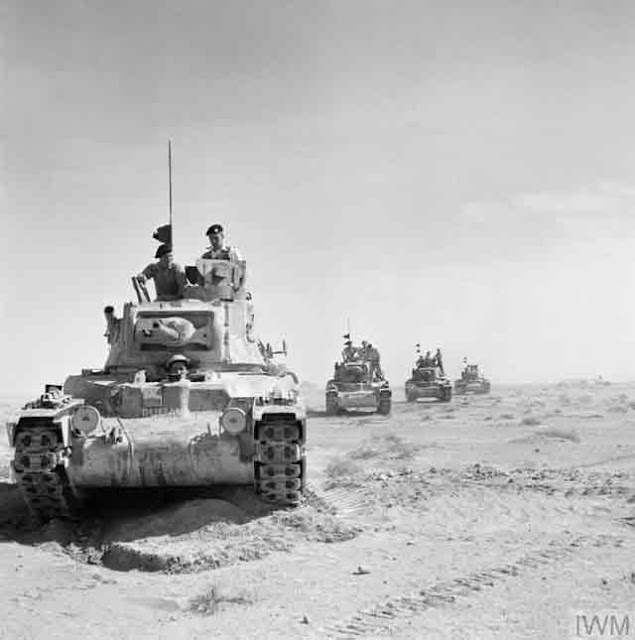
After several months of relative quiet on the North African front, the war erupts again into a hail of gunfire on 18 November 1944 when the British launch Operation CRUSADER. This is an attempt by the British Eighth Army, led by General Sir Alan Gordon Cunningham, to relieve the besieged garrison of Tobruk and, most optimistically, push the Afrika Korps led by General Erwin Rommel back across Cyrenaica.
German General Erwin Rommel, commander of Panzer Gruppe Africa, dismisses Italian warnings of a possible British attack and destroys Italian reconnaissance photographs revealing a massive increase in British vehicles and men. Rommel states the Italian warnings as “excessive Latin nervousness.” Luckily for Rommel, General Ettore Bastico, governor of Libya and commander of all troops on the North African Theatre, convinces Rommel not to deploy his armored units around Tobruk. General Gastone Gambara, commander of the Maneuverable Corps and Lieutenant General Fedele de Giorgis, commander of the 55th Division Savona, place the Ariete, Trieste and Savona Divisions on alert.
Operation CRUSADER begins. This British attack has the XXX Corps cross into Libya from Egypt. With 450 cruiser tanks and 132 infantry models and more in the Tobruk Garrison. The Afrika Korps has 180 Mk III and IV tanks with 220 Italian and other German models. This British attack disrupts Rommel’s plan to attack Tobruk on the 21st. British forces, reorganized into the 8th Army under command of Lieutenant General Alan G. Cunningham, began Operation Crusader with a sortie by the British 30th Corps over the Egyptian border into Libya. British, New Zealand, and Indian troops launched Operation CRUSADER, a major offensive from Egypt into Libya. Surprise was achieved, and the attack met no serious resistance on the first day. The Germans would later call this offensive Winterschlacht. After sundown, British cruisers HMS Naiad and HMS Euryalus and destroyers HMS Kipling and HMS Jackal bombarded German positions at Halfaya Pass. The U.S. M3 Stuart light tank has its first trials in action with the British 8th Army, at the start of Operation CRUSADER.
Opposing the British is Panzergroup Afrika. Its main force is Afrika Korps under the command of Lieutenant General Ludwig Cruwell. Cruwell has at his disposal the 15th Panzer Division, 21st Panzer Division (total of 260 tanks ), the Division z.b.V Afrika which had been formed in Africa as a composite formation, and was renamed the 90th Light Africa Division in late November, and the Italian 55th Infantry Division Savona. While General Rommel is under the command of the Italian High Command and is subject to the orders of General Ettore Bastico, Rommel exercises a completely free hand in operations and treats Cruwell almost as his chief of staff. Everybody understands that this is a German show and that the Italian soldiers are of limited value, though they are necessary and useful when handled properly (i.e., given static tasks and “corsetted” by always keeping German units nearby).
The main limitation of Rommel’s forces has been resupply issues. Panzer Group Africa depends almost entirely on convoys from Naples (via Palermo) to Benghazi and Tripoli. Supply also depends upon transport from the ports to the front, which very often is lacking. About 75% of convoys get through, though there are some instances when none of the ships arrive at all, such as the 9 November Duisburg Convoy. The main problem is the fuel for the panzers because as much as half of the gasoline that arrives in North Africa is used up by transporting the remainder to the front. Convoys that might be sent are often delayed or eliminated entirely by the sinkings in the Sicilian Strait. The land convoys to the front also are vulnerable to RAF attacks both from Malta and Egypt. The Luftwaffe is much weaker in North Africa late in 1941 than it was in the spring due to the demands of the Eastern Front, which has sucked up resources that otherwise could have supported Afrika Korps. Hitler appoints Air Field Marshal Albert Kesselring as Luftwaffe Commander in Chief South as his effort to improve the convoy situation. Kesselring immediately transfers his Luftlotte 2 headquarters (but not its forces) from Russia to Rome.
The British are in much better shape than the Germans in North Africa. General Cunningham has built up an armada of 770 tanks (including many of the new Crusader Cruiser tanks, after which the operation was named, and many new American M3 Stuart light tanks supplied by Lend Lease via Suez). The British forces include South African, New Zealand, Indian, Australian, and Polish troops in discrete units. The RAF has over 700 combat aircraft under the command of Air HQ Western Desert. The Royal Navy is a constant factor because much of the action takes place along coastal roads and in ports that are easily shelled during night-time sorties from Alexandria. While the Italian Navy on paper is superior to the ships of the Royal Navy’s Mediterranean Station, it is well known to prefer to stay in port as a “fleet in being” both through timidity induced by early war losses and fuel issues. While the Kriegsmarine does have a presence in the Mediterranean, it is a minimal one which is disguised by some flashy successes such as the sinking of Royal Navy aircraft carrier HMS Ark Royal on 13-14 November 1941.
The British Eighth Army attacks before dawn from its base at Mersa Matruh and crosses the border near Fort Maddalena. From there, about 50 miles (80 km) south of Sidi Omar, 7th Armored Division’s 7th Armored Brigade heads northwest toward Tobruk with 22nd Armored Brigade screening its left (western) flank. This attack is made through “no man’s land” and there is virtually no fighting on 18 November. However, due to rain late on the 17th, the RAF Desert Air Force was unable to launch raids on Luftwaffe fields and Wehrmacht troop concentrations, so General Rommel begins the battle with his forces basically intact. He immediately orders 21st Panzer Division to move south from Gambut. The panzers are supported by powerful 88 mm gun batteries which can be used as both ground artillery and anti-aircraft fire. The initial flashpoint will be Sidi Rezegh airfield, which both sides need to support ground operations around Tobruk.
Operation FLIPPER ended in British failure. This was a British commando raid during the Second World War, mainly by men from No. 11 (Scottish) Commando. The operation included an attack on the headquarters of Erwin Rommel, the commander of Panzergruppe Afrika in North Africa. It was timed for the night of 17/18 November 1941, just before the start of Operation Crusader. The operation failed as Rommel had left the target house weeks earlier and all but two of the commandos who landed were killed or captured. One member of the Special Boat Section team, who had secured the beach for the commando party, also escaped.
Although not specified in the orders, the goal of the raid was to kill or capture Rommel, to disrupt German organization before the start of Crusader. Rommel’s headquarters was believed to be at Beda Littoria, because Captain John Haselden had reconnoitered the area disguised as an Arab and reported that Rommel’s staff car came and went from the former Prefecture.
The operation was led by Lieutenant-Colonel Robert Laycock; Lieutenant-Colonel Geoffrey Keyes, present throughout the planning stage, selected the most hazardous task of the attack on Rommel’s headquarters for himself. Unbeknownst to the planners, Beda Littoria had only briefly been Rommel’s headquarters and had been taken over by the chief quartermaster of Panzergruppe Afrika, General Schleusener. Some weeks earlier, Rommel had moved his headquarters nearer to Tobruk to be close to the action. Rommel was not even in North Africa during FLIPPER, having gone to Rome to request replacements for supply ships sunk by the British.
On the principle that neither total war nor total defense can afford any lengthy breathing spells, the operations on the vast Russian-German front continue regardless of the weather, but thrusts and counterthrusts do not appear to have greatly modified the main features of the front line as it has existed for more than a month and where it shows tendencies of stabilizing itself with the coming of Winter.
German 4th Panzer Army launched a 400-tank attack 70 miles west of Moscow, Russia, supported by 3 infantry divisions; Soviet 30th Army fell back northward to Klin, while Soviet 16th Army was pushed south to Istra. 120 miles south of Moscow, German 3rd Panzer Army was held up at Tula, with its latest attempt to surround the Soviet garrison there foiled by the newly-arrived Soviet 413th Rifle Division.
Fighting near Venev, seriously holds up Guderian’s infantry divisions with heavy losses. The Germans commit additional 2nd Panzer Army forces to recover ground lost yesterday when his 112th Infantry Division panicked and broke. The new attacks captured Epifan and Dedilovo south of Moscow.
At Strokovo, in an act of tremendous heroism, 11 Red Army engineers hold up 20 German tanks.
The teams dispatched on the previous day out of Leningrad, Russia to Lake Ladoga returned to the besieged city at 0400 hours, reporting that the ice on the lake was about 10 centimeters thick, which made light travel possible, but not for heavy equipment such as 1-ton trucks.
The Soviet Foreign Affairs Commissariat today issued a communique denying Finnish contentions that Finland was at war with Russia in self-defense against Soviet imperialism.
Alfred Rosenberg, Reich Ministry for the Occupied Eastern Territories, tells German journalists at a confidential briefing that the “Final Solution” has begun; a “biological extermination of all Jews in Europe.” No Jew could remain on the continent to the Ural Mountains; they will either be forced beyond the Urals or exterminated. The press is not to write about the extermination in detail, but the reporters could use stock phrases such as the “definite solution” or the “total solution of the Jewish question.”
General John Dill, the Chief of the Imperial General Staff, was promoted to the rank of Field Marshal.
General Brooke replaces General Dill as Chief of the Imperial General Staff. General Dill is assigned to Washington, DC. General Paget becomes C. in C. British Home Forces. These appointments will become effective in December. Brooke comes from an Ulster Loyalist family in County Fermanagh. There is a well-established tradition of having a loyal Irishman as Britain’s top soldier. The list includes Sir Henry Wilson, assassinated by the IRA in 1922, as well as Brooke’s predecessor, Sir John Dill.
General Brooke has a passion for innovation in military mobility, mechanization and gunnery. He commanded II Corps of the BEF in the Dunkirk withdrawal. On his return to took over from Lord Ironside as Chief of the Home Defence Forces, becoming responsible for leading resistance to invasion. Now aged 58, he is described by Dill as “a young man” who should have a chance to get on.
Japan requested Germany to not conclude a separate peace with any common enemies of the two countries, but did not share its plans to attack the United States.
RAF Bomber Command, Night of 18/19 November 1941
Brest
6 Stirlings to bomb warships. Only 3 aircraft bombed the approximate position of the ships. No losses.
Submarine HMS Sealion sank Norwegian trawler Vesco (331grt) by gunfire off northern Norway.
Submarine HMS Trident, on passage from Murmansk to the United Kingdom, was directed to patrol off the Norwegian coast in the area of 62N, 4-20E. Submarine Trident departed the patrol area for Blyth on the 25th. Submarine HMS Tuna, on passage to the Northern patrol area, was directed to patrol in the area of 61-02N, 3-50E.
French submarine Rubis departed Dundee to patrol off the Norwegian coast.
T/Sub Lt (A) D. Worth RNVR, was killed when his Fulmar of 884 Squadron crashed near Donibristle.
Light cruiser HMS Hermione was detached from aircraft carrier HMS Argus, which with escort returned to Gibraltar. The light cruiser joined battleship Nelson to search for an enemy supply ship reported in the Biscay area.
British operation APPROACH was cancelled with the exception of the sailing of tankers Toneline and Lesbos which departed Alexandria escorted by sloops HMAS Yarra and HMAS Parramatta, minesweeping whaler HMS Sotra, and two anti-submarine trawlers.
When tanker Toneline broke down, sloop HMAS Parramatta assisted the tanker returning to Mersa Matruh. The tanker sailed after dark on the 19th for Tobruk. Tanker Lesbos, escorted by anti-submarine whaler HMS Klo, arrived late at Tobruk. Whaler Klo and motor launch ML.1048 were damaged by shellfire on the 20th. After temporary repairs to a direct hit, whaler Klo was able to depart for Alexandria.
Battleships HMS Queen Elizabeth, HMS Barham, and HMS Valiant, light cruisers HMS Naiad, HMS Galatea, and HMS Euryalus, and destroyers HMS Jervis, HMS Kimberley, HMS Kingston, HMAS Napier, HMAS Nizam, HMS Kipling, HMS Jackal, HMS Decoy, HMS Avonvale, and HMS Eridge departed Alexandria to support Operation CHIEFTAIN, the dummy convoy intended to divert attention from Operation CRUSADER in the Eastern Mediterranean. The Battle Fleet turned back after dark on the 18th and arrived at Alexandria during the morning of 19 November. Light cruisers Naiad and Euryalus and destroyers Kipling and Jackal, which had been detached late on the 18th, bombarded the Halfaya fortifications around Tobruk. The light cruisers and destroyers arrived later at Alexandria.
Force K of light cruisers HMS Aurora and HMS Penelope and destroyers HMS Lance and HMS Lively departed Malta to participate in the CHIEFTAIN operation. The ships arrived back at Malta during the night of 18/19 November.
British aircraft accidentally attacked anti-submarine whaler HMS Southern Maid in 31-15N, 28-02E, reporting her as a submarine. Destroyers HMS Farndale and HMS Eridge departed Alexandria to search for the submarine.
Submarine HMS Perseus, which had been under repair at Malta, departed on trials, but was forced to return with a defective hydroplane gear.
Submarine HMS Thorn unsuccessfully attacked a steamer in the Aegean. The steamer was later found to be a Turkish Red Crescent relief ship.
An Italian convoy of steamers Amba Aradam and Brook (1225grt), escorted by torpedo boat Partenope arrived at Benghazi from Brindisi.
Turkish steamer Yenice (428grt) was sunk by Soviet submarine SC.215 off Vasiliko, in the Black Sea. Twelve crewmen were lost on the steamer. Two survivors were rescued.
Anti-submarine trawler HMS Scottish intercepted French fishing ketch Belle Bretagne 22 miles 280° from Cape Espichel. The ketch was sent into Gibraltar.
Convoy OS.12 departed Liverpool. The convoy was joined on the 19th by sloops HMS Folkestone, HMS Londonderry, HMS Wellington, and HMS Weston and escort vessels HMS Sennen and HMS Totland. Sloop Londonderry was detached on 2 December, sloop Weston on 7 December, sloops Folkestone and Wellington and the escort vessels on 8 December. Escort vessel HMS Gorleston joined the convoy on 4 December and was detached on 6 December. On 6 December, destroyers HMS Vansittart and HMS Velox and corvettes HMS Bergamot, HMS Lavender, and HMS Starwort joined the convoy and escorted it into Freetown, arriving on 11 December.
Convoy SL.93 departed Freetown escorted by destroyers HMS Brilliant to 23 November and HMS Stanley to 24 November, sloop HMS Bideford to 10 December, corvettes HMS Bergamot and HMS Crocus to 23 November, HMS Cyclamen to 10 December, HMS Nigella and HMS Orchis to 23 November, escort vessels HMS Culver, HMS Landguard, and HMS Lulworth to 10 December and HMS Gorleston to 1 December, and anti-submarine whaler HMS Southern Pride to 23 November. On the 27th, ocean boarding vessel HMS Corinthian joined to 10 December. Sloop HMS Londonderry joined on 2 December to 10 December. Anti-submarine trawler HMS Arab escorted the convoy on 10 December. The convoy arrived at Liverpool on 10 December.
Today in Washington, President Roosevelt conferred with party leaders from Capitol Hill; he held his usual Tuesday press conference, received Josephus Daniels and William C. Bullitt and conferred with government, labor and railway leaders on the threatened strike of rail workers.
The Senate was in recess; its Privileges and Elections Committee heard final arguments on the fitness of Senator Langer; the Irrigation Committee reported favorably the bill granting consent for the Republican River diversion compact.
The House killed the Hobbs alien detention bill, received the Cochran bill to exempt materials used in fulfilling defense contracts from taxation, granted $25,000 additional to the Military and Naval Committees for defense program investigations, heard Representative Norton announce plans for legislation changing the defense mediation system and adjourned at 5:59 PM until noon tomorrow. The Rules Committee continued consideration of price-control legislation.
A work stoppage by thousands of commercial coal miners in sympathy with the strike of their fellow unionists in the captive pits became imminent tonight after a day which saw a further rebuke by President Roosevelt to John L. Lewis but no specific government action. President Roosevelt today described as not a valid point John L. Lewis’s principal ground for insisting upon acceptance of the union shop as a basis for settling the strike of 53,000 coal miners in the captive mines of the major steel companies. Mr. Lewis contended, in conferences with the steel executives and in his report to the President yesterday, that he could not execute the open shop agreement demanded by the steel companies and recommended by the National Defense Mediation Board without giving up the union shop in all the other bituminous coal fields. Mr. Roosevelt, seeking to prevent this captive mine strike from spreading to all the nation’s soft coal mines, asserted that the wages, hours, working conditions and degree of union recognition accorded the 400,000 other soft coal mining members of the United Mine Workers Union would not be affected if Mr. Lewis signed an open shop contract for the captive mines.
The strike in the captive coal mines and anti-strike legislation were discussed this morning at a conference between President Roosevelt and leaders of Congress, one of whom was Speaker Rayburn. The discussion failed to produce a definite “go ahead” order on anti-strike legislation which some officials had been expecting, but the conferees left the President with the impression that he would. use all the power at his command. to obtain a resumption of coal production necessary for the manufacture of steel, basic defense material. One of the leaders at the conference expressed the opinion that the mine operators would grant no concessions to the workers on the closed shop issue. He said the controversy would probably be settled “one way or another within a very few days.” He expressed doubt that troops would be called into the situation until all other means of settling the controversy had been tried. added that it would be impossible to tell whether the President would send a message to Congress calling for labor legislation until some time next week. Asked whether the President might make a personal appeal to the miners to return to work, he declared: “That is a possibility, of course, if other means fail.”
Full support of President Roosevelt’s foreign policy was voted by the Congress of Industrial Organizations at its annual convention today while a group of followers of John L. Lewis sat in glum silence and refused to give their approval. Delegates adopted a resolution commending the chief executive’s “forthright” stand in the foreign field, attacking Charles A. Lindbergh whose name provoked a scattering of hisses and urging extension of all possible aid and cooperation to Great Britain, the Soviet Union and China. An overwhelming majority of the delegates rose in approbation but most of the delegation of United Mine Workers John L. Lewis’ own union and most of the representatives of the United Construction Workers Organizing committee, including their chairman, A. D. Lewis, brother of John L. Lewis, remained seated.
Wendell L. Willkie said last night that the closed shop issue, the cause of the present conflict in the coal industry, “should not be settled during an emergency when Hitler is holding a pistol at our heads.” The 1940 Republican candidate for President thus took issue with John L. Lewis, leader of the United Mine Workers, who was his chief labor supporter in the Presidential campaign.
President Roosevelt took personal command today of efforts to avert a threatened nationwide strike of railroad workers on December 7, and it was reported in informed quarters tonight that a compromise wage increase probably will settle the dispute between rail unions and management. Mr. Roosevelt conferred for forty-five minutes at the White House with John J. Pelley, president of the Association of American Railroads, and R. V. Fletcher, general counsel; George M. Harrison, president of the Brotherhood of Railway Clerks, and Alvanley Johnston, president of the Brotherhood of Locomotive Engineers. Solicitor General Charles Fahy, Senator James M. Mead of New York, Joseph B. Eastman, chairman of the Interstate Commerce Commission, and David J. Lewis, chairman of the National (Railway) Mediation Board, sat in on the negotiations.
Representative Dies of Texas, chairman of the committee to investigate un-American activities, suggested today that there be an investigation of the “influences” which have brought about “an influx of Communists and fellow travelers” into Washington official life.
The House killed late today the Hobbs Alien Detention Bill, which would have empowered the Justice Department to detain aliens who cannot be deported under current war conditions. The vote was reported at 167 to 141.
Major General H.H. Arnold, chief of the Army Air Corps, said today that the nation’s air forces were using the Carolina First Army maneuvers to test plane-ground communications based on lessons learned from the European war.
Major General John N. Greely, until recently in command at Fort Sam Houston, one of the country’s largest Army posts, is scheduled to leave soon for Archangel, Russian White Sea port, as the head of a large United States military mission in process of formation, responsible quarters reported today.
The Navy set up a priorities system today for arming merchant ships and provided that vessels which will carry munitions to Britain and Russia through the North Atlantic would be the first to receive guns and gun crews.
A stage adaptation of the Sally Benson semi-autobiographical story collection “Junior Miss” opened at the Lyceum Theatre on Broadway.
Mexico broke off diplomatic relations with Bulgaria, Hungary and Romania.
A personal message from President Manuel Avila Camacho of Mexico was handed to President Roosevelt today by Josephus Daniels, retiring Ambassador to Mexico, who told reporters subsequently that Mexico was extremely anxious for an early settlement of oil expropriation problems.
Japanese Ambassador to the U.S. Admiral Nomura Kichisaburō sends the following message to Tokyo: “On the evening of the 17th, both of us (Nomura and special envoy Kurusu) went to call on a certain cabinet member and this is what he told us: “The President is very desirous of an understanding between Japan and the United States. In his latest speech he showed that he entertained no ill will towards Japan. I would call that to your attention. Now the great majority of the cabinet members, with two exceptions, in principle approve of a Japanese American understanding. If Japan would now do something real, such as evacuating French Indo-China, showing her peaceful intentions, the way would be open for us to furnish you with oil and it would probably lead to the re-establishment of normal trade relations. The Secretary of State cannot bring public opinion in line so long as you do not take some real and definite steps to reassure the Americans.”
U.S. Secretary of State Hull conferred for two hours and 45 minutes today with Japan’s ambassador and special envoy, but he indicated afterwards that the discussion which may settle the question of war or peace still remained in an exploratory stage. Ambassador Kichisaburō Nomura struck an optimistic note, however, both before the lengthy parley and after it.
Nomura and Kurusu meet with Secretary of State Cordell Hull at 1030 hours and then sends the following in a message to Tokyo: “In our conversations of today, as a practical means of alleviating the ever worsening front with which we are faced and to quiet the fearful situation, as well as, to bring about a return to the situation existing before the application of the freezing legislation, we suggested the evacuation of Japanese troops stationed in the southern part of French Indochina. During this meeting, Hull brought up the question of the Tripartite Pact between Germany, Italy and Japan, and Kurusu said “. . . he could not say that Japan would abrogate the Tripartite Pact . . . he desires to emphasize that Japan would not be a cat’s-paw for Germany, that Japan’s purpose in entering into the Tripartite alliance was to use it for Japan’s own purposes, that Japan entered the Tripartite Pact because Japan felt isolated.” Special emissary Kurusu intimated Japan might do something to “outshine” the Axis Pact.
Doctor L. A. DuBridge of the Radiation Laboratory reported that the initial design of a 3-centimeter aircraft intercept radar was completed.
MacArthur tasks FEAF to review the “installation and operation of the Air Force as projected.”
American cruiser USS Boise departed Pearl Harbor escorting U.S. Army convoy 4001 of Army transport USAT President Grant and steamers American Leader, Cape Fairweather, John Lykes, and Dona Nati to Manila. The convoy arrived at Manila on 4 December and light cruiser Boise was ordered to join the Asiatic Fleet.
Japanese submarines of the 1st and 2nd Submarine Flotillas departed Yokosuka and Kure on 18 and 19 November for operations in the Central Pacific. Submarine I-26 reconnoitered Kiska, Alaska, on the 25th and during the night of 27/28 November flew her aircraft over Dutch Harbor. On the 30th, the submarine reconnoitered Kodiak. Submarine I-10 reconnoitered Suva on the 29th by aircraft and was off Pago Pago on 4 December. From 3 December, submarines I-9, I-15, I-17, and I-25 were in a line north of Oahu. I 7 was south of Oahu. I-1, I-2, and I-3 were west of Oahu. I-4, I-5, and I-6 were east of Oahu. The 3rd Submarine Flotilla from Kwajalein with I-8, I-68, I-69, I-70, I-71, I-72, I-73, I-75, and I-76 were deployed south of Oahu. Submarines I-16, I-18, I-20, I-22, and I-24 which carried midget submarines for an attack on Pearl Harbor departed Yokosuka on the 18th. The main IJN carrier force of Kido Butai, the invasion operation, sails from Saeki Bay for Hittokappu (Tankan) Bay, awaiting the final order to sail east. The Japanese continue to negotiate in Washington for a peaceful settlement and do not tell even their German allies of their military plans. Security is very tight, and not even the American “Magic” decryption operation led by Joseph Roquefort has an inkling that the invasion fleet has sailed.
Joseph Rochefort’s U.S. Navy cryptanalytic team reported no Japanese carrier movement. The First Air Fleet detached its radio operators to land bases where they continued to transmit, each with their distinctive “fist,” making it appear that the carriers would remain in home waters for the next three weeks.
Japanese luxury ocean liner Hikawa Maru arrived at Yokohama, completing her 74th and last round trip across the Pacific.
Dow Jones Industrial Average: 115.87 (-0.33)
Born:
David Hemmings, English actor (“Blow-up”; “Barbarella”), in Guildford, Surrey, England, United Kingdom (d. 2003).
Conleth “Con” Cluskey, Irish pop vocalist (The Bachelors — “Diane”; “I Wouldn’t Trade You For The World”), in Dublin, Ireland.
Sterling Slaughter, MLB pitcher (Chicago Cubs), in Danville, Illinois.
Died:
Émile Nelligan, 61, Canadian poet.
Walther Nernst, 77, German physicist and Nobel laureate (1920).
Chris Watson, 74, 3rd Prime Minister of Australia.
Naval Construction:
The Royal Navy LCT (Mk 3)-class landing craft, tank HMS LCT 300 is laid down by Stockton Construction (Thornaby, U.K.).
The U.S. Navy Auk-class minesweeper USS Sway (AM-120) is laid down by the John H. Mathias Co. (Camden, New Jersey, U.S.A.).
The U.S. Navy Auk-class minesweeper USS Symbol (AM-123) is laid down by the Savannah Machinery and Foundry Co. (Savannah, Georgia, U.S.A.).
The U.S. Navy Arcturus-class cargo ship USS Electra (AK-21; later AKA-4) [ex-MV Meteor] is launched by the Tampa Shipbuilding and Drydock Co. (Tampa, Florida, U.S.A.).
The Royal Fleet Auxiliary Dale-class fleet tanker RFA Eaglesdale (X 104; postwar A104) is launched by the Furness Shipbuilding Company (Haverton Hill-on-Tees, England).
The Royal Navy LCT (Mk 2)-class landing craft, tank HMS LCT 159 is launched by A. Findlay (Old Kirkpatrick, Scotland, U.K.).
The Royal Navy LCT (Mk 2)-class landing craft, tank HMS LCT 168 is launched by Tees-Side Bridge (Middlesbrough, U.K.).
The U.S. Navy Accentor-class coastal minesweeper USS Fearless (AMc-80) is launched by W.A. Robinson Inc. (Ipswich, Massachusetts, U.S.A.).
The Royal Navy “S”-class (Third Group) submarine HMS Safari (P 211) is launched by the Cammell Laird Shipyard (Birkenhead, U.K.).
The Kriegsmarine (German Navy) Type IXD2 U-boat U-179 is launched by AG Weser, Bremen (werk 1019).
The Kriegsmarine (German Navy) Type IXC U-boat U-514 is launched by Deutsche Werft AG, Hamburg (werk 310).
The Royal Canadian Navy Flower-class corvette HMCS Kitchener (K 225) [ex-HMCS Vancouver] is launched by George T. Davie & Sons Ltd. (Lauzon, Quebec, Canada).
The Royal Canadian Navy Tribal-class destroyer HMCS Athabaskan (G 07) is launched by Vickers Armstrong (Newcastle-on-Tyne, U.K.); completed by Parsons.
The Royal Navy Hunt-class (Type III) escort destroyer HMS Belvoir (L 32) is launched by Cammell Laird Shipyard (Birkenhead, U.K.).
The Royal Navy Fairmile B-class motor launch ML 050 is commissioned.
The Royal Navy Fairmile B-class motor launch ML 337 is commissioned.
The Вое́нно-морско́й флот СССР (ВМФ) (Soviet Navy) “ShCh” (ShChuka)-class (6th group, Type X-modified) submarine ShCh-137 is commissioned.
The Kriegsmarine (German Navy) Type VIIC U-boat U-704 is commissioned. Her first commanding officer is Oberleutnant zur See Horst Kessler.
The Royal Canadian Navy Flower-class corvette HMCS Oakville (K 178) is commissioned. Her first commanding officer is T/Lieutenant Alex Charles Jones, RCNR.
19…

