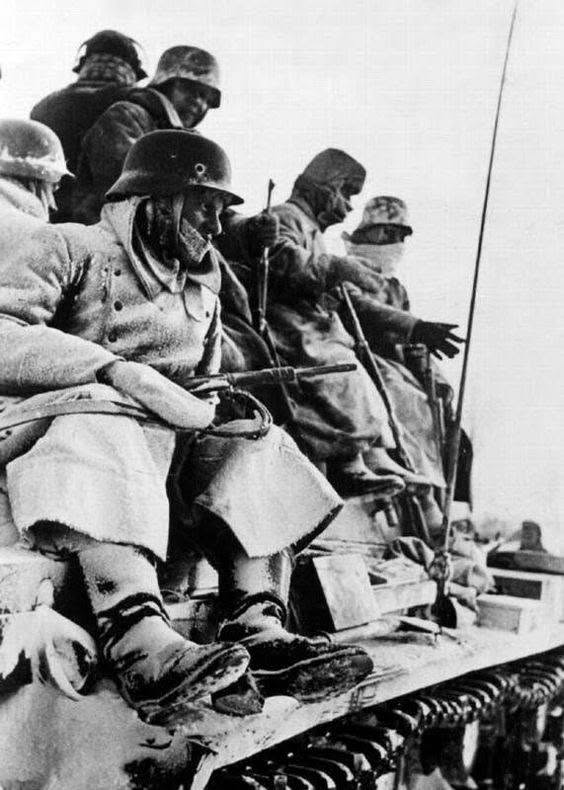
Marshal Mannerheim and General Hjalmar Siilasvuo of the Finnish high command on 17 November 1941 directs its forces to cease active offensive operations and dig in for the winter where they stood. This includes forces pursuing Operation SILVER FOX, the advance toward the Murmansk Railway at Loukhi, and Operation ARCTIC FOX, the offensive in the far north toward Murmansk. Since operations out of Finland have been led by Finnish forces and the performance of German units has been decidedly mediocre, this independent decision must be accepted by the Germans as a fait accompli. The German leaders are not happy about this decision and continually attempt to reverse it, with only occasional and minimal success. Thus, in the largest sense, 17 November 1941 marks the end of Finnish attempts to advance into the Soviet Union during World War II.
The Finns have several different reasons for halting operations. They have been receiving intense diplomatic pressure from the United States and Great Britain to stop advancing, using the argument that further advances would imperil Lend-Lease supplies to the Soviet Union. The Wehrmacht troops in Finland have performed poorly, being unused to the forests and marshes that characterize the front, and have no prospects for being reinforced. This has put the main military burden on the Finns, who have been fighting hard and losing dozens of men every day and sometimes many more.
Having the most effective troops under their control has given the Finns leverage to make whatever decisions they want without regard to German desires. In addition, and perhaps most importantly, Mannerheim always has taken the position that he never wants to create the impression that Finland is a threat to the Soviet Union. Mannerheim knows that his country could never survive such a relationship in the long run. Recovering lost territory is one thing, but attempting to conquer all of Russia is completely out of the question. Thus, ending operations makes more sense than aggravating further Finland’s already tense relations with the USSR, Great Britain, and the United States.
The halt in activities leaves the Finnish front on the outskirts of Leningrad, on the Svir River, and running up parallel to the Murmansk Railway all the way to Petsamo. In the ARCTIC FOX area, Siilasvuo has waited until the Finnish 3rd Division west of Loukhi has killed 3,000 Soviet soldiers and captures 2,600, leaving them with a secure front and no Soviet remnants in the rear. The Murmansk Railway remains about 30 km (19 miles) to the east. Further north, in the SILVER FOX sector, the front already has been stable for about two months, and the Finnish decision merely codifies the actual state of operations. Here, the German Mountain Corps Norway at least has occupied the Petsamo area and its extremely valuable nickel mines. However, the true prize, the port of Murmansk, remains far over the horizon. Supply difficulties all but rule out any resumption of the offensive in either sector without full Finnish cooperation which is not forthcoming.
The advance of the German 1st Panzer Group continues near Rostov. Soviet General Semen Timoshenko, commander of the Southwestern Theater, begins a counterattack on the flank of the German column.
Soviet attacks by massed T-34 tanks strike the German 112th Infantry Division. The Germans break in panic, losing most of a regiment, the first time this has occurred in World War II.
German troops near Moscow, Russia fought Central Asian troops for the first time (Soviet 44th Cavalry Division) at Musino, Russia, 70 miles west of the capital. German artillery blunted the cavalry charges, with the Germans claiming 2,000 killed.
German Luftwaffe III./KG 55 received orders to relocate from Kirovograd, Ukraine to Saint-André-de-l’Eure, France for rest and refitting after spending only seven weeks at Kirovograd.
Soviets dispatched several small teams to test the thickness of the ice on Lake Ladoga near Leningrad, Russia.
The Reichskommissariat Ostland was established under Alfred Rosenberg to administer territories taken from the Soviet Union. This ministry is new and has jurisdiction over the Baltic states and White Russia. The mission is to exploit them for German economic benefit while ridding them of “undesirable elements” such as Jews and Communists. Rosenberg is the Nazi Party “expert” for racial matters.
Himmler telephones Heydrich and tells him about the results of his meeting with Rosenberg, the situation in the Government General, and the “elimination of the Jews.”
British Lieutenant Colonel Geoffrey Keyes led the daring Operation Flipper commando raid to either kill or capture Rommel at his Afrika Korps Headquarters at Sidi-Rafa. He was mortally wounded and the other commandos were forced to withdraw. Only two men made it back, the rest being either killed or captured. Keyes would be awarded a posthumous Victoria Cross even though the raid was doomed from the start — Rommel was not even at Sidi-Rafa.
German submarine U-331 landed eight commandos on the Egyptian coast to mine the railway line near Daba, 60 miles west of Alexandria. They would soon be captured before they completed their mission.
German intercept stations in Egypt report complete radio silence from the British.
Following twelve months of illness, depression and strain at the Luftwaffe’s increasing losses on the Eastern Front, Generaloberst Ernst Udet, the German Director General of Air Armament, committed suicide by shooting himself. The official version was that he had died whilst testing a “new weapon” and Jagdgeschwader 3 was named in his honor. Udet was accorded a state funeral at which he was eulogized by Hermann Göring, who described him as his “best friend”. World War I flying ace Generalluftzeugmeister Generaloberst Udet, German Director General of Air Armament, commits suicide in Berlin. He shoots himself in the head while on the telephone with his girlfriend after expressing deep unhappiness with the actions of Reichsmarschall Hermann Göring, yelling as his final words, “Man of iron (Göring’s nickname), why have you abandoned me!” (some sources claim he wrote this on the headboard of his bed in red). Udet has been in lingering disfavor with both Hitler and Göring due to the failures of the Luftwaffe during the Battle of Britain. Blaming Udet is unfair, as he never intruded on strategy, but the alternative is to blame Göring himself for the failure (and where the true blame does lie) and that is not acceptable. The fault did lie somewhat in aircraft procurement, as the Luftwaffe’s medium bombers were inadequate to the strategic bombing tasks asked of them, but Göring had the final say in those decisions during the 1930s. Udet’s death is an ill omen for the future course of the war, and the events surrounding the Udet funeral set in motion changes that will drastically affect the Luftwaffe’s future.
Allied convoy QP.2 arrived at Kirkwall, Scotland, United Kingdom and convoy PQ-4 departed Hvalfjörður, Iceland.
The ration of canned meat, canned fish, and canned beans began in the United Kingdom; this was announced 15 days earlier by the British Minister of Food.
Heavy cruiser HMS Kent departed the Faroes-Iceland patrol for Hvalfjord. Light cruiser HMS Sheffield took over patrol of this area and her own area. The heavy cruiser arrived at Hvalfjord on the 18th.
Light cruiser HMS Edinburgh departed Denmark Strait patrol for Hvalfjord. The light cruiser arrived at Hvalfjord on the 18th.
Heavy cruiser HMS Berwick with destroyers HMS Onslow and HMS Offa departed Hvalfjord at 0900 for Seidisfjord where they arrived at 0900/18th. After refueling, the warships departed Seidisfjord at 1300/19th to rendezvous with convoy PQ.4 and escort it to Archangel.
Convoy PQ.4 departed Reykjavik with steamers Soviet Alma Ata (3611grt), Day Y Bryn (5117grt), Eulima (6027grt), Soviet Rodina (4441grt), Soviet Budenni (2482grt), Empire Meteor (7457grt), Soviet Mossovet (2981grt), and Soviet Sukhona (3124grt). The convoy was escorted by trawlers HMS Bute and HMS Stella Capella from 17 to 27 November. Heavy cruiser HMS Berwick and destroyers HMS Offa and HMS Onslow escorted the convoy from 25 to 27 November. The convoy was to have been met on the 20th, but the warships were unable to locate the convoy. On the 27th, minesweepers HMS Gossamer, HMS Seagull, and HMS Speedy met the convoy relieving the heavy cruiser, destroyers, and trawlers, which proceeded to Murmansk, arriving at 1030/28th. The heavy cruiser and destroyers were bombed unsuccessfully as they entered harbour. The convoy arrived at Archangel on the 28th.
Minesweeper HMS Ross departed the Humber for Aberdeen and the Faroes.
T/Sub Lt M. S. H. Christopher RNVR, was lost overboard from submarine HMS P 38 while the ship was returning from patrol southwest of Ireland and west of Land’s End. The submarine arrived at Portsmouth on the 22nd.
British steamer Bovey Tracey (1212grt) was sunk by German bombing in 52-58N, 2-05E. The entire crew was rescued.
German steamer Schwaneck (2194grt) was lost on a mine near Stettin.
Light cruisers HMS Ajax, HMS Neptune, and HMAS Hobart and destroyers HMS Kandahar, HMS Hasty, and HMS Hotspur departed Alexandria to bombard the Sollum area during the night of 17/18 November. The bombardment was cancelled due to poor weather. The ships joined the Battle Fleet departing Alexandria on the 18th at noon on the 18th.
Captain H. St. L. Nicolson, Captain 2nd Destroyer Flotilla, which had been ashore since damage to destroyer HMS Ilex, took command of destroyer HMS Griffin as Leader of the 2nd Destroyer Flotilla.
Submarines HMS Upright and HMS Urge unsuccessfully attacked a convoy in the Ionian Sea.
Anti-submarine trawlers HMS Stella Carina and HMS Lady Hogarth departed Gibraltar to meet arriving Norwegian tanker President de Vogue (9320grt). The trawlers were reassigned to join the escort of outward tanker Thorshavet on the 23rd. Corvette HMS Vetch departed Gibraltar to meet tanker President de Vogue and arrived back with her on the 25th.
Dutch steamers Pluto (1156grt) and Rhea (1388grt) were seized by French forces at Algiers.
U-331 landed two German officers and seven enlisted men of a Commando group near Daba, sixty miles west of Alexandria, to mine the railway. All nine German Commandos were captured later the same day before any sabotauge was done.
Vichy French submarine Le Heros sank Norwegian steamer Thode Fagelund (5757grt) thirty five miles east of East London. The entire crew was rescued. The attack was in retaliation for the British operation against a French convoy on the 2nd.
In Washington today, President Roosevelt asked Congress for a supplemental Army appropriation of $6,687,369,046 and a supplemental Navy appropriation of $380,050,000. His trip to Warm Springs, Georgia, Wednesday, was postponed. He received Secretary Hull, Japanese Ambassador Nomura, and Saburō Kurusu, special Japanese envoy. Other visitors included Benjamin F. Fairless, Eugene Grace and Frank Purnell, Senator Mead and Postmaster General Walker.
The Senate passed the bill to regulate manufacture and use of explosives, approved the O’Mahoney resolution asking OPM for information of priorities administration, received the Connally bill extending the President’s plant seizure power to include mines, received the McKellar bill to require labeling of propaganda and filing of copies with the government, received the defense investigating committee’s report on lack of strategic materials and adjourned at 3:03 PM until noon Wednesday. The Military Affairs Committee heard support for bills raising pay of the armed services; the Privileges and Elections Committee concluded hearings on charges against Senator Langer; the Public Lands subcommittee issued a preliminary report urging the development of mineral resources.
The House received the Wickersham bill providing for operation of struck defense industry plants with soldiers, heard Representatives Vinson and Howard Smith urge immediate consideration of anti-strike legislation, heard Representative Norton defend the Labor Committee, authorized Representative Fish to appear before the District of Columbia grand jury when the House is not in session and adjourned at 3:21 PM until noon tomorrow. The Rules Committee considered price control legislation.
The seven seas and belligerent ports of the world formally were thrown open to armed American merchant ships at 4:30 PM today when President Roosevelt signed into law the bill repealing all neutrality act shipping restrictions. Simultaneously this afternoon the Navy began the task of arming American merchantmen, a process which promised to go slowly at first, but one for which large amounts of guns and ammunition already are at hand. For more than six months the Navy has been manufacturing guns and munitions in anticipation of the order to proceed, and while production figures are secret, the schedule indicated that the program is more than half completed. Anticipating the great increase authorized in merchant-ship construction in recent months, President Roosevelt today asked Congress for another $120,000,000 for arms to provide for the 1,200 new ships to be constructed in 1942 and 1943. Whatever ships are diverted to the work of supplying Britain must be manned by American crews. Heretofore, ships placed in British service have been registered under a foreign flag and operated by British or Allied crews. While most American ships now in operation will continue on their assigned routes, nevertheless they will be armed against far-ranging submarines and surface raiders, with priority given to those which face the greatest risk.
Supplemental appropriations totaling $7,082,419,046 for the Army, Navy and defense housing were asked of Congress today by President Roosevelt. If granted they would bring to $67,577,000,000 the net total for appropriations and contractual authority for the defense program since its inception in June, 1940. Mr. Roosevelt asked $6,687,369,046 for the Army, of which the largest single item was $3,719,883,246 for ordnance. He requested $380,050,000 for the Navy and $15,000,000 for defense housing. The House Appropriations Committee immediately began consideration of the requests, completing during the afternoon the testimony of Navy Department officials who gave justifications for the fund asked for the Navy. Of the amount, $50,000 was for the office of Secretary of the Navy, $250,000,000 for maintenance of Navy vessels, $120,000,000 for defense installations on merchant vessels and $10,000,000 for a naval emergency fund. The committee expects to add today’s requests to a pending deficiency bill in order to speed them to the floor of the House.
Without a dissenting voice, the Congress of Industrial Organizations today placed its unqualified support behind John L. Lewis and his United Mine Workers in their demand for a union shop in captive coal pits. As the C.I.O. opened Its fourth annual convention here, delegates also applauded a call for “wholehearted” backing of President Roosevelt’s foreign policy. In pledging unanimous support to the U.M.W. the convention approved a resolution adopted yesterday by the executive board. The convention also received for later consideration an executive board statement contending that arms production was lagging and urging full employment of the nation’s manpower and productive facilities in the defense program. President Philip Murray drew cheers when he advocated “wholehearted” support of the administration’s foreign policy.
An effective strike of United Mine Workers (C.I.O.) slowed the flow of fuel to steel mills to a trickle today, and John L. Lewis, belligerently defying the government threat to use troops, declared “the army is not going to shoot our people and the soldiers are not going to mine coal.” To President Roosevelt, who had asked for a personal report on weekend negotiations concerning U.M.W.’s demand for a union shop in “captive” coal mines, Lewis sent instead a letter which he also made public. This communication recited mine workers’ contention an open shop agreement with steel companies which own the captive mines would violate union shop agreements with commercial coal mines.
A definite assurance was given to the House today by Speaker Rayburn that anti-strike legislation would be considered “at the earliest opportunity,” as the defense labor situation flared up in both branches of Congress. Mr. Rayburn was unable to give an answer to the question of “when” such legislation would be taken up, but every indication pointed to a decision being made tomorrow when House and Senate leaders meet with President Roosevelt in the regular weekly conference. Mr. Rayburn’s statement to his press conference that he would carry out his promise, delivered to the House during the Neutrality Act revision debate, that strike legislation would be permitted on the legislative program was considered particularly significant since he made it prior to the convening of the regular weekly legislative conference at the White House.
The Catholic bishops of the United States tonight branded Nazism and communism alike as “the two greatest evils of today” and pledged whole-hearted support of “adequate defense of our country. In a formal statement, they also appealed for unity among the American people, expressed hope for labor peace and asked prayers for the president, the congress and “all who bear the grave responsibilities of government in these difficult days.”
The United States and Great Britain, it was learned today, have made “substantial progress” toward the completion of an important agreement on the broad economic principles that they intend to follow at the end of the war.
Bureau of Navigation directs that naval district personnel who received Armed Guard training be assigned to Little Creek, Virginia, or San Diego, California, for further instruction. They will be transferred to Armed Guard centers at New York, New York, and Treasure Island, California, for assignment to merchant ships.
A U.S. Army bomber plunged to a fiery end in the snow-lashed Wasatch Mountains early today after five of the seven men aboard had parachuted to safety. Major Robert E. L. Pirtle, 34 years old, of Council Grove, Kansas, plummeted several thousand feet to death with a torn parachute trailing him. He was commander of the Eighty-eighth Reconnaissance Squadron, based at Fort Douglas in Utah. Sergeant J. D. Anderson, 20, of Ogden, Utah, stayed with the plane and was killed as it plowed into a tree-studded mountainside and exploded. The pilot, First Lieutenant William E. Baysy was the only one of the five survivors to be injured seriously. His gale-driven parachute dropped in rugged terrain, then dragged him along the rock and brush-covered hills, several miles northeast of the crash scene. Private Robert L. Togensen of Mason City, Iowa, jumped so suddenly that he lacked time to buckle his parachute straps. He clung on with his hands and hooked his arms through the cords.
Three or four patients were believed to have perished early today in a fire that destroyed one of the buildings of the Brunswick Home, a private hospital in Amityville, Long Island, New York.
Destroyers USS Benson (DD-421) and USS Edison (DD-439), screening convoy ON.34, depth charge submarine contacts.
TU 4.1.5 (Commander William K. Phillips) intercepts and joins convoy HX.160; although none of the destroyers in the task unit will be damaged by enemy action, all — USS Mayo (DD-422), USS Babbitt (DD-128), USS Leary (DD-158), USS Schenck (DD-159), and USS Nicholson (DD-442) — will suffer storm damage of varying degrees between this date and 28 November.
German blockade runner Odenwald, captured by light cruiser USS Omaha (CL-4) and destroyer USS Somers (DD-381) on 6 November, is escorted into San Juan, Puerto Rico, by Somers and turned over to U.S. authorities.
The United States delivered escort carrier HMS Archer to the United Kingdom, the first of 38 escort carriers that would be delivered during the war under Lend-Lease.
Japanese special envoy Kurusu Saburō arrived in Washington, DC, and met with U.S. Secretary of State Cordell Hull. Ambassador Kurusu told President Roosevelt that Germany had not requested Japan to fight.
Conferences that may decide whether there will be peace or war in the Far East opened today when President Roosevelt received Saburō Kurusu, special Japanese envoy, for an hour-and-a-quarter conference at the White House. Secretary of State Cordell Hull and Japanese Ambassador Kichisaburō Nomura also were present.
U.S. Ambassador to Japan, Joseph C. Grew, warned that the embassy in Japan was not in a position to warn of an impending Japanese attack and that the government should, “… take into account the probability of the Japanese exploiting every possible tactical advantage, such as surprise and initiative.”
The Nationalist leader, Chiang Kai-Shek, calls for the western democracies to take action against Japan. A declaration by Generalissimo Chiang Kai-shek that Japan is on the point of opening a drive to shut the Burma Road coincided today with, the assertion of his Foreign Minister, Quo Tai-chi, that “all signs seem to point” toward an “A.B.C.D.” alliance of America, Britain, China and the Netherland (Dutch) Indies to resist Japan.
Japan pushed the Pacific crisis toward the point of peace or war today. Tokyo warned the United States that her patience was nearing an end and laid down terms for keeping the war out of the Pacific. They were that the economic blockade must be lifted, that the “military encirclement” of Japan through agreements of America, Britain, China and the Netherlands be abolished, and that normal trade relations be restored. These points were pronounced by Premier Hideki Tojo, who declared to the Diet that the United States-British economic freezing measures were only a “little less hostile than carrying on armed warfare.” Foreign Minister Shigenorl Togo then told the Diet that the time for negotiations with the United States was drawing toward a close and warned: “There is naturally a limit to our conciliatory attitude.”
In an atmosphere of gloom the Japanese Diet gave the impression that the empire had fatalistically resolved to go to war with the United States unless Washington made what would amount to utter capitulation in the Pacific. Japan’s House of Representatives heard, without questions save from a single speaker who was more a friendly interlocutor than a critic, those “minimum” peace requirements which the house of peers already had approved. These are that the United States quit helping China and drop its alleged participation with Britain, China and the Dutch East Indies in what Tokyo claims is an “economic blockade” and “military encirclement.” The house quickly approved the government’s $874,000,000 extraordinary military budget, with passage today by the house of peers a certainty.
In a detailed speech before the Diet, Premier Hideki Tojo declared today that Japan was bending all efforts toward a peaceful diplomatic settlement in the Pacific which would safeguard the existence and prestige of the empire and establish a “New Order in East Asia,” but that Great Britain, the United States and the Netherlands Indies, viewing Japan’s legitimate effort at self-defense with suspicion, had taken military measures and had established an economic blockade against Japan “in which stand we by no means acquiesce.” Because of this, Premier Tojo outlined a three-point program on the fulfillment of which he indicated success of the present negotiations in Washington, now reinforced by special envoy Saburō Kurusu, would depend.
Foreign Minister Shigenori Togo said an amicable conclusion of Japan’s negotiations with the United States was by no means impossible. . . if the Government of the United States are, on the one hand, as genuinely solicitous for world peace as are the Imperial Government, and on the other understand Japan’s natural requirements and her position in East Asia and consider the situation as it exists there in the light of realities,” but Japan would face any threat to its empire or compromise of its prestige with firm resolve. “…there is naturally a limit to our conciliatory attitude.”
Japan has requested the Indo-China Government to provide facilities for 50,000 additional Japanese troops in the French colony, which would establish a Japanese force in that strategic country of more than double the 40,000 agreed upon last July, according to trustworthy reports received here tonight.
Imperial Japanese Navy aircraft carrier HIJMS Kaga arrived at Saeki Bay off Oita, Japan and embarked 100 specially modified aerial torpedoes.
Kido Butai, the Pearl Harbor Carrier Striking Force, assembles at the mouth of the Inland Sea. It comprises six aircraft carriers, two modern battleships (Hiei and Kirishima) with 14-inch guns, two heavy cruisers (Chikuma and Tone), and numerous other ships. All told, the carriers have 360 planes, including 81 fighters, 135 dive bombers, 104 horizontal (high-level) bombers, and 40 torpedo bombers. The torpedo bombers’ Type 91 Model 2 torpedoes have been specially modified to account for the shallow depths of Pearl Harbor. After dark, the ships of Kido Butai leave their anchorages and head north to a rendezvous point a thousand miles north of Tokyo. Admiral Yamamoto, who is remaining behind aboard a battleship, has had all senior commanders briefed on the mission. However, diplomatic efforts continue in Washington in a last-ditch effort to prevent the outbreak of hostilities, so the next step is subject to final orders from Tokyo.
Dow Jones Industrial Average: 116.2 (-0.52)
Born:
Peter Hoagland, American politician (Rep-D-Nebraska 1989-1995), in Omaha, Nebraska (d. 2007).
Tova Borgnine [Tove Traesnaes], Norwegian-American businesswoman, beauty entrepreneur and founder of Tova Beverly Hills, in Oslo, Norway (d. 2022).
Died:
Ernst Udet, 45, German World War I flying ace and Luftwaffe general, by suicide.
Naval Construction:
The Royal Navy YMS-1-class auxiliary motor minesweeper HMS BYMS 2007 (J 807) is laid down by the Wheeler Shipbuilding Corp. (Whitestone, Long Island, New York, U.S.A.).
The U.S. Navy Auk-class Minesweepers USS Speed (AM-116), USS Strive (AM-117), USS Steady (AM-118) and USS Sustain (AM-119) are laid down by the American Shipbuilding Co. (Lorain, Ohio, U.S.A.).
The U.S. Navy SC-497-class (110-foot wooden hull) submarine chaser USS PC-669 (later SC-669) is laid down by the Daytona Beach Boat Works Inc. (Daytona Beach, Florida, U.S.A.).
The U.S. Navy SC-497-class (110-foot wooden hull) submarine chasers USS PC-670 (later SC-670) and USS PC-671 (later SC-671) are laid down by Inland Waterways Inc. (Duluth, Minnesota, U.S.A.).
The Royal Navy Vosper 72-foot motor torpedo boat HMS MTB 278 is laid down by the Annapolis Yacht Yard Inc. (Annapolis, Maryland, U.S.A.). She is transferred to the Royal Indian Navy on completion and commissions as HMIS MTB 278.
The U.S. Navy Cleveland-class light cruiser Huntington (CL-77) is laid down by the New York Shipbuilding Corp. (Camden, New Jersey, U.S.A.). She is later reordered in March 1942 and completed as the light fleet aircraft carrier USS Cowpens (CVL-25).
The Royal Navy LCT (Mk 2)-class landing craft, tank HMS LCT 141 is launched by Stockton Construction (Thornaby, U.K.).
The Royal Navy LCT (Mk 2)-class landing craft, tank HMS LCT 167 is launched by Tees-Side Bridge (Middlesbrough, U.K.).
The Royal Navy LCT (Mk 3)-class landing craft, tank HMS LCT 141 is launched by Tees-Side Bridge (Middlesbrough, U.K.).
The Kriegsmarine (German Navy) Type VIIC U-boat U-660 is launched by Howaldtswerke Hamburg AG, Hamburg (werk 809).
The Royal Navy Fairmile B-class motor launch HMCS ML 053 is commissioned.
The Royal Navy Fairmile B-class motor launch HMCS ML 450 is commissioned.
The Royal Navy Fairmile B-class motor launch HMCS ML 451 is commissioned.
The Royal Navy harbor defence motor launch HMS HDML 1078 is commissioned.
The Royal Navy LCT (Mk 2)-class landing craft, tank HMS LCT 129 is commissioned.
The Royal Navy Bangor-class (Reciprocating-engined) minesweeper HMS Stornoway (J 31) is commissioned. Her first commanding officer is T/Lieutenant Charles Robertson Fraser, RNR.
The Royal Canadian Navy Flower-class corvette HMCS Midland (K 220) is commissioned. Her first commanding officer is T/Lieutenant Allan Brown Taylor, RCNR.
The Royal Navy Long Island/Archer-class escort carrier HMS Archer (D 78) is commissioned. Her first commanding officer is Commander James Ian Robertson, RN.
.
.
.
20 days to Operation Z.

