Secretary of State George P. Shultz appeared to propose a further retreat today from the American offer to eliminate all nuclear ballistic missiles in 10 years. In a speech in Chicago, he suggested that the United States might wish to retain “a small nuclear ballistic missile force” to guard against cheating by the Soviet Union in arms control. He spoke two days after Prime Minister Margaret Thatcher said here that President Reagan had agreed not to press the Soviet Union to ban all ballistic missiles by 1996, as he had proposed in Iceland. Nor, she said, would he seek the abolition of all offensive strategic forces, which he had accepted as a 1996 goal when it was presented by Mikhail S. Gorbachev, the Soviet leader.
The White House and the West German Defense Ministry sought today to link nuclear arms-control proposals put forth by the Reagan Administration at the Iceland meeting with parallel steps to balance other forces of the Atlantic alliance and the Warsaw Pact nations. But statements by Defense Minister Manfred Worner on the course of future arms-control talks diverged in some regards from the Reagan Administration’s description of its arms-control policies. Mr. Worner, after meetings today with President Reagan and Defense Secretary Caspar W. Weinberger, told reporters that West Germany, like other Western European nations, supported the idea of a 50-percent reduction in strategic nuclear forces over a five-year period and a reduction to zero in intermediate-range missiles stationed in Europe.
Defense Minister Sergei L. Sokolov, who missed key meetings because of illness, showed up today for the opening of the fall session of the Supreme Soviet. Mr. Sokolov, who is 75 years old, missed the Revolution Day parade across Red Square on November 7, fueling rumors that he was ill. Gennadi I. Gerasimov, the Foreign Ministry spokesman, later confirmed that Mr. Sokolov had been ailing.
The president of Renault, the state-owned auto maker, was shot to death tonight in front of his home, the police said. The assailants escaped. There was no initial claim of responsibility for the killing of the industrialist, Georges Besse. But police officials said they suspected the terrorist group Direct Action. Police officers and witnesses said Mr. Besse, 58 years old, was shot several times by a man and a woman, or possibly two women, after he got out of his car. Prime Minister Jacques Chirac went immediately to the scene of the shooting on the Boulevard Edgar Quinet, in the Montparnasse district. He was accompanied by Robert Pandraud, Minister for Security; Alain Marsaud, head of the newly created anti-terrorist section of the Paris prosecutor’s office, and Pierre Touraine, head of the Paris judicial police. The neighborhood was sealed off. Mr. Chirac said he was “horrified by the beastly assassination,” adding, “Nothing can justify or explain this action.” President Francois Mitterrand, on an official visit to Burkina Faso, said: “This event confirms once again that all our forces must unite against terrorism, without flinching and without compromise.”
The trial of two Palestinians charged in a bombing here opened today with a reading by the judge of pretrial testimony implicating Syria and its embassy in East Berlin. The bombing last March, at an Arab social club, left nine people severely wounded. The defendant, Ahmed Nawaf Mansour Hazi, a 35-year-old Jordanian, interrupted the first day’s proceedings with an emotional political harangue, asserting that he had been deranged by “waves of voices” that he said had been beamed into his cell by Western intelligence agencies. The Jordanian is the brother of Nezar Hindawi, who last month was sentenced by a British court to 45 years’ imprisonment for trying to plant a bomb, hidden in his pregnant fiancee’s bag, aboard an El Al Israel Airlines jumbo jet. The Hindawi trial pointed to the involvement of Syrian intelligence agents and the Syrian Embassy in London in the failed El Al attack, prompting Britain to break off diplomatic ties with Damascus.
Demonstrators attacked officers guarding Greek government buildings during a march on the U.S. Embassy in Athens, injuring four officers, two of them seriously, police said. Most of about 100,000 demonstrators dispersed peacefully after the march commemorating a student uprising 13 years ago, but about 1,500 of the marchers attacked guards along the route and stole four police revolvers, police said. Scores of students were killed in the 1973 uprising against the military regime then ruling Greece. The protesters marched on the U.S. Embassy because, they said, Washington was “morally responsible” for military rule.
Police said 36 Shell gasoline stations in Copenhagen and other parts of Denmark have been vandalized by anti-apartheid activists protesting the oil company’s involvement in South Africa. Copenhagen police said activists cut pump hoses, poured sugar or cement into fuel storage tanks and broke windows in Shell station buildings. Five activists were arrested. They identified themselves as members of the Solidarity With Steve Biko organization. Biko was a black activist who died in South African police custody in 1977.
Israeli helicopter gunships struck today at Palestinian targets on the outskirts of the southern Lebanese port of Sidon. It was the second Israeli air attack in that area in as many days. The police said three Cobra helicopters made direct hits on a two-story building at the southern edge of the Palestinian district of Ain Khilwe. Parts of the building collapsed as a big cloud of smoke billowed from the rubble, the police said. Ambulances were seen rushing toward Ain Khilwe to evacuate casualties, which had not yet been counted, local radio stations reported. The building served as operational headquarters for a Damascus-based guerrilla group, the Popular Struggle Front, according to local residents and the Israeli radio, monitored in Beirut.
In talking publicly about the possibility he might resign, Secretary of State George P. Shultz appears to have swayed White House policy on Iran in his direction, at least for the moment. But even though President Reagan said personally today that he had “absolutely no plans” to send more arms to Iran, it was far from clear that this would put to rest widespread speculation in Washington that Mr. Shultz’s days in the Reagan Administration may be numbered. Top aides to Mr. Shultz said they thought he was sending a message, in his extraordinary television appearance on Sunday, and the initial reaction at the State Department was that it was having positive results: that Mr. Reagan, who watched Mr. Shultz’s performance, had rushed to say what Mr. Shultz had wanted to have said — no more arms to Iran. But it remained unclear whether this was the firm return sought by Mr. Shultz to the policy that existed before the secret arms shipments to Iran were begun against his recommendation. Mr. Reagan is due to hold a news conference on Wednesday night, and State Department aides hope for an unequivocal statement by the President backing up Mr. Shultz’s position.
President Reagan said today that he had “absolutely no plans” to send more arms to Iran, and the White House urged United States allies to refrain from shipping weapons to Teheran as well. White House aides said later that the President was referring not only to weapons but also to all military supplies and parts. Mr. Reagan’s comment seemed to represent a gesture in the direction of Secretary of State George P. Shultz, who has said he opposes further military shipments to Iran. Mr. Shultz has made little effort in public to disguise his disapproval of the clandestine operation. With White House officials conceding that the disclosure of American arms shipments to Iran has turned into one of the most embarrassing episodes of the Reagan Presidency, White House aides today sought to play down divisions within the Administration.
Contrasting statements by Iranian officials about secret American arms shipments to Iran do not indicate basic disagreements, diplomats at the UN and other Iran experts believe. On the contrary, they said, Iranian officials seem united in their eagerness to exploit the controversy for domestic and foreign consumption. “What’s going on in Tehran is almost a mirror image of what’s going on in the Reagan Administration, with different officials saying different things,” a Reagan Administration official said. “In fact, there is no difference in the Iranian line, while there is considerable disagreement over our policy.”
Terry Waite, the Anglican Church envoy involved in hostage negotiations in the Middle East, said today that his task had been made “immeasurably more difficult” by the disclosure of American arms shipments to Iran. But he said he did not personally feel he had been exploited by the Reagan Administration. “I am conscious of the fact that you step into these waters and run the risk of being used every day by a different party,” he said at a news conference. “But ‘used’ depends on the user and this is for them to answer.”
Lawyers for 17 defendants charged with plotting to ship more than $2-billion worth of arms to Iran demanded dismissal of the case in U.S. District Court in New York. They contended that the defendants were doing nothing illegal because President Reagan himself had set up a secret arms pipeline to the Mideast nation. “The foreign policy of the United States contemplates the very kind of arms shipments we are charged with,” said Paul R. Grand, a lawyer for one of the defendants. However, government lawyers argued that the case is unrelated to the White House action.
Waves of Soviet and Afghan air force jets bombed and rocketed guerrilla positions in eastern Afghanistan as ground forces pounded the insurgents’ fortifications with artillery and tank fire. Guerrilla sources said thousands of troops are involved in a major offensive in Nangarhar province, close to the Pakistani border. The mujahedeen rebels have been reported under heavy attack since late last week, when the Soviet and Afghan forces began an effort to close rebel supply routes.
In a significant spur to the negotiations to end the guerrilla war in Sri Lanka, Prime Minister Rajiv Gandhi of India today endorsed the Sri Lankan Government’s proposals for a political settlement with the Tamil insurgents. Leaders of the main Tamil guerrilla group were reported tonight to have again rejected the Colombo proposals for greater political autonomy for Tamil areas. But Mr. Gandhi’s action had the effect of increasing pressure on them to accept eventually.
North Korea reported today that its leader, Kim Il Sung, greeted a foreign group this morning. The report, also carried by the Chinese press agency, was apparently intended to dispel rumors that Mr. Kim had been killed. But confusion over the fate of the North Korean leader persisted amid reports in South Korea that his Defense Minister had seized power. The North Korean press agency said Mr. Kim had “warmly met” a visiting Mongolian delegation at the airport in Pyongyang and then joined his guests in reviewing a military honor guard. Thousands of people were on hand, the report said.
The North Korean leader recently visited Moscow, and his death would be a matter of concern for the Russians. The Soviet Union, which has nurtured closer ties with North Korea in recent years, withheld comment today on conflicting reports of political turmoil in that country. If Soviet officials knew whether Kim Il Sung, the North Korean leader, had been killed or ousted, as unconfirmed reports from South Korea asserted, they were not talking publicly about it. Moscow’s stake in any leadership change would be considerable because of North Korea’s efforts over the years not to side with either China or the Soviet Union in disputes between these two countries.
Leftist activists entered the political struggle today with a general strike that shut down some public transport and slowed work at some factories in Manila and other areas outside the capital. The strike, called to protest the killing Wednesday of a militant union leader, had only limited effect, but its organizers said they had decided to continue it for the next three days. The revival of activism among the left added to a growing polarization fueled by the agitation of Defense Minister Juan Ponce Enrile and brought to a head by the killing of the union leader, Rolando Olalia, and the kidnapping Saturday of a Japanese businessman, Nobuyuki Wakaoji. Leftist leaders said they sensed a moment of both heightened danger and increased opportunity as the splits in the nation became sharper and the extent of the Government’s control came into question.
Caribbean and Central American leaders meeting in Miami criticized President Reagan’s program aimed at boosting their economies. The three-year-old Caribbean Basin Initiative provides duty-free entry to the United States for scores of goods from 21 Caribbean and Central American countries. However, it has failed to remove duties and quotas on principal Caribbean goods such as textiles, petroleum products and sugar and to stem a decline in the dollar value of the region’s exports, the leaders complained. U.S. officials responded that the region’s governments need to do more to attract foreign investment.
Eugene Hasenfus’ lawyer said the American will not appeal his 30-year prison sentence to the Nicaraguan revolutionary court that convicted him of terrorism and crimes against the state. “I have no case to appeal,” said Enrique Sotelo Borgen, the Nicaraguan lawyer. “His sentence was a planned thing. I think there’s no other way out.” The attorney said a decision on a pardon will be made by the ruling directorate of the Sandinista National Liberation Front and President Daniel Ortega. Hasenfus, of Marinette, Wis., was captured by Sandinista troops October 6, the day after a C-123 cargo plane carrying supplies for U.S.-backed rebels was shot down in southern Nicaragua.
The Vice President of Nicaragua, in Atlanta for a conference on emerging democracies, hinted today that a presidential pardon was a possibility for Eugene Hasenfus, an American sentenced to 30 years for his role in flying military supplies to United States-backed insurgents. The official, Sergio Ramirez Mercado, said a pardon by the Nicaraguan President “could help to improve relations between the U.S. Government and Nicaragua.” Beyond movement in the Hasenfus case, Mr. Ramirez held out little hope for a change in Nicaragua’s relations with the United States. He spoke to an audience that included a dozen or so leaders and former leaders in Latin America, Canada and the United States. They included former Presidents Jimmy Carter and Gerald R. Ford, President Raul Alfonsin of Argentina and President Vinicio Cerezo of Guatemala.
Peruvian Indian life is improving under a Government program that pays Indians to work for themselves and their community. The program is part of an attempt to defy leftist guerrillas in the sierras.
Brazilian President Jose Sarney conferred today with senior ministers to discuss important economic changes after a landslide Government victory in national elections. In Saturday’s vote, the Government coalition won the governorships of all 23 states. It was the most sweeping victory in Brazil’s electoral history. The senior partner in the coalition, the Brazilian Democratic Movement Party, also won a majority in the Senate and Chamber of Deputies.
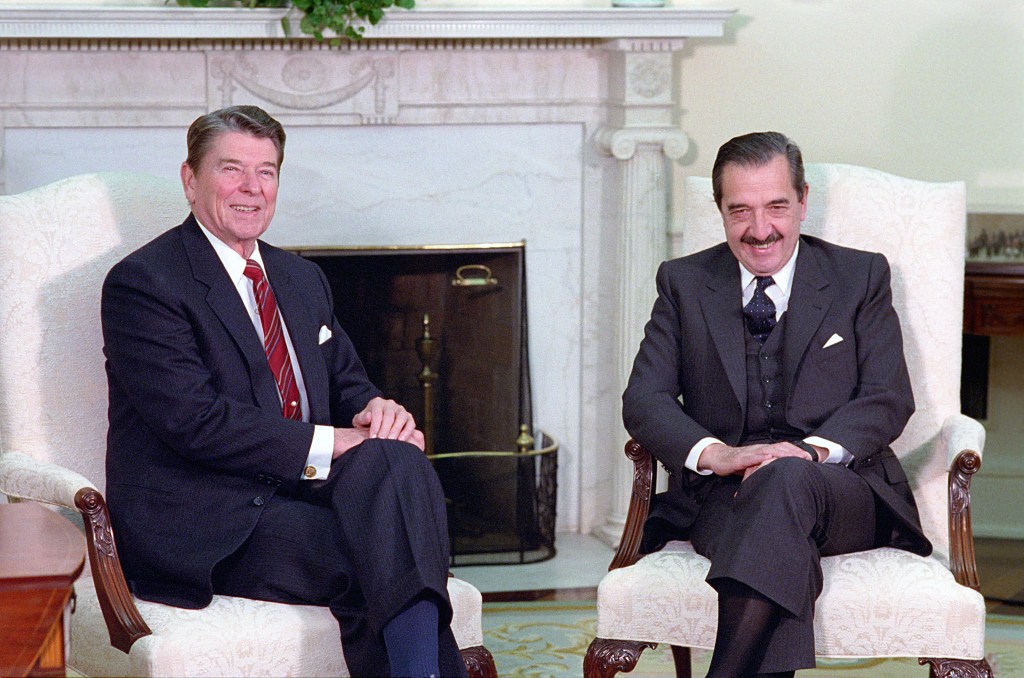
Argentina said today that it would formally end hostilities with Britain if Britain drops a 150-mile “protection zone” around the Falkland Islands, where the two nations fought a 74-day war in 1982. All Argentine planes and ships are barred from that zone in the South Atlantic, which Britain declared at the end of the war. In London, the British Government said it was studying the proposal. Argentina’s offer came hours before a scheduled meeting between President Raul Alfonsin and President Reagan in Washington. The Falkland issue was expected to dominate the encounter. On Saturday and Sunday, Mr. Reagan met with Prime Minister Margaret Thatcher of Britain. Argentine troops invaded and seized the Falklands in April 1982. A British task force ejected the Argentines after 74 days of fighting in which 712 Argentines and 256 Britons were killed. The sovereignty dispute recently intensified, when Britain claimed exclusive fishing rights within 150 miles of the islands and said it would enforce those rights starting February 1.
United States-backed guerrillas have opened a new front in their 11-year-old war against Angola’s Marxist Government, military and diplomatic sources said here today. They said the broadened new fighting had erupted in the oil-rich northern region of this African nation. “We feel that Unita has tried to open a front in the north, supplied from Zaire,” Angola’s highest-ranking military officer, Col. Antonio dos Santos Franca, said today. In the first nine months of this year, 230 guerrillas of the Union for the Total Independence of Angola, or Unita, were killed in Uige and Zaire provinces, an area 800 miles from the group’s traditional stronghold in Angola’s southeast corner, the Angolan officer, who is known as Colonel Ndalu, said.
South African policemen used dogs and whips today to break up a gathering of striking workers at the General Motors plant in Port Elizabeth, witnesses said. General Motors said it called in the police after workers, striking in protest at details of the American company’s plan to sell out to local buyers, intimidated fellow workers into staying away from the plant. The strike started on October 29 to back demands for union representation on the board of the local company to be formed as General Motors’ successor and for severance pay when the company changes hands.
Only two Federal agencies have submitted budget requests that comply with the limits suggested by President Reagan for the next fiscal year, Administration officials said today. Except for the the Departments of Education and Energy, the Government agencies have all requested more money than was suggested by the White House in formal “guidance” given to them last summer, the officials said. According to a confidential analysis prepared by the White House Office of Management and Budget, “Most agency requests have exceeded guidance, implying budget deficit of approximately $146 billion — $38 billion over target” for the next fiscal period. It is not unusual for agencies to request more than the amounts recommended by the White House, but the details of such discrepancies are rarely made public. Budget officials said that efforts by agencies to obtain more money than they were instructed to request would prove futile. They said Mr. Reagan was determined to submit a budget that meets the budget-balancing law’s 1988 deficit target of $108 billion without proposing any tax increases.
The Pentagon’s budget may not grow next year, according to members of the Senate Armed Services Committee, who say the Democrats’ control of the Senate could mean trouble for the Administration’s program.
President Reagan participates in a signing ceremony for H.R. 6, the Water Resources Conservation, Development, and Infrastructure Improvement Act. President Reagan, pressed by Oregon GOP senators to overrule a Justice Department veto recommendation, signed a bill designating the Columbia River Gorge, which borders Washington state and Oregon, a national scenic area. Reagan voiced “grave doubts as to the constitutionality” of a key provision that he said could lead to undue federal intervention in land-use decisions. The provision permits a panel to veto condemnation actions taken by the federal government in connection with the administration of the gorge.
President Reagan participates in a Domestic Policy Council meeting to discuss the report of the federalism working group.
In an apparent effort to avoid a clash with Congress, the Administration said today that President Reagan’s national security adviser would hold informal meetings with two Congressional intelligence committees that are looking into American arms shipments to Iran. Both panels are preparing for hearings scheduled to open Friday. The announcement appeared intended to avert a confrontation with Congress over the issue of whether members of the Presidential staff would be compelled to appear before the committees. In the past, members of the National Security Council staff have not appeared before Congressional committees.
In cooperating with a Federal investigation of illegal insider trading on Wall Street, Ivan F. Boesky allowed his conversations with other senior investment industry figures to be electronically recorded in recent weeks, according to several sources with knowledge of the inquiry. Mr. Boesky, one of Wall Street’s leading speculators, has agreed to pay $100 million, in a fine and by returning profits, and to plead guilty to one criminal charge. The sources, who spoke on condition that they not be identified, said the recorded conversations produced evidence involving leading investment bankers, takeover stock speculators and lawyers in the financial world, many of whom had relationships for years with Mr. Boesky. They were not aware their conversations were being tape-recorded, the sources said. A widening of the insider trading scandal to include other investment industry figures could have broad repercussions. Already, several Congressional leaders have said they were considering holding hearings that could lead to tougher stock trading legislation. And yesterday, many of the corporate takeover stocks that have been in the news recently tumbled in price as the rumor mill suddenly grew quiet. Some Wall Street figures were served with Federal subpoenas shortly after Mr. Boesky’s involvement in the insider trading scandal was announced Friday afternoon.
A federal appellate panel in Atlanta halted the execution in Florida of suspected mass slayer Theodore R. Bundy, 39, less than seven hours before he was to die for the murder of a 12-year-old girl. A three-judge panel of the U.S. 11th Circuit Court of Appeals said there was too little time before Bundy’s scheduled 7 AM electrocution to consider his attorney’s arguments, and that “a stay of execution is mandated.” The ruling came after a U.S. District judge in Orlando refused to grant a stay, and after the Florida Supreme Court rejected the appeal. The ruling came less than three hours after Federal District Judge George Sharp in Orlando refused to halt the execution, and after the Florida Supreme Court unanimously rejected Mr. Bundy’s appeal for a stay. Judge Sharp, who issued his 19-page order after almost seven hours of consideration, wrote that Mr. Bundy “failed to make a substantial showing of a denial of a Federal right” in claiming that he was mentally incompetent to stand trial and act as his own attorney in the 1980 trial. The death warrant, signed by Governor Bob Graham, was the first issued in the 12-year-old’s case. Mr. Bundy, 39, has twice outlived death warrants on his conviction for the murders of two sorority sisters in Tallahassee in 1978. Mr. Bundy gained notoriety after he escaped from a jail in Colorado, where he was being held on charges of murdering a nurse. At that time, he was was sought for questioning in 36 slayings of young women.
More than 40 years after its much-criticized decisions upholding the Government’s wartime detention of Japanese-Americans, the Supreme Court agreed today to review a Government appeal disclaiming any liability to pay them damages. The complex case involves what the Government has conceded was a great moral wrong. But the pending appeal does not directly involve the legality of the detention, and could turn on highly technical issues of jurisdiction or statute of limitations. It is thus unclear whether the Court will address the legality or morality of the Government’s actions in uprooting 120,000 American citizens and resident aliens of Japanese ancestry from their homes in Western states and herding them into prison camps.
The Supreme Court ruled today that employers may satisfy their duty to accommodate their employees’ need to observe religious holidays by making any reasonable proposal that avoids conflicts with the employees’ work obligations. The decision, a partial victory for employers, sent back for further proceedings in lower Federal courts a suit by an Ansonia, Connecticut, teacher who had sued his school district for docking his pay for some of the six days a year he took off for religious observance.
The reputed head of the Colombo crime family in New York, Carmine (Junior) Persico, was sentenced to 39 years in prison for racketeering by a judge who called his life “a tragedy.” Persico, along with seven others, is also being tried in New York on charges he is a member of a ruling commission that controls Mafia families in the United States. The jury is still deliberating in that trial. Persico’s son, Alphonse (Little Allie Boy), 33, was sentenced to 12 years, and Gennaro (Jerry Lang) Langella, reputed Colombo underboss, was given a 65-year term for racketeering convictions last June.
More than half (54%) of those surveyed favor quarantine of AIDS patients and more than 25% would decline elective surgery if a blood transfusion were needed, according to the Gallup Poll. In the survey, conducted earlier this month for Newsweek magazine, 48% said that everyone should be tested for acquired immune deficiency syndrome and 89% said they would submit to the blood tests. Of those who backed mandatory screening, 42% said that only the patient should be told of the results, and 38% believed the findings should be reported to the government.
Scores of anti-nuclear demonstrators, including the actor Martin Sheen, were arrested yesterday as they tried to keep workers from entering Energy Department headquarters in Washington and a nuclear test site in Nevada. The police in Washington said 140 people were arrested, while in Nevada the police said 59 people, including Mr. Sheen, were arrested at the site 65 miles northwest of Las Vegas where the nation’s nuclear weapons are tested.
Early in his career, as a Czech intelligence operative known as Ladislav Bittman, Lawrence Martin says, he helped alter old Nazi files and then dumped them into a lake near the West German border. A few days later, a Czechoslovak television crew supposedly investigating ancient legends of the lake dredged up the documents and used them to depict some top West German politicians as war criminals. The operation was a classic example of Soviet-directed disinformation, Mr. Martin says, and he has made it into a case study for a popular new course he is teaching at Boston University called “Disinformation and the Press.” Last week Mr. Martin also officially opened what he describes as the nation’s first center for the study of disinformation at Boston University. Mr. Martin, who changed his name when he sought asylum in the United States after the Soviet invasion of Czechoslovakia in 1968, believes the center can serve as an important buffer against systematic Russian disinformation, which he asserts is undermining America’s role in the world.
Captain Etienne Boerenveen, called the No. 2 man in Suriname’s military government, was sentenced in Miami to 12 years in U.S. prison for offering his South American nation as a stopover for Colombian cocaine dealers for a fee of $1 million a load. He was convicted last September of conspiring to import cocaine and of travel in furtherance of the conspiracy. Boerenveen, 28, and two others, who were given lighter sentences, were arrested last March aboard a yacht in Biscayne Bay, Florida.
In the first successful case of its kind, a Colombian citizen convicted of laundering money has agreed to pay the U.S. government $4 million from a Swiss bank account to satisfy his tax liabilities, the Justice Department announced. Carlos Ernesto Armenta LaFaurie, now of Coral Gables, Florida, agreed to make the payments after the Justice Department’s tax division sued him to collect the funds from his $13 million Swiss bank account.
The body of a Federal drug agent’s wife was found Sunday, two days after she disappeared from her real estate office, the police said. Evidence of a struggle in the office indicated that the woman, Jacqueline L. Lard, 40 years old, had been kidnapped, said Captain Ralph Williams of the Stafford County Sheriff’s office. Mrs. Lard, whose body was found in the woods of Prince William County, was the wife of Ronald Lard, an agent with the Drug Enforcement Administration. The authorities said they had found no links between the death and Mr. Lard’s work as an agent.
I.B.M. will leave an Indiana city. Greencastle, Indiana, population 8,403, will lose nearly 1,000 jobs when I.B.M.’s parts distribution center pulls out, by March, 1987. After 33 years in this western Indiana community, the International Business Machines parts distribution center, the county’s largest employer, which pumps upwards of $20 million a year into local cash registers, had announced it was moving out, lock, stock and memory chip: Nearly 1,000 jobs suddenly gone in a community of 8,403. That announcement, which came six days ago, caused worries in many other communities where plant closings seem to be a weekly event. The new move takes effect by March.
The First Interstate Bancorp today decided to press ahead with its efforts to acquire the ailing BankAmerica Corporation. The decision by First Interstate’s board of directors is likely to increase the pressure on BankAmerica to accept or reject First Interstate’s bid on its merits. It is also expected to raise the level of hostility between the two companies.
The Interior Department proposed today that aircraft be barred from part of the Grand Canyon, but it stopped short of seeking to ban all flights below the rim. The director of the National Park Service, William Penn Mott Jr., along with the National Park Service staff in the Grand Canyon and many conservation groups, had asked that all aircraft flights below the rim and in areas over the rim be ended. They said such flights posed a threat to public safety and interfered with the public’s enjoyment of the natural beauty and serenity of the canyon. Spokesmen for several conservation groups said the Interior Department’s proposal today, which affects the lower, narrow part of the canyon closest to the Colorado River, changed virtually nothing. They also said they would ask the courts and Congress to block future flights inside the canyon.
An investigation of a campus clash was launched. The chancellor of the University of Massachusetts at Amherst said the fight among several hundred students may have been sparked by racial tensions.
A Minnesota official is accused of misrepresenting his career in the recent elections. The state’s next Treasurer, a former cab driver, denies trying to mislead voters.
The common herpes virus that causes fever blisters and cold sores may also play a role in the development of heart disease, a researcher reported. Herpes simplex appears to induce the accumulation of cholesterol in human cells, which leads to atherosclerosis, or hardening of the arteries, David Hajjar of Cornell University Medical College in New York, told the American Heart Assn.’s annual meeting in Dallas. It remains unclear whether the herpes virus plays a major or minor role in the process, however.
Perennially frozen Antarctic lakes with little green patches of ice are helping scientists develop new ways to look for life on Mars. If American spacecraft someday return to Mars, lessons learned from Antarctic lakes should help determine if life ever evolved on the red planet, according to Christopher McKay, an astrophysicist, and Robert Wharton, a biologist, both of the National Aeronautics and Space Administration’s Ames Research Laboratory in Mountain View, California. “Our whole approach to looking for life on Mars has changed in recent years,” Dr. McKay said in a telephone interview. “We are no longer looking for extant life. Rather, we are looking for evidence of extinct life.” With this goal in mind, he said, Antarctic lakes are an ideal laboratory because they are similar to ancient Martian lakes, where life could have evolved.
Musical revue “Oh, Coward!” featuring the songs of Noël Coward, opens at the Helen Hayes Theater, NYC; runs for 56 performances.
NFL Monday Night Football:
When the 49ers faced Washington on Monday Night Football on this night in 1986, Joe Montana threw for 441 yards and Jerry Rice hauled in 12 catches for 204 yards. San Francisco finished with 501 total yards but somehow failed to score a touchdown in a 14–6 loss. It remains one of just two games in NFL history in which a team gained 500+ yards without scoring a touchdown. The Washington victory, ending a wild match 3 hours 50 minutes after the opening kickoff at 9:05 tonight, featured tenacious defense, lots of penalties and punts and no apparent harm done to Montana in his second game after back surgery. More importantly for the Redskins, it enabled them to remain tied with the Giants for the lead in the National Conference East. Each team is 9–2. The 49ers fell to 6–4–1. The two teams combined to run 158 plays — 49ers 81, Redskins 77- and generated 767 total yards — 49ers with 501 and Redskins with 266. Another key part of the game was penalties, as the 49ers were called for 15 flags for 118 yards, while the Redskins were called for just 3 penalties for 22 yards. It was a game that the great Joe Montana might want to forgot. He completed 33 of 60 attempts for 441 yards and 3 interceptions, and he lost a fumble. He threw zero touchdown passes and helped his team score just 6 points — the 49ers second lowest regular season game output since Walsh took over in 1979. Only the three points scored against the Bears in 1983 was more futile.
San Francisco 49ers 6, Washington Redskins 14
The shock of the widening insider trading scandal created a somber mood on Wall Street yesterday, with stocks involved in takeover situations being sold wildly while the bulk of the market moved lower in a more gentle fashion. Experts had been uncertain how the financial community would react to the news, disclosed after the markets closed on Friday, that Ivan F. Boesky, the most prominent takeover speculator, had agreed to surrender $100 million in assets to settle civil charges that he profited from advance knowledge of upcoming takeovers. Stock prices, which were down sharply in the first 30 minutes of trading yesterday, had recovered by noon before weakening again in the afternoon. The Dow Jones industrial average ended down 13.07 points, to 1,860.52.
Dow Jones Industrial Average: 1860.52 (-13.07)
Born:
Greg Rutherford, British long jumper (Olympics, gold medal, 2012; bronze medal, 2016), in Milton Keynes, Buckinghamshire, England, United Kingdom.
Everth Cabrera, Nicaraguan MLB shortstop (All-Star, 2013; San Diego Padres, Baltimore Orioles), in Nandaime, Nicaragua.
Erik Lorig, NFL defensive end (Tampa Bay Buccaneers, New Orleans Saints), in Rolling Hills, California.
Fendi Onobun, NFL tight end (St. Louis Rams, Jacksonville Jaguars), in Houston, Texas.
Rashanda McCants, WNBA forward (Minnesota Lynx, Tulsa Shock), in Asheville, North Carolina.
Died:
Georges Besse, 58, French president-director of Renault, murdered.
Alan Hewitt, 71, American character actor (“My Favorite Martian”).

