British carrier HMS Ark Royal sinks off Gibraltar at 0813 hours from the damage sustained from the previous day’s German submarine attack. Lord Haw-Haw has claimed the sinking of HMS Ark Royal so many times that it had become a standing joke with the British. It is no joke today, however, as the great carrier sinks 25 miles from Gibraltar after a fight to keep her afloat.
The Captain of the Ark Royal, Loben Maund, will be court-martialed in February 1942 for negligence. He will be found guilty on two counts of negligence: one of failing to ensure that properly constituted damage control parties had remained on board after the general evacuation, and one of failing to ensure the ship was in a sufficient state of readiness to deal with possible damage. Only one man out of the 1488 crewmen on board loses his life due to the lengthy time it takes the ship to sink.
With HMS Illustrious and HMS Formidable both under repair in the USA, the Mediterranean Fleet is left without a carrier — a parlous situation since Hitler, desperate to supply Rommel, is preparing to order one Fliegerkorps of bombers from Russia to Sicily — a serious threat to Malta and the Royal Navy.
There are many oft-overlooked truths in a military campaign, and perhaps the most significant truth is the importance of supplies. As Napoleon famously said:
“An army marches on its stomach. To be effective, an army relies on good and plentiful food.”
There are many correlations between Napoleon’s 1812 invasion of Russia and Hitler’s 1941 invasion. The influence and effects of supply problems may be the biggest of them all. The difficulty in this subject is that logistical issues are not “sexy.” They usually become sterile discussions of production and transportation that are important in the background to battles and campaigns but function well enough to never be noticed. It is much more gripping to talk about bombing raids or tank raids or surrenders, when, in fact, all of those moments of glory are determined in the final analysis by logistics. In late 1941, however, logistics take center stage in Russia.
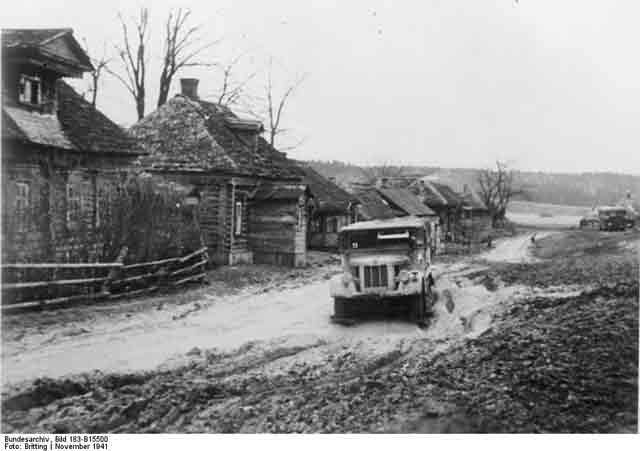
Put bluntly, the German supply network in the Soviet Union is beginning to break down by 14 November 1941. At the Orsha Conference on 13 November, where future German strategy is discussed, these supply difficulties were discussed with chiefs of staff from the army groups and a number of individual armies. These problems are not being resolved and in fact, are getting worse as each day passes. Thus, the continuation of Operation Typhoon into the winter ordered at the Orsha Conference appears almost to be a desperate attempt to achieve victory before the supply chain degrades to a point where the armies are being literally and figuratively starved. Having better and more plentiful weapons is useless if those weapons receive no ammunition, and having more effective soldiers is of no benefit if they do not have enough to eat or proper clothing in which to stay warm during sub-zero temperatures.
Today, General Franz Halder, who administered the Orsha Conference, amplifies in his war diary on the supply issues discussed at the Orsha Conference. He writes that Quartermaster-General Eduard Wagner rather dire description of the supply situation was no exaggeration. Halder writes that Wagner discusses with him:
“Organizational consequences of the truck situation (the Divs. now have only horse-drawn trains; truck columns pooled in Armies).”
This suggests a growing triage situation of supply— divisions are being left to fend for themselves while the supplies that can be delivered are going straight from the railheads to the army headquarters. With frigid weather closing in, supplies such as gasoline and winter clothing and spare parts to replace those that freeze become critical.
The supply situation is not just affecting the Germans, but it is a false equivalence to say that the Red Army is facing the same issues as the Wehrmacht. The Soviets have a secure, intact supply network coming over railway systems that all converge on Moscow (one of the reasons that the Soviet capital always has been an important objective despite Hitler’s long denials of that fact). The Germans, however, are trying to use railways that have been destroyed. The Soviet railway gauge is different than the German gauge, so trains from Berlin cannot just continue straight to the outskirts of Moscow. Instead, cargoes must be reloaded onto captured Soviet trains which can proceed only as far as the tracks have been repaired. Well, that is all well and good and can be accomplished with some slave labor, but the greater problem is that the Germans haven’t captured enough Soviet trains and there aren’t enough Soviet trainmen to run them. This requires transferring Germans from the German rail system to run the Soviet trains— and nobody wants to suddenly go run trains in a war zone in winter. The German army heads complain that the trains wind up being run by the “culls of the entire rail system.” The bottom line is that the German Army is organized to run by trains, and train service is severely lacking in the conquered territories.
The German supply issues in the East are causing insidious problems throughout the areas of the German occupation. It is not just the Wehrmacht soldiers who are suffering without sufficient winter clothing and other supplies. The Soviet POWs— literally millions of them— are getting almost nothing and they are serving as a sort of “canary in the coal mine” as to what awaits the Wehrmacht itself. Halder notes in his diary today after a stop at Molodeczno, Belarus on his way home from the Orsha Conference:
“Typhus camp of Russian POWs (20,000) doomed to die. Several German doctors fatally ill. In other camps in the neighborhood no typhus, but every day many prisoners die from starvation. Ghastly picture, but relief appears impracticable at the moment.”
Halder also stops at Kovno and gets a similar story there:
“Colonel Just, Area Commander. Confirms earlier story of self-seeking policy of the civil administration and intrigues against the Army. Plight of POWs. Typhus in POW camps.”
The desperate German drive on Moscow, where there would be plenty of ways to get through the winter, is beginning to take on the aspect of a fight for survival as much as one of conquest.
Elements of the German 11th Army close on Sevastopol, cutting the city off from landward communications. On the other side of the peninsula, Kerch is occupied. Meanwhile, the Soviet 49th Army hits the German 12 and 13 Corps in the Tula area. Fighting is very heavy.
Soviet destroyer Gordy struck a mine and sank en route to Hanko, Finland.
Soviet submarine L-2 struck three mines in a minefield off Keri, Estonia in the Baltic Sea between 0107 and 0617 hours, eventually sinking, killing 50 of 53 aboard.
Soviet submarine M-98 struck a mine and sank in the Gulf of Finland, killing all aboard.
Soviet submarine ShCh-211 was lost to unknown reason off Varna, Bulgaria in the Black Sea, presumably lost of a Romanian mine.
Governor-General Wouters of the Dutch Antilles refuses Jews refuge. Governor-General Gielliam Johannes Wouters of the Dutch Antilles (Curaçao) initially refused entry to 86 predominantly Jewish refugees who arrived at Willemstad aboard the Spanish passenger ship SS Cabo de Hornos. The refugees had already spent months at sea and had been denied entry by multiple South American countries, including Brazil and Argentina. Wouters resisted letting them ashore due to strict colonial policies regarding foreign nationals and concerns over resources. However, his refusal was overcome through intense diplomatic negotiations, direct pressure from the Dutch government-in-exile in London, and financial guarantees provided by the American Jewish Joint Distribution Committee (JDC). On November 19, 1941, the refugees were finally allowed to disembark in Curaçao. Despite being granted safety from the vessel, they were not given immediate freedom. Governor Wouters placed them into segregated internment camps located at Suffisant and Plantersrust. Their situation improved significantly in 1942 when Piet Kasteel succeeded Wouters as Governor. Kasteel unified the camps and granted the refugees relative freedom of movement. Supported by the local Jewish community and aid organizations, most of these refugees eventually secured visas and relocated to the United States, Colombia, and Venezuela by 1946.
This was not the first time Wouters had opposed incoming refugees; in June 1940, he similarly tried to refuse entry to a group of Austrian Jewish refugees, only relenting under direct pressure from the Dutch Minister for the Colonies before sending them to an internment camp on Bonaire.
Operation FLIPPER: After dark, submarines HMS Torbay and HMS Talisman delivered 36 (of planned total of 59, due to rough seas) British commandos of No. 11 (Scottish) Group behind enemy lines in Libya.
The British launched unescorted freighters disguised as French, Italian, and Spanish ships with supplies for Malta. Meanwhile, Operation ASTROLOGER was commenced with transports Empire Defender and Empire Pelican, also with supplies for Malta; Empire Pelican was found and sunk by Italian SM.79 torpedo bombers near the Galite Islands off Tunisia, killing 1. The British cargo ship Empire Defender was also torpedoed and sunk south of the Galite Islands, Tunisia by Italian aircraft.
The National Broadcasting Co., Columbia Broadcasting system and Mutual Broadcasting system have been banned from the air in Berlin, it was announced officially tonight. The American companies were banned, German radio officials said, because their “Berlin representatives transmitted to New York unjustified complaint without consulting the Reichsrundfunk Gesellschaft (German radio organization) about their wishes.”
Revision of the Neutrality Law will plunge the United States into a “sea of incidents” because German warships “obviously will be obliged” to fire on American ships carrying munitions to Britain or Russia, an authorized spokesman in Berlin said today.
Finnish officials indicated today they were waiting for the American and British Governments to make the next move, hoping that it would not be a declaration that would place Finland at war with the world’s democracies.
The Berlin Foreign Office press chief, Paul Schmidt, will arrive in Ankara Monday at the head of a German press mission to begin a Winterlong campaign designed to obtain favorable publicity for the Reich in the Turkish press.
There were no RAF Bomber Command operations from 10 to 15 November 1941.
U-561, commanded by Oberleutnant zur See Robert Bartels, sank Panamanian steamer Crusader (2939grt), straggling behind convoy SC.53, in the North Atlantic. On 4 Nov 1941 the Crusader was supposed to sail with convoy SC.53, but failed to join in fog and was reported missing thereafter. At 0337 hours on 14 November, U-561 fired a spread of three torpedoes at an unescorted steamer, which immediately stopped after two hits and then sank fast by the stern. No survivors or lifeboats were sighted by the U-boat. It is reported that the Brazilian coal passer Edward Barreto from Rio de Janeiro was the only survivor of Crusader, held as prisoner of war at Milag Nord and released in 1945, but it is not known when and how he was captured. The 2,939 ton Crusader was carrying general cargo, including foodstuffs, cotton, iron, and steel and was bound for Liverpool, England.
The aircraft carrier HMS Ark Royal (91), which had been torpedoed and damaged by the U-81, commanded by Kapitänleutnant Friedrich Guggenberger, sank with almost all of her aircraft approximately 300 miles east of Gibraltar in the western Mediterranean Sea. The HMS Ark Royal had been taken in tow by tugs from Gibraltar and some personnel rejoined the ship but they were unable to control the flooding or extinguish the fires.
Light cruiser HMS Edinburgh and heavy cruiser HMS Suffolk departed Hvalfjord for Denmark Strait patrol.
Destroyer HMS Escapade departed Scapa Flow at 2015 for Hvalfjord to join the force under the Commander in Chief, Home Fleet. The destroyer embarked mail for the fleet before sailing. Destroyer Escapade arrived at Hvalfjord at 1000/16th.
Submarine HMS P 35 departed patrol off Norway for Dundee.
Minesweeper HMS Fitzroy departed the Faroes to boiler clean at Aberdeen.
T/A/Sub Lt (A) P. R. Cassels RNVR, was killed when his Hurricane of 759/760 Squadron crashed in Dawlish Bay.
Soviet destroyer Gordy was sunk on a mine off Naissaari in the Baltic.
Minelaying cruiser HMS Abdiel and destroyers HMS Hero, HMS Hotspur, and HMAS Nizam departed Alexandria for Tobruk in the second series of Operation APPROACH. The ships arrived back at Alexandria on the 15th. General Sikorski returned to Alexandria on cruiser Abdiel.
Destroyer HMS Eridge departed Port Said and joined destroyers HMAS Napier, HMS Kandahar, and HMS Hasty in an anti-submarine sweep. After an unsuccessful search, the destroyers returned to Alexandria on the 16th.
Anti-aircraft ship HMS Carlisle, destroyer HMS Avonvale, and Australian sloops HMAS Parramatta and HMAS Yarra passed through the Suez Canal and sailed for Alexandria. Destroyer Avonvale was recalled to escort landing ship Glengyle the following day. Destroyer HMS Heythrop passed through the Suez Canal on the 15th and on arrival at Port Said departed with destroyer Avonvale escorting landing ship Glengyle to Alexandria. Destroyer Heythrop arrived from Gibraltar, via the Cape. The anti-aircraft ships and the sloops arrived at Alexandria on the 15th. The landing ship and destroyers Avonvale and Heythrop arrived at Alexandria on the 16th. Destroyer Heythrop joined the 2nd Destroyer Flotilla for duty in the Mediterranean Fleet.
Submarines HMS Torbay and HMS Talisman, which had departed Alexandria on the 10th, landed commandoes on the North African coast to strike at Rommel’s Headquarters near Apollonia. The submarines arrived back at Alexandria on the 23rd.
British steamer Empire Pelican (6463grt), en route to Malta, was sunk by Italian bombing ten miles southwest of Galita Island. One crewman was lost. Thirty five crewmen and nine gunners were made prisoners of war.
Ocean boarding vessel HMS Marsdale departed Gibraltar on Western Patrol.
Swiftly following up his neutrality revision victory in the house, President Roosevelt announced today a decision to withdraw the token force of American marines in China, thus leaving protection of American interests in that section of the world to the Asiatic fleet. The disclosure, at the president’s press conference, was made even as a special Japanese envoy arrived in this country for what appeared to be one more and possibly the last joint effort to discover a formula for peace in the Pacific. Mr. Roosevelt declined to discuss the significance of the China move in respect to Japanese-American relations, but diplomatic observers generally attached as much importance to the timing of the announcement as to the decision itself. 750 U.S. Marines were ordered to withdraw from Shanghai, Peiping, and Tientsin in Japanese occupied China. 183 had transportation difficulties and would be imprisoned by the Japanese after hostilities began on December 7.
Withdrawal of 970 United States marines from China will start late next week on a United States President liner that is being sent to Shanghai for the purpose, it was understood. The first contingent to leave will be about 450 men, part of the garrisons of 750 men here, 165 in Peiping and 55 in. Tientsin. The rest of the men will follow on a later ship. All probably will be sent to Manila for re-assignment. Officers and men have been standing by ready for instant departure for more than a week. Scores of Americans probably will evacuate Shanghai and other points in China on the ship carrying the first marines, it is understood.
American merchant seamen declared yesterday their readiness to take vessels under the United States flag into any ports in any war zones, and joined with shipping men to welcome the Congressional action that cleared merchant marine decks of restrictions.
William S. Knudsen, director general of the Office of Production Management, told a gathering of 1,200 naval architects and marine engineers last night that, “as long as you keep the line open to England, Hitler can’t win, and if you can get superiority in the air Hitler is going to lose.”
At the bidding of President Roosevelt, representatives of major steel companies and the United Mine Workers resumed direct negotiations today on the issue of a union shop in captive coal mines, but reached “no conclusions” at their first sitting. “Pursuant to President Roosevelt’s instructions we have been meeting, but no conclusions have been reached,” was the terse announcement of John L. Lewis, U.M.W. head, as the conferees emerged from a hotel suite. President Roosevelt told organized labor in general and the United Mine Workers in particular today that “the Government of the United States will not order nor will Congress pass legislation ordering a so-called closed shop.”
The National Defense Mediation Board in two cases today rejected the demands of American Federation of Labor unions for union shops or strong union security clauses as the compensation for no-strike agreements.
Fifty-one railroads will be shut down at 6 AM on December 7 in the first day of a three-part program designed to stop all major carriers to enforce wage demands, the “big five” operating brotherhoods stated today.. On the second day workers will strike on forty-three more roads and the day after sixty-two other carriers will be affected. The total is 156, with 180 in all eventually to be shut down, if plans go through. Included in the first group to be struck are the Pennsylvania, the New York Central, the Long Island, the Santa Fe, the Southern and the Southern Pacific. In the second group are the Chesapeake & Ohio, the Chicago & Northwestern and the Gulf Coast lines, embracing fifteen roads. Executives of the brotherhoods issued rules today which are to govern the conduct of the 350,000 operating workers in the strike. The men involved are locomotive engineers, firemen, switchmen, conductors, and trainmen.
Uninterrupted flow of diplomatic, commercial and private communications to all parts of the world was assured yesterday when Arthur S. Meyer, chairman of the State Mediation Board, announced that two weeks of negotiation in the offices of the board had resulted in an agreement between RCA Communications, Inc., and the American Communications Association, C.I.O., on terms of a new two-year contract.
Sidney Hillman, associate director of the Office of Production Management, told regional leaders of the American Federation of Labor today that “no grievance is big enough to warrant loss of production at this time.”
One of the many morale problems in the United States Army today is the resentment of the trainees against strikes in the defense industries, particularly in those cases where the workers on strike include young men deferred from the draft because they are needed in industry. If 76 percent of the public had its way, all such deferred men would be inducted into the Army when they go on strike, according to a new Gallup poll.
The House judiciary committee decided today that a grand jury subpoena served on Representative Fish violated the rights and privileges of the House, but added that the House could waive those privileges under such conditions as it might determine.
Damage estimated at upward of $1,000,000 resulted today from an earthquake centering in suburban Torrance and Gardena in the Los Angeles, California, area. Although it was the heaviest since the disastrous shock of 1933, which cost 130 lives, no deaths or injuries were reported. Frank R. McGregor, regional coordinator for the OPM priorities division, said needs of the stricken area would be put on “an immediate list” for reconstruction materials. The rolling east-to-west shock hit the Los Angeles area at 12:42 AM, Pacific standard time, continuing eighteen or twenty seconds. in the Torrance and Gardena areas. It awakened residents of Los Angeles and inland communities north and east as far as Glendale, Pasadena and Whittier and was felt heavily in Long Beach and other seacoast cities. A lighter quake, felt chiefly in the Torrance area, followed at 1:36 AM. In Hawthorne some windows were broken, plaster fell from the ceiling of a hotel in Redondo Beach, bricks were shaken loose and windows were broken. Long Beach, which bore the brunt of the 1933 quake, escaped with slight loss. In Torrance, an industrial community of about 10,000 population southwest of Los Angeles, William H. Stanger, superintendent of the city Water Department, put property damage at $1,000,000 or more, with broken windows accounting for $25,000 of the total. Walls of forty or more business buildings were thrown down, hundreds of show windows were shattered and chimneys and fireplaces toppled. Older structures bore the brunt of the loss. Reinforced concrete buildings erected since the 1933 quake appeared undamaged.
Destroyer USS Benson (DD-421) and USS Niblack (DD-424), screening convoy ON.34, depth charge sound contacts.
Destroyer USS Edison (DD-439), en route to MOMP in TU 4.1.1 to screen convoy ON.35, attacks a sound contact southwest of Iceland at 62°53’N, 24°30’W.
The Alfred Hitchcock-directed romantic psychological thriller film “Suspicion” starring Cary Grant and Joan Fontaine was released.
By ordering United States marines to withdraw from China and through remarks made at a press conference, President Roosevelt today made clear his belief that the situation in the Far East contains elements of danger that might lead to war between the United States and Japan. He expressed hope, however, that peace would be maintained. The President postponed his plans to depart Saturday night for Warm Springs, Ga. This step, precipitated in part by the domestic labor situation, will permit him to be in Washington to learn what new proposal, if any, is being brought by Saburō Kurusu, Japan’s special envoy, who is scheduled to arrive in Washington tomorrow by air after a transpacific flight.
A first-ranking diplomat of Japan, speeding toward momentous talks in Washington, dropped from fog-shrouded skies of San Francisco today with a message that Japan still saw hope of peace in the war-fearful Pacific. Dapper, graying Saburō Kurusu wouldn’t say whether he was carrying specific proposals for amity from his government, but commented in typical American English that “I hope to break through the line and make a touchdown.” Kurusu arrived on the California Clipper, fog-bound two hours over San Francisco Bay before the landing, from Honolulu.
The Japanese Ambassador in Washington, Nomura Kichisaburō, sends the following message to Foreign Minister Matsuoka Yosuke in Tokyo: “However, I must tell you the following: (1) As I told you in a number of messages, the policy of the American Government in the Pacific is to stop any further moves on our part either southward or northward. With every economic weapon at their command, they have attempted to achieve this objective, and now they are contriving by every possible means to prepare for actual warfare. (2) In short, they are making every military and every other kind of preparation to prevent us from a thrust northward or a thrust southward; they are conspiring most actively with the nations concerned and rather than yield on this fundamental political policy of theirs in which they believe so firmly, they would not hesitate, I am sure, to fight us. It is not their intention, I know, to repeat such a thing as the Munich conference which took place several years ago and which turned out to be such a failure. Already I think the apex of German victories has been passed. Soviet resistance persists, and the possibility of a separate peace has receded, and hereafter this trend will be more and more in evidence. (3) The United States is sealing ever-friendlier relations with China, and insofar as possible she is assisting Chiang. For the sake of peace in the Pacific, the United States would not favor us at the sacrifice of China. Therefore, the China problem might become the stumbling block to the pacification of the Pacific and as a result the possibility of the United States and Japan ever making up might vanish.”
The Foreign Ministry sends the following message to the Japanese embassy in Hong Kong: “Though the Imperial Government hopes for great things from the Japan-American negotiations, they do not permit optimism for the future. Should the negotiations collapse, the international situation in which the Empire will find herself will be one of tremendous crisis. Accompanying this, the Empire’s foreign policy as it has been decided by the cabinet, insofar as it pertains to China, is: (a) We will completely destroy British and American power in China, (b) We will take over all enemy concessions and enemy important rights and interests (customs and minerals, etc.) in China, We will take over all rights and interests owned by enemy Powers, even though they might have connections with the new Chinese government, should it become necessary. In realizing these steps in China, we will avoid, insofar as possible, exhausting our veteran troops. Thus we will cope with a world war on a long-time scale. Should our reserves for total war and our future military strength wane, we have decided to reinforce them from the whole Far Eastern area. This has become the whole fundamental policy of the Empire. Therefore, in consideration of the desirability to lighten our personal and material load, we will encourage the activities of important Chinese in their efforts in the occupied territories insofar as is possible. Japan and China, working in cooperation, will take over military bases. Thus, operating wherever possible, we will realize peace throughout the entire Far East. At the same time, we place great importance upon the acquisition of materials (especially from unoccupied areas). In order to do this, all in the cabinet have concurred, in view of the necessity, in a reasonable relaxation of the various restrictions now in force (after you have duly realized the critical situation which has brought the above decisions into being you will, of course, wait for instructions from home before carrying them out).
Japan’s answer to international developments will be revealed at an extraordinary session of the Diet that begins at 10 AM tomorrow with a meeting of both houses for organization. The formal opening ceremony will be held tomorrow morning in the presence of Emperor Hirohito, who will read an imperial message calling on the Diet to cooperate with the government in meeting the critical situation.
Imperial Japanese Navy aircraft carrier HIJMS Kaga exited the drydocks at Sasebo Naval Shipyard, Japan.
Imperial Japanese Navy aircraft carrier HIJMS Shokaku was relieved of her status as the flagship of Carrier Division 5; that responsibility was passed to HIJMS Zuikaku.
Liner Tatsuta Maru departed Yokohama, Japan.
Dow Jones Industrial Average: 116.81 (+1.14)
Born:
Darrell Sutherland, MLB pitcher (New York Mets, Cleveland Indians), in Glendale, California.
Hemus Kriel, South African politician, 1st Premier of the Western Cape, in Karamas, South Africa (d. 2015).
Died:
Paraskev Stoyanov, 70, Bulgarian-Romanian surgeon, anarchist and professor.
Naval Construction:
The Royal Indian Navy Basset-class minesweeping trawler HMIS Kolaba (T 322) is laid down by the Scindia Steam Navigation Co. Ltd. (Bombay, India).
The Royal Australian Navy Bathurst-class minesweeper-corvette HMAS Shepparton (J 248) is laid down by the Melbourne Harbour Trust (Williamstown, Victoria, Australia).
The U.S. Navy Accentor-class coastal minesweeper USS Fearless (AMc-80) is launched by W.A. Robinson Inc. (Ipswich, Massachusetts, U.S.A.).
The Royal Canadian Navy Llewellyn-class minesweepers HMCS Llewellyn (J 278) and HMCS Lloyd George (J 279) are launched by Chantier Maritime de St. Laurent (Ile de Orleans, Quebec, Canada).
The U.S. Navy PC-461-class (173-foot steel hull) submarine chaser USS PC-472 is launched by the Defoe Shipbuilding Co. (Bay City, Michigan, U.S.A.).
The Royal Navy Fairmile B-class motor launch HMS ML 238 is commissioned. Her first commanding officer is Lieutenant D.W.S. Arnaud, RNVR.
The Royal Navy Bangor-class (Turbine-engined) minesweeper HMS Whitehaven (J 121) is commissioned. Her first commanding officer is Commander (retired) Claude Plumer, RN.

