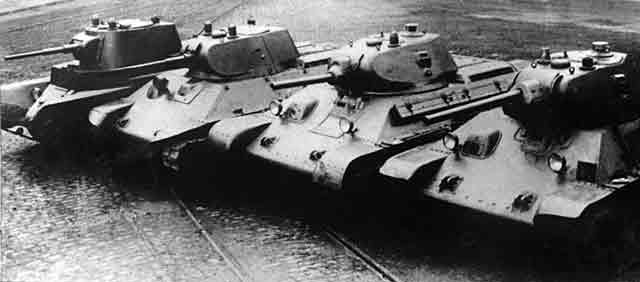
German panzers as a group generally can be considered to be the best tanks in the world in 1941. Every country has its “best” tanks and is proud of them, but the Panzer III and Panzer IV, along with their accompanying support vehicles, have had little difficult storming across both East and West Europe. While there have been some unpleasant encounters on the Eastern Front with some advanced Soviet models, those have been few and far between. Most Wehrmacht armored troops have never encountered anything more dangerous than an obsolete T-26. However, on 12 November 1941, that begins to change as the Soviets begin to unleash the T-34 on both ends of the Battle of Moscow.
While the T-34 is considered a medium tank, at 26.5 tons it is heavier than any of the German tanks. Its main gun is an L-10 76.2 mm (3 in) gun, enough to easily pierce all but the 80 mm frontal armor of the Panzer IV. The typical Panzer IV, meanwhile, has the short-barreled, howitzer-like 75 mm (2.95 in) Kampfwagenkanone 37 L/24 (7.5 cm KwK 37 L/24) tank gun, which cannot penetrate the T-34’s 45 mm frontal armor except at very close range. The Germans, at Hitler’s insistence, have plans to upgrade the Panzer IV’s main gun to the deadlier 50 mm (1.97 in) Pak 38 L/60 gun, but the first prototype of that is not delivered until 15 November 1941. The Soviets have even heavier KV tanks, but they are slow and the Germans have figured out ways to contain them. The T-34, though, is a good all-around tank that is hard to kill and deals out devastating blows. While every country’s citizens believe that its T-34 or Panzer IV or Valentine or Sherman is the best, the T-34 is among the elite. In short, the T-34 may not be the best tank in the world, particularly in terms of poor reliability, but in combat, it is at least a match for the best that the Wehrmacht has in late 1941. The Soviets have had them throughout Operation Barbarossa, but only now is furious tank production since June beginning to unleash large numbers of the T-34.
The impact of the T-34 is felt first at Tikhvin. The city of Tikhvin north of Moscow is nothing special in comparison with the many other cities the Wehrmacht has captured. However, Tikhvin may be the most strategically important place outside of Moscow itself. The city controls the only remaining land routes from Moscow to Lake Ladoga that are in Soviet hands. If the Germans can hold Tikhvin, they can capture Leningrad without firing a shot. Thus, Tikhvin’s recapture is absolutely vital to the Soviet Union. The Germans have occupied Tikhvin, but the city is at the tip of a long, tenuous salient east from the Volkhov River which is very vulnerable. The German 12th Panzer Division expended the last of its strength to capture the city, and winter has set it, with temperatures on 12 November 1941 never exceeding 5 degrees Fahrenheit (-15 C). The Wehrmacht is completely unprepared for such weather conditions, and the men are dying of frostbite already and the vehicles have no antifreeze. This is the perfect time for the Red Army to attack, and it does.
Soviet 52nd Army (General Nicolai Kuzmich Klykov) follows the textbook procedure and attacks the German infantry divisions holding the right (southern) arm of the salient. German 126 Infantry Division (General Paul Laux) at Malai Vishera and the Spanish Blue Division (250th Division) just south of there guard that sector of the front. The T-34s form a hard crust around the weaker T-26 tanks. The Germans barely withstand the first shock of the attack and hastily form infantry tank-killer groups that use bundles of grenades to blow off the tanks’ tracks. The Soviet attack peters out due to superior German defensive tactics, but it is clear to everybody that more such attacks would be fatal to the German hold on Tikhvin once the Soviets figure out how to use their armor efficiently.
South of Moscow, at Tula, General Guderian also is finding the Soviet armor to be a problem. Here, the issue is more his own weakness, as Colonel Heinrich Eberbach’s Kampf Gruppe has taken serious losses. The Germans are down to barely 50 panzers. The Soviets are bringing up fresh Siberian troops and T-34 tanks. There is fierce fighting today northwest of Tula where a Soviet cavalry division and two rifle divisions fight to prevent the German 31st and 131st Infantry Divisions from encircling Tula and bypassing it. The fighting there is inconclusive, but with the weather turning frigid and the Soviets continually bringing forward reinforcements that the Wehrmacht cannot match, a tie essentially is a victory for the Red Army. The Germans are still in the fight and have not been pushed back, but they also are not advancing any longer — which means they are left out in the open as winter closes in.
Winter came to the Eastern Front as no German units anywhere recorded a temperature higher than 5°F. After sundown, the temperature in the Moscow region of Russia dropped to 5 degrees Fahrenheit or -15 degrees Celsius, which was harsh on the troops on either side, but particularly to the Germans who were less prepared to deal with the weather. The vehicles that had not been frozen, however, were now able to move as the mud hardened, and the 3rd and 4th Panzer Armies prepared to take advantage of the situation for an offensive. Meanwhile, 22 infantry divisions, 14 cavalry divisions, and 11 ski battalions began to arrive to reinforce the Soviet capital.
At Orsha senior German commanders are shown the plans for the continuing attacks on Moscow. Three Panzer groups and three infantry armies will participate.
The Red Army uses its ski troops in combat for the first time in the Great Patriotic War today.
Stuka dive bombers of German StG 77 damaged Soviet cruiser Chervona Ukraina with 3 bombs at Sevastopol, Russia. Destroyers Sovershenny and Besposhchadny were also damaged, with the former capsizing at the naval shipyard.
Soviet submarine S-34 was lost off the Bulgarian coast near Cape Emine, presumably to a mine; all 51 aboard were lost.
Finnish vessels laid mines in the Gulf of Finland to disrupt the Soviet attempts to evacuate personnel from Hanko in southern Finland.
Finland again rejected the United States suggestions that she make peace with the Soviet Union.
Oberleutnant Adalbert Karbe and Hauptmann Heinrich Wittmer of the German Kampfgeschwader 55 wing were awarded the Knight’s Cross of the Iron Cross.
King George VI opened a new session of British Parliament. “The developments of the past year have strengthened the resolution of my peoples and of my allies to prosecute this war against aggression until final victory,” his speech from the throne began.
Prime Minister Winston Churchill gave the House of Commons, opening its new session today, late figures showing that the Battle of the Atlantic was proceeding steadily in Great Britain’s favor. He foresaw that “the freedom-loving powers will be possessed of large quantities of ships in 1943 which will enable overseas operations to take place utterly beyond British resources at the present time.” The Prime Minister gave another encouraging report about Britain’s food supplies and reserve stocks, which are being continuously built up. He declared there would be no immediate Cabinet changes and renewed his warning that the country must remain prepared against a German attempt at a large-scale invasion next Spring.
British Commandos executed Operation ASTRAKAN, an overnight raid on Houlgate in France. The raid was carried out by No. 101 (Folbot) Troop, No. 6 Commando over the night of 12/13 November 1941. The objective of the operation was to gather reconnaissance for Operation SUNSTAR, ten nights later.
German submarine U-203, with one engine and aft diving planes damaged by a British air attack on the previous day, arrived in Brest, France.
British aircraft carriers HMS Ark Royal and HMS Argus from the Operation PERPETUAL convoy launched 37 Hurricane fighters to reinforce Malta.
General Charles Huntziger, the Vichy war minister, was killed 50 miles north of Nimes today, in a plane accident. He was returning from a mission to North Africa, to consult General Weygand on a possible German bid to use French North Africa. Though Huntziger signed the armistice with the Germans in June last year, he was a staunch defender of French interests against German encroachment and the strongest opponent of Laval’s efforts to open French ports to Germany.
There were no RAF Bomber Command operations in Western Europe from 10 to 15 November 1941.
The merciless pounding of Naples and points in Sicily continued last night. Nothing comparable with the continuous and prolonged raids on Naples has yet been seen in Italy, for this was the fourth night in succession that the British rained explosive and incendiary bombs on the great port.
Heavy cruiser HMS Kent arrived at Hvalfjord from Denmark Strait patrol.
Destroyer HMS Hurworth departed Scapa Flow at 0930 for Scrabster with His Royal Highness Crown Prince Olaf of Norway. The destroyer arrived back at 1200 and embarked her motor boat. Destroyer Hurworth departed Scapa Flow for the Clyde to boiler clean prior to proceeding to the Mediterranean.
Destroyer HMS Pytchley departed Leith for Scapa Flow at 1645. The destroyer arrived at 0900/13th to carry out working up practices.
Submarine HMS Sealion departed Murmansk for patrol off Svaerholthavet.
British cable ship Francolin (ex-Faraday, 322grt, T/A/Skipper Lt J. Dinwoodie RNR) was sunk by German bombing two miles N 25° E from Haisborough Light House.
British steamer trawler Ben Screel (195grt) was damaged by German bombing fourteen miles northeast by north of St Abb’s Head.
British steamer Maurita (199grt) was sunk on a mine at Hilbre Swash, in the Dee Estuary.
Soviet light cruiser Chervonaya Ukrania was sunk by bombing at Sevastapool.
Soviet destroyer Sovershenny, under repairs at Sevastapool, was damaged further by German bombing.
Soviet steamer Krasny Profintern (4648grt) was damaged by German bombing in the Black Sea.
Destroyers HMS Farndale and HMS Heythrop arrived at Aden to join the Mediterranean Fleet. They were sailed for Suez. The destroyers had accompanied light cruiser HMS Euryalus for most of the passage.
Greek destroyer RHS Aetos departed Alexandria to transit the Suez Canal, en route to refitting in India.
Greek submarine RHS Glaukos sank a caique north of Crete with gunfire. On the 14th, the submarine sank a second caique north of Crete with gunfire.
Submarine HMS Porpoise departed Malta for Alexandria.
During a sweep during the night of 11/12 November, seven Swordfish of 830 Swordfish took off to attack a convoy of two merchant ships and escorts reported west of Pantelleria. Swordfish piloted by Lt P. E. O’Brien, Sub Lt (A) M. Thorpe, and T/A/Sub Lt (A) R. S. Vercoe RNVR, were forced to return to Malta with engine problems. The other four Swordfish were lost when the aircraft ran out of fuel. Lt Cdr J.G. Hunt, Lt G. M. T. Osborn DSC, and Sergeant M. Parke; T/A/Sub Lt (A) S. W. L. Campbell RNVR, and Leading Airman J. R. Fallon; T/Sub Lt (A) R. W. Taylor RNVR, and P/T/A/Sub Lt (A) F. L. Robinson RNVR,were rescued and made prisoners of war. Lt (A) A. F. Wigram RNVR, and Leading Airman K. D. Griffiths were not found.
Submarine HMS Olympus arrived at Gibraltar from patrol in the Mediterranean.
Convoy WS.12Z departed Liverpool and the Clyde and rendezvoused off Oversay on the 13th with steamers Adrastus, Empire Star, Sussex, Mataroa, Duchess of Bedford, Empress of Asia, Narkunda, Empress of Japan, Aorangi, Arundel Castle, Orduna, Monarch of Bermuda, Capetown Castle, Deucalion, Abbekerk, and Rimutaka. The convoy was escorted by destroyers HMS Whitehall, HMS Witch, HMS Badsworth, HMS Vanquisher, and HMS Exmoor from 13 to 16 November. Destroyer HMS Maori was with the convoy from 13 to 17 November. The destroyer arrived at Gibraltar on the 20th for duty in the 19th Destroyer Flotilla. Battleship HMS Royal Sovereign and destroyers HMS Fury, HMS Forester, and HMS Foresight departed the Clyde on the 12th to join the convoy. They were route via Milford Haven and south of Ireland. On the 13th, the warships arrived at Milford Haven and departed later that day to join the convoy. Destroyers Fury, Foresight, and Forester escorted the convoy from 16 to 19 November. On the 19th, destroyers Foresight, Forester, and Fury parted company with the convoy in 34-05N, 25-50W to refuel from oiler RFA Dingledale. The destroyers then proceeded to search for an enemy merchant ship report. The oiler arrived back at Gibraltar on the 25th, escorted by corvettes HMS Jonquil and HMS Coreopsis. Destroyer Forester later proceeded to Ponta Delgada to complete fueling. She departed on the 22nd and rejoined destroyers Foresight and Fury. Battleship Royal Sovereign and destroyers HMS Dulverton and HMS Southwold escorted the convoy from 16 to 24 November. Destroyers HMS Vimy and HMS Velox escorted the convoy from 21 to 24 November. Corvette HMS Clover escorted the convoy from 22 to 24 November. The convoy arrived at Freetown on the 24th. On the 24th, the convoy departed Freetown with Sussex, Adrastus, Empire Star, Duchess of Bedford, Empress of Asia, Mataroa, Narkunda, Empress of Japan, Arundel Castle, Monarch of Bermuda, Aorangi, Capetown Castle, Orduna, Deucalion, Rimutaka, and Abbekerk. The convoy was escorted by destroyers Southwold and Dulverton from 28 November to 14 December. Battleship Royal Sovereign escorted the convoy from 28 November to 18 December. Sloop HMS Milford and corvettes HMS Verbena and HMS Hollyhock escorted the convoy from 28 November to 15 December. Corvettes HMS Aster and HMS Marguerite escorted the convoy from 15 December to 18 December, when the convoy arrived at Durban. The convoy departed Durban on 24 December with Nieuw Amsterdam, Empress of Japan, Orduna, Duchess of Bedford, Narkunda, Empire Star, Deucalion, Adrastus, Aronda, Indrapoera, Eastern Prince, Capetown Castle, Sussex, Aorangi, and Abbekerk, escorted by battleship HMS Royal Sovereign. The convoy off Mombasa on 31 December was split into three units. Convoy WS.12 ZA of Orduna, Aronda, Eastern Prince, and Nieuw Amsterdam was detached at 1-26S, 48-44E, escorted by light cruiser HMS Colombo. Convoy WS.12 ZA arrived at Aden on 4 January. Convoy WS.12 ZB was steamers Capetown Castle, Empress of Japan, Duchess of Bedford, Indrapoera, Deucalion, Adrastus, and Empire Star, plus U.S. liner Orizaba which had been brought out from Mombasa by light cruiser HMS Colombo. The convoy was detached at 1-26S, 48-44E and escorted by heavy cruiser HMS Cornwall. Convoy WS.12 ZB arrived at Bombay on 6 January. Convoy DM.1 of liners Narkunda, Aorangi, Sussex, and U.S. Mount Vernon was detached at 1-26S, 48-44S and escorted by light cruiser HMS Emerald. The convoy proceeded to Addu Atoll. The convoy was then escorted by heavy cruiser HMS Exeter, light cruisers HMS Emerald and HMS Durban, and sloop HMIS Jumna from 9 January. Dutch light cruiser HNLMS de Ruyter escorted the convoy on 10 January only. Destroyers HMS Jupiter, HMS Encounter, and HMAS Vampire escorted the convoy from 10 to 13 January. Dutch cruisers HNLMS de Ruyter and HNLMS Tromp escorted the convoy on 11 and 12 January. The convoy arrived at Singapore on 13 January.
Convoy SL.91GF departed Gibraltar escorted by sloops HMS Fowey and HMS Black Swan to 18 November, ocean boarding vessel HMS Maron to 15 November, and corvettes HMS Campion and HMS Heliotrope to 16 November and HMS Carnation and HMS Stonecrop to 18 November.
Convoy SL.91 GS departed Gibraltar escorted by destroyer HMS Wrestler to 16 November, sloops HMS Fleetwood, HMS Leith, HMS Sandwich, and HMS Scarborough to 19 November, and corvettes HMS Anchusa, HMS Calendula, and HMS Mignonette to 19 November. Corvettes HMS Acanthus, HMS Gentian, and HMS Honeysuckle to 19 November, and HMS Myosotis to 15 November joined on the 13th. Anti-submarine whaler HMS Southern Star joined on the 17th to 18 November.
Today in the nation’s capital, President Roosevelt reported a White House conference Friday between officials of the miners’ union and operators of captive coal mines. Suffering from a cold, he canceled his engagements, but late in the day conferred with Speaker Rayburn.
The Senate was in recess; its Privileges and Elections Committee continued hearings on the fitness of Senator Langer.
The House considered Neutrality Act revision, received the Coffee resolution for investigation of dollar-a-year men, received the Celler bill calling for a special investigation of Treasury tax proposals, received the Lesinski bill to provide wartime pensions for members of the armed services injured on hazardous duty and adjourned at 5:33 PM until 11 AM tomorrow. The Public Buildings and Grounds Committee heard Nathan Straus, USHA Administrator, on decentralization of government agencies.
Administration leaders fought with their backs to the wall today to save Neutrality Act amendments permitting American ships to enter belligerent ports from rejection by the House of Representatives. Worried by defection among southern Democrats who previously had supported the administration’s foreign policy, they spent the day solicitously talking to uncommitted members and conferring in the office of speaker Rayburn. Rayburn went to the White House at dusk, spent an hour with the president discussing the Neutrality issue and said as he left that “everything is fine,” that the amendments would pass. Some influential Democrats said President Roosevelt was apprehensive lest an administration defeat, coming just before the arrival of a special Japanese envoy, might aggravate the already critical situation in the Orient.
President Roosevelt called a new conference on the raging coal dispute today as mounting labor troubles threatened to halt soft coal production, tie up the nation’s railroads and possibly defeat the neutrality revision bill. While a C.I.O. boycott of the National Defense Mediation Board dealt a crippling blow to that peace-making agency, Mr. Roosevelt asked three C.I.O. leaders and three major steel company executives to meet with him at the White House Friday.
Leading operators and plain miners Joined today in predicting that any stoppage of coal digging in the captive mines owned by the steel companies because of the unionshop controversy would be short-lived if it even developed.
A strike on the country’s railroads beginning at 6 AM, December 7, was ordered today by the executives of the “Big Five” operating brotherhoods. The 350,000 workers in the brotherhoods — engineers, firemen, conductors, brakemen and switchmen — were instructed to leave their jobs.
Notice of an intent to strike at the Chrysler tank arsenal in Macomb County has been filed with the State Labor Mediation Board by the United Automobile Workers, C.I.O., Local 833, the board announced today.
From Congressional sources it was learned early today that President Roosevelt is considering a three-point plan to end strikes in defense industries. It was indicated that the President might submit his plan to Congress after the House has disposed of Neutrality Act amendments now pending. This gave support to earlier reports that at White House conferences yesterday, Mr. Roosevelt had assured Congressional leaders that a formula for solution of the defense labor situation would be put forward after restrictions on shipping imposed by the Neutrality Act had been eliminated. The program which it was authoritatively said the President was considering would be modeled somewhat after the plan now in effect in Canada. It would guarantee present wages to workers in defense industries, guarantee increases to meet increased living costs and pledge labor, in return for these guarantees, not to call strikes in defense industries. It was understood that these points were advanced as a possible solution of labor difficulties, after indications had developed that the Administration’s neutrality revision program might be jeopardized in the House by insistence of Representatives upon passage of anti-strike legislation, as a prerequisite to approval of amendments to the Neutrality Act which would permit American ships to sail into belligerent ports.
An undetermined number of Southern Democrats, estimated to be sufficient to turn the scales either way on the pending amendments to the Neutrality Act, was reported tonight to have won from the Administration a promise of antistrike legislation to curb walkouts during the emergency period. These Democrats, led by Representative Howard W. Smith of Virginia, were said to have received assurances through Congressional leaders that the “strike situation would be taken care of” through legislation to be supported by President Roosevelt. The inference was that if they stood by the Administration on the all-important vote, possibly tomorrow, on amendments to the act to permit ship arming and the dispatch of vessels to the belligerent zones, they would not have to worry about obtaining legislation to prevent strikes that halt the flow of materiel to Great Britain and the defense forces of the United States.
The United States will probably have to devote 40 percent of its national income to manufacture of the materials of war in order to defeat Hitler, Donald M. Nelson, OPM Director of Priorities, told a conference on labor legislation and the problems of its administration today.
Secretary of State Cordell Hull, discussing at his press conference today Finland’s “polite” refusal to heed his plea to cease offensive military operations and negotiate peace with the Soviet Union, expressed the hope that the Finnish people were still not irrevocably committed to the war and a collaboration with Germany that would mean the loss of their liberties and institutions.
In California, 15 Japanese-American businessmen and community leaders in Los Angeles Little Tokyo are picked up in an F.B.I. raid. Records and membership lists for such organizations as the Japanese Chamber of Commerce and the Central Japanese Association are seized. The 15 would cooperate with authorities, while a spokesman for the Central Japanese Association states: “We teach the fundamental principles of America and the high ideals of American democracy. We want to live here in peace and harmony. Our people are 100% loyal to America.”
The War Department is asking National Guardsmen and selectees to re-enlist for three-year terms in the Regular Army and to serve overseas if necessary.
An order for about $240,000 worth of small airplanes, let today by the War Department, marked the introduction into military operations of light aircraft of the types heretofore used exclusively by private fliers.
Ten American women, each outstanding in her own field, will be invited to visit England in the near future under the auspices of the British Government, to see at first hand the conditions under which women are living and working in Great Britain, it was announced today.
Alma Heflin becomes the first female test pilot for commercial aircraft at Piper Corporation, Lock Haven, Pennsylvania.
TU 4.1.3 (Commander Richard E. Webb) assumes escort duty for convoy ON.34.
Destroyer USS Decatur (DD-341), screening convoy HX.159, twice depth charges sound contacts that are later evaluated as “non-submarine.” Destroyer USS Badger (DD-126), depth charges sound contact that is later evaluated as perhaps Decatur’s wake. Coast Guard cutter Campbell reports sound contact and conducts search; she is joined by destroyer USS Livermore (DD-429).
Canadian Prime Minister W. L. Mackenzie King told the House of Commons today by implication that in the event of war between the United States and Japan Canada would immediately follow the course that Prime Minister Winston Churchill has set for Great Britain. Mr. King, however, refused to make so forthright a declaration as that by Mr. Churchill that Britain would declare war “within the hour.”
Nicaragua has ten thousand soldiers ready to assist the United States in twenty-four hours if this nation should become involved in war, Colonel Irving A. Lindberg, Honorary Commissioner of Customs and High Commissioner of Nicaragua, revealed here yesterday.
The Japanese government was cautiously silent today in the face of the most direct challenge leveled at this country in years Winston Churchill’s warning that Japan’s involvement in war with the United States would mean war with Britain, too, within the hour but the influential newspaper Yomiuri declared the Japanese people were “burning with anger.”
The Armistice Day speeches of President Roosevelt, United States Navy Secretary Frank Knox and Under-secretary of State Sumner Welles, coming right on top of Prime Minister Winston Churchill’s speech, produced a profound impression on Japan as a final demonstration of Anglo-American solidarity.
The Tokyo radio in a broadcast said, “the United States and Great Britain are already in a state of undeclared war with Japan.” This conclusion, it said, was drawn from “the fact that these two countries have formed a united bloc against Japan. All that will follow now on the military field will be only a logical consequence of the forming of this bloc.”
The Japanese situation in the Pacific area is “very serious,” and Administration officials are “very much concerned over it,” said Attorney General Francis Biddle today.
Saburō Kurusu, Japanese diplomat chosen to attempt to break the impasse in Japanese-American relations at Washington, arrived late today on the China Clipper from Midway Island. The special envoy left Japan on twenty hours’ notice last week and flew to Hong Kong, where he boarded the Clipper November 7, for his dramatic trans-Pacific flight. He was delayed two days at Midway, Pan American Airways base, 1,300 miles northwest of Honolulu, while engine repairs were made to the Clipper.
China now has 6,000,000 men under arms and 4,000,000 at the front, with plenty of food, small arms and ammunition, General Ho Yingchin, War Minister and Chief of Staff, said today.
The most extensive maneuvers yet held in Northern Malaya began today in the jungles and rice lands of Selangor, Kedah and neighboring Malay States. The maneuvers are designed to perfect methods of warfare in the tropics and to test the effectiveness of mechanized equipment under Malayan conditions and generally to familiarize the forces with battle problems in their fighting areas. Indian and British troops, including a number of famous English and Scottish regiments, will engage in the war games which are under the direction of Major Gen. Sir Lewis Heath, who led the British troops that smashed the Italian armies in East Africa last year. Most of the newspaper correspondents here were not invited to the maneuvers, though one British correspondent and one British cameraman are being permitted to attend. Malaya’s mock warfare will be followed next week by similar large-scale war games in Burma.
Philippine President Manuel Quezon, running for reelection, held a commanding lead In general elections today as scattered violence was reported throughout the Philippine commonwealth. With half of Manila’s ballots counted, Quezon had received 88 percent of the votes.
Dow Jones Industrial Average: 115.44 (-2.01)
Born:
Jenny McLeod, New Zealand composer (Earth and Sky; Seven Tone Clock Pieces; Hohepa), and educator, in Wellington, New Zealand.
Died:
Abe Reles, AKA “Kid Twist”, 35, American New York gangster and police informer, killed falling from a window under suspicious circumstances.
Ernie Koob, 49, MLB pitcher (no-hitter 1917; St. Louis Browns), from a lung ailment.
Naval Construction:
The Royal Navy LCT (Mk 2)-class landing craft, tank HMS LCT 171 is laid down by Stockton Construction (Thornaby, U.K.).
The U.S. Navy YMS-1-class auxiliary motor minesweeper USS YMS-62 is laid down by the Gibbs Gas Engine Co. (Jacksonville, Florida, U.S.A.).
The U.S. Navy Auk-class minesweepers USS Pursuit (AM-108) and USS Requisite (AM-109) are laid down by the Winslow Marine Railway and Shipbuilding Co. (Winslow, Washington, U.S.A.).
The Royal Navy “U”-class destroyer HMS Ulster (R 83) is laid down by Swan Hunter and Wigham Richardson Ltd. (Wallsend-on-Tyne, U.K.); completed by Wallsend.
The U.S. Navy Kennebec-class oiler USS Winooski (AO-38) is launched by the Bethlehem Steel Corp. (Sparrows Point, Maryland, U.S.A.).
The Royal Navy LCT (Mk 2)-class landing craft, tank HMS LCT 160 is launched by A. Findlay (Old Kirkpatrick, Scotland, U.K.).
The U.S. Navy SC-497-class (110-foot wooden hull) submarine chaser USS PC-518 (later SC-518) is launched by the Elizabeth City Shipyard (Elizabeth City, North Carolina, U.S.A.).
The Royal Canadian Navy Flower-class corvette HMCS Ville de Quebec (K 242) is launched by the Morton Engineering and Dry Dock Co. (Quebec City, Quebec, Canada).
The Royal Navy Bar-class boom defense vessel HMS Barford (Z 209) is commissioned.
The U.S. Navy Aloe-class net tender USS Elder (YN-15; later AN-20) is placed in service. Her first commanding officer is Lieutenant Thomas Donald Evan Martin, USNR.
The Вое́нно-морско́й флот СССР (ВМФ) (Soviet Navy) “M” (Malyutka)-class (3rd group, Type XII) submarine M-114 is commissioned.

