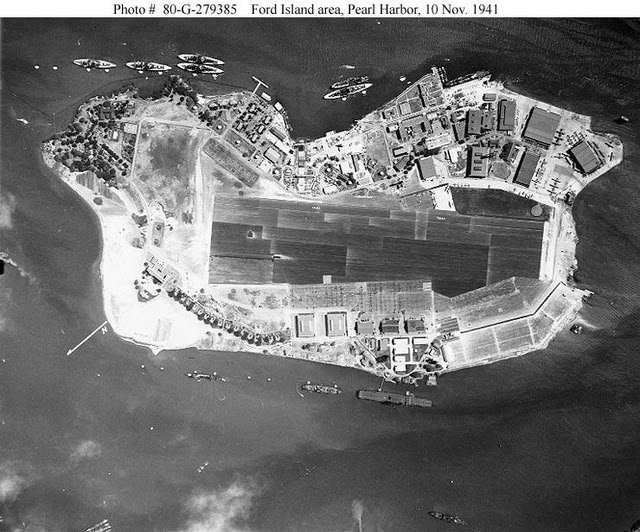
(Official U.S. Navy Photograph # 80-G-279385/ U.S. National Archives)
There are now 27 days remaining until the Japanese launch Operation “Z”.
German General Erich von Manstein launched a major assault against Sevastopol, Russia with 50th Infantry Division, followed by the 132nd Infantry Division on the next day. On the Soviet side, Vice Admiral F. S. Oktyabrsky (with Major General I. A. Petrov as his deputy) mobilized 52,000 men, of whom 21,000 were sailors, together with 170 guns (some were in modern steel and concrete emplacements), for the defense of Sevastopol.
General Erich von Manstein has been given the task of conquering the Crimea with his 11th Army. So far, it has gone quickly and fairly routinely as these things go. On 10 November 1941, he launches his first planned attack on the Soviet naval base of Sevastopol in the southeastern section of the Crimea. It is well-defended and surrounded by natural obstacles but defended by isolated and presumably demoralized troops. Sevastopol does not seem like much of a problem. As OKH Chief of Staff Franz Halder confidently notes in his war diary on 10 November 1941:
“Good progress has been made in the Crimea, but it will take a few more days before we have cleared out the last enemy.”
So, everything thing is going as planned and Soviet resistance is collapsing as everyone knew it would. Manstein uses the 50th Infantry Division to begin the assault in the area southeast of Sevastopol. It is commanded by Lieutenant General Karl-Adolf Hollidt, a recipient of both classes of the Iron Cross during World War I who is considered a true fighting general. General Hollidt is just the man to roll into Sevastopol and accept the honor of the surrender.
Hollidt’s attack makes good ground in the direction of Balaklava. His men capture Uppa near the upper reaches of the Chorna (Chernaya) River, which flows into Sevastopol. As the day progresses, though, Manstein waits before expanding the attack with additional forces, which blunts the effort. Thus, Hollidt’s offensive turns into more of a probing attack than a full-scale attempt to conquer the elaborate Soviet defenses, which include numerous bunkers and fortifications. The Sevastopol perimeter is 44 kilometers long, which poses problems for both armies but more so for the Germans, who have difficulty concentrating their forces for a determined attack. However, the Germans have heavy Luftwaffe support, though its effectiveness is somewhat lessened due to the hilly terrain. Manstein is confident that he can expand the gains in the morning.
On the Soviet side, Major General Ivan Efimovich Petrov commands the Coastal Army that had been evacuated in good order by sea from Odesa, which fell to the Romanians. Petrov first had led his forces north of Sevastopol after entering the Crimea at Sevastopol to try to defend the Perekop Isthmus. However, after discussing it with his divisional commanders, Petrov then had decided to retreat to Sevastopol rather than east to the safer Kerch Peninsula (because it would be easier to retreat further east from there). Petrov’s decision rests on his belief that it is important to defend this main base of the Soviet Black Sea Fleet and that he has enough men to do it. Petrov commands about 52,000 Red Army soldiers, an impressive number. However, they have left much of their equipment and supplies behind in Odessa, and 21,000 of them are sailors untrained in land warfare. His best asset is 170 artillery pieces, some protected by massive concrete bunkers constructed in the 1930s that are impervious to all but the largest artillery shells or bombs. Petrov’s troops only returned to Sevastopol one day ago, so the terrain is almost as new to them as to the Wehrmacht.
Hollidt’s attack follows the coastal route from Yalta to Sevastopol along the old Vorontsov road which achieved fame during the Crimean War of the 1850s. This is the traditional attack route into Sevastopol by those coming by sea, as did the British 90 years earlier. The advantage of this route is that it avoids the hills in the central and northern sectors of the Sevastopol perimeter which serve almost as towering walls. However, Petrov is no fool and also realizes that the coastal road is easy to perceive as the “easy” road into the port and thus a likely avenue of attacks. He defends the area with crack troops of the first and second defensive sectors. Their objective is to give ground in the flatlands but hold the hills around Balaklava and at the village of Kamary (Oboronnoye), where the east-west valleys coming from the east end and the ground becomes flat again into the port itself. Hollidt today gets nowhere near these vital spots. Thus, while Hollidt does make some progress, he does not succeed in capturing anything vital to the Soviet defense. Manstein prepares to feed in another division on the 11th and see what happens. So far, everything still seems to be going according to plan on the German side.
Walther von Brauchitsch suffered a heart attack.
The Finnish troops of Group O (Maj. General Woldemar Oinonen) cut the Murmansk railway at Perälahti. This doesn’t seriously hinder the Soviet supply flow, however; Soviets had already constructed a railway further east.
British Prime Minister Winston Churchill announced that “should the United States become involved in a war with Japan, a British declaration of war will follow within the hour.” Churchill also stated that, “… every preparation to defend British interests in the Far East and to defend the common cause now at stake has been and is being made.”
Operation FLIPPER was launched, with submarines HMS Torbay and HMS Talisman, with commandos aboard, to be delivered behind enemy lines in Libya. Their mission was to kill or seize Rommel.
The Operation PERPETUAL convoy, escorted by battleship HMS Malaya, cruiser HMS Hermione, and seven destroyers, departed from Gibraltar. At the center of the convoy, British carriers HMS Ark Royal and HMS Argus were tasked with delivering 37 Hurricane fighters for Malta. Royal Navy aircraft carrier HMS Ark Royal completes its mission of ferrying aircraft to Malta and turns to head back to Gibraltar with the rest of Force H. But the Germans have received word of this operation and have positioned U-81 (Friedrich Guggenberger) along the route.
British submarine HMS Proteus sank German ship Ithaka off the island of Milos, Greece.
Greek submarine RHS Glaukos damaged German ship Norburg north of Crete, Greece.
The Italian “San Marco” naval infantry regiment formed a 3rd battalion by drawing three companies from the two existing battalions.
There were no RAF Bomber Command operations from 10 to 15 November 1941.
Heavy cruiser HMS Cumberland departed Scapa Flow at 1600 to join the Commander in Chief’s force at Hvalfjord. The cruiser arrived on the 12th.
Destroyer HMS Escapade departed Rosyth at 0800 for Scapa Flow on completion of boiler cleaning. The destroyer arrived at 0030/11th, sustaining weather damage en route.
Destroyer HMS Pytchley departed the Tyne at 0900 for Methil to land trial parties before proceeding to Scapa. Due to bad weather, the destroyer was ordered to Leith, where she arrived at 1500.
Destroyer HMS Maori departed Scapa Flow at 1600 for the Clyde on completion of a short working up program. The destroyer arrived at 1215/11th.
Submarine HMS Seawolf arrived at Murmansk from Scapa Flow.
Lt E. A. Holloway was killed when his Martlett of 888 Squadron crashed on approach three miles north of Bishops Waltham, Hants.
Swedish steamer Vollrath Tham (5787grt) was sunk on a mine one and half miles from Hubert Gat. The crew was rescued and taken to a German port.
Examination vessel Longscar was damaged by German bombing near misses off Middlesbrough in 54-41-30N, 1-09-45W.
Battleship HMS Malaya, aircraft carriers HMS Ark Royal and HMS Argus, light cruiser HMS Hermione, and destroyers HMS Laforey, HMS Legion, HMS Lightning, HMS Gurkha, HMS Sikh, HMS Zulu, and HNLMS Isaac Sweers for Operation PERPETUAL.
On the 12th, the carriers flew aircraft off to Malta. On the 13th, U-205 attacked a destroyer and aircraft carrier HMS Ark Royal unsuccessfully. On the 13th, aircraft carrier Ark Royal was torpedoed by U-81 in 36-03N, 4-45W. Destroyer HMS Wild Swan, tugs HMS St. Day and HMS Thames, and motor launches ML.121, ML.130, ML.132, ML.135, ML.170, ML.172, and ML.176 departed Gibraltar to assist. Tugs Thames and St. Day arrived and took the carrier in tow. The aircraft carrier sank at 0613 on the 14th. Only one rating, Able Seaman E. Mitchell, was lost in the aircraft carrier. Battleship HMS Malaya, aircraft carrier HMS Argus, and light cruiser HMS Hermione arrived at Gibraltar on the 13th.
Ocean boarding vessel HMS Marsdale arrived at Gibraltar after Western Patrol.
Battleship HMS Barham, light cruiser HMS Galatea, and destroyers HMS Kandahar, HMS Kingston, HMS Kimberley, and HMS Jupiter departed Alexandria to exercise.
Light cruiser HMS Euryalus arrived at Suez from the United Kingdom to join the Mediterranean Fleet. The light cruiser arrived at Alexandria on the 11th.
Submarine HMS Proteus sank German steamer Ithaka (1773grt) off Milos.
Greek submarine RHS Glaukos damaged German steamer Norburg (2392grt) off Candia.
Submarine HMS Upholder arrived at Malta after parol.
Allied convoy WS.12X departed Halifax with the British troops delivered in convoy CT 5/7th in U.S. transports USS Mount Vernon, USS Leonard Wood, USS Joseph T. Dickman, USS Orizaba, USS West Point, and USS Wakefield escorted by American aircraft carrier USS Ranger (Flag Rear Admiral Arthur Cook; Harrill), heavy cruisers USS Quincy (Battle) and USS Vincennes (Riefkohl), and Destroyer Squadron 8 with destroyers USS Wainwright and USS Moffett, Destroyer Division 17 with destroyers USS McDougal and USS Winslow, and Destroyer Division 16 with destroyers USS Mayrant, USS Rhind, USS Rowan, and USS Trippe. Oiler USS Cimarron joined on the 19th at Trinidad. Aircraft carrier Ranger was detached at 17S, 20W and returned to Trinidad escorted by destroyers Trippe and Rhind. Battle on cruiser Quincy relieved Cook on aircraft carrier Ranger as force commander. The convoy arrived at Capetown on 9 December. The original destination was Basra, but the convoy was ordered to Singapore, via Bombay. The U.S. escorts were detached at Capetown. The convoy sailed on 13 December escorted by heavy cruiser HMS Dorsetshire. The U.S. destroyers were employed for a local anti-submarine screen to 14 December and arrived back at Capetown on 15 December. On 16 December, heavy cruisers Quincy and Vincennes and destroyers McDougal, Mayrant, Winslow, Rowan, Wainwright, and Moffet departed Capetown for the Caribbean. On 21 December, light cruiser HMS Ceres met the convoy and took liner HMS Orizaba to Mombasa. The convoy arrived at Bombay on 27 December. Liner Mount Vernon was detached to meet light cruiser HMS Colombo on 23 December, but the rendezvous was not kept. The liner proceeded to Mombasa to join convoy DM.1.
Convoy SC.54 departed Sydney, CB, escorted by corvettes HMCS Battleford, HMCS Drumheller, HMCS Dunvegan, HMCS Sorel, and HMCS Summerside, and minesweeper HMCS Nipigon. These corvettes were relieved on the 12th by destroyers HMCS Columbia and HMCS Skeena and corvettes ACONIT, HMCS Brandon, HMCS Camrose, Mimosa, HMCS Shediac, and HMCS Wetaskiwin. Destroyers HMCS Columbia and HMCS Skeena and corvettes Aconit, Mimosa, HMCS Shediac, and HMCS Wetaskiwin were detached on the 22nd when relieved by destroyers HMS Broke and HMS Wolverine and corvettes HMS Begonia, HMS Eglantine, HMS Larkspur, and HMS Montbretia. Corvette HMCS Brandon was detached on the 25th. The convoy arrived at Liverpool on the 26th.
New Zealand light cruiser HMNZS Achilles departed Auckland with a U.S. liner for Sydney.
In Washington today, President Roosevelt nominated Robert P. Butler as United States Attorney for Connecticut; his callers included Democratic leaders from the Capitol, Secretary Hull and the French Ambassador, Henry-Haye; the Chinese Ambassador, Dr. Hu Shih; Representatives Baldwin, Cole, Gale, Hill and Maas, and Philip Murray, president of the Congress of Industrial Organizations.
The Senate heard Senator O’Mahoney urge enactment of legislation to aid small business, received the Shipstead resolution asking for a State Department statement on Finnish-American relations, received the Bridges bill to regulate strike votes and other labor matters, and recessed at 4:22 PM until noon Thursday. The Privileges and Elections Committee heard Senator Langer deny misconduct charges; the Judiciary Committee approved the nomination of Charles Fahy as Solicitor General.
The House received the President’s request for a $116,099,000 supplemental appropriation for the War Department, approved a resolution for investigation of the issuance of a summons to Representative Fish to appear before a District of Columbia grand jury and adjourned at 2:21 PM until noon Wednesday. The Rules Committee approved a rule permitting eight hours of debate on Neutrality Act revision.
President Roosevelt will make a brief address today at the Unknown Soldier’s tomb, as the end of one world war is commemorated by a nation which has established a tremendous stake in the outcome of another. Twenty-three years after the guns of the first world conflict ceased their slaughter, America once more is arming feverishly, preparing for any international eventuality, and converting her vast industrial resources into an arsenal for foes of Hitler. The presidential address will be delivered about 11 a.m. (E.S.T.) in the somber setting of Arlington National Cemetery, where thousands of America’s warrior dead sleep high on a ridge overlooking the national capital. The three major networks will broadcast it.
President Roosevelt was advised by his Congressional leaders today that the House would authorize him Thursday afternoon to send American ships into belligerent ports and through combat zones. After Mr. Roosevelt expressed his pleasure at the Senate’s decision to arm our merchant vessels and send them anywhere in the world, House leaders explained that while a large group of Democrats undoubtedly would vote against the measure they were confident that the lower Chamber would concur in the Senate’s action.
President Roosevelt disclosed tonight that he had made an urgent appeal to congress to hasten new tax legislation lest a large part of the national income “evaporate through inflation.” A plea from President Roosevelt that the House Ways and Means Committee initiate action for further anti-inflationary tax legislation which would become effective “within two or three months” brought today from Representative Doughton, chairman of this committee, a statement that the committee already has voted that consideration of such a proposal should be “deferred temporarily.”
Franklin Roosevelt ordered protection for dams, power plants, and other important infrastructure sites. In the evening, he had dinner with Lucy Mercer Rutherfurd.
Tomorrow, Armistice Day, the American Red Cross will open a drive to equal its greatest membership during the World War. The campaign will end on November 30. President Roosevelt urged today that every American join as a member and emphasized that “support must be increased substantially this year.”
President Roosevelt asked Congress today to appropriate $104,000,000 for construction of a third set of locks at the Panama Canal, as a project to guard further against stoppage of canal operations by damage to existing locks. He requested, in addition, appropriation of $7,569,000 for other “protective works” at the canal.
Hugh D. Scott Jr., the only Republican Representative from Philadelphia, asked President Roosevelt today to give the nation seven pledges, including one denouncing all aspirations for a fourth term, to win complete unity for the foreign policy now being pursued. Mr. Scott suggested that the President make the promises in the form of an “act of executive fidelity,” a kind “of A. E. F. which we can all support.” Mr. Scott undertook to speak only for himself, but was confident that Republican support generally would be won over by Mr. Roosevelt if he would give the pledges requested. Mr. Scott asked the President to promise that he would:
•Save labor from those who would betray it and preserve the right of every man to produce for his country’s defense.
•Put defense production under a single, responsible, capable head.
•Cut non-defense expenditures.
•Clean the Communists and radicals out of the government.
•Disclaim here and now all ambitions for a fourth term. Let us be sure we are fighting for democracy and not for a dictatorship here at home.
•Keep out of local politics. A President dedicated to winning a war ought not to take time to meddle with the election of coroners and magistrates.
•Clarify the foreign policy. Let us know what we are fighting for and how far the Administration believes and intends we should go. Is there going to be an American Expeditionary Force?”
Then Mr. Scott added: “Give us these assurances, Mr. President, and I am sure that the American people will give you a united effort, dedicated to victory, down whatever road you want to take us.”
The House instructed Representative Hamilton Fish, Republican, of New York, today to “refrain from responding” to a summons to appear Wednesday before the grand jury of a United States court investigating Nazi propaganda.
The Supreme Court today unanimously sustained the right of Alabama to impose its 2 percent sales and use taxes on materials bought for government defense projects by contractors holding “cost-plus-a-fixed-fee” agreements. By this decision, one of the court’s first of the present term, with a new Chief Justice and two new Associates, the way was opened for what the government says will be an added cost of $28,000,000 in contracts already let for Army camps and other enterprises, and an added annual cost of perhaps $100,000,000 for the defense program. Many States besides Alabama have or contemplate such taxes. The Alabama opinion was the first written by Harlan F. Stone as Chief Justice. Neither of the two new Associates, James F. Byrnes and Robert H. Jackson, announced a majority ruling, but Mr. Jackson, in a case affecting financial obligations of the Indianapolis Gas Company, wrote a dissent shared by Justices Stone, Roberts and Reed, which split the court five to four.
A demand that Secretary of State Cordell Hull, cease his reported threats to Finland that she will lose this country’s friendship unless she ceases fighting Soviet Russia was offered in the Senate today by Senator Henrik Shipstead, Republican, of Minnesota.
By a vote of 9 to 2 the National Defense Mediation Board today rejected the demand of the United Mine Workers for a closed shop in the “captive” mines and thereby brought on what is believed in the Capitol will be a definite showdown between President Roosevelt and John L. Lewis.
A strike of building trades workers on naval construction projects in the San Diego area was outlawed by American Federation of Labor leaders here tonight within a few hours after the Navy Department had ordered the commandant there to proceed with the work despite the strike, which he characterized “open revolt against the United States Government.”
American-escorted convoy WS.12 (Rear Admiral Arthur B. Cook), formed around carrier USS Ranger (CV-4) and transporting more than 20,000 British soldiers (see 2 November) in six U.S. Navy transports, sails from Halifax.
Destroyer USS Ericsson (DD-440), screening convoy HX.157, depth charges sound contact later evaluated as a “doubtful” submarine.
British Prime Minister Winston Churchill’s assertion today that Britain would immediately join the hostilities if the United States became involved in war with Japan was taken in Washington as another indication that the situation in the Pacific had reached a particularly tense stage. Washington is waiting, however, to see what new proposals Saburō Kurusu, Japan’s special envoy, is bringing. Secretary of State Cordell Hull is expected to undertake preliminary conversations with Mr. Kurusu, who is due here within a few days. Whether the talks will thereafter be shifted to the White House, it is believed in diplomatic circles here, will depend upon whether Mr. Kurusu has a proposal that indicates a real shift in Japan’s attitude toward China. The United States Government, it was asserted in usually well-informed quarters today, has not altered its view that Japan must eschew conquest by force if any arrangement on Japanese-American difficulties is to be reached.
The United States, Britain, China and the Netherlands have reached an agreement in regard to “Japan’s next move in the Pacific,” T.T. Tsiang, government spokesman, said today. He added that the Japanese move was expected to be a Japanese drive on the Burma Road munitions route, over which American lease-lend supplies are being delivered to China.
Commander in Chief Asiatic Fleet (Admiral Thomas C. Hart) receives permission to withdraw river gunboats from the Yangtze and USMC forces from China.
Going beyond cautious and flexible formulas employed by both Premier Hideki Tojo and Foreign Minister Shigenori Togo, to the effect that Japan’s policies aim at a successful conclusion of the “China incident” and the establishment of “a greater East Asia co-prosperity sphere,” Finance Minister Okinori Kaya declared yesterday it was also Japan’s aim to “force Britain and the United States to retreat from East Asia.”
The Japanese Ambassador to the U.S., Nomura Kichisaburō, sends the following message to the Foreign Office in Tokyo: “I sent Moore [a] to contact Senator Thomas of the Senate Foreign Relations Committee and [Secretary of State Cordell] Hull. His report reads as follows: “The United States is not bluffing. If Japan invades again, the United States will fight with Japan. Psychologically the American people are ready. The Navy is prepared and ready for action.” Yesterday evening, Sunday, a certain Cabinet member, discarding all quibbling, began by saying to me: “You are indeed a dear friend of mine and I tell this to you alone.” Then he continued: “The American Government is receiving a number of reliable reports that Japan will be on the move soon. The American Government does not believe that your visit on Monday to the President or the coming of Mr. Kurusu Saburō will have any effect on the general situation.” I took pains to explain in detail how impatient the Japanese have grown since the freezing; how they are eager for a quick understanding; how both the Government and the people do not desire a Japanese-American war; and how we will hope for peace until the end.”
Elements of Admiral Chūichi Nagumo’s Pearl Harbor strike force began departing Kure naval base to rendezvous in the Kurile Islands.
Dow Jones Industrial Average: 117.45 (-0.81)
Born:
John Geoghegan, U.S. Army infantry lieutenant and Silver Star recipient, in Pelham, New York (d. 1965).
Naval Construction:
The Royal Navy Isles-class minesweeping trawler HMS Gairsay (T 290) is laid down by the Ardrossan Dockyard (Ardrossan, Scotland); completed by Plenty.
The Kriegsmarine (German Navy) Type IXC/40 U-boat U-528 is laid down by Deutsche Werft AG, Hamburg (werk 343).
The Nihon Kaigun (Imperial Japanese Navy) Kaidai-type submarine (KD7 sub-class) (I-176-class) HIJMS I-182 is laid down by the Yokosuka Naval Arsenal (Yokosuka, Kanagawa Prefecture, Japan).
The U.S. Navy Gato-class submarine USS Tunny (SS-282) is laid down by the Mare Island Navy Yard (Vallejo, California, U.S.A.).
The Royal Navy “T”-class destroyer (Flotilla Leader) HMS Troubridge (R 00) is laid down by the John Brown Shipbuilding & Engineering Company Ltd. (Clydebank, Scotland).
The Royal Navy MMS I-class motor minesweeper HMS MMS 83 (J 583) is launched by the Wivenhoe Shipyard Ltd. (Wivenhoe, England, U.K.).
The Royal Navy ocean boarding vessel HMS Largs (F 43) [ex-French fruit/banana ship Charles Plumier] is commissioned. Her first commanding officer is A/Commander Eric Arthur Divers, RNR.

