The Duisburg Convoy
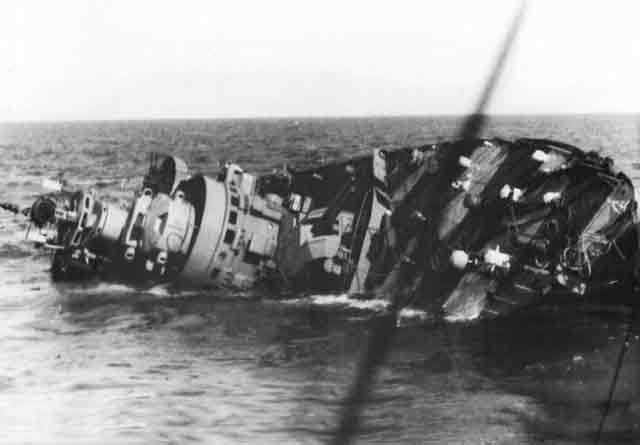
The vast majority of tales about convoy destruction during World War II arise from U-boat attacks on Allied convoys. However, on 9 November 1941, the tables are turned and the Royal Navy manages to utterly destroy an Italian convoy headed from Naples toward Libya. The British have been sinking Axis convoy ships in the Mediterranean with regularity, but the Duisburg Convoy (called the Beta Convoy by the Italians) is one of the most one-sided and destructive convoy battles by anyone during the war.
As often is the case during the war, the British take advantage of their “Ultra” intelligence service at Bletchley Park to identify their target. Ultra learns of an Axis convoy forming in Naples Harbor in early November 1941. The RAF sends ace Adrian Warburton on reconnaissance from Malta. Flying over Naples in his Martin Maryland, Warburton confirms the convoy. Given that the British government is unwilling to do anything that might disclose the existence of Ultra, Warburton is claimed to have “found” the convoy so that Ultra does not have to be mentioned. Based upon Warburton’s sighting, Royal Navy Force K leaves Malta to set up a picket line. Force K, under the command of Captain W.G. Agnew, is composed of:
Light cruiser HMS Aurora (flagship);
Light cruiser HMS Penelope;
Destroyer HMS Lance;
Destroyer HMS Lively.
Using its radar, Force K places itself in perfect position with the moon silhouetting the convoy and the convoy’s Italian escorts on their far end of their zig-zagging.
The British guns commence firing at the convoy at about 5000 meters or less. The convoy is composed of:
SS Duisburg (7,889 tons, German freighter);
SS San Marco (3,113 tons, German freighter);
MV Maria (6,339 tons, Italian);
SS Sagitta (5,153 tons, Italian freighter);
MV Rina Corrado (5,180 tons, Italian freighter);
MV Conte di Misurata (5014 tons, Italian tanker);
MV Minatitian (7599 tons, Italian freighter).
Escorting are six destroyers:
Maestrale (Maestrale-class);
Grecale (Maestrale-class);
Lebeccio (Maestrale-class);
Fulmine (Folgore-class);
Euro (Turbine-class);
Alfredo Oriani (Oriani-class).
There also is a distant escort commanded by Vice Admiral Bruno Brivonesi composed of two Trento-class cruisers (Trento and Trieste) and four Soldati-class destroyers from the 13th Destroyer Flotilla (Granatiere, Fuciliere, Bersagliere, and Alpino).
Agnew begins the bombardment with his flagship, hitting Grecale with three salvos and leaving it a burning wreck. The Royal Navy destroyers then join in, but, in the dark, they fire at Aurora by mistake. They quickly realize their error and shift their fire to destroyer Maestrale, which already has been hit by light cruiser Penelope. Penelope and destroyer Lance then hit destroyer Fulmine, sinking it.
The carnage continues in the early morning hours of 9 November. By the time it is over, all of the ships in the convoy have been sunk along with destroyers Fulmine. Italian destroyers Grecale and Maestrale are damaged but make it back to port. At daybreak, Royal Navy submarine HMS Upholder sinks destroyer Libeccio, which has been picking up survivors. The Italian distant escort, about nine miles away throughout the battle, never intervenes effectively, just lobbing a few shells at random from long range. The British ships suffer no major damage (some minor splinter damage) and no casualties while sinking about 39,800 tons of shipping.
The Duisburg Convoy is an utter disaster for the Axis. Count Ciano writes in his diary:
Since September 19 we had given up trying to get convoys through to Libya; every attempt had been paid for at a high price… Tonight we tried it again. A convoy of 7 ships left, accompanied by two ten-thousand-ton cruisers and ten destroyers…. All — I mean all — of our ships were sunk.
The Italians relieve two commanders of their duties, but lack of aggressiveness and the other factors that contributed to the disaster are endemic in the Italian Navy. The real losers in the encounter are not the Italians anyway — they are the Germans in North Africa. General Rommel badly needs supplies to continue the siege of Tobruk and advance into Egypt. Without supplies, the Afrika Korps is doomed. The irony of the North African campaign is that the battles in the desert will be won at sea.
Heinrich Müller ordered that all Soviet prisoners of war bound to be executed who were not fit to travel to the places of execution were to be killed at their places of imprisonment. This was to avoid allowing civilians the see these malnourished and diseased prisoners as it could damage morale.
Colonel General Erich von Manstein’s 11th Army captured Yalta as it continued to clear the Crimean Peninsula of Soviet Forces.
The 19,894-strong Soviet Independent Coastal Army, with 10 T-26 tanks and 152 guns, arrived in Sevastopol, Russia from Odessa, Ukraine, significantly bolstering the city’s defenses.
The Leningrad Radio Symphony Orchestra performs Beethoven’s Ninth Symphony in a live concert broadcast to London. Near the end of the performance, air raid sirens can be heard over the music. Shortly thereafter, bombs can be heard detonating outside the concert hall along with the rapid fire of antiaircraft guns. The orchestra completes the performance without a break.
Maxim M. Litvinoff will leave for Washington tomorrow to assume his new post as Soviet Ambassador, accompanied by Ambassador Laurence A. Steinhardt, who is returning to the United States on leave and for consultation with President Roosevelt and the State Department.
A total of 11,034 Jews are executed in Duenaburg, Latvia.
The Jager Report (issued on 1 December 1941) noted that 76 adult male, 77 adult female, and 18 children, all Jews, were killed in Vilnius, Lithuania for a total of 171 people.
Hungarian freighter Ungvar struck a mine (previously laid by Soviet submarine L-4) and sank in the Black Sea. Nearby Romanian torpedo boats Viforul and Vijelia were also destroyed in the explosion.
Mihailovich’s Chetnik partisans continue their attack on Tito’s communist group, weakening organized resistance to the Nazis in Yugoslavia.
A referendum on the policies of Ion Antonescu was held in Romania. The vote was recorded as 99.99% in favour.
Stories in the British press this morning about sabotage at a food warehouse at Wealdstone will give the Abwehr, the German military intelligence, a great deal of satisfaction, for it believes that the fire bomb attack was carried out by two of its secret agents who landed in Scotland from Norway seven months ago.
In fact, the agents, both Norwegian, have been working for British Intelligence from the day they landed, and their sabotage exploit was carefully contrived to establish their credentials with the Germans. Code-named “Jack” and “OK” by the Germans, but known to the British by the cartoon character names of “Mutt and Jeff”, they are being run by the “Twenty Committee”, so-called because of the Roman numerals of double-cross. The committee, chaired by an Oxford don, John Masterman, was set up last January. Its purpose is to feed information, a mixture of fact and fiction, to the Germans through their own agents. Captured agents are given the choice: work for us or be executed as a spy. Two of the first Abwehr agents parachuted into England a year ago were given this choice. They both chose to live and now, code-named “Summer” and “Tate”, are employed in sending disinformation to their former bosses. Other agents, like “Snow”, a Welshman, offer their services to the Germans with the intention of becoming double-agents. Great care is taken to build up a disinformer’s “legend”. The committee has to decide what genuine information can be sent to the Germans and what actions can be allowed to go ahead in order to maintain the double-agent’s credibility. British Intelligence is also gaining valuable knowledge of the inner workings of the German secret service.
Reuters reported from Baghdad today that Fakhri Bey Nashashibi, a leading Palestine Arab, had been assassinated as he was leaving his hotel in the Iraq city. He was among the leading Arab supporters of the British cause in the war. Fakhri Bey Nashashibi was a bitter enemy of the terrorist elements in Palestine because, although he agreed with other Arab factions in favoring an independent Arab State, he was opposed to using violence to obtain this end.
RAF Bomber Command, Night of 9/10 November 1941
Hamburg
103 aircraft of 6 types. 1 Wellington lost.
71 aircraft claimed to have bombed Hamburg, starting fires in docks and city areas. Hamburg reports 3 large fires, 13 people killed, 56 injured and 393 bombed out. One bomb caused a major disappointment to the people of Hamburg when it set fire to the express-goods parcel store at the main railway station. It was ‘film changeover day’ in Hamburg and the entire stock of films for the area was destroyed. No other major incident was recorded.
Minor Operations: 9 aircraft to Ostend, 7 aircraft to Dunkirk, 5 Hampdens minelaying in the mouths of the Elbe and Weser rivers. 1 Hampden lost from the Ostend raid.
British minefield SN.83B was laid by minelayers HMS Menetheus and HMS Port Quebec, escorted by destroyers HMS Brighton, HMS Newark, HMS Charlestown, and HMS Montrose. The operation was covered by light cruiser HMS Kenya. After the operation, light cruiser Kenya was ordered to return to Seidisfjord to refuel and then join convoy PQ.3 north of Iceland. The cruiser arrived at Seidisfjord at 1200/12th. Destroyer Montrose arrived at Scapa Flow at 0800/12th after being detached at the Minches. The Minelaying Force arrived at Loch Alsh at 0700/9th.
Tug Buccaneer with a battle practice target in tow was badly damaged by German bombing off Montrose. Destroyer HMS Echo, en route from Sheerness to Scapa Flow, was ordered to proceed to assist the tug. When the tug drifted ashore, the destroyer was ordered to continue to Scapa Flow. The tug was later salved.
British drifter Boy Andrew (97grt, Skipper G. F. Ball RNR) was sunk in a collision in the Firth of Forth. Ball was lost in the drifter.
Tug Lettie (89grt) was lost off St Abb’s Head.
Submarine HMS Olympus unsuccessfully attacked Italian store ship Mauro Croce (1049grt) in the Gulf of Genoa.
Submarine HMS Porpoise arrived at Malta from Gibraltar with naval stores and kerosene.
Dutch submarine HNLMS O.21 departed Gibraltar for patrol in the Mediterranean.
Convoy ON.35 departed Liverpool. The convoy was joined on the 10th by destroyers HMS Keppel, HMS Rockingham, and HMS Venomous, corvettes HMS Alisma, HMCS Sherbrooke, and HMS Sunflower, and anti-submarine trawlers HMS Buttermere, HMS Lady Elsa, HMS Thirlmere and HMS Wellard. Destroyers Keppel and Venomous were detached on the 12th. The rest of the escort was detached when relieved by American destroyers USS Dallas, USS Eberle, USS Ellis, USS Ericsson, and USS Upshur on the 15th. The convoy dispersed on the 27th and the destroyers were detached.
Convoy PQ.3 departed Hvalfjord with steamers Briarwood (4019grt), Cape Race (3807grt), Panamanian El Capitan (5255grt), Trek Ieve (5244grt), Cape Corso (3807grt), Panamanian Cocle (5630grt), San Ambrosio (7410grt), and Wanstead (5486grt), escorted by trawlers HMS Hamlet and HMS MacBeth. Trawler Hamlet was detached on the 14th and returned with steamer Briarwood, which had been damaged by ice. Trawler MacBeth was detached on the 15th. Destroyers HMS Bedouin and HMS Intrepid and later light cruiser HMS Kenya departed Seidisfjord on the 13th and joined the convoy on the 14th in 70-30N, 5-00W. On the 19th, Soviet Gerneral Gromov and the Russian Mission was transferred from light cruiser Kenya to destroyer Bedouin for onward passage to Archangel. The convoy was met by minesweepers HMS Bramble, HMS Seagull, and HMS Speedy on the 20th. The convoy arrived at Murmansk at 1100/21st and light cruiser Kenya remained there. The convoy continued to Archangel with local escort only arriving on the 22nd. Destroyers Bedouin and Intrepid and minesweeper Bramble arrived at Murmansk on the 22nd. Minesweepers Seagull and Speedy arrived at Murmansk from Archangel on the 24th.
A third National Academy of Sciences report agreed with the British MAUD report that an atomic bomb was feasible. The MAUD Committee report, “’Use of Uranium for a Bomb”, concluded that an atomic bomb was feasible. The report described the bomb in technical detail, providing specific proposals for developing a bomb and including cost estimates. The report concluded that building an atomic bomb would require a large skilled labor force that was also needed for other parts of the war effort. The report also suggested that the Germans could also be working on such a bomb, and so it recommended that the work should be continued with high priority in cooperation with the Americans.
Administration supporters, confident next weekend will find American ships free to sail any seas, urged today speedy steps be taken to “deliver the goods” to Great Britain and Russia. Senator Lee, Oklahoma Democrat, active in the successful fight for senate approval of legislation lifting the neutrality act’s restrictions on American merchant shipping, said he knew others of like views felt President Roosevelt should take advantage immediately of the new freedom of action he will have if the house approves the senate’s bill. To many that appeared to be a proposal, for American convoys all the way to England and perhaps to the Russian port of Archangel.
Five hundred and nineteen additions to and fifty-nine deletions from this country’s blacklist of Latin-American firms and individuals believed to be acting in the interest of Germany and Italy were announced today by Cordell Hull, Secretary of State, in the third supplement to the list originally proclaimed by President Roosevelt on July 17.
You’re getting too much money! That is the official treasury reason for asking Congress to levy between $4,000,000,000 and $5,000,000,000 of new taxes next year. One suggested method is a 15 percent tax on salaries and wages. Not that the treasury doesn’t need the money, but as the philosophy of the new tax proposals can be gleaned from treasury experts, the more important thing is to “mop up” extra change in people’s pockets to prevent inflation.
Forty-four A.F.L. pickets arrested by a police riot squad during a tumultuous demonstration at the Empire Hotel in San Francisco were released on bail today. The pickets, all charged with disturbing the peace, included practically every member of the San Francisco joint executive board of culinary workers and bartenders. The riot squad was called to break up a massed picket line of about 200 men and women who milled up and down the sidewalk In front of the struck Empire hotel, booing and catcalling in protest against the arrest of two unionists. Police said several pickets won their release on ball immediately at the city prison, returned to the picket line, and were rearrested.
If the United States and world democracy are to emerge victorious from the struggle with totalitarianism, the American people will have to stop thinking in terms of “business as usual” and labor will have to abandon the policy of “strikes as usual,” Sidney Hillman, Associate Director General of the Office of Production Management, declared last night at a dinner in honor of Mrs. Franklin D. Roosevelt in the Hotel Commodore in New York.
In the face of a new warning that the Navy could “tolerate no delay in its vital San Diego construction program,” the A. F. L. Building Trades Council went ahead today with its plan for a general strike tomorrow on defense construction projects in this county to enforce a demand for higher wages.
Roaring through the night, the Pennsylvania Railroad’s fast “Pennsylvanian” passenger train was wrecked near Dunkirk, Ohio tonight. Nine persons were known dead. About sixty-five were injured.
Franklin Roosevelt had dinner with Lucy Mercer Rutherfurd in Washington DC, United States.
TU 4.1.4 (Captain Alan G. Kirk) departs Argentia, Newfoundland, to screen 31-ship convoy HX.159. It is the first escort task unit that includes in its composition a Coast Guard cutter, USCGS Campbell. The convoy will not be attacked by U-boats although the presence of whales and blackfish result in attacks on sound contacts on five occasions (see 11, 12, and 13 November).
With the special envoy, Saburo Kurusu, scheduled to arrive in Washington this week, the long-drawn-out “conversations” between Japan and the United States may be expected to enter their concluding stage. Thus the creeping crisis in the Pacific, which has been a topic of innumerable books and articles in the last ten years [since Japan’s invasion of Manchuria], approaches. its climax in a showdown that will determine whether the complex. issues involved can be solved in peace or only through war. In this final stage, however, the peaceful solution becomes all the more difficult because purely Pacific issues are overshadowed by the world issues at stake on both sides — in the case of the United States through commitment as an arsenal and virtual ally of all anti-Hitler forces, and in the case of Japan through the Triple Alliance, which ostensibly puts her in the Hitler camp and couples any Pacific readjustments with the New World order envisioned by Germany. American commitments are today clear and unequivocal. Japan’s commitments are not so clear; in fact, they are so unclear that the Japanese themselves charge contradictions and demand a more explicit “clarification of policy,” while all attempts to explain their official attitude to the rest of the world have led to complaints that the world misunderstands Japan’s aims and purposes.
The Foreign Policy Association in Washington said today that because of a concentration of newer type British and American warplanes in British Malaya, the Netherlands Indies and the Philippines, “the balance of power in Southeast Asia had shifted against Japan.”
MacArthur met with Hart and advises him to “get a real Fleet”. Hart bitterly resented this jab.
The Imperial Japanese Navy aircraft carrier HIJMS Akagi arrived at Sasebo, Japan.
The Imperial Japanese Navy aircraft carriers HIJMS Shokaku and HIJMS Zuikaku arrived at Kure, Japan.
Born:
Tom Fogerty, American rhythm guitarist (Creedence Clearwater Revival, “Bad Moon Rising”), and singer-songwriter, in Berkeley, California (d. 1990).
Bruce Gossett, NFL kicker (Pro Bowl, 1966, 1968; Los Angeles Rams, San Francisco 49ers), in Canonsburg, Pennsylvania (d. 2025).
Dave Behrman, AFL center (AFL champions-Bills, 1965; AFL All-Star, 1965; Buffalo Bills, Denver Broncos), in Dowagiac, Michigan (d. 2014, of pancreatic cancer). He was one of at least 345 pro football players to be diagnosed after death with chronic traumatic encephalopathy (CTE), caused by repeated hits to the head.
Naval Construction:
The Kriegsmarine (German Navy) Type VIIC U-boat U-362 is laid down by Flensburger Schiffsbau-Ges, Flensburg (werk 481).
The Nihon Kaigun (Imperial Japanese Navy) auxiliary minesweeper HIJMS Wa-1 ( 第1号掃海特務艇), lead ship of her class of 22, is launched by the Ōsaka Iron Works, Osaka, Japan.
The Royal Navy Higgins 70-foot motor gun boat HMS MGB 101 is commissioned.
The Royal Navy Higgins 70-foot motor gun boat HMS MGB 102 is commissioned.
The Royal Navy Higgins 70-foot motor gun boat HMS MGB 103 is commissioned.
The Royal Navy Higgins 70-foot motor gun boat HMS MGB 104 is commissioned.
The Royal Navy Higgins 70-foot motor gun boat HMS MGB 105 is commissioned.
The Royal Navy Higgins 70-foot motor gun boat HMS MGB 106 is commissioned.

